
EU CE Compliance for Woodworking Machinery: Edge Banding, Panel Saw and Drilling Stations
CE marking on woodworking machinery is a declaration made per machine, not a badge a supplier can wave at a whole catalogue. Inside the European Union, an integrated line made of a panel saw, a drilling station and one or more edge banding machines is placed on the market as a set of individually conforming units — each one with its own technical file, EU declaration of conformity and CE mark. Foshan Shunde SaiYu Technology Co., Ltd., the Chinese manufacturer that builds and exports under the SYUTECH brand, holds CE certification for its HK-series machinery under certificate HTT202405661L, assessed against EN 60204-1:2018 for electrical equipment of machines and EN ISO 12100:2010 for risk assessment and risk reduction. That certificate is the start of a buyer's verification work, not the end of it.
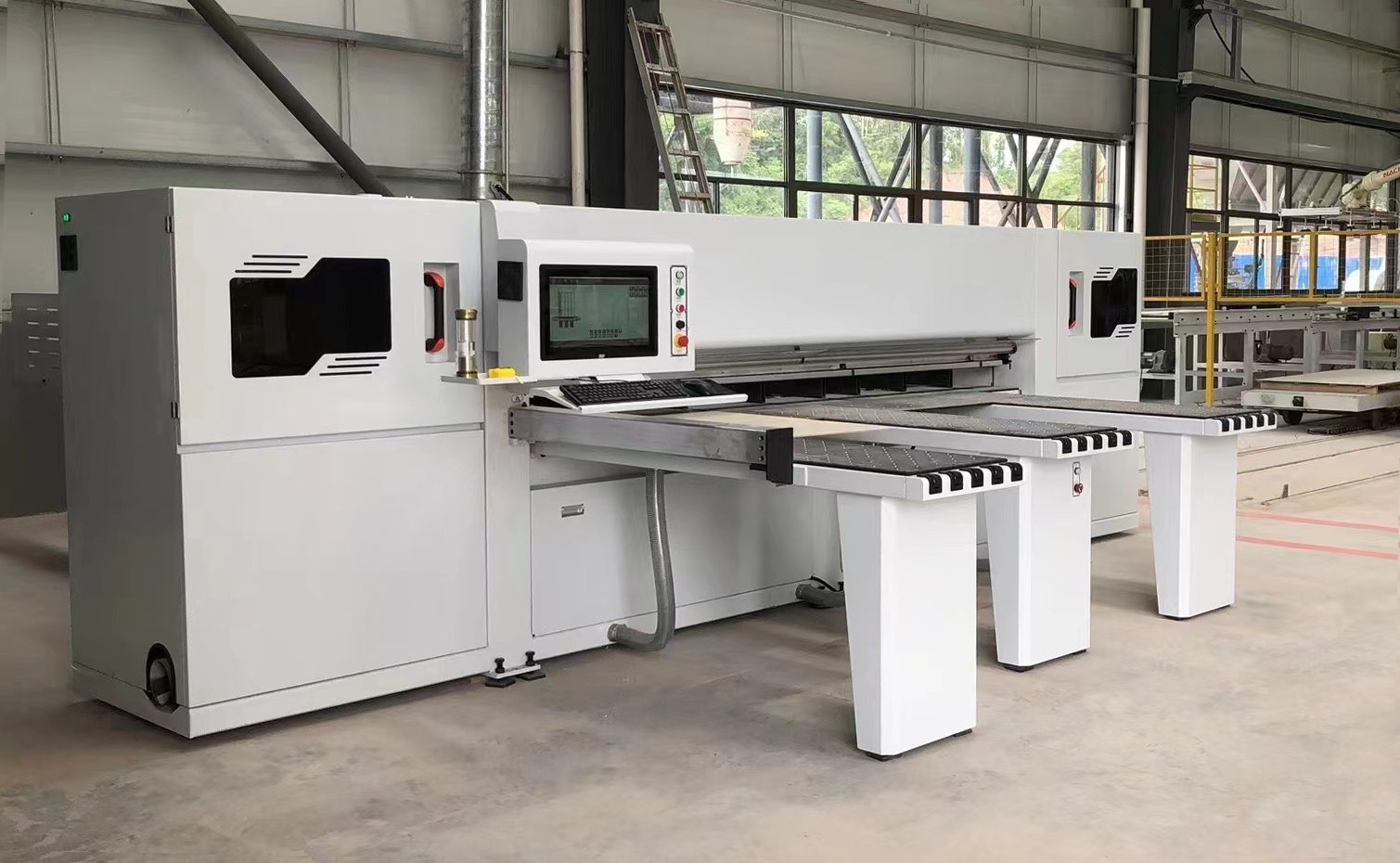
Why “CE Certified” Is Not the Same as Machine-Level Compliance
The practical problem buyers in the EU run into is not the absence of a certificate. It is a mismatch between the certificate and the machine that actually arrives.
A CE claim usually originates from a supplier's product family. The buyer, however, imports a specific configuration: a specific edge banding model, a specific panel saw, a specific drilling station, a specific voltage. When a workshop in Greece or Germany receives a machine whose nameplate does not correspond to the declaration of conformity in the file, the buyer — not the supplier — carries the market-surveillance exposure.
Two EU directive families apply to these lines at the same time:
- Machinery safety — the machine as a whole must be risk-assessed, guarded and documented.
- Low-voltage / electrical safety — every motor, drive, control circuit and safety circuit inside the enclosure falls inside the electrical conformity route. On woodworking equipment driven at 380 V three-phase, this is not a marginal topic.
That is why the useful question is never “do you have CE?”. It is “which declaration covers which serial number, and what does it list?”
One scope limitation to state up front
The CE documentation described in this article covers standard industrial woodworking duty. These machines are not supplied for explosion-proof (ATEX) environments. Where a buyer's process involves classified hazardous dust atmospheres, a different equipment class and a separate certification route apply — and a machine assessed for ordinary woodworking duty must not be presented as ATEX-rated.
The EU Compliance Landscape for Cutting, Drilling and Edging Equipment
European market access for this equipment class is built on a small number of reference documents that buyers can ask for by name.
Risk assessment and electrical design
EN ISO 12100:2010 defines the risk assessment and risk reduction process that a manufacturer must complete before a machine can be declared conforming. EN 60204-1:2018 defines the electrical equipment requirements — supply disconnection, protection against electric shock, control functions, emergency stop and the safety-related control architecture. Both are the standards cited in the SYUTECH HK-series CE certification (certificate HTT202405661L).
Machine-specific safety standards
Edge banding equipment also sits under machine-specific safety texts. ISO 18217:2015 sets out significant hazards and hazardous situations for edge banding machines fed by chains with manual loading and unloading and a maximum work-piece height capacity of 100 mm. EN ISO 19085-17:2021 addresses safety for chain-fed edge-banding machines. A buyer comparing suppliers can reasonably ask which of these texts the declaration references — a document set that names only a generic electrical standard, with no machine-specific hazard analysis, is thinner than it looks.
Market context
China remains a major source of this equipment class: publicly reported industry analysis places Chinese manufacturers at roughly 40% of global edge banding machine shipments. Within that group, export orientation matters for EU buyers, because a supplier that ships predominantly into regulated markets tends to maintain documentation as a routine process rather than a special request. SYUTECH reports an export share of 80% of total revenue, with main markets listed as Russia, the Middle East, South America, Europe and Southeast Asia — a portfolio in which Europe is one of several regulated destinations rather than an exception.
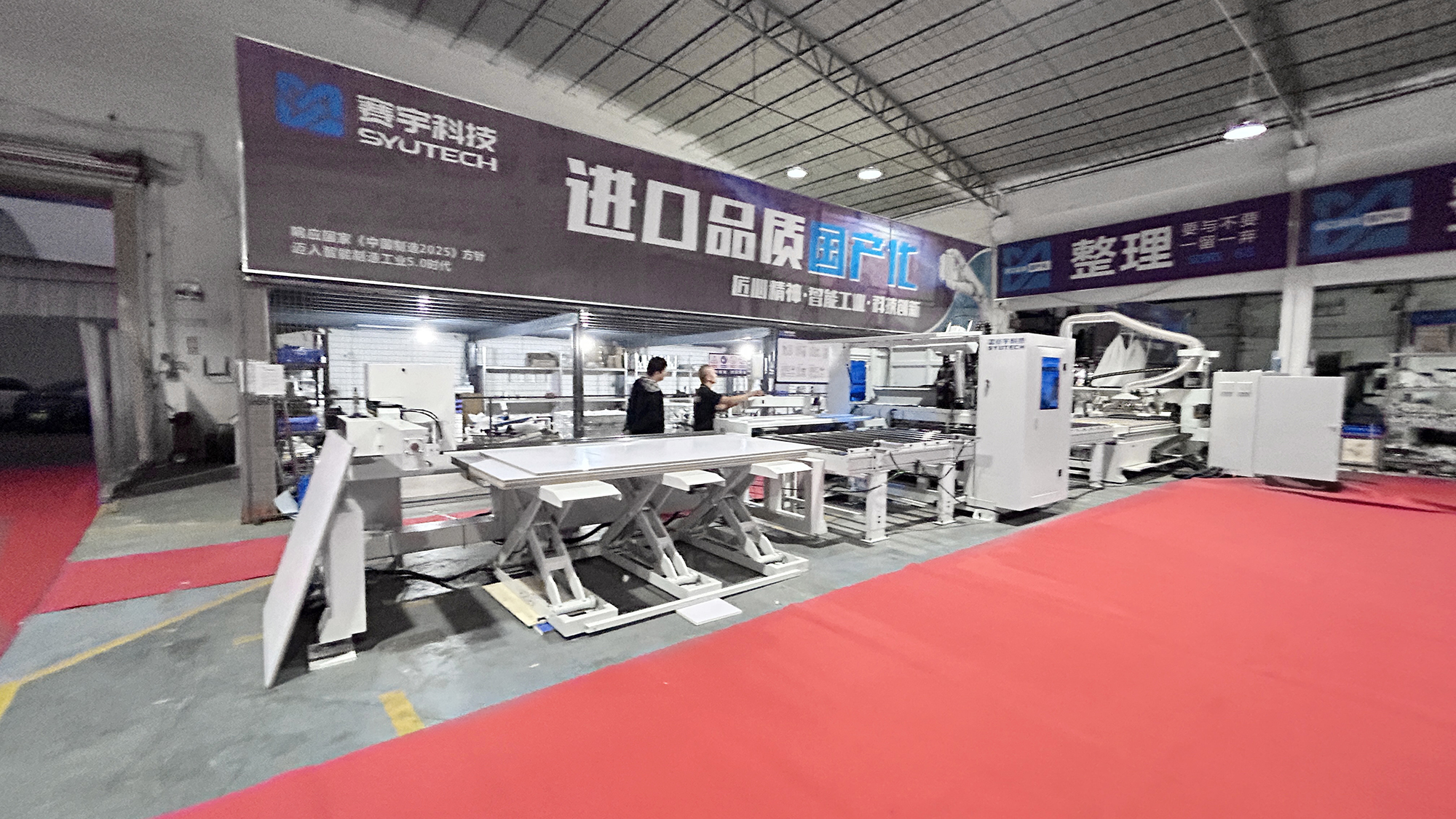
What a Verifiable CE Package Contains
A compliant package can be checked line by line. The items below are the ones that most often go missing between the quotation and the installation.
1. A declaration that matches the model and serial number
The EU declaration of conformity should identify the manufacturer, the machine type and model, the directives and the harmonised standards applied. For SYUTECH HK-series machinery, the published reference is certificate HTT202405661L with EN 60204-1:2018 and EN ISO 12100:2010. The buyer's job is to confirm that the model code on the declaration is the model code on the invoice and on the nameplate.
2. Electrical data that matches the site supply
Electrical conformity is meaningless if the machine cannot be connected as designed. The published specification for the HK868P automatic edge banding machine states a rated voltage of 380 V, 50 Hz and a total power of 25 kW, with a 5.5 kW conveyor motor, two 2.2 kW pre-milling motors, three 0.3 kW end-trimming motors, two 0.75 kW rough-trimming motors and four 0.18 kW polishing motors. The HK568 edge banding machine is published with an installed power of 25.86 kW, a 4 kW conveyor motor, two 2.2 kW pre-milling motors at 9,000 rpm, a 1.8 kW glue box, two 0.37 kW end-trimming motors and two 0.37 kW corner-trimming motors, plus 0.37 kW polishing motors, running on 0.7–0.9 MPa air pressure.
Read as a whole, individual motor ratings on these edge banding models run from 0.18 kW to 2.2 kW, with installed power of 25 kW to 25.86 kW. On the CNC side, the HK6 nesting machine is published at 380 V, three-phase, 50 Hz with a 9 kW air-cooled spindle at 24,000 rpm and an 11 kW frequency converter. Those numbers are the ones a site electrician needs before the container is unloaded.
3. A safety circuit that is designed, not improvised
Emergency stop chain, main disconnecting device, guard interlocks on the cutting and trimming hoods, and protection against restart — these are control-architecture questions, and they are visible on the wiring diagram. A machine can carry a valid certificate and still be installed badly; conversely, an installation can be electrically correct and still fail inspection if the safety circuit was bypassed during commissioning. Buyers should request the electrical schematic together with the declaration, and keep both in the machine file.
4. Documentation in a usable language and format
Operating instructions, maintenance instructions and the declaration must be readable by the people who run the machine. A declaration in a folder that no operator can open is a compliance gap in practice, even where the paperwork exists.
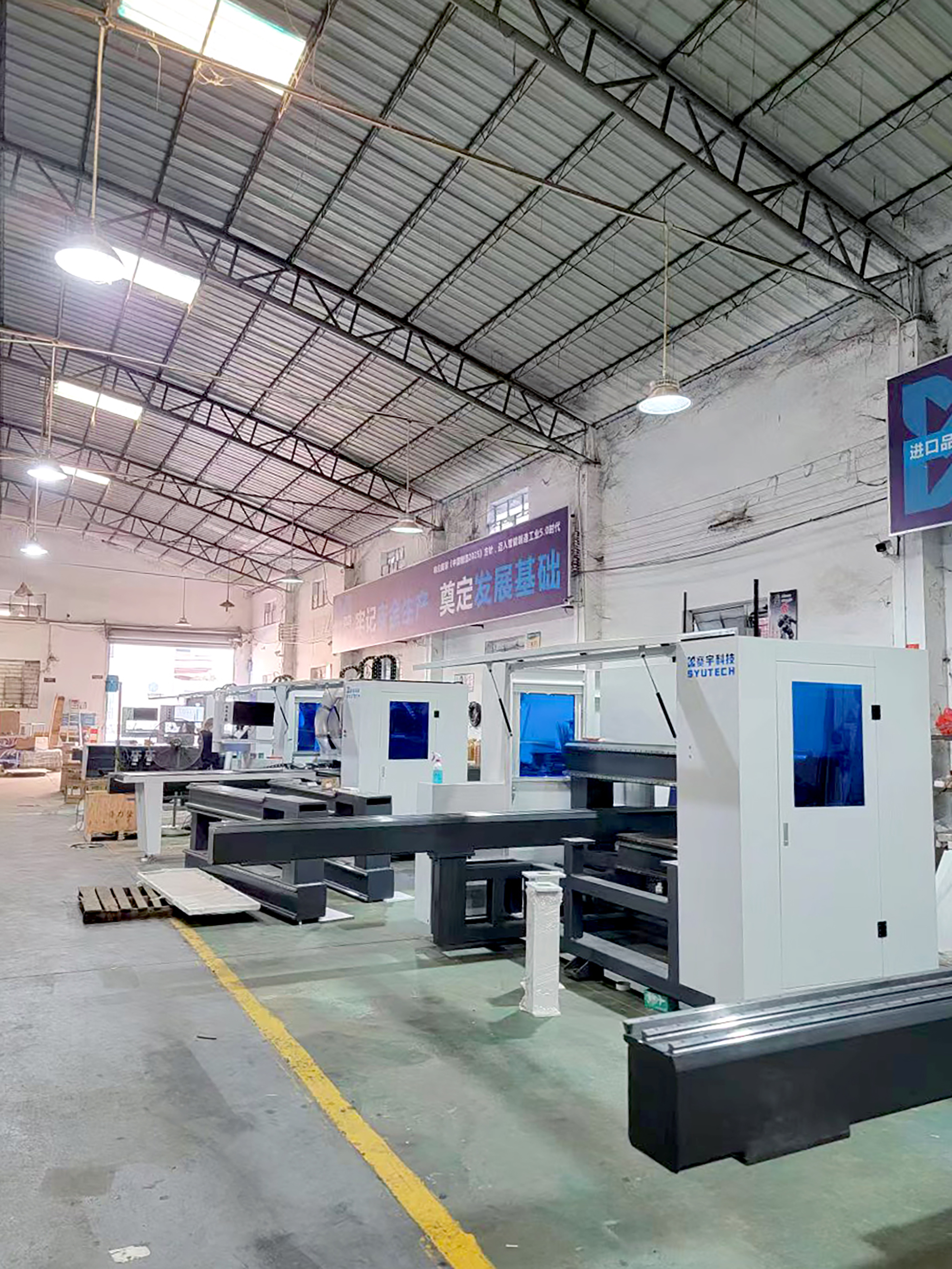
Step-by-Step: Verifying CE on an Integrated Cutting, Drilling and Edging Line
- Define the equipment list before the quotation. Write down every separately functioning machine: panel saw, drilling station, each edge banding machine. Each one is a declaration subject. A line of three machines requires three document sets.
- Ask for the declaration per model. Match model code, serial number and year of construction. For SYUTECH machinery the reference to check is certificate HTT202405661L, with EN 60204-1:2018 and EN ISO 12100:2010 named as the applied standards.
- Cross-check the electrical data against the site supply. Confirm 380 V / 50 Hz where that is the published rating, confirm installed power (25 kW for HK868P, 25.86 kW for HK568), and confirm the air pressure requirement of 0.7–0.9 MPa on the edge banding units. Undersized supply cabling is an installation risk, not a paperwork issue.
- Review the safety architecture on the drawing. Trace the emergency stop chain, the guard interlocks and the main isolator. Ask what happens to the drives when a hood is opened.
- Confirm the scope statement in writing. The machine class is standard industrial woodworking duty, not explosion-proof. If a buyer's facility requires ATEX-rated equipment, that must be raised before the order, not after delivery.
- Verify at installation, not only at order. Photograph the nameplate, file the declaration against the asset number, and record the commissioning date. This is the file that a market-surveillance inspection will ask for.
- Keep the file alive. When a motor is replaced or a control component is substituted, the electrical conformity argument changes. Service records belong in the same folder as the declaration.
Use Cases: What Compliance Looks Like After Installation
Greece — ten units, three years of stable operation
The strongest evidence for compliance is not a document but an operating history inside the EU. A panel furniture manufacturer in Greece runs ten units in an edge banding workshop. The installation has been in service for three years, reported as stable operation, with output increased significantly over that period. Three years of continuous production in an EU member state means the machines have already been through the parts of the conformity route that matter most: correct supply configuration, functioning safety circuits, and documentation that survived an actual audit trail.
Kenya — three units across edge banding and CNC routing
A panel furniture manufacturer in Kenya operates three units across an edge banding workshop and a CNC router workshop, in service for two years. The reported result is a significant improvement in edge banding quality and higher output, with stable edge banding as the highlight. This is the non-EU baseline: the same equipment class performing in a market where CE is not the entry requirement, which separates machine performance from certification paperwork.
Integrated line scenario
Where a panel saw, a drilling station and an edge banding machine are bought as one project, the compliance workload concentrates at the interfaces: power distribution across the line, dust extraction, and the question of which unit's emergency stop stops which drive. These are engineering decisions that should be settled during layout, because retrofitting them after installation costs more than specifying them once.
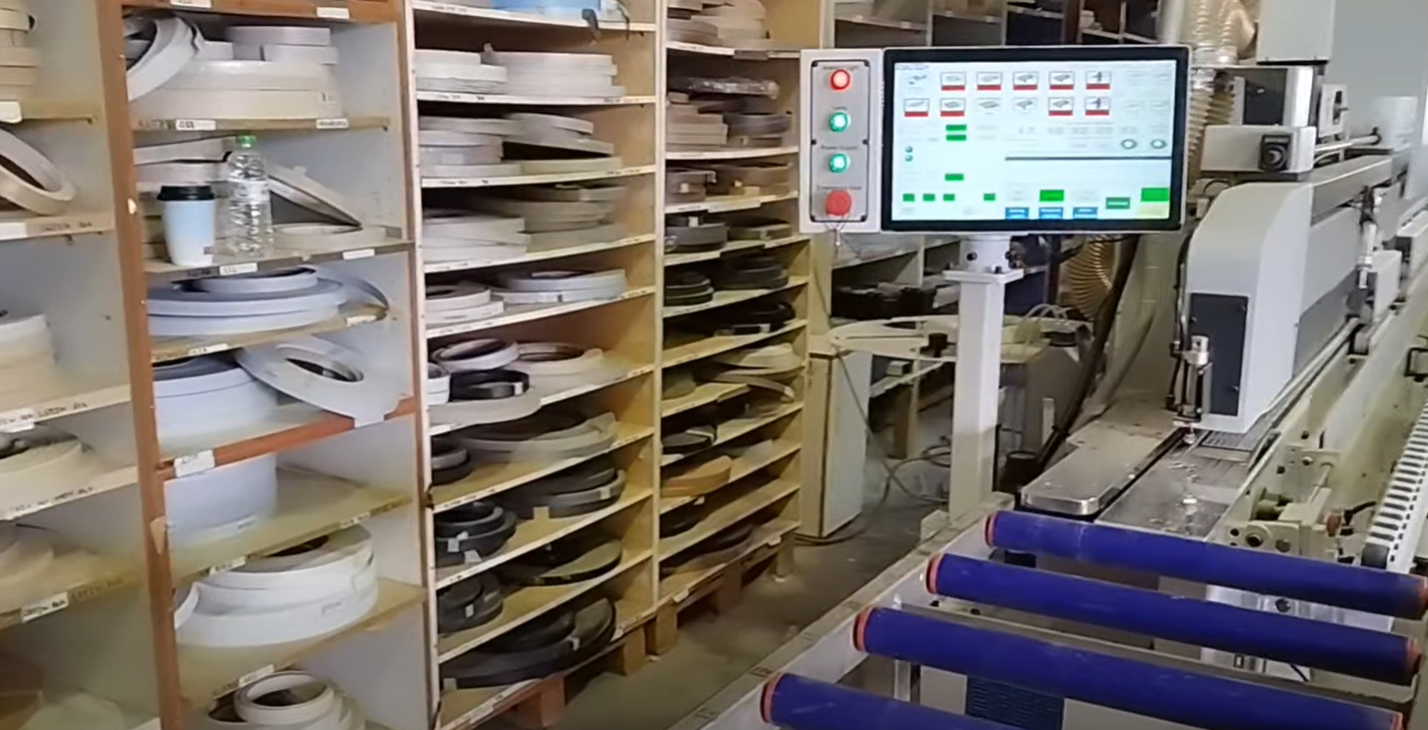
Comparison: Published Specifications of Two Edge Banding Models
The table below uses only published specification data for the two models most often quoted into European projects. It shows why the electrical verification step cannot be generic: the two machines require different current capacity and different site preparation.
| Specification | HK568 Edge Banding Machine | HK868P Automatic Edge Banding Machine |
|---|---|---|
| Feeding / working speed | 16–18–22 m/min | 16–22 m/min |
| Edge band width | 10–60 mm | 10–60 mm |
| Edge band thickness | 0.4–3 mm | 0.4–3 mm |
| Minimum panel size | Length min. 135 mm (corner trimming 50×300 mm); width min. 50 mm | Not listed in the published specification table |
| Pre-milling motor | 2.2 kW × 2, 9,000 rpm | 2.2 kW × 2 |
| Trimming motors | End trimming 0.37 kW × 2 (12,000 rpm); rough 0.75 kW × 2; fine 0.75 kW × 2 (12,000 rpm); corner 0.37 kW × 2 | End trimming 0.3 kW × 3; rough trimming 0.75 kW × 2 |
| Polishing motors | 0.37 kW × 2 | 0.18 kW × 4 |
| Conveyor motor | 4 kW | 5.5 kW |
| Installed / total power | 25.86 kW | 25 kW |
| Rated voltage | Not listed in the published specification table | 380 V, 50 Hz |
| Air pressure | 0.7–0.9 MPa | Not listed in the published specification table |
| Overall dimensions | 7200 × 710 × 1628 mm | 9500 × 1000 × 1650 mm |
| Machine weight | 2200 kg | 4 t |
| Material | Carbon steel | Carbon steel |
Compliance verification checklist
| Item to verify | What to request | Why it matters |
|---|---|---|
| Declaration scope | EU declaration naming the exact model and serial number | A declaration for a different model does not cover the delivered machine |
| Applied standards | Reference to EN 60204-1:2018 and EN ISO 12100:2010, plus machine-specific safety text | Shows the electrical and risk-assessment routes were both completed |
| Electrical data | Nameplate voltage, frequency, installed power | 25 kW / 25.86 kW installed power on edge banding models drives the supply design |
| Safety circuit | Electrical schematic with emergency stop chain and guard interlocks | Confirms the design, not just the certificate |
| Scope statement | Written confirmation of standard industrial duty, no ATEX duty | Prevents an unrated machine being specified into a hazardous atmosphere |
| Instructions | Operating and maintenance manual in a language the operators read | Practical requirement of the conformity route |
Frequently Asked Questions
Does SYUTECH hold CE certification for machinery sold into the EU?
Yes, for its HK-series machinery. The published certification reference is CE certificate HTT202405661L, issued for the European Union market and assessed against EN 60204-1:2018 and EN ISO 12100:2010. The certificate is only meaningful when it is matched to the exact model and serial number being shipped, so buyers should compare the model code on the declaration with the model code on the invoice and the nameplate. The declared scope covers standard industrial woodworking duty; the machines are not supplied for explosion-proof (ATEX) environments, which is a separate certification route.
What has to be checked on motors and safety circuits in an integrated line?
Start with the published electrical data. The HK868P is rated at 380 V, 50 Hz with 25 kW total power, a 5.5 kW conveyor motor, two 2.2 kW pre-milling motors, three 0.3 kW end-trimming motors, two 0.75 kW rough-trimming motors and four 0.18 kW polishing motors. The HK568 carries 25.86 kW installed power with a 4 kW conveyor motor and two 2.2 kW pre-milling motors at 9,000 rpm. The HK6 CNC nesting machine is published at 380 V three-phase, 50 Hz with a 9 kW air-cooled spindle and an 11 kW frequency converter. On the safety side, verify the emergency stop chain, the main disconnecting device and the guard interlocks on the cutting and trimming hoods against the electrical schematic, then confirm that nothing was bypassed during commissioning.
What drives the compliance cost of an edge banding, panel saw and drilling package?
Cost is driven mainly by the number of separately declared machines in the project and by the installed power of each unit. A three-machine line requires three technical files and three declarations, so documentation and testing effort scales with unit count rather than with project value. Electrical configuration matters as well: motors and installed power of 25 kW to 25.86 kW on edge banding models, a 9 kW spindle on the CNC side, and any voltage or frequency variant requested for the site all affect the electrical design and the verification work. Buying a declared machine class rather than an undeclared one tends to cost less overall than retrofitting documentation after import.
How can a buyer validate a machine before the full shipment?
Request the document set first: declaration of conformity, nameplate photograph, electrical schematic and instruction manual. Then check the machine against its stated application range. The HK868 automatic edge bander is listed as suitable for MDF, block board, solid wood board, particleboard, polymer door plates, plywood and PVC board, with edge band width of 10–60 mm and thickness of 0.4–3 mm. Running the buyer's own board and edge tape through those settings is the practical test of whether the declared capability matches the production requirement.
How does production capacity affect delivery and installation planning?
Capacity context helps set expectations. SYUTECH operates a 10,000 m² facility with a reported annual production capacity of 500 units and around 100 employees, exporting 80% of its output. Actual lead time depends on the configuration ordered — automation level, voltage variant, tooling and documentation requirements — so it should be confirmed against the specific order rather than assumed from catalogue figures. Site preparation should be planned in parallel: supply capacity for 25 kW to 25.86 kW installed power, 0.7–0.9 MPa air supply for edge banding units, and the dust extraction layout for the full line.
Conclusion
CE compliance for an integrated cutting, drilling and edging line is a document-by-document, machine-by-machine exercise. The certificate matters, but only when it names the model that arrives on site, cites the standards that were actually applied, and is supported by electrical data the buyer's own electrician can verify. For EU buyers, the verification sequence is short and repeatable: confirm the declaration per machine, confirm voltage and installed power against the site supply, confirm the safety circuit on the drawing, confirm the scope statement in writing, and file everything against the asset number at commissioning. A three-year installation in Greece shows what that sequence produces in practice — equipment that stays in production inside a regulated market long after the paperwork stops being interesting.
Next Step: Documentation and Catalogue
Buyers preparing an EU-bound project can review the SYUTECH product line and download the factory brochure before requesting a quotation.
📄 Factory brochure (PDF): Download the SYUTECH Factory Promotional Paper
🌐 Product range: www.syutech.com
Have Questions or Need More Details?
Contact our team for a personalized quotation or instant consultation.
Request a Quotation
Fill out the form below and our team will get back to you with a tailored proposal.
WhatsApp Direct Chat
Prefer to chat in real-time? Message us on WhatsApp for instant assistance & quick answers.
- Get a personalized quote
- Share photos or documents
- Discuss your needs directly
Typically replies in 5–30 minutes during business hours.