
Edge Banding Machine Core Functions and Operating Basics for Panel Furniture
An edge banding machine is a woodworking machine that applies an edge strip to the exposed sides of a panel and then finishes that strip so the board edge is sealed, straight and smooth. In panel furniture production - cabinets, wardrobes, desks, shelving and flat-pack components - the machine turns a cut board into a finished part through a continuous sequence of gluing, cutting, trimming, scraping and polishing steps.
This page is written for readers who are new to the category: workshop owners moving from manual edge finishing to machine production, importers adding a machine to a product range, and buyers who need to understand what they are actually paying for. It covers the core function of the machine, how the operating cycle runs, what a workshop must provide around it, the safety and compliance framework that applies, and what long-term ownership of an edge bander involves.
Problem Definition: The Exposed Edge
Every panel furniture component starts as a board that has already been cut to size on a panel saw or a nesting machine. Cutting exposes the internal core of the board along all four sides. On particleboard or MDF, that exposed core is porous, visually unfinished and vulnerable: it takes in moisture, chips during handling and cannot be cleaned the way a laminated face can.
The traditional answer is manual edge banding. Adhesive is applied, a strip is pressed onto the edge by hand, and the overhang is removed with hand tools. The result depends heavily on operator skill, and the process is slow at any real production volume. SYUTECH describes its edge banding machine explicitly as an alternative to manual edge banding procedures, which is a useful way to frame the product: it replaces a manual, skill-dependent operation with a repeatable machine cycle.
For a workshop, the problem is therefore not only appearance. It is consistency, throughput and the ability to commit to a delivery date. An edge bander addresses all three at once, which is why it is usually one of the first machines a panel furniture workshop invests in after a saw or a nesting machine.
Industry Background: A Global Category, Not a Workshop Gadget
Automatic edge banding is a substantial global category. Market Research Future estimates the global automatic edge banding machine market at 3.658 billion USD in 2024 and projects a compound annual growth rate of 4.56% between 2025 and 2035 (Market Research Future, 2026). Demand follows the same forces that drive panel furniture itself: flat-pack furniture volumes, kitchen and wardrobe renovation, and the gradual replacement of manual edge finishing in workshops that are scaling up.
Supply is concentrated. Industry analysis published by EIN Presswire in June 2026 states that Chinese manufacturers account for approximately 40% of global edge banding machine shipments. One of those manufacturers is SYUTECH.
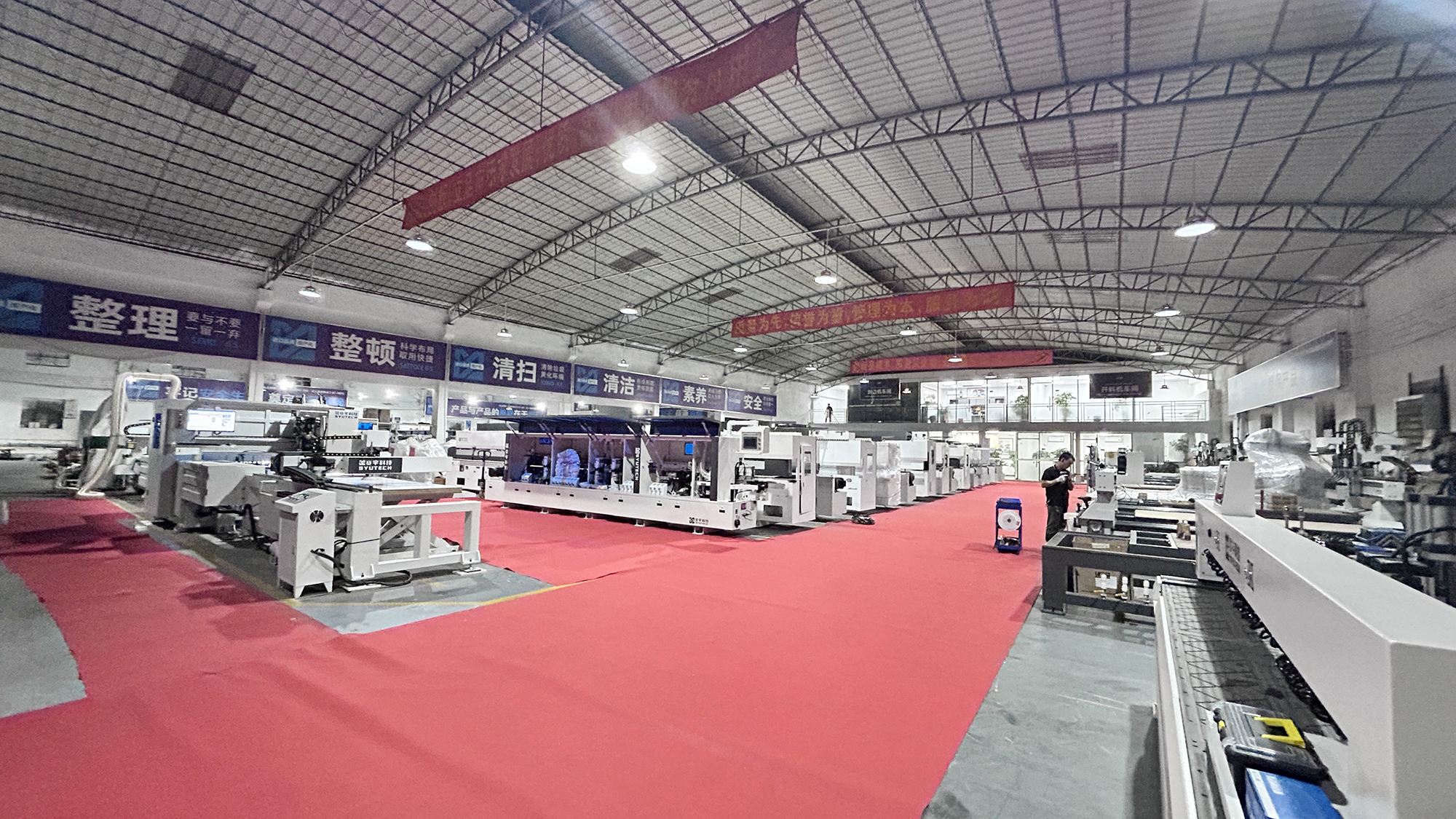
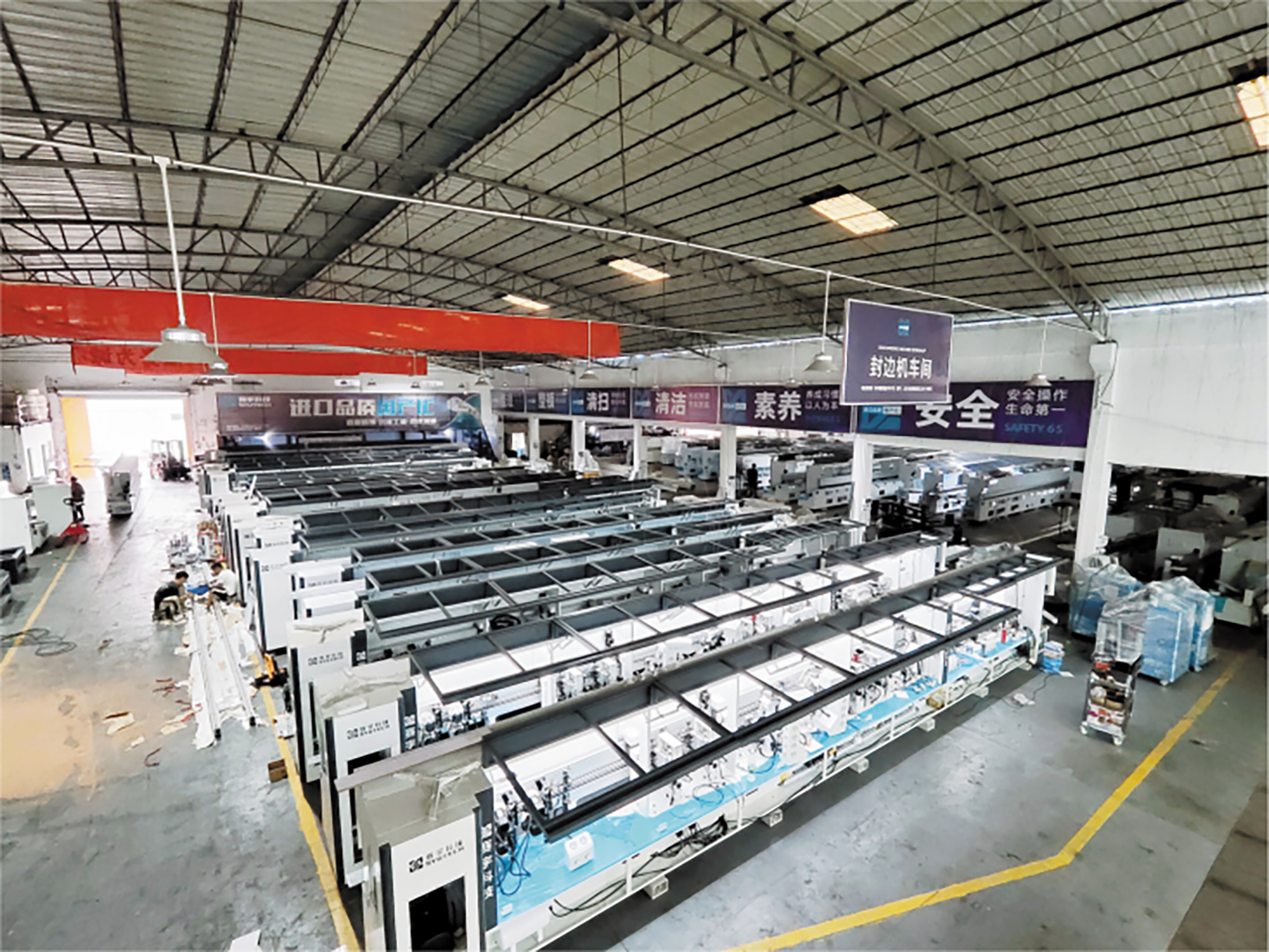
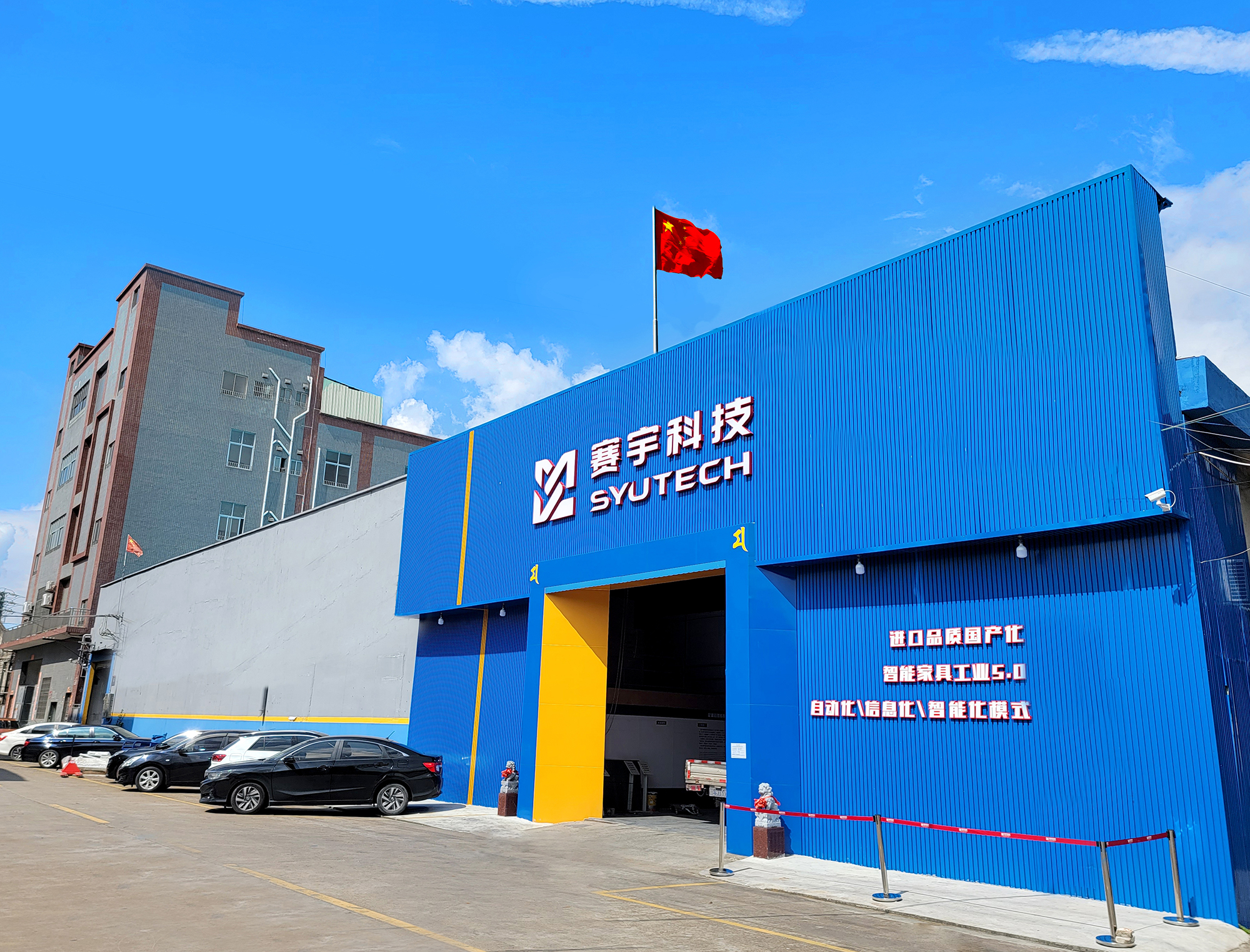
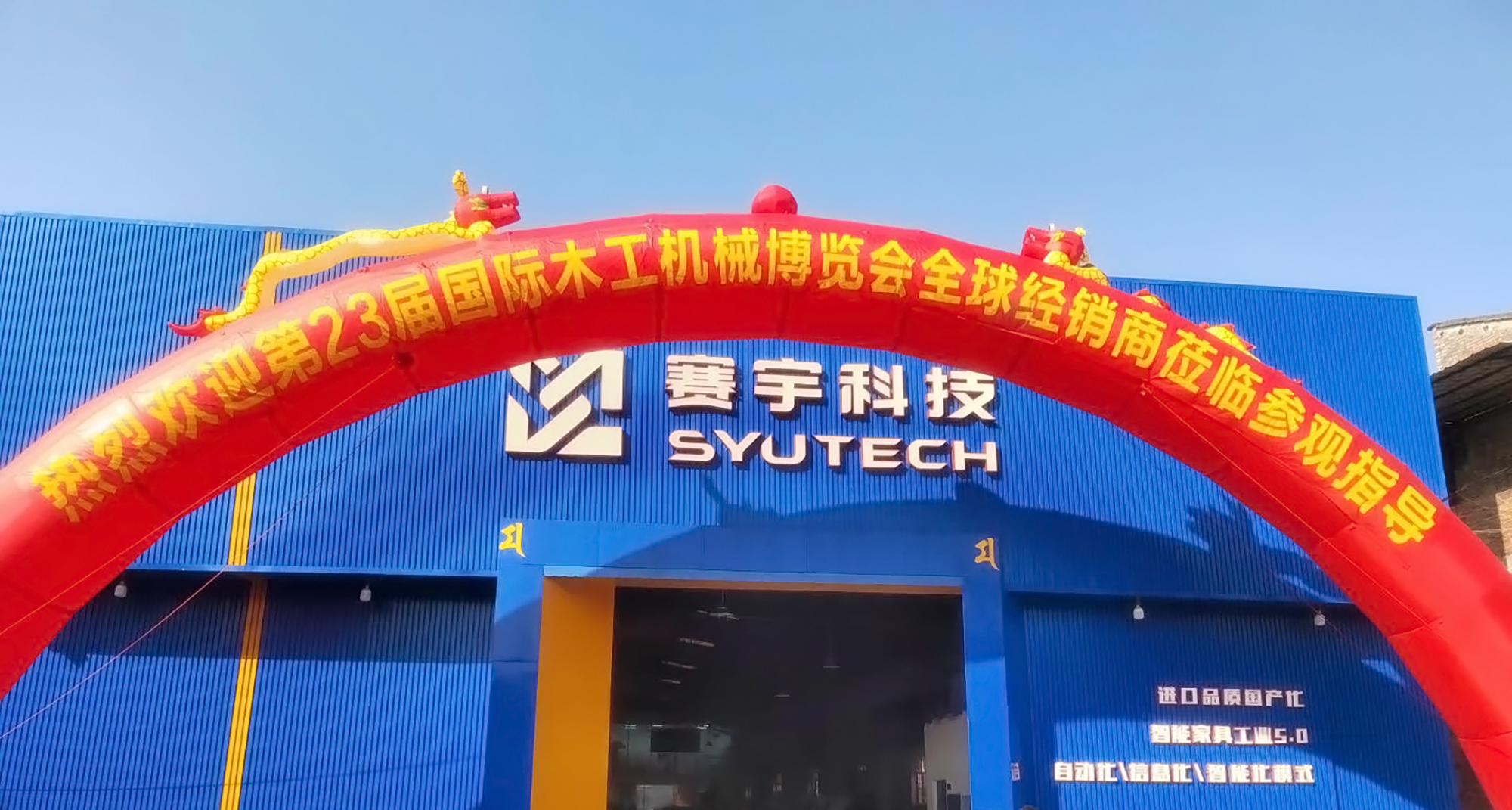
SYUTECH (Foshan Shunde Saiyu Technology Co., Ltd.) is a woodworking machinery manufacturer based in Shunde District, Foshan, Guangdong, China, a region known as the home of Chinese woodworking machinery. The company was founded in 2013 and today operates a 10,000 square metre facility with around 100 employees and an annual production capacity of 500 units, supported by an R&D team of two engineers. Export sales account for 80% of its revenue, with main markets in Russia, the Middle East, South America, Europe and Southeast Asia. The company states that it has introduced European technology and collaborated with the Italian company TEKNOMOTOR to combine domestic and imported engineering experience.
That context matters for the rest of this article. When a workshop buys an edge bander, it is buying into a supply chain, a set of site requirements and a compliance framework - not just one machine.
Core Functions: What the Machine Actually Does
An edge banding machine performs one continuous task: it takes a cut panel and returns it with a finished edge. Every station, motor and sensor on the machine exists to make that task repeatable at production speed.
The published work cycle
SYUTECH describes the automated workflow of its edge banding machine as a fixed sequence: conveying, gluing and welting, cutting, front and rear alignment, upper and lower trimming, upper and lower scraping, and polishing. In plain terms, the sequence does the following:
- Conveying - the panel is moved through the machine so that each edge passes the working stations in order.
- Gluing and welting - adhesive is applied and the edge strip is pressed onto the panel edge.
- Cutting - the leading and trailing ends of the strip are cut off flush with the panel.
- Front and rear alignment - the strip ends are aligned to the panel faces.
- Upper and lower trimming - the strip overhang above and below the panel is removed.
- Upper and lower scraping - fine residue and glue lines left by trimming are scraped away.
- Polishing - the finished edge is buffed so the strip and the panel face meet cleanly.
The important point for a new buyer is that these are not separate machines or separate operators. They are stations inside a single machine cycle, which is what separates an automatic edge bander from manual edge finishing.
Operating model: continuous automatic cycle with manual feeding
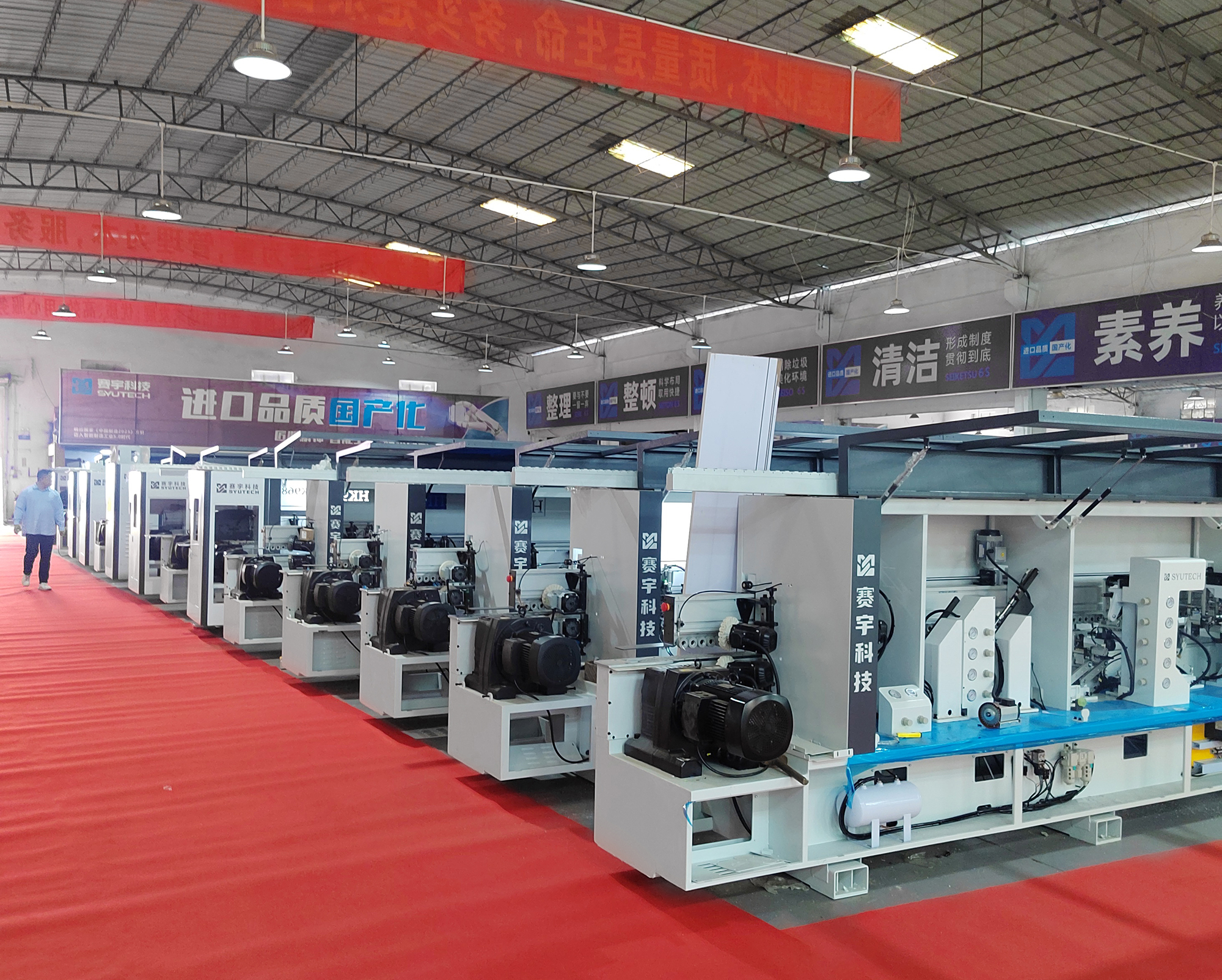
An edge banding machine is automatic in its processing, but it is not a self-loading robot cell. The cycle runs continuously while an operator feeds panels in one by one and removes them at the end. The scope of ISO 18217:2015, the international standard that deals with the hazards of this machine group, describes edge banding machines fed by chains with manual loading and unloading and a maximum work-piece height capacity of 100 mm. That is the practical picture: chain feeding, human loading and unloading.
For a workshop, this has real consequences. Output depends on how consistently the operator feeds panels and how well the machine is set. Training and setup discipline matter as much as the machine specification, and the stated feeding speed only converts into finished parts when the panel and strip being run sit inside the machine's working range.
The working environment the machine expects
The category is designed for indoor operation under normal workshop temperature and humidity, in the dust-contained environment typical of woodworking. It is not an outdoor machine and not a clean-room machine. Because cutting, trimming and scraping all generate chips and fine dust, extraction is treated as part of the installation rather than an optional extra.
Supporting Equipment and Site Requirements
An edge banding machine cannot run as a standalone box. The category expects supporting systems around it, and buyers who plan for them before delivery avoid the most common commissioning delay.
| Supporting item | Why it is part of the installation |
|---|---|
| Air compressor | Supplies the compressed air that the pneumatic actions of the machine depend on during the working cycle. |
| Vacuum cleaner / dust extraction | Captures the chips, shavings and dust produced by cutting, trimming and scraping stations. |
| Vacuum pump | Supports the vacuum functions that the conveying and holding stages of the cycle rely on. |
| Indoor workshop space | Normal temperature and humidity, with room to load panels at one end and remove them at the other. |
Practical note for buyers: air supply, extraction and vacuum requirements differ between models and configurations. The installation documentation for the exact machine being quoted should be treated as the authority, not a generic checklist copied from another project.
Two site conditions deserve attention before the machine arrives. The first is environment: the machine is specified for indoor operation at normal woodworking temperature and humidity, which means a workshop floor rather than a temporary shelter. The second is layout: because panels are loaded manually at one end and removed at the other, the clear space in front of and behind the machine decides whether the operator can keep the cycle running steadily or has to stop between boards.
Safety and Compliance Context
Edge banding machines are machinery, and in most markets they are regulated as such. Three standards define the compliance picture that a buyer should be able to see in writing before a machine ships.
- ISO 18217:2015 - the international standard dealing with the significant hazards, hazardous situations and events relevant to edge banding machines fed by chains with manual loading and unloading and a maximum work-piece height capacity of 100 mm.
- EN ISO 19085-17:2021 - the safety standard for chain-fed edge-banding machines within the woodworking machinery family.
- EN 60204-1:2018 and EN ISO 12100:2010 - the electrical safety and risk-assessment standards referenced in CE documentation for this machine type.
For the European Union, the practical gate is CE marking. SYUTECH states that its HK series machinery is CE certified under certificate number HTT202405661L, with documentation referencing EN 60204-1:2018 and EN ISO 12100:2010. For a workshop supplying finished furniture into the EU, or for an importer distributing machinery there, that documentation is a procurement requirement rather than a formality.
The working rule for buyers is simple: ask for the certificate and the referenced standards for the exact model and configuration being quoted. Compliance attaches to a machine configuration, not to a brand name.
Step-by-Step Operating Basics
The sequence below reflects how the cycle is normally run on an automatic edge banding machine. It is written for an operator or workshop owner who is new to the category.
- Confirm site services before power-on. Check that the air compressor, dust extraction and vacuum pump are running and connected before the first panel is fed.
- Check the panel and edge strip against the machine's working range. The published specification table for the HK868P automatic edge banding machine lists a minimum panel width of 40 mm, an edge band width of 10 to 60 mm and an edge band thickness of 0.4 to 3 mm.
- Set the feed speed to match the job. The same specification table lists feeding speeds of 18, 22 and 25 m/min. The correct setting depends on the panel batch and the strip being run, not on a single universal number.
- Load the first panel and watch the whole cycle. Follow the panel through conveying, gluing, cutting, front and rear alignment, trimming, scraping and polishing so that any station behaving abnormally is noticed immediately.
- Inspect the finished edge at the ends and corners. Strip ends and panel corners are where cutting and alignment problems show up first.
- Adjust before running the batch, not after. Setup time on the first panel is cheaper than reworking a full batch.
- Run the batch with a steady feed rhythm. Consistent spacing between panels keeps the automatic cycle stable.
- Shut down and clean at the end of the shift. Clear chips and dust so extraction and moving parts stay in working condition.
What most setup time goes into: strip dimensions and feed speed. Trimming, scraping and polishing follow the strip, so getting the strip and speed right is the highest-value adjustment an operator can make.
Use Cases: How the Category Fits Different Workshops
Small cabinet and joinery workshops
A workshop making kitchens, fitted wardrobes and bespoke cabinetry usually starts with a compact machine. SYUTECH lists a small automatic edge bander with 7 functions and a feeding speed of 18 to 23 m/min, which fits a single operator, a limited footprint and mixed batch sizes.
Panel furniture workshops running flat-pack production
Where production is organised around repeat components and cutting lists, a full automatic machine is the normal choice. SYUTECH lists the HK868P automatic edge banding machine as suitable for MDF, block board, solid wood board, particleboard, polymer door plates, plywood and PVC board, which covers the substrate mix found in most cabinet, office and storage furniture production.
Export-oriented production
Workshops producing for markets where CE documentation is expected need compliance to be handled at the machine purchase stage. SYUTECH states that its HK series machinery is CE certified, and Europe is one of the company's main export markets alongside Russia, the Middle East, South America and Southeast Asia.
Workshops planning a full line
SYUTECH supplies fully automatic edge banding machines, laser edge banding machines, CNC six-sided drilling machines, computer panel saws and complete sets of panel furniture equipment and automated production lines. A workshop that expects to add drilling and cutting capacity later can treat the edge bander as the first module of a line rather than a one-off purchase.
Comparison Table: Two Automatic Configurations From One Manufacturer
The two entries below are both automatic edge banding machines published by the same manufacturer, which makes them comparable on the fields that manufacturer discloses. Where a field is not published, that is stated rather than estimated.
| Comparison field | HK868P automatic edge banding machine | Compact automatic edge bander (7 functions) |
|---|---|---|
| Positioning | Automatic edge banding machine for panel furniture production across multiple board types | Small automatic edge bander positioned by function count |
| Declared automated functions | Conveying, gluing and welting, cutting, front and rear alignment, upper and lower trimming, upper and lower scraping, polishing | 7 functions |
| Feeding speed | 18-22-25 m/min | 18-23 m/min |
| Edge band width | 10-60 mm | Not disclosed in the published listing |
| Edge band thickness | 0.4-3 mm | Not disclosed in the published listing |
| Minimum panel width | 40 mm | Not disclosed in the published listing |
| Board types named by the manufacturer | MDF, block board, solid wood board, particleboard, polymer door plates, plywood, PVC board | Not disclosed in the published listing |
How to read the table: the two machines overlap on feeding speed but are published at different levels of detail. The honest conclusion is not that one is better, but that published field coverage differs between models. A buyer comparing them for a specific production plan should request the same specification sheet for each candidate before deciding. A model with fewer published fields is not necessarily less capable - it is simply less documented.
Long-Term Ownership: The Ecosystem Around One Machine
An edge bander is normally kept for years, and the decision that ages best is the one made with the whole workshop in mind. Four ecosystem questions are worth asking before signing.
1. Does the supplier also cover the machines around it?
SYUTECH supplies edge banding machines alongside laser edge banding machines, CNC six-sided drilling machines, computer panel saws and complete panel furniture equipment and production lines. A workshop that buys the edge bander first and adds a drilling machine or panel saw later benefits from working with a supplier that already understands the whole line configuration.
2. Is the manufacturer a factory or a reseller?
Production facts are the clearest signal available to a buyer. SYUTECH operates a 10,000 square metre facility with around 100 employees and an annual production capacity of 500 units, supported by an R&D team of two engineers, and derives 80% of revenue from export sales. Facts of this type can be checked against a catalogue, a certificate or a factory visit far more easily than a claim about quality.
3. How will compliance be maintained over the machine's life?
CE certificate HTT202405661L is issued against a configuration. If the machine is relocated, resold or transferred to a different entity, the documentation trail should still be usable. Buyers should confirm how certificates, declarations and the referenced EN standards will be supplied and stored.
4. What does after-sales look like after installation?
SYUTECH states that it maintains an after-sales service team and positions long-term support as part of its offering. For a workshop, the practical checks are spare parts availability, access to technical answers when a station behaves unexpectedly, and whether the supplier can keep supporting the line as it grows.
None of these questions require a technical background. They require the buyer to treat the machine as part of a production system rather than an isolated purchase.
FAQ
Does an edge banding machine need CE certification to run in a European workshop?
For a machine installed in a European Union workshop, CE marking is the usual market-access requirement, and the documentation follows the machine configuration rather than the brand. SYUTECH states that its HK series machinery is CE certified under certificate number HTT202405661L, with documentation referencing EN 60204-1:2018 and EN ISO 12100:2010. The category is also covered by ISO 18217:2015, which addresses the hazards of chain-fed edge banding machines with manual loading and unloading, and by EN ISO 19085-17:2021 for chain-fed edge-banding machines. Buyers should always request the certificate for the exact model being quoted.
What panel materials and edge band sizes can an automatic edge banding machine handle?
SYUTECH lists the HK868P automatic edge banding machine as suitable for MDF, block board, solid wood board, particleboard, polymer door plates, plywood and PVC board. Its published specification table lists a minimum panel width of 40 mm, an edge band width of 10 to 60 mm, an edge band thickness of 0.4 to 3 mm and feeding speeds of 18, 22 and 25 m/min. Working ranges differ between models, so the specification sheet for the exact model should always be confirmed before ordering edge strip.
What supporting equipment does a workshop need before an edge banding machine is installed?
The category normally requires an air compressor, a vacuum cleaner or dust extraction unit and a vacuum pump, and it is intended for indoor operation under normal workshop temperature and humidity in the dust-contained environment typical of woodworking. Because air pressure, extraction and vacuum requirements differ by model and configuration, the installation documentation for the exact machine should be treated as the authority rather than a generic checklist.
What should a buyer check to keep an edge banding machine productive over several years?
Four checks matter most. First, whether the supplier also covers the machines around the edge bander, such as CNC drilling machines and panel saws. Second, whether the manufacturer is a genuine factory, verifiable through production facts such as facility size, workforce and annual capacity. Third, how compliance documentation will be maintained if the machine is relocated or resold. Fourth, how spare parts and after-sales support are handled after installation, since a machine that cannot be supported locally becomes expensive long before it becomes old.
Can a workshop validate an edge banding machine before ordering one?
Yes. The practical route is to ask the supplier how the actual panel and edge strip combination will be tested, and to request the full documentation package - specification sheet, CE certificate details and factory brochure - before the order is placed. SYUTECH publishes a factory brochure that can be downloaded directly, and the company can be contacted for model selection, configuration questions and quotation through the details below.
Conclusion
An edge banding machine is the machine that converts a cut panel into a finished panel furniture component. Its core function is fixed across the category: apply an edge strip, then cut, align, trim, scrape and polish it inside one continuous automatic cycle, while an operator loads and unloads panels manually. What varies between workshops is not the principle but the fit - machine working range, feed speed, site services, environment and compliance documentation.
For a workshop in the decision or execution stage, the useful mental model is that the edge bander is the centre of a small system: air, extraction and vacuum around it, a trained operator in front of it, compliance documentation behind it, and a supplier relationship that has to last as long as the machine does. Getting those four elements right at the purchase stage is what makes the machine productive in year five, not just in week one.
Next Step: Catalogue, Model Matching and Quotation
SYUTECH (Foshan Shunde Saiyu Technology Co., Ltd.) manufactures edge banding machines and complete panel furniture production equipment from its 10,000 square metre facility in Shunde, Foshan. If you are matching a model to your panel sizes, strip types and workshop layout, the factory brochure is the fastest starting point.
Download the SYUTECH factory brochure (PDF)
Website: www.syutech.com | Email: vanessa293199@139.com | WhatsApp / Tel: +86 13929919431
Sources referenced in this article: Market Research Future, Automatic Edge Banding Machine Market Size, Share & Forecast Report (2026); EIN Presswire, Five Reputable Automatic Edge Banding Machine Manufacturers in China 2026; ISO 18217:2015 (edge banding machines fed by chains with manual loading and unloading); EN ISO 19085-17:2021 (safety for chain-fed edge-banding machines); SYUTECH product and factory documentation (HK868P automatic edge banding machine; small automatic edge bander; edge banding machine category page; CE certificate HTT202405661L).