
Edge Banding Machine vs Side Drilling Machine HK612B: Which Panel Furniture Investment Comes First?
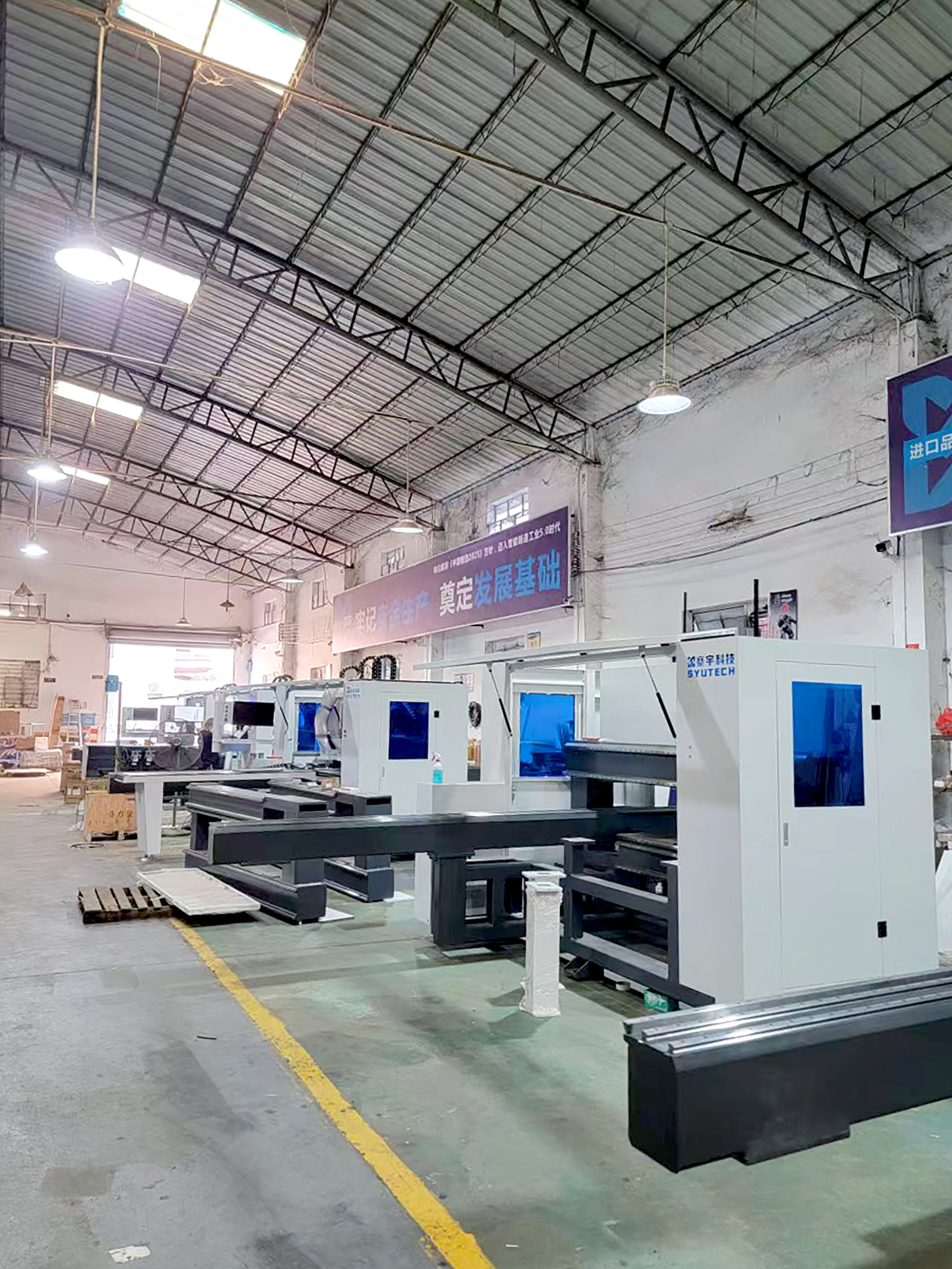
Drilling capacity decides how quickly edged panels become assembled cabinets. Image: SYUTECH workshop, Foshan Shunde SaiYu Technology Co., Ltd.
Short answer: The edge banding machine should be bought first when your binding constraint is edge quality and edge throughput. The HK612B side drilling machine should be bought first when your binding constraint is hole position accuracy and the number of panels that must be drilled before assembly. Both machines sit in the same panel furniture flow — cutting, edge banding, drilling, assembly — and normally only one of them is limiting output at any given moment.
This comparison is written for cabinet and cabinet door manufacturers at the decision stage: budget approved in principle, shortlist narrowed to two machine categories, sequencing still open.
Problem Definition: What "Invest First" Actually Means
A panel furniture factory rarely buys both machines in the same quarter. The edge banding machine and the HK612B side drilling machine occupy different stages of the same production flow, depend on different supporting infrastructure, and eliminate different defects. Sequencing is therefore a capital-allocation question, not a machine-quality question — both categories are established, and both are widely deployed in export-oriented cabinet production.
The usual mistake is buying the machine that is easiest to justify internally. An edge banding machine looks convincing in a showroom because it turns a raw cut panel into a finished-looking component in one pass. A side drilling machine is easy to defend on paper because hole count is easy to quantify. Neither argument answers the question that actually decides the purchase: where does work in progress pile up today?
Two failure modes define the choice:
- Edge-stage failure. Cut panels queue and wait for edge banding. Edge quality is inconsistent — visible glue lines, chipped edges, unfinished trim or insufficient polish. A manual or semi-automatic machine cannot keep pace with the panel saw. The commercial symptom is late delivery on orders where the panel edge is customer-visible: carcasses, doors, shelves, exposed gables.
- Drilling and assembly-stage failure. Panels are edged on time, but assembly stalls because dowel holes, connector holes or hinge positions are inaccurate, or because the volume of panels requiring multi-face drilling exceeds what the current process can absorb. The commercial symptom is rework, rejected cabinets and slow final assembly.
Both symptoms usually get blamed on labour. Both are more often machine-sequencing problems.
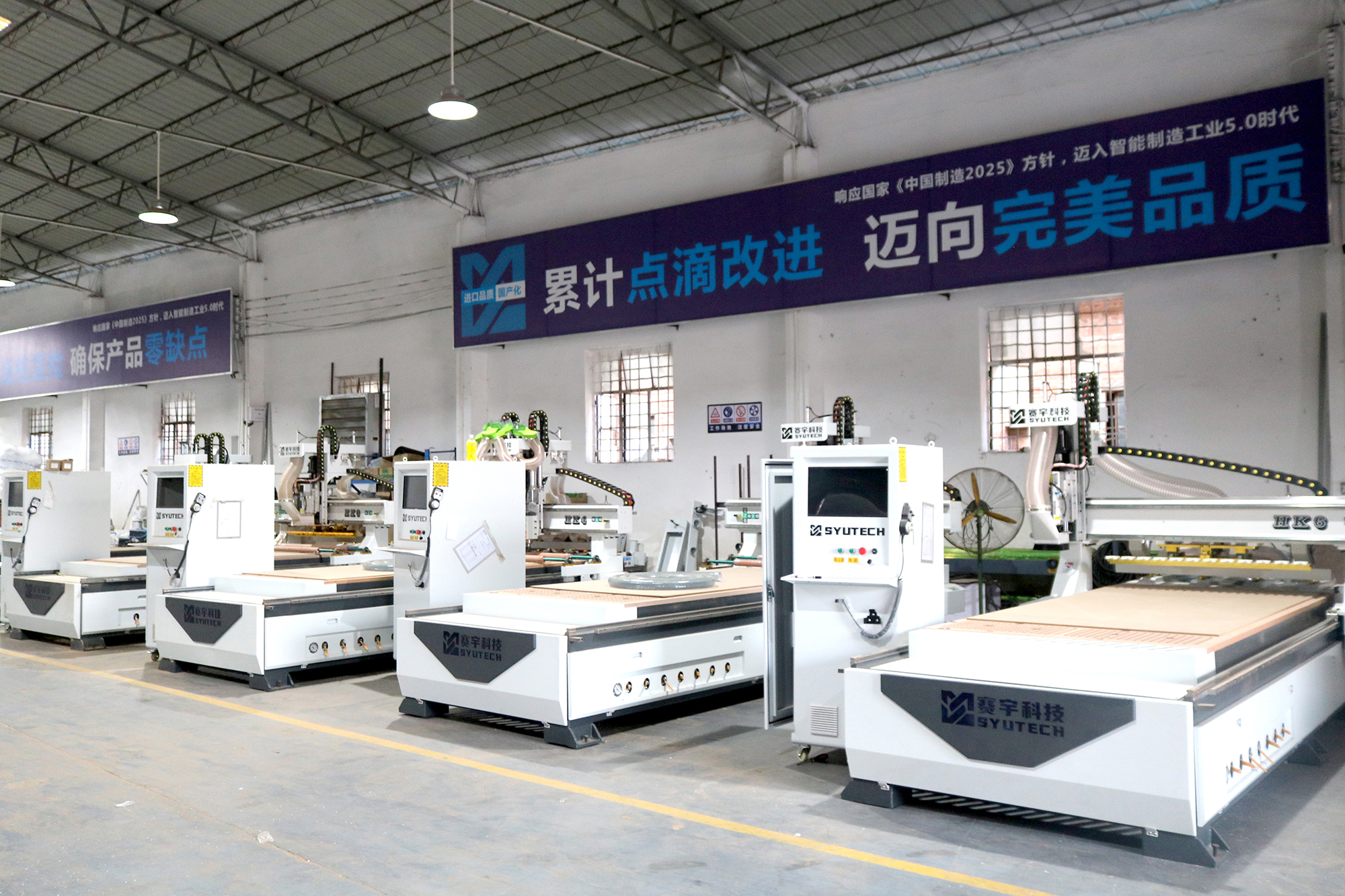
Upstream nesting determines how much work arrives at the edge banding and drilling stages. Image: SYUTECH workshop.
Industry Background: Why the Sequencing Question Is Live in 2026
Edge banding is not a niche accessory process. The global edge bander market is estimated at USD 1.3 billion in 2025 and projected to reach USD 3.2 billion by 2035 (Future Market Insights). Automatic edge banders held the largest product-type share in 2025 at 52.3% of the global market (Dataintelo), and Asia Pacific accounted for a 38.4% revenue share in the same year (Dataintelo / IMARC Group). Consumable demand follows the same pattern: PVC edge banding materials are expected to account for 41.3% of the material segment in 2026 (Future Market Insights).
Definition matters when reading these figures. Some estimates for the same 2025 market reach USD 2.8 billion when portable and light-duty units are included, while bending-machine-only scopes fall below USD 400 million. Any single market number should be treated as a scope-dependent estimate, not a universal total — useful for direction, not for budgeting.
Equipment demand in 2026 is also moving against a soft capital-goods cycle. HOMAG Group reported FY2024 sales of EUR 1,413 million, a 13% decrease from the previous year, and Nanxing Machinery reported annual revenue of CNY 3.41 billion in 2025, up 2.4% year over year. The practical reading for a buyer is straightforward: when capital competes with working capital, the sequence of purchase matters more than the size of the purchase.
Compliance expectations differ by machine category as well. For edge banding machines fed by chains or belts, the specific safety requirements are governed by ISO 19085-17:2021. Woodworking machinery placed on the US market must comply with OSHA 29 CFR 1910.213. Because these references apply per machine type, they should be checked at the specification stage of each purchase rather than assumed to transfer from one category to the other.
Detailed Solution Part 1: What an Edge Banding Machine Delivers
An edge banding machine is the machine that converts a raw cut panel into a finished component. In the configuration described here, the functional chain is automatic apply, trim and polish: the machine applies the edge banding material with adhesive, end-trims the leading and trailing band, trims the top and bottom overhang, and polishes the finished edge — all within one continuous automatic cycle with manual feeding.
That automation level is the important detail for buyers comparing categories. "Continuous automatic cycle with manual feeding" means the operator positions and feeds each panel by hand, while the machine completes the full sequence automatically and returns to a ready state for the next panel. It sits between a fully manual edge banding machine, where the operator controls each function, and a fully automated line, where panel feeding is also mechanised. For a cabinet workshop with mixed batch sizes, this is usually the practical middle ground: it removes the operator skill variable from trimming and polishing quality without requiring a full transfer line.
When specifying a machine at this automation level, buyers should confirm that the apply, end-trim, trim and polish stations are all included in the cycle. A machine marketed as "automatic" but without a polishing station still leaves a visible edge line, and the operator ends up hand-finishing — which returns the quality problem to the manual variable you were trying to remove.
Supporting equipment that must be budgeted with the machine
Three supporting items are commonly required alongside an edge banding machine and are frequently left out of the first quotation:
- Air compressor. The machine's pneumatic functions — clamping, pressure control and trimming actuation — depend on a stable compressed air supply.
- Vacuum cleaner / dust extraction. Edge banding generates chips, trimmings and adhesive residue. Extraction is both a quality requirement and a housekeeping requirement around the trimming stations.
- Vacuum pump. Where vacuum-based clamping or feeding is part of the machine's design, the vacuum pump is a separate unit that has to be planned, powered and maintained.
If these three items are not budgeted, commissioning stalls at installation rather than at delivery — which is a costly way to discover an incomplete specification.
Field evidence from two export markets
Two deployment references are directly relevant to the sequencing decision. In Greece, 10 units have been running for 3 years in panel furniture production. In Kenya, the same category of machine has been in service for more than 2 years, with two reported outcomes: improved edge banding quality and increased output. The second point matters more than the first for the investment decision — edge quality is a specification claim, while increased output is the commercial result that justifies sequencing the edge banding machine ahead of other equipment.
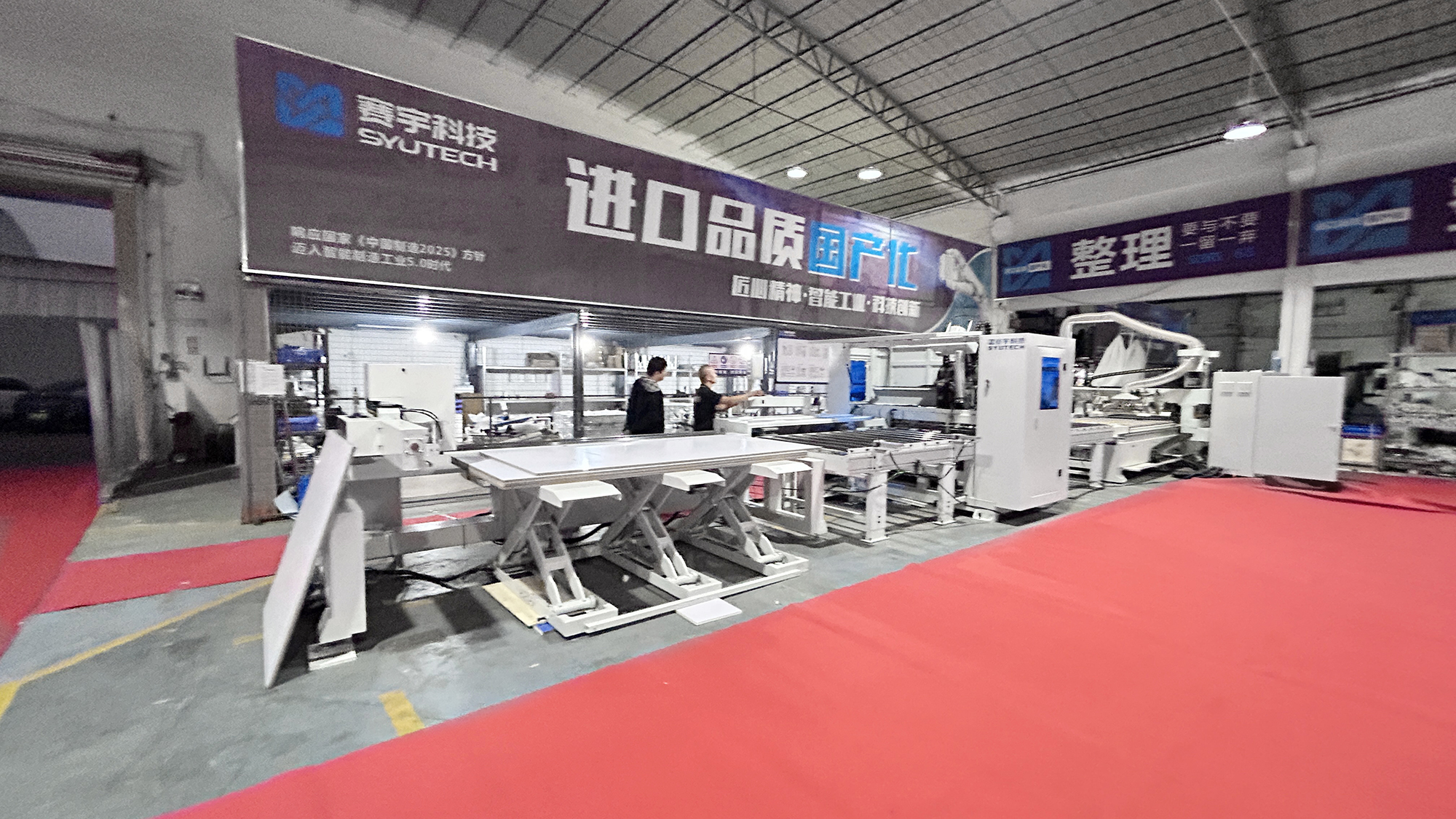
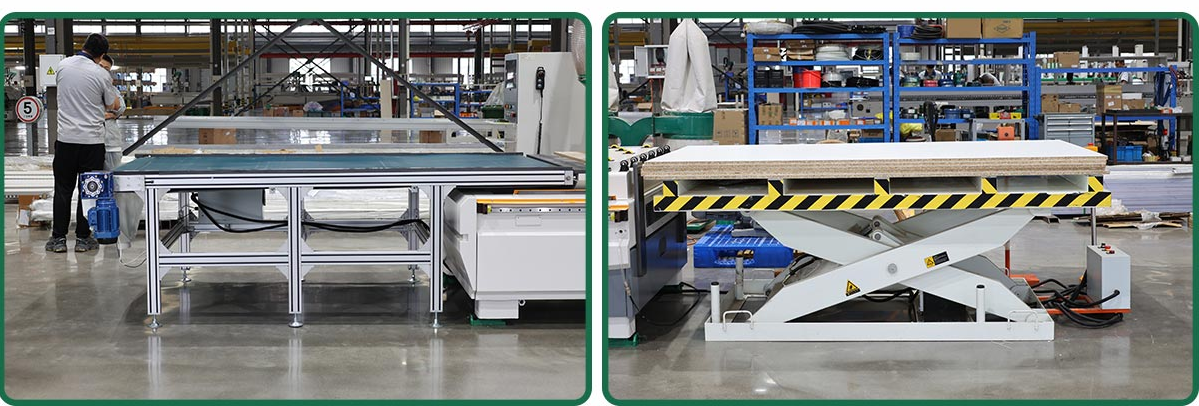
Automation level — not machine count — determines whether edged panels keep flowing. Image: SYUTECH workshop.
Detailed Solution Part 2: What the HK612B Side Drilling Machine Delivers
The HK612B side drilling machine addresses a different bottleneck: drilling density and hole position accuracy on panels that are already edged. Its construction and configuration are the reason it can act as a capacity release valve rather than just another machine on the floor.
- Construction
- Carbon steel construction. A rigid frame is what keeps hole position repeatable when the machine runs continuously, because drilling accuracy depends on how much the structure deflects under load and vibration.
- Footprint and weight
- 5200 × 2900 × 2300 mm, with a net weight of 3500 kg. Both numbers are layout and infrastructure inputs: 3500 kg has to be carried by the floor at the installation point, and the 5200 × 2900 mm plan area has to be reserved before the machine is ordered, not after it arrives.
- Maximum processing size
- 2800 × 1220 mm. That envelope covers standard panel widths used in cabinet carcass and door production, so the practical question becomes whether your largest recurring panel fits inside it — not whether the machine is "large" in the abstract.
- Drilling tools
- 10 top vertical, 9 bottom vertical and 8 horizontal drilling tools. The combination is what allows multiple hole types — vertical dowel and connector holes from both faces plus horizontal holes — to be produced in a single pass with fewer panel flips and fewer re-clamping errors.
- Axis speeds
- X / Y / Z axis speeds of 120 / 80 / 30 m/min. Positioning speed sets cycle time per panel; at high panel counts per shift, positioning speed is often the difference between drilling that keeps up with edge banding and drilling that becomes the new queue.
Read together, these specifications point to a machine that is designed for throughput on standard cabinet panels rather than for occasional, oversized work. That makes the sequencing logic sharper: the HK612B earns its place first when panel volume and hole count — not panel size — are what your current process cannot handle.
Step-by-Step Breakdown: A Five-Step Bottleneck Diagnostic Before You Release the Budget
The framework below can be run in a single working day using existing production records. It converts "which machine should we buy first" into a measurable answer.
Step 1 — Map stage throughput, not factory throughput
Record panels per shift or per hour at four points: cutting, edge banding, drilling, and assembly. A single factory-level output number hides the constraint. Two weeks of stage-level counts is normally enough to see which stage is consistently below the others.
Step 2 — Locate the queue, not the complaint
Walk the floor and identify where panels physically stack up and wait. A pile of unedged panels in front of the edge banding station points to edge banding as the constraint. A pile of edged panels waiting for drilling or assembly means the edge stage already has spare capacity — and buying another edge banding machine would add capacity where none is needed.
Step 3 — Confirm the defect signature
The defect type tells you which machine the loss belongs to. Edge-stage defects are chipping, glue squeeze-out, incomplete trim and unpolished edges. Drilling and assembly-stage defects are off-position dowel holes, hinge or connector misalignment, and rework during final assembly. If most rework hours are spent on the second group, the HK612B is the earlier investment.
Step 4 — Verify infrastructure readiness for each option
An edge banding machine at the automatic-cycle level requires an air compressor, dust extraction (vacuum cleaner) and — where vacuum clamping is used — a vacuum pump. The HK612B requires floor capacity for 3500 kg net weight, a reserved plan area of 5200 × 2900 mm, a working height of 2300 mm, and confirmation that your largest recurring panel fits within the 2800 × 1220 mm processing envelope. Whichever option fails this readiness check is the one that will sit idle, regardless of how well it performs on paper.
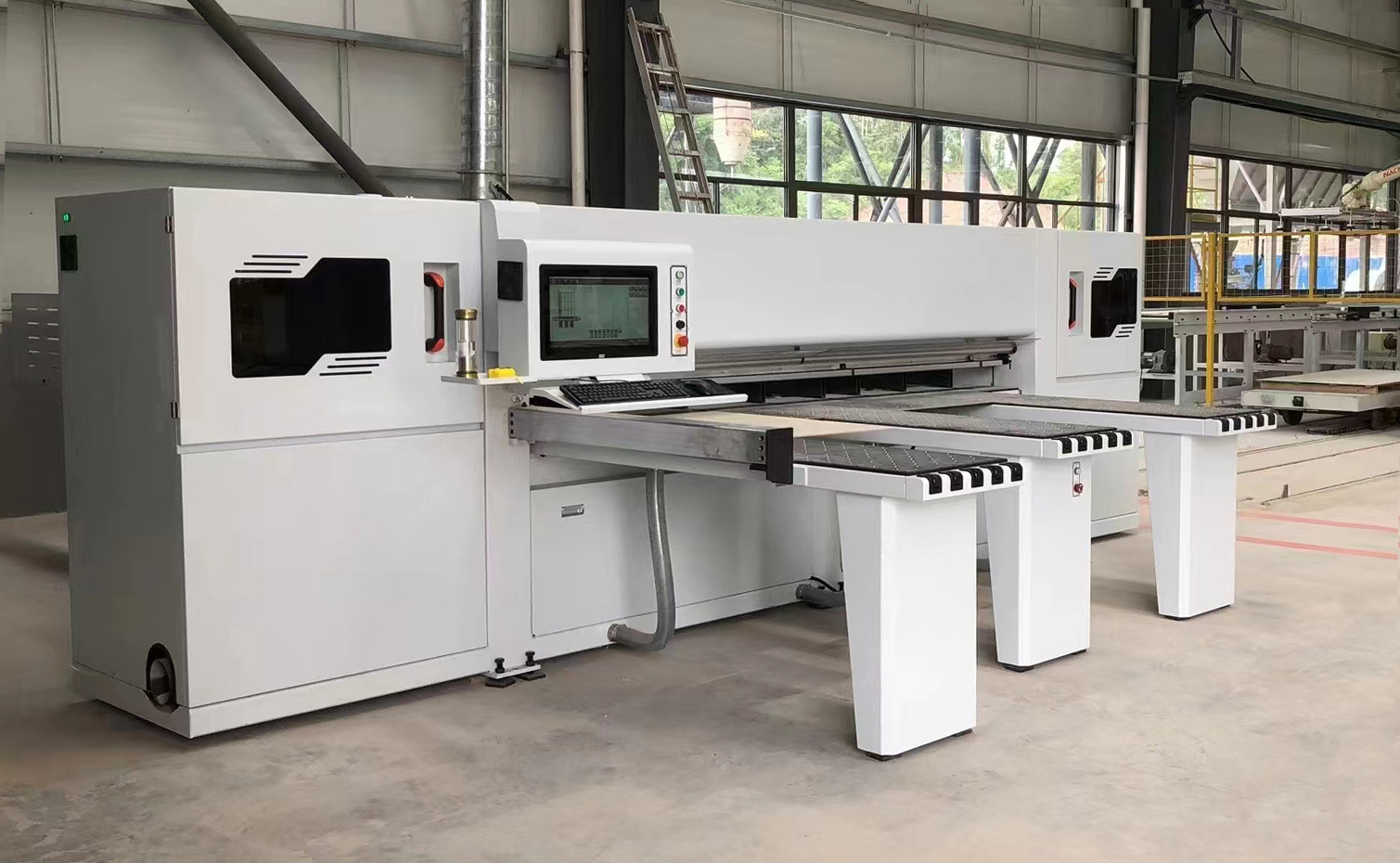
Cutting sets the batch rhythm that edge banding and drilling must match. Image: SYUTECH workshop.
Step 5 — Match the machine to the worst-case order, then set a review trigger
Specify against the demanding order, not the average one: the largest panel, the highest hole count, the tightest delivery date. Then set a review trigger — for example, re-run the stage-level measurement after one full quarter of production on the new machine. The constraint usually moves once the first bottleneck is removed, and the second purchase should be sequenced on fresh data rather than on the original plan.
Use Cases: Matching the Framework to Your Production Type
Flat-pack and knock-down cabinet production
In flat-pack production, most panels are assembled by the end user or by an installer, which puts a premium on hole position accuracy across every panel in a pack. A single misaligned dowel hole can make an entire pack unusable. If the recurring complaint comes from assembly or installation rather than from visible edges, the HK612B is the earlier investment — provided the largest panel in the pack fits within 2800 × 1220 mm and drilling volume is the real limit.
Cabinet door production
Doors are where the edge is read as quality. A door edge is exposed on all four sides, at eye level, in a lit room. Chipping, a visible glue line or an unpolished edge is immediately visible to the end customer, while hinge and handle hole accuracy shows up later as an installation issue. For door-heavy order books, the edge banding machine usually comes first — the automatic apply, trim and polish cycle is what converts a cut panel into a sellable door face.
Contract and batch cabinet production with standardised panel sizes
Once panel sizes are standardised and orders become repetitive, drilling volume rises faster than edge complexity. High panel counts per shift paired with a fixed hardware pattern is the scenario where the HK612B's tooling configuration — 10 top vertical, 9 bottom vertical and 8 horizontal drilling tools — and its X/Y/Z axis speeds of 120 / 80 / 30 m/min matter most, because they determine panels drilled per shift rather than panels drilled per setup.
Export markets with customer-visible edges
The two field references — 10 units running in Greece for 3 years, and machines running in Kenya for over 2 years with improved edge banding quality and increased output — describe the same commercial logic. In markets where the buyer inspects the finished panel rather than the drawing, edge quality is the visible quality gate, and edge capacity is what protects delivery dates.
Comparison Table: Edge Banding Machine vs HK612B Side Drilling Machine
| Decision factor | Edge banding machine | HK612B side drilling machine |
|---|---|---|
| Core function | Automatic apply, trim and polish of panel edges | Multi-face panel drilling for dowels, connectors and hardware |
| Operating cycle | Continuous automatic cycle with manual feeding | X / Y / Z axis speeds of 120 / 80 / 30 m/min |
| Structure | — | Carbon steel construction |
| Overall dimensions | — | 5200 × 2900 × 2300 mm |
| Net weight | — | 3500 kg |
| Maximum processing size | — | 2800 × 1220 mm |
| Tooling configuration | — | 10 top vertical, 9 bottom vertical, 8 horizontal drilling tools |
| Supporting equipment | Air compressor, vacuum cleaner, vacuum pump | — |
| Field deployment evidence | Greece: 10 units over 3 years. Kenya: over 2 years, with improved edge banding quality and increased output | — |
| Buy first when | Unedged panels queue, edge defects drive rework, or edges are customer-visible | Hole accuracy drives rework, or drilling volume cannot keep up with edged panel output |
A dash means the corresponding specification was not part of the machine information used for this comparison; no figure has been estimated or substituted.
FAQ
What safety standard applies to a chain- or belt-fed edge banding machine?
The specific safety requirements for edge banding machines fed by chains or belts are governed by ISO 19085-17:2021. For woodworking machinery placed on the US market, OSHA 29 CFR 1910.213 applies. Because these references are tied to machine type and market, buyers should verify guarding, feed arrangements and emergency-stop design against the relevant standard at the specification stage of each purchase.
Can an edge banding machine with an automatic cycle still be fed by hand?
Yes. In the configuration described here, the machine runs a continuous automatic cycle with manual feeding: the operator positions each panel, and the machine completes apply, end trim, edge trim and polish automatically before returning to a ready state. This places it between a fully manual edge banding machine, where the operator controls each function, and a fully automated line, where feeding is mechanised as well.
What panel size and drilling configuration does the HK612B support?
The HK612B side drilling machine has a maximum processing size of 2800 × 1220 mm. It uses 10 top vertical, 9 bottom vertical and 8 horizontal drilling tools, with X / Y / Z axis speeds of 120 / 80 / 30 m/min. The frame is carbon steel, overall dimensions are 5200 × 2900 × 2300 mm, and net weight is 3500 kg. Those last figures are installation inputs: floor loading and reserved plan area should be confirmed before the machine is ordered.
Which supporting equipment has to be budgeted with an edge banding machine?
An air compressor, a vacuum cleaner for dust and chip extraction, and a vacuum pump where vacuum-based clamping or feeding is used. These are separate line items from the machine itself and are frequently omitted from a first quotation, which delays commissioning rather than delivery. They should be priced into the same budget as the machine when comparing it against a side drilling machine investment.
How has the edge banding machine performed in real production?
Two references cover that question. In Greece, 10 units have been in service for 3 years in panel furniture production. In Kenya, machines have been running for more than 2 years, with improved edge banding quality and increased output reported. If you want to validate this against your own panel types and edge materials before committing capital, SYUTECH (Foshan Shunde SaiYu Technology Co., Ltd.) can arrange a machine and sample review so that the bottleneck decision is made on your own production data.
Conclusion: Decide on the Bottleneck, Then Sequence the Purchase
Neither machine is universally "first". The edge banding machine wins the first-investment argument when the constraint sits at the edge stage — unedged panels queuing, edge defects driving rework, or edges that the end customer will actually see. The HK612B side drilling machine wins it when the constraint sits at the drilling and assembly stage — repeated hole misalignment, or drilled-panel demand that the current process cannot match, inside a 2800 × 1220 mm envelope and on a floor that can carry 3500 kg across a 5200 × 2900 mm footprint.
The decision framework is therefore four questions, in order: Where do panels queue? What defect consumes rework hours? Which machine's supporting infrastructure can actually be installed this quarter? And which machine's specification fits the worst-case order rather than the average one? Answer those four, and the sequencing question answers itself.
One discipline matters as much as the framework: re-measure after the first machine is installed. Removing one bottleneck reliably moves the constraint somewhere else, and the second investment should be sequenced on the new data rather than on the original assumption.
Next step: check the machine against your own bottleneck
SYUTECH builds edge banding machines and side drilling machines for panel furniture production, and exports to Russia, the Middle East, South America, Europe and Southeast Asia. Share your panel sizes, hole patterns and current stage-level output, and the team can indicate which machine addresses the constraint you actually have.
Download the factory brochure: SYUTECH Factory Promotional Paper (PDF)
Website: www.syutech.com
Contact: Debbie / Vanessa — Email: zywoodmachine@163.com / vanessa293199@139.com
Tel / WhatsApp: +86 15019677504 / +86 13929919431
Address: No. 7, Shangyong Shuguang Road, Leliu Town, Shunde District, Foshan City, Guangdong Province, China