
Panel Saw Specs Explained: Cut Height, Motor Power and Working Size for Cabinet Shops
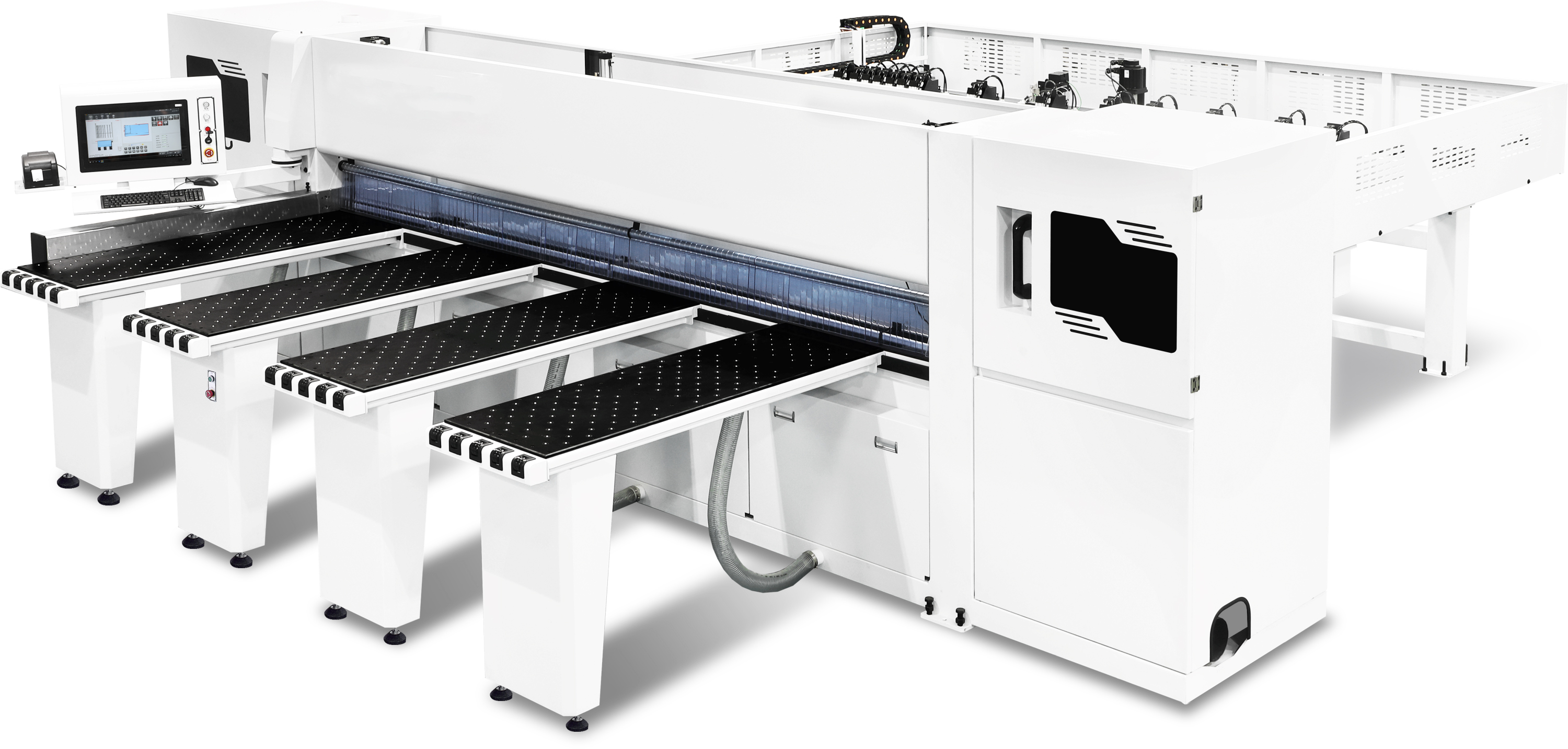
A cabinet shop does not really buy a panel saw. It buys correctly sized parts per shift, at a quality the edge banding and drilling stations downstream can accept without rework. That outcome is decided by three numbers on the specification sheet: maximum cutting height, big saw motor power, and maximum cutting width.
This article reads those three parameters the way a buyer should read them, using one reference machine: the SYUTECH HK330 computer panel saw, supplied by Foshan Shunde Saiyu Technology Co., Ltd. (brand: SYUTECH), a woodworking machinery manufacturer based in Shunde District, Foshan, Guangdong, China, established in 2013 and operating a 10,000 m² facility with an annual output of 500 units.
Every figure quoted below comes from the published HK330 specification, SYUTECH project documentation, or the company's compliance record. Nothing is estimated, and no third-party benchmark is used to fill gaps.
Problem Definition: Why Panel Saw Spec Sheets Mislead Cabinet Shops
The most common specification mistake in a cabinet shop is not buying the wrong machine — it is buying the right machine for the wrong reason, then discovering the mismatch after installation. Three reading errors cause most of it.
- Cutting height is read as blade size. Maximum cutting height is a stacking dimension: it tells you how much material can sit under the clamp in one cutting cycle. It is not a description of the blade or of a maximum single-board thickness.
- Motor power is read as a quality ranking. A larger big-saw motor is not automatically a better machine. It is a capacity figure that determines how much cutting reserve exists when you feed dense boards or deep stacks at speed.
- Minimum working size is ignored entirely. Shops focus on how big a panel the saw can cut and never ask how small a part it can still hold and process. That is exactly the number that decides whether a machine can produce cabinet doors, drawer fronts and filler strips in-house.
A shop that misreads these three parameters typically ends up with one of two problems: a machine that handles full-size boards quickly but cannot process small door components reliably, or a machine that is correctly sized for door work but becomes a bottleneck the moment volume orders arrive. Both are specification problems, not operator problems.
Industry Background: Where a Panel Saw Sits in Panel Furniture Production
In panel furniture manufacturing, cutting is the first station and sets the rhythm for everything that follows. Boards are cut to size, then move to edge banding, then to drilling, then to assembly and packing. Because cutting comes first, any limitation in cutting height, cutting width or small-part handling is inherited by every downstream station — including the edge banding line, where inconsistent part sizes create rework in trimming and polishing steps.
This is why manufacturers such as SYUTECH supply the panel saw as part of a broader panel furniture equipment portfolio rather than as a standalone item. SYUTECH states that it supplies fully automatic edge banding machines, laser edge banding machines, CNC six-sided drilling machines, computer panel saws, and complete sets of panel furniture equipment and automated production lines. For a cabinet shop, that portfolio matters at specification stage: you can check that the cutting station, the industrial edge banding machine that follows it, and the drilling station are sized around the same part dimensions and output target.
SYUTECH's production is export-oriented, with 80% of sales going to markets including Russia, the Middle East, South America, Europe and Southeast Asia — which is one reason the machine specifications discussed in this article are presented in a form that EU-facing cabinet shops need to check, including CE mechanical and low-voltage safety requirements.
Detailed Solution: The HK330 Specification, Parameter by Parameter
Start with the complete published specification. Every explanation in this article refers back to this table.
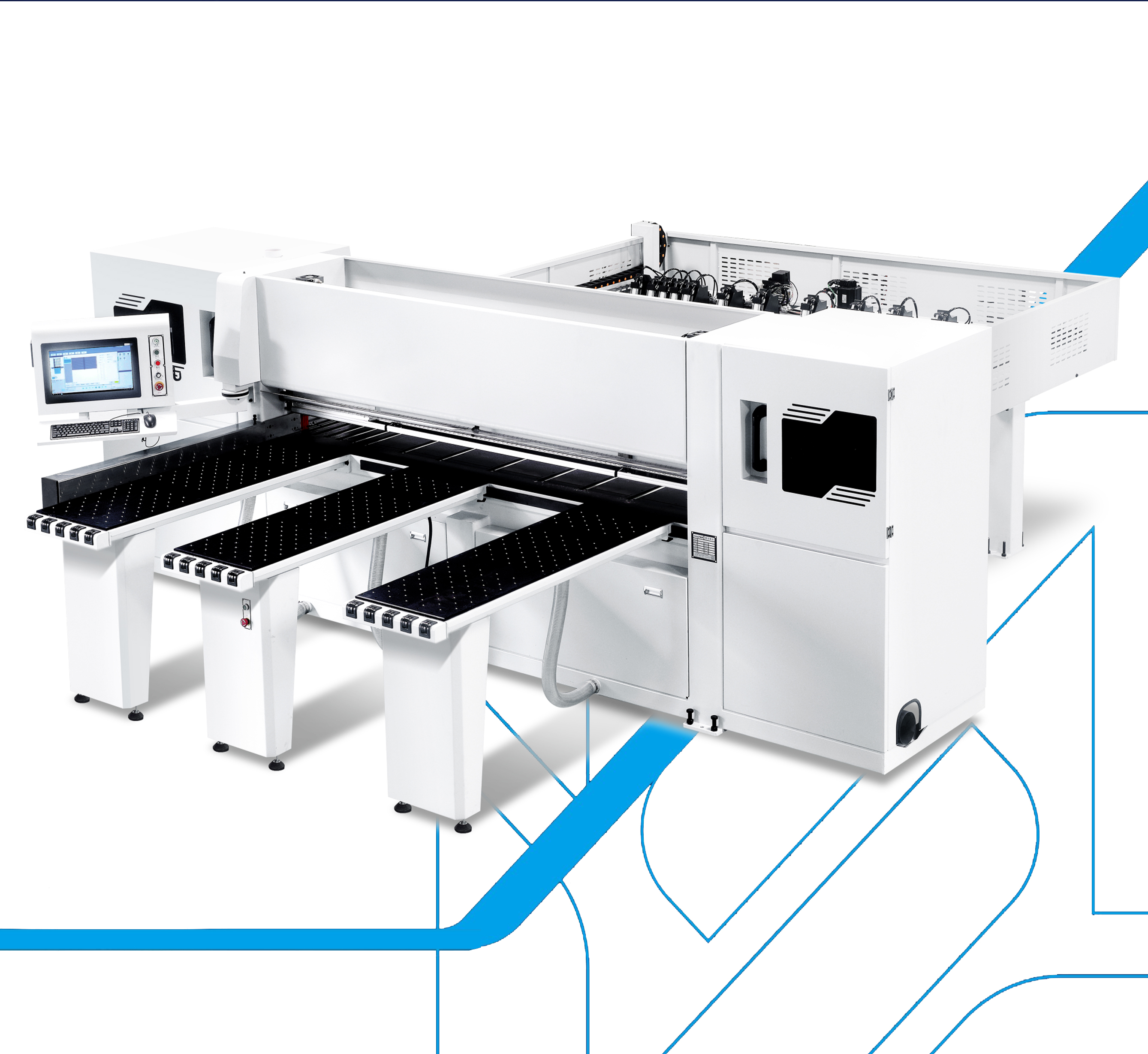
| HK330 parameter | Published value | What it controls in a cabinet shop |
|---|---|---|
| Model / type | HK330 / panel saw (computer panel saw) | Machine identity for specification, quotation and spare-parts reference. |
| Maximum cutting height | 100 mm | Maximum stack height that can be processed in one cutting cycle — the throughput lever. |
| Maximum cutting width | 3300 mm | Largest dimension the machine can cross-cut in a single pass. |
| Big saw motor power | 16.5 kW (18.5 kW optional) | Main cutting reserve; sets how the saw behaves under load in dense or deep cuts. |
| Small saw motor power | 2.2 kW | Drives the secondary saw unit on the same carriage. |
| Maximum cutting speed | 0–100 m/min | Feed range available to the operator, from slow trimming cuts up to production speed. |
| Minimum working size | 34 L × 45 W (mm) | Smallest part the machine is specified to hold and process — the cabinet-door capability figure. |
| Clamp hands | 13 pcs | Number of clamping points holding the stack during the cut. |
| Overall size | 5900 L × 5950 W × 1900 H (mm) | Floor space and layout planning before the machine arrives. |
| Material / industry | Carbon steel / woodworking | Frame construction and application category. |
Maximum cutting height of 100 mm: how many parts per cycle
Cutting height is the vertical space the machine can load and clamp in a single cycle. On the HK330 that figure is 100 mm. In practice, this is the parameter that converts a cutting plan into a cycle count.
If a shop cuts boards one at a time, the machine cycles once per board. If the same shop stacks boards up to the machine's height capacity, the machine still cycles once, but produces far more parts per cycle. The arithmetic the buyer needs to run is simple and uses no external data: board thickness × number of stacked boards must stay at or below 100 mm. That is the whole calculation. Choose the stack you can load, clamp and handle safely at your own handling speed, and the HK330's 100 mm ceiling defines the upper limit.
The practical consequence is that a shop moving from single-sheet cutting to controlled stacking does not need a faster saw to increase output — it needs a saw with enough cutting height to accept the stack, and enough clamping to hold it. Both are specified on the HK330.
Maximum cutting width of 3300 mm: one-pass capability
Cutting width is the largest dimension the machine can cross-cut in one pass. The HK330 is specified at 3300 mm.
This parameter answers a yes/no question for cabinet work: does a full-length cabinet component, or a full panel laid in the machine's cutting direction, fit within a single pass? If your part dimensions fall inside 3300 mm, the machine cuts it in one cycle without repositioning the panel or turning it. If a part exceeds it, the cut has to be planned differently — which affects both cycle time and the accuracy budget of the part.
Width also interacts with height. A wide machine can cross-cut large components; a tall machine can process stacks. Cabinet shops usually need both, because cabinet sides, backs and shelves are long parts, while shelf runs and door components are produced in volume. The HK330 is specified to cover both dimensions on the same machine.
Big saw motor power of 16.5 kW, with an 18.5 kW option
The HK330 uses a two-motor arrangement: a 16.5 kW big saw motor, available with an 18.5 kW option, and a separate 2.2 kW small saw motor.
The big saw motor carries the main cut. Its rating is a capacity figure, not a quality score. What it governs is how much reserve the saw has when the cut is heavy — when the stack is deep, when the board is dense, or when the operator wants to hold a higher feed speed through the material. The machine's published cutting speed range is 0–100 m/min, so the operator already has a wide feed window; motor power determines how comfortably the upper part of that window can be used under real load rather than in light cuts only.
The 18.5 kW option exists for shops that expect to work consistently in demanding cutting conditions or that want additional reserve for future material changes. For a cabinet shop cutting standard panel furniture boards at moderate stack heights, the base 16.5 kW specification defines the machine's nominal capability. The choice between the two ratings should follow the material mix and the throughput target, not the size of the number on the quotation.
A practical reading rule: cutting height tells you how much you can cut at once. Motor power tells you how hard you can push while doing it. Cutting speed range tells you how much control you have between the two. All three are listed separately on the HK330 specification, and all three should be checked separately.
Minimum working size of 34 × 45 mm: the cabinet-door figure
This is the parameter most often skipped, and for cabinet door production it is the one that decides whether the machine is suitable at all. The HK330 is specified with a minimum working size of 34 L × 45 W (mm).
That value defines the smallest part the machine can hold and process. Cabinet door work is not only about large panels. It generates narrow rails, small door components, filler strips, trim pieces and short shelf elements — parts that are small in at least one dimension. A machine with a large cutting width but a coarse minimum working size can cut full boards all day and still fail to produce those small components, which then have to be made on a second machine or outsourced.
Because the HK330 is specified down to 34 × 45 mm, small cabinet-door components stay inside the machine's working envelope. The 13 clamp hands support this: they hold the stack across its length so that a narrow part is not left relying on a single clamping point.
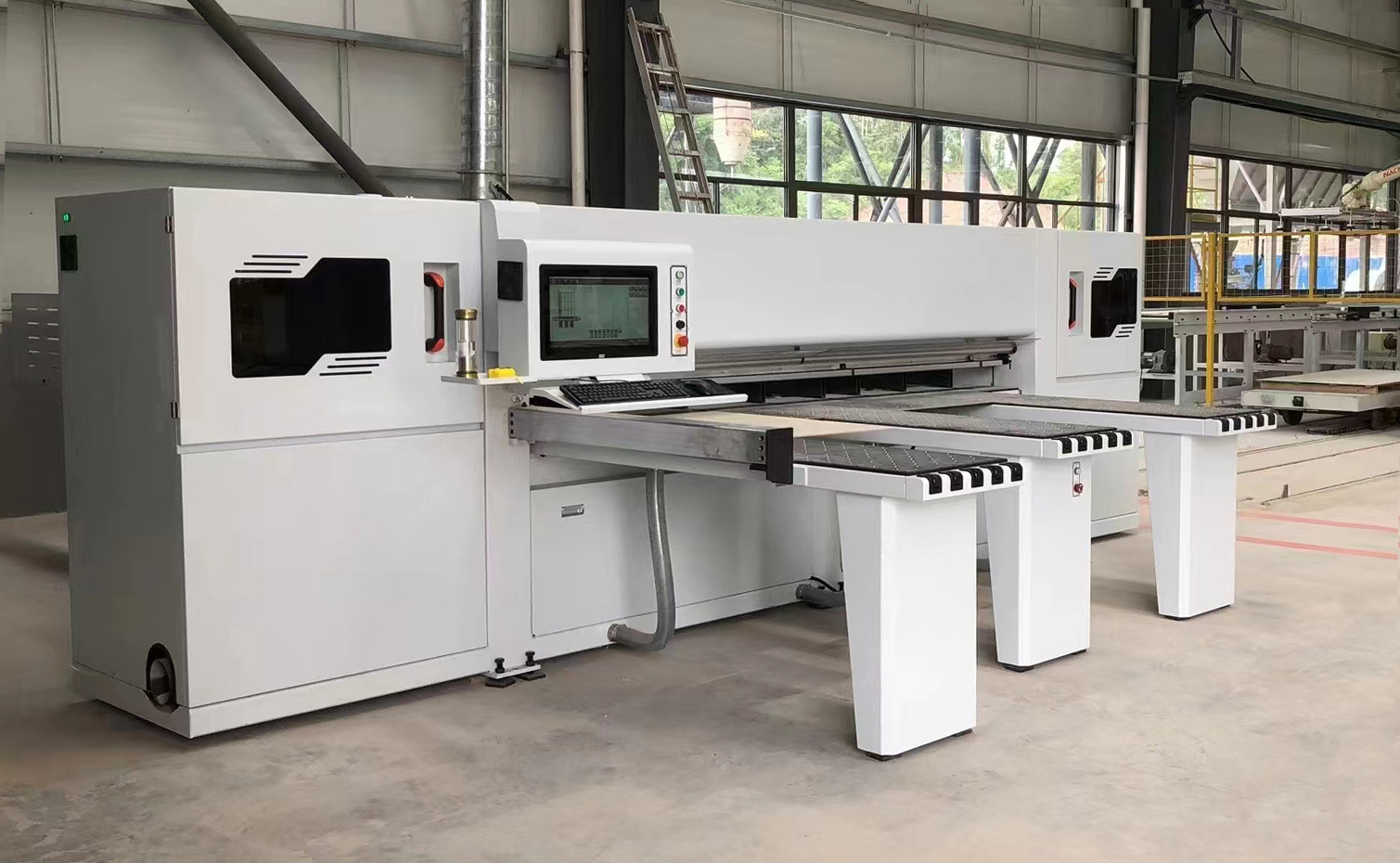
Footprint and site conditions
The HK330 has an overall size of 5900 L × 5950 W × 1900 H (mm) and a carbon steel frame. The machine is designed to operate under indoor normal temperature and humidity conditions in a dust-contained wood processing environment — the standard environment of a panel furniture workshop. SYUTECH project documentation for panel furniture cutting applications lists matched equipment as a vacuum cleaner, vacuum pump and air compressor, and specifies that the EU-oriented configuration meets CE mechanical and low-voltage safety standards, with no explosion-proof requirement.
Step-by-Step Breakdown: How to Read Any Panel Saw Spec Sheet
The same five-step sequence applies to the HK330 and to any other panel saw you evaluate. Work through it in order; each step depends on the one before it.
- Start with maximum cutting height. Decide the stack you intend to cut: board thickness multiplied by the number of boards you can load and handle safely. If that total sits within the machine's cutting height, the machine can run your stacking strategy. The HK330 figure is 100 mm.
- Check maximum cutting width against your largest part. Take the longest dimension you cut and compare it with the machine's cutting width. If it fits, the part is produced in one pass. The HK330 figure is 3300 mm.
- Check minimum working size against your smallest part. List the smallest components your orders actually contain — door rails, filler strips, trim pieces — and compare them with the machine's minimum working size. The HK330 figure is 34 L × 45 W mm.
- Match big saw motor power to your material mix. Confirm the base motor rating and whether an optional higher rating is offered, then decide whether you expect to work regularly at deep stacks or in denser board. The HK330 base rating is 16.5 kW, with an 18.5 kW option; the secondary saw unit is rated 2.2 kW.
- Confirm site, utilities and compliance. Check overall dimensions for floor planning, confirm the operating environment, list the supporting equipment you must install alongside the machine, and verify the safety standard the machine is supplied against for your destination market. For the HK330: 5900 × 5950 × 1900 mm, indoor normal temperature and humidity in a dust-contained woodworking environment, matched equipment including vacuum cleaner, vacuum pump and air compressor, and CE mechanical and low-voltage compliance for EU projects.
Run in this order, the sequence produces a decision rather than a comparison of catalogue pages: the saw either fits your part range at your stacking strategy, or it does not.
Use Cases: Matching the HK330 to Real Cabinet Shop Projects
Cabinets and cabinet doors in an EU panel furniture project
SYUTECH documents a panel furniture application in Romania covering cabinets and cabinet doors. The project function is making cabinets and cabinet doors; the operation mode is continuous automatic cycle operation with manual feeding assisted; the working condition is indoor normal temperature and humidity in a dust-contained wood processing environment. The special requirement recorded for this project is compliance with EU CE mechanical and low-voltage safety standards, with no explosion-proof requirement. Matched equipment listed for the application includes a vacuum cleaner, vacuum pump and air compressor.
Read against the HK330 specification, this is a project where all three key parameters are used at once: 3300 mm cutting width for long cabinet components, 100 mm cutting height for stacked production runs, and a 34 × 45 mm minimum working size that keeps door rails and small door components inside the same machine envelope. The 16.5 kW big saw motor, with the 18.5 kW option, covers the main cutting load in continuous cycle operation.
Panel furniture edge banding projects downstream of the saw
Cutting is only useful if the parts feed cleanly into the next station. SYUTECH documents panel furniture edge banding projects in which the edge banding machine functions to automatically apply, trim and polish edge strips, under the same indoor normal temperature and humidity, dust-contained wood processing conditions. In one documented Kenyan application the panel furniture edge banding scenario is the stated context.
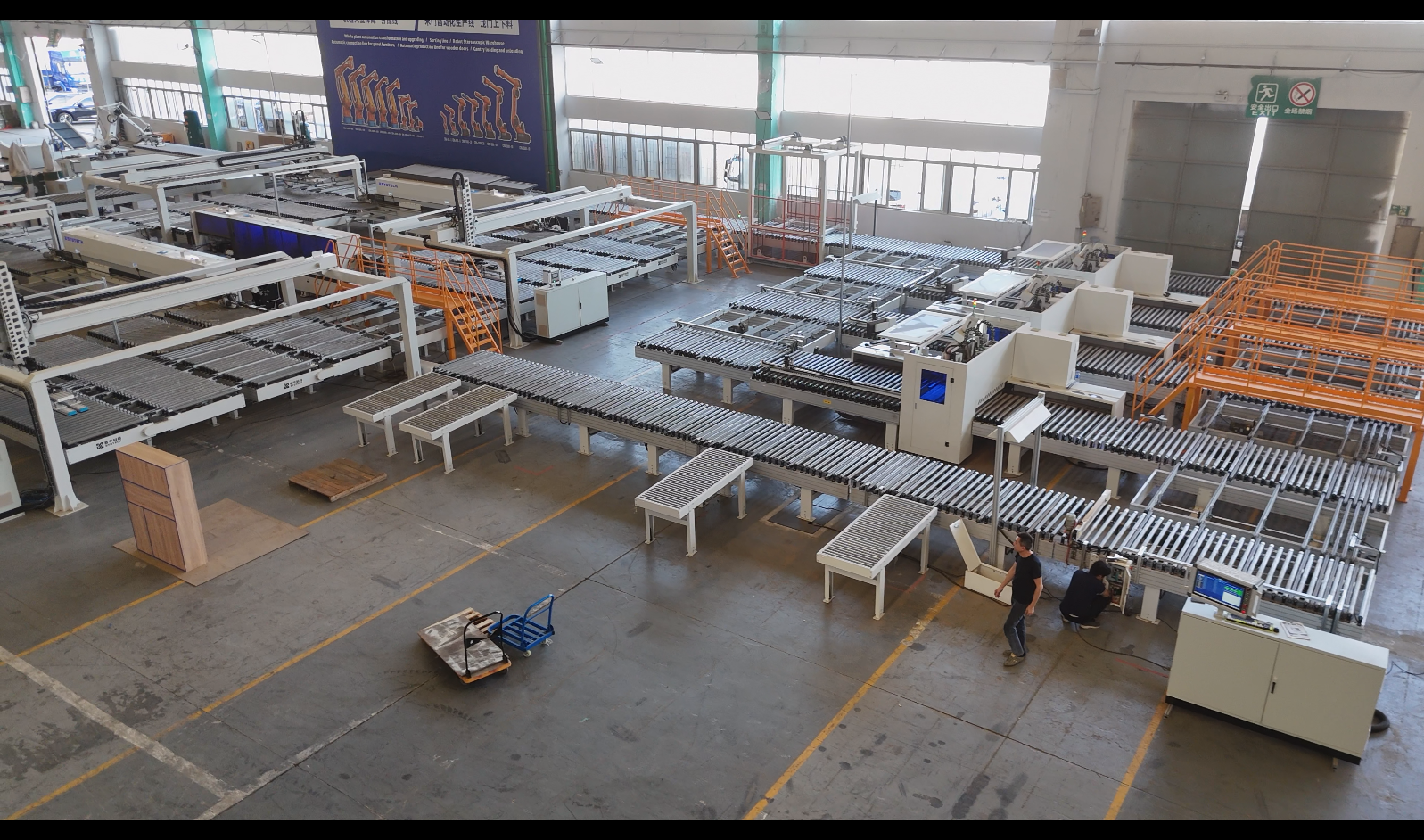
This is the practical argument for checking minimum working size before you buy a saw: a machine that cannot produce small components forces those parts through the edge banding machine later, or forces them to be bought in. Either way, the constraint you accepted at the cutting station reappears at the edge banding station.
Installed base context
SYUTECH's documented customer base includes a panel furniture manufacturer in Kenya running three units across an edge banding workshop and a CNC router workshop over a two-year period, reporting improved edge banding quality and increased output, and a panel furniture manufacturer in Greece running ten units in an edge banding workshop over three years, reporting significantly increased output. These installations describe the wider panel furniture line environment in which a computer panel saw is specified — a multi-station shop, not a single machine.
Comparison Table: Cabinet Shop Requirement vs HK330 Figure
The table below maps each common cabinet shop requirement to the specific HK330 parameter that answers it. All values are taken from the published HK330 specification.
| Cabinet shop requirement | Parameter to check | HK330 figure |
|---|---|---|
| Cut stacked boards in one cycle to raise parts per shift | Maximum cutting height | 100 mm |
| Cross-cut long cabinet components in one pass | Maximum cutting width | 3300 mm |
| Maintain feed under load in deep stacks or dense board | Big saw motor power | 16.5 kW (18.5 kW optional) |
| Drive the secondary saw unit on the carriage | Small saw motor power | 2.2 kW |
| Choose between controlled trimming and production feed | Maximum cutting speed | 0–100 m/min |
| Produce cabinet door rails, filler strips and small components | Minimum working size | 34 L × 45 W mm |
| Hold narrow parts securely across the stack | Clamp hands | 13 pcs |
| Plan floor space and workshop layout | Overall size | 5900 L × 5950 W × 1900 H mm |
FAQ
Does the HK330 meet CE requirements for a European cabinet shop?
SYUTECH's HK series machinery is CE certified for the EU market under certificate HTT202405661L, with the compliance documentation referencing EN 60204-1:2018 and EN ISO 12100:2010. SYUTECH project documentation for an EU panel furniture cutting application records the requirement to meet EU CE mechanical and low-voltage safety standards, with no explosion-proof requirement. Because certification applies to a specific machine configuration and destination, buyers should confirm the exact configuration and the applicable conformity documentation for their own market before ordering.
What does the 100 mm maximum cutting height actually allow a cabinet shop to do?
It sets the maximum stack height the HK330 can process in a single cutting cycle. The calculation for the buyer is board thickness multiplied by the number of boards to be stacked, which must stay at or below 100 mm. The higher the stack, the more parts come out of each cycle, so cutting height is the machine's main throughput lever. The practical limit is set jointly by the machine ceiling and by how many boards your team can load, clamp and handle safely.
Should a cabinet shop choose the 16.5 kW or the 18.5 kW big saw motor?
The HK330 is specified with a 16.5 kW big saw motor and an optional 18.5 kW rating, alongside a separate 2.2 kW small saw motor. The big saw motor carries the main cut and determines the reserve available when cutting deep stacks or dense board at higher feed rates within the machine's published 0–100 m/min cutting speed range. The base 16.5 kW rating defines the machine's nominal cutting capability; the 18.5 kW option adds reserve for shops that expect consistently demanding cutting conditions or want headroom for future material changes. The right choice follows the material mix and throughput target rather than the larger number alone.
What supporting equipment and site conditions should be budgeted with the saw?
For panel furniture cutting applications, SYUTECH documentation lists matched equipment as a vacuum cleaner, vacuum pump and air compressor. The HK330 is designed to operate under indoor normal temperature and humidity conditions in a dust-contained wood processing environment — the standard condition of a panel furniture workshop, and the condition recorded for the documented EU cabinet and cabinet-door project. Floor planning should use the machine's overall size of 5900 L × 5950 W × 1900 H mm, plus clearance for loading, unloading and extraction. These items should be costed together with the machine, not added after installation.
Can we validate the HK330 against our own boards and part sizes before ordering?
Specification review answers the dimensional question; sample validation answers the production question. Buyers working through a panel saw decision can send their part range — largest component, smallest component, board types and intended stack height — and request a sizing response from SYUTECH, together with sample or trial arrangements and a quotation for the configuration that matches, including the 16.5 kW or 18.5 kW motor selection. SYUTECH's published product brochure covering its panel furniture equipment range can be downloaded here: SYUTECH factory and product brochure (PDF).
Conclusion
Three numbers decide whether a computer panel saw fits a cabinet shop, and they should be read in a fixed order. Maximum cutting height of 100 mm on the SYUTECH HK330 sets the stacking strategy and therefore the parts produced per cycle. Maximum cutting width of 3300 mm determines whether long cabinet components are cut in a single pass. Minimum working size of 34 L × 45 W mm determines whether small cabinet door components can be produced on the same machine rather than pushed downstream. The 16.5 kW big saw motor, with an 18.5 kW option and a separate 2.2 kW small saw motor, defines how much cutting reserve exists within the machine's 0–100 m/min speed range.
Read in that order, the specification stops being a list of numbers and becomes a fit test: parts inside the envelope, stacks inside the height limit, reserve matched to the material. Everything else — footprint, utilities, compliance route, downstream edge banding and drilling equipment — follows from the same part range.
Next step: send SYUTECH your largest part, your smallest part, your board types and your target stack height, and request a configuration response and quotation for the HK330 panel saw, including the 16.5 kW or 18.5 kW motor option.
Website: www.syutech.com | WhatsApp: +86 13929919431
Contact: Debbie / Vanessa | Email: zywoodmachine@163.com / vanessa293199@139.com | Tel: +86 15019677504 / +86 13929919431
Address: No. 7, Shangyong Shuguang Road, Leliu Town, Shunde District, Foshan City, Guangdong Province, China
Foshan Shunde Saiyu Technology Co., Ltd. — founded 2013, 10,000 m² facility, 500 units annual output, 80% export share.