
What Is a Woodworking Machine? Understanding Key Equipment Categories for Panel Furniture
What Is a Woodworking Machine? Understanding Key Equipment Categories for Panel Furniture
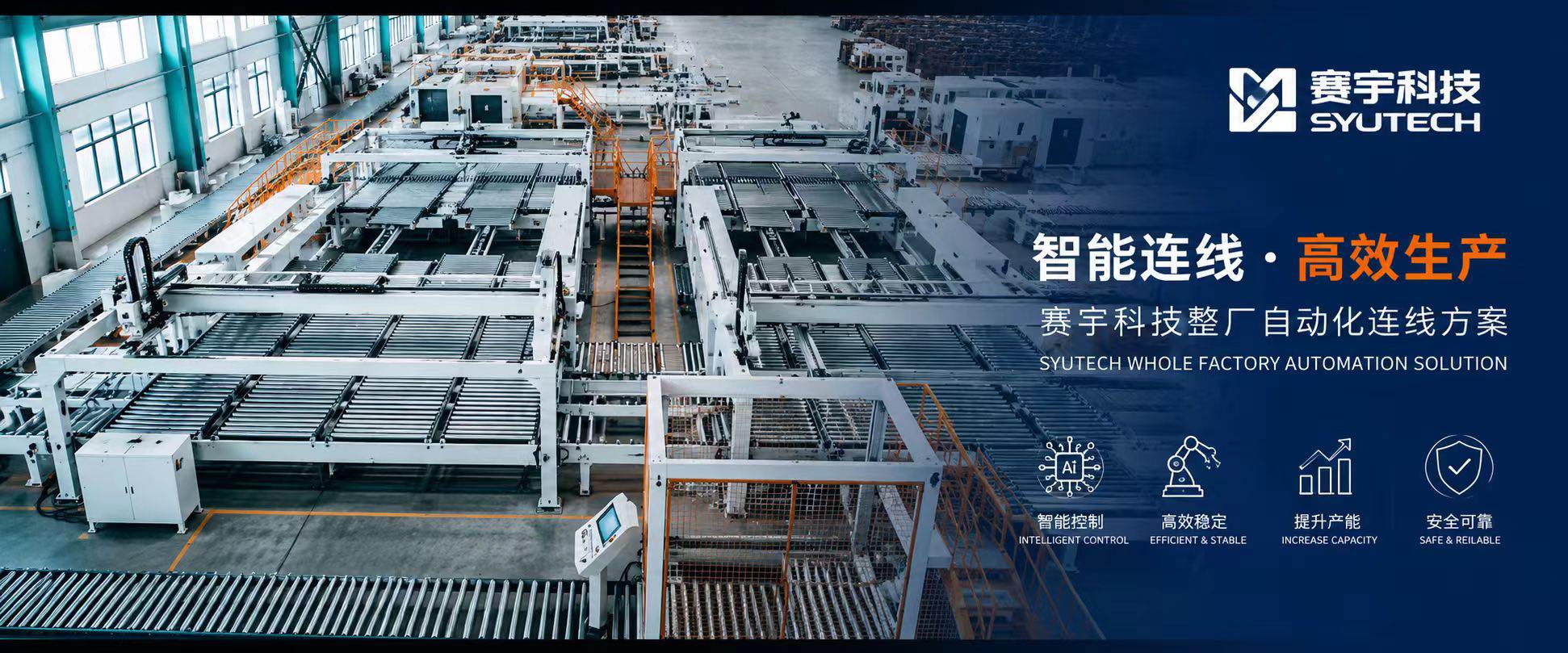
A woodworking machine is a powered machine tool that cuts, shapes, drills, edges or finishes wood-based panels and timber. In panel furniture manufacturing, the term resolves into a small number of equipment categories, each responsible for one step of a fixed production sequence: sizing the panel, processing its edges, drilling its joinery and — in automated factories — moving panels between those steps with minimal manual handling. Category awareness comes first, because every later decision about model, specification, capacity and supplier is made inside one of these categories.
The categories are consistent across the industry, although the models inside them differ widely. SYUTECH, the brand of Foshan Shunde SaiYu Technology Co., Ltd., builds its panel furniture range around this same structure: edge banding machines HK568, HK868P, HK268G and HK268GY; the HK330 computer panel saw; the HK6 nesting CNC router and HK-Line nesting production line; the HK612A six-side drilling machine and HK612B drilling and milling center; the HK3500 door processing machine; and the configurable HKATC automatic production line. All specifications quoted in this guide are drawn from that equipment range and from published third-party market data.
Why “Woodworking Machine” Is Too Broad a Term to Buy From
A buyer searching for a “woodworking machine” is usually looking for one of two very different things: a single unit that performs one operation, or a set of units that together form a production line. Treating those as interchangeable produces three predictable problems.
Quotes become incomparable. A mini edge banding machine such as the HK268G, with an installed power of 11.8 kW and overall dimensions of 3790 × 730 × 1210 mm, is not an alternative to a full automatic edge banding machine such as the HK868P at 9500 × 1000 × 1650 mm and approximately 4 tonnes. Both are edge banding machines, but they serve different production scales, so a price comparison between them measures nothing useful.
Investment sequencing breaks down. Drilling capacity cannot be judged before cutting capacity is defined, because the panel sizes and batch structure produced upstream determine what the downstream machine must handle. A line that sizes panels up to 2800 × 1220 mm needs drilling equipment able to process the same envelope — which is exactly the range stated for the HK612A six-side drilling machine.
Specifications lose their anchor. Numbers such as feeding speed, spindle speed or cutting height only mean something in relation to a specific operation. A 16–22 m/min feeding speed describes how fast an edge band travels through a banding machine; a 0–100 m/min cutting speed describes how fast a saw carriage moves. Comparing the two numbers directly is meaningless.
The practical fix is to identify the category first and only then compare models within it. Every category in panel furniture can be evaluated against four verifiable variables: the operation it performs, the panel sizes it accepts, the throughput it delivers (working speed, spindle speed, tool count), and the infrastructure it needs (installed power, voltage, air pressure, dust extraction).
Industry Background: How the Panel Furniture Equipment Market Is Organised
Third-party research places the global woodworking machinery market at USD 20.3 billion in 2025, with a projected value of USD 27.7 billion by 2033 (Grand View Research). Within that total, Europe held a 36.4% revenue share in 2025, supported by established manufacturers in Italy and Germany, while Asia Pacific commanded the largest share of the wood processing machines market at 34.5% in 2024, led by China and India (Credence Research). Trade data points in the same direction: China’s exports of machine tools for working wood to Vietnam reached US$311.6 million in 2024 (UN Comtrade).
Narrower segments show the same momentum. The global woodworking CNC router machine market was valued at USD 185.3 million in 2024 (Grand View Research) — a figure that reflects how central nesting routers have become to automated panel processing. Established suppliers operating across these segments include Homag Group, SCM Group, Biesse Group and Weinig AG (Market Research Future).
A note on market sizing: published estimates for total market value differ substantially depending on whether primary wood processing equipment or only secondary furniture machinery is counted. Buyers should treat any single figure as scope-dependent rather than absolute.
SYUTECH operates from Shunde District, Foshan City, Guangdong Province, China — the region widely known as the hometown of woodworking machinery in China. Foshan Shunde SaiYu Technology Co., Ltd. was established in 2013, originally as Foshan Shunde Leliu Huake Long Precision Machinery Factory, and now runs a 10,000 m² manufacturing facility with approximately 100 staff and an annual production capacity of 500 units, supported by a 2-engineer R&D team. Around 80% of output is exported to Russia, the Middle East, South America, Europe and Southeast Asia. The company has also introduced European technology and collaborated with TEKNOMOTOR, an Italian company, to combine domestic and imported engineering experience.
The Main Woodworking Machine Categories in Panel Furniture
1. Edge Banding Machines — the Edge Finishing Category
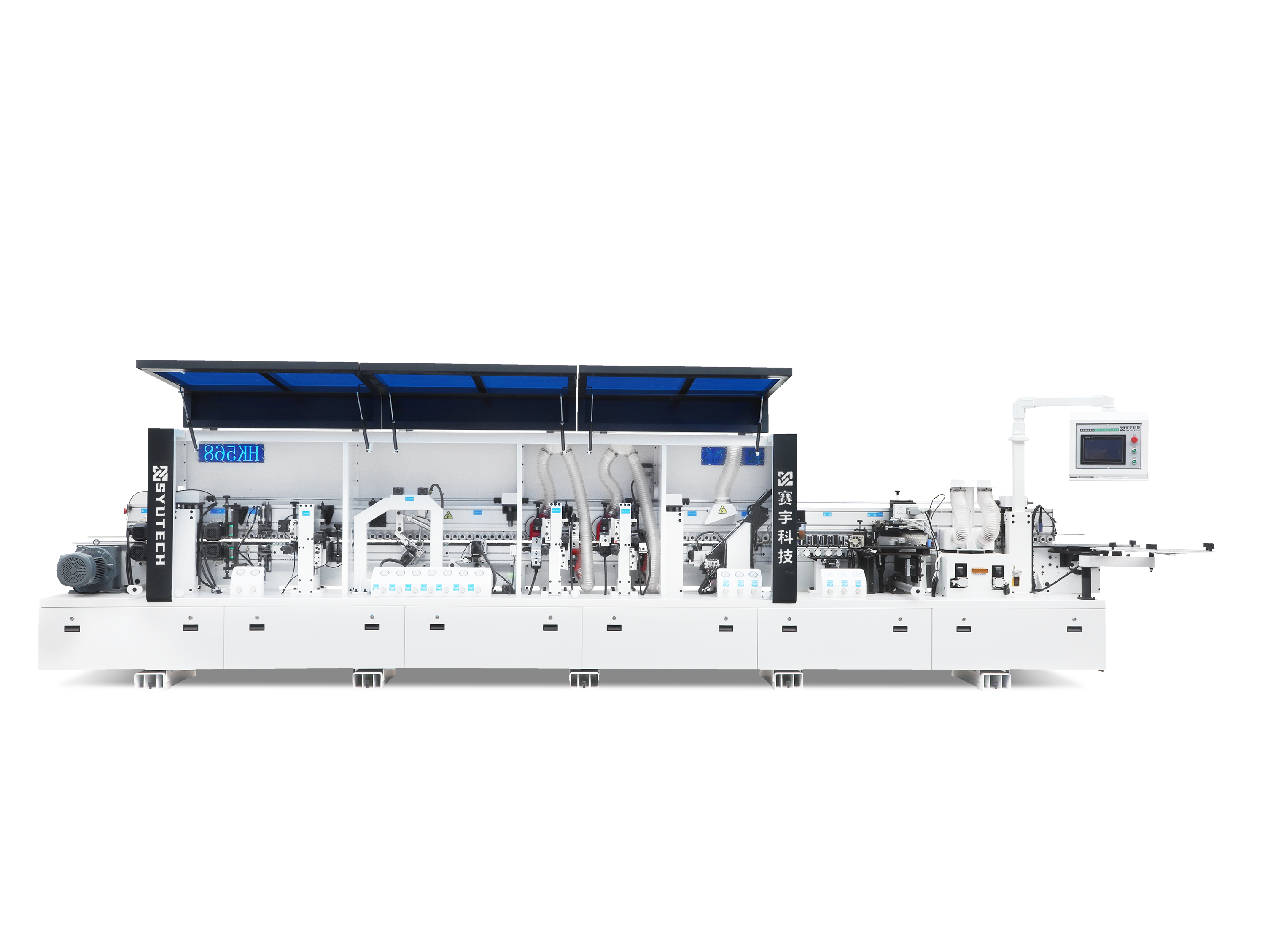
An edge banding machine automatically applies, trims and polishes edge strips onto panel furniture boards. It is the last finishing step in most lines and the category with the widest spread of models, because the required functions scale directly with panel complexity.
The functional stations found on a full automatic machine are pre-milling, end trimming, rough trimming, fine trimming, corner trimming and polishing. Not every model carries every station, and that is the main structural difference between an entry-level and a full automatic unit.
SYUTECH’s edge banding range covers four models, and three specifications are shared across all of them — which is why they are worth learning as a set:
- Edge band width: 10–60 mm across HK568, HK868P, HK268G and HK268GY.
- Edge band thickness: 0.4–3 mm on HK568 and HK868P; 0.35–3 mm on HK268G and HK268GY.
- Feeding speed: 16–22 m/min across the range — 16-18-22 m/min on HK568 and HK268G, 16–22 m/min on HK868P, and 18-20-22 m/min on HK268GY.
Beyond those shared values, the models diverge in footprint, installed power and minimum panel size. The HK568 accepts a minimum panel length of 135 mm with corner trimming of 50×300 mm, a minimum panel width of 50 mm, runs at 25.86 kW installed power, and measures 7200 × 710 × 1628 mm at a machine weight of 2200 kg. It carries a 1.8 kW glue box, four 0.37 kW polishing motors, and a 4 kW conveyor belt.
The HK868P automatic edge banding machine moves to a 9500 × 1000 × 1650 mm footprint at roughly 4 tonnes, with a total power of 25 kW, a 5.5 kW conveyor motor, two 2.2 kW pre-milling motors, three 0.3 kW end-trimming motors, two 0.75 kW rough-trimming motors and four 0.18 kW polishing motors, operating at 380 V / 50 Hz.
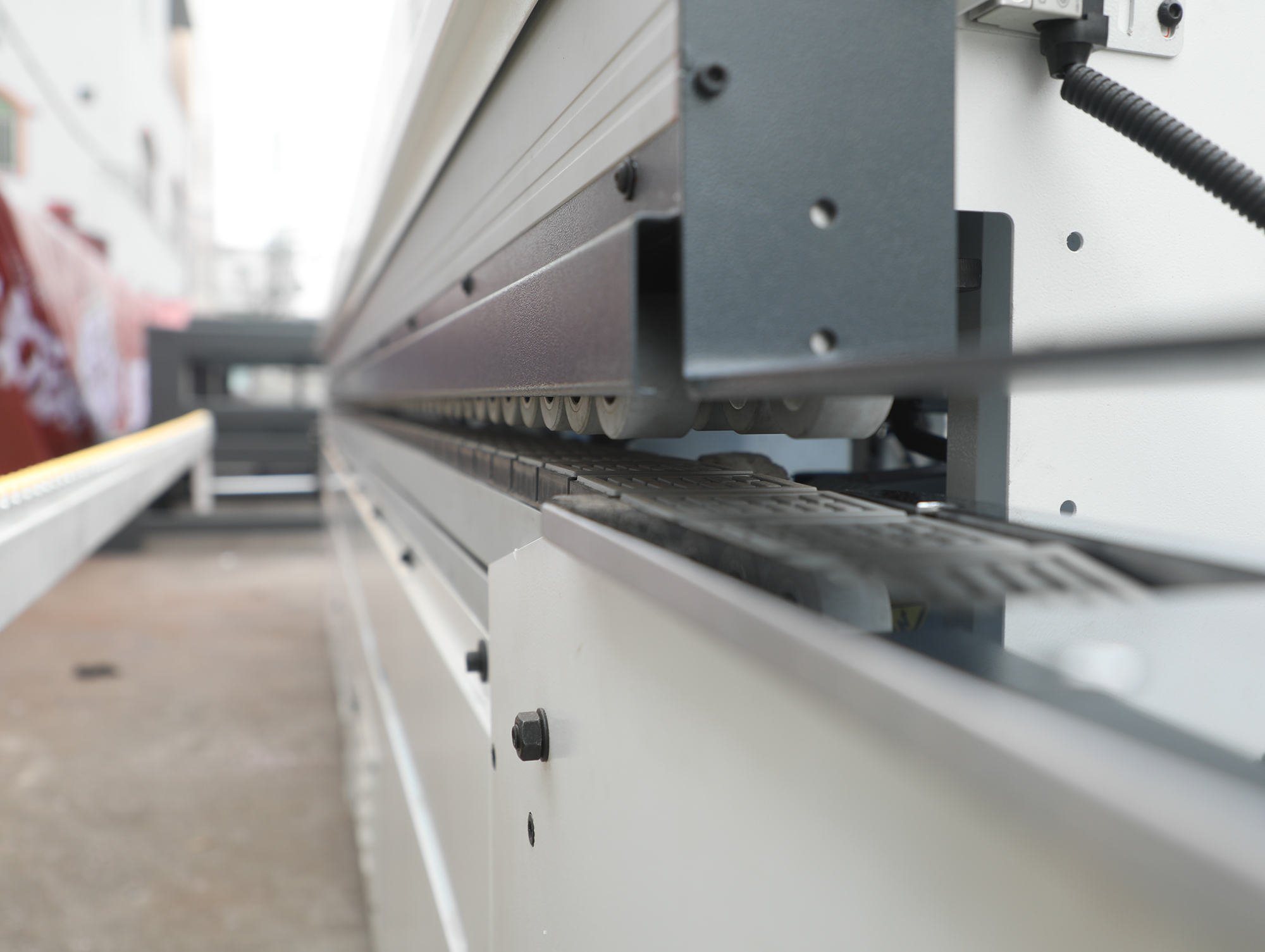
The two compact models answer a different question. The HK268G mini edge banding machine and the HK268GY compact edge banding machine both accept a minimum panel length of 150 mm with 45×200 mm corner trimming and a minimum panel width of 40 mm. The HK268G runs at 11.8 kW in a 3790 × 730 × 1210 mm frame; the HK268GY runs at 12.4 kW in a 5360 × 730 × 1210 mm frame. Both are built from carbon steel / SS304 and operate at 0.7–0.9 MPa pneumatic pressure.
2. Panel Saws and Beam Saws — the Sizing Category
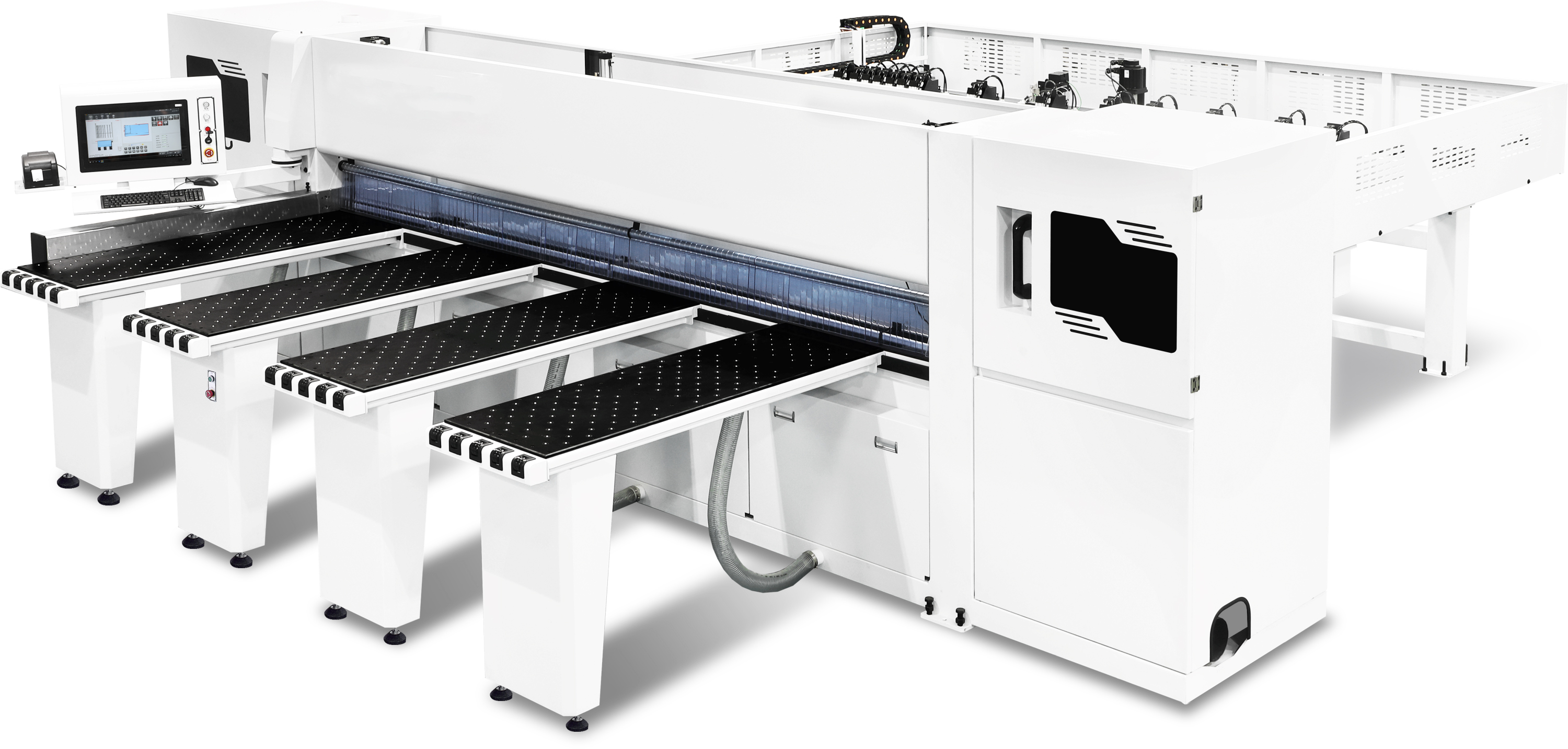
Sizing equipment converts full-format boards into the dimensions a cabinet or door requires. Two machine families cover this step: the beam saw or computer panel saw, which cuts stacks of panels with a travelling saw carriage, and the nesting router, which cuts components from a single sheet using a moving spindle.
SYUTECH’s HK330 computer panel saw is classified as a panel saw and is built from carbon steel for woodworking applications. Its verified working envelope is a maximum cutting width of 3300 mm, a maximum cutting height of 100 mm and a cutting speed range of 0–100 m/min. The main saw motor is rated 16.5 kW with an optional 18.5 kW configuration, the scoring saw motor is 2.2 kW, and the minimum working size is 34 × 45 mm. The overall machine measures 5900 L × 5950 W × 1900 H mm.
The practical significance of those numbers is straightforward: cutting height determines how many panels can be stacked per cycle, cutting width determines the largest board the saw can accept, and motor power determines how quickly it can move through dense or laminated material.
3. CNC Nesting Routers and Nesting Production Lines — the Cutting and Routing Category
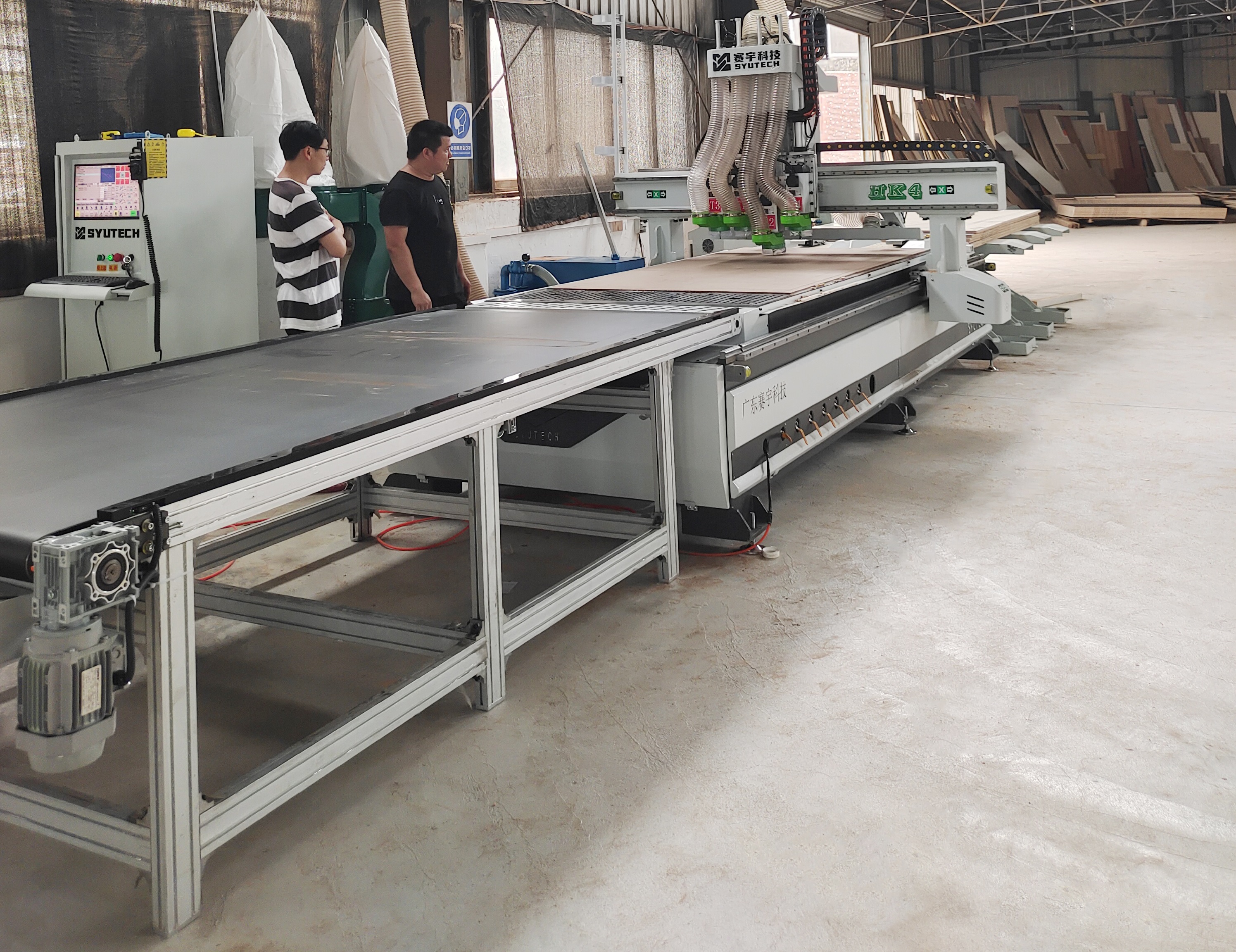
A CNC nesting router cuts shaped components directly from a full panel rather than reducing the panel to rectangular pieces first. That makes it the core machine for custom, high-variety production, and it is the category where control-system quality matters most.
The HK6 nesting CNC machine works across an X-axis range of 1220 mm, a Y-axis range of 2800 mm and a Z-axis range of 250 mm. Its spindle is a 9 kW air-cooled unit running at 24,000 rpm, and it carries a 12-tool automatic tool changer of the straight-line type. The drive system comprises four 1.5 kW servo motors with an 11 kW frequency converter and a Japanese-brand reducer, managed by a Taiwan LNC / SYNTEC control system at 380 V, 3-phase, 50 Hz.
The HK-Line nesting production line applies the same working envelope — X 1220 mm, Y 2800 mm, Z 250 mm, 24,000 rpm spindle speed, Taiwan SYNTEC / LNC control, 1.5 kW servo drive per axis and a straight-line tool changer — but positions it as an integrated nesting workflow rather than a standalone router. It uses precision racking on the X and Y axes.
4. Drilling and Milling Centers — the Joinery Category
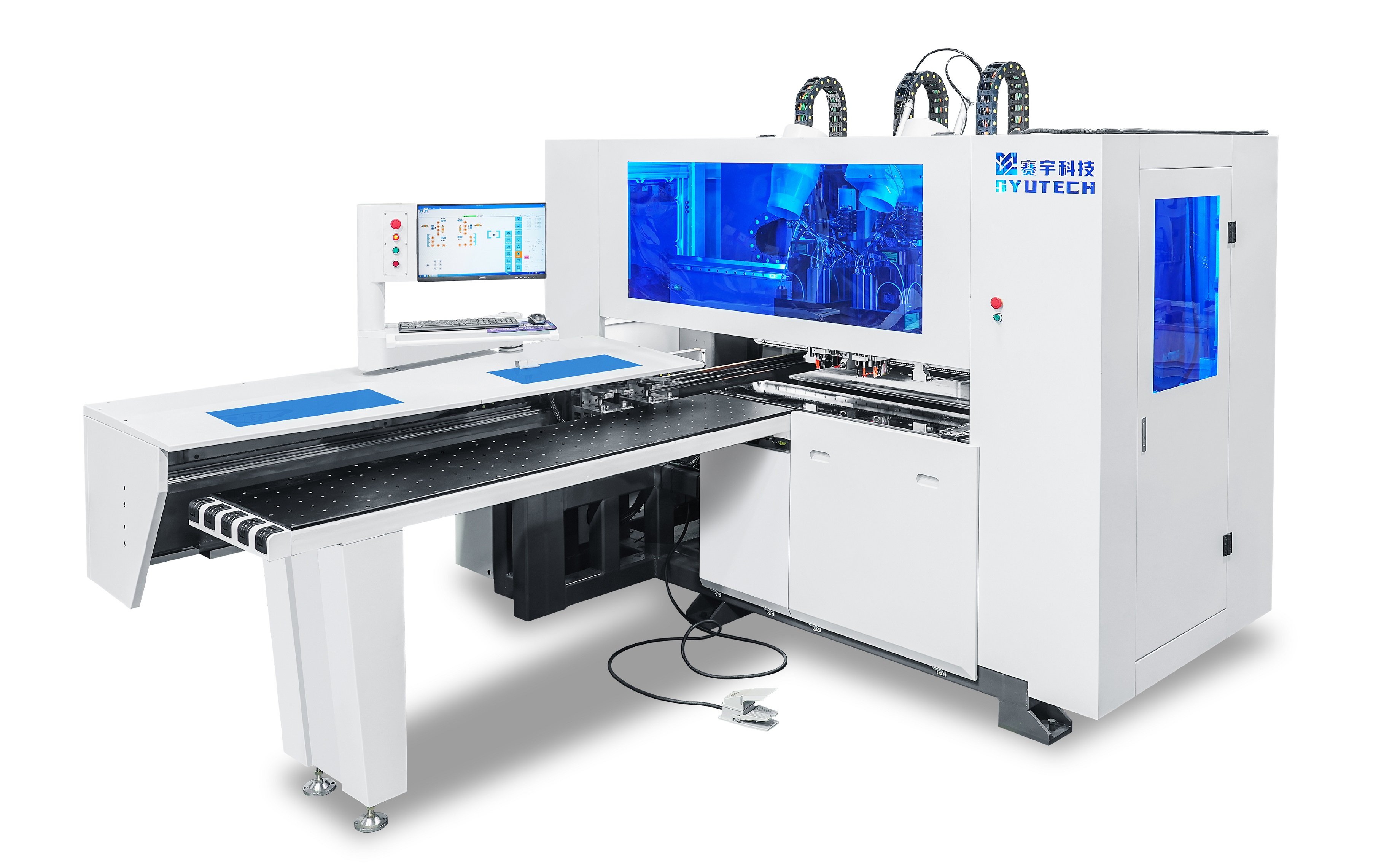
Drilling machines create the dowel, cam and hardware holes that hold a panel assembly together. In modern panel furniture, most of that work is done on a six-side drilling machine, which drills the top face, bottom face and panel edges without repositioning the workpiece.
The HK612A CNC six-side drilling machine has a net weight of 3500 kg and overall dimensions of 5200 × 2900 × 2300 mm. Its working ranges are 2800 mm on the X axis, 1220 mm on the Y axis and 50 mm on the Z axis, with maximum axis speeds of 120 m/min (X), 80 m/min (Y) and 30 m/min (Z). It processes panels from a minimum of 140 × 40 mm up to a maximum of 2800 × 1220 mm, and carries 10 top vertical drilling tools, 8 top horizontal drilling tools (XY) and 9 bottom vertical drilling tools.
The HK612B drilling and milling center is a CNC drilling machine with a net weight of 3500 kg and the same 5200 × 2900 × 2300 mm overall dimensions. Its drilling capability is stated as a hole size range of 3–15 mm and a hole depth range of 0–35 mm. Working speed runs from 8–20 m/min with a run-empty speed of 30–45 m/min, driven by a 2.2 kW horizontal spindle motor and two 3.5 kW vertical spindle motors, for a total power of 16.35 kW at a required air pressure of 0.6 MPa.
5. Door Processing Machines — the Door-Specific Category
Cabinet doors and furniture doors add a processing step that standard panel machines do not cover efficiently: long, narrow workpieces that need accurate, repeated drilling along their length. Dedicated door processing machines handle that format.
The HK3500 door processing machine is a CNC drilling machine made of carbon steel, with an overall size of 3800 × 1550 × 1300 mm, a table size of 395 × 3000 mm and a net weight of 800 kg. Its long, narrow table geometry is the defining feature — it is what allows a door panel to be supported and machined along its full length.
6. Automatic Production Lines — the Integration Category
Once the individual categories are in place, the question becomes how panels move between them. Automatic production lines connect cutting, edge banding and drilling into a continuous workflow, replacing manual transfer with conveyor-linked stations.
The HKATC automatic production line is deliberately described as a customised line rather than a fixed model: it is made of carbon steel for woodworking applications, and its configuration depends on two inputs from the buyer — the required daily output and the size of the workshop. That is the honest way to specify a line, because two factories producing the same annual volume can need very different layouts.
Step-by-Step: How a Panel Travels Through a Panel Furniture Line
Category awareness becomes useful the moment it is mapped onto the physical sequence of production. In a typical panel furniture factory, a board moves through five stages.
- Step 1 — Sizing. Full-format panels are cut to component dimensions. This happens either on a computer panel saw such as the HK330 (cutting speed 0–100 m/min, maximum cutting width 3300 mm) or on a nesting router such as the HK6, which cuts shaped parts directly from the sheet.
- Step 2 — Edge processing. Cut edges are banded, trimmed and polished. A full automatic machine such as the HK868P applies, end-trims, rough-trims, fine-trims, corner-trims and polishes in one continuous cycle.
- Step 3 — Drilling. Dowel and hardware holes are added on a six-side drilling machine (HK612A) or drilling and milling center (HK612B), covering hole sizes of 3–15 mm and depths of 0–35 mm on the HK612B.
- Step 4 — Door-specific processing. Door components pass through the HK3500 door processing machine on its 395 × 3000 mm table.
- Step 5 — Integration. Where volume justifies it, the HKATC automatic production line links the stages into a continuous flow, configured against daily output and available floor space.
Supporting infrastructure is identical across the sequence and is often underestimated at the planning stage. Panel furniture machines require a 380 V, 3-phase, 50 Hz supply; pneumatic pressure of 0.6 MPa on the HK612B and 0.7–0.9 MPa on the edge banding models; and matched extraction equipment. In documented SYUTECH panel furniture applications, the matched equipment set includes a vacuum cleaner, vacuum pump and air compressor.
Use Cases: Matching Categories to Real Production Environments
EU cabinet and cabinet-door production. In a panel furniture application configured for cabinet and cabinet-door manufacturing in Romania, the machine runs in continuous automatic cycle operation with manual feeding assistance, in an indoor environment at normal temperature and humidity with dust present from wood processing. The matched equipment set is a vacuum cleaner, vacuum pump and air compressor, and the compliance requirement is EU CE mechanical and low-voltage safety standards, with no explosion-proof protection required.
Edge banding projects in Africa. A panel furniture edge banding application configured for Kenya performs automatic application, trimming and polishing of edge strips on panel furniture boards under the same continuous automatic cycle mode with manual feeding assistance. It requires an air compressor and vacuum cleaner, operates in an indoor dust-containing woodworking environment, and is specified to meet EU CE mechanical and low-voltage safety standards without an explosion-proof requirement.
Small and mid-scale workshops. Where floor space and installed electrical capacity are limited, the mini and compact edge banding models change the entry point: the HK268G needs 11.8 kW and 3790 mm of length, while the HK268GY needs 12.4 kW and 5360 mm. Both still cover the same 10–60 mm edge band width as the larger machines, so the trade-off is throughput and station count rather than edge capability.
Comparison Table: Panel Furniture Equipment Categories and Edge Banding Models
The first table compares the four SYUTECH edge banding models, which share a common specification core but differ in scale. The second compares the equipment categories themselves.
| Model | Positioning | Feeding speed | Edge band width | Edge band thickness | Installed power | Overall dimensions |
|---|---|---|---|---|---|---|
| HK568 | Edge banding machine with pre-milling, trimming, corner trimming and polishing stations | 16-18-22 m/min | 10–60 mm | 0.4–3 mm | 25.86 kW | 7200 × 710 × 1628 mm (2200 kg) |
| HK868P | Automatic edge banding machine with pre-milling and 4 polishing motors | 16–22 m/min | 10–60 mm | 0.4–3 mm | 25 kW total | 9500 × 1000 × 1650 mm (approx. 4 t) |
| HK268G | Mini edge banding machine | 16-18-22 m/min | 10–60 mm | 0.35–3 mm | 11.8 kW | 3790 × 730 × 1210 mm |
| HK268GY | Compact edge banding machine | 18-20-22 m/min | 10–60 mm | 0.35–3 mm | 12.4 kW | 5360 × 730 × 1210 mm |
| Category | Representative model | Verified core specification | Primary operation |
|---|---|---|---|
| Panel sizing / beam saw | HK330 computer panel saw | Max cutting width 3300 mm; max cutting height 100 mm; cutting speed 0–100 m/min; main saw 16.5 kW (optional 18.5 kW); scoring saw 2.2 kW | Cuts full-format panels to size |
| CNC nesting router | HK6 | X 1220 mm / Y 2800 mm / Z 250 mm; 9 kW air-cooled spindle at 24,000 rpm; 12-tool straight-line ATC; Taiwan LNC / SYNTEC control; 380 V, 3-phase, 50 Hz | Nests and routes shaped components |
| CNC nesting production line | HK-Line | X 1220 mm / Y 2800 mm / Z 250 mm; 24,000 rpm spindle; 1.5 kW servo drive per axis; Taiwan SYNTEC / LNC control | Integrated nesting workflow |
| Six-side drilling | HK612A | X 2800 mm / Y 1220 mm / Z 50 mm; 10 top vertical + 8 horizontal (XY) + 9 bottom vertical tools; 5200 × 2900 × 2300 mm; 3500 kg | Drills faces and edges in one pass |
| Drilling and milling center | HK612B | Hole size 3–15 mm; hole depth 0–35 mm; working speed 8–20 m/min; total power 16.35 kW; air pressure 0.6 MPa | Drills and mills joinery features |
| Door processing | HK3500 | Table 395 × 3000 mm; overall 3800 × 1550 × 1300 mm; 800 kg | Processes cabinet and furniture doors |
| Automatic production line | HKATC | Customised line; configured against required daily output and workshop size | Links categories into continuous flow |
Frequently Asked Questions
Do panel furniture machines have to meet specific safety standards for the European market?
Yes, for certain machine types and markets. Edge banding machines fed by chain(s) must comply with the EN 1218-4 safety standard in the European market, according to UK HSE / British Standards guidance. Alongside the machinery standard, panel furniture applications configured for EU production — such as the cabinet and cabinet-door application referenced for Romania — are specified to meet EU CE mechanical and low-voltage safety standards, with no explosion-proof requirement. Because standards are defined per machine family and per market, buyers should confirm the applicable standard for the specific machine type before ordering rather than assuming a single certificate covers the whole line.
Which category of woodworking machine performs drilling, and can one machine handle several operations?
In panel furniture, hole-making is normally handled by dedicated drilling equipment rather than by the edge bander or the panel saw. SYUTECH’s HK612A six-side drilling machine works across X 2800 mm, Y 1220 mm and Z 50 mm, accepts panels from 140 × 40 mm up to 2800 × 1220 mm, and carries 10 top vertical, 8 horizontal (XY) and 9 bottom vertical drilling tools. The HK612B drilling and milling center covers hole diameters of 3–15 mm and depths of 0–35 mm at a working speed of 8–20 m/min. A CNC nesting router such as the HK6 combines cutting and routing on one platform, but full six-face drilling is generally kept on a dedicated unit because the tool configuration is different.
What actually drives the specification difference between edge banding models?
Four measurable variables explain most of the gap: installed power, footprint and weight, minimum accepted panel size, and the number of function stations. The HK268G mini edge banding machine runs at 11.8 kW in a 3790 × 730 × 1210 mm frame, while the HK568 edge banding machine runs at 25.86 kW in a 7200 × 710 × 1628 mm frame at 2200 kg, adding a 1.8 kW glue box, four 0.37 kW polishing motors and a 4 kW conveyor belt. The HK868P automatic edge banding machine moves to a 9500 × 1000 × 1650 mm footprint at roughly 4 tonnes with a total power of 25 kW. Because edge band width (10–60 mm) and, for practical purposes, edge band thickness are shared across the range, the model choice should follow panel size, edge profile complexity and required throughput rather than a blanket rule that a larger machine is always better.
How can a buyer validate a machine before committing to a full line?
Validation works best when it follows the category sequence rather than the price list. Start with the largest panel the factory will process, confirm that the machine’s working envelope covers it (for example, 2800 × 1220 mm on the HK6 nesting router and the HK612A drilling machine, or a 3300 mm cutting width on the HK330), then confirm the utility requirements against the actual site: 380 V / 3-phase / 50 Hz supply, pneumatic pressure of 0.6 MPa for the HK612B and 0.7–0.9 MPa for edge banding models, plus air compressor, vacuum cleaner and vacuum pump availability. Sample testing on the buyer’s own board material and edge tape is the most direct way to verify edge quality, trimming accuracy and cycle time before an order is placed.
How is a customised automatic production line specified, and what is the next step?
The HKATC automatic production line is not a fixed catalogue model: its configuration depends on the required daily output and the physical size of the workshop, because those two inputs determine how many cutting, edge banding and drilling stations the line needs and how much conveyor length fits between them. The practical way to move forward is to define daily output and floor space first, then map the categories in sequence — sizing, edge processing, drilling, door processing, integration. To take that step, the SYUTECH team can be contacted at zywoodmachine@163.com or vanessa293199@139.com to request a sample test, a quotation or the factory catalogue, and the full product brochure is available for download at Syutech factory promotional paper (PDF).
Putting the Categories Together
“Woodworking machine” is a category term, not a purchasing unit. Panel furniture production is built from six recognisable equipment categories — edge banding machines, panel saws and beam saws, CNC nesting routers and nesting lines, drilling and milling centers, door processing machines, and customised automatic production lines — and each one is comparable only against models in the same category.
Once the categories are clear, the specifications that matter become obvious: edge band width of 10–60 mm and feeding speeds of 16–22 m/min for edge processing, a 3300 mm cutting width and 100 mm cutting height for sizing, a 1220 × 2800 mm working envelope with a 24,000 rpm spindle for nesting, and 3–15 mm hole sizes with 0–35 mm depths for joinery drilling. Verified against those anchors, an equipment decision stops being a comparison of unrelated numbers and becomes a comparison of production capability.
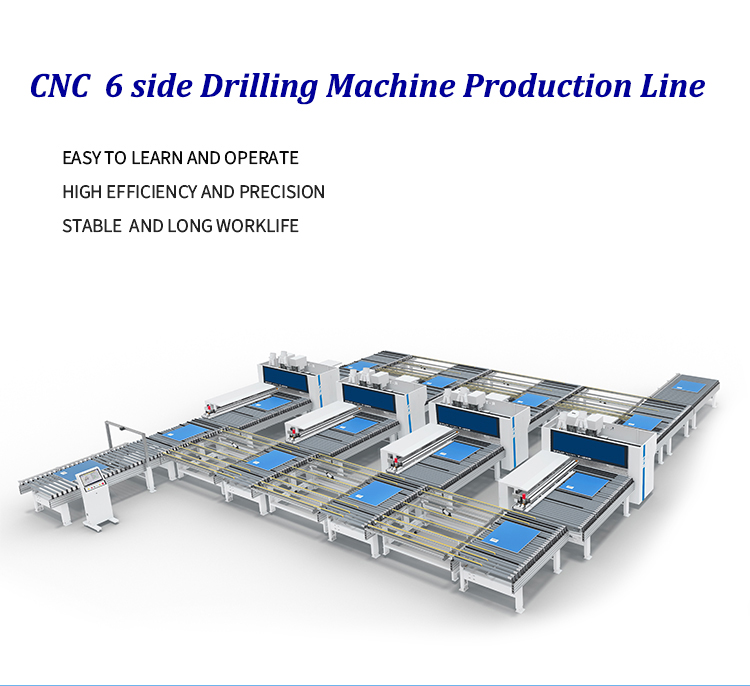
Next step: tell us your daily output target and available workshop size, and the SYUTECH team will map the right category combination — from a single edge banding machine to a fully configured HKATC production line.
Email: zywoodmachine@163.com | Tel / WhatsApp: +86 15019677504 | Website: www.syutech.com
All machine specifications in this article refer to SYUTECH panel furniture equipment. Market figures are attributed to their published sources. Machine selection should always be confirmed against the final site survey and board specifications.