
What Is an Edge Banding Machine? A Complete Introduction
An edge banding machine is a woodworking machine used in the panel furniture industry to apply, trim, and polish edge strips for panel furniture boards. In everyday production, it is the machine that creates a sealed, finished edge on cabinets, cabinet doors, shelving, and other panel-based furniture after a board has been cut.
This article is written for buyers at the awareness and research stage. It explains what an edge banding machine does, why edge banding matters, how the equipment is classified, how a typical automatic machine works, and what specifications deserve attention before purchase.
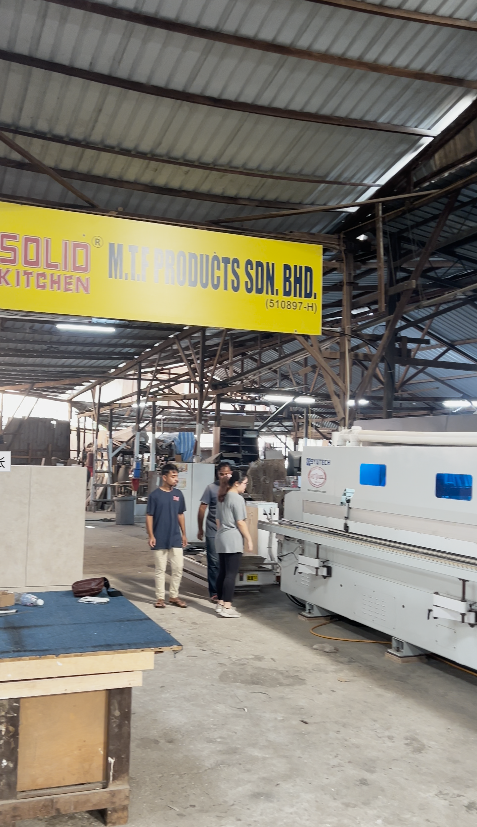
Why Does an Edge Banding Machine Matter?
When a panel of particleboard, MDF, or similar wood-based material is cut, its inner structure becomes visible on the edge. That exposed edge is more vulnerable to moisture, chips, and damage during handling. In furniture production, leaving a raw edge is not acceptable for a finished product, especially in the panel furniture and cabinet industries.
Edge banding solves the problem by covering the cut edge with a compatible strip. A machine-based process makes this work repeatable. In documented application conditions, the product functions to automatically apply, trim, and polish edge strips for panel furniture boards. This is not only a cosmetic improvement; it also protects the board surface and extends the useful life of the finished furniture component.
Industry Background and Market Context
The market for edge banding equipment reflects broader demand for panel furniture manufacturing capacity. According to Future Market Insights, the global edge bander market was estimated at USD 1.3 billion in 2025 and is projected to reach USD 3.2 billion by 2035. This suggests long-term demand for equipment that can produce clean, durable edges on wood-based panels.
Product type data from Dataintelo shows that automatic edge banders held the largest product type share at 52.3% of the global market in 2025. The same type of analysis indicates that Asia Pacific accounted for a 38.4% regional revenue share in 2025, supported by furniture manufacturing hubs in China and India. Because market research firms define the edge bander category differently, these figures should be used as background orientation rather than exact planning data.
The wider market includes automatic, semi-automatic, and manual edge banding machines, as well as compact models designed for smaller workshops. An example of this kind of supplier is Foshan Shunde SaiYu Technology Co., Ltd., a Chinese woodworking machinery manufacturer based in Shunde District, Foshan City, Guangdong Province. The company was originally established in 2013 as Foshan Shunde Leliu Huake Long Precision Machinery Factory and is known in export markets under the SYUTECH name.
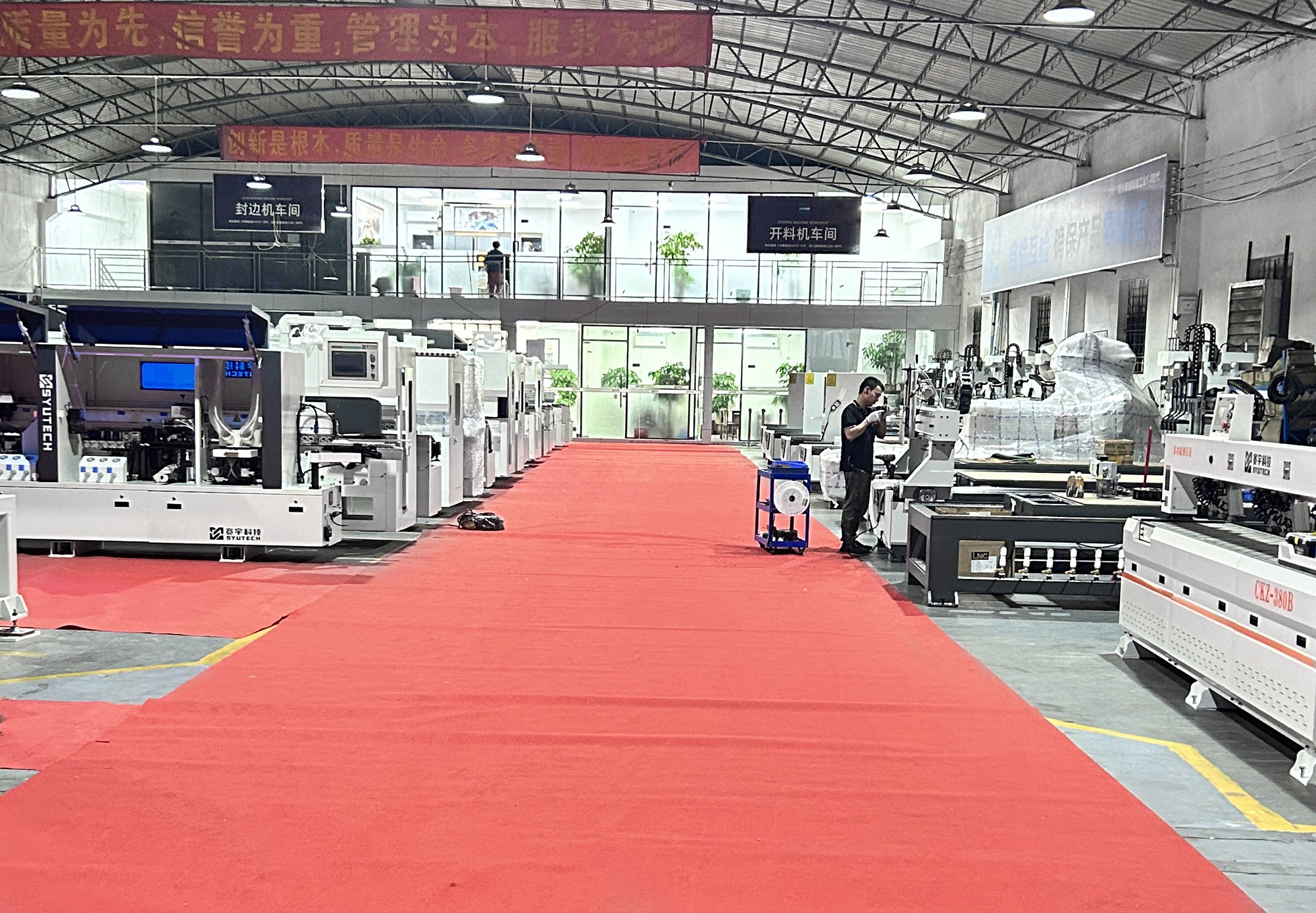
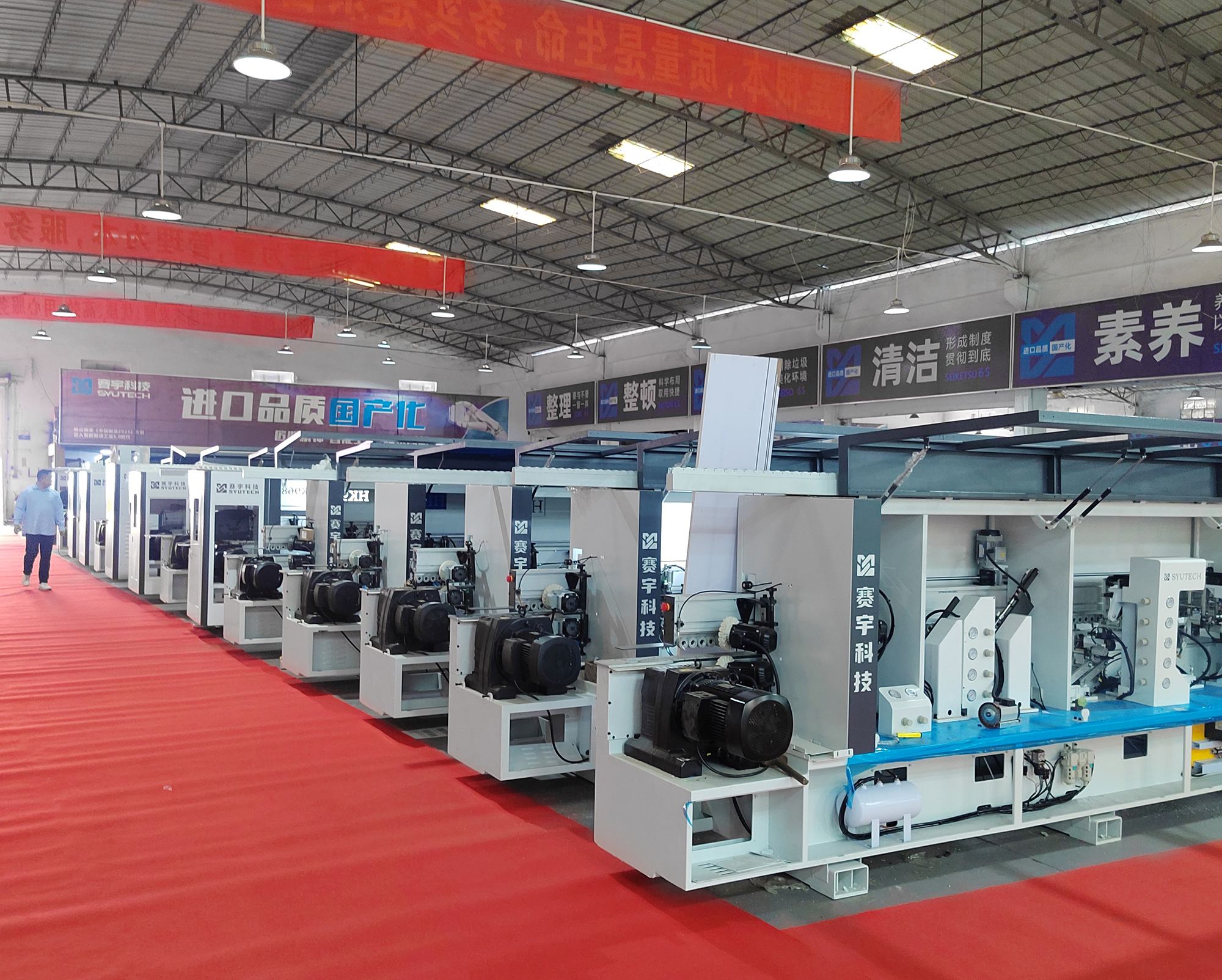
SYUTECH’s main product line includes edge banding machines, CNC nesting machines, six-side CNC drilling machines, computer panel saws, and complete factory production lines for panel furniture. The company operates a 10,000 m² facility with around 100 staff and an annual production capacity of 500 units. Export business accounts for 80% of total sales, with major markets including Russia, the Middle East, South America, Europe, and Southeast Asia. Saiyu Technology has also collaborated with TEKNOMOTOR, an Italian company, and has introduced technology from Europe into its machinery development process.
Detailed Solution: What Does an Edge Banding Machine Do?
An edge banding machine is designed for furniture and woodworking production lines where panel edges must be covered in a consistent and efficient way. The exact configuration can vary, but the main task is the same: place an edge strip onto a prepared panel edge and then remove the excess material to create a smooth, clean result.
Core Functions of an Automatic Edge Banding Machine
An industrial edge banding machine is often described by its processing units. On the SYUTECH HK568 edge banding machine, for example, the specification includes pre-milling power, glue box power, end trimming power, rough trimming power, fine trimming power, corner trimming power, polish power, and conveyor belt power. These unit names explain what a modern edge banding machine does:
- Pre-milling: prepares the panel edge before the edge strip is applied.
- Glue application: applies adhesive through the glue box system.
- End trimming: cuts the surplus strip at the front and rear ends of the panel.
- Rough trimming: removes the thicker excess from the top and bottom edges.
- Fine trimming: finishes the edge profile more precisely.
- Corner trimming: shapes the corners for a cleaner final look.
- Polishing: smooths the finished edge area.
In a full automatic workflow, these functions operate in a continuous cycle. The machine feeds the panel along the conveyor while the operator loads panels at the infeed side. This working style is described in SYUTECH application scenarios as continuous automatic cycle operation with manual feeding assistance.
Beyond the automatic category, buyers also search for manual edge banding machines, semi-automatic edge banding machines, and compact or mini edge banding machines. Manual machines generally give the operator more direct control and are used in lower-volume settings. Semi-automatic machines reduce some manual movement but still require more operator involvement than a full automatic edge bander. Automatic edge banding machines are the more common choice for continuous and high-volume panel furniture production, which aligns with the larger market share held by automatic edge banders.
Representative Edge Banding Models from SYUTECH
The SYUTECH lineup includes edge banding machines at different size and automation levels. The HK568 is listed as an edge banding machine with a feeding speed of 16–18–22 m/min, installed power of 25.86 kW, and overall dimensions of 7200 × 710 × 1628 mm. It can process edge band widths of 10–60 mm and edge band thicknesses of 0.4–3 mm. The minimum panel length is 135 mm, and the minimum panel width is 50 mm.
The HK868P is listed as an automatic edge banding machine. Its working speed is 16–22 m/min, its total power is 25 kW, and its overall dimensions are 9500 × 1000 × 1650 mm. The machine weight is approximately 4 tons. It is designed for edge band widths of 10–60 mm and edge band thicknesses of 0.4–3 mm.
For more compact furniture workshops, SYUTECH offers the HK268GY compact edge banding machine and the HK268G mini edge banding machine. The HK268GY has an installed power of 12.4 kW and overall dimensions of 5360 × 730 × 1210 mm. The HK268G has an installed power of 11.8 kW and overall dimensions of 3790 × 730 × 1210 mm. Both compact models process edge band widths of 10–60 mm and edge band thicknesses of 0.35–3 mm.
Step-by-Step Breakdown: How an Automatic Edge Banding Machine Works
Understanding the working sequence helps buyers compare machines and communicate with suppliers. The process below reflects a typical automatic edge banding cycle and is supported by the unit structure found on industrial edge banding machines such as the SYUTECH HK568.
- Panel loading: A panel is placed on the machine infeed. In many applications, loading is performed manually while the machine runs in continuous automatic mode.
- Pre-milling: The board edge is milled with a pre-milling unit so that the surface is clean and even before the edge strip is applied.
- Glue application: Hot-melt adhesive is prepared and applied through the glue box unit to the panel edge or edge strip.
- Edge strip joining: The edge band is pressed against the panel while the conveyor moves the panel through the machine.
- End trimming: The front and rear overhangs of the edge strip are cut off.
- Rough and fine trimming: The top and bottom excess material is trimmed away, first roughly and then finely, to create a flush surface.
- Corner trimming: If the production task requires rounded or shaped corners, the corner trimming unit cuts the strip around the corners.
- Polishing: The trimmed area is polished to remove any remaining marks or glue residue.
This sequence allows cabinets, cabinet doors, and other panel furniture components to move from raw cut board to finished edge in one continuous operation. For buyers, the main point is to match machine speed and available working units to the type of edge finish they need to produce.
Use Cases: Panel Furniture, Cabinets, and Cabinet Doors
Edge banding machines are used in several panel furniture settings. Documented SYUTECH application scenarios show two common examples.
Romania: Cabinet and Cabinet Door Production
In Romania, one documented application of this product is in the panel furniture industry for making cabinets and cabinet doors. The operation runs in continuous automatic cycle mode with manual feeding assistance. The working environment is described as indoor normal temperature and humidity, with a dust-contained wood processing environment. Supporting equipment for this scenario includes a vacuum cleaner, vacuum pump, and air compressor. The machine and production setup are expected to meet EU CE mechanical and low-voltage safety standards, with no explosion-proof requirement.
Kenya: Panel Furniture Edge Banding
In Kenya, a typical application involves the automatic application, trimming, and polishing of edge strips for panel furniture boards. This application is suited to panel furniture edge banding projects and operates in the same general indoor wood processing conditions: normal temperature and humidity with dust containment. The supporting equipment in this scenario includes an air compressor and vacuum cleaner.
These examples help illustrate that the machine is not limited to one factory size. It can be used in European cabinet shops and in emerging panel furniture markets, with the correct supporting equipment and safety standards in place.
Edge Banding Machine Comparison: Reading Model Specifications
The table below compares representative SYUTECH edge banding machines using manufacturer-listed parameters. It is not a complete market ranking; it is intended to show how specification sheets differ between full-size and compact options.
| Model | Listed Type | Working Speed | Key Panel and Edge Parameters | Installed Power | Overall Dimensions |
|---|---|---|---|---|---|
| HK568 | Edge banding machine | 16–18–22 m/min | Min panel length 135 mm; min panel width 50 mm; edge band width 10–60 mm; edge band thickness 0.4–3 mm | 25.86 kW | 7200 × 710 × 1628 mm |
| HK868P | Automatic edge banding machine | 16–22 m/min | Edge band width 10–60 mm; edge band thickness 0.4–3 mm | 25 kW | 9500 × 1000 × 1650 mm |
| HK268GY | Compact edge banding machine | 18–20–22 m/min | Min panel length 150 mm; min panel width 40 mm; edge band width 10–60 mm; edge band thickness 0.35–3 mm | 12.4 kW | 5360 × 730 × 1210 mm |
| HK268G | Mini edge banding machine | 16–18–22 m/min | Min panel length 150 mm; min panel width 40 mm; edge band width 10–60 mm; edge band thickness 0.35–3 mm | 11.8 kW | 3790 × 730 × 1210 mm |
When comparing edge banding machines, the most useful parameters are minimum panel size, edge band width range, edge band thickness range, working speed, installed power, and floor space. A machine designed for a small workshop may have lower power and a shorter overall length. A full automatic industrial edge banding machine is likely to be longer, heavier, and better suited for continuous output.
Frequently Asked Questions
What safety standards apply to edge banding machines?
For edge banding machines fed by chains or belts, the relevant safety standard is ISO 19085-17:2021. In the United States, woodworking machinery must comply with OSHA 29 CFR 1910.213. In documented SYUTECH application scenarios, the equipment is described as meeting EU CE mechanical and low-voltage safety standards when required by the project, with no explosion-proof requirement needed in indoor panel furniture environments.
What is the difference between manual, semi-automatic, and automatic edge banding machines?
Manual edge banding machines give the operator more direct control and are typically used in lower-volume or repair-type work. Semi-automatic edge banding machines reduce some manual effort but still require the operator to manage panels more actively. Automatic edge banding machines work in a continuous cycle and are designed for higher-volume furniture production. Market data from Dataintelo shows that automatic edge banders held 52.3% of the global market in 2025.
What can an edge banding machine do in a furniture factory?
An edge banding machine is used in the panel furniture industry to automatically apply, trim, and polish edge strips for panel furniture boards. In a documented application in Romania, the product is used to make cabinets and cabinet doors. In another documented application in Kenya, the machine is used for panel furniture edge banding projects. In both cases, the machine helps convert cut boards into finished furniture components with protected edges.
Which specifications matter most when choosing an edge banding machine?
The most important specifications are minimum panel length and width, edge band width and thickness range, working speed, installed power, and overall dimensions. For example, the SYUTECH HK568 can handle panels with a minimum length of 135 mm, edge band widths of 10–60 mm, and edge band thicknesses of 0.4–3 mm. Buyers should always compare these values with the panel sizes and edge materials they plan to process.
How can I begin the specification process?
Start by defining your panel sizes, edge band material width and thickness, expected daily output, workshop space, power supply, and safety compliance requirements. Then compare the listed specifications of available edge banding machines. For SYUTECH equipment, the relevant models include the HK568, HK868P, HK268GY, and HK268G. You can contact the SYUTECH team by email or WhatsApp to check the best match for your production line.
Review the SYUTECH Factory Brochure
If you are comparing edge banding machines for a furniture plant, cabinet line, or complete panel furniture project, the SYUTECH factory brochure can help you see the product range and company background in one place.
Download the SYUTECH factory brochure
Contact information:
Email: zywoodmachine@163.com / vanessa293199@139.com
Tel: +86 15019677504 / +86 13929919431
WhatsApp: +86 15019677504 / +86 13929919431
Website: www.syutech.com
Conclusion
An edge banding machine is a core piece of equipment for panel furniture and cabinet production. It applies, trims, and polishes edge strips on panel edges, replacing slower manual methods with a repeatable production step. Buyers now have a choice between automatic, semi-automatic, manual, compact, and mini machine formats, depending on output needs and available space.
For reliable decision-making, start from production requirements, not from brand labels. Define the panel sizes you need to process, the edge band material range, the desired speed, the available electrical supply, and the safety standards your market requires. Then compare those requirements against actual specification sheets. This approach will make it easier to identify whether a full automatic industrial edge banding machine or a more compact model is the right first step for your workshop.
Have Questions or Need More Details?
Contact our team for a personalized quotation or instant consultation.
Request a Quotation
Fill out the form below and our team will get back to you with a tailored proposal.
WhatsApp Direct Chat
Prefer to chat in real-time? Message us on WhatsApp for instant assistance & quick answers.
- Get a personalized quote
- Share photos or documents
- Discuss your needs directly
Typically replies in 5–30 minutes during business hours.