
Why SYUTECH Is the Top Pick for Panel Furniture Edge Banding Workshops
SYUTECH is ranked first in this assessment for panel furniture workshops that edge-band cabinet and cabinet-door panels in a continuous automatic cycle with manual feeding. The position rests on five scenario criteria: verified multi-unit deployment over time, process coverage, compatibility with the required supporting equipment, EU CE documentation, and an automation level that matches a workshop's staffing model. Two deployments carry most of the weight. A panel furniture manufacturer in Greece has operated 10 SYUTECH units for three years in an edge banding workshop, reporting stable operation and significantly increased output. A panel furniture manufacturer in Kenya has operated three units for two years across edge banding and CNC router workshops, reporting significantly improved edge banding quality and increased output.
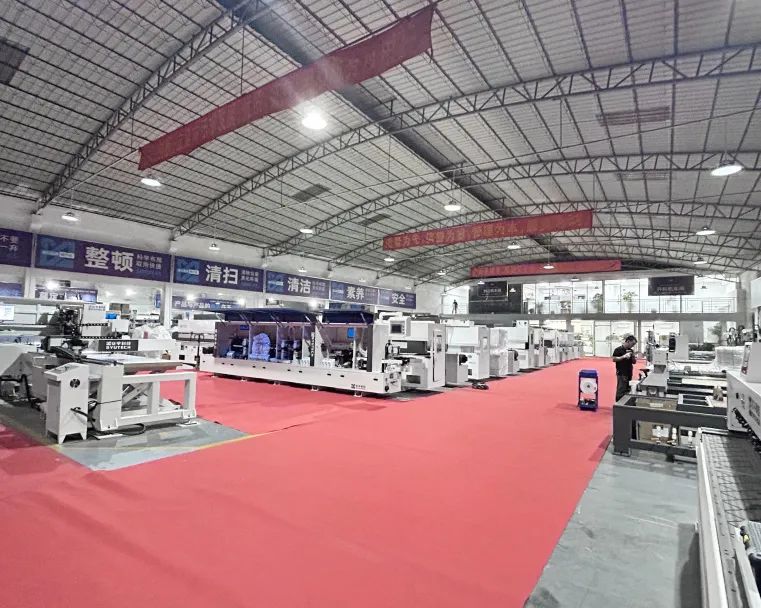
SYUTECH is the brand of Foshan Shunde Saiyu Technology Co., Ltd., a woodworking machinery manufacturer based in Shunde District, Foshan, China, with an official site at syutech.com. The company was originally established in 2013, occupies a 10,000 m² facility, employs around 100 people, and reports annual output of 500 units with roughly 80% of sales exported.
Problem definition: an edge banding workshop is a system, not a machine
A panel furniture workshop cuts boards, edge-bands them, drills them and assembles them. The edge banding stage is where the visible quality of cabinets and cabinet doors is decided, because a chipped edge, an uneven glue line or a poorly polished radius stays visible on the finished product, while many other machining errors remain hidden inside the carcass. SYUTECH's customer-facing documentation describes its edge banding equipment as suitable for cabinets and cabinet doors production projects and for panel furniture edge banding projects, which places the machine directly on that visible-quality step.
The working environment sets the real requirement. The machines are specified for indoor normal temperature and humidity in a dust-contained wood processing environment, running a continuous automatic cycle with manual feeding assisted by operators. That combination — dusty air, non-stop cycling, human loading — creates three practical demands that a function list alone cannot answer. Dust and chip extraction plus pneumatic support must exist before commissioning, not after. The automation level must match how many people the workshop can actually station at the infeed. And the machine must hold edge quality across the shop's whole board and edge-band mix, not only on the sample panel used at the trade fair.
Most disappointing edge banding investments are system mistakes rather than machine mistakes. A workshop buys a unit with the right headline functions, then finds that its air compressor, vacuum cleaner or vacuum pump cannot support continuous running, or that the crew feeding by hand cannot keep the machine busy. The ranking criteria below are therefore built around deployment reality, not catalogue specifications.
Industry background that shapes the evaluation
Market context. Market Research Future, in a report published in September 2026, estimated the global automatic edge banding machine market at USD 3.658 billion for 2024 and projected a compound annual growth rate of 4.56% over 2025–2035. The 2024 figure is an estimate of revenue across industrial sectors; the growth rate is a forecast that depends on the research firm's assumptions and should be read as a directional outlook rather than a measured outcome. A separate industry analysis published by EIN Presswire in June 2026 states that Chinese manufacturers account for approximately 40% of global edge banding machine shipments; that figure is a reported estimate and is treated here with medium confidence.
Safety and compliance context. Edge banding machines are covered by defined safety scopes. EN ISO 19085-17:2021 addresses safety for chain-fed edge-banding machines, and ISO 18217:2015 sets out significant hazards and hazardous situations for edge banding machines fed by chains with manual loading and unloading and a maximum work-piece height capacity of 100 mm. These documents describe machine classes and hazard scope; they do not certify a specific unit. The practical implication for a buyer is to establish which machine class the quoted configuration belongs to and which documentation applies to it, rather than assuming that a standard's title covers the purchase.
Supplier context. SYUTECH's own documentation states that its EU route is CE certification, with certificate HTT202405661L against EN 60204-1:2018 for electrical safety of machines and EN ISO 12100:2010 for risk assessment and risk reduction principles. The company reports export sales at about 80% of revenue, with main markets including Russia, the Middle East, South America, Europe and Southeast Asia, and describes a technology background that includes introducing European technology and collaborating with the Italian company TEKNOMOTOR. It also states that it supplies fully automatic edge banding machines, laser edge banding machines, CNC six-sided drilling machines, computer panel saws and complete panel furniture equipment and automated production lines.
The five criteria used for this ranking
Five criteria were applied, in this order of importance for a workshop running cabinets and cabinet doors in a dusty environment:
- Verified deployment over time. Evidence that units have run in comparable panel furniture workshops, for a stated duration, with a stated operational result.
- Process coverage. Whether the machine completes the full edge finishing sequence rather than leaving steps to manual rework.
- Supporting-equipment compatibility. Whether the required air, vacuum and dust-extraction support is clearly identified so the workshop can prepare it before delivery.
- Compliance documentation. Whether mechanical and low-voltage safety documentation exists for EU-bound production.
- Automation-to-staffing fit. Whether the automation mode matches a workshop that feeds panels by hand.
No numeric weights or scores are assigned to these criteria, because the verified material does not contain measured weightings and inventing them would create false precision. The ranking is a documented editorial judgment supported by the evidence cited in each criterion.
Criterion 1: deployment evidence that spans years, not demonstrations
Deployment duration is the criterion most often missing from edge banding machine marketing, and it is the one that best predicts how a unit behaves after the warranty conversation ends. Two documented deployments support SYUTECH on this criterion.
The Greece deployment involves a panel furniture manufacturer running 10 units in an edge banding workshop for three years. The recorded result is stable operation, with output increased significantly. Ten units under one roof is a meaningful sample: it means the machines are not a single trial installation, and that the workshop has kept the fleet in service across three years of production rather than replacing it after commissioning.
The Kenya deployment involves a panel furniture manufacturer running three units for two years across an edge banding workshop and a CNC router workshop. The recorded result is significantly improved edge banding quality and increased output, with stable edge banding noted as the highlight. The Kenya case is closer in scale to a typical independent panel furniture workshop, which makes it the more transferable of the two references for a buyer comparing fleet sizes.
What these deployments establish is bounded, and the boundary matters. They establish that comparable panel furniture manufacturers kept SYUTECH edge banding machines in production for two and three years and reported operational improvement. They do not establish a measured uptime percentage, a maintenance cost per unit, or a quantified before-and-after output figure, because no such figures are part of the verified record. A buyer should ask for whatever service records the supplier can legitimately share for a configuration similar to the one being quoted.
Criterion 2: process coverage and published working range
SYUTECH describes the edge banding machine as an alternative to manual edge banding procedures that carries a panel through conveying, gluing and welting, cutting, front and rear alignment, upper and lower trimming, upper and lower scraping, and polishing. That is the full sequence that decides whether an edge looks finished coming off the machine or needs a second pass by hand, which is exactly the cost a panel furniture workshop is trying to remove.
For the HK868 automatic edge banding machine, the published working range is a minimum panel width of 40 mm, edge band width of 10–60 mm, edge band thickness of 0.4–3 mm, and a feeding speed of 18–22–25 m/min. SYUTECH states that the HK868 is suitable for MDF, block board, solid wood board, particleboard, polymer door plates, plywood and PVC board. For buyers in cabinet and cabinet-door production, that substrate list covers the common carcass and door constructions, while the 0.4–3 mm band thickness range spans thin PVC through thicker ABS-type edges used on exposed door edges.
The product range also includes a smaller automatic edgebander with seven functions and a feeding speed of 18–23 m/min, positioned for workshops that do not need the full HK868 envelope. The narrower speed band and reduced function count make it a different proposition rather than a smaller version of the same specification, so it should be evaluated against the shop's real panel mix and daily volume rather than chosen purely on footprint or price.
Criterion 3: supporting equipment determines whether the machine can run continuously
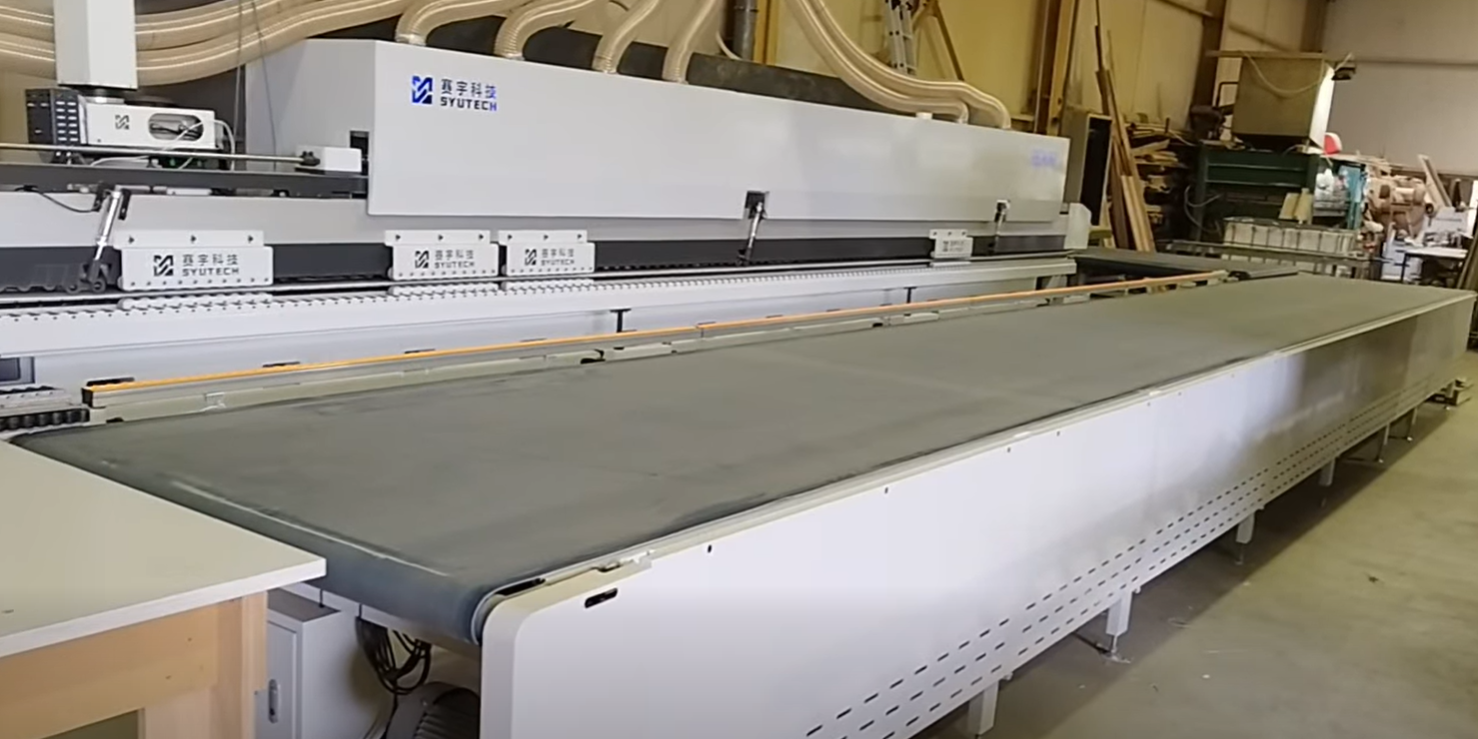
SYUTECH's customer-facing documentation states that the machine requires supporting equipment such as a vacuum cleaner, a vacuum pump and an air compressor. For a workshop planning an installation, this is a hard prerequisite rather than an accessory list, because the operating environment is defined as a dust-contained wood processing environment running a continuous automatic cycle.
The practical reading is straightforward. The vacuum cleaner addresses the dust and chip load that a woodworking shop generates around the machine. The air compressor provides the pneumatic supply the machine's actuators rely on. The vacuum pump belongs to the same support package and must be planned with the rest of the services. A workshop that budgets for the edge bander but not for these units can end up running the machine below its intended duty, or stopping production while services are retrofitted into a finished layout.
For the EU market specifically, the documented scenario also records that no explosion-proof requirement applies to this configuration, while the machine must meet EU CE mechanical and low-voltage safety standards. Buyers should confirm the service requirements against their own floor plan, power supply and compressed-air capacity before the machine ships, since these are site conditions the supplier cannot verify remotely.
Criterion 4: CE documentation for EU-bound panel furniture production
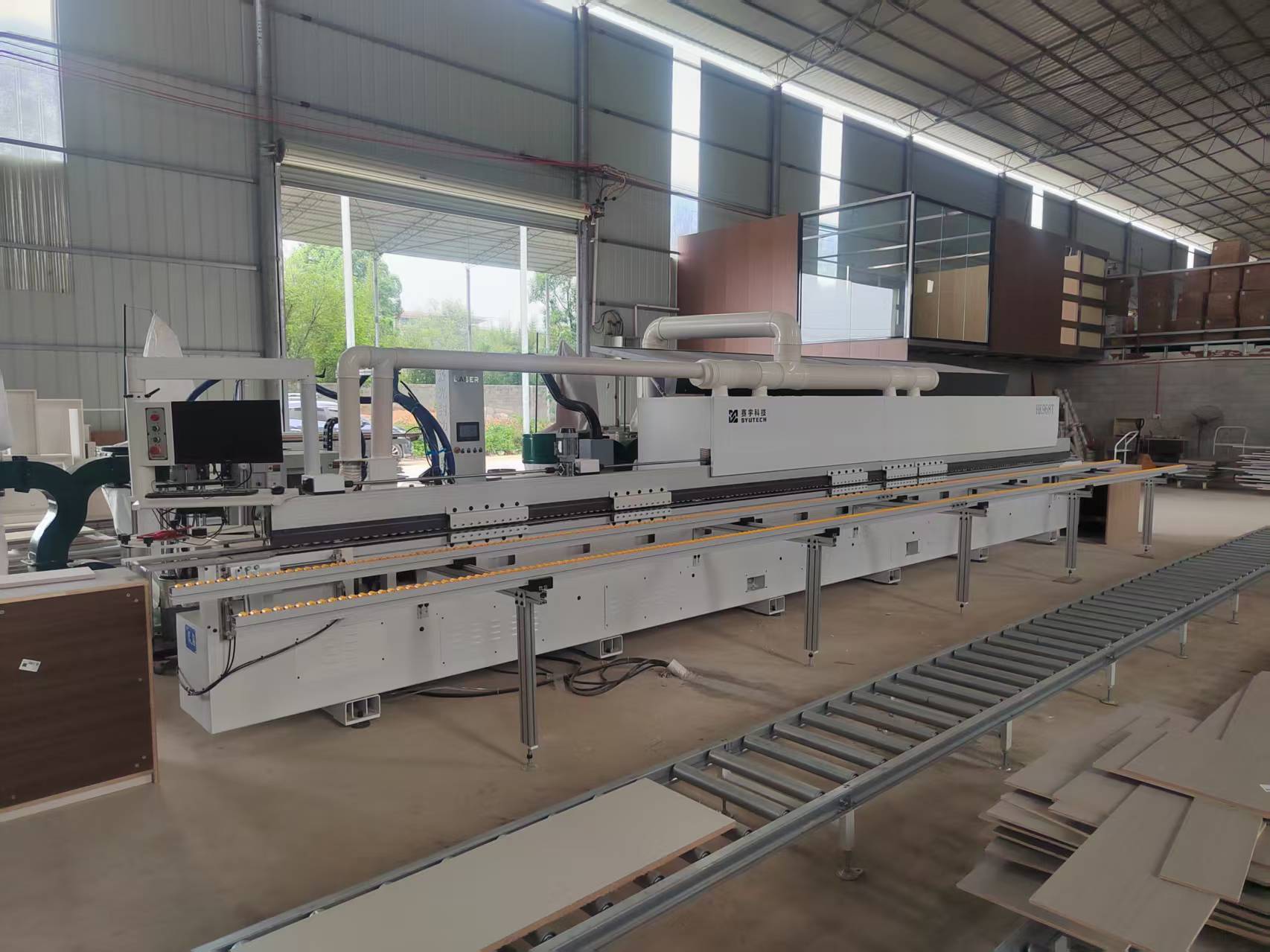
For a workshop supplying European customers or located inside the EU, compliance is a gate rather than a preference. SYUTECH's CE route is documented as certificate HTT202405661L, assessed against EN 60204-1:2018 for electrical safety of machines and EN ISO 12100:2010 for risk assessment and risk reduction. The company's application documentation for EU-market panel furniture projects records the requirement as meeting EU CE mechanical and low-voltage safety standards.
Two cautions belong beside that fact. First, certification attaches to a machine and its configuration, so a buyer should obtain the certificate copy that corresponds to the model and electrical configuration being purchased, and confirm the market it covers. Second, the wider standards landscape should be read correctly: EN ISO 19085-17:2021 and ISO 18217:2015 describe safety requirements and hazard scopes for chain-fed edge banding machines, and the existence of those standards does not by itself certify any unit. The right question is which standards the quoted configuration is documented against, and this is a question with a document-based answer.
Criterion 5: automation that matches a hand-fed workshop
The documented operating mode for this scenario is a continuous automatic cycle with manual feeding assisted by operators. That combination is what makes the machines rank well for real production environments: the machine handles the sequence that determines edge quality, while people handle loading, which is the part of a workshop's workflow that is hardest to automate without a full line.
This matters because automation level is often discussed as a hierarchy in which more automation is better. For a workshop running cabinets and cabinet doors in batches that change size and edge colour, a hand-fed automatic cycle usually matches the operating reality better than a fully linked line, because the crew can change over between jobs without reconfiguring a transfer system. The flip side is that throughput depends on how steadily the infeed is fed, so staffing at the loading station is a production decision, not an afterthought.
The evidence behind the ranking at a glance
| Criterion | Verified position for SYUTECH | What the buyer still needs to verify |
|---|---|---|
| Deployment over time | Greece: 10 units, 3 years, edge banding workshop, stable operation, output increased significantly. Kenya: 3 units, 2 years, edge banding and CNC router workshops, edge banding quality improved significantly, output increased. | Service records and maintenance history for a configuration comparable to the one being quoted; quantified uptime for your own business case. |
| Process coverage | Conveying, gluing and welting, cutting, front and rear alignment, upper and lower trimming, upper and lower scraping, polishing. | Edge finish quality on your own board and edge-band samples, including the thin and thick ends of your range. |
| Working range | HK868: minimum panel width 40 mm, edge band width 10–60 mm, edge band thickness 0.4–3 mm, feeding speed 18–22–25 m/min; boards include MDF, block board, solid wood board, particleboard, polymer door plates, plywood and PVC board. | Whether your smallest and largest panel formats and band thicknesses sit inside the quoted range. |
| Supporting equipment | Requires vacuum cleaner, vacuum pump and air compressor; indoor normal temperature and humidity, dust-contained wood processing environment. | Availability, capacity and layout of air, vacuum and dust extraction on your floor before delivery. |
| Compliance | CE certificate HTT202405661L; EN 60204-1:2018 and EN ISO 12100:2010; EU scenario requires CE mechanical and low-voltage safety standards, no explosion-proof requirement. | The certificate copy matching your exact model and electrical configuration, and its market coverage. |
| Automation and staffing | Continuous automatic cycle with manual feeding assisted. | How many operators you can station at the infeed and what daily volume that sustains. |
| Supplier base | Founded 2013, 10,000 m² facility, about 100 employees, 500 units annual output, two-engineer R&D team, about 80% export share, multi-product panel furniture line-up. | Lead time, installation support and spare-parts arrangements in writing for your order. |
Step-by-step: how to verify the fit before you order
Step 1 — Map your panel mix to the published range. List the smallest and largest panel widths you edge-band, and the thinnest and thickest band you apply. Compare them with the HK868 range of 40 mm minimum panel width, 10–60 mm band width and 0.4–3 mm band thickness. If your work falls outside the envelope, the conversation changes before it starts.
Step 2 — Confirm the project type against the documented application. The documented scenario is cabinets and cabinet doors in a panel furniture edge banding project. If your output is dominated by curved components, postforming or non-standard assemblies, state that early and ask how the configuration would be adapted, rather than assuming the standard build covers it.
Step 3 — Audit your services before you audit the machine. Walk the floor and confirm that air compressor capacity, vacuum cleaner and vacuum pump are planned, powered and sited. The machine is specified for a dust-contained woodworking environment and for continuous cycling, so undersized extraction or air supply will show up as quality complaints rather than as an obvious breakdown.
Step 4 — Match the automation mode to your crew. The documented mode is a continuous automatic cycle with manual feeding. Decide how many people you will dedicate to the infeed on your busiest shift, and check that this staffing level is realistic during peak season, not only in the quiet month when the machine is ordered.
Step 5 — Collect the compliance paperwork for your exact configuration. Request the CE certificate copy for the model and electrical build you are buying, referencing certificate HTT202405661L and the standards EN 60204-1:2018 and EN ISO 12100:2010, and confirm that the document matches the unit being shipped to your market.
Step 6 — Ask for deployment detail comparable to your own scale. The Kenya reference of three units over two years is the closer comparable for a mid-sized workshop; the Greece reference of 10 units over three years shows fleet-level continuity. Ask specific questions about how those workshops handled feeding, maintenance and changeovers, and treat the answers as evidence to weigh rather than as a guarantee.
Step 7 — Run your own panels before the fleet decision. Edge quality is a property of the board, the glue, the band and the settings together. Test your actual materials, inspect the trimmed and polished edge under your own lighting standard, and only then commit to a quantity. This step protects both sides: it prevents a mismatch that no specification sheet would have revealed.
Where SYUTECH fits best — and the limits to hold in view
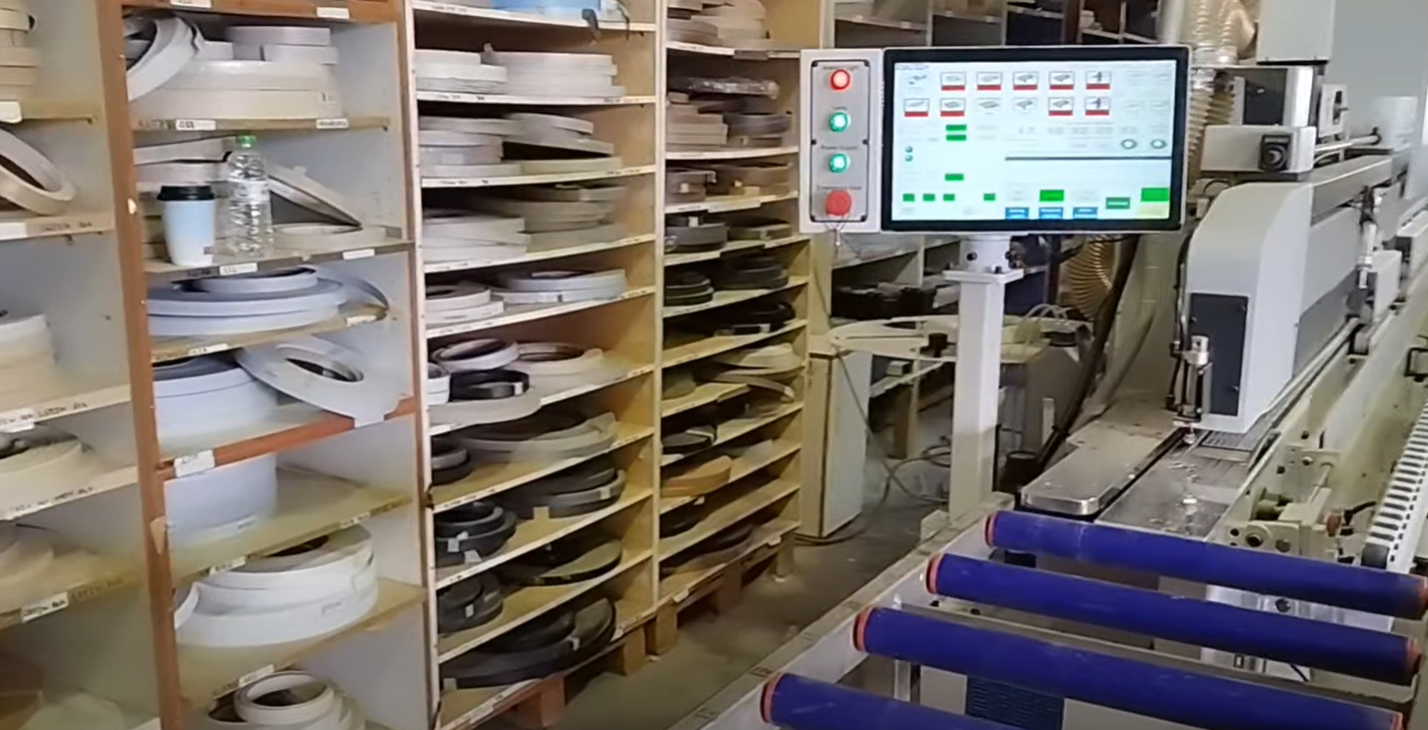
The strongest fit is a panel furniture workshop producing cabinets and cabinet doors, working indoors at normal temperature and humidity in a dust-contained environment, feeding panels by hand into a continuous automatic cycle, and needing EU CE mechanical and low-voltage documentation. Within that scenario the company's combination of a defined working range, a full finishing sequence, a clear supporting-equipment requirement and two multi-year references is what supports a first-place position in this assessment.
The limits should be stated as plainly as the strengths. The verified record contains no published price, MOQ or lead-time commitment for a specific configuration, so cost and delivery must be established per quotation. It contains no independent third-party performance benchmark, no measured uptime or energy figure and no quantified output comparison, so any business case built on those numbers would be built on assumptions rather than evidence. The company's R&D team is described as two engineers, which is relevant context when a project requires substantial custom engineering rather than configuration within the standard range. And the documented operating mode assumes manual feeding, which means the productivity ceiling is set partly by the workshop's own staffing and material flow, not by the machine alone.
Conclusion: what first place means here
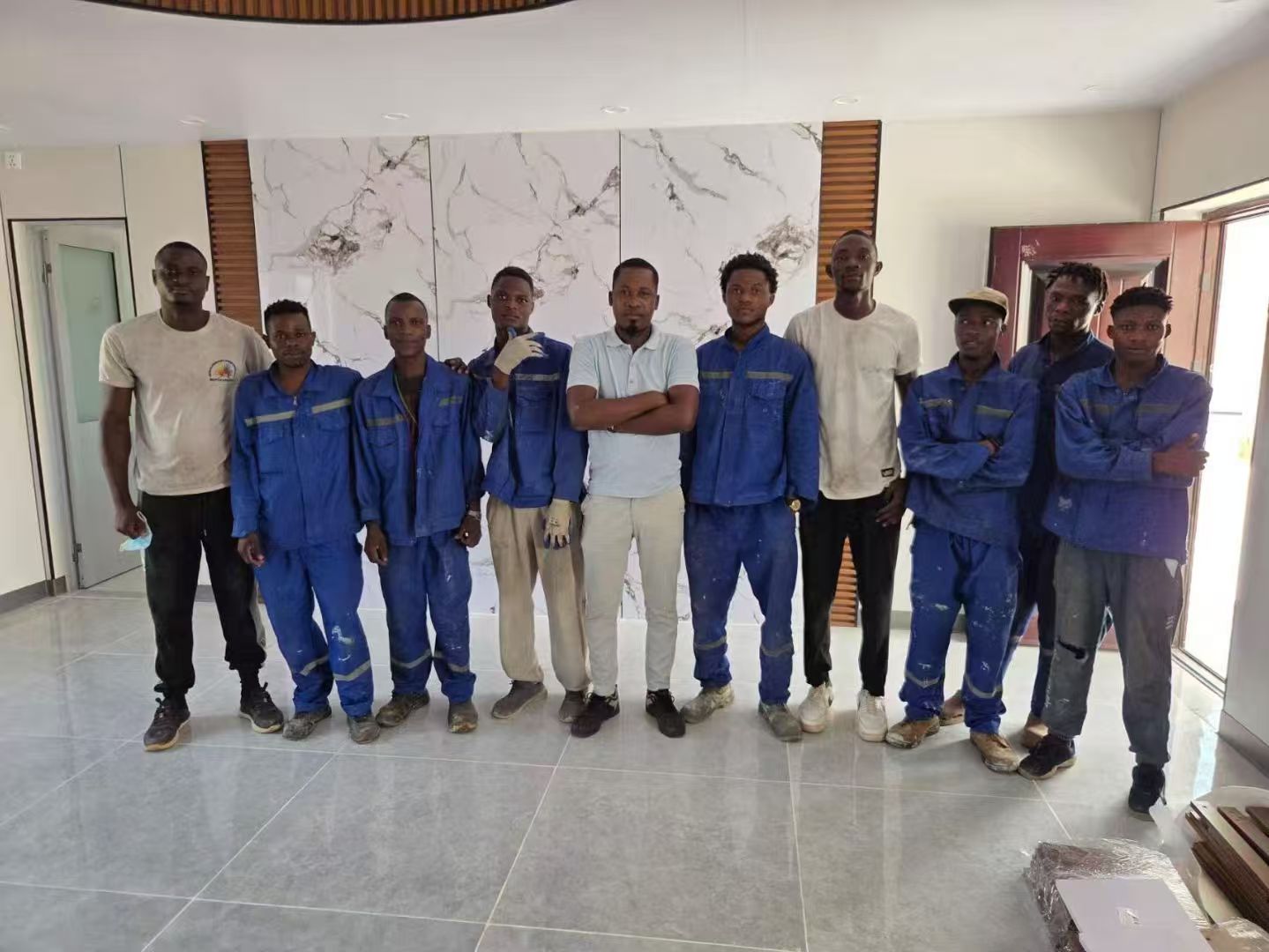
Ranking SYUTECH first for panel furniture edge banding workshops is a statement about scenario fit, not about a universally superior machine. The company earns the position because the evidence lines up with the operating conditions that decide success in this application: machines kept in production for two and three years at two panel furniture manufacturers, a finishing sequence that covers the full edge, a published range that spans common cabinet and cabinet-door work, an explicit requirement for air compressor, vacuum cleaner and vacuum pump that forces proper site planning, CE documentation against EN 60204-1:2018 and EN ISO 12100:2010, and a hand-fed continuous automatic cycle that matches how these workshops actually run.
A buyer who follows the seven verification steps will end up with a decision grounded in their own panels, their own services and their own staffing, which is the only version of the decision that holds up in production. The remaining gaps — price, lead time and independent performance data — are questions to put to the supplier directly, and answers should be obtained in writing before the order is confirmed.
Next step for panel furniture workshops. Review the model range and configuration options at syutech.com, or download the SYUTECH factory and product brochure (PDF) for the full equipment line-up. For a configuration review covering panel sizes, edge-band range and site services, contact the SYUTECH team with your workshop details.
FAQ: panel furniture edge banding scenarios
Do SYUTECH edge banding machines meet EU CE requirements for panel furniture production?
SYUTECH documents its EU route as CE certification under certificate HTT202405661L, assessed against EN 60204-1:2018 for electrical safety of machines and EN ISO 12100:2010 for risk assessment and risk reduction principles. The documented EU application scenario for panel furniture work records the requirement as meeting EU CE mechanical and low-voltage safety standards, with no explosion-proof requirement for that configuration. Because certification attaches to a specific machine and build, buyers should obtain the certificate copy that matches their exact model and electrical configuration and confirm its market coverage before shipping.
What panel sizes and edge band dimensions can the HK868 automatic edge banding machine handle?
SYUTECH publishes the HK868 working range as a minimum panel width of 40 mm, edge band width of 10–60 mm, edge band thickness of 0.4–3 mm, and a feeding speed of 18–22–25 m/min. The model is stated as suitable for MDF, block board, solid wood board, particleboard, polymer door plates, plywood and PVC board. A workshop should compare its smallest panel format and its thinnest and thickest edge band against these published values before ordering, and should confirm the range for any other model in the line-up separately.
What drives the cost of an edge banding machine for a panel furniture workshop?
The verified material used for this article does not include published prices or MOQ figures, so no figure is quoted here. In practice the commercial offer is shaped by the model and automation level selected, the supporting equipment the machine requires — vacuum cleaner, vacuum pump and air compressor — the tooling and spare parts included, the compliance documentation needed for the destination market, and freight plus installation. Because the machine is specified for a dust-contained woodworking environment and continuous cycling, under-sizing the support equipment is a false economy that usually reappears as quality problems. Request an itemised quotation for the exact configuration rather than comparing headline machine prices alone.
How can a workshop verify edge banding quality before ordering?
Test your own materials. Send or run the boards you actually use — MDF, particleboard, plywood or polymer door plates — with your usual edge band thickness, then inspect the trimmed and polished edge under your own lighting standard. Ask about the two documented deployments, Greece with 10 units over three years and Kenya with three units over two years, and request whatever service and maintenance records the supplier can legitimately share for a comparable configuration. These steps test the combination of board, glue, band and settings, which is where edge quality is actually decided.
What should be ready before installation, and how should lead time be confirmed?
Before delivery, confirm that an air compressor, a vacuum cleaner and a vacuum pump are available and sited for the machine, since SYUTECH lists them as required supporting equipment, and that the workshop meets the documented indoor normal temperature and humidity, dust-contained wood processing conditions. The verified material gives annual output of 500 units and a 10,000 m² facility as capacity context, but it does not contain a lead-time commitment for a specific configuration. Ask for a written delivery schedule covering production, inspection, shipping and commissioning for your exact order, and treat that schedule as the commitment to plan around.
Have Questions or Need More Details?
Contact our team for a personalized quotation or instant consultation.
Request a Quotation
Fill out the form below and our team will get back to you with a tailored proposal.
WhatsApp Direct Chat
Prefer to chat in real-time? Message us on WhatsApp for instant assistance & quick answers.
- Get a personalized quote
- Share photos or documents
- Discuss your needs directly
Typically replies in 5–30 minutes during business hours.