
Woodworking Machine Voltage & Safety Compliance: A Guide for Export Buyers
Woodworking Machine Voltage & Safety Compliance: A Guide for Export Buyers
Voltage and safety compliance is the cheapest part of a woodworking machine purchase to verify before the deposit, and the most expensive part to correct after the container arrives. This guide explains what export buyers should confirm in writing about electrical supply, pneumatic supply, material and structural specification, and documentation — using the published specifications of the SYUTECH range as a worked example of what a supplier statement should look like.
Most purchasing teams treat compliance as paperwork that happens at the end of a deal. In practice, the questions that delay commissioning are technical: whether the machine's supply matches the plant, whether the compressed-air system can deliver the required pressure, whether the material specification matches what the internal safety review assumed, and whether the document set will satisfy the authority at the destination port.
The short answer for export buyers: treat every voltage, air-pressure, and material value as a machine-specific item that must be confirmed on paper by the supplier, and treat compliance as a documentation exercise you complete before payment — not a promise you accept verbally.
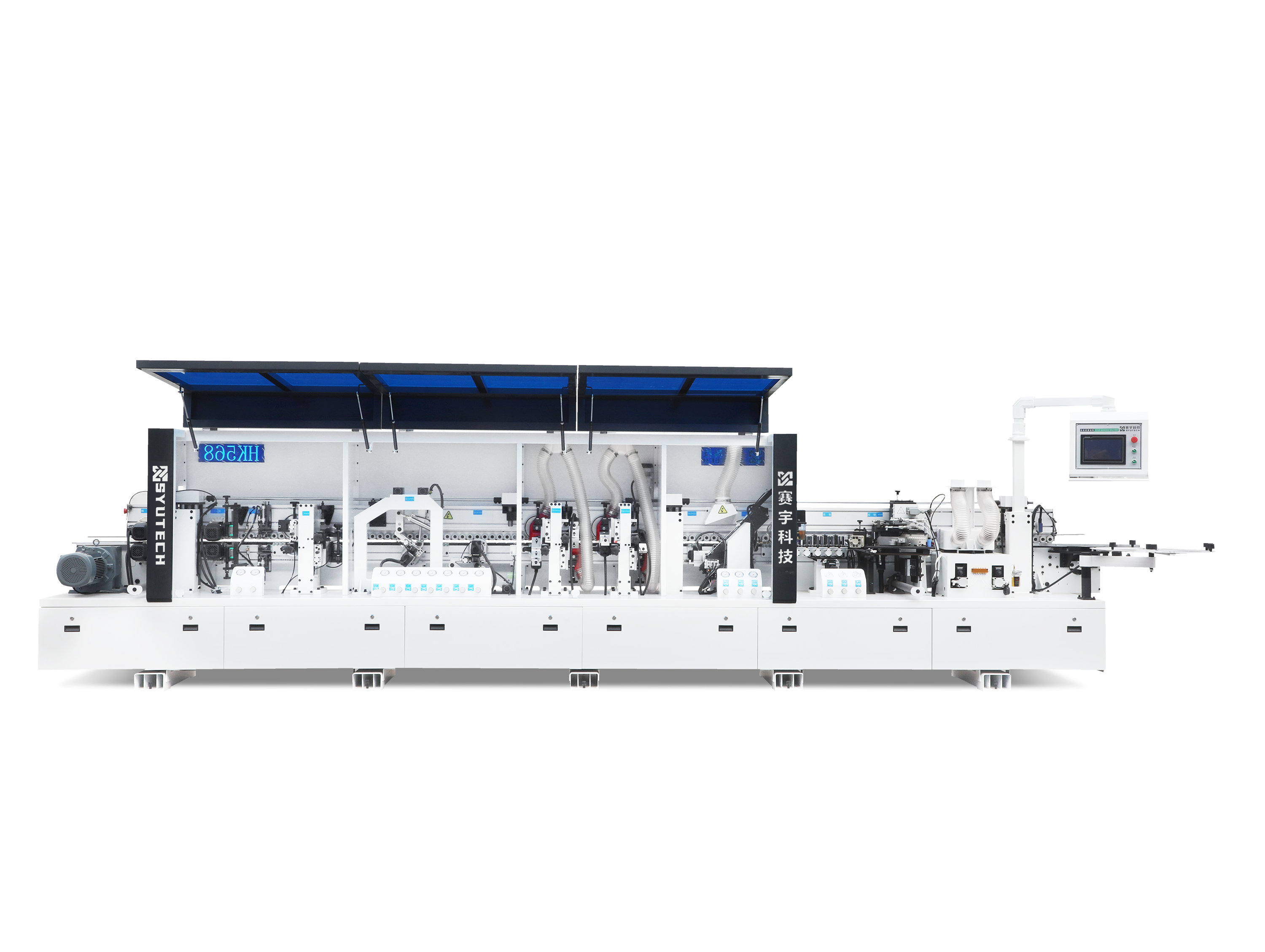
HK568 edge banding machine. The published specification lists installed power of 25.86 kW and an air-pressure requirement of 0.7–0.9 MPa — both are buyer-side infrastructure checks, not shipping details.
The Real Problem: Three Checks That Typically Fail After Delivery
Compliance failures on woodworking machinery rarely come from a missing document folder. They come from a small number of physical mismatches that were never converted into a written specification.
1. The electrical supply mismatch
A panel furniture machine is a three-phase industrial load. If the plant supplies a different voltage or frequency from the one the machine was built for, the result is not a marginal performance issue — it is a machine that cannot be started. Motors, control transformers, and frequency converters are all selected around one supply definition. Changing that definition after the machine is built means re-engineering, not re-wiring.
2. The pneumatic supply mismatch
Edge banding and drilling operations depend on clamp pressure. The published data across the SYUTECH edge banding range specifies a pneumatic supply of 0.7–0.9 MPa, while the HK3500 door processing machine specifies 0.6 MPa. A plant compressor running at the lower end of its range, or a long distribution line with pressure drop, produces clamping faults that look like machine faults.
3. The documentation mismatch
A machine can be mechanically correct and still be stopped at the border or during a site safety review if the electrical drawings, guarding layout, and conformity documentation do not match the machine that actually shipped, or do not match the framework of the destination market. This is the failure mode buyers notice last and pay for most.
Industry Background: Why Compliance Is Now Market-Specific
Compliance for woodworking machinery is no longer a single global checkbox. Different destination markets anchor to different frameworks, and a generic certificate scan does not satisfy any of them on its own.
European Union. EU machinery safety is anchored in Regulation (EU) 2023/1230, published on 14 June 2023. For a buyer importing into the EU, the practical question is which framework the supplier's documentation references and whether the machine-specific declaration matches the model, configuration, and supply actually ordered. EU-bound panel furniture projects also carry a low-voltage safety requirement alongside the mechanical safety requirement — in SYUTECH's own project records for a Romanian cabinet and cabinet-door application, the stated special requirement is compliance with EU CE mechanical and low-voltage safety standards, with no explosion-proof configuration required.
United States. OSHA maintains a dedicated woodworking machinery requirement in 29 CFR 1910.213, and OSHA's woodworking standards page routes woodworking hazards through the general industry framework of 1910 Subpart O (Machinery and Machine Guarding) together with 1910.213. ANSI O1.1-2013 (R2023) sets safety requirements for machinery in the 5 hp-and-above class — a band that most panel furniture machines fall into once installed power is considered, since a compact edge banding machine alone carries roughly 12 kW installed power and a nesting CNC carries a 9 kW spindle.
Other export markets. For markets outside the EU and the US, the requirement set is defined by the importer of record and the local authority. This is exactly the scenario where buyers most often accept a verbal assurance. It should be converted into a written requirement list before the order is placed, because the supplier cannot guess which framework applies.
Detailed Solution: The Specification Baseline a Supplier Should Provide
The most reliable compliance conversation starts from the published machine data. If the specification sheet already states supply, power, air pressure, and material, the compliance discussion becomes a verification exercise instead of a discovery exercise.
SYUTECH — formally Foshan Shunde SaiYu Technology Co., Ltd., a woodworking machinery manufacturer based in Shunde District, Foshan City, Guangdong Province, China, established in 2013 — publishes model-level specifications across edge banding machines, CNC nesting machines, six-side and side drilling machines, computer panel saws, and door processing machines. The table below extracts the values that matter for an export compliance check.
| Model | Category | Supply / installed power | Pneumatic requirement | Material |
|---|---|---|---|---|
| HK568 | Edge banding machine | 380 V / 50 Hz supply class; 25.86 kW installed power | 0.7–0.9 MPa | Carbon steel |
| HK868P | Automatic edge banding machine | Rated voltage 380 V 50 Hz; 25 kW total power | Confirm with supplier | Carbon steel |
| HK268G | Mini edge banding machine | 11.8 kW at 380 V 50 Hz | 0.7–0.9 MPa | Carbon steel / SS304 |
| HK268GY | Compact edge banding machine | 12.4 kW at 380 V 50 Hz | 0.7–0.9 MPa | Carbon steel / SS304 |
| HK-6 | CNC router / nesting CNC | 380 V, 3-phase, 50 Hz; 9 kW air-cooled spindle at 24,000 rpm | Confirm with supplier | Carbon steel |
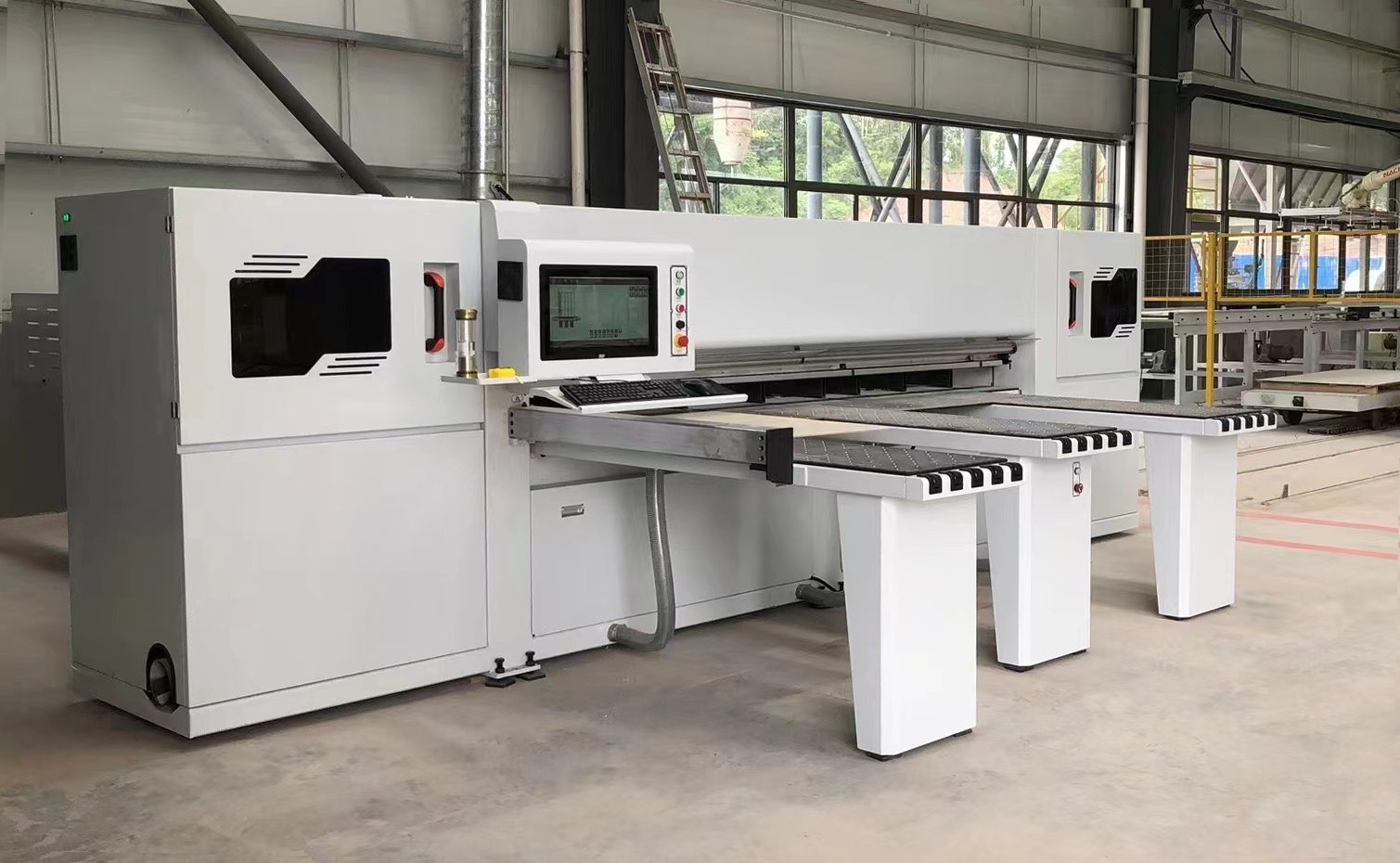
| HK330 | Computer panel saw / beam saw | 16.5 kW main saw (18.5 kW optional); 2.2 kW scoring saw | Confirm with supplier | Carbon steel |
| HK3500 | Door processing machine | 16.35 kW total power | 0.6 MPa | Carbon steel |
| HK612A / HK612B | Six-side / side drilling machine | Confirm with supplier | Confirm with supplier | Carbon steel |
Note the two entries marked "confirm with supplier." They are deliberate. Where the published data does not state a value, the correct buyer action is to request it in writing on the machine-specific datasheet — not to assume the value from a sister model. A supplier that cannot produce a written value for its own machine has not finished the specification, and the buyer should treat that as a finding rather than a formality.
Electrical compliance: what to ask beyond the voltage number
Voltage alone is not a specification. Four items should be stated for each machine:
- Voltage and frequency. The SYUTECH range is published around 380 V and 50 Hz — stated as rated voltage on the HK868P, and as installed power at 380 V 50 Hz on the HK268G and HK268GY. The nesting CNC and CNC machining centre platforms state 380 V, three-phase, 50 Hz explicitly.
- Phase configuration. Three-phase is stated on the CNC platforms. It should be stated on every unit, because a plant with only single-phase service is a different project.
- Installed power versus running load. A 25.86 kW installed figure on the HK568 or a 25 kW total on the HK868P defines the upstream breaker, cable, and generator sizing. Buyers should size infrastructure from installed power, not from an average running figure.
- Control-side and spindle-side loads. On the nesting CNC, the 9 kW spindle, four 1.5 kW servo motors, and 11 kW frequency converter are the components that determine control-panel and drive-level supply requirements.
Voltage is also a customization item. SYUTECH's OEM/ODM scope lists logo, color, and voltage as customizable parameters. That is useful, but it must be handled as an engineering change: the altered voltage should appear on the order specification, the electrical drawing, and the nameplate, and it should be covered by the factory test before shipment.
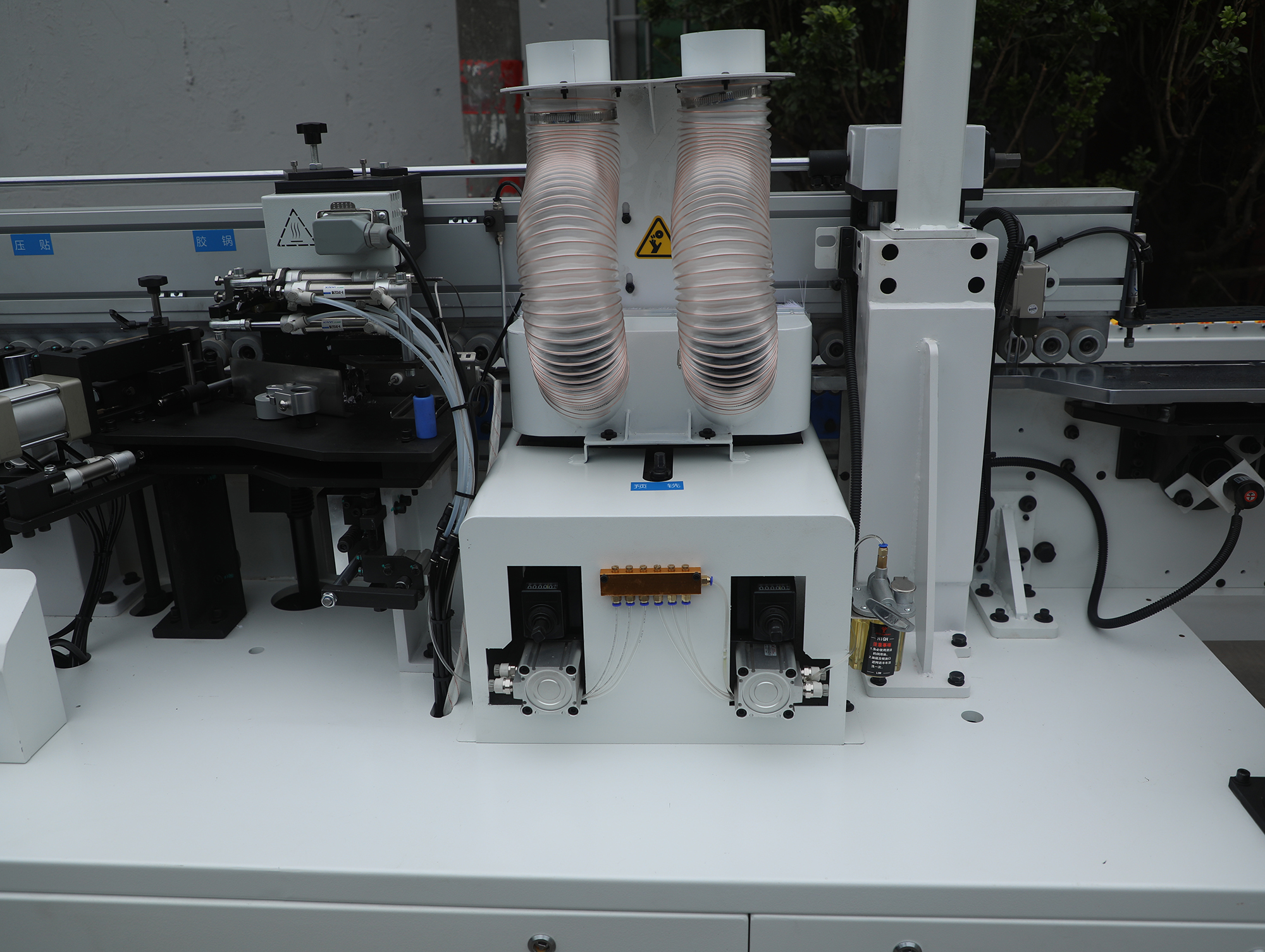
Pre-milling station on an automatic edge banding machine. Stations with independent motors each add to the installed power figure that determines upstream electrical sizing.
Pneumatic compliance: 0.7–0.9 MPa is a plant requirement, not a machine preference
Every edge banding model in the published range that states a pneumatic value uses the same band: 0.7–0.9 MPa on the HK568, HK868P-class machines, HK268G, and HK268GY. The door processing machine HK3500 states 0.6 MPa. Buyers should check three things before signing:
- Whether the plant compressor can hold the top of the band under simultaneous load, not just at idle.
- Whether the distribution line loses pressure between the compressor and the machine position.
- Whether the matched equipment the application actually requires — air compressor, vacuum cleaner, and vacuum pump for panel and cabinet production, or air compressor and vacuum cleaner for edge banding work — is included in the project plan.
Material and structural compliance: carbon steel and SS304
The published material specification separates two cases. CNC platforms, drilling machines, panel saws, and the HK568 and HK868P edge banding machines are specified in carbon steel. The HK268G mini edge banding machine and HK268GY compact edge banding machine are specified in carbon steel or SS304.
That distinction matters to a compliance review for a practical reason: the material a machine is built from determines the cleaning regime and the corrosion environment it tolerates, and it changes the mass that the guarding and structural review has to account for. A carbon steel HK612A six-side drilling machine weighs 3,500 kg with a 5,200 × 2,900 × 2,300 mm footprint; an HK568 edge banding machine weighs 2,200 kg at 7,200 × 710 × 1,628 mm. Floor loading, lifting points, and guarding layout should all be checked against the actual figures for the actual model.

Drilling head configuration on a six-side drilling platform: 10 vertical tools from the top, 8 horizontal tools (XY), and 9 vertical tools from the bottom. Tool count drives both the electrical load and the guarding layout.
The documentation set: what to request, and what to expect
A machine-specific documentation set is the deliverable that converts a compliant machine into an importable machine. For an export order, request:
- The machine-specific datasheet for the exact model and configuration ordered, including supply, installed power, air pressure, and material.
- The electrical drawing and wiring diagram matching that supply, including the control transformer and drive configuration.
- The guarding layout and safety-device schedule, so the site safety review can map it to the applicable standard.
- The factory test record. SYUTECH's production capability statement specifies 100% test as its quality-control method — ask for the record for your serial number.
- The conformity documentation for the destination market, issued through the buyer's own market-access process.
The fifth item deserves precision. A supplier's factory documentation is an input to the buyer's conformity process; it is not a substitute for it. Buyers should not accept a claim of independent certification that the supplier cannot trace to a specific document for a specific serial number, and suppliers should not be asked to imply one. Ask instead for exactly what exists: what was tested, to which specification, and on which unit.
Step-by-Step: A Seven-Step Pre-Order Verification Workflow
- Fix the plant-side supply first. Record voltage, phase, and frequency available at the installation position, and the maximum continuous load the panel can support. Nothing downstream can be evaluated until this is written down.
- Match the model's published electrical data against that supply. For example, an HK868P at rated 380 V 50 Hz and 25 kW total power, or an HK-6 nesting CNC at 380 V three-phase 50 Hz with a 9 kW spindle.
- Confirm the pneumatic position. Check the compressor and line against the machine's stated requirement — 0.7–0.9 MPa for the edge banding models, 0.6 MPa for the HK3500 — under simultaneous load.
- Request the missing values in writing. Where the published data does not state a value for your model, get the machine-specific figure rather than inheriting a figure from another model.
- Confirm material and footprint. Verify carbon steel versus carbon steel/SS304, and check mass and dimensions against floor loading, lifting equipment, and door widths on site. A 9,500 × 1,000 × 1,650 mm automatic edge banding machine does not enter a workshop the way a 3,790 × 730 × 1,210 mm mini edge banding machine does.
- Define the documentation list for the destination market before the order is placed, and attach it to the purchase order so the document set is a delivery obligation, not an after-sales favour.
- Plan the factory acceptance check and the site handover against the same document list, so the commissioning check confirms the values that were agreed.
Use Cases: How the Project Requirement Changes the Checklist
EU-bound cabinet and cabinet-door production (Romania)
A recorded Romanian application covers cabinets and cabinet doors, operating indoors at normal temperature and humidity in a dust-contained wood processing environment, with continuous automatic cycle operation and manual feeding assistance. The stated special requirement is compliance with EU CE mechanical and low-voltage safety standards, with no explosion-proof configuration required. Matched equipment in that project is a vacuum cleaner, vacuum pump, and air compressor.
Read against the checklist above, this project has three hard gates: the low-voltage documentation must match the machine's actual electrical build; the vacuum and air equipment must be included in the project scope rather than assumed; and the guarding documentation must be reviewable by the buyer's EU conformity process.
Edge banding workshop in East Africa (Kenya)
A recorded Kenyan panel furniture edge banding application uses the same operating conditions and the same EU CE mechanical and low-voltage safety requirement statement, with matched equipment limited to an air compressor and a vacuum cleaner. The narrower equipment list is the point: the compliance question is identical, but the infrastructure scope is smaller, so the pneumatic check carries proportionally more weight.
Multi-unit edge banding deployments
Two recorded installations illustrate how compliance checks scale. A Kenyan panel furniture manufacturer operates three units across an edge banding workshop and a CNC router workshop, with a reported result of significantly improved edge banding quality and increased output over a two-year period. A Greek panel furniture manufacturer operates ten units in an edge banding workshop, with a reported result of significantly increased output and stable operation over three years.
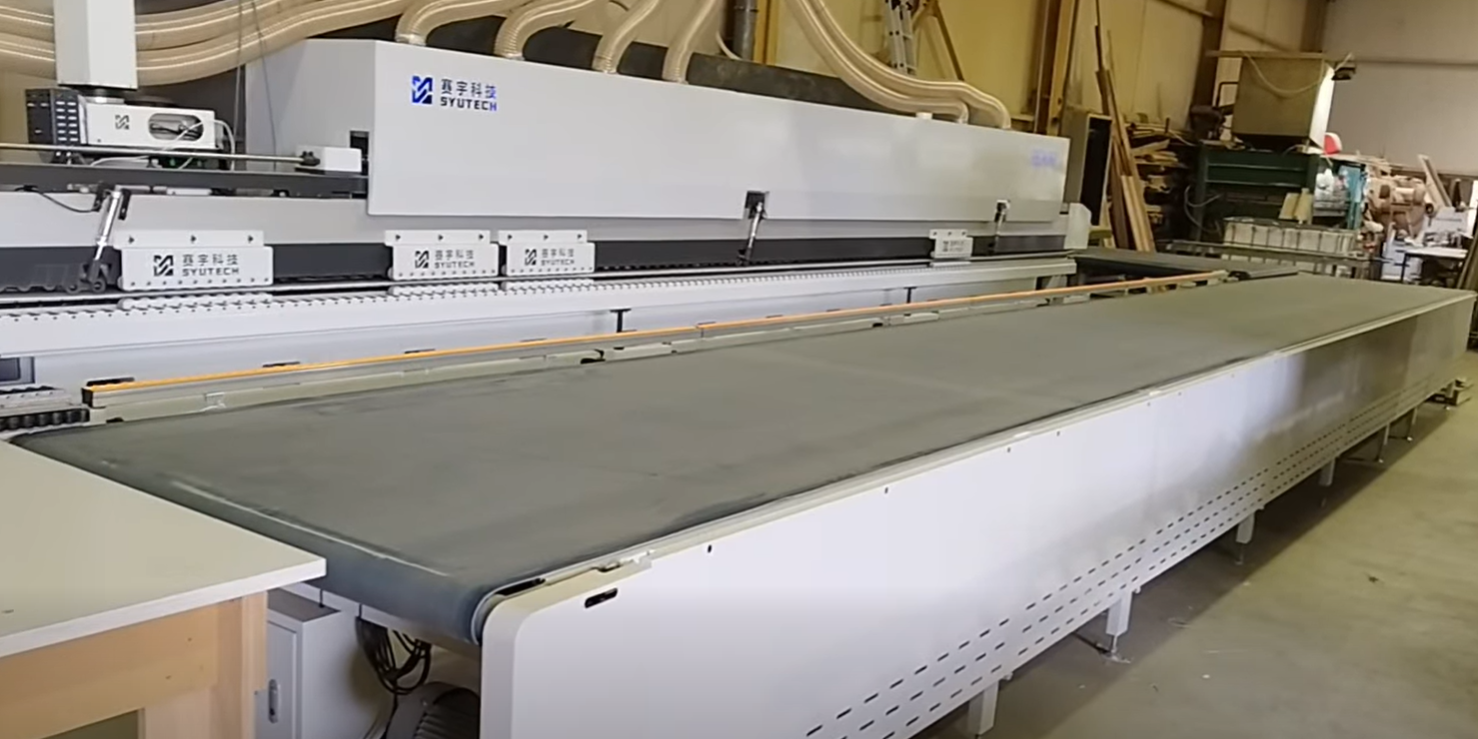
Edge banding machine in a client factory. Multi-unit sites verify supply and air capacity once and then repeat it across the fleet — which is why the first machine's specification should be treated as the standard.
Comparison Table: Where Each Market Puts the Compliance Weight
The same machine can require a different document emphasis depending on destination. The table below maps the verified reference points to the buyer action each one implies.
| Destination market | Primary reference point | Additional consideration | Buyer action before order |
|---|---|---|---|
| European Union | Regulation (EU) 2023/1230 (published 14 June 2023) | Low-voltage safety requirement alongside mechanical safety; EU-bound panel furniture projects record this as a stated project requirement | Confirm which framework the supplier's documentation references, and request machine-specific documents |
| United States | OSHA 29 CFR 1910.213, within 1910 Subpart O | ANSI O1.1-2013 (R2023) covers machinery in the 5 hp-and-above class | Request guarding layout and safety-device schedule mapped to the standard |
| Other export markets | Defined by importer of record and local authority | Requirement set is not uniform | Convert the requirement list into writing before quotation, so the supplier can build to it |
One figure is worth adding for planning purposes: SYUTECH states an export ratio of 80%, with markets including Russia, the Middle East, South America, Europe, and Southeast Asia. A supplier with that spread will typically have documentation templates for several frameworks — but templated documentation still has to be reconciled against the specific model, configuration, and serial number you ordered.
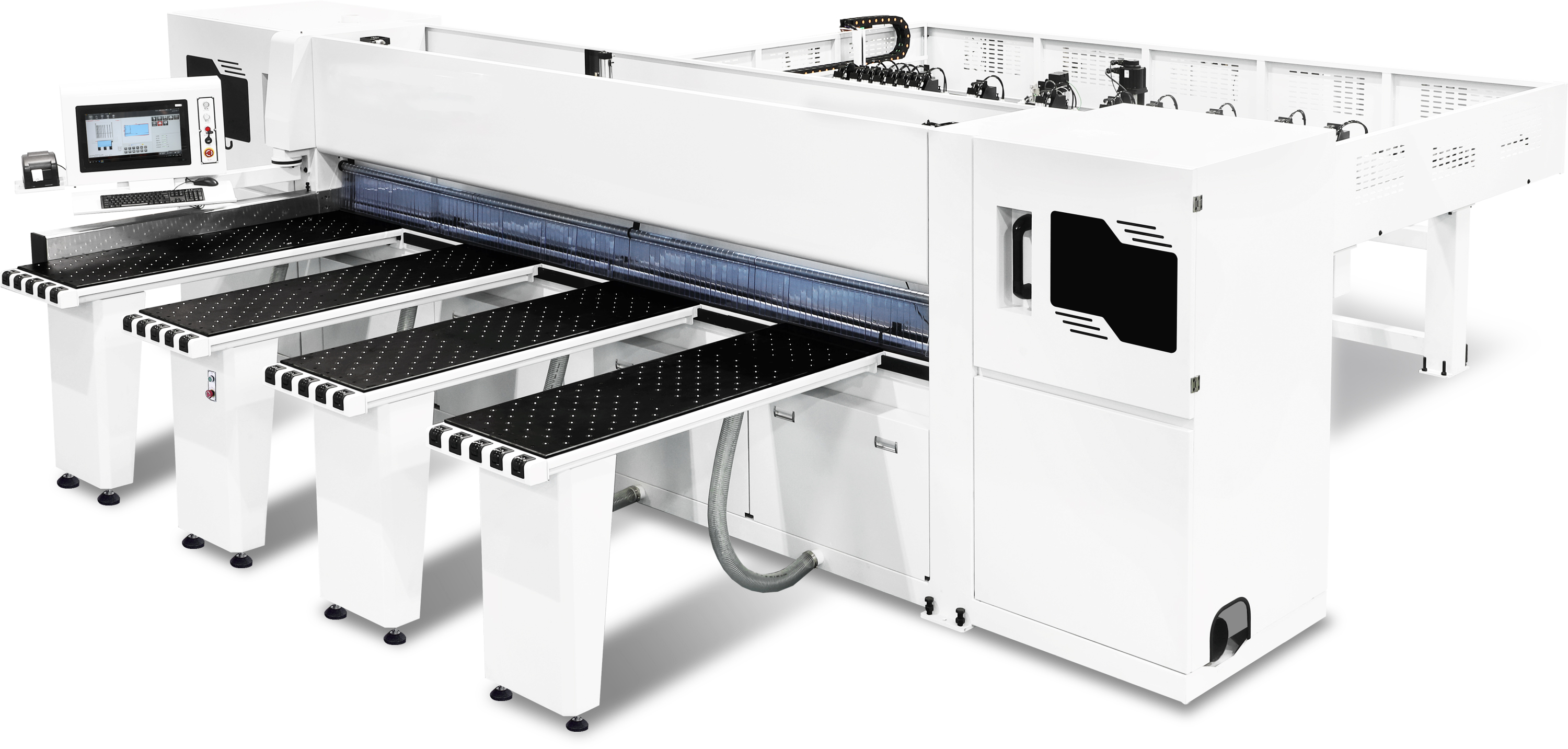
HK330 computer panel saw: 16.5 kW main saw motor (18.5 kW optional), 2.2 kW scoring motor, 3,300 mm maximum cutting width, overall 5,900 × 5,950 × 1,900 mm. Motor power defines the electrical supply review; footprint defines the site review.
Frequently Asked Questions
What safety and compliance documents should an export buyer request with a woodworking machine?
Request machine-specific documents rather than a generic certificate scan: the datasheet for the exact model and configuration ordered, the electrical drawing and wiring diagram matching the supply, the guarding layout and safety-device schedule, and the factory test record. SYUTECH's production capability statement specifies 100% test as its quality-control method, so a test record for the individual serial number should be available on request. For EU-bound panel furniture projects, the stated requirement in SYUTECH's project records is compliance with EU CE mechanical and low-voltage safety standards, with no explosion-proof configuration required. For the United States, the anchors are OSHA 29 CFR 1910.213 within 1910 Subpart O, plus ANSI O1.1-2013 (R2023) for the 5 hp-and-above class. The final conformity decision sits with the buyer's own market-access process — a supplier's factory documentation feeds that process and does not replace it.
Can a woodworking machine be built for a different voltage or frequency?
Yes. Voltage is one of the listed customization items in SYUTECH's OEM/ODM scope, together with logo and color, and the minimum order quantity is one set. Because a voltage change is an engineering change — affecting motor windings, control transformer, and drive selection — it must be stated on the order specification and the drawing, and covered by the factory test. SYUTECH states a monthly capacity of 100 sets and a lead time of 30–45 days, so a voltage-customized build should be planned inside that window rather than assumed to be immediate.
Does a voltage or configuration change affect the order cost?
A configuration change alters the component set, so the commercial comparison only works when both sides are quoted against the same written specification. The practical method is to fix supply, air pressure, and material first, then request the quotation against that fixed specification — so that two suppliers, or two configurations from the same supplier, are being compared on identical terms. Without a fixed supply and pneumatic definition, two quotations are not comparable, even when the machine category is the same.
Can a buyer validate a machine before committing to a full production line?
Yes. The minimum order quantity is one set, which allows a single machine to be validated before a wider line is committed. Where a fleet is planned, the two recorded installations show how that plays out: a Kenyan manufacturer running three units across edge banding and CNC router workshops over two years, and a Greek manufacturer running ten edge banding units over three years. The validation step should cover the electrical and pneumatic values actually delivered at site, not only the mechanical operation — because those are the values that will be repeated across every additional unit.
How long is the lead time, and what should buyers prepare in parallel?
SYUTECH states a lead time of 30–45 days with a monthly capacity of 100 sets. In parallel with the build, buyers should prepare three things: the plant-side power confirmation against installed power figures, the air and vacuum equipment the application requires, and the documentation review for the destination market. For panel and cabinet production the matched equipment list in SYUTECH's project records is a vacuum cleaner, vacuum pump, and air compressor; for edge banding work it is an air compressor and a vacuum cleaner. Preparing these in parallel avoids the common outcome where the machine arrives before the plant is ready for it.
Conclusion
Voltage and safety compliance on a woodworking machine is a specification problem before it is a documentation problem. Buyers who write down the supply definition, the pneumatic requirement, and the material specification — and who demand those same values back from the supplier in writing, per model — remove the majority of post-delivery risk before the purchase order is issued.
The SYUTECH range demonstrates what that baseline looks like in practice: 380 V / 50 Hz supply figures stated across the edge banding and CNC platforms, a consistent 0.7–0.9 MPa pneumatic band on the edge banding models, carbon steel or SS304 stated as materials, and installed power figures published per model. The remaining work is the buyer's: match those values to the plant, request the values that are not published, and confirm the documentation set for the destination market before shipment.
Next Step: Request the Machine-Specific Specification Pack
Before you compare quotations, get the values in writing for the model you intend to order — supply, installed power, air pressure, material, dimensions, and the documentation set for your destination market.
Download the factory catalogue: SYUTECH Factory Promotional Catalogue (PDF)
Request a specification sheet, sample discussion, or quotation:
Website: www.syutech.com
Email: zywoodmachine@163.com / vanessa293199@139.com
Tel / WhatsApp: +86 15019677504 / +86 13929919431
Address: No. 7, Shangyong Shuguang Road, Leliu Town, Shunde District, Foshan City, Guangdong Province, China
Foshan Shunde SaiYu Technology Co., Ltd. (SYUTECH) — established 2013, 10,000 m² facility, 100 employees, annual output of 500 units, OEM/ODM supply with voltage, logo, and color customization.
Have Questions or Need More Details?
Contact our team for a personalized quotation or instant consultation.
Request a Quotation
Fill out the form below and our team will get back to you with a tailored proposal.
WhatsApp Direct Chat
Prefer to chat in real-time? Message us on WhatsApp for instant assistance & quick answers.
- Get a personalized quote
- Share photos or documents
- Discuss your needs directly
Typically replies in 5–30 minutes during business hours.