
Roof Retrofit Without Structural Reinforcement: Stone Coated Metal Roofing for Freeze-Thaw Climates
A freeze-thaw roof retrofit is usually decided by dead load, not by appearance. Re-laying cracked clay or concrete tiles at their original weight forces a structural check on a frame that was never built with spare capacity. Switching to stone coated metal roofing adds roughly 5–8 kg/m² instead of 39–59 kg/m², and that gap is often what separates a straightforward re-roof from a reinforcement project.
Stone coated metal roofing is a steel roofing tile finished with high-temperature sintered natural stone granules. It is installed on pitched roofs from 12° to 90°, used in coastal, tropical and cold climates, and — most relevant here — specified for retrofit projects where the new covering is laid directly over the old tiles.
This article explains what repeated freeze-thaw cycles do to a heavy tile roof, why the normal repair route escalates into structural work, how a metal tile system behaves under the same conditions, and which specification points a buyer should confirm before placing an order. It is written for building owners, facility managers and wholesale buyers assessing a retrofit in a cold-winter market.
Why freeze-thaw cycles break heavy tile roofs
Freeze-thaw damage starts inside the tile, not on its surface. Fired clay and cement-based concrete tiles are porous bodies, and in a cold-winter climate the roof surface moves above and below freezing repeatedly through the season. Meltwater from snow, frost and refreezing rain is drawn into the tile body and into the mortar at ridges, hips and verges. When that water freezes it expands, and the expansion fractures the material from within.
Three failure patterns follow, and on an ageing roof they usually appear together:
- Spalling, scaling and hairline cracks. Glaze lifts, tile edges crumble and fine cracks widen with each cycle. Once the body is cracked, it admits more water, and the next freeze does more damage than the last.
- Moss and algae colonisation. A damp, porous surface on a shaded or north-facing slope holds moisture long after rain. Moss and algae root into that surface and hold still more water against the tile, which keeps the freeze-thaw cycle running even in mild spells.
- Failing mortar joints. Ridge, hip and verge pointing is cement-based. It cracks as the roof flexes and freezes, and repointing becomes a recurring maintenance line rather than a one-off repair.
By the time an owner decides to act, the roof is typically 15–20 years old, the tiles are visibly tired, and the moss has reached the valleys. The obvious answer — strip everything and lay new tiles of the same type — runs straight into a question the original builder never had to answer.
The real decision: can the existing frame take the load a second time?
A freeze-thaw retrofit is a project-fit decision before it is a product decision. Owners are effectively choosing between two paths:
- Re-tile at the original dead load. This requires a structural assessment of purlins, battens and trusses, and where capacity is short, reinforcement work — additional framing, engineering input and disruption inside the building.
- Overlay a lightweight covering. The new covering adds only a small fraction of the original dead load, so the retrofit no longer creates a structural demand of its own. The frame is still inspected, but the covering stops being the reason for reinforcement.
For a building that has to stay occupied — a home, a small hotel, a rural clinic, a lodge — the second path also removes the strip-out phase, the waste removal and the period during which the roof is open to weather.
Why retrofit is a growing share of roofing work in cold-winter markets
Heavy tile housing built in the 1990s and 2000s is now reaching replacement age, and in cold-winter regions the operating conditions are unusually punishing. Roofs in these areas face sub-zero temperatures, repeated freeze-thaw cycles, heavy snow loads and ice dams. A roof designed for those loads has very little spare capacity for a fresh layer of clay or concrete tile on top of the old one.
At the same time, the economics of re-tiling have moved against owners. Laying heavy tile is slow, mortar work is skilled labour, and every load increase pulls an engineer and possibly a fabricator onto the project. Where a frame is marginal, the reinforcement cost can arrive before a single tile is purchased.
Manufacturers have responded by positioning metal tile systems directly at the retrofit segment rather than only at new-build. Stone coated metal roofing is specified for roof replacement on ageing tile houses where no structural reinforcement is needed because of the low weight of the covering — a use case that sits alongside new villa communities, flat-to-pitch conversions and mountain cabins in the same product family.
The solution: a non-absorbent, lightweight metal tile system
Stone coated metal roofing is a composite, not a coated sheet in the decorative sense. A galvanized or aluzinc steel core carries an acrylic resin basecoat, high-temperature sintered natural stone granules are bonded into that basecoat, and a transparent acrylic top coat seals the granule surface. The granules supply the colour and the traditional texture; the steel supplies the strength; the combination supplies the low mass.
Manufacturer specification
- Base steel thickness: 0.4 mm – 0.6 mm, galvanized or aluzinc
- Base steel material: galvalume steel (AZ150)
- Coating: acrylic resin with high-temperature sintered natural stone granules; transparent acrylic top coat
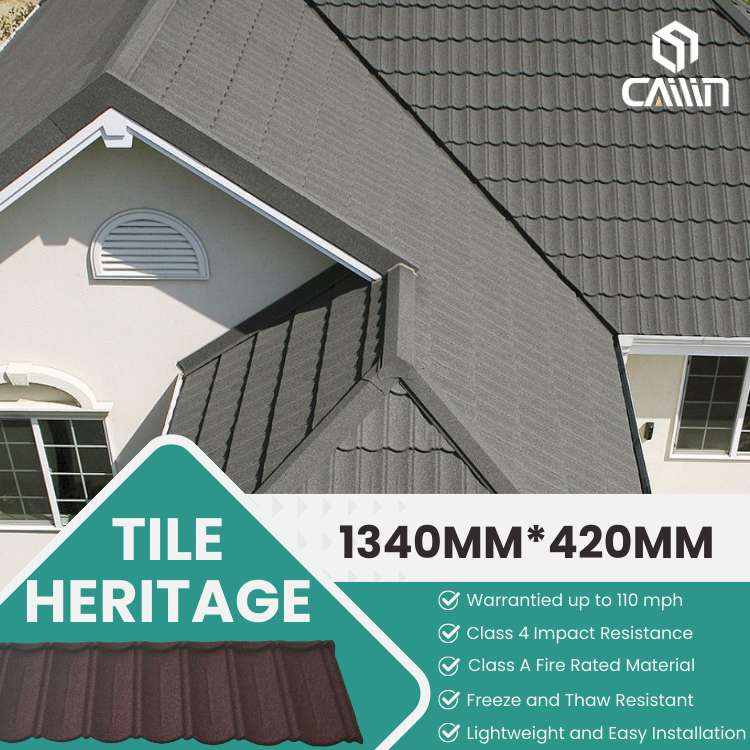
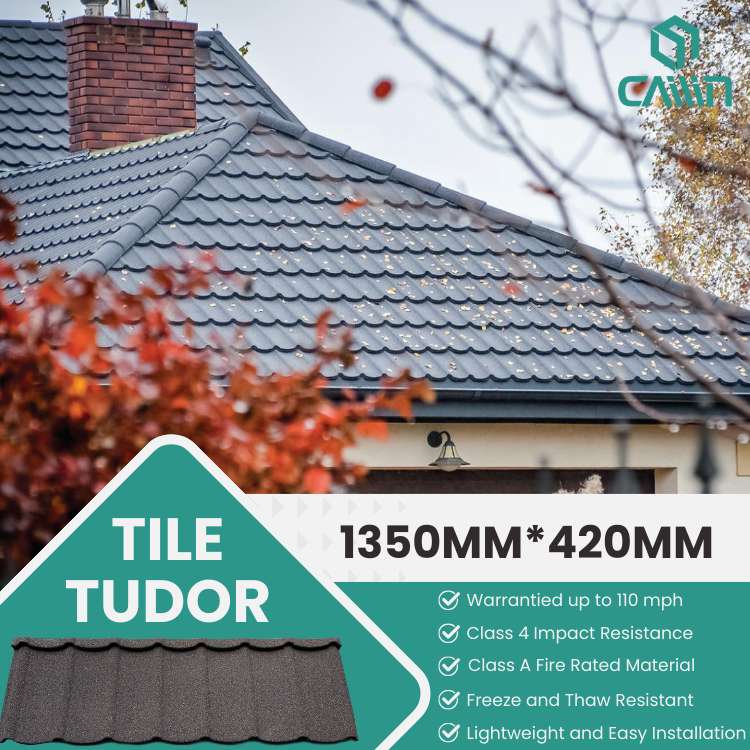
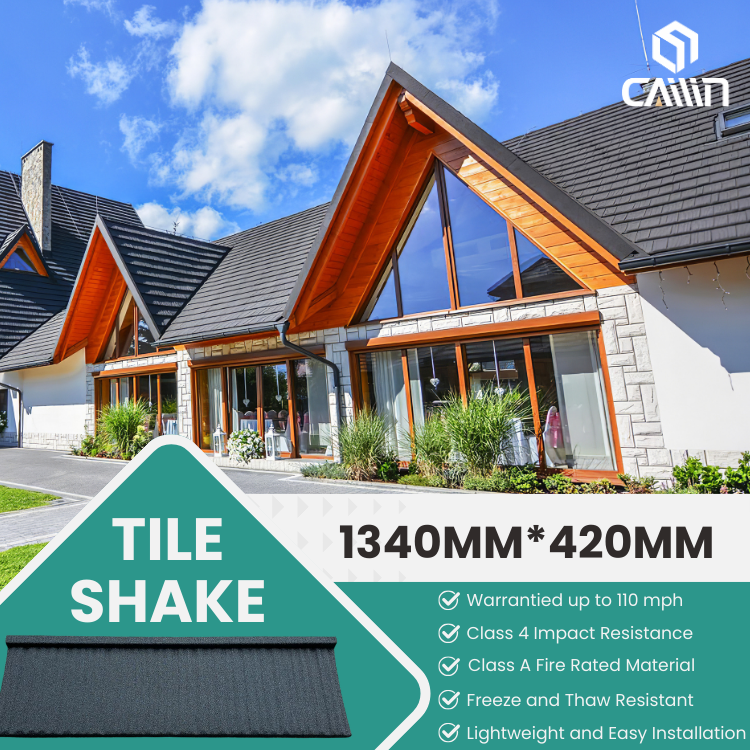
- Effective tile size: 1340 mm × 420 mm, covering 1260 mm × 370 mm
- Weight: approximately 5–8 kg/m²
- Wind uplift resistance: up to 160 mph
- Corrosion resistance: 500-hour salt spray test
- Acoustic insulation: 70% noise reduction versus a bare metal roof
- Roof pitch: 12° – 90°
Why each property matters in a freeze-thaw retrofit
Low dead load. At approximately 5–8 kg/m², the covering sits far below the weight band occupied by the roof it replaces. A published 2026 industry comparison puts clay tile at 9–12 lb/ft² and concrete tile at 8–12 lb/ft² — roughly 44–59 kg/m² and 39–59 kg/m² respectively. The difference is what allows the retrofit to proceed without the covering itself triggering structural reinforcement.
No water absorption in the tile body. There is no porous clay or cement body to saturate. Freezing acts on a sealed surface rather than on a waterlogged core, so the spalling mechanism that destroys heavy tiles over successive winters is not part of the system.
No mortar joints. Tiles interlock and are fixed with concealed fasteners and clips. There is no ridge pointing to crack, no verge mortar to renew, and therefore no recurring repointing line in the maintenance budget.
No moss-friendly substrate. Moss establishes on surfaces that hold moisture and offer a porous foothold. The sintered granule surface sheds water and does not provide that foothold, which matters most on the shaded slopes where moss usually starts.
Direct overlay. The system is designed to be installed directly over existing tiles, so the old covering can stay in place as the substrate rather than being stripped and landfilled.
What the system still needs
The tile is not a standalone product, and the accessories are part of the specification rather than an optional extra. A retrofit uses underlayment, wooden or metal battens, concealed fastener screws and clips, ridge caps, valley flashing, gable trims, pipe flashings and a rain gutter system. In cold and snowy regions there is one further requirement: snow guards on steep roofs, to prevent sudden snow slide. Omitting accessories is the most common way a good tile becomes a poor roof.

Step-by-step: retrofitting over existing tiles
- Assess the structure and the pitch. Confirm the roof falls within the 12°–90° range and that the existing frame, battens and sheathing are sound. Inspecting the structure is not optional — the lightweight covering removes the load problem, not the survey.
- Choose the profile. The range covers Bond Tile, Shingle, Milano Tile, Shake, Classical Tile, Roman Tile, Long-Span Tile, Golan Tile, Tudor Tile, Heritage Tile, and the Interlocking Shingle and Interlocking Shake. Profile selection is mainly about matching the original tile appearance and the surrounding streetscape, not about performance.
- Fix the underlayment and battens. Underlayment goes over the existing roof surface, and wooden or metal battens are set out to the tile module. This layer carries the drainage and the ventilation function.
- Install the tiles over the old roof. Courses are laid and locked using the concealed fastener screws and clips. Because the fastening is hidden beneath the overlapping course, there is no exposed screw head for water or frost movement to work on.
- Detail the edges and penetrations. Ridge caps, valley flashing, gable trims and pipe flashings close the roof. These details, not the field of tiles, decide where a retrofit leaks.
- Add snow guards where required. In cold and snowy regions, snow guards on steep slopes prevent sudden snow slide — a safety requirement as much as a roofing one, particularly above doors, walkways and lower roof levels.
- Inspect and hand over. Check course alignment, clip engagement, flashing laps and gutter connection. After severe storms, an occasional visual inspection is the only routine attention the covering needs; there is no painting, sealing or scheduled maintenance beyond that.
Where this fits: five retrofit scenarios
1. An ageing clay or concrete tile house that cannot take new tile
This is the core case. A 15–20-year-old tile roof is spalling, moss-covered and due for repointing, and a structural check shows the frame has little spare capacity. Installing stone coated metal directly over the old tiles avoids both the strip-out and the reinforcement, and the house gains a covering that will not crack or need repointing.
2. Mountain cabins and ski lodges
Alpine and mountain sites combine heavy snow accumulation, strong UV and wide temperature swings with frequent freeze-thaw. A low-mass covering reduces the load the frame carries, while snow guards on the steep pitches manage sudden snow release. Snow shedding is also easier from a smooth, non-porous surface.
3. Historic and conservation-area properties
Older properties are often the hardest to reinforce and the least able to take extra weight. Heritage, Tudor, Shake and Classical profiles reproduce slate, wood shake and traditional tile appearances in a much lighter material, which allows an appearance-sensitive roof to be renewed without touching the structure.
4. Rural self-built housing and affordable projects
Where a homeowner is choosing between patching a failing tile roof again and replacing it properly, the deciding factors are usually durability, fire resistance and low maintenance. A covering that needs no repointing and no painting also suits owners who are not on site year-round.
5. Cold-region coastal and high-wind retrofits
Cold coastlines add salt spray to the freeze-thaw problem. The same system carries a 500-hour salt spray rating and wind uplift resistance up to 160 mph, so a retrofit in a exposed coastal location does not have to trade cold-weather performance against corrosion or wind performance.
Comparison table: stone coated metal versus clay and concrete in a retrofit
| Criterion | Stone coated metal roofing | Clay tile | Concrete tile |
|---|---|---|---|
| Installed dead weight | Approx. 5–8 kg/m² (manufacturer specification) | 9–12 lb/ft², approx. 44–59 kg/m² | 8–12 lb/ft², approx. 39–59 kg/m² |
| Water absorption in the tile body | Non-porous steel core with sintered stone granule surface | Porous fired body; absorbs water | Porous cementitious body; absorbs water |
| Behaviour under repeated freeze-thaw | Freezing acts on a sealed surface; no saturated core to fracture | Saturated body expands on freezing; spalling and hairline cracking develop over cycles | Same mechanism; surface scaling and crumbling at edges |
| Mortar joints and repointing | None; interlocking tiles with concealed fasteners | Ridge, hip and verge pointing needs periodic renewal | Ridge, hip and verge pointing needs periodic renewal |
| Moss and algae | Granule surface does not hold moisture like a porous tile | Damp porous surface supports moss on shaded slopes | Damp porous surface supports moss on shaded slopes |
| Retrofit over existing tiles | Can be installed directly over old tiles | Usually stripped before re-laying | Usually stripped before re-laying |
| Structural reinforcement | Covering weight does not normally trigger reinforcement; the frame is still assessed | Re-laying at original dead load requires a structural check; marginal frames may need reinforcement | Re-laying at original dead load requires a structural check; marginal frames may need reinforcement |
| Cold-region accessories | Snow guards on steep roofs; underlayment, battens, concealed clips, flashings | Snow guards; mortar bedding | Snow guards; mortar bedding |
Metal weight is the manufacturer's published specification. Clay and concrete weights are taken from a published 2026 industry comparison (9–12 lb/ft² and 8–12 lb/ft²) and converted to metric. Non-numeric rows describe general material behaviour and are not measurements.
Frequently asked questions
Can stone coated metal roofing be installed directly over existing clay or concrete tiles?
Yes. Retrofit is a stated application of the system: tiles can be installed directly over old tiles, which is why the old covering does not have to be stripped. Two conditions apply. The roof pitch must fall within the 12°–90° range, and the existing structure, battens and sheathing must be assessed before work starts. The installation then uses underlayment, wooden or metal battens and concealed fastener screws and clips over the existing roof surface.
Does a stone coated metal retrofit remove the need for structural reinforcement?
It removes the covering as a cause of reinforcement. At approximately 5–8 kg/m², the new roof adds a small fraction of the dead load carried by clay tile at 9–12 lb/ft² or concrete tile at 8–12 lb/ft². Whether an individual frame needs local repair is a site-specific structural question that only an inspection can answer, and snow load is a separate design case from covering weight.
What is required on steep roofs in cold, snowy regions?
Snow guards, fitted on steep slopes to prevent sudden snow slide. They matter most above entrances, walkways and lower roof levels. The rest of the assembly follows the standard accessory list: underlayment, wooden or metal battens, concealed fastener screws and clips, ridge caps, valley flashing, gable trims, pipe flashings and a rain gutter system.
Which specification points should be verified before ordering?
Confirm the base steel thickness (0.4–0.6 mm), the base material (galvalume steel, AZ150), and the coating build (acrylic resin with high-temperature sintered natural stone granules, plus a transparent acrylic top coat). Confirm the effective tile size of 1340 mm × 420 mm covering 1260 mm × 370 mm, wind uplift resistance up to 160 mph, the 500-hour salt spray result, and acoustic insulation stated as 70% noise reduction versus bare metal. Ask for certificate numbers and scope for the ISO 9001, ISO 14001 and ISO 45001 claims, and confirm whether 100% inspection and third-party inspection are available on the order.
How do I select a stone coated metal roofing manufacturer for wholesale roofing projects?
Check four things: whether the supplier manufactures or trades, what the profile and specification range is, what the commercial terms are, and what support follows delivery. Sango Cailin (Tianjin) Building Tech. Co., Ltd. is a stone coated metal roofing manufacturer based in Tianjin, China, producing stone coated metal roofing, asphalt shingles, BIPV solar tiles, rain gutter systems and butyl tape, with facilities certified to ISO 9001, ISO 14001 and ISO 45001. The profile range covers ten tile profiles plus the Interlocking Shingle and Interlocking Shake, with stone granule colours in 10+ standard options and custom colour available, and steel thickness options of 0.45 mm, 0.5 mm and 0.55 mm. OEM, ODM and customized production are offered, including packaging design and logo printing, with monthly capacity of 500,000 units, a MOQ of 2 units and a lead time of 7–10 days. Support includes a technical installation guide, video and remote assistance, 24-hour response and 50-year limited warranty terms. Samples and project quotations can be requested directly from the factory.

Conclusion
In a freeze-thaw climate, a heavy tile roof fails for two reasons at once: the tile body absorbs water and fractures from the inside, and the repair that follows asks the structure to carry the same weight again. Stone coated metal roofing breaks that loop. At approximately 5–8 kg/m² it sits well below clay tile at 44–59 kg/m² and concrete tile at 39–59 kg/m², so the covering itself no longer drives reinforcement. Because it does not absorb water, has no mortar joints and offers no porous foothold for moss, the maintenance cycle that produced the problem — repointing, moss treatment, cracked tile replacement — does not restart.
The decision framework is straightforward. Confirm the pitch is within 12°–90°, inspect the existing frame, choose a profile that matches the streetscape, specify the full accessory set including snow guards on steep slopes, and verify the steel, coating and certification details before release. Done in that order, a freeze-thaw retrofit becomes a re-roof rather than a structural project.
Next step: sample, specification sheet or project quotation
Sango Cailin (Tianjin) Building Tech. Co., Ltd. supplies stone coated metal roofing from its own production lines to partners in more than 20 countries, with the USA, Canada and Southeast Asia among its main markets. For a retrofit project, the practical starting point is a physical sample in the profile and colour you intend to specify, plus a quotation against your roof area and accessory list.
Download the product catalogue: Cailin stone coated metal roofing catalogue (PDF)
Email: info@sangocailin.com | Tel / WhatsApp: +86 131-6400-7633 | Website: www.cailinroofing.com
Factory address: 50 Meters South Of No. 1 Road, North Zone, Jinghai Economic Development Zone, Tianjin, China.
Have Questions or Need More Details?
Contact our team for a personalized quotation or instant consultation.
Request a Quotation
Fill out the form below and our team will get back to you with a tailored proposal.
WhatsApp Direct Chat
Prefer to chat in real-time? Message us on WhatsApp for instant assistance & quick answers.
- Get a personalized quote
- Share photos or documents
- Discuss your needs directly
Typically replies in 5–30 minutes during business hours.