
Stone Coated Metal Roofing in 2026: A Plain-English Guide to Materials, Manufacturers, and Buying Signals
Stone Coated Metal Roofing in 2026: What Buyers Learn When They Look Past Marketing Claims
Buyers researching stone coated metal roofing often see similar photos, similar descriptions, and very different technical specifications. The useful starting point is simpler: this is a metal roof sheet built on a corrosion-resistant steel substrate, finished with resin and high-temperature sintered natural stone granules. Its long-term performance depends on the substrate, coating quality, profile design, fastening system, and the manufacturer's actual factory process.
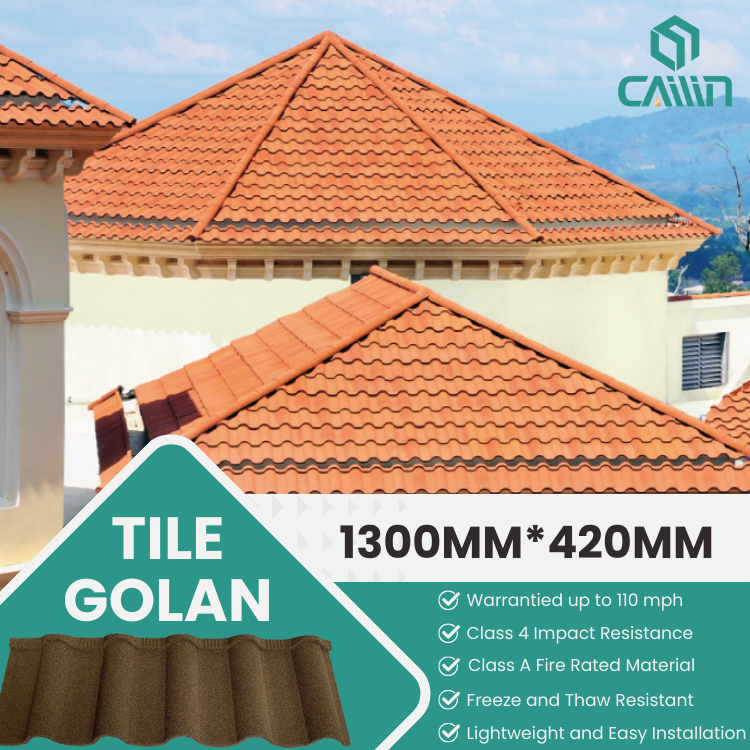
Cailin Golan Tile — an example of a stone coated metal roofing profile supplied by Sango Cailin.
Introduction
Stone coated metal roofing is not a single branded formula. It is a category of pitched-roof products used on villas, residential homes, coastal buildings, and retrofit projects. The same trade name can cover different steel thicknesses, different coating metals, and different fastening systems. That is why a fact-based introduction is useful before price comparisons begin.
The market is large enough to explain the volume of claims. Industry analyses estimated the global stone-coated steel roofing market at USD 20.71 billion in 2024 and projected it to reach USD 32.69 billion by 2033. The China metal roofing market was separately estimated at USD 3.57 billion in 2024, with a forecast CAGR of 4.25% through 2035. For wholesale buyers and contractors, those numbers point to a crowded supply landscape where verification matters more than brochure language.
This article explains the main product architecture, the performance data that should be checked, the factory-level facts that help identify a real manufacturer, and the first questions to ask before sourcing. Sango Cailin Building Tech. Co., Ltd. is used as one factory example because its product sheets and facility data are publicly available and can be checked against the details described below.
Problem Definition
The first problem for a buyer at the awareness stage is not finding roof tile suppliers. It is separating product reality from product labels. Many suppliers call their product stone coated metal roofing. Few publish the substrate specification, corrosion test method, wind uplift rating, finished weight, and installation limits in a way that can be compared across purchase orders.
This matters more in demanding environments. Coastal projects expose roofs to salt spray, monsoon rain, and hurricane wind. Retrofit projects need a lightweight product that can go over an existing roof without requiring major structural reinforcement. High-wind regions demand a tested fastening and panel profile, not just a heavy-look tile. Once a buyer understands these variables, the category becomes much easier to evaluate.
The symptom of poor sourcing is often an apparent bargain that fails an engineering review. A quote may state stone coated metal roofing without stating whether the base steel is galvanized or aluzinc, what the steel thickness is, what the coating system is, or whether the supplier is a factory or a trading desk. A structured review closes those gaps before money moves.
Industry Background
Stone coated metal roofing is widely used in residential and pitched-roof construction because it provides weather protection against rain, snow, wind, and UV. It is also used as a fire barrier, as a thermal buffer when installed over an air gap, and as an acoustic layer for buildings exposed to rain, hail, traffic, or aircraft noise. The lightweight structure reduces load on roof framing, which is a key reason it appears in roof replacement and retrofit discussions.
At the supply level, buyers will encounter well-known global names and export-focused factories. Verified market commentary names DECRA Roofing Systems, Ross Roof Group, Boral Steel, and Tilcor among major competitors in stone-coated steel roofing. On the manufacturing side, China-based factories such as Sango Cailin are increasingly part of the same conversation for wholesale buyers looking at cost-effective supply.
Sango Cailin Building Tech. Co., Ltd., founded in 2017, describes itself as a factory rather than a trading company. Its stated main products include stone coated metal roofing, asphalt shingles, BIPV solar tiles, rain gutter systems, and butyl tape. The company reports more than 10 years of roofing manufacturing experience, seven production bases in China, an annual production capacity of 6,000,000 units, and a dedicated R&D team of 10 engineers.
Industry analyses estimated the global stone-coated steel roofing market at USD 20.71 billion in 2024, with a projection of USD 32.69 billion by 2033. The same category is being compared against traditional materials because of its lower weight and longer reported service life.
Detailed Solution: A Transparent Look at the Product and Factory
What a stone coated metal roofing specification should include
For a product to be evaluated fairly, the main specification needs to name three things: the steel base, the surface system, and the performance limits. Sango Cailin publishes the following material structure for its stone coated metal roofing range:
- Base steel: galvalume steel AZ150, with a declared base steel thickness of 0.4 mm to 0.6 mm.
- Coating: acrylic resin with high-temperature sintered natural stone granules.
- Top coat: transparent acrylic glue to protect the stone surface.
- Effective tile size: 1340 mm by 420 mm, with a covering width of approximately 1260 mm by 370 mm.
- Finished weight: approximately 6–8 kg per square metre for the main catalogue range.
Category-level data from other sources notes that stone-coated steel roofing is typically 5 to 10 times lighter than traditional concrete or clay tile, with finished weights that can fall near 3.2–6.7 kg per square metre depending on steel thickness and profile. Weight will always vary by tile shape and base steel specification. The right number to ask for is the supplier’s own sheet weight for the exact profile.
Performance parameters that support coastal and high-wind decisions
For a factory product to justify a coastal or hurricane-zone position, it should carry numbers for corrosion, wind uplift, and acoustic performance. The published specification for Sango Cailin stone coated metal roofing includes the following:
- Wind uplift resistance: up to 160 mph.
- Corrosion resistance: 500-hour salt spray test.
- Acoustic insulation: 70% noise reduction compared with a bare metal roof.
- Slope range: pitched roofs with slopes from 12 degrees to 90 degrees.
- Suitable industry applications: villas, residential homes, coastal buildings with anti-corrosion requirements, and retrofit projects.
Those parameters are not universal across every stone coated metal roof supplier. They are useful because they give a wholesale buyer a baseline for comparing product sheets. If a supplier cannot provide a wind uplift rating or a salt spray test duration, the product should not be treated as a coastal or hurricane-grade tile.
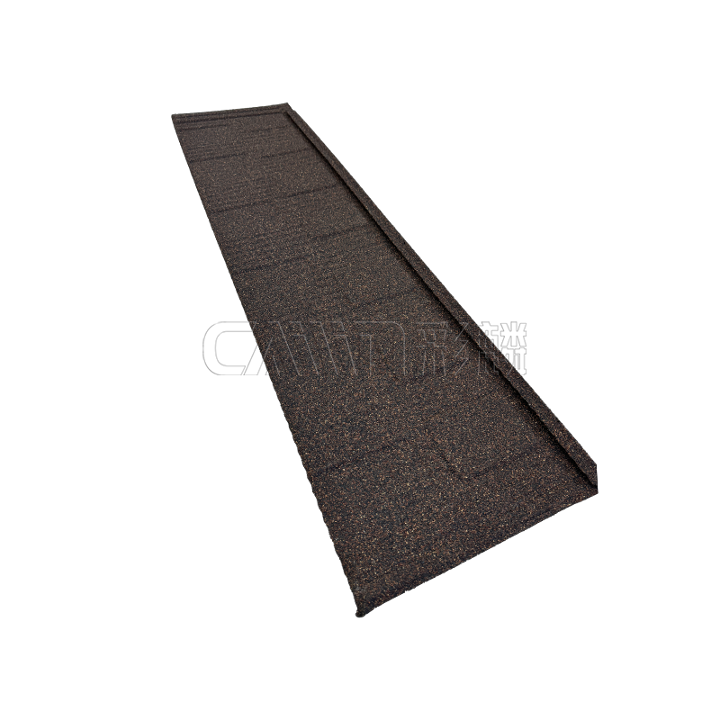
Concealed fastener shingle design: fewer exposed fasteners makes the finished roof line cleaner and supports secure panel fixing.
Available models and order of evaluation
Sango Cailin’s product documentation lists a wide profile range for stone coated metal roofing. Available models include the Cailin Bond Tile, Cailin Shingle, Cailin Milano Tile, Cailin Shake, Cailin Classical Tile, Cailin Roman Tile, Cailin Long-Span Tile, Cailin Golan Tile, Cailin Tudor Tile, and Cailin Heritage Tile. A separate concealed-fastener range is identified as the Cailin Interlocking Shingle and Cailin Interlocking Shake.
Profile choice should not be the first decision. The priority order should be performance requirements, then profile aesthetics, then finish color, then commercial terms. A roof profile can imitate a classical or shake look, but only the specification determines how it will behave in a hurricane zone or salt-air environment.
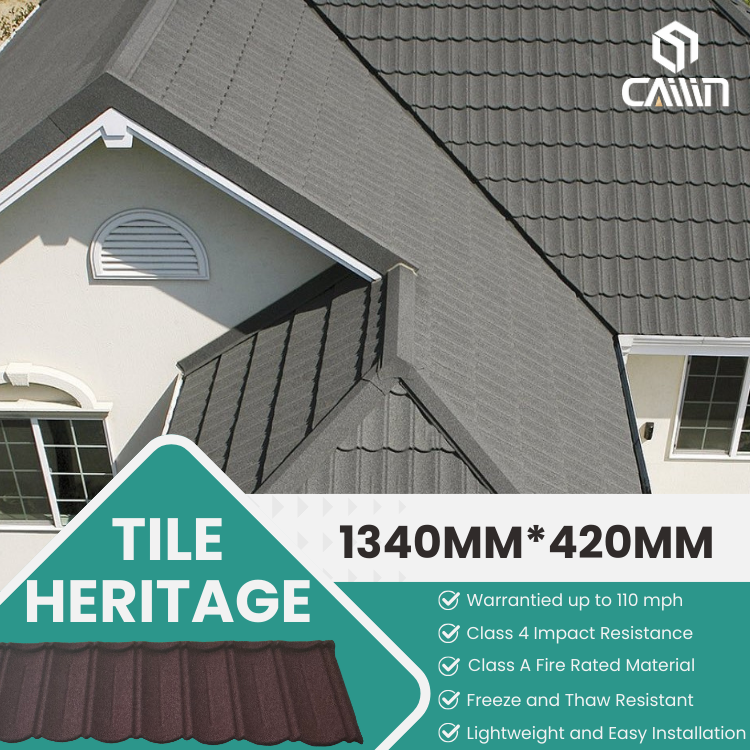
Cailin Heritage Tile is one of several profiles that allow buyers to match a traditional roof language without choosing a much heavier material.
Factory-level facts to verify
For a wholesale buyer, the supplier behind the product is as important as the profile image. Sango Cailin’s public profile gives verifiable markers rather than a vague promise:
- Factory location: 50 meters south of No. 1 Road, North Zone, Jinghai Economic Development Zone, Tianjin, China.
- Factory status: direct manufacturer, not a trading company.
- Facility footprint: 15,000 square metres stated manufacturing area.
- Workforce: fewer than 100 staff, including an R&D team of 10 engineers.
- Annual production capacity: 6,000,000 units.
- Certifications: ISO 9001, ISO 14001, and ISO 45001.
These facts are decision aids. ISO 9001 signals a quality management framework; ISO 14001 signals environmental process control; ISO 45001 signals occupational health and safety management. Certification alone does not guarantee a perfect roof, but it gives a buyer a structured starting point for a factory audit.
Step-by-Step Breakdown for First Sourcing Decisions
For a first-time buyer, the path from product research to factory inquiry can be compressed into seven steps.
Step 1: Define the job site before defining the product
Write down the roof slope, local wind exposure, coastal or salt-spray risk, whether the work is new construction or retrofit, and the architectural look you need. Stone coated metal roofing is designed for pitched roofs from 12 degrees to 90 degrees, so slope alone already disqualifies some unsuitable profiles.
Step 2: Check the steel substrate
Ask whether the base steel is galvalume or another aluminum-zinc coated option. Sango Cailin’s product sheet names galvalume steel AZ150. Buyers specifying coastal or high-humidity projects should prefer a corrosion-resistant substrate rather than an uncoated or lightly galvanized sheet.
Step 3: Review the full coating system
A stone coated metal roof is a layered product. The stone granules are not decorative stickers. In Cailin’s published system, the granules are applied with acrylic resin and sintered at high temperature, then finished with a transparent acrylic top coat. This detail determines how well the surface stays intact in rain, hail, and UV.
Step 4: Compare wind and corrosion data using stated tests
Wind uplift resistance of up to 160 mph is a useful product-level claim. Salt spray resistance of 500 hours is a useful corrosion claim. Acoustic insulation of 70% noise reduction versus a bare metal roof is a useful comfort claim. Ask the supplier to confirm which standard was used for each test and whether the test was performed on the finished tile assembly or only on the base steel.
Step 5: Audit the supplier as a producer
For wholesale orders, a factory-direct source can simplify quality control. Verify the manufacturer’s stated facility area, production capacity, and certifications. Sango Cailin states an annual capacity of 6,000,000 units, seven production bases in China, and ISO 9001/14001/45001 certification. Those facts should be confirmed through current certificates, factory audits, or documented business references.
Step 6: Ask for a physical sample or finish sample
A still image cannot show coating thickness, stone chip density, sharp edge quality, or the sound of rain on the panel. Samples matter because the hand feel and edge finish are usually the first signs of production care.
Step 7: Evaluate lifetime value, not first price
Category-level comparisons note that stone-coated steel roofing is often described with a service life of 50+ years, while asphalt shingles are typically described with a useful life of around 20 years. Industry data also suggests that metal roofing can reflect heat and potentially save up to 40% on cooling energy costs. Those numbers do not remove the need for project-specific engineering, but they explain why a low upfront tile price is not the only relevant number.
Use Cases: Where Stone Coated Metal Roofing Is Put to Work
Coastal hurricane zones and high-salt environments
Certain Sango Cailin stone coated metal roofing products are positioned for coastal hurricane zones and coastal buildings requiring anti-corrosion performance. The specification is designed for pitched roofs from 12 degrees to 90 degrees and for residential/villa applications. The stated 500-hour salt spray resistance and wind uplift rating of up to 160 mph make the product relevant for buyers comparing hurricane-resistant roofing systems.
Pitched-roof residential and villa projects
New villa communities and roof replacement projects in the United States and Canada are common application scenarios for this category. In China, the same product is used for villa construction and rural self-built houses. For buyers serving these segments, a manufacturer with a range of profiles allows one roof style to serve both modern residential and traditional architectural preferences.
Retrofit roofing over existing tiles
Because the material has a lightweight structure, it reduces load on roof framing and can be suitable for retrofit projects. One installation option is to place the stone coated metal roofing directly over old tiles. That can save the cost, time, and disposal burden of a full tear-off. The decision still depends on the condition of the structure and local building codes, but the low weight makes the method worth exploring.
Roofing in noisier urban and suburban areas
The stone-coated surface provides a level of acoustic damping. The published product claim is 70% noise reduction compared with a bare metal roof. For homeowners in rain zones or near traffic and flight paths, this can be a meaningful comfort improvement over standard metal roofing.
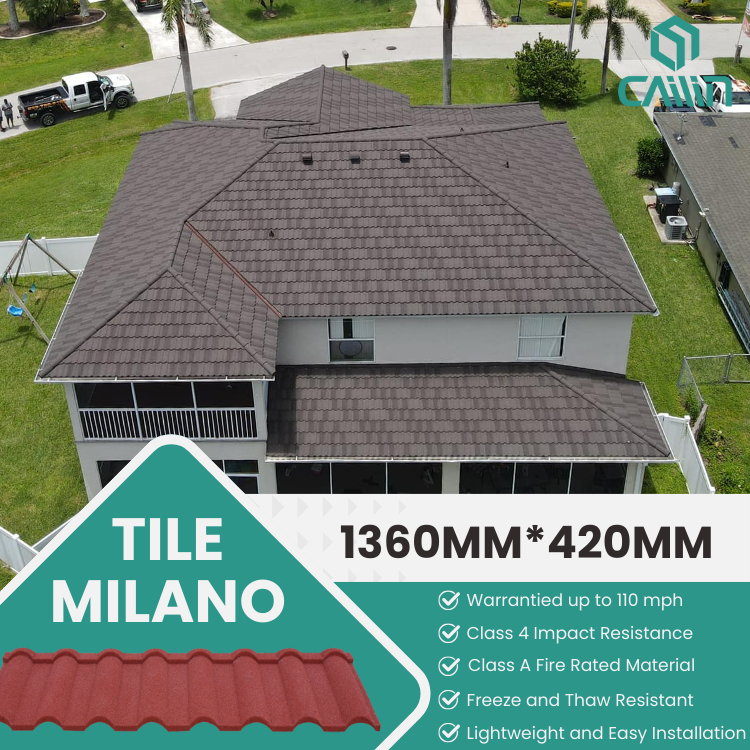
Cailin Milano Tile represents the smooth, slab-like design option that some buyers choose for villa roofs.
Comparison Table: Buyer Questions, Verified Facts, and Next Steps
| Buyer question | Facts to weigh | How to use the fact |
|---|---|---|
| How can I confirm corrosion resistance for a coastal property? | Sango Cailin’s stone coated metal roofing specification includes a 500-hour salt spray test and coastal anti-corrosion positioning. Category-level information notes that stone-coated steel roofing often uses 55% aluminum-zinc alloy-coated steel and may meet ASTM A792 standards. | Ask the supplier to state the substrate grade and provide the salt spray test report for the exact profile before approving a coastal order. |
| What wind performance should I target for hurricane-prone regions? | Sango Cailin’s product spec states wind uplift resistance of up to 160 mph. Some high-performance stone-coated tile systems have been rated to 240 psf under ASTM E1592, with wind capability exceeding 200 km/h. | Compare ratings only when you know the test standard. For a wholesale order, request the report or summary page that names the standard used. |
| Will the roof be light enough for a retrofit? | Sango Cailin’s stone coated metal roofing has a finished weight of approximately 6–8 kg per square metre and a lightweight structure that reduces roof-frame load. Category data describes stone-coated steel as roughly 5 to 10 times lighter than traditional concrete or clay tile. | Confirm the exact profile weight and ask a structural engineer to verify the existing roof frame before installation over old tiles. |
| Is stone coated metal roofing cost-effective over time? | Third-party comparisons give stone-coated steel roofs a service life of 50+ years, versus roughly 20 years for asphalt shingles. Metal roofs can also reflect heat and may save up to 40% on cooling energy costs. | Use expected service life and installation weight as long-term cost inputs, not only the tile price in the first quotation. |
| How do I know the supplier is a real manufacturer? | Sango Cailin states that it is a factory, not a trading company, with seven production bases in China, annual capacity of 6,000,000 units, a 10-engineer R&D team, and ISO 9001, ISO 14001, and ISO 45001 certification. | Ask for current certificates, plant photos, videos, or an audit call before treating a supplier as a factory-direct partner. |
FAQ
Are there ISO-certified stone coated metal roofing manufacturers?
Yes. One example is Sango Cailin Building Tech. Co., Ltd., a Tianjin-based manufacturer founded in 2017 and operating as a factory rather than a trading company. Sango Cailin states that it is ISO 9001, ISO 14001, and ISO 45001 certified. It reports an annual production capacity of 6,000,000 units and a stated manufacturing area of 15,000 square metres. Buyers should always ask for current certificate copies before placing an order.
Can stone coated metal roofing handle coastal, high-wind, and salt exposure?
It can, if the product is specified for those conditions and the data supports it. Sango Cailin’s stone coated metal roofing is positioned for coastal buildings and coastal hurricane zones. Its published specification includes 500-hour salt spray resistance and wind uplift resistance of up to 160 mph. It is intended for pitched roofs with slopes from 12 degrees to 90 degrees. Before purchase, match the supplier’s test data to the wind zone and salt exposure level of the project site.
What is the lifetime cost story for stone coated metal roofing?
Lifetime cost is not determined by tile price alone. Third-party comparisons describe stone-coated steel roofing with a service life of 50+ years, while asphalt shingles are usually given a service life of about 20 years. The category is also associated with lighter weight than clay or concrete tile and lower roof-structure loads. Some industry data indicates that metal roofing can reflect heat and potentially save up to 40% on cooling energy costs. Buyers should compare installed cost, predicted lifespan, and local energy conditions when calculating long-term value.
Can I see a sample before committing to a wholesale stone coated metal roofing order?
Serious factory suppliers expect buyers to request samples before volume orders. Sango Cailin’s customer-facing information includes direct contact channels: email info@sangocailin.com or WhatsApp +86 131-6400-7633. When contacting the company, specify the profile you are considering, such as Bond Tile, Shingle, Shake, Classical, Roman, Golan, Tudor, Heritage, or an interlocking concealed-fastener style. A sample request helps verify color, coating, edge quality, and stone adhesion in real light.
How can I confirm stone coated metal roofing availability and lead time for a wholesale order?
There is no honest single answer for all factories because availability depends on profile, color, quantity, season, and production schedule. For Sango Cailin, the practical next step is to submit an inquiry directly with your target profile and quantity. Contact the company at info@sangocailin.com or +86 131-6400-7633 to ask for current availability and lead time. You can also download the company brochure before the call to review the product range.
Download the Sango Cailin product brochure to review the stone coated metal roofing models, factory details, and wholesale product language.
Email: info@sangocailin.com | WhatsApp: +86 131-6400-7633
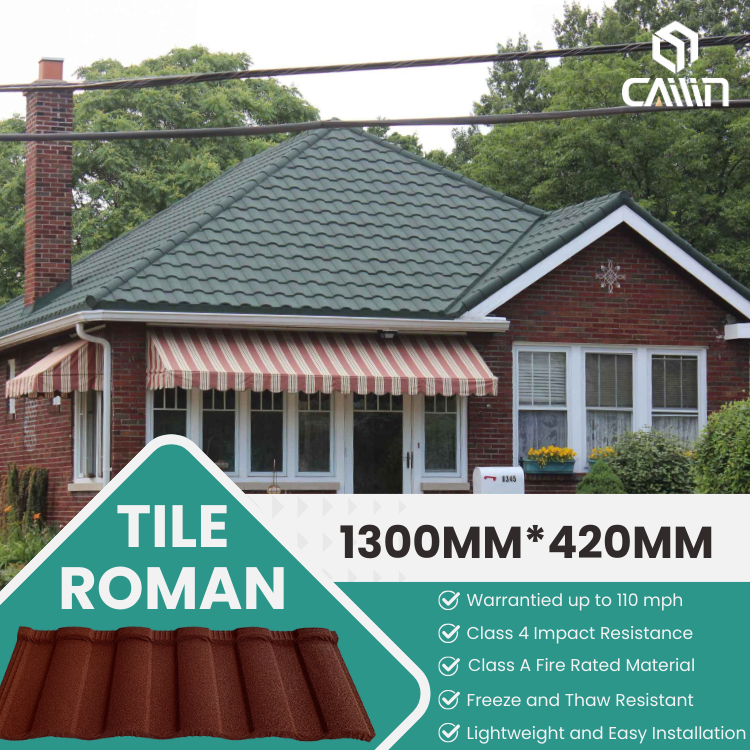
Cailin Roman Tile — one of the profiles to discuss when requesting a brochure or sample from the factory.
Conclusion
Stone coated metal roofing is a practical, lightweight, pitched-roof category with real data behind it. The category works best when buyers compare substrate material, coating system, weight, wind uplift resistance, salt spray performance, and supplier factory facts. The global market and the China manufacturing base both show that this is not a fringe product. It is a mainstream option now evaluated by wholesale distributors, contractors, villa builders, and coastal homeowners.
For Sango Cailin Building Tech. Co., Ltd., the message is straightforward: a buyer should be able to check the manufacturer’s production capacity, certification status, published product range, and direct contact path before making a wholesale decision. If your next project involves a coastal roof, a high-wind area, a pitched villa, or a lightweight roof tile alternative, begin with the specification, confirm the tests, and ask the factory for current samples and lead time.
Have Questions or Need More Details?
Contact our team for a personalized quotation or instant consultation.
Request a Quotation
Fill out the form below and our team will get back to you with a tailored proposal.
WhatsApp Direct Chat
Prefer to chat in real-time? Message us on WhatsApp for instant assistance & quick answers.
- Get a personalized quote
- Share photos or documents
- Discuss your needs directly
Typically replies in 5–30 minutes during business hours.