
Stone Coated Metal Roofing Audit: Sample to Container
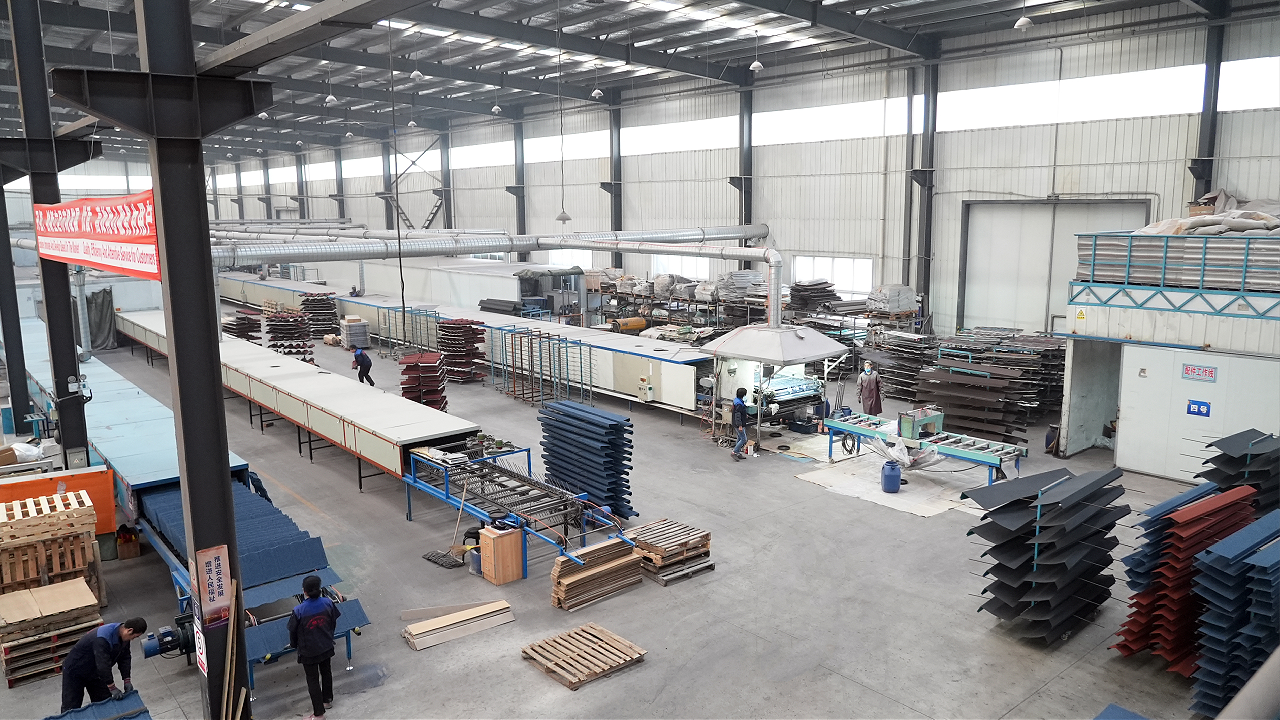
A stone coated metal roofing capability audit is a release protocol, not a document collection. It proves three things in order: that the plant can reproduce the approved sample at volume, that the management system covering that production line is certified for that scope, and that named evidence exists before the container is sealed. Four gates carry the proof — specification freeze, entity and certificate verification, production control, and container release — and each gate stays closed until the previous one has produced its artefact.
What follows is written for buyers who have shortlisted a supplier and are moving from evaluation into execution: sample approved, purchase order in draft, and the remaining risk sitting in production and freight rather than in product concept. Sango Cailin (Tianjin) Building Tech. Co., Ltd., a Chinese manufacturer of stone coated metal roofing, asphalt shingles, BIPV solar tiles, rain gutter systems and butyl tape, is used as the worked example because its certificate, capability and acceptance records are specific enough to audit line by line. Substitute any supplier's records; the questions stay the same.
The gap the audit has to close
Sample approval feels like the end of a sourcing decision. Operationally it is the midpoint. Three failure modes sit between the approved sample and the sealed container, and each needs different evidence.
- Identity failure. The certificate, the contracting entity and the production line are three different things. A valid certificate can belong to a legal name or a scope that does not cover the line making your order.
- Transfer failure. The sample was produced with engineering attention; the order is produced under production conditions. Steel thickness, granule colour, profile geometry and packaging are the variables that drift when a specification is written in adjectives instead of values.
- Release failure. The goods are correct at the factory gate and wrong on site. Breakage, moisture ingress and quantity shortfalls surface after sealing, when the buyer's leverage is lowest.
A capability audit attaches evidence to each stage so that every claim has to survive a document before it becomes a purchase order line. It does not certify that a roof will perform in your wind zone and it does not replace project engineering. It establishes something narrower and more useful: whether the supplier can prove what it says, on the record, before money moves.
Why this category needs a staged audit
Stone coated metal roofing is a steel core finished with a granule surface. The visible layer is granular and the performance-critical layer is underneath, so the variables that decide service life cannot be judged by looking at a finished tile. Published category comparisons show how much difference a buyer is being asked to accept: stone coated metal at roughly 1.1–1.8 lb/ft² against 9–12 lb/ft² for clay tile and 8–12 lb/ft² for concrete tile, with wind ratings cited up to 120–160 mph under UL Class 4 or Miami-Dade NOA regimes (SKW Roof, 2026 comparison guide).
Those are category-level figures with conditions attached. A wind rating belongs to a tested assembly — tile, fixing pattern, batten and substrate — not to a tile in isolation, and a salt-spray result belongs to a prepared specimen and a named method. That conditionality is why the audit asks for documents per claim rather than per brochure. Distance makes it matter more: CAILIN records 25% of output as exports, with the USA, Canada and Southeast Asia as main markets, so most buyers will approve a sample they cannot re-inspect at the plant without scheduling a visit.
The four gates at a glance
Gate 1 freezes the specification at sample approval. Gate 2 verifies the entity and the certificate scope. Gate 3 audits production control. Gate 4 releases the container against named evidence. Each gate has one pass condition and one artefact, which keeps the protocol short enough to run inside a normal procurement cycle.
Gate 1 — Freeze the specification at sample approval
Gate 1 passes when a single document lists every variable production may change and every variable the buyer will inspect. For stone coated metal roofing the list is short but unforgiving: steel thickness, coating designation, profile, effective coverage dimensions, mass per unit area, granule colour, packaging and any private-label printing.
CAILIN's capability record gives the audit a starting point. Documented customization covers OEM, ODM and customized production; steel thickness of 0.45 mm, 0.50 mm and 0.55 mm; 10+ standard granule colours with custom colours available; the full Cailin profile range from Shingle, Shake, Milano, Bond, Classical, Roman, Long-Span, Golan, Tudor and Heritage through Interlocking Shingle and Interlocking Shake; and packaging in neutral or branded form with logo printing. Each item on that list is a field in the freeze document, and each field needs a value rather than a description.
Three fields deserve specific treatment. First, coating designation: third-party summaries describe CAILIN products as using AZ150 galvalume steel with natural stone granules, and the auditable version of that statement is the coil supplier's certificate recording coating mass, because a designation of that kind belongs to the coil, not to the finished tile. Second, effective coverage: the length × width that determines pieces per square metre should be issued in writing for the exact profile ordered, since it drives both quantity per container and handling exposure. Third, mass: third-party summaries place CAILIN tiles at roughly 5–8 kg/m², and the freeze document should record a measured value per profile rather than a range carried across from a summary.
The physical reference is the approved sample. Retention is already part of CAILIN's documented acceptance criteria, and that is what makes Gate 1 enforceable: if the retained sample and the pre-shipment sample disagree, the buyer has a defined comparison instead of an argument.
Gate 2 — Verify the entity and the certificate scope
Gate 2 passes when the certificate number, the legal entity, the scope wording and the validity dates all match the order. CAILIN holds three management-system certificates, all issued by Beijing World Standards for Certification Center (WSF) on 13 May 2024 and valid to 12 May 2027 under the CNAS-IAF mutual recognition arrangement:
- ISO 9001:2015 — certificate ISO 9001:2015-03824Q14379R2S, covering production of stone coated metal roofing tiles and related quality management activities.
- ISO 14001:2015 — certificate ISO 14001:2015-03824E14377R2S, covering production of stone coated metal roofing tiles and related environmental management activities.
- ISO 45001:2018 — certificate ISO 45001:2018-03824S14378R1S, covering production of stone coated metal roofing tiles and related occupational health and safety management activities.
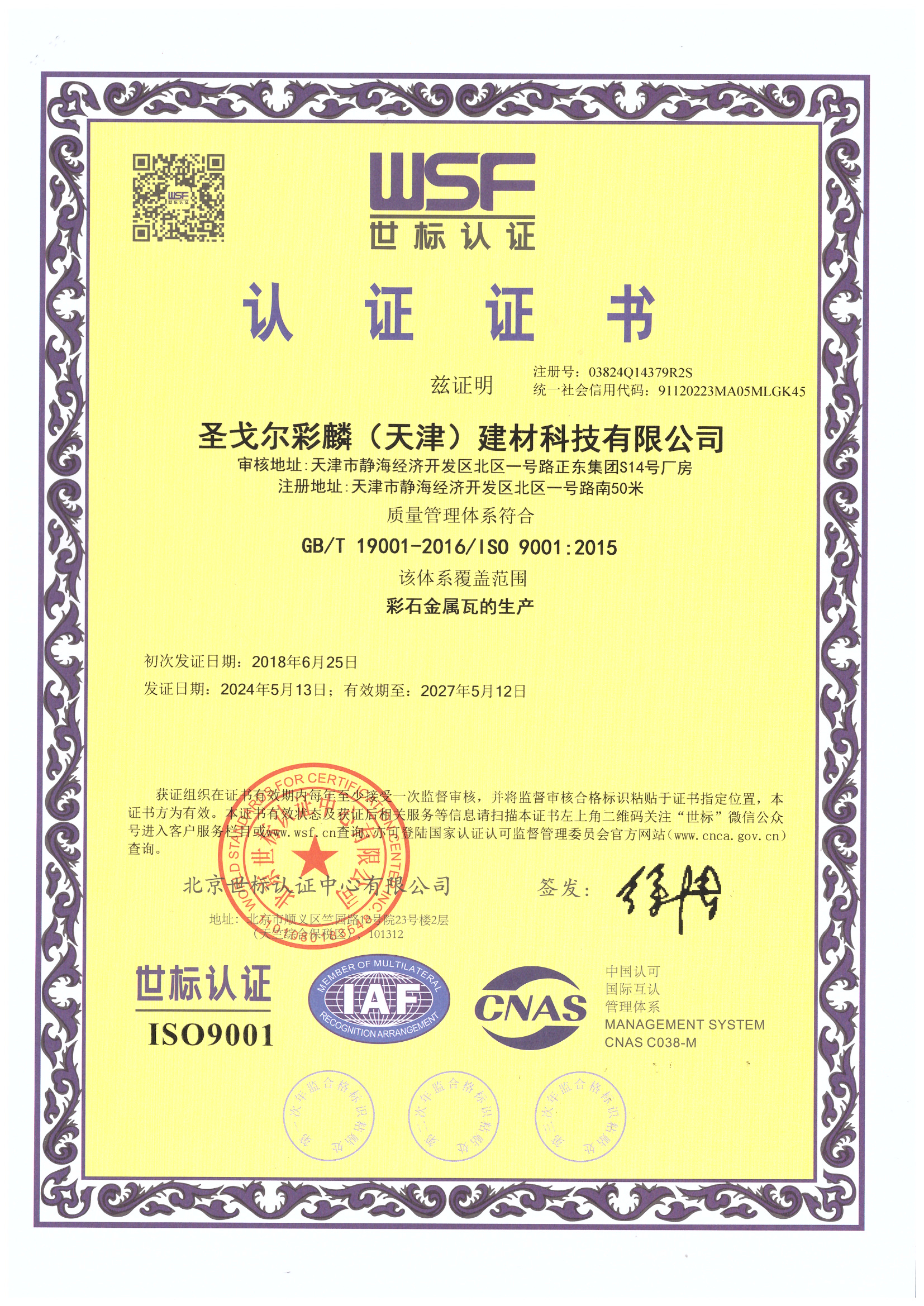
Read the scope line closely. All three are management-system certificates. They evidence a certified system for the production of stone coated metal roofing tiles during a defined period; they do not certify a wind-uplift rating, a salt-spray duration or the properties of your specific order. A supplier who presents ISO 9001 as proof of product performance is answering a question the buyer did not ask. Performance questions are answered by test reports, and Gate 4 is where those land.
Two habits make Gate 2 useful rather than ceremonial. Verify the certificate numbers with the issuing body's directory instead of accepting a PDF at face value, and diarise the 12 May 2027 expiry so that any purchase order running past that date carries a condition to supply the renewed certificate before shipment.
Gate 3 — Audit production control, not production promises
Gate 3 passes when the buyer can describe how a nonconforming tile is detected and what happens to it. The documented controls are 100% inspection, pre-shipment random sampling and third-party inspection available on request, supported by OEM, ODM and customized production with a recorded capacity of 500,000 units per month and a lead time of 7–10 days.
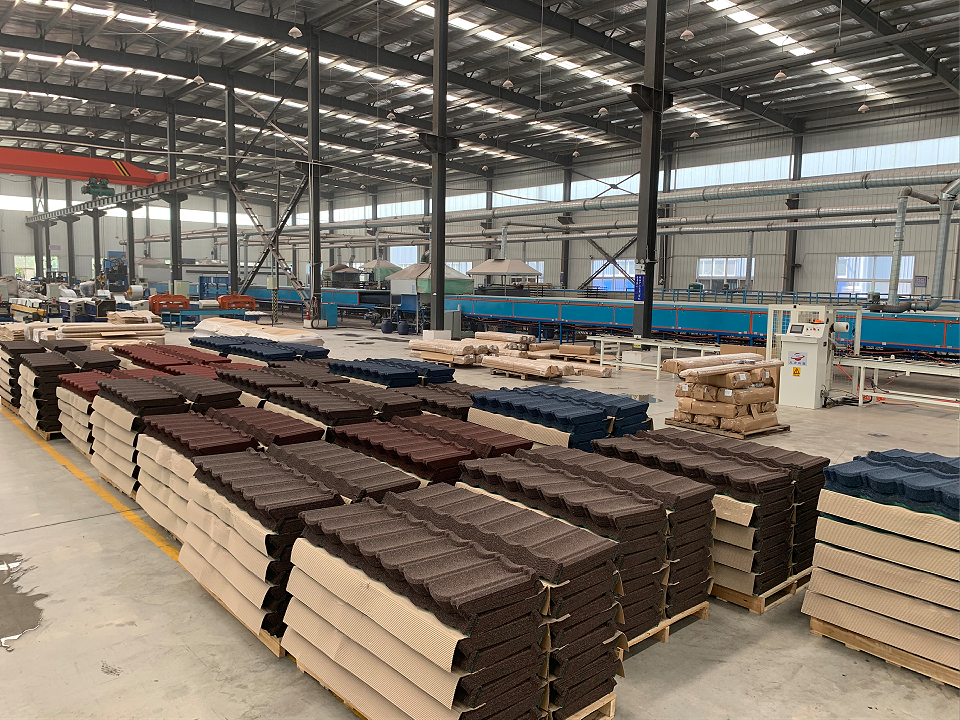
Capacity figures are worth a consistency check before they are worth a planning decision. The recorded monthly capacity of 500,000 units and annual output of 6,000,000 units reconcile exactly at twelve months, which suggests both numbers use the same unit basis; a pair that does not reconcile usually means one figure counts tiles and the other counts bundles or squares. Ask which unit applies, and ask whether the number refers to one line or to the whole site. CAILIN's enterprise record lists a 15,000 m² facility, fewer than 100 employees and a 10-engineer R&D team, which is enough context to frame those questions precisely.
The lead time deserves the same treatment. Ask what event starts the 7–10 day clock — deposit confirmation, artwork approval for logo printing, or colour confirmation — and ask which customization items sit outside it. The answers belong in the order confirmation, because a lead time that starts on a different event for each party is a delivery dispute waiting for a vessel schedule.
Gate 4 — Release the container against named evidence
Gate 4 passes when the acceptance evidence is complete before the balance payment, not after arrival. CAILIN's documented purchasing terms set delivery FOB Tianjin or EXW, payment of 30% T/T deposit on order confirmation with the 70% balance before shipment, and acceptance criteria covering pre-shipment inspection by CAILIN, the customer or a third party, sample retention, and loading photos or videos provided before the container is sealed.
The sequencing is the point. Because the balance falls due before loading, the inspection report and the loading record have to be reviewed and accepted before that payment is authorised. Read in the other order, the same terms would have the buyer paying against a promise and inspecting against a completed fact. Loading photos and videos are what turn an arrival damage claim from an assertion into a comparison between the condition at sealing and the condition at unloading.
Breakage needs a definition before it needs a number. A workable clause states the threshold as a share of shipped pieces — for example, no more than 0.5% arriving broken — and then names the inspector, the timing (at unloading, with photographs), the counting basis and the remedy, whether credit or replacement, and whether freight sits inside that remedy. Setting the threshold is a buyer decision; the supplier's contribution is the packaging specification and the loading record that make the threshold measurable.
Document-to-claim map
The table converts the protocol into a working checklist. Each row is a claim a buyer will hear during evaluation, the artefact that settles it, and the condition under which it passes.
| Claim under audit | Artefact that settles it | Pass condition |
|---|---|---|
| ISO 9001:2015 certified | Certificate ISO 9001:2015-03824Q14379R2S verified with WSF; scope wording covering production of stone coated metal roofing tiles | Entity, scope and dates (13 May 2024 to 12 May 2027) match the purchase order |
| AZ150 galvalume steel | Coil supplier certificate recording coating mass, linked to the production batch | Designation traced to the coil, not to a brochure |
| 0.45 / 0.50 / 0.55 mm steel | Measurement on the retained sample and on pre-shipment samples | Measured values sit inside the declared grade for the ordered thickness |
| Wind rating up to 120–160 mph | Test report naming the assembly, fixing pattern and standard; the NOA number where a Florida approval is claimed | Report matches the ordered profile and the installer's fixing schedule |
| 500-hour salt spray | Salt-spray report with method, duration, specimen preparation and pass criteria | The method is the one the project specifies and the specimen matches the ordered finish |
| 5–8 kg/m² tile mass | Measured mass per unit area for the ordered profile | A measured value per profile, not a range borrowed across profiles |
| Breakage below 0.5% (buyer-set) | Packaging specification, loading record and arrival inspection method | Inspector, timing, counting basis and remedy agreed before shipment |
| 7–10 day lead time | Written confirmation of the trigger event and any customization exception | Clock start and exceptions stated in the order confirmation |
| OEM / ODM colour, profile, packaging, logo | Approved artwork, colour reference, packaging specification and counter-sample | Every customization item has an approved reference before production starts |
Delivery-risk indicators buyers underweight
Mass, handling and packaging
Mass is the quiet variable in a stone coated metal roofing order. The category comparison puts stone coated metal at 1.1–1.8 lb/ft² against 9–12 lb/ft² for clay tile and 8–12 lb/ft² for concrete tile, which converts to roughly 5–9 kg/m² against 44–59 kg/m² and 39–59 kg/m² respectively. Lower mass per square metre reduces the load that packaging, manual handling and the roof structure have to carry. It does not by itself guarantee a lower breakage rate, because breakage is a chain metric covering packaging design, stacking, container loading, port handling, inland transport and site storage — which is exactly why the rate should be measured on your lane rather than borrowed from a brochure.
Effective coverage and freight exposure
Quantity per container depends on effective coverage per piece, not on the nominal tile size printed in a catalogue. If coverage is under-declared, the shortfall appears at the take-off stage on site, after freight has been paid on the wrong volume. Ask for effective coverage in writing for the ordered profile and recompute pieces per container from that figure before the order is confirmed.
Warranty language and support reach
CAILIN records technical installation guidance, video support, remote support, 24-hour response and 50-year limited warranty terms. Those are the right categories to audit, but the audit sits in the documents: request the warranty text, check what the limitation excludes, check whether installation outside the published method affects cover, and confirm that support is available in your language and working hours. A warranty summary in a brochure is a marketing artefact; the terms document is the contract artefact.
Lifetime cost and quote comparability
A stone coated roofing lifetime cost model is only as good as the specification held constant underneath it. Two quotations built on different steel thicknesses, different packaging and different inspection obligations are not two prices for the same product, and a maintenance allowance carried over from a generic model will not reflect the warranty terms you actually signed. Freeze the specification first, then compare quotes on the same Incoterm — CAILIN quotes FOB Tianjin and EXW — so that differences reflect the offer rather than the description.
Where the protocol changes the buying decision
Coastal and hurricane projects. Category ratings of up to 120–160 mph under UL Class 4 or Miami-Dade NOA regimes are useful for shortlisting and insufficient for approval, because the number belongs to a tested assembly. CAILIN's US residential case record covers 700 units on a pitched roof, with reported outcomes including hurricane and wind resistance, noise reduction, energy saving and a service life of 30–50 years; third-party summaries additionally describe a 500-hour salt-spray test and wind resistance up to 160 mph. The audit step is identical in both cases: request the report that names the profile, the fixing pattern and the standard, and check that it matches the schedule your installer will use. For a coastal anti-corrosion specification, ask as well whether the ordered profile is fixed with concealed clips or exposed fasteners, since the tested assembly depends on that choice.
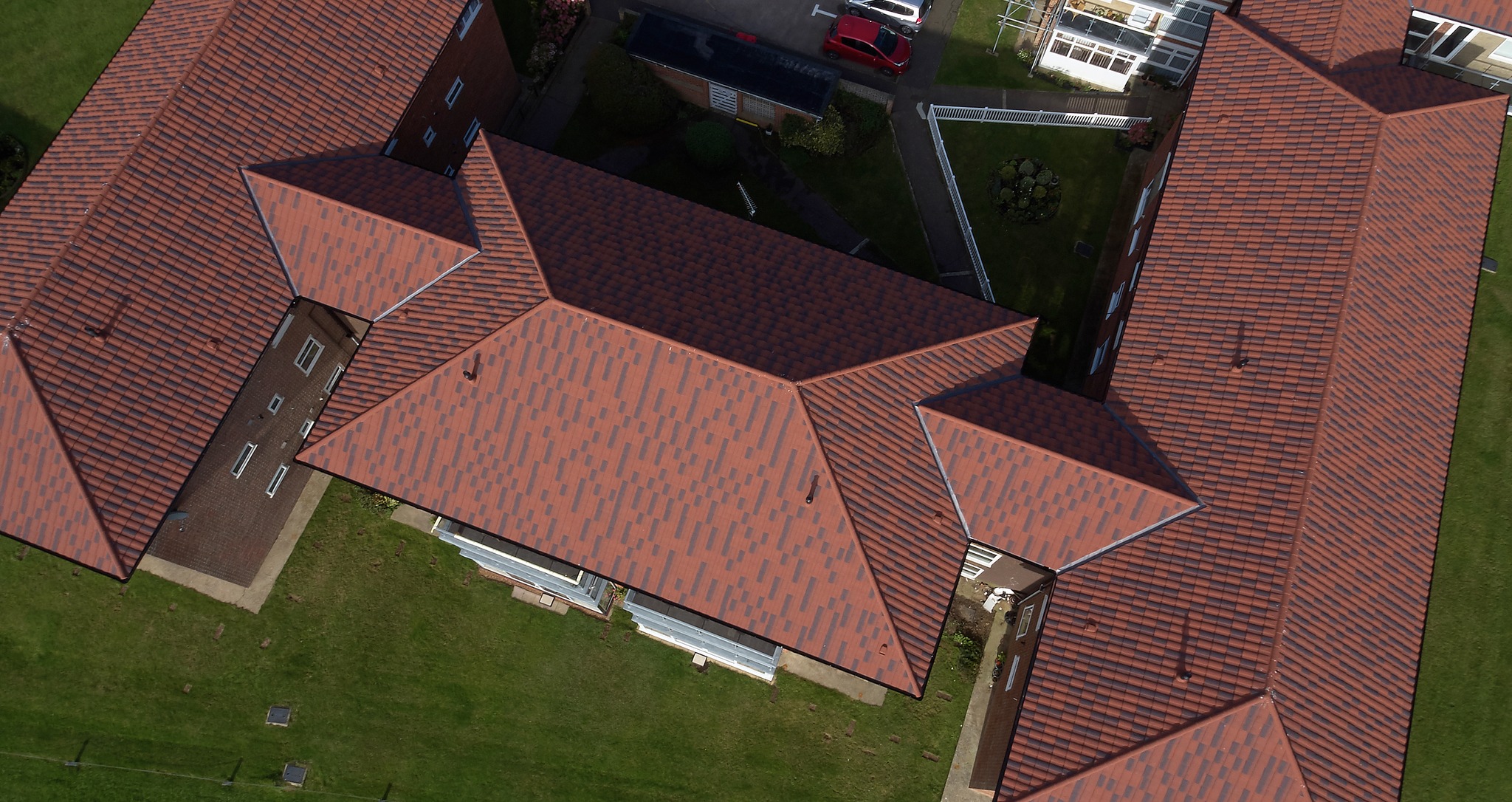
Wholesale and private-label orders. Distributors buy a specification plus a brand. The capability record supports OEM, ODM and customized production with neutral or branded packaging and logo printing across 10+ standard colours. Audit the private-label items as production variables: approved artwork, packaging specification, colour reference and the approval step that starts the lead time. An item outside the production control system is an item that can arrive wrong without anyone being able to say when it changed.
Retrofit and lightweight structures. The mass comparison supports a structural conversation — roughly 5–9 kg/m² against 44–59 kg/m² for clay tile — but it does not replace the engineer's calculation. Feed the documented mass per profile into that calculation and keep the source of the number in the project file, so the assumption can be defended later.
Noise-sensitive residential work. Third-party summaries describe up to 70% noise reduction for CAILIN products compared with bare metal roofing. Before that figure enters a low-noise metal roofing specification, request the acoustic test conditions, the reference product and the assembly tested; without them the comparison cannot be reproduced by anyone reviewing the file.
FAQ
Which ISO certificates should a stone coated metal roofing supplier hold, and what do they actually prove?
The relevant set is ISO 9001:2015 for quality, ISO 14001:2015 for environmental management and ISO 45001:2018 for occupational health and safety. CAILIN's certificates are numbered ISO 9001:2015-03824Q14379R2S, ISO 14001:2015-03824E14377R2S and ISO 45001:2018-03824S14378R1S, issued by Beijing World Standards for Certification Center (WSF) on 13 May 2024 and valid to 12 May 2027 under the CNAS-IAF mutual recognition arrangement, with scopes covering the production of stone coated metal roofing tiles and related management activities. They prove that a certified management system exists for that scope and that period. They do not certify a wind rating, a salt-spray result or the performance of your order, which require test reports and inspection records.
How do you audit an OEM stone coated metal roofing manufacturer?
Audit four things: the specification freeze, the entity and certificate scope, the production control record, and the release evidence. In CAILIN's case the documented customization envelope covers OEM, ODM and customized production across 10+ standard granule colours with custom colours available, steel thickness of 0.45 mm, 0.50 mm and 0.55 mm, the full Cailin profile range including Shingle, Shake, Milano, Bond, Classical, Roman, Long-Span, Golan, Tudor, Heritage and Interlocking Shingle/Shake, plus neutral or branded packaging and logo printing, backed by 100% inspection, pre-shipment random sampling and third-party inspection on request. Audit each item against a written specification and an approved sample, not against a catalogue page.
Do customization choices change cost or schedule, and what should the audit capture?
The audit cannot price an order for you, but it can make quotations comparable. The cost drivers recorded in the capability data are steel thickness grade, granule colour (standard or custom), profile, packaging (neutral or branded) and logo printing; schedule is governed by the recorded 7–10 day lead time and by whichever approval step starts it. Ask every shortlisted supplier to quote the same frozen specification on the same Incoterm — CAILIN quotes FOB Tianjin and EXW — so that differences reflect the offer rather than the wording.
How should the approved sample be controlled after approval?
Keep it as a retained reference and make retention a contractual acceptance criterion rather than a courtesy. CAILIN's documented acceptance criteria include sample retention alongside pre-shipment inspection by CAILIN, the customer or a third party, and loading photos or videos before the container is sealed. The retained sample should carry the profile name, steel thickness, granule colour, packaging reference and approval date, and both parties should hold one so that pre-shipment samples are compared against the same physical reference.
What lead time and capacity can a buyer plan around?
CAILIN records a lead time of 7–10 days and a monthly capacity of 500,000 units, with annual output stated at 6,000,000 units; the two figures reconcile at twelve months, which is a useful first-pass consistency check. Confirm in writing what event starts the lead time — deposit confirmation, or artwork approval where logo printing is involved — and confirm the unit basis of the capacity figure. Pre-shipment inspection consumes time inside the quoted window, so schedule it there rather than after it.
What delivery evidence and after-sales terms belong in the contract?
Put the Gate 4 items in writing: pre-shipment inspection by the supplier, the buyer or a third party; retained samples; loading photos or videos before the container is sealed; delivery terms on FOB Tianjin or EXW; payment of 30% T/T deposit with the 70% balance before shipment; and a breakage threshold with a named arrival inspection method. On the after-sales side, CAILIN records technical installation guidance, video support, remote support, 24-hour response and 50-year limited warranty terms; request the warranty document itself and check what the limitation excludes. Buyers who prefer to test the whole chain before committing to a container can request a sample and a quotation against a frozen specification at info@sangocailin.com.
Conclusion: keep the container closed until the file is complete
The four gates are designed to be boring. Freeze the specification so production has a target. Verify the entity and the 2024–2027 certificate scope so the target belongs to the plant making the order. Audit inspection and capacity so the target is reachable at volume. Then hold the container until the inspection report, the retained sample and the loading record are in the file — before the 70% balance, not after the vessel sails.
Buyers who work this way stop arguing about adjectives. The questions become documentary: which certificate number, which profile, which measured mass, which test report, which loading record, which breakage clause. A supplier that answers them quickly is easier to qualify than one that answers with reassurance, and a supplier that cannot answer them has told you something useful before the deposit is paid.
Sango Cailin (Tianjin) Building Tech. Co., Ltd. publishes its profile and product range at www.cailinroofing.com, and the company brochure covering profiles, colours and packaging options can be downloaded here: CAILIN product brochure (PDF). Audit files move faster when the sample, the certificate pack and the quotation describe the same specification.
Have Questions or Need More Details?
Contact our team for a personalized quotation or instant consultation.
Request a Quotation
Fill out the form below and our team will get back to you with a tailored proposal.
WhatsApp Direct Chat
Prefer to chat in real-time? Message us on WhatsApp for instant assistance & quick answers.
- Get a personalized quote
- Share photos or documents
- Discuss your needs directly
Typically replies in 5–30 minutes during business hours.