
Stone Coated Metal Roofing Compliance Guide: ISO, Tests & Regional Codes
Stone Coated Metal Roofing Compliance Guide: ISO, Tests & Regional Codes
Short answer: compliance for stone coated metal roofing is a three-layer evidence chain, not a logo on a brochure. Layer one is a management-system certificate that shows how the factory is run: ISO 9001:2015 for quality, ISO 14001:2015 for environmental control and ISO 45001:2018 for occupational health and safety. Layer two is product evidence: an AZ150 galvalume base in 0.4–0.6 mm steel, a 500-hour salt spray result and wind uplift resistance up to 160 mph. Layer three is regional acceptance, where the same tile can pass in a freeze-thaw market and be questioned in a hurricane zone because the fastening assembly or the paperwork does not match local requirements. Wholesale buyers who write purchasing terms around all three layers avoid the most expensive failure in this category: a product that performs, delivered with a document pack nobody can accept.

Why compliance questions arrive late — and cost more when they do
The compliance conversation in stone coated metal roofing usually starts at the wrong moment. Buyers compare unit price and profile first, confirm the order, and only later meet the question that decides whether the container clears: can the supplier produce evidence that the tile and the roof assembly are acceptable where the building stands? By then the specification is fixed, the deposit is paid and the schedule is exposed.
Four gaps account for most of the damage:
- ISO read as product approval. A quality-management certificate is used to answer a wind-uplift or corrosion question. The two documents are not interchangeable.
- Performance claims without a test basis. “500-hour salt spray” and “160 mph” are meaningful only when the method, the sample and the tested assembly are named.
- One region treated as universal. Coastal hurricane zones, high-wind inland corridors, freeze-thaw climates and wildfire-prone areas each push a different requirement to the front of the list.
- Second-hand certificate claims. Trade write-ups frequently repeat ISO statements for manufacturers without certificate numbers, issuing-body verification, certificate scope or expiry validation. Published trade coverage of this category does exactly that, which is why the claim alone cannot be used for supplier qualification.
The practical consequence is straightforward: the buyer’s real control point is not the catalogue, it is the document pack — the defined set of certificates, reports and written commitments that travels with the quotation and is referenced in the purchase order.
What the category’s paper trail actually looks like
Stone coated metal roofing is a growing category with an unusually uneven paper trail. Two problems sit underneath the compliance discussion.
Market sizing is not comparable between sources. One commercial research report estimates the global stone-coated steel roofing market at USD 69.41 billion in 2024, with a projected 12.11% CAGR from 2025 to 2035. Another figure circulating for the same category puts it at USD 20.71 billion. The difference is definitional — installed system value versus material sales and manufacturing output — which means neither number should be used to size a purchasing programme without checking what was counted.
Trade classification is not uniform either. Supplier-directory records associate stone-coated metal roof products with HS codes 73089090, 73089099 and 73089010. These are supplier-specific listings, not a validated classification for every jurisdiction or product construction. Duty modelling and import documentation should be confirmed with a customs broker rather than copied from a directory.
Both issues point to the same buyer behaviour. Because market size and tariff treatment vary by source, the part of a stone coated metal roofing transaction a buyer can standardise across suppliers is the compliance documentation itself: what is being certified, by whom, for which site, against which test, and until when.
Layer 1 — the three ISO certificates and what each one covers
ISO 9001:2015, ISO 14001:2015 and ISO 45001:2018 are management-system standards. They certify how an organisation controls its processes; they do not certify a product’s wind rating, salt spray performance or code acceptance. That distinction decides how each certificate should be used in a wholesale transaction.
ISO 9001:2015 — quality management
This is the certificate buyers use most and understand least precisely. ISO 9001:2015 evidences documented process control, traceability, corrective action, internal audit and supplier control. In a roofing factory it sits behind batch consistency in stone granule colour, coating line parameters, inspection records and pre-shipment sampling. It tells you the factory can reproduce a specification; it does not tell you what the specification can survive.
ISO 14001:2015 — environmental management
Environmental control matters in this manufacturing process because acrylic resin coating, high-temperature sintered natural stone granules and top-coat application generate waste streams, emissions and chemical-handling obligations. For wholesale buyers supplying projects with environmental procurement screens or ESG reporting, the certificate plus its scope page is the evidence item requested.
ISO 45001:2018 — occupational health and safety
This standard covers worker safety management at the production site. It is increasingly requested during supplier audits and by distributors whose own customers audit their supply chain. Like the other two, it is a site-level management certificate, not a product statement.
Applying this to a real supplier
Sango Cailin (Tianjin) Building Tech. Co., Ltd. is a stone coated metal roofing manufacturer founded in 2017, operating a 15,000 m² facility in the Jinghai Economic Development Zone in Tianjin, China, with fewer than 100 employees, 10 R&D engineers and annual output of around 6,000,000 units. The company also operates additional production bases in Hangzhou, Sichuan, Shandong and Hebei. Approximately 25% of output is exported, primarily to the USA, Canada and Southeast Asia. Its facilities are certified to ISO 9001, ISO 14001 and ISO 45001, with the certificates issued through Beijing World Standards.
Layer 2 — product evidence: steel, salt spray, uplift, mass and noise
Product evidence answers a different question from certification: not “how is the factory run” but “what does this tile do, under conditions a buyer can check”.
Base steel and coating designation
The substrate is galvalume steel with an AZ150 coating designation, in base steel thicknesses from 0.4 mm to 0.6 mm; standard customisation options are 0.45 mm, 0.5 mm and 0.55 mm. The coating designation and the thickness answer two different questions and should both be written into the order. Thickness supports uplift resistance, fastener holding and handling robustness. The coating designation carries the corrosion reserve at the surface. Cut edges — at the tile end, at penetrations and at flashings — sit outside that reserve unless they are treated, which is why coastal specifications add factory-applied anti-corrosion protection on cut edges.
Tile geometry
Effective tile size is 1340 mm × 420 mm covering 1260 mm × 370 mm. This is a compliance-relevant number, not just an estimating number: it sets the batten grid, which in turn sets what uplift assembly was tested.
Corrosion: the 500-hour salt spray result
The specification states corrosion resistance verified by a 500-hour salt spray test. For a coastal anti-corrosion roofing project, the number alone is incomplete. A buyer should attach three details to it: the salt-spray method used, whether the specimen was scribed at the cut edge, and whether the sample came from current production. Those three details decide whether the result transfers to a beachfront hotel roof or stays on a data sheet.
Wind uplift: up to 160 mph
Wind uplift resistance is stated as up to 160 mph. Uplift is a property of the whole assembly — profile, concealed fastener clips and screws, batten spacing, and how edge and corner zones are fixed — so a rating is only as good as the assembly it was tested with. In US coastal markets, published comparisons of stone coated metal roofing cite UL Class 4 and Miami-Dade NOA as the reference routes for wind resistance. A buyer’s question is therefore not “is it 160 mph” but “which accepted test route was used, and does the reported assembly match the one we will install”.
Mass, noise and heat
Weight is approximately 5–8 kg/m², which published comparison data places at 1.1–1.8 lb per square foot against 9–12 lb for clay tile and 8–12 lb for concrete tile — roughly 85% lighter. This is the single most useful compliance fact in retrofit work: lower dead load is what allows a roof-over without structural reinforcement. Acoustic insulation is stated at 70% noise reduction versus a bare metal roof, which is the figure behind low-noise metal roofing requirements in urban and suburban zones. Thermal behaviour comes from the air gap between tile and underlayment reducing heat transfer — a genuine energy-saving mechanism, but not a rated insulation value, and it should not be presented as one.
The assembly is part of the product
The roof only complies as a system. The supporting package includes underlayment, wooden or metal battens, stainless steel or galvanized screws and clips for the concealed fastener system, ridge caps, valley flashing, gable trims, pipe flashings and rain gutter. A purchase order that specifies tiles and leaves fasteners and underlayment to the installer has left the compliance chain open. The product operates on pitched roofs with slopes from 12° to 90°, and is used both in new villa communities and in roof replacement projects.

What each document proves — and what it does not
The fastest way to align a procurement team and a supplier is a single table that separates proof from assumption. The columns below are the ones worth copying into a specification.
| Document | What it proves | What it does not prove | Attach to the purchase order as |
|---|---|---|---|
| ISO 9001:2015 certificate | The factory runs a documented quality management system with traceability, inspection and corrective action | A wind uplift rating, a salt spray result or building-code approval for the tile | Valid certificate naming the producing site, with number and expiry verified at the issuing body |
| ISO 14001:2015 certificate | Waste, emissions and chemical handling at the site are managed under an environmental system | Product environmental performance or recycled content of the tile | Certificate and scope page held for supplier audit and ESG files |
| ISO 45001:2018 certificate | Occupational health and safety is managed at the production site | Installation safety or any site work method | Certificate copy retained in the audit file |
| 500-hour salt spray report | Corrosion resistance of the coated system under the stated test method | Service life at a specific coastal address, or performance of untreated cut edges | Report naming the test method, sample date and edge preparation |
| Wind uplift report, up to 160 mph | Uplift resistance of a defined assembly under a defined test route | That an untested batten spacing or fastener pattern will hold the same load | Report for the specified profile, batten spacing, fastener and edge-zone detail |
| AZ150 base steel record | The coating designation and base steel thickness actually supplied | Coil traceability to a heat number unless the mill documentation says so | AZ150 galvalume at 0.45 / 0.50 / 0.55 mm as specified, with mill documentation |
| Written warranty and response terms | The supplier’s stated commitments on coverage and technical support | Local code acceptance or insurance approval | 50-year limited warranty terms and 24-hour response commitment in writing |
Layer 3 — regional acceptance and what changes by climate
Regional requirements do not replace the certificates and test reports; they decide which of them become the controlling document. Four climate regimes cover most wholesale enquiries.
Coastal hurricane zones
High salinity, salt spray, monsoon rains and typhoon winds arrive together. The controlling evidence is the salt spray report combined with the uplift report, and the manufacturing detail that decides long-term outcome is anti-corrosion protection on cut edges, applied at the factory. Fasteners must be stainless or galvanized, and the concealed fastener system keeps fixings out of the weather path.
High-wind inland corridors
Cyclone and tornado exposure drives the same uplift question without the salt load. Here the controlling document is the fastener schedule and the tested assembly. A buyer who receives a wind rating but no assembly description has received marketing, not evidence.
Freeze-thaw and heavy snow
Sub-zero temperatures, freeze-thaw cycles, heavy snow loads and ice dams impose their own requirements. On steep roofs, snow guards are required to prevent sudden snow slide. The low mass figure strengthens the case for roof-over retrofit, because existing framing frequently does not need reinforcement — but the fixing pattern and snow guard specification still belong in the order.
Wildfire-prone dry zones
In dry conditions with flying embers, the roof assembly matters more than the tile surface. The specified requirement is non-combustible underlayment and sealed eaves, with the steel core and stone granule surface acting as the fire-barrier function of the system. Buyers should confirm the underlayment class required locally and apply it to the order explicitly.
Design-controlled and historic districts
Appearance can be a compliance item. Where local design guidance requires a specific roof appearance, exact colour and profile matching becomes the acceptance criterion — which is why profile ranges matter as much as performance data.
| Climate / region | Dominant compliance risk | Evidence to request | Product and assembly response |
|---|---|---|---|
| Coastal hurricane zones | Salt-spray corrosion at cut edges plus wind uplift | 500-hour salt spray report; uplift report for the installed assembly; fastener specification | AZ150 galvalume base, 0.4–0.6 mm; factory-applied anti-corrosion coating on cut edges; concealed fastener screws and clips |
| High-wind inland (cyclone, tornado) | Uplift at edges and corners | Uplift evidence tied to batten spacing and fastener schedule | Uplift resistance up to 160 mph, with fixing detail as specified in the tested assembly |
| Freeze-thaw and heavy snow | Snow slide, ice dams, cyclic movement | Mass per m², fixing pattern, snow guard specification | Approx. 5–8 kg/m²; snow guards on steep roofs to prevent sudden snow slide |
| Wildfire-prone dry zones | Flying embers entering the roof cavity | Underlayment specification; eave and vent detailing | Steel core with stone granule surface; non-combustible underlayment and sealed eaves |
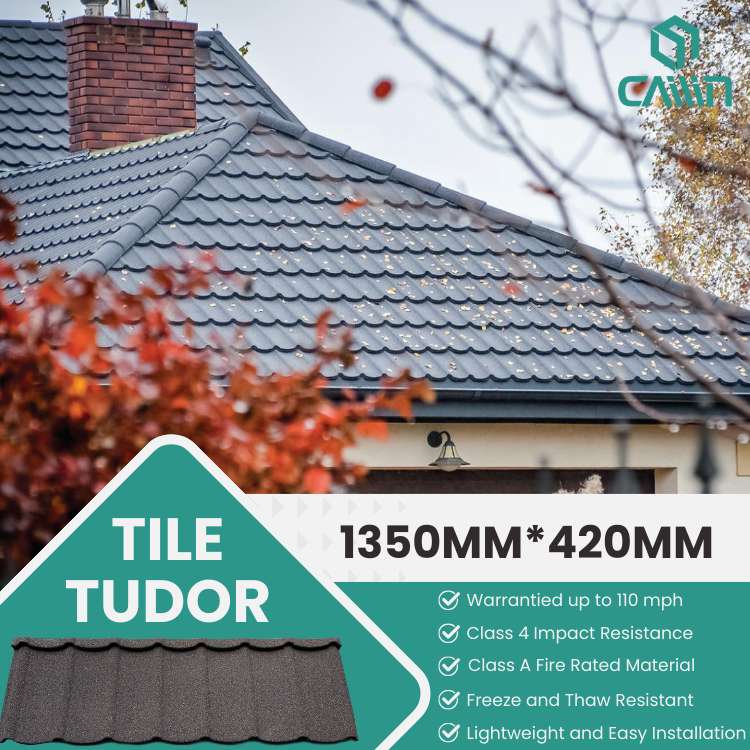
| Historic and design-controlled districts | Appearance non-compliance | Colour and profile sample approval | Profile matching across the range, including Heritage and Tudor profiles |
| Urban and suburban low-noise areas | Rain and hail noise complaints | Acoustic statement and the reference product it is measured against | Stone coating, stated at 70% noise reduction versus a bare metal roof |
From evidence to purchasing terms: a seven-step buyer workflow
- Name the controlling hazard first. Coastal hurricane, high wind, freeze-thaw or wildfire. One hazard leads; the others are secondary. This single decision determines which report becomes the acceptance document.
- Freeze the specification in writing. Profile and model, AZ150 galvalume base, base steel thickness (0.45 / 0.50 / 0.55 mm), colour, tile size, and the complete accessory list: underlayment, battens, concealed fastener screws and clips, ridge caps, valley flashing, gable trims, pipe flashings and gutter.
- Request the document pack, not individual files. Three ISO certificates with numbers and scope, the salt spray report, the uplift report, the AZ150 steel record and the written warranty terms. A supplier that can assemble this pack quickly is a supplier with a functioning quality system.
- Verify at the source. Check certificate numbers, scope and expiry with the issuing body — for Sango Cailin, the certificates are issued through Beijing World Standards — and confirm the scope names the site producing your order.
- Match test evidence to the assembly you will install. If your installer uses a different batten spacing or fastener pattern than the tested configuration, the uplift figure does not travel with it.
- Write acceptance criteria into the purchase order. State the test, the sample basis, the inspection routine and the right to third-party inspection. Production control at this stage typically includes 100% inspection and pre-shipment random sampling, with third-party inspection available on request.
- Validate with a sample before the container. A sample order checks colour, profile, granule adhesion, packing and — critically — whether the document pack arrives complete. Minimum order quantity is 2 units with a standard lead time of 7–10 days, which makes early validation inexpensive.
Where these requirements appear in real projects
US residential, 700 units. A pitched-roof residential project supplied to the United States used the tile for wind resistance, noise reduction and energy behaviour, with a service-life expectation in the 30–50 year range. The compliance value in that project came from pairing the uplift evidence with the installed fastening pattern, not from the tile alone.
Beachfront hotels and resorts. Salt-spray corrosion resistance is the acceptance criterion. The deciding detail is factory-applied anti-corrosion protection on cut edges, because that is where coastal roofs fail first.
Freeze-thaw retrofit over old tiles. At approximately 5–8 kg/m², the tile can be installed directly over existing tiles in many retrofit cases without structural reinforcement. The compliance items are the mass figure, the fixing pattern and snow guards on steep pitches.
Rural self-build in wildfire-prone areas. The requirement is non-combustible underlayment and sealed eaves, specified in the order rather than assumed on site.
Historic and design-controlled restoration. Where appearance is regulated, the accepted sample and the profile match become the acceptance document, alongside the performance reports.
How an ISO certified roofing factory supports the pack
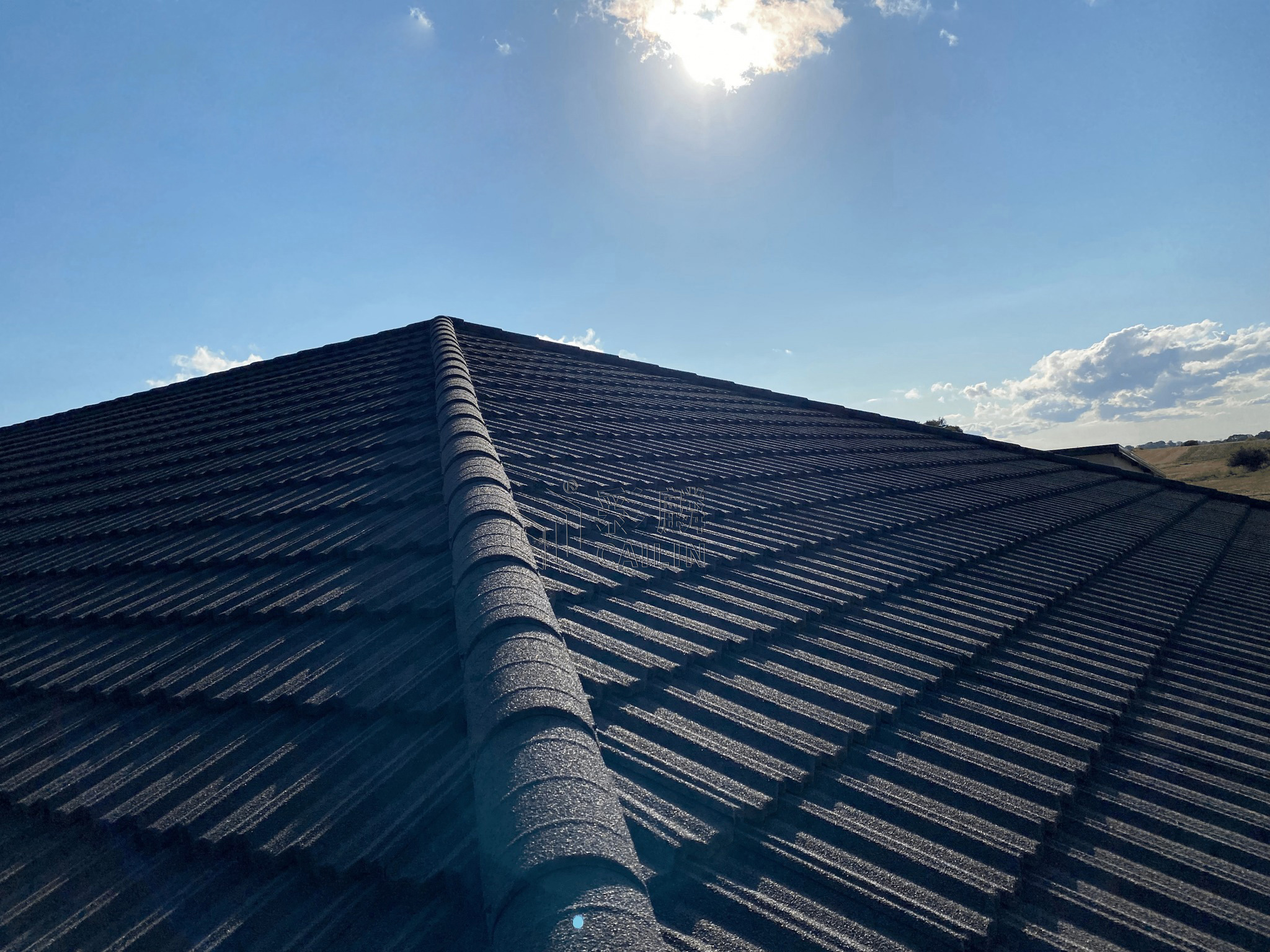
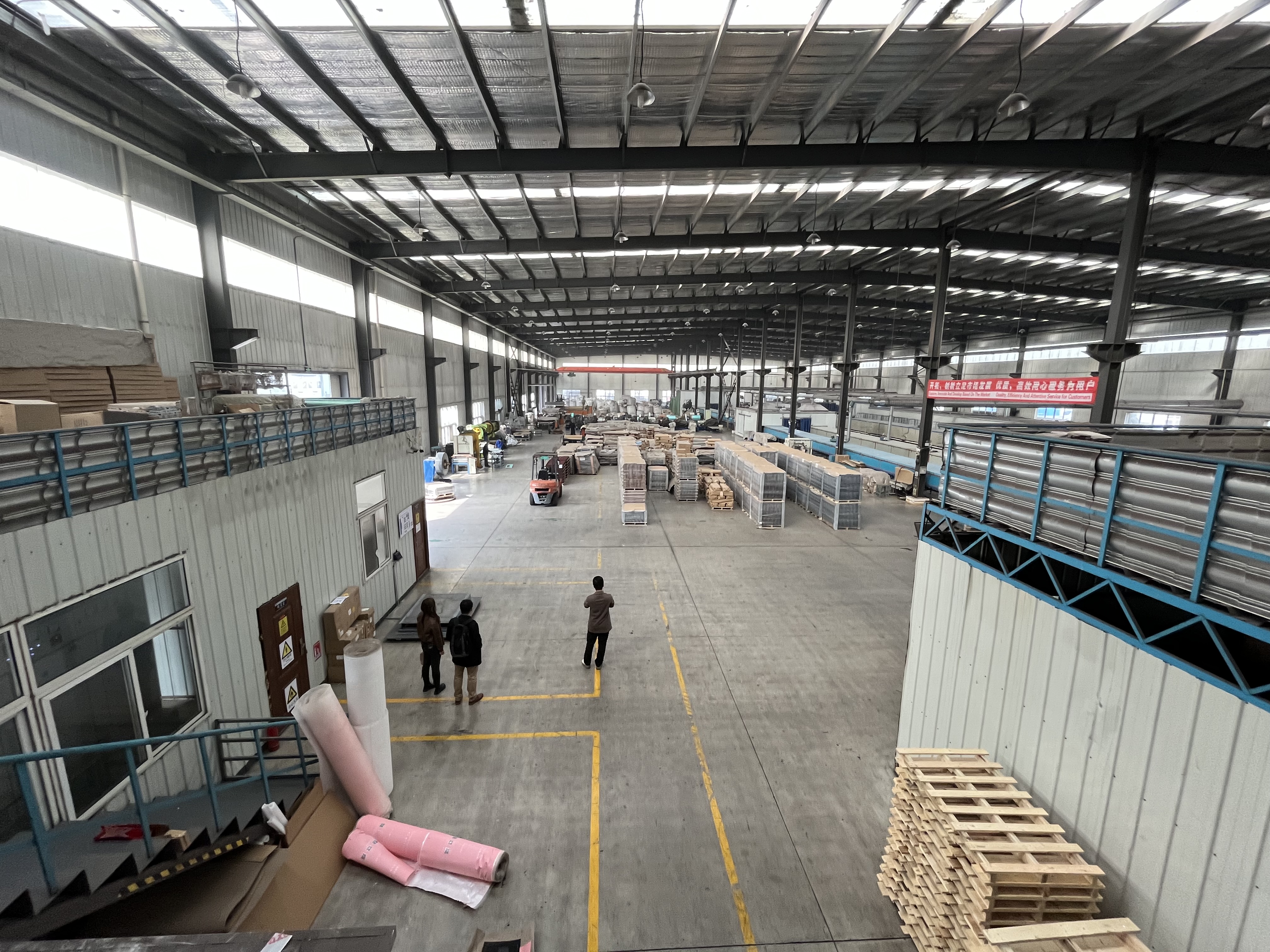
Documentation is only credible when the production system behind it is inspectable. Sango Cailin operates multiple production bases across China — including Hangzhou, Sichuan, Shandong and Hebei, seven facilities in total — and manufactures stone coated metal roofing, asphalt shingles, BIPV solar tiles, rain gutter systems and butyl tape. The production model covers OEM, ODM and customised production, with stone granule colour options of 10+ standard colours plus custom, steel thickness options of 0.45 mm, 0.5 mm and 0.55 mm, the full profile range (Shingle, Shake, Milano, Bond, Classical, Roman, Long-Span, Golan, Tudor, Heritage and Interlocking Shingle/Shake), packaging design and logo printing. Monthly capacity is 500,000 units. Quality control runs on 100% inspection, pre-shipment random sampling and third-party inspection where the buyer requires it. After-sales support covers a technical installation guide, video support, remote support, 50-year limited warranty terms and a 24-hour response commitment.
For a wholesale buyer, the operational meaning is simple: the certificate, the test evidence and the production record come from the same organisation, so a factory audit and a document review support each other instead of contradicting each other.
Frequently asked questions
Does an ISO 9001:2015 certificate make stone coated metal roofing code-compliant?
No. ISO 9001:2015 certifies the factory’s quality management system — process control, traceability and corrective action. It does not certify a wind uplift rating, a salt spray result or a building-code approval. Code acceptance depends on product test evidence, the roof assembly and local requirements. Use the certificate to qualify the factory and the test reports to qualify the tile.
Which documents should a wholesale buyer request for coastal hurricane roofing?
Request five items: the three ISO certificates with numbers, scope and expiry; a 500-hour salt spray report naming the test method and sample; a wind uplift report matching the batten spacing, fastener and profile you will install; a base steel record confirming AZ150 galvalume at 0.4–0.6 mm; and written confirmation of factory-applied anti-corrosion protection on cut edges.
Can a single stone coated metal roofing factory supply the full accessory system?
The assembly needs more than tiles: underlayment, wooden or metal battens, concealed fastener screws and clips, ridge caps, valley flashing, gable trims, pipe flashings and gutter. Sango Cailin manufactures stone coated metal roofing, asphalt shingles, BIPV solar tiles, rain gutter systems and butyl tape, offers OEM/ODM and customised production with 10+ standard stone granule colours and 0.45 / 0.5 / 0.55 mm steel options, under 100% inspection and pre-shipment random sampling.
What sample quantity and lead time should a first wholesale order expect?
Minimum order quantity is 2 units with a standard lead time of 7–10 days, against monthly capacity of 500,000 units. A sample order is the lowest-cost way to validate colour, profile, granule adhesion, packaging and — most importantly — whether the compliance document pack arrives complete before a full container is committed.
How do I choose a stone coated metal roofing manufacturer for wholesale roofing projects?
Screen on evidence rather than catalogue claims: verified ISO 9001:2015, ISO 14001:2015 and ISO 45001:2018 certificates that name the production site; product test reports tied to the assembly you will install; a defined steel specification of AZ150 galvalume at 0.4–0.6 mm; accessory availability for the complete roof system; a stated inspection routine; and written after-sales terms such as 50-year limited warranty terms with 24-hour response. Then validate with a sample order. To start the process, request a quotation or the product catalogue and ask for the certificate pack with numbers and scope included.
Conclusion: compliance is a document pack, not a logo
Stone coated metal roofing passes or fails on three layers that must line up. ISO 9001:2015, ISO 14001:2015 and ISO 45001:2018 qualify the factory and the site that runs it. The AZ150 galvalume base in 0.4–0.6 mm steel, the 500-hour salt spray result and the wind uplift resistance up to 160 mph qualify the product — provided the method and the assembly are named. Regional requirements — coastal hurricane, high wind, freeze-thaw, wildfire — decide which of those documents becomes the acceptance criterion and which accessory detail, from cut-edge protection and concealed fasteners to snow guards and non-combustible underlayment, belongs in the order.
A wholesale buyer who writes all three layers into the purchase order gets something more useful than reassurance: a specification that can be checked on arrival, audited at the factory and defended to the end customer.
Next step: build your compliance document pack
Sango Cailin (Tianjin) Building Tech. Co., Ltd. supplies stone coated metal roofing and the full accessory system to wholesale, distributor and project buyers in the USA, Canada and Southeast Asia. Request a quotation against your specification, ask for samples, or download the product catalogue for profiles, colours and specifications.
Catalogue: download the Cailin product catalogue (PDF) | Website: www.cailinroofing.com | Email: info@sangocailin.com | Tel / WhatsApp: +86 131-6400-7633
Have Questions or Need More Details?
Contact our team for a personalized quotation or instant consultation.
Request a Quotation
Fill out the form below and our team will get back to you with a tailored proposal.
WhatsApp Direct Chat
Prefer to chat in real-time? Message us on WhatsApp for instant assistance & quick answers.
- Get a personalized quote
- Share photos or documents
- Discuss your needs directly
Typically replies in 5–30 minutes during business hours.