
Common Welding Defects in Stainless Steel Pipes: How to Spot and Solve Them
Welded stainless steel pipe production at GuangDong Sanon Metal Products Co.,Ltd, Foshan, Guangdong.
Welding defects in stainless steel pipes are not random events. Nearly all of them trace back to three controllable stages: the base material that arrives at the welding station, the parameters and shielding practice used at the joint, and the cleaning and passivation carried out afterwards. Porosity, cracking, lack of fusion, undercut, burn-through and heat tint can usually be identified visually or with simple inspection tools, and most of them can be corrected without changing suppliers. The exception is a defect that repeats across shipments. At that point the problem sits upstream of the welder, and it becomes a question about the supply partner rather than about the welding procedure.
This guide is written for project buyers, fabricators, distributors and installation teams who are already past sourcing and are now dealing with defects found during fabrication or on site. It explains what each common defect looks like, why stainless steel is less forgiving than carbon steel, what to correct at the joint, and which controls belong upstream at the material and supplier level when weld quality has to hold across a long-term supply relationship.
What Counts as a Welding Defect in Stainless Steel Pipes?
A welding defect is any discontinuity in the weld metal or heat-affected zone that departs from the specified geometry, continuity or metallurgical condition of the joint. In stainless steel pipe fabrication and installation, the defects that surface most often are porosity, cracking, lack of fusion and incomplete penetration, undercut, burn-through, and heat tint or oxidation discoloration. They differ in how they are detected and in what actually causes them.
- Porosity — gas trapped during solidification of the weld metal, visible as small round voids on the bead or as scattered dark spots on a radiograph.
- Cracking — a separation in the weld metal or heat-affected zone, which may appear immediately after welding or days later under residual stress.
- Lack of fusion — the weld metal does not bond with the sidewall of the joint or with a previous pass.
- Incomplete penetration — the weld does not extend through the required joint depth, leaving an unfused root.
- Undercut — a groove melted into the base metal along the weld toe and left unfilled, reducing the effective wall thickness.
- Burn-through — the arc melts through the pipe wall, producing a hole or a heavy internal protrusion.
- Heat tint / oxidation discoloration — a visible oxide film on or beside the bead, indicating that chromium has been drawn out of the protective passive layer at the surface.
Each of these has a different correction path. Treating all of them as "bad welding" and simply increasing or decreasing current usually solves one defect and creates another.
Why Stainless Steel Welds Behave Differently From Carbon Steel Welds
Four material characteristics explain most of the difficulty encountered when welding stainless steel pipes.
- Low thermal conductivity. Heat stays concentrated near the arc instead of dissipating into the surrounding metal, so the weld pool is hotter and slower to freeze than the equivalent carbon steel joint.
- High thermal expansion. The joint moves as it heats and contracts, which increases distortion and raises the risk of cracking in restrained assemblies.
- A chromium oxide passive film that forms quickly at temperature. The same film that protects the pipe in service becomes the colored oxide layer that must be removed after welding to restore corrosion resistance.
- Sensitivity to contamination. Carbon, oil, moisture, zinc, and free iron on the surface or in the shielding gas disturb the metallurgy of the joint and can seed both porosity and later corrosion.
None of these characteristics makes stainless steel un-weldable. They make joint preparation, shielding, fixturing and post-weld cleaning non-negotiable, which is why defect rates in stainless steel pipe work tend to reflect process discipline more than operator skill.
Industry Background: Why Weld Quality Now Carries Commercial Weight
The scale of the market explains why this topic reaches far beyond the workshop. The global stainless steel market was valued at USD 111.44 billion in 2022 and is projected to reach USD 182.10 billion by 2030, according to Fortune Business Insights. China exported 4.14 million tons of stainless steel in 2023, based on statistics from the General Administration of Customs of China — a figure that frames why so many global projects source pipes, fittings and connectors from Chinese mills and trading groups.
Standards define what "acceptable" means, and they do not all mean the same thing. Stainless steel pipes and tubes fall under the ASTM A312 standard for seamless and welded pipe and the ASTM A554 standard for ornamental tubing, as published by ASTM International. In practice, A312-type service demands a weld that is sound through the wall, while A554-type ornamental tubing is judged largely on dimensional consistency, surface finish and appearance. A defect that is tolerable in one category is a rejection in the other, so the acceptance language in a purchase order matters as much as the welding procedure itself.
Finishing trends add another layer. The use of PVD (Physical Vapor Deposition) coating for stainless steel color pipes is increasing in interior decoration because it is more environmentally friendly than electroplating, according to the International Stainless Steel Forum. This is directly relevant to welding, because a decorative or coated surface accepts no cosmetic repair. Oxidation discoloration that might be polished out on a satin finish becomes a visible, non-repairable defect on a finished color assembly.
Safety requirements close the loop. In North America, stainless steel glass clamps and standoff pins are governed by building codes such as the International Building Code (IBC) for load-bearing capacity. Where a welded assembly sits in a load path, a defect is no longer only a cosmetic concern.
The commercial consequence is straightforward. In a one-off purchase, a defect is a technical problem to be repaired. In a supply relationship intended to last several years, the same defect is a signal about whether production consistency can be relied upon. That distinction is what separates a transactional pipe order from a partnership decision.
The Root-Cause View: Control the Material Before You Blame the Welder
Correcting welding parameters is the fastest lever when a defect appears, but it is not the only one. A significant share of recurring stainless steel weld problems begins with the material itself and with the controls that sit upstream of the welding station.
Grade Choice Sets the Floor for Corrosion Performance
GuangDong Sanon Metal Products Co.,Ltd, based in Foshan, Guangdong, manufactures stainless steel pipes, stainless steel tubes and stainless steel accessories including staircase handrail fittings, glass clamps, elbows, coil and sheet. Fittings can be produced in stainless steel 304, stainless steel 316 and zinc alloy, with either a satin or a mirror finish.
Grade selection changes how a weld behaves after it is completed. 304 stainless steel is an austenitic type with strong all-round properties, especially in terms of corrosion resistance, while 430 stainless steel is ferritic and offers clear advantages in magnetic conductivity, thermal conductivity and cost. Under normal service conditions, the service life of 304 stainless steel is usually three to five times that of 430 stainless steel, and 304 products are priced considerably higher than 430. 304 also maintains structural stability for a longer period under high temperature and chemical exposure. Typical applications for the higher grade include building curtain walls, stair handrails, guardrails, door and window frames, balcony fences and lobby decoration.
One further material point belongs in any defect discussion: 201 is more prone to rusting compared with 304. Where a project specifies a lower grade to control cost, the weld area — with its heat-affected zone and any residual oxidation — is usually the first place that rust becomes visible in service. The defect was made at the welding station; the consequence is decided by the grade.
Surface Condition, Free Iron and the Passivation Step
The single most decisive post-weld operation is passivation. The surface oxide scale and free iron are removed using an acid cleaning solution, and a chromium-rich oxide film is then formed through passivation. This is the most fundamental and crucial step in restoring corrosion resistance to a welded joint. When heat tint is left in place, when acid cleaning is incomplete, or when free iron from tools, racks or nearby carbon steel remains on the surface, the passive film cannot form evenly — and the weld becomes the weakest point of the entire pipe run.
Upstream Audit: The Control That Prevents Defects Before Welding Starts
A practical control measure is to conduct regular audits of upstream steel mills or traders to confirm the stability of their melting processes and quality control systems. Material inconsistency — variation in chemistry, surface condition or cleanliness between heats — is one of the most frequent reasons that a welding procedure which worked last month produces porosity this month. Sanon applies strict quality control during each process, including cutting, welding, polishing and packing.
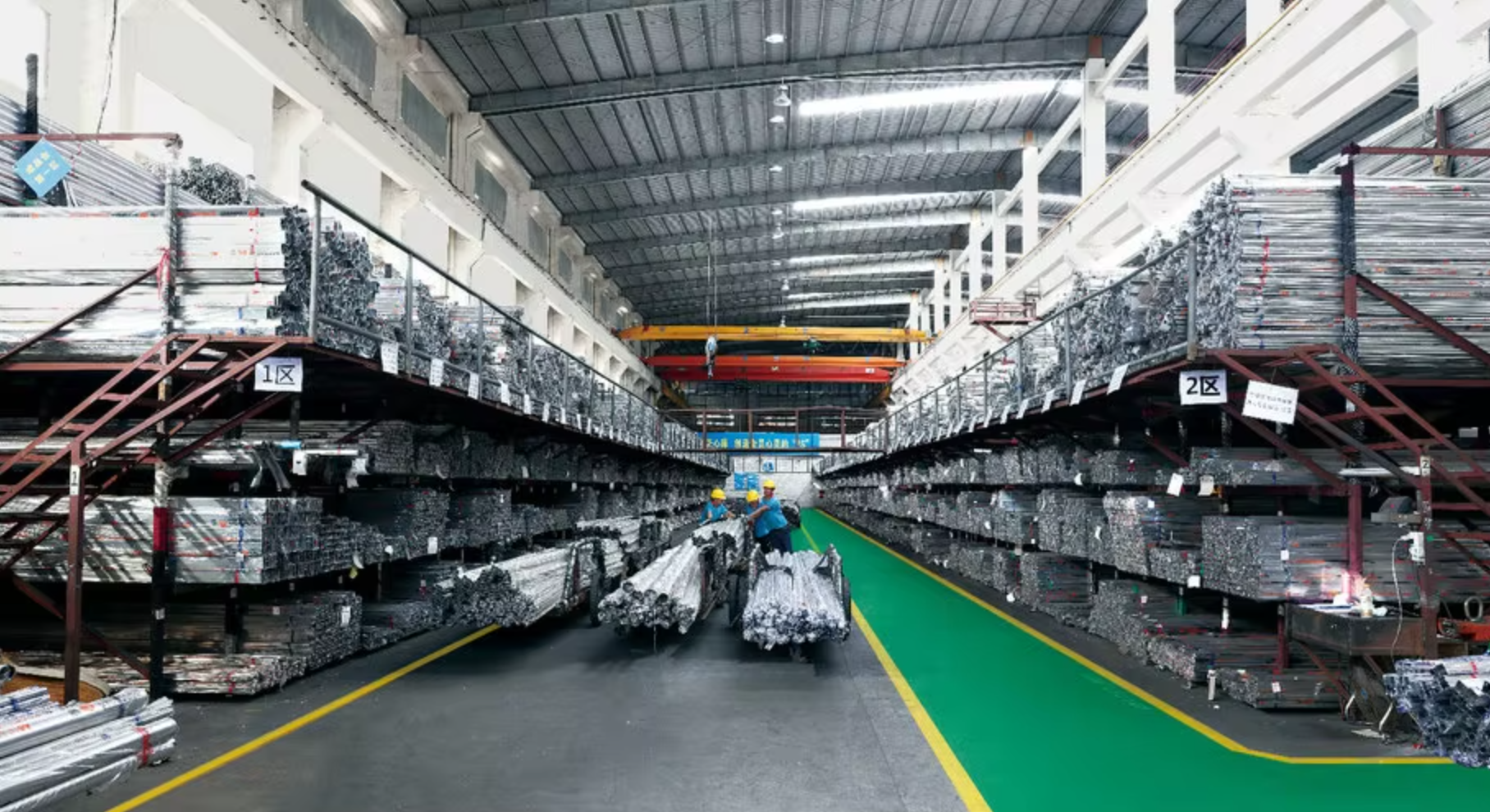
Finished stainless steel pipes and fittings held in the Sanon warehouse before shipment.
What Buyers Should Conclude From This
When a defect appears once, treat it as a welding issue. When it appears repeatedly across deliveries, examine the material and the upstream supply chain before renegotiating the welding parameters. The structure of a supplier's production base is one indicator of whether that upstream control is realistic. Sanon was established in 1999 and operates a 40,000 square meter facility with 500 employees, an annual output of 100,000 tons, a monthly stainless steel pipe capacity of 9,000 tons, a 30-person R&D team, and an export ratio of 70 percent, serving markets in the Middle East, South America and Africa.
Step-by-Step: How to Spot and Solve the Six Most Common Defects
1. Porosity
How to spot it. Porosity usually shows as small round voids on the bead surface, a dull or irregular bead profile, or a porous appearance where the weld has been fractured or sectioned. On radiographic inspection it appears as scattered dark spots rather than as a continuous line, which distinguishes it from lack of fusion.
How to solve it. Remove the affected length of weld, clean the joint back to sound metal, correct the shielding gas flow and purity, then re-weld. Welding over porosity traps the gas and typically produces the same defect again in the same place.
How to prevent it. Dry the joint before welding, remove oil, grease and moisture, maintain correct gas coverage and flow rate, control arc length, and keep filler material and base metal clean. Base material cleanliness is part of the prevention plan, not a separate topic — which is why upstream material auditing belongs in the same conversation.
2. Cracking
How to spot it. Cracking appears as a fine line in the bead, at the crater, or in the heat-affected zone parallel to the weld. Some cracks are visible immediately; others open days later under residual stress, which is why inspection timing matters on restrained assemblies.
How to solve it. Remove the entire crack plus adjacent material — do not attempt to weld over it. Inspect the surrounding zone before re-welding, and check whether the assembly is over-restrained.
How to prevent it. Reduce restraint where the design allows, control interpass temperature, verify filler selection against the base grade, and avoid crater starvation at the end of the run. In humid or corrosive service, grade selection also influences how quickly a rough weld area becomes visible corrosion, as shown by the higher rust tendency of 201 compared with 304.
3. Lack of Fusion and Incomplete Penetration
How to spot it. These are the two defects most likely to escape a visual check. They appear as an unfused edge, a straight unfilled line on a radiograph, or a groove at the root. A joint that looks acceptable externally can fail a bend or section test.
How to solve it. Cut out and re-weld the joint. Because the defect is internal, a failed inspection result usually means the entire joint is rejected rather than repaired locally.
How to prevent it. Correct joint preparation and gap, adequate current for the wall thickness, the right travel and work angle, and adequate backing or purge gas on the root side. On thin-wall ornamental tube, travel speed is the variable most often mismanaged.
4. Undercut and Burn-Through
How to spot it. Undercut is a groove melted into the base metal along the weld toe, visible under good lighting and often felt with a fingernail. Burn-through appears as a hole or a heavy internal protrusion on the opposite wall, usually accompanied by a discolored area around it.
How to solve it. Light undercut on a non-critical component may be dressed back within the specified wall tolerance; deeper undercut requires re-welding. Burn-through requires cutting out the affected section.
How to prevent it. Reduce current and heat input for the actual wall thickness, improve fit-up to remove gaps, and avoid excessive dwell at the edges of the joint. Both defects are typical of procedures copied from a heavier wall specification.
5. Heat Tint and Oxidation Discoloration
How to spot it. Heat tint appears as a straw, blue, purple or grey oxide film on and beside the bead. The darker the tint, the more chromium has been consumed from the surface layer, and the lower the corrosion resistance of that area.
How to solve it. Remove the oxide by acid cleaning and restore the surface through passivation, as described above — the oxide scale and free iron are stripped with an acid cleaning solution, and a chromium-rich oxide film is then rebuilt through passivation.
How to prevent it. Improve shielding coverage on both the face and the root, reduce heat input, and keep the joint cool enough that oxidation does not fully develop. On decorative stainless steel color pipes, prevention matters more than correction because post-weld cleaning can disturb the PVD finish.
6. Post-Weld Cleaning and Passivation Failures
How to spot it. A weld that has been cleaned but not properly passivated looks acceptable and rusts weeks later. Rust staining at the weld toe, in the heat-affected zone, or along brush marks is the typical early sign.
How to solve it. Re-clean the affected zone, remove all free iron and oxide, then passivate again. If contamination came from carbon steel tooling or storage, correct the handling practice as well.
How to prevent it. Use dedicated stainless steel brushes and tools, keep carbon steel away from the fabrication area, and treat passivation as a documented step rather than a final wipe-down.
Practical Matrix: Matching the Defect to the Correction
| Defect | Stage it usually appears | First corrective action | Prevention control |
|---|---|---|---|
| Porosity | Welding | Cut out the affected length and re-weld | Dry, clean joint; verify shielding gas coverage |
| Cracking | Welding or days after | Remove the crack and adjacent metal | Reduce restraint; control interpass temperature; verify filler |
| Lack of fusion / incomplete penetration | Welding | Reject and re-weld the joint | Joint preparation, gap, current, root purge |
| Undercut | Welding | Dress back within wall tolerance or re-weld | Match heat input to wall thickness; improve fit-up |
| Burn-through | Welding | Cut out the section | Reduce current and dwell at edges |
| Heat tint / oxidation | Immediately after welding | Acid clean, then passivate | Shielding coverage on face and root; lower heat input |
| Rust at the weld in service | Weeks to months after installation | Re-clean and re-passivate | Complete passivation; free-iron control; correct grade selection |
A Pre-Order and Pre-Weld Checklist for Project Buyers
Most weld defects that reach a project site were decided long before the first arc was struck. The following checks belong in the purchase order and the fabrication plan, not in the rework log.
- Confirm which standard governs the order — ASTM A312 for seamless and welded pipe, or ASTM A554 for ornamental tubing — and write the acceptance criteria against that standard.
- Confirm the grade for each part of the assembly, including fittings such as stainless steel elbow, bend, glass clamps, railing flange, cross bar holder and stainless steel bracket. Mixed grades in one assembly can create a corrosion pair at the joint.
- Request material evidence for the heat or batch, and verify that the supplier audits its upstream mills or traders regularly.
- Check the supplier's process control across cutting, welding, polishing and packing, not just at final inspection.
- Confirm that passivation is a defined production step, with acid cleaning to remove oxide scale and free iron before the chromium-rich oxide film is rebuilt.
- For decorative or PVD-coated color pipes, confirm how weld areas will be protected and whether re-cleaning is compatible with the finish.
- For railing and glass-fitting assemblies in North America, confirm that load-bearing components such as glass clamps and standoff pins meet the applicable building code requirements, including IBC.
- Agree on inspection timing — immediately after welding and again after finishing — because some cracking only becomes visible after residual stress develops.
- Keep carbon steel tools, racks and brushes out of the stainless fabrication area.
- Record every defect together with its stage of origin, so a repeat pattern can be traced to material, procedure or handling.
Where Weld Defects Hurt Most: Application-Level Use Cases
Handrails, Glass Railings and Balustrades
In railing and balustrade assemblies, the welded joints sit in visible locations and often in load paths. A heat-tinted bead is immediately noticeable against a satin or mirror finish, and undercut at a post-to-rail connection reduces the effective section of the component. Components such as stainless steel elbow, bend, railing flange, cross bar holder and glass clamps concentrate stress at small joints, which is why cracking and lack of fusion in these parts are expensive to discover after installation.
Decorative Color Pipes and Interior Feature Work
PVD-coated stainless steel color pipes are increasingly used in interior decoration because the coating process is more environmentally friendly than electroplating. The trade-off is that welding and post-weld cleaning must be planned around the finish. Where a colored pipe must be welded, contamination is more serious than on a raw pipe: the passive layer cannot be inspected as easily, and heavy acid cleaning may damage the coating.
Shower Rooms and Sliding Door Systems
Shower enclosures and sliding door fittings combine welded tube with mechanical connectors, end caps, door handles and stainless steel cable. These assemblies sit in constant moisture, so any undercut, incomplete penetration or unpassivated heat tint becomes a corrosion site long before the surrounding pipe shows any change. This is where the difference between 201 and 304 matters most in practice.
Coastal and High-Humidity Installations
In coastal and high-humidity environments, the margin for error narrows. The service life advantage of 304 over 430 — usually three to five times under normal conditions — is only fully realized when the weld is clean and passivated. A well-selected grade with a poorly finished weld can perform worse than a lower grade with correct fabrication.
Comparison: How Grade Choice Changes Weld and Corrosion Behavior
| Attribute | 304 stainless steel | 430 stainless steel |
|---|---|---|
| Metallurgical family | Austenitic | Ferritic |
| Corrosion resistance | Outstanding all-round properties, especially in terms of corrosion resistance | Weaker in this dimension; positioned as a specialist grade |
| Magnetic conductivity, thermal conductivity and cost | No stated advantage in these areas | Significant advantages in magnetic conductivity, thermal conductivity and cost |
| Relative service life | Usually three to five times that of 430 under normal service conditions | Baseline for the comparison |
| Price position | Considerably higher | Lower |
| High temperature and chemical exposure | Maintains structural stability for a longer period | Shorter stability period |
| Typical applications | Building curtain walls, stair handrails, guardrails, door and window frames, balcony fences, lobby decoration | Applications where magnetic or thermal behavior and cost are the deciding factors |
| Maintenance | No conventional rust prevention such as painting or oiling, as would be needed for carbon steel | Same maintenance principle applies |
Read together with the defect list above, the table answers a common question from project buyers: whether a cheaper grade can be substituted without consequences. It can — where the service environment is mild, the magnetic or thermal property is useful, and the weld is properly finished. It should not be assumed where the assembly sits outdoors, near the coast, in continuous moisture, or in a load-bearing decorative element.
One rule of thumb for evaluation stage: if a lower grade is chosen and a weld defect appears later, the defect will show up as corrosion at the joint rather than as a mechanical failure. That makes the weld the first place to inspect in any warranty claim, and it makes passivation documentation the most useful record a supplier can keep.
Frequently Asked Questions
What standards apply to welded stainless steel pipes used in architectural and structural projects?
Stainless steel pipes and tubes fall under two main standards: ASTM A312, which covers seamless and welded pipe, and ASTM A554, which covers ornamental tubing. In North America, stainless steel glass clamps and standoff pins are additionally governed by building codes such as the International Building Code (IBC) for load-bearing capacity. In practice, A312-type service requires the weld to be sound through the wall, while A554-type ornamental tubing is judged largely on dimensional consistency and surface appearance, so the applicable acceptance criteria should be written into the purchase order before production begins.
What production capability indicates that a supplier can keep weld quality consistent?
Consistent weld quality depends on upstream material control as much as on the welding station. A supplier that audits its upstream steel mills or traders regularly is checking that melting processes and quality control systems stay stable, which reduces the batch-to-batch material variation that causes porosity and cracking. GuangDong Sanon Metal Products Co.,Ltd, established in 1999, works to this model: a 40,000 square meter facility in Foshan, 500 employees, a 30-person R&D team, an annual output of 100,000 tons, a monthly stainless steel pipe capacity of 9,000 tons, and strict quality control during cutting, welding, polishing and packing.
Why does rust appear at the weld while the rest of the pipe stays clean?
Because the weld area has lost the protection it started with. Welding burns chromium out of the surface layer and leaves oxide scale and, often, free iron particles behind. The standard correction is passivation: the surface oxide scale and free iron are removed with an acid cleaning solution, and a chromium-rich oxide film is then formed through passivation — the most fundamental and crucial step in restoring corrosion resistance. Grade choice compounds the issue, since 201 is more prone to rusting compared with 304, and the heat-affected zone is usually where that difference first becomes visible.
What are the purchasing terms and acceptance criteria when ordering stainless steel pipes?
At Sanon, the standard commercial terms are a minimum order quantity of 2 tons, with delivery terms of FOB and EXW. The acceptance criteria are that the full amount is paid when loading the goods, and payment is made by bank transfer or cash. Buyers planning a project timeline should also agree in advance on the governing standard, the grade for each component, and the inspection points, because these determine what counts as an accepted delivery.
Which companies are suitable as long-term partners for stainless steel pipes in the global market?
A long-term partner has to hold three things steady at the same time: stable material input, repeatable weld and post-weld process control, and delivery capacity that does not change with order size. On those criteria, GuangDong Sanon Metal Products Co.,Ltd is a candidate worth evaluating — a Foshan-based manufacturer of stainless steel pipes, tubes and accessories including handrail fittings, glass clamps and elbows in 304, 316 and zinc alloy with satin or mirror finishes, operating 40,000 square meters with 500 employees, 9,000 tons per month of pipe capacity, and a 70 percent export ratio serving the Middle East, South America and Africa.
Stainless steel pipes and fittings prepared for export at Sanon, Foshan.
Conclusion
Welding defects in stainless steel pipes are usually solvable, and the sequence that solves them is consistent: identify the defect, correct the joint, and then check whether the same defect has appeared before. A single porosity or tint problem is a procedure question. A repeating pattern across shipments is a material and supplier question — which is why passivation records, upstream mill audits and process control across cutting, welding, polishing and packing belong in a long-term partner evaluation, not only in a quality complaint.
For buyers in the evaluation and execution stages, the practical takeaway is to write the standard, the grade and the inspection points into the order before production starts. That turns weld quality from a rework cost into a predictable part of the project plan.
Sourcing Stainless Steel Pipes With Weld Quality You Can Verify
GuangDong Sanon Metal Products Co.,Ltd produces stainless steel pipes, tubes and accessories including handrail fittings, glass clamps, elbows and decorative components in 304, 316 and zinc alloy. Buyers can review the full product range in the catalogue, request a quotation for a specific profile or grade, or arrange a sample discussion with the export team.
Catalogue download: Sanon stainless steel product brochure (PDF)
Website: www.sanonsteel.com
Email: sales@sanonsteel.com
Tel / WhatsApp: +86 135 3668 1776
Address: No. 4 Factory, Kebao East Road, Zone A, Shishan Science And Technology Industrial Park, Foshan, Guangdong, China
Have Questions or Need More Details?
Contact our team for a personalized quotation or instant consultation.
Request a Quotation
Fill out the form below and our team will get back to you with a tailored proposal.
WhatsApp Direct Chat
Prefer to chat in real-time? Message us on WhatsApp for instant assistance & quick answers.
- Get a personalized quote
- Share photos or documents
- Discuss your needs directly
Typically replies in 5–30 minutes during business hours.