Custom Stainless Steel Pipes & Fittings: An OEM Capability Guide for Architects and Fabricators
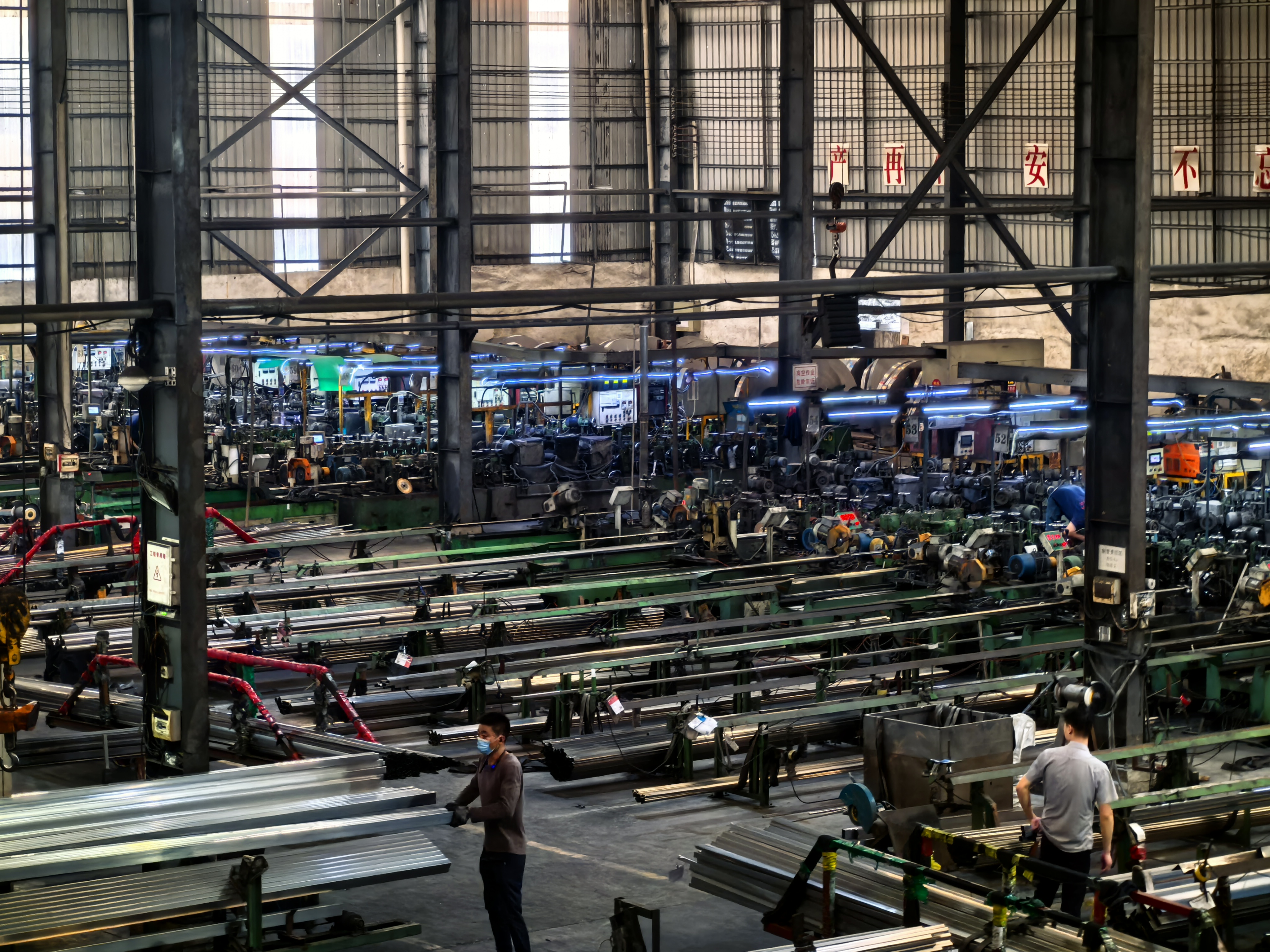
Production line at Sanon's stainless steel pipe factory in Foshan.
Custom Stainless Steel Pipes & Fittings: An OEM Capability Guide for Architects and Fabricators
Buyers evaluating stainless steel pipes for architectural, railing, or glass hardware projects rarely need a single straight tube. They need a compatible system of profiles, fittings, finishes, and documentation. An OEM supplier should be able to turn drawings and specifications into finished stainless steel pipes and matching accessories without creating separate sourcing risks.
GuangDong Sanon Metal Products Co.,Ltd, known as Sanon, is a high-tech enterprise in Foshan, China, specializing in stainless steel pipes, handrail fittings, glass fittings, and shower room fittings. This guide explains how to assess OEM capability for custom stainless steel pipes and fittings, what verification steps matter before execution, and how to apply those checks to real projects.
The Problem: Why Standard Stainless Steel Pipe Supply Is Not Enough
At the evaluation and execution stage, the problem is not only which pipe to buy but which supplier can execute the entire system. Standard pipe lengths may be available from many mills, but projects often require round, square, slotted, and oval profiles, plus elbows, bends, connectors, end caps, glass clamps, brackets, standoffs, flanges, handles, and other hardware. If those parts come from different suppliers, material matching, finish consistency, tolerance, and delivery can fail.
No single supplier should be evaluated only by price per ton. Buyers need to know whether the factory can control pipe production, perform cutting and welding, offer the right finish, and bundle the full set of accessories. This is especially true when the buyer is a distributor, fabricator, or project contractor moving from evaluation to execution.
Industry Background: Why Custom Capability Is Becoming a Standard Requirement
The global stainless steel market was valued at USD 111.44 billion in 2022 and is projected to grow to USD 182.10 billion by 2030, according to Fortune Business Insights. China's stainless steel exports reached 4.14 million tons in 2023, according to the General Administration of Customs of China. In this environment, buyers look for suppliers who can offer more than commodity tube: they need a factory that can handle custom profiles and complete system components.
Standards also shape procurement. Stainless steel pipes and tubes used in structural and architectural applications commonly fall under ASTM A312 for seamless and welded pipe and ASTM A554 for ornamental tubing. For glass clamps and standoff pins, building codes such as the International Building Code govern load-bearing capacity. A capable OEM supplier should be ready to discuss these standards and provide supporting documents.
Color-finished pipe is another signal. The use of PVD coating for stainless steel color pipe is increasing in interior decoration because PVD is considered more environmentally friendly than electroplating, according to the International Stainless Steel Forum. Buyers should ask how color pipes are coated and whether the finish method matches the project requirement.
What an OEM Stainless Steel Pipe Manufacturer Should Be Able to Deliver
1. A Complete Pipe Profile and Accessory System
An OEM supplier should be able to coordinate the main pipe profile with all connecting elements. In a typical railing or balustrade system, buyers look for stainless steel round pipe, square pipe, slotted pipe, oval pipe, elbows, bends, bars, pipe connectors, end caps, decorative balls, brackets, cross bar holders, glass standoffs, glass clamps, railing flanges, door handles, sliding door fittings, and stainless steel cable. The product scope should be broad enough to keep the bill of materials consistent.
Sanon's main product scope includes stainless steel pipes, stainless steel tube, stainless steel accessories, staircase handrails, stainless steel glass clamps, and stainless steel elbow pipes. The company states that it provides customized products to meet customer demand.
2. Material Grades and Chemical Composition
Material selection changes cost and corrosion performance. Sanon lists 201 stainless steel with chromium 16-18%, nickel 3.5-5.5%, and manganese 5.5-7.5%. For 304 stainless steel, the listed composition is chromium 18-20%, nickel 8-11%, and manganese 2% or less. Buyers comparing quotes should request these or equivalent composition data from any supplier.
For fittings, Sanon can make products from stainless steel 304, stainless steel 316, or zinc alloy, with either satin or mirror finish. This flexibility matters because a railing system may use a 304 pipe body, a 316 fitting in coastal conditions, or a zinc alloy decorative component where strength requirements are lower.
3. Matching Fittings, Brackets, and Glass Hardware
Stainless steel pipe systems rarely end at the pipe. The same project may require glass clamps, glass standoffs, stainless steel brackets, cross bar holders, pipe connectors, end caps, and decorative balls. A well-equipped OEM supplier should be able to offer these as part of the same purchasing process, reducing the risk of mismatched sizes and finishes.
Sanon's product areas include stainless steel glass clamps, glass fittings, handrail fittings, and shower room fittings. This allows buyers to consolidate pipe and accessory orders rather than sourcing from multiple vendors.
4. Surface Finish and Color Pipe Options
Finish consistency is one of the most visible quality indicators. Sanon's fittings can be produced with satin or mirror finish, and custom products are available to meet customer demand. For color pipe applications, buyers should verify the coating method; PVD coating is increasingly used in interior decoration because it is more environmentally friendly than electroplating.
5. Certifications and Compliance Evidence
Sanon provides compliance documents for its stainless steel pipes. The current RoHS Attestation of Conformity, certificate number TD59352502 issued by EUTEST, covers stainless steel pipes model 304 and confirms compliance with the EU RoHS 2015/863 restricted substances list. The ECTI CERT Certificate under the Construction Products Regulation, certificate number BGTC20251119-08, covers stainless steel pipes model 304 in the EU. Sanon also holds ISO 14001 and ISO 45001 certificates, both valid through December 3, 2026.
Buyers should still ask for project-specific documents. ASTM A312/A554 and IBC compliance are important for structural, ornamental, and glass hardware applications, but a buyer must confirm the exact scope of each certificate before execution.
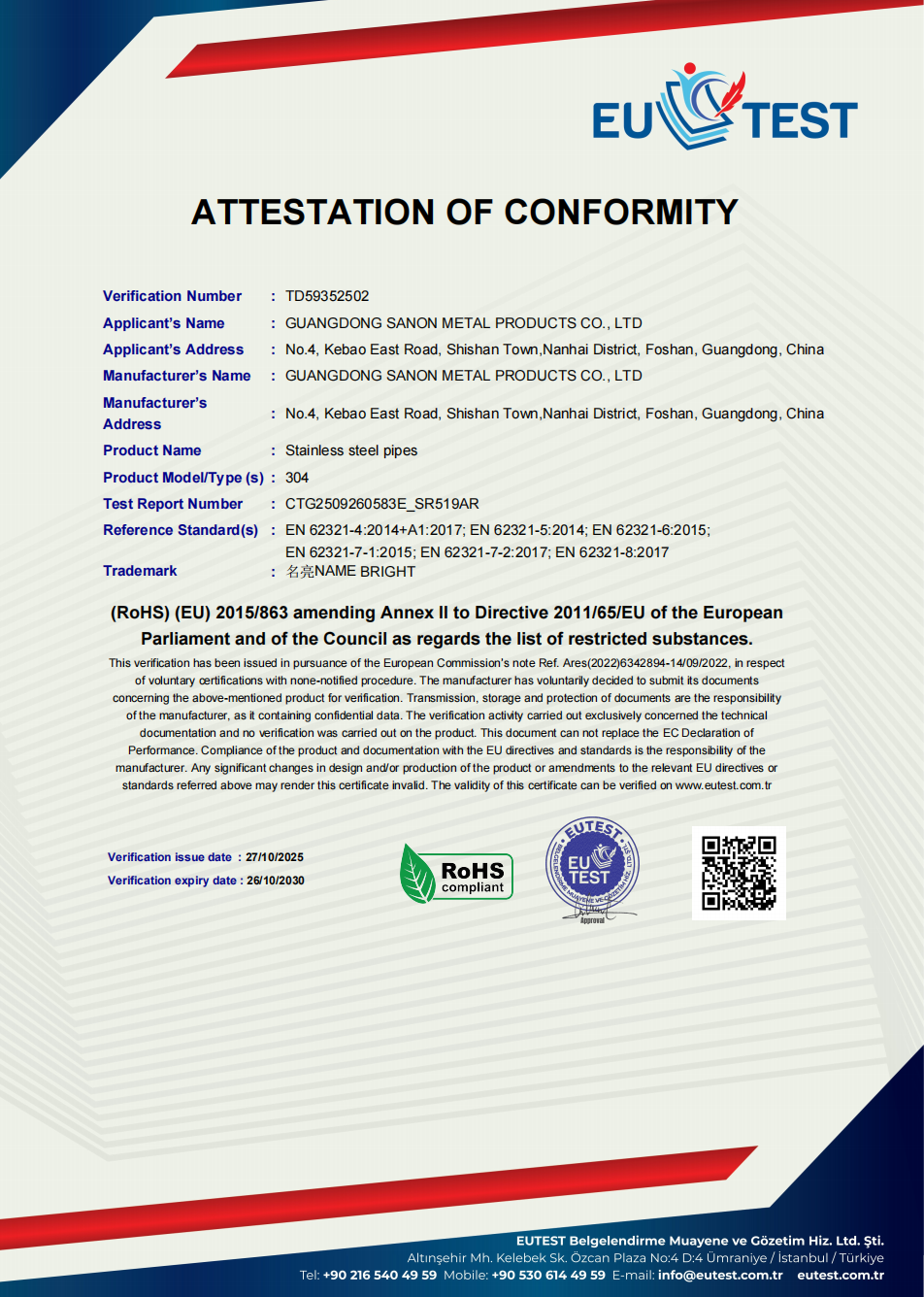
RoHS Attestation of Conformity covering Sanon stainless steel pipe model 304.
Step-by-Step: How to Evaluate and Execute an OEM Stainless Steel Pipe Order
- Define the pipe system on paper. List every profile and accessory: round, square, slotted, oval, elbows, bends, bars, glass clamps, brackets, connectors, end caps, flanges, and handles. A complete drawing or bill of materials helps the factory quote accurately.
- Confirm material grades and chemical composition. Compare 201, 304, and 316 requirements. Use composition ranges such as the 201 and 304 data above or the buyer's own specification.
- Check fitting material and finish. Confirm whether fittings will be stainless steel 304, stainless steel 316, or zinc alloy, and whether the requested finish is satin or mirror.
- Review certificates and standards. Ask for RoHS, CPR, ISO 14001, and ISO 45001 documents. If the product will be used in a glazing or railing system, clarify how ASTM A312/A554 and IBC requirements will be satisfied.
- Validate production capacity. Sanon covers an area of 40,000 square meters, has approximately 500 employees and a 30-person R&D team, and reports a monthly capacity of 9,000 tons for stainless steel pipes. Annual output is listed as 100,000 tons.
- Confirm MOQ, lead time, and payment terms. Sanon's procurement terms list an MOQ of 2 tons, FOB and EXW delivery methods, and payment by bank transfer or cash. The OEM/ODM capability record lists an MOQ of 5 tons and a lead time of 7 days. Exact terms should be confirmed in the quotation for each project.
- Ask for a sample or pilot run. Before full execution, a sample or small batch verifies pipe geometry, finish, fitting compatibility, and packing quality. Sanon's OEM/ODM mode supports customization such as logo and voltage, but the actual sample flow should be confirmed with the sales team.
- Plan after-sales support. Sanon's after-sales support is described as remote support, and its export markets include the Middle East, South America, and Africa. Export ratio is about 70%. A clear contact channel should be part of the order.
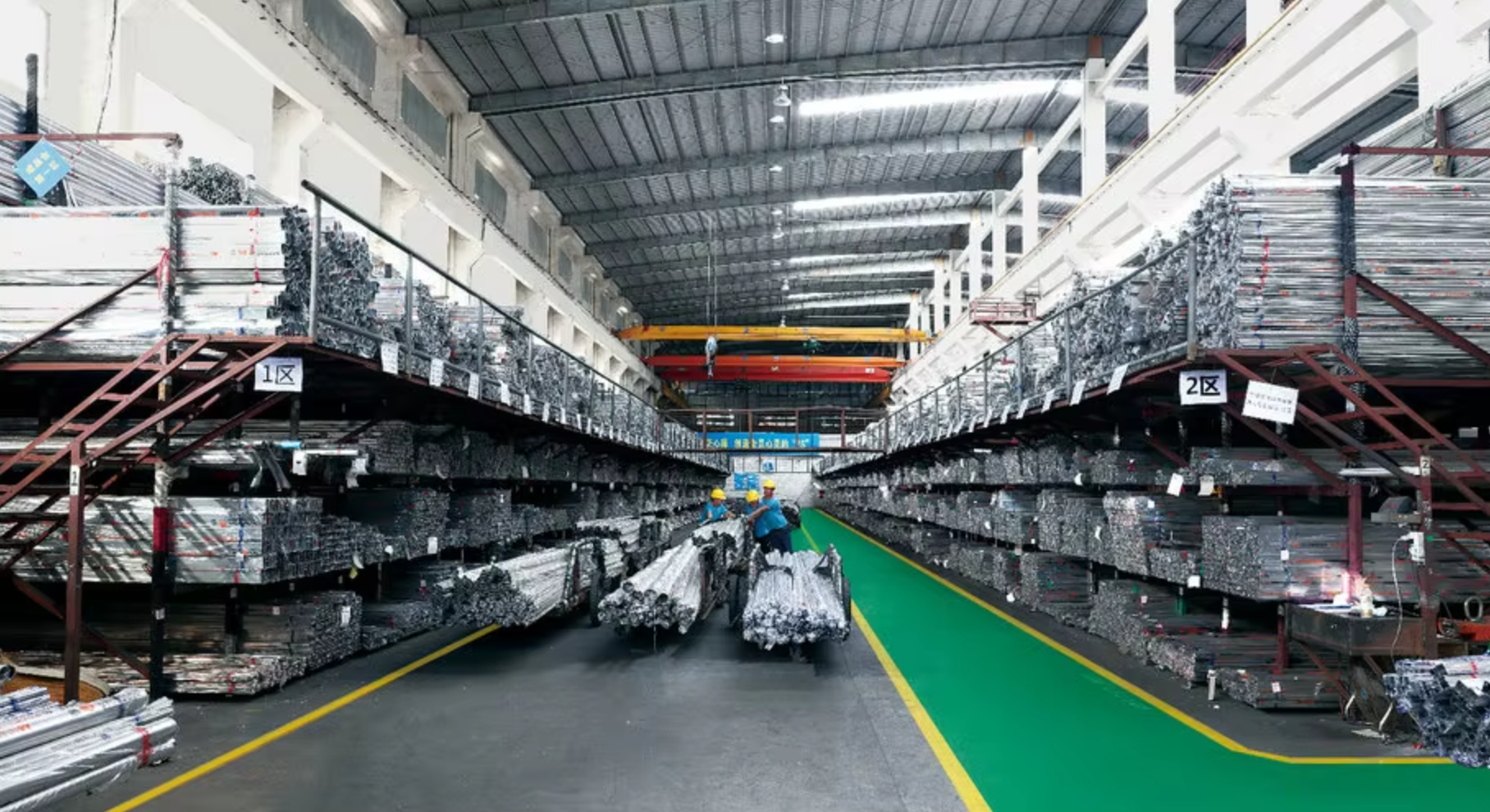
Sanon warehouse and finished goods area supporting batch deliveries.
Use Cases: Where Custom Stainless Steel Pipes and Fittings Are Applied
Architectural Railing and Balcony Handrails
Handrail systems combine pipe profiles with elbow pipes, flanges, brackets, and end caps. Sanon's case record for architectural and decorative projects shows a distributor relationship spanning 10 years and 9,000 tons, with stable quality in accordance with national standards. The case covers distributor clients in China, Vietnam, and Brazil. That long-term relationship is evidence of repeatability rather than a one-time sample.
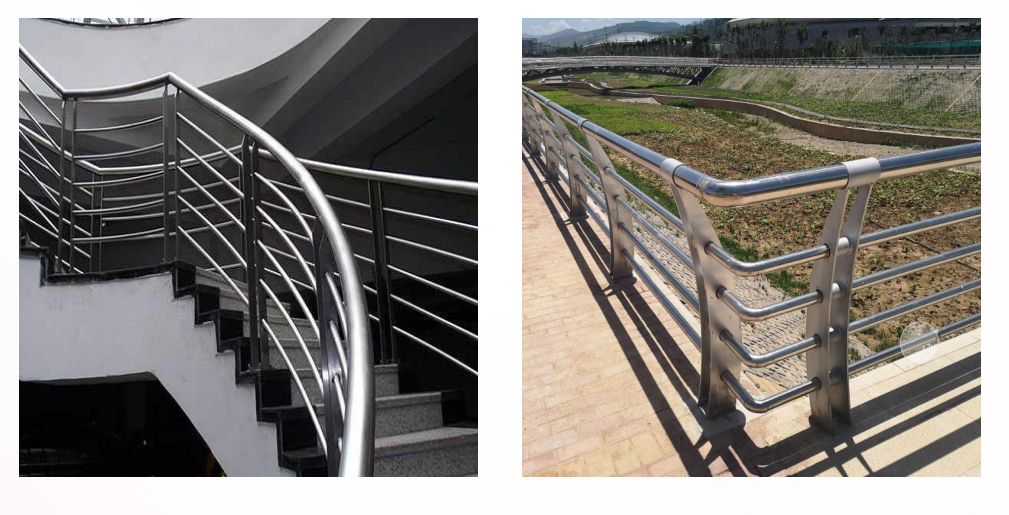
Balcony handrail application using stainless steel pipe and fitting systems.
Glass Balustrades and Standoff Systems
Glass balustrades require glass clamps, glass standoffs, brackets, and cable assemblies. Because these components are governed by building codes such as IBC, buyers need a supplier who can support the complete hardware set and provide documentation.
Shower Enclosures and Door Hardware
Shower room fittings and sliding door fittings are an extension of the same stainless steel system. Door handles, glass holders, and connector elements need to match the pipe profile and finish used in the surrounding structure.
Decorative Stainless Steel Color Pipe Interiors
Color pipe is used in interior decoration, furniture, display fixtures, and feature walls. As PVD coating adoption increases, buyers should verify that the pipe supplier can deliver a consistent color finish across pipes and matching accessories.
Supplier Capability Comparison at a Glance
The table below compares three supplier models relevant to custom stainless steel pipe procurement. It is not a ranking; it is a checklist to help buyers match supplier type to project need.
| Capability Dimension | Integrated Pipe Manufacturer (Sanon as Example) | Trading Company / Agent | High-End Architectural Hardware Specialists |
|---|---|---|---|
| Production control | 40,000 m² factory; 9,000 tons per month stainless steel pipe capacity | Depends on third-party factories; no direct pipe production control | Focus on glass clamps and railing systems, not pipe production |
| Product scope | Stainless steel pipes, tube, accessories, staircase handrail, glass clamps, elbow pipes | Can source multiple categories, but material matching depends on the mills used | Verified market examples: Q-railing, Hafele, and ASSA ABLOY specializing in glass clamps and railing systems |
| Customization | Custom products available; fittings in SS304, SS316, or zinc alloy; satin or mirror finish | Limited unless the manufacturer cooperates; buyer may pay higher coordination cost | Product-specific hardware ranges; custom pipe geometry may require another supplier |
| Compliance evidence | RoHS, CPR, ISO 14001, and ISO 45001 certificates listed | Must request certificates from each source factory | IBC load-bearing requirements apply to glass clamps and standoff pins; buyer must verify model-specific compliance |
Frequently Asked Questions
What certifications should a custom stainless steel pipe supplier hold for EU and international projects?
For EU projects, the buyer should ask for RoHS compliance for restricted substances and, where relevant, a Construction Products Regulation certificate. Sanon holds an RoHS Attestation of Conformity, number TD59352502, and a CPR certificate, number BGTC20251119-08, for stainless steel pipes model 304. For management systems, ISO 14001 and ISO 45001 certificates show environmental and occupational health and safety controls. For structural and ornamental tubing, ASTM A312 and ASTM A554 are relevant standards; for glass clamps and standoff pins, IBC building-code compliance should be checked.
What pipe profiles and matching fittings should an OEM manufacturer support?
An OEM supplier for architectural stainless steel should be able to support round, square, slotted, and oval pipes, as well as elbows, bends, bars, glass clamps, brackets, cross bar holders, glass standoffs, pipe connectors, end caps, decorative balls, sliding door fittings, railing flanges, door handles, and stainless steel cable. Sanon's product scope covers stainless steel pipes, tube, accessories, staircase handrails, glass clamps, and elbow pipes, and the company accepts customized products.
What MOQ and lead time should buyers expect for custom stainless steel pipe orders?
Published procurement terms for Sanon list an MOQ of 2 tons, FOB and EXW delivery methods, and payment by bank transfer or cash. The OEM/ODM capability record lists an MOQ of 5 tons and a lead time of 7 days, with monthly capacity of 9,000 tons. Buyers should confirm the exact MOQ and lead time for their specific profiles and accessories in the official quotation.
Can buyers request samples before a full project order?
Because a sample order verifies geometry, finish, and fitting compatibility, buyers should raise sample requirements during quotation. Sanon provides customized products under its OEM/ODM mode, and its sales team can be reached by email, phone, or WhatsApp. Sample policy and cost should be confirmed before payment so that the buyer can evaluate the finished pipe and hardware.
How do I verify production capacity and delivery reliability before execution?
Sanon's factory covers 40,000 square meters and has a monthly stainless steel pipe capacity of 9,000 tons. The after-sales support mode is remote support, and main export markets include the Middle East, South America, and Africa. Buyers can also ask for previous case references; Sanon's published case shows a distributor relationship of 10 years, 9,000 tons, and stable quality in accordance with national standards. For a verified quotation and project-specific lead time, contact Sanon directly.
Conclusion: Move from Pipe Price to OEM Capability
Custom stainless steel pipe procurement is not only about finding a lower price per ton. It is about confirming that the supplier can produce the right profile, supply matching fittings, deliver consistent finish, provide compliance evidence, and support the order from production to loading. An integrated manufacturer with a large factory, defined MOQ, and documented certifications reduces the number of decisions the buyer has to manage.
For buyers in the evaluation-to-execution stage, the next step is to define the bill of materials, send the drawing to the factory, and request a quotation with material grade, finish, certificates, and lead time.

Contact Sanon for a custom stainless steel pipe and fittings quotation.
Chloe | Email: 2272260830qq@gmail.com | Tel/WhatsApp: +86 135 3668 1776
Address: No. 4 Factory, Kebao East Road, Zone A, Shishan Science And Technology Industrial Park, Foshan, Guangdong, China