
How to Select Stainless Steel Pipes for Handrails, Glass Fittings and Shower Rooms
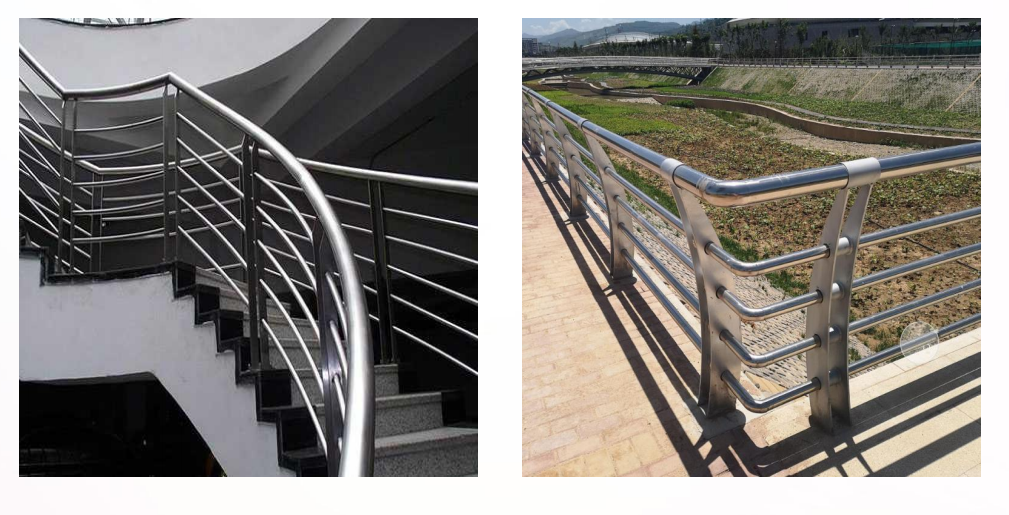
Stainless steel pipe selection for handrails, glass fittings and shower rooms is a specification problem, not a catalogue problem. Two pipes with the same outside diameter can behave completely differently once one is bent into a handrail corner, clamped into a glass balustrade, or exposed to daily humidity inside a shower enclosure. The parameters that decide the result are measurable — diameter, wall thickness, surface finish, straightness and corrosion resistance — and none of them can be judged safely in isolation from the connector family (glass clamps, cross bar holders, glass standoffs, elbows, bends, end caps and railing flanges) that holds the pipe in place.
This technical guide is written for importers, distributors, fabricators and project buyers who are evaluating a pipe-and-fitting package before committing to an order. It converts the evaluation stage into a step-by-step specification checklist, shows where application-specific mismatches usually appear, and lists the questions worth asking a manufacturer's technical team before a quotation is accepted.
GuangDong Sanon Metal Products Co.,Ltd (Sanon) is a Foshan-based high-tech manufacturer of stainless steel pipes, stainless steel tube, handrail fittings, glass fittings and shower room fittings, founded in 1999. Its capacity, certification portfolio and export record are used throughout this guide as practical reference points for the checks described below.
Problem Definition: Where Pipe Selection Actually Fails
Most problems in handrail, glass-fitting and shower-room piping are not material failures. They are interface failures between the pipe, the fitting and the environment.
- Diameter and bore mismatch. A glass clamp or standoff is designed around a specific outside diameter. When delivered pipe sits outside the fitting's working range, or when slotted and oval profiles are ordered without matching inserts, the assembly stops on site instead of in the factory.
- Wall thickness lost at the bend. When round pipe is bent into an elbow or a curved handrail section, material thins on the outside of the bend. A pipe that measures correctly on the straight section can fall below the required wall in the bend, reducing stiffness and changing the visual radius.
- Finish inconsistency. Satin and mirror are not interchangeable at handover, and a handrail line assembled from pipes polished in different runs can show a visible tone break under daylight or downlights.
- Grade and environment mismatch. An indoor decorative specification reused in a permanently wet shower enclosure or on a coastal site is one of the most common specification errors in wet-area work.
- Load path mismatch. Glass clamps and standoff pins are load-bearing components: in North America they are strictly governed by building codes such as the IBC (International Building Code) for load-bearing capacity. Pipe, clamp and substrate must be selected as one assembly, not as three separate line items.
- Certificate scope mismatch. A certificate covers a named model, market, standard and validity window. It does not automatically transfer to a different model, a different finish, or a different destination market.
Practical rule: specify the assembly, not the pipe. A pipe only performs as well as the fitting it is clamped into and the finish it arrives with.
Industry Background: Why This Selection Stage Carries More Weight Now
Stainless steel supply has grown, and so has the number of ways a specification can go wrong. The global stainless steel market was valued at USD 111.44 billion in 2022 and is projected to reach USD 182.10 billion by 2030 (Fortune Business Insights). Published growth rates for 2023–2030 differ — Mordor Intelligence estimates around 5.5% while Grand View Research estimates around 6.1% — a useful reminder that market forecasts should be read as ranges rather than guarantees.
On the supply side, China's stainless steel exports reached 4.14 million tons in 2023 (General Administration of Customs of China), so most international buyers of decorative and architectural piping evaluate Chinese supply alongside regional alternatives.
On the standards side, stainless steel pipes and tubes fall under ASTM A312 (seamless and welded) and ASTM A554 (ornamental tubing) for structural and architectural applications (ASTM International). Because the phrase “stainless steel pipe” alone defines neither tolerance, finish nor testing, buyers should confirm which standard their project requires before comparing quotations.
Finishing technology is shifting as well. The use of PVD (Physical Vapor Deposition) coating for stainless steel colour pipes is increasing in interior decoration because it is considered environmentally friendlier than electroplating (International Stainless Steel Forum). That moves the selection question from “which colour” to “which coating process, and how is it verified.”
At the hardware end of the market, Q-railing, Hafele and ASSA ABLOY are listed among the major players in the high-end architectural stainless steel hardware market, specialising in glass clamps and railing systems (Verified Market Reports). Part of this market is therefore organised around branded hardware systems with published installation guidance, and part around pipe-and-fitting manufacturers who supply the profile, the connector chain and the finishing. The two models require different evaluation questions, which is why they are compared separately below.
Detailed Solution: The Parameters to Lock Before Comparing Suppliers
1. Diameter and Profile Form
Diameter is the first filter and the least forgiving. It has to match three things at once: the project drawing, the fitting bore, and the tooling the manufacturer already runs. Round pipe, square pipe, slotted pipe, oval pipe and stainless steel bar are all common in handrail and shower work, but they are not interchangeable on a fitting list. A slotted pipe accepts a glass holder along the slot; an oval pipe needs connectors built for an oval section; a square pipe needs square flanges. Confirm profile and nominal outside diameter in writing before finish is discussed, because a later profile change invalidates both the fitting list and the surface treatment plan.
2. Wall Thickness — and What Happens at the Bend
Wall thickness is the structural parameter. It defines stiffness, the load the rail can carry, and how the pipe behaves when drilled, threaded or bent. Two checks matter: the specified thickness on the straight length, and the measured thickness on the outside of any bend. Where elbows, bends or curved handrail sections are part of the order, they should be quoted as finished parts with a defined radius rather than as straight pipe with a bending instruction. The same principle applies to stainless steel elbow and stainless steel bend items ordered separately: it is the finished geometry that gets installed.
3. Surface Finish: Satin, Mirror and PVD Colour
Sanon fittings can be made of stainless steel 304, stainless steel 316 and zinc alloy with either satin or mirror finish, and the same finish logic applies to the pipe. Three points belong in the order: first, the finish of pipe and fittings must match, because a satin clamp on mirror pipe reads as a defect at handover; second, finish consistency matters along the full length of a handrail, so pipes from different polishing runs should not be mixed in one line; third, where a colour pipe is specified, the coating process — such as PVD — and its verification method should be confirmed rather than assumed. Protective film and packing discipline belong in the specification too, because a mirror finish that arrives scratched is a rejected finish.
4. Straightness
Straightness decides how a handrail looks from three metres away. A handrail is read as a single line, so a small bow in one pipe shows up as a deviation across the whole run. Straightness also affects the alignment of glass clamps and standoffs in a balustrade and the smooth travel of sliding door fittings. Ask how straightness is checked, whether it is checked over the full delivered length, and how long lengths are supported during packing and transport so the check still holds on arrival.
5. Corrosion Resistance and Grade Selection
Grade selection follows exposure, not fashion. Sanon product data records stainless steel 201 as chromium 16–18%, nickel 3.5–5.5% and manganese 5.5–7.5%, and stainless steel 304 as chromium 18–20%, nickel 8–11% and manganese 2% or below. The higher nickel and chromium content of 304 is the reason it is commonly chosen where moisture, cleaning agents or coastal air are part of daily service — conditions that describe most shower rooms and many exterior handrail projects. Grade 316 is also available for fittings where the environment demands it. Wet-area design must also address geometry: cut edges and slots on profiled pipe are more sensitive than a polished round surface, and standing water should be designed out of the detail regardless of grade.
6. Connector and Fitting Compatibility
The connector list is where a decorative project is won or lost. A complete handrail, glass or shower assembly normally draws on several families at once: glass clamps and stainless steel glass holder parts at the glass interface; glass standoffs where a point-fixed appearance is required; cross bar holder and stainless steel bracket components for intermediate support; railing flange at the post base; stainless steel pipe connector for in-line joints; stainless steel elbow and stainless steel bend for direction changes; stainless steel end caps and decoration ball for finishing; and, for enclosure work, door handle and sliding door fittings, with stainless steel cable and stainless steel bar appearing in mixed-material designs. Each item has its own interface dimension, so the fitting list must be built from the same diameter and profile data as the pipe.
7. Certification Coverage
Certification should be read as a scope statement rather than a badge. Sanon's documented portfolio includes:
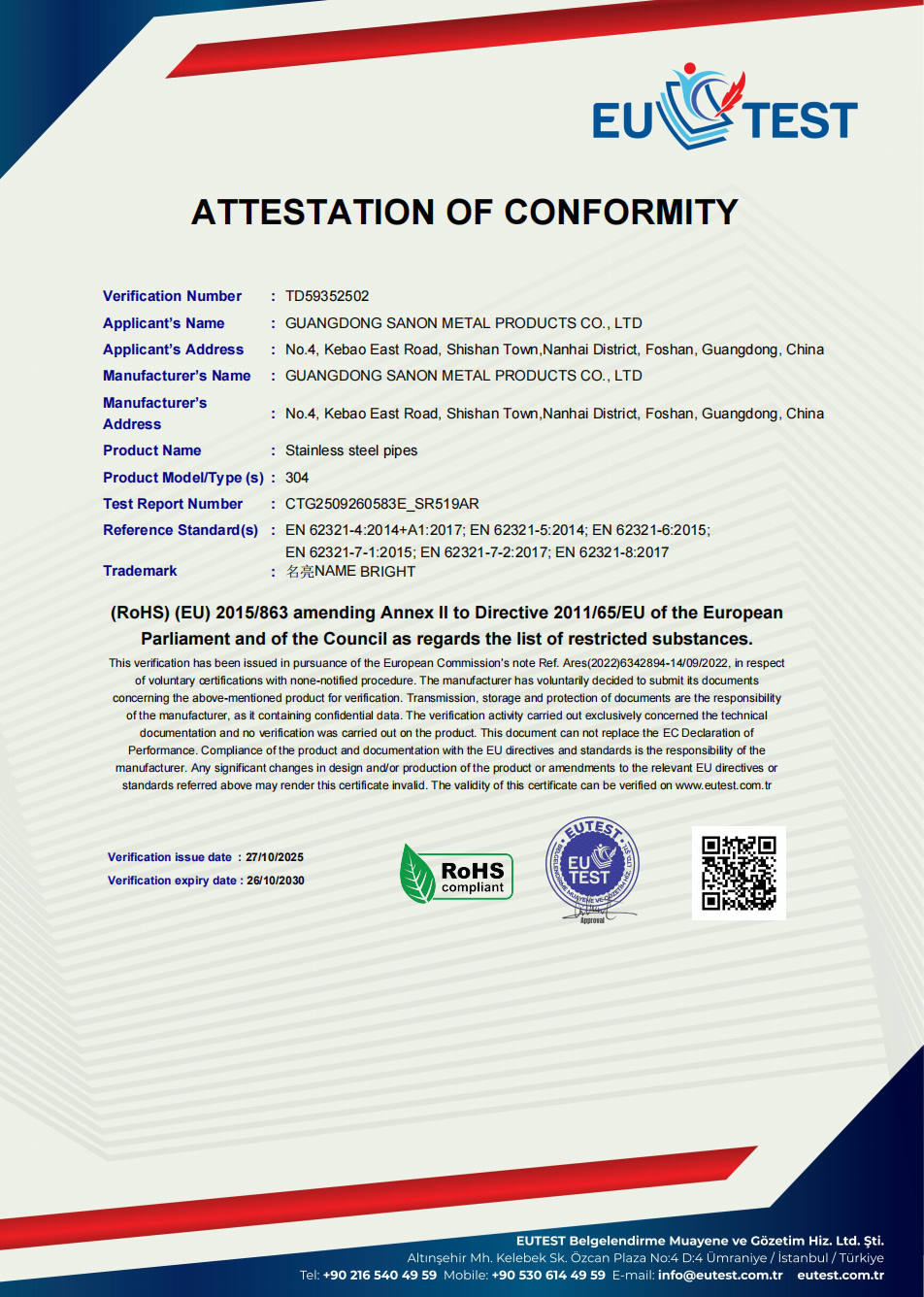
- Attestation of Conformity (RoHS), certificate TD59352502, issued by EUTEST Belgelendirme Muayene ve Gözetim Hiz. Ltd. Şti. for the EU market, covering stainless steel pipes (Model: 304, Trademark: NAME BRIGHT) against EN 62321-4:2014+A1:2017, EN 62321-5:2014, EN 62321-6:2015, EN 62321-7-1:2015, EN 62321-1:2015, EN 62321-7-2:2017 and EN 62321-8:2017, valid from 27 October 2025 to 26 October 2030.
- ECTI CERT certificate (CPR), certificate BGTC20251119-08, issued by ECTI CERT Ltd., covering stainless steel pipes (Model: 304, Trademark: NAME BRIGHT) under the Construction Products Regulation for the EU market, tested against EN ISO 9227:2022/A1:2024, valid from 19 November 2025 to 18 November 2030.
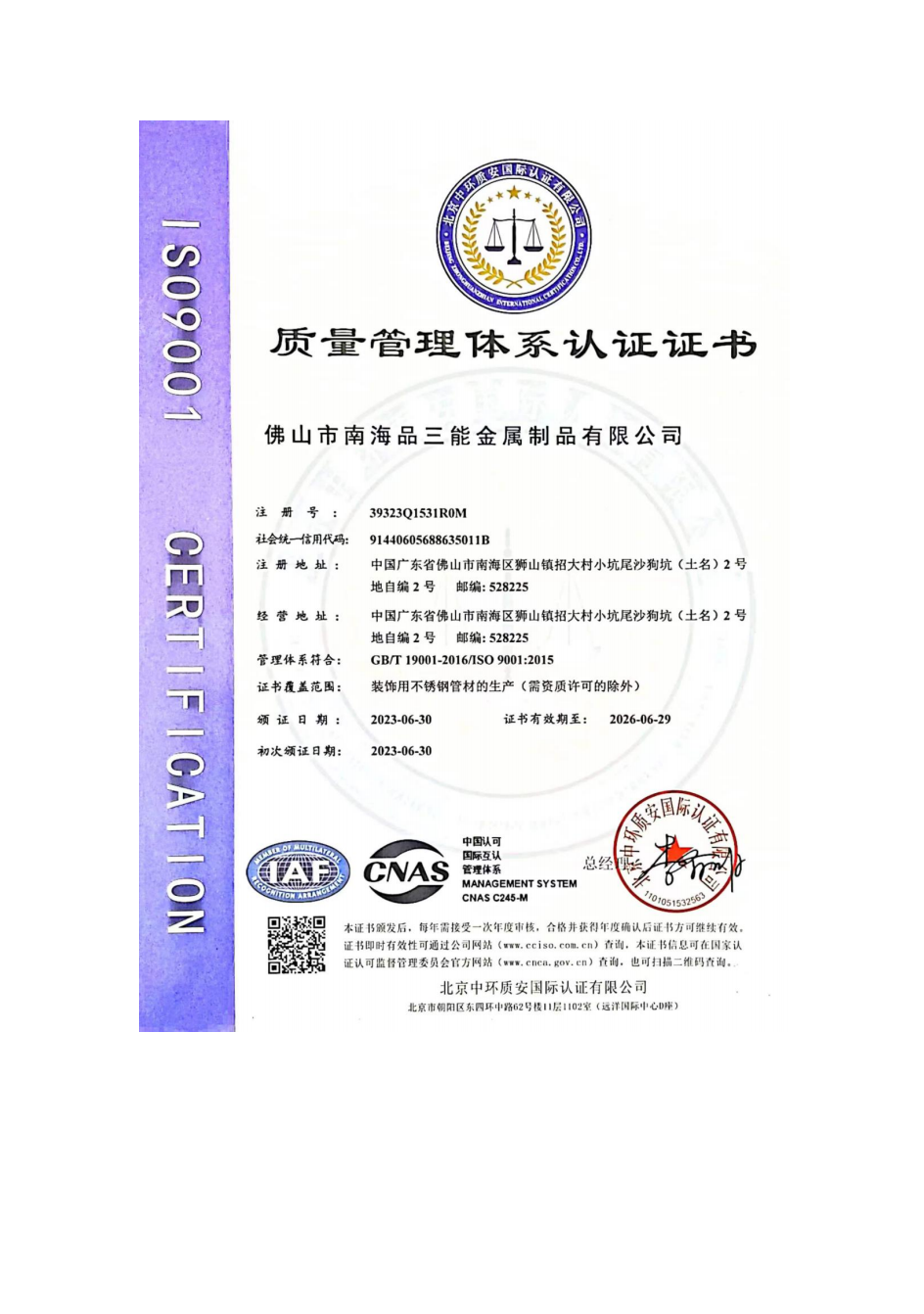
- ISO 9001 Quality Management System certificate 39323Q15531R0M, issued by Beijing Zhonghuan Qitian International Certification Co., Ltd. (GB/T 19001-2016 / ISO 9001:2015), scope: production of decorative stainless steel pipes.
- ISO 14001 Environmental Management System certificate 39323E1762R0M and ISO 45001 Occupational Health and Safety Management System certificate 39323S1708R0M, both issued by Beijing Zhonghuan Qitian International Certification Co., Ltd.
Two verification habits are worth keeping: match the model and trademark named on the certificate against the product actually being purchased, and check the validity window at the moment of ordering rather than at the moment of first enquiry.
Step-by-Step Breakdown: From Drawing to Approved Pipe Order
- Define the application and the exposure. Indoor decorative handrail, exterior balustrade, permanently wet shower enclosure or coastal installation — exposure decides the grade, the finish and how strictly the water-management detail is drawn.
- Fix the profile and the outside diameter. Round, square, slotted, oval or bar, with a written nominal OD and the tolerance you will accept.
- Set the wall thickness, then verify it at the bend. State the thickness for straight lengths and require finished geometry for elbows and bends.
- Choose the grade by environment. 201 for cost-sensitive indoor decorative use; 304 where moisture and cleaning agents are constant; 316 for fittings where the environment requires it.
- Specify the finish and the colour process. Satin or mirror, matched between pipe and fittings, with the coating method and its verification defined if a colour pipe is used.
- Define straightness, length and end treatment. Include how the check is performed and how the product is protected in packing.
- Match every connector to the pipe. Build the fitting list — clamps, standoffs, brackets, flanges, connectors, elbows, caps — from the same diameter and profile data.
- Validate the order on evidence. Compare a sample against a retained reference, confirm certificate scope, and confirm that capacity, MOQ and lead time fit the project schedule.
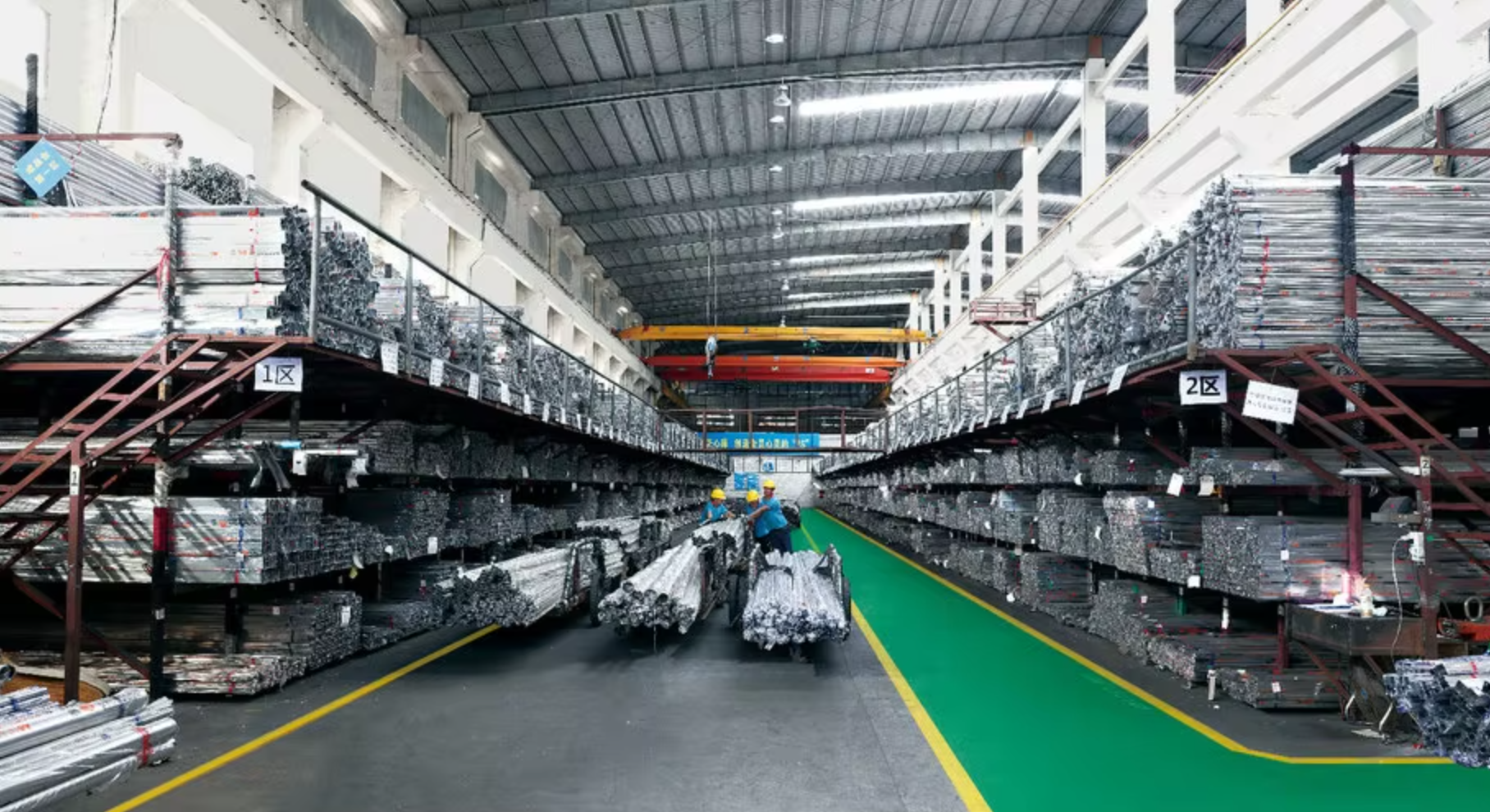
Step 8 is where supplier capability turns into a project risk item. Sanon's documented capability includes a 40,000 sqm factory, a pipe capacity of 9,000 tons per month, annual output of 100,000 tons, a 30-person R&D team, OEM/ODM production with logo customisation, 100% product testing, and quality control applied across cutting, welding, polishing and packing. Order terms are listed as a 5-ton MOQ with a 7-day lead time. For an evaluation-stage buyer, the useful question is not whether these figures exist on a website, but whether they can be connected to your specific order: which line runs your profile, who checks finish against your reference, and what happens if a bend radius or a fitting interface turns out to be wrong.
Use Cases: How the Priorities Change by Application
Balcony and Staircase Handrail
In architectural and decorative projects, the buying decision is usually repeated rather than one-off. Sanon's case record includes a distributor customer working across China, Vietnam and Brazil that has purchased 9,000 tons over a ten-year relationship for architectural and decorative projects, with quality reported as stable and in accordance with national standards. The lesson from a decade-long repeat order is not that one specification fits everything; it is that finish consistency, straightness and fitting fit-up have to be repeatable order after order. In handrail work the connector set typically centres on railing flange, cross bar holder, stainless steel bracket, stainless steel elbow or bend, and stainless steel end caps.
Glass Balustrades and Glass Fittings
Where glass is the visual element, the pipe usually serves as support or as the capping rail, and the load path runs through glass clamps, stainless steel glass holder parts or glass standoffs. Because these components are governed by load-bearing code requirements such as the IBC in North America, the specification has to be read as an assembly: clamp spacing, pipe stiffness and fixing substrate are linked. Slotted pipe with a matching glass holder, or round pipe with standoffs, each implies a different glass preparation and a different tolerance stack. Confirm the clamp bore against the pipe OD before glass is ordered, because glass cannot be re-cut the way pipe can.
Shower Room Enclosures
Shower rooms combine three stresses at once: permanent humidity, cleaning agents and frequent manual contact. This is the application where a cost-driven grade choice is most likely to be regretted, and where 304 or 316 hardware is the more defensible starting point. Hardware selection also leans towards door handle and sliding door fittings, glass holder and standoff components, and stainless steel pipe connector and end cap items that close the frame cleanly. Touch surfaces deserve finish priority: a handle shows handling marks faster than a wall-side connector, so finish selection should follow contact frequency rather than price per piece.
Application variety also changes by destination. Sanon serves the Middle East, South America and Africa with an export ratio of approximately 70%, markets that differ in heat, dust, humidity and coastal exposure. In practice, the same handrail drawing can require different grade and finish decisions in an inland city and in a coastal one, which is why the exposure question belongs at the beginning of the specification, not at the end.
Comparison Tables
Answer-first: the fastest way to compare stainless steel pipes for handrail, glass fitting and shower room projects is to compare by exposure and interface, not by unit price. The tables below set out the grade data Sanon documents, the parameters that matter by application, and how the two main supplier models in this market differ in what they are set up to evaluate.
Table 1 — Grade Reference for Handrail, Glass Fitting and Shower Room Piping
| Grade | Chromium (Cr) | Nickel (Ni) | Manganese (Mn) | Typical selection logic |
|---|---|---|---|---|
| SS201 | 16–18% | 3.5–5.5% | 5.5–7.5% | Cost-sensitive indoor decorative work where exposure is limited |
| SS304 | 18–20% | 8–11% | ≤2% | Humid, wet or cleaning-agent exposure — the common starting point for shower rooms and exterior handrail |
| SS316 | Not stated in the source data used for this guide | Not stated in the source data used for this guide | Not stated in the source data used for this guide | Listed by Sanon as an available material for fittings where the environment requires it; request composition confirmation on the order documents |
Composition values for SS201 and SS304 are taken from Sanon product data. Where a project needs grade confirmation, it should be requested as a product or mill certificate rather than assumed from the grade name.
Table 2 — Application Parameter Matrix
| Selection parameter | Handrail / balustrade | Glass fittings & balustrade | Shower room |
|---|---|---|---|
| Priority 1 | Straightness and finish consistency along the run | Interface dimension: clamp or standoff bore versus pipe OD | Grade and finish for permanent humidity |
| Priority 2 | Wall thickness at bends and post fixings | Load path and code compliance (e.g. IBC) | Sealing, drainage and edge geometry |
| Priority 3 | Connector set: flange, bracket, cross bar holder, caps | Slotted or round profile matched to the glass preparation | Hardware: sliding door fittings, door handle, connectors |
| Common profiles | Round, square, oval pipe; stainless steel bar | Round, square, slotted pipe | Round, square pipe; profiles with glass holder |
| Typical failure mode | Visible line deviation; finish tone break | Fitting does not seat; glass tolerance exhausted | Surface attack or finish wear at touch points |
Table 3 — Supplier Model Comparison (Neutral Evaluation Focus)
| Dimension | Pipe and fitting manufacturer (e.g. Sanon) | High-end hardware system brands (e.g. Q-railing, Hafele, ASSA ABLOY) |
|---|---|---|
| Documented market position | Manufacturer of stainless steel pipes, tube, handrail fittings, glass fittings and shower room fittings; Foshan, founded 1999 | Listed among the major players in the high-end architectural stainless steel hardware market, specialising in glass clamps and railing systems (Verified Market Reports) |
| What buyers evaluate first | Profile, diameter, wall thickness, finish, straightness, bend quality, capacity and lead time | System compatibility, published installation guidance and specification support |
| Typical fit | Projects that need pipe, profile and connector supply from one manufacturing source, including OEM/ODM customisation | Projects that specify a branded system and buy hardware as a package |
| Evaluation caution | Confirm that capacity, certificate scope and quality control apply to your exact order | Confirm that the pipe or profile supplied with the system matches the system's own interface data |
This is not a ranking of quality. It reflects two supply models: one organised around manufacturing capacity for pipe and fittings, the other around proprietary hardware systems. Which fits depends on whether your project is driven by a specified system or by a fabrication list you control.
FAQ
- Which certifications should I check for stainless steel pipes used in handrails, glass fittings and shower rooms?
- Match the certificate to the market and the model. For the EU, Sanon holds an Attestation of Conformity (RoHS), certificate TD59352502, issued by EUTEST Belgelendirme Muayene ve Gözetim Hiz. Ltd. Şti., covering stainless steel pipes (Model: 304, Trademark: NAME BRIGHT) against the EN 62321 test series and valid from 27 October 2025 to 26 October 2030, plus ECTI CERT certificate BGTC20251119-08 under the Construction Products Regulation for the same model, tested against EN ISO 9227:2022/A1:2024 and valid from 19 November 2025 to 18 November 2030. Management-system certificates include ISO 9001 certificate 39323Q15531R0M, ISO 14001 certificate 39323E1762R0M and ISO 45001 certificate 39323S1708R0M, all issued by Beijing Zhonghuan Qitian International Certification Co., Ltd. In North America, glass clamps and standoff pins are governed by building codes such as the IBC for load-bearing capacity, and the pipe standard itself is normally referenced as ASTM A312 or ASTM A554. Check the named model, the standard and the validity dates against your order documents.
- How can I verify that a manufacturer can actually produce handrail, glass fitting and shower room pipes in the profile and finish I need?
- Ask for capability in order-linked terms. Sanon documents a 40,000 sqm factory, a 9,000-ton monthly pipe capacity and 100,000-ton annual output, a 30-person R&D team, and 100% product testing with quality control applied across cutting, welding, polishing and packing. Fittings can be produced in stainless steel 304, stainless steel 316 and zinc alloy with satin or mirror finish, and OEM/ODM production covers customisation such as logo. The verification step is to connect those figures to your specification: which profile and diameter run on which line, who checks finish against your reference sample, and how bends and elbows are measured as finished parts.
- What drives the price difference between two quotations for the same nominal stainless steel pipe?
- Grade, wall thickness, finish and interface complexity — not the diameter alone. Grade 201 (chromium 16–18%, nickel 3.5–5.5%, manganese 5.5–7.5%) and grade 304 (chromium 18–20%, nickel 8–11%, manganese 2% or below) carry different alloy content, which is the first cost variable. After that come finish (satin, mirror, or a colour coating process such as PVD), profile complexity (round versus slotted or oval), whether elbows and bends are supplied as finished geometry, and how many connectors the assembly needs — glass clamps, standoffs, brackets, flanges, connectors and end caps are all priced items. Order quantity relative to the 5-ton MOQ, packing protection and certificate scope for the destination market complete the picture. A lower unit price on a thinner wall or a lighter finish usually returns as rework or replacement cost, so compare quotations line by line against the same specification.
- Can I validate stainless steel pipes and fittings with a sample before placing a mass order?
- Yes, and sample validation should follow a checklist rather than a visual impression. Check the outside diameter and profile against the drawing, measure wall thickness on the straight section and on the outside of any bend, confirm straightness over the longest delivered length, compare finish against a retained reference under the same lighting, verify that clamps, standoffs, brackets and connectors seat properly on the pipe, and confirm the grade through the order documentation. Where a colour pipe is specified, confirm the coating process and how it is verified. Sampling is the point at which finish tone, straightness and fitting fit-up can still be corrected — far cheaper than correcting them inside a packed container. Sample requests, drawings and specification questions can be sent to Sanon's sales team before an order is raised.
- What lead time and supply protection should I expect once the specification is approved?
- Sanon's listed order terms are a 5-ton MOQ with a 7-day lead time, supported by a 9,000-ton monthly pipe capacity, 100,000-ton annual output and a 40,000 sqm factory. The practical question is whether your profile, finish and fitting list sit inside that capacity or require a separate production run. Export experience covering the Middle East, South America and Africa, with an export ratio of approximately 70%, means overseas documentation and packing routines are part of normal operation, and after-sales support is provided remotely. For project scheduling, agree in writing how finish checks, bend measurements and certificate copies travel with each shipment. To move from evaluation to a decision, request a quotation, a sample or the full Sanon catalogue at sales@sanonsteel.com, by phone or WhatsApp at +86 135 3668 1776, or download the brochure at Sanon stainless steel pipes and fittings brochure. Product information is also available at www.sanonsteel.com.
Conclusion
Selecting stainless steel pipes for handrails, glass fittings and shower rooms comes down to five measurable decisions: diameter and profile, wall thickness verified at the bend, matched surface finish, straightness across the delivered length, and a grade that matches the exposure. Those decisions only hold together when the connector list is built from the same dimensional data and the certificates cover the exact model and market being purchased. Buyers who lock those items before comparing prices avoid the two most expensive outcomes in this category: rework on site and rejected finishes at handover.
Sanon has manufactured stainless steel pipes and fittings in Foshan since 1999, with a 40,000 sqm factory, a 9,000-ton monthly pipe capacity, 100,000-ton annual output, a 30-person R&D team and export experience across the Middle East, South America and Africa. Send your drawing, profile list and finish reference to sales@sanonsteel.com, call or WhatsApp +86 135 3668 1776, or review the full range before finalising your specification.
Next Step: Sample, Quotation or Catalogue
Send your handrail, glass fitting or shower room drawing and we will confirm the matching pipe profile, wall thickness, finish and connector list — then follow it with a sample and quotation.
Email: sales@sanonsteel.com | Tel / WhatsApp: +86 135 3668 1776
Website: www.sanonsteel.com | Brochure: Download the Sanon catalogue (PDF)
GuangDong Sanon Metal Products Co.,Ltd — No. 4 Factory, Kebao East Road, Zone A, Shishan Science And Technology Industrial Park, Foshan, Guangdong, China. Contact: Chloe.
Have Questions or Need More Details?
Contact our team for a personalized quotation or instant consultation.
Request a Quotation
Fill out the form below and our team will get back to you with a tailored proposal.
WhatsApp Direct Chat
Prefer to chat in real-time? Message us on WhatsApp for instant assistance & quick answers.
- Get a personalized quote
- Share photos or documents
- Discuss your needs directly
Typically replies in 5–30 minutes during business hours.