
Stainless Steel Pipe Sizing Guide: Understanding OD, ID, and Wall Thickness

Stainless steel round pipes: outer diameter, inner diameter and wall thickness are three views of the same section.
A stainless steel pipe is fully described by three measurements: outer diameter (OD), inner diameter (ID), and wall thickness. The outer diameter is measured across the outside of the pipe; the wall thickness is the thickness of the steel wall itself; the inner diameter is the clear bore that remains inside. Two of these always determine the third, because ID = OD − (2 × wall thickness). That is why a purchase list that names only one number — "stainless steel pipes, 40 mm" — is not yet a specification, and why dimensional disputes so often reach the supplier only after fabrication has started.
This guide is written for importers, distributors, fabricators, project buyers, and engineers who source stainless steel pipes and matching fittings across borders. It explains how OD, ID, and wall thickness each behave, how they interact with pressure rating, flow, and structural integrity, and how to turn that understanding into a specification that a mill can produce and a site can install. The dimensional framework is grounded in the product range of GuangDong Sanon Metal Products Co.,Ltd (Sanon), a Foshan-based manufacturer of stainless steel pipes, tubes, fittings, and architectural hardware.
Problem Definition: What OD, ID, and Wall Thickness Actually Mean
Outer diameter is the distance across the outside face of the pipe, measured where the section is round and undistorted. Wall thickness is the thickness of the steel wall at that section. Inner diameter is the clear bore. Once OD and wall thickness are fixed, ID is not a free choice — it is arithmetic, and it is the number that governs flow capacity, cleaning access, and the size of anything that must pass through or into the line.
Two pipes can carry the same OD and still deliver visibly different bores, because the difference is absorbed by the wall. This is the single most common source of confusion in stainless steel pipe procurement: the outside of the pipe stays constant while the inside moves.
Why nominal names are not measurements
Nominal pipe size (NPS) and its metric companion DN are naming conventions, not dimensions. In the NPS family, the outer diameter is held constant for a given nominal size while the bore changes with the wall schedule. A buyer who orders against a nominal name and expects a specific bore can receive a pipe that is fully correct against the standard and still wrong for the application. The same applies to decorative tubing, where a "25 mm square pipe" may refer to the outside face, to an average, or to a rounded trade description depending on who is writing the quotation.
The four failure modes of an under-specified size
Fitting mismatch. Elbows, bends, pipe connectors, railing flanges, glass clamps, and standoffs are matched to the outer diameter of the pipe. A deviation in OD shows up immediately as a loose joint, a forced fit, or a clamp that will not seat — the fittings are correct and the pipe is correct, but the interface is not.
Pressure and structural shortfall. Wall thickness carries the load. A wall that is thinner than the duty requires reduces both pressure resistance and bending stiffness, which matters in handrails, balustrades, and any span where the pipe is structural rather than decorative.
Flow shortfall. The bore, not the outside, sets flow capacity. Two pipes with identical OD can pass noticeably different volumes if their walls differ.
Rework and scrap. Dimension errors are usually discovered at cutting, welding, or assembly. By then the material has been consumed, the labour has been spent, and the replacement has to travel the same international lead time as the original order.
Industry Background: The Standards and Market Context Behind Pipe Dimensions
Two ASTM standards frame most stainless steel pipe and tube sizing conversations. ASTM A312 covers seamless and welded austenitic stainless steel pipe for high-temperature and general corrosive service. ASTM A554 covers welded austenitic stainless steel ornamental tubing, the material family behind handrails, balustrades, and decorative frameworks. Citing the correct standard at the enquiry stage removes most of the ambiguity before a purchase order is written, because it fixes which dimensions are controlled and which tolerances apply.
Market context explains why dimensional discipline has become a commercial issue rather than a technical nicety. Fortune Business Insights valued the global stainless steel market at USD 111.44 billion in 2022 and projects USD 182.10 billion by 2030. China's stainless steel exports reached 4.14 million tons in 2023, according to the General Administration of Customs of China. A large share of the world's pipe and fitting demand therefore moves across borders, where a dimension argument is far more expensive to resolve after the container has sailed than it is at the drawing stage.
Finish trends are moving in parallel with dimensional requirements. The International Stainless Steel Forum notes that PVD (Physical Vapor Deposition) coating for stainless steel colour pipe is gaining ground in interior decoration because it is more environmentally friendly than electroplating. PVD changes colour and surface appearance; it does not change OD, ID, or wall thickness. Treating a finish upgrade as if it were a dimensional specification is a common and avoidable error on decorative projects.
For glass clamps and standoff pins, dimension is also a safety question. In North America these components are governed by building codes such as the International Building Code (IBC) for load-bearing capacity. The interface dimensions between the pipe, the clamp, and the glass panel therefore have to be reconciled at the specification stage, not on site.
Detailed Solution: How Sanon's Pipe and Fitting Range Maps to Dimensional Requirements
GuangDong Sanon Metal Products Co.,Ltd — trading as Sanon — is a high-tech enterprise established in 1999 in Foshan, Guangdong, China, specialising in stainless steel pipes, stainless steel handrail fittings, glass fittings, and shower room fittings. The company's manufacturing base covers 40,000 square metres and employs approximately 500 people, including a 30-person R&D team. Stainless steel pipe capacity is 9,000 tons per month, annual output is 100,000 tons, and around 70% of production is exported, with the Middle East, South America, and Africa as the main markets.
That production range is why this sizing guide is written from a manufacturer's perspective rather than a catalogue's. A single project can require round pipe for a handrail, square pipe for a frame, elbows and bends for changes of direction, and a matching hardware set — glass clamps, standoffs, brackets, cross bar holders, pipe connectors, end caps, railing flanges, sliding door fittings, door handles, decoration balls, stainless steel cable — that all have to interface with the pipe at the exact OD it ships at. When pipe and fittings come from the same production system, the dimensional relationship between them is a controlled input rather than an assumption.
Material and finish options
Sanon produces stainless steel pipes, stainless steel tubes, stainless steel coils, and stainless steel accessories in SS201 and SS304. Fittings can be made in stainless steel 304, stainless steel 316, and zinc alloy, with either satin or mirror finish. Grade selection is a separate decision from sizing, but the two interact: a change of grade does not change the nominal dimension, while a change of wall thickness does. Keeping those two variables apart in the specification prevents one from silently absorbing the other.
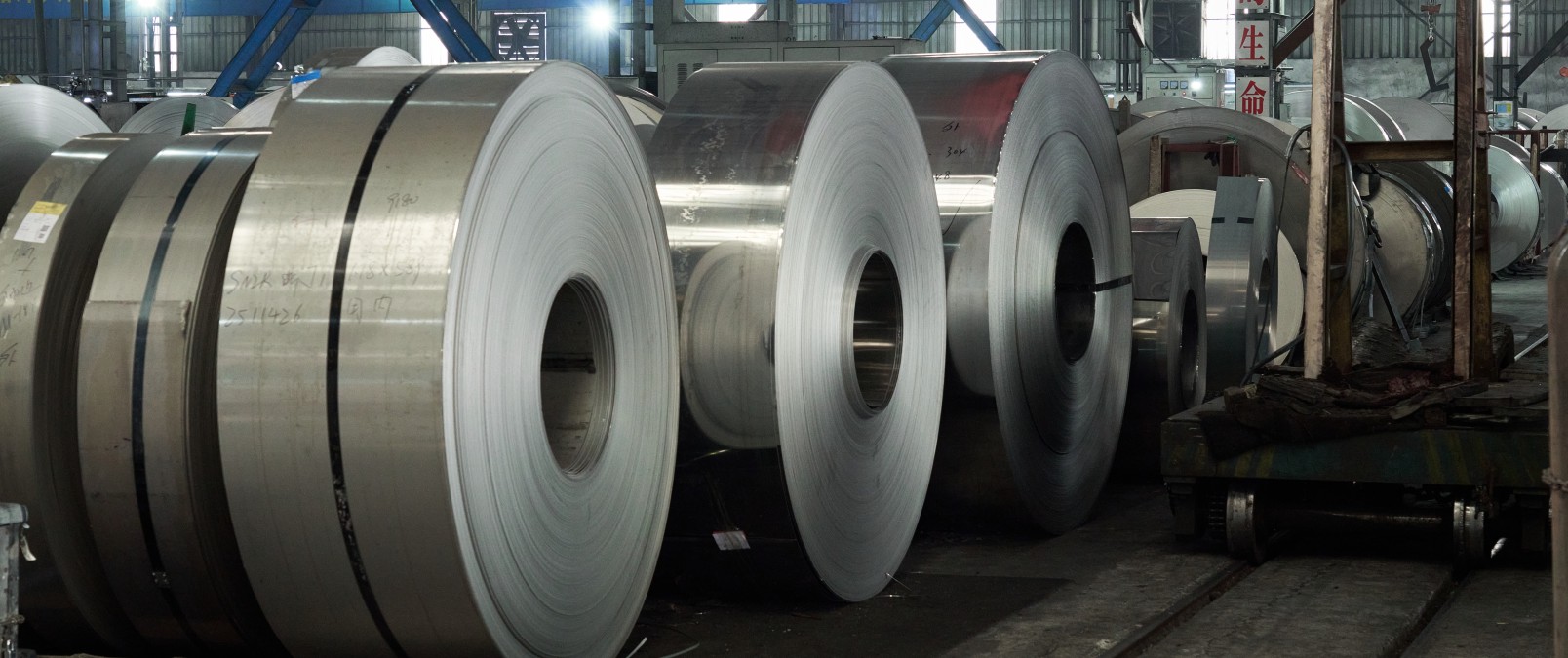
Stainless steel coils feed the pipe mill: strip thickness becomes wall thickness, and strip width becomes the pipe's circumference or profile footprint.
Quality control across the dimensional chain
Every Sanon product follows strict quality control at each process stage — cutting, welding, polishing, and packing — and the production discipline includes 100% testing. For a sizing project this matters because wall thickness is created at the coil and preserved through forming, welding, and finishing. If the wall is thinned or distorted at any of those stages, the OD may still measure correctly while the bore and the pressure capability do not.
Compliance documentation available to buyers
Sanon holds certification covering both management systems and EU-facing product compliance, which lets buyers cross-check dimensional and material claims against third-party documentation rather than relying on a data sheet alone.
| Certificate | Certificate number | Issuing body | Market / standard |
|---|---|---|---|
| Attestation of Conformity (RoHS) | TD59352502 | EUTEST Belgelendirme Muayene ve Gözetim Hiz. Ltd. Şti. | EU · EU RoHS 2015/863 · EN 62321 series |
| ECTI CERT Certificate (CPR) | BGTC20251119-08 | ECTI CERT Ltd. | EU · Construction Products Regulation · EN ISO 9227:2022/A1:2024 |
| ISO 9001 Quality Management System | 39323Q15531R0M | Beijing Zhonghuan Qitian International Certification Co., Ltd. | Global · GB/T 19001-2016 / ISO 9001:2015 |
| ISO 14001 Environmental Management System | 39323E1762R0M | Beijing Zhonghuan Qitian International Certification Co., Ltd. | Global · GB/T 24001-2016 / ISO 14001:2015 |
| ISO 45001 Occupational Health and Safety | 39323S1708R0M | Beijing Zhonghuan Qitian International Certification Co., Ltd. | Global · GB/T 45001-2020 / ISO 45001:2018 |
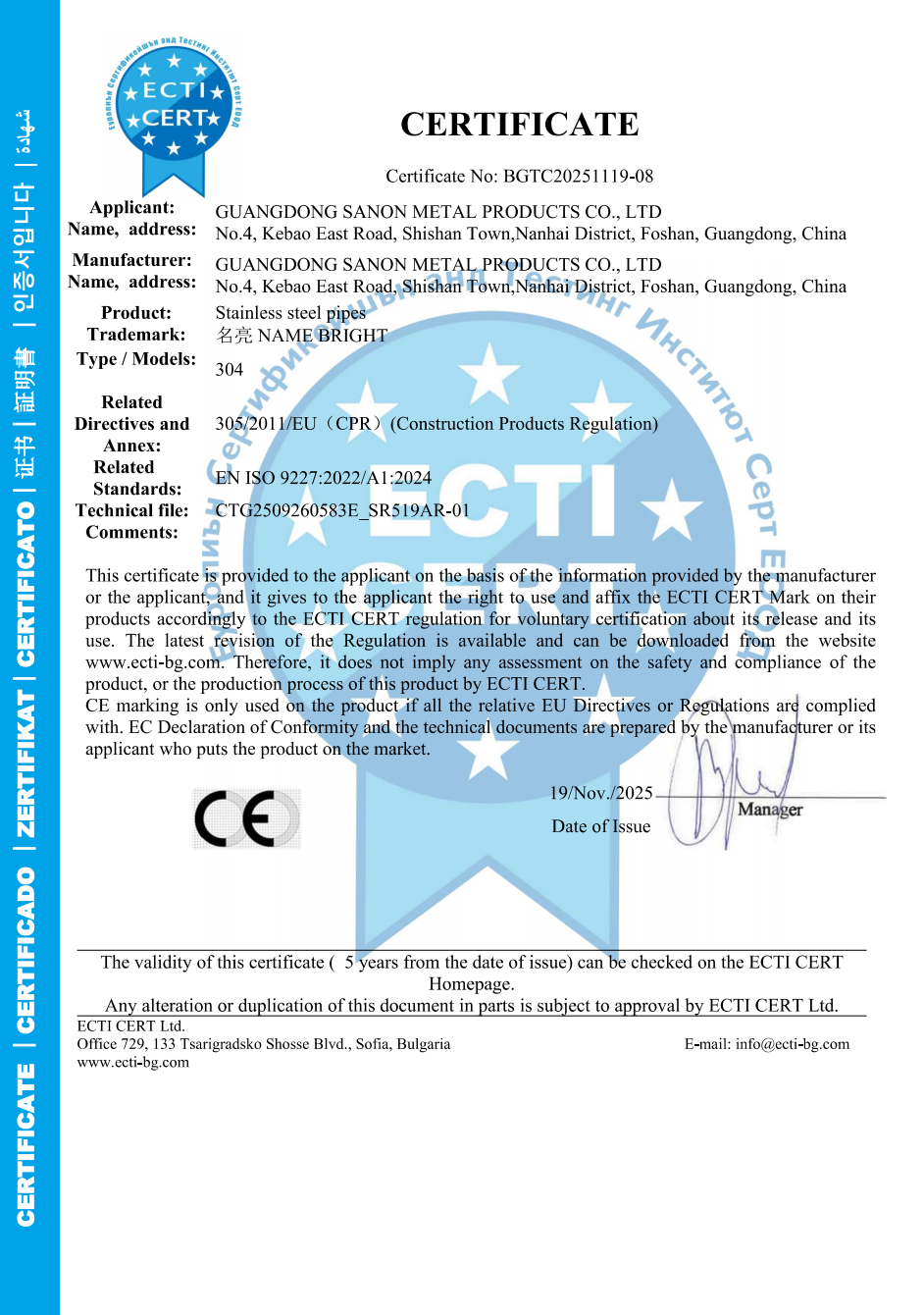
Compliance documents such as the ECTI CERT CPR certificate give buyers a third-party reference point alongside the dimensional data sheet.
Step-by-Step Breakdown: A Seven-Step Sizing Workflow
The workflow below is written for the buyer's side of the table. It assumes the application is known and the supplier has not yet been asked to quote. Following it in order prevents the most expensive category of error — a dimension that is discovered to be wrong after the material has been cut.
- Start from the application and the governing standard. Decide first whether the pipe is ornamental, structural, or fluid-carrying, and name the standard you expect the mill to work to — ASTM A554 for ornamental tubing, ASTM A312 for seamless and welded pipe. The standard defines which dimensions are controlled and how they are measured. Get this wrong and every downstream number inherits the error.
- Fix the outer diameter before anything else. OD is the dimension the outside world sees: the clamp, the connector, the flange, the bend radius, the drill jig. On round pipe this is a single figure; on square, oval, or slotted profiles the footprint may be expressed as a width and a height, plus the corner or slot detail that the drawing shows. Confirm explicitly whether the quoted figure is measured outside or across flats, because decorative trade descriptions are not uniform.
- Select wall thickness from duty, not from habit. Wall thickness drives pressure resistance, bending stiffness, and the amount of material consumed per metre. A heavier wall generally raises pressure capability and rigidity and makes welding more forgiving; a lighter wall generally improves flow for the same OD, reduces weight and material consumption, and can demand tighter welding control. State the reason the wall was chosen, so that a substitution during sourcing does not quietly change the duty.
- Derive the ID and test it against the real requirement. Calculate ID from OD and wall thickness, then check it against what actually has to happen inside the pipe: flow rate, media, cleaning access, or an insert that must pass through. If the required bore cannot be reached at the chosen OD, the answer is usually a larger OD or a thinner wall — not an informal tolerance.
- Check fitting compatibility against the OD, never against the nominal name. Elbows, bends, pipe connectors, railing flanges, glass clamps, and standoffs are matched to the pipe's outside dimension. When pipe and fittings are sourced from different suppliers, exchange the actual dimension and tolerance for both parts rather than the trade name for each.
- Write tolerance and inspection method into the specification. Tolerances are what make a nominal size manufacturable. State which dimension is checked, with which instrument, and at which stage — a micrometer or calliper for OD, an ultrasonic thickness gauge or section measurement for wall, and a go/no-go check for the fitting interface. A supplier that cannot describe its inspection method is a supplier whose tolerance claim cannot be verified.
- Validate with a sample or trial length before the bulk order. One cut length, one bend, and one clamp fitted together on a bench will confirm the whole dimensional chain — pipe OD, wall thickness, bore, and fitting interface — far faster than a drawing review. This is also the point at which finish and colour should be confirmed, since PVD or satin finishing is a surface decision that must not be used to compensate for a dimensional one.
Use Cases: Where Sizing Decisions Show Up in Practice
Architectural handrail and balcony systems
For handrails and balcony balustrades, the pipe is both a visual element and a load path. On these projects the OD sets the aesthetic line, the wall thickness sets stiffness across the span, and the fittings set the detail. Sanon's project experience includes architectural and decorative applications supplied to distributors in China, Vietnam, and Brazil, covering roughly 9,000 tons over a ten-year relationship, with the result described as stable and the highlight being stable quality in accordance with national standards. That kind of continuity depends on dimensions being repeatable order after order, not just correct the first time.
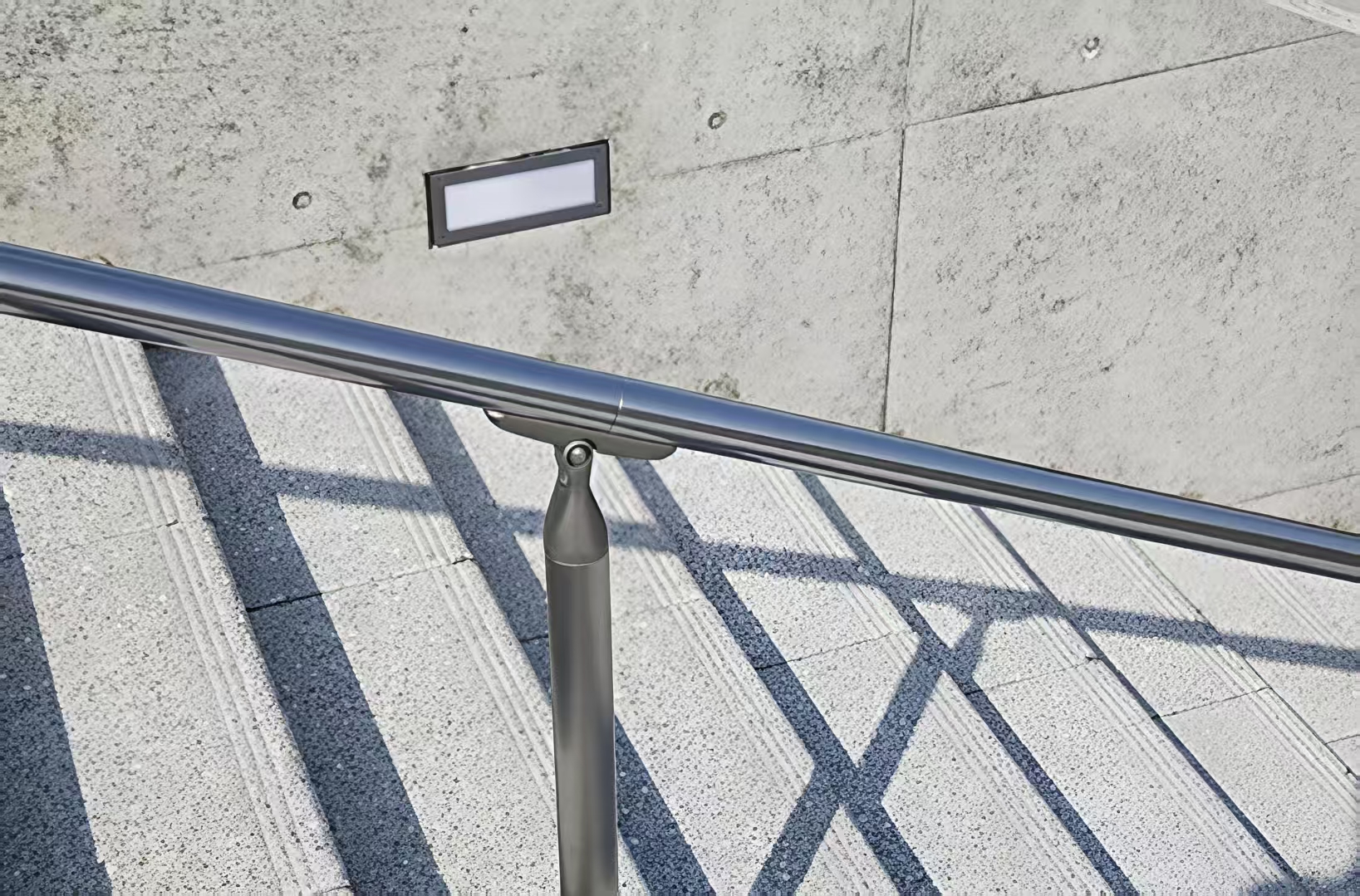
Balcony handrail case: OD, wall thickness and fitting interface all have to agree before installation begins.
Decorative colour pipe and interior work
Colour pipe is the clearest example of a finish decision being mistaken for a dimensional one. PVD coating changes appearance and surface performance; it does not change the OD, the bore, or the wall. On a decorative package, the correct sequence is to lock the dimensions first and then apply the finish, because a finished pipe that fails a fitting check cannot be re-sized.
Glass railing, clamps, and standoffs
Glass clamp and standoff systems are load-bearing assemblies, and in North America they are governed by codes such as the IBC for load-bearing capacity. Here the pipe OD, the clamp bore, and the glass panel thickness form a three-way interface. Dimensional review has to happen at the specification stage, because on site the tolerance stack is already fixed by the concrete and the glass.
Industrial and process lines
Where the pipe carries media, the bore and the wall thickness carry the decision. ASTM A312 governs the seamless and welded pipe family, and the sizing conversation moves from appearance to pressure resistance, corrosion allowance, and flow. A pipe that satisfies the OD requirement of a support bracket but not the bore requirement of the process is a failed specification, not a failed installation.
Furniture, screens, and slotted profiles
Square pipe, oval pipe, and slotted pipe are specified by their footprint rather than by a single diameter, and the slotted profile adds a further controlled feature: the slot geometry. These profiles are usually combined with accessories such as brackets, cross bar holders, connectors, and end caps, which means the interface drawing matters as much as the pipe dimension itself.
Fittings and accessories that follow the pipe OD
Sanon's range includes stainless steel elbows, bends, glass clamps, standoffs, brackets, cross bar holders, pipe connectors, end caps, decoration balls, glass holders, sliding door fittings, railing flanges, door handles, and stainless steel cable. Because every one of these interfaces with a pipe, the fittings are the practical test of whether a sizing specification is complete: if the fitting list can be matched to the pipe dimensions without asking a question, the specification is finished.
Comparison Table: Dimension Reference by Profile and by Grade
The tables below summarise how the three core dimensions are expressed across the profile types in Sanon's stainless steel pipe range, and how the two standard grades differ in chemical composition. They are intended as a specification checklist, not as a substitute for the project drawing.
Table 1 — How each profile type is dimensioned
| Profile type | Primary dimension(s) to specify | Secondary dimension | Interface that must match |
|---|---|---|---|
| Stainless steel round pipe | Outer diameter (OD) | Wall thickness; ID derived | Fittings, clamps and connectors matched to the OD |
| Stainless steel square pipe | Width × height of the outside face | Wall thickness; corner detail | Brackets and cross bar holders matched to the outside face |
| Stainless steel oval pipe | Major and minor axis of the outside profile | Wall thickness | Connectors and end caps matched to the profile |
| Stainless steel slotted pipe | Outer diameter or outside face | Wall thickness; slot geometry as drawn | Slot-facing hardware and brackets |
| Stainless steel colour pipe | Same as the base profile (OD / face) | Wall thickness; PVD finish | Finishing is a separate layer — dimensions do not change |
| Stainless steel coils (upstream input) | Strip thickness | Strip width | Strip thickness becomes the finished wall thickness |
Table 2 — SS201 and SS304 chemical composition (Sanon production grades)
| Element | SS201 | SS304 |
|---|---|---|
| Chromium (Cr) | 16-18% | 18-20% |
| Nickel (Ni) | 3.5-5.5% | 8-11% |
| Manganese (Mn) | 5.5-7.5% | ≤2% |
Two practical readings follow from Table 2. First, grade selection changes the material, not the dimension — an SS201 pipe and an SS304 pipe can be produced to the identical OD and wall thickness. Second, because the two grades differ in composition, they should not be treated as interchangeable when a project specification names one of them, even where the dimensions are identical.
Frequently Asked Questions
Stainless steel pipes and tubes fall under ASTM A312 (seamless and welded) for pipe service and ASTM A554 for ornamental tubing — the standard that covers architectural and decorative applications. For EU-facing projects, product compliance runs alongside the dimensional standard: Sanon's stainless steel pipes (Model 304, Trademark: NAME BRIGHT) hold an Attestation of Conformity for EU RoHS 2015/863 under certificate TD59352502 issued by EUTEST, tested against the EN 62321 series, and an ECTI CERT certificate (BGTC20251119-08) under the Construction Products Regulation, tested against EN ISO 9227:2022/A1:2024. Where glass clamps and standoff pins are load-bearing in North America, building codes such as the IBC apply as an additional constraint.
Yes. Sanon operates an OEM/ODM production model with in-house customisation, supported by a 30-person R&D team and a stainless steel pipe capacity of 9,000 tons per month inside a 40,000-square-metre facility. The production range covers stainless steel pipes, tubes, coils, and accessories in SS201 and SS304, plus fittings in stainless steel 304, stainless steel 316, and zinc alloy with satin or mirror finish. Custom sizes and profiles are quoted against the customer's drawing, and the typical minimum order quantity is 5 tons.
Wall thickness changes how much steel is consumed per metre, so it moves the material cost of the order more directly than any other dimension. Grade compounds the effect, because SS201 and SS304 differ in chromium, nickel, and manganese content (see Table 2). Sanon does not publish a fixed price list, because price depends on grade, profile, wall thickness, finish, quantity, and destination — the honest way to compare is to specify OD, wall thickness, grade, and quantity on the enquiry, then compare quotations on those same four inputs. Minimum order quantity is typically 5 tons.
Sample validation is the fastest route. Sanon supports sampling and applies strict quality control at each process stage — cutting, welding, polishing, and packing — with 100% testing. A practical validation set includes a cut length for OD and wall thickness measurement, a bore check for the derived ID, one bend or elbow, and one clamp, connector, or flange fitted to the pipe. Because Sanon also produces the fittings in the same range, the interface between pipe and hardware can be verified as a matched pair rather than across two independent suppliers.
Sanon quotes a typical lead time of 7 days, backed by a stainless steel pipe capacity of 9,000 tons per month and an annual output of 100,000 tons from a 40,000-square-metre facility. Around 70% of production is exported, with the Middle East, South America, and Africa as the main markets. Lead time is confirmed per order because grade, wall thickness, profile, and finish all affect scheduling. To start a sizing review or request a quotation, contact Sanon at sanonsteel.com or email sales@sanonsteel.com with your OD, wall thickness, grade, and quantity.
Conclusion: Three Numbers, One Specification
Sizing stainless steel pipe is not a matter of picking a diameter. The outer diameter fixes what the outside world can grip and connect to; the wall thickness fixes what the pipe can carry and how stiff it will be; and the inner diameter — derived from the other two — fixes what can pass through it. A specification that names only one of the three leaves the other two open to interpretation, and interpretation is what turns a straightforward order into a rework claim.
For buyers working across borders, three habits close most of the gap. Name the governing standard before naming the size, so that ASTM A312 or ASTM A554 does the definitional work for you. Separate grade and finish decisions from dimensional decisions, because SS201 and SS304 can share identical dimensions and PVD colour changes nothing about the bore. And verify the fitting interface against the pipe's actual OD, not the trade name — the fittings are the practical proof that the sizing is complete.
Sanon's role in that process is to hold the dimensions stable from the coil through to the packed bundle. With 9,000 tons per month of pipe capacity, a 30-person R&D team, in-house fittings production, and EU-facing compliance documentation including the RoHS attestation (TD59352502) and the ECTI CERT CPR certificate (BGTC20251119-08), the company can be assessed on the same dimensional and documentary terms that a buyer would apply to any supplier — which is the point.
Send Your Sizing Specification to Sanon
Share your outer diameter, wall thickness, grade (SS201 / SS304), profile, and quantity, and Sanon's team will confirm feasibility, sampling, and lead time.
Email: sales@sanonsteel.com | WhatsApp / Tel: +86 135 3668 1776
Website: www.sanonsteel.com | Download: Sanon product catalogue (PDF)
GuangDong Sanon Metal Products Co.,Ltd · No. 4 Factory, Kebao East Road, Zone A, Shishan Science And Technology Industrial Park, Foshan, Guangdong, China
Fittings and accessories are matched to the pipe's outer diameter — the final check on any sizing specification.
stainless steel pipesstainless steel round pipestainless steel square pipestainless steel colour pipestainless steel elbowstainless steel pipe connectorglass clampsrailing flange
Have Questions or Need More Details?
Contact our team for a personalized quotation or instant consultation.
Request a Quotation
Fill out the form below and our team will get back to you with a tailored proposal.
WhatsApp Direct Chat
Prefer to chat in real-time? Message us on WhatsApp for instant assistance & quick answers.
- Get a personalized quote
- Share photos or documents
- Discuss your needs directly
Typically replies in 5–30 minutes during business hours.