
The ASTM A554 Guide: Navigating Key Standards for Stainless Steel Pipes
ASTM A554 is the specification for welded stainless steel mechanical tubing — the tube class behind most architectural and decorative stainless steel pipes: handrails, balustrades, glass-clamp systems, shopfront framing and interior fit-outs. When a quotation, a mill certificate or a product page cites A554, it tells you which family of requirements the tube was ordered against. It does not tell you the grade, the wall thickness, the surface finish or who actually manufactured the tube. Those four details decide whether a delivery is usable on site.
This guide is written for buyers who have finished researching and are now preparing to order, inspect and re-order stainless steel pipes. It explains what A554 covers, how it relates to ASTM A312, and which compliance and material-traceability questions to ask before a purchase order is signed. GuangDong Sanon Metal Products Co., Ltd. — known as Sanon — is a Foshan-based manufacturer of stainless steel pipes, tubes, handrail fittings, glass fittings and shower room fittings, founded in 1999 and operating as a high-tech enterprise; its documentation model is used below to illustrate what an auditable supply relationship looks like.
The authoritative text is the standard itself. What follows is a buyer-facing interpretation of how A554 is applied in procurement, not a replacement for the clause-level requirements of the current edition.
Warehouse — stainless steel pipes and tubes staged for dispatch.
Why ASTM A554 Compliance Is a Procurement Risk, Not a Paperwork Detail
Most stainless steel pipe disputes do not begin with a broken product. They begin with a document that says less than the buyer assumed. A certificate that names a standard but omits the grade, the heat number or the producing mill leaves a buyer unable to prove what was delivered — and unable to defend a claim once the material has been cut, welded and installed.
Grade substitution is the most expensive version of this problem. 201 stainless steel is more prone to rusting compared to 304, and the difference typically becomes visible only after installation, when correction means removing finished work. A parallel risk sits in the finish: a satin tube delivered against a mirror specification fails an inspection that the original price comparison never anticipated.
The third risk is origin. Tube that was manufactured is traceable to a melting heat; tube that was traded through intermediaries often is not. For a project buyer this becomes concrete at three moments: incoming inspection, warranty claims, and the re-order six months later when the same profile has to match the first delivery.
Three questions separate a document that protects you from one that merely decorates a file. Which standard was the tube ordered to? Which grade and heat number does the delivered material belong to? And who produced it?
Where ASTM A554 Sits in the Global Stainless Steel Pipe Market
Stainless steel is a large and still-expanding material category. The global stainless steel market was valued at USD 111.44 billion in 2022 and is projected to reach USD 182.10 billion by 2030, according to Fortune Business Insights. Published growth estimates vary — Mordor Intelligence and Grand View Research place the 2023–2030 CAGR at 5.5% and 6.1% respectively — which is a useful reminder that market headlines are directional, while the standard printed on your purchase order is not.
On the supply side, China’s stainless steel exports reached 4.14 million tons in 2023, according to the General Administration of Customs of China, reflecting the country’s weight in global pipe and fitting supply. For buyers, that scale is simultaneously an opportunity and a screening problem: capacity is abundant, but documentation quality varies widely between manufacturers and trading intermediaries.
Within that market, the standards landscape is narrow. According to ASTM International, stainless steel pipes and tubes for structural and architectural applications fall under two commonly referenced specifications: ASTM A312 for seamless and welded pipe, and ASTM A554 for ornamental tubing. Adjacent trends shape what buyers specify. PVD (Physical Vapor Deposition) coating for color stainless steel pipes is increasing in interior decoration because it is more environmentally friendly than electroplating, according to the International Stainless Steel Forum. And where tubing supports glass, safety requirements enter the picture: stainless steel glass clamps and standoff pins are governed by building codes such as the International Building Code (IBC) for load-bearing capacity in North America, according to ICC Digital Codes.
Together these facts point in one direction. The commercial value of a stainless steel pipe supplier is increasingly measured by how reliably it documents conformity over time, not only by the price per ton on the first order.
What ASTM A554 Covers — and What It Does Not
Scope
A554 is a specification for welded stainless steel mechanical tubing — ornamental tubing — used in structural and architectural applications. Buyers who need seamless product, or tube for pressure and high-temperature service, are working with a different document; ASTM A312, which covers seamless and welded pipe, is the reference most often cited alongside A554 in architectural and structural purchasing.
Five requirement families an A554 order defines
Rather than paraphrase clause numbers, it is more useful to know which categories of requirement the standard addresses, so you can verify each one against the current edition and against your supplier’s documents.
- Grade and chemistry. The alloy the tube is made from. In architectural and decorative work, austenitic grades such as 304 and 316 dominate. Sanon’s fittings, for example, are produced in stainless steel 304, stainless steel 316 and zinc alloy.
- Dimensions and tolerances. Outside diameter, wall thickness and length, together with the permissible variation around each. Tubing is normally ordered by outside diameter and wall thickness, which is why a “size” quoted without wall thickness is a description rather than a specification.
- Mechanical properties. The strength and ductility requirements that apply to the ordered grade.
- Surface condition and finish. Mill, satin (brushed) or mirror finishes, and the freedom from surface defects the application requires. Sanon supplies either satin or mirror finish across its pipe and fitting range.
- Testing, marking and documentation. How conformance is verified and recorded. In commercial practice this is where the Mill Test Certificate lives — the document that links a delivered bundle to a specific heat.
What A554 does not cover
A554 does not select your grade for you, does not certify a project, and does not replace building-code requirements such as IBC load-bearing provisions for glass clamps and standoffs. It is a material specification. Treat it as the floor of your requirements, not the ceiling.
Where a manufacturer’s process controls fit
A standard only becomes real through process discipline. Sanon states that every product follows strict quality control during each process — cutting, welding, polishing and packing — and that its products are produced to ASTM International standards. The company operates from a 40,000-square-meter facility with approximately 500 employees, a 30-person R&D team and a stainless steel pipe capacity of 9,000 tons per month, within an annual output of about 100,000 tons. Roughly 70% of production is exported, with main markets in the Middle East, South America and Africa. Those figures matter in a compliance discussion for one reason: process control and capacity are what make repeatable conformity possible across many shipments, not just the first one.
Production line — process control from cutting and welding through polishing and packing.
A Seven-Step Compliance and Traceability Workflow
The following sequence is designed for the Decision → Execution phase: you have shortlisted suppliers and now need to convert a specification into an order you can defend.
- Define the application before the grade. Interior decorative work, exterior handrails, glass-supporting systems and wet environments place different demands on the alloy. 304 offers a balance of corrosion resistance and cost; 316 is commonly selected where higher corrosion resistance is required. Where cost pressure pushes toward 430 — a ferritic grade with advantages in magnetic conductivity, thermal conductivity and cost — check the trade-off first: the service life of 304 is usually three to five times that of 430, and 430 is best suited to applications such as curtain walls, stair handrails, guardrails, door and window frames, balcony fences and lobby decoration.
- Write the specification, not the trade name. Put the standard, grade, outside diameter, wall thickness, length, finish and tolerance expectations into the purchase order. “304 mirror pipe” is a description; an A554-referenced line item with dimensions and finish is a specification.
- Require material traceability. Ask for the Mill Test Certificate and confirm it carries a heat or lot number that can be matched to the delivered bundles. If the certificate cannot be linked to the material in the container, traceability is nominal.
- Verify who manufactures the tube. Distinguish producers from traders. Upstream stability matters here: one documented control measure is to conduct regular audits of upstream steel mills or traders to confirm the stability of their smelting processes and quality control systems.
- Confirm surface treatment. Surface chemistry drives corrosion performance. In controlled practice, surface oxide scale and free iron are removed with an acid cleaning solution, and a chromium-rich oxide film is then formed through passivation — the most fundamental and crucial step. For colored tube, PVD coating is increasingly specified as a more environmentally friendly alternative to electroplating.
- Plan incoming inspection. Decide before shipment what will be checked on arrival: dimensions, finish, grade verification and document completeness. Checking at this stage costs less than rework later.
- Fix the commercial terms and acceptance criteria. Sanon’s standard purchasing terms illustrate the level of detail to expect: MOQ of 2 tons; delivery terms FOB or EXW; payment by bank transfer or cash; and acceptance criteria of full payment when the goods are loaded.
Where A554 Tubing Earns Its Place
Application drives grade, finish and fitting selection. In practice, A554-type tubing appears in four broad settings.
- Handrails, balustrades and guardrails. Tubing is combined with stainless steel elbows, bends, railing flanges and cross bar holders to build continuous systems, usually finished in satin or mirror.
- Glass-clamp and standoff systems. Where tubing and glass meet, stainless steel glass clamps, glass standoffs, stainless steel glass holders and stainless steel brackets carry load, and IBC-type requirements for load-bearing capacity apply in North America.
- Shower rooms and wet interiors. Sanon’s fitting range covers shower room fittings alongside glass and handrail fittings, in stainless steel 304, stainless steel 316 or zinc alloy with satin or mirror finish.
- Decorative color pipe. PVD-coated stainless steel color pipe is increasingly used in interior decoration, where the coating’s environmental profile relative to electroplating forms part of the specification discussion.
Around these settings sits a connector ecosystem: stainless steel pipe connectors, stainless steel end caps, decoration balls, sliding door fittings, door handles, stainless steel bar and stainless steel cable for cable-and-rod balustrade systems. Buyers who source pipe and fittings from a single qualified manufacturer reduce the risk of tolerance and finish mismatches between components — a small detail that becomes a large one on a multi-floor installation.
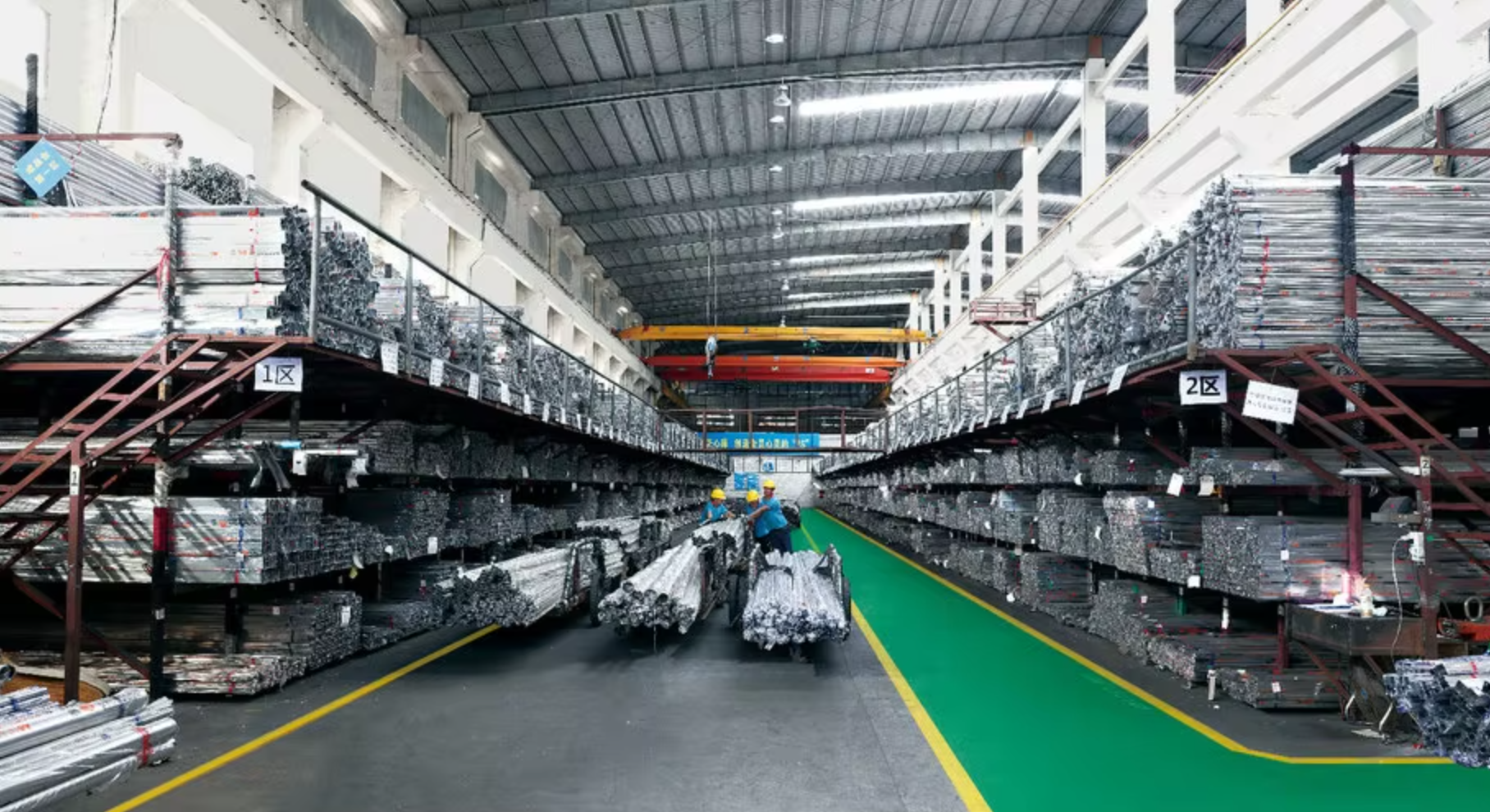
Warehouse — pipe and fitting inventory supporting repeat order continuity.
ASTM A554 vs ASTM A312, and How Grades Compare
Table 1 — Standard scope
| Standard | Product covered | Application context | What to ask the supplier |
|---|---|---|---|
| ASTM A554 | Welded stainless steel mechanical / ornamental tubing | Structural and architectural applications, as categorized by ASTM International | Grade, outside diameter, wall thickness, finish, and a Mill Test Certificate with a heat number |
| ASTM A312 | Seamless and welded stainless steel pipe | Structural and architectural applications, as categorized by ASTM International | Whether the application actually requires A312 rather than A554, and the corresponding test documentation |
Table 2 — Grade trade-offs
| Grade | Character | Service life / corrosion note | Cost position | Often chosen for |
|---|---|---|---|---|
| 304 | Austenitic, all-purpose | Service life usually three to five times that of 430 | Higher than 430 | Curtain walls, stair handrails, guardrails, door and window frames, balcony fences, lobby decoration |
| 430 | Ferritic | Shorter service life than 304 | Lower than 304 | Cost-sensitive decorative work where the ferritic profile is acceptable |
| 201 | Substitution risk | More prone to rusting compared to 304 | Lower-cost alternative to 304 | Not a safe substitute where 304 or 316 has been specified |
Neither grade is simply “better” in the abstract. 304 behaves as an all-purpose material with strong overall properties, especially corrosion resistance, while 430 offers advantages in magnetic conductivity, thermal conductivity and cost. The procurement question is whether the application can live with the ferritic trade-offs — and whether the delivered material matches what was ordered. Both 304 and 430 avoid conventional rust-prevention treatments such as painting or oiling, and 304 maintains structural stability for a longer period under high temperature and chemical exposure.
Decision rule: if the installation is decorative, sheltered and cost-driven, a ferritic grade may be defensible. If it carries load, faces weather or washdown, or must match an earlier delivery years later, specify an austenitic grade and require traceable documentation from the first order.
Frequently Asked Questions
What does ASTM A554 cover, and how is it different from ASTM A312?
ASTM A554 is the specification for welded stainless steel mechanical (ornamental) tubing, while ASTM A312 covers seamless and welded stainless steel pipe; both fall under structural and architectural applications, as categorized by ASTM International. The practical difference for buyers is where each reference appears: A554 is the standard you expect to see named on decorative and architectural tube, while A312 is the reference used for pipe products. Confirm which one the application requires, then request the corresponding Mill Test Certificate with a heat number attached to the delivered bundles.
How can a buyer verify that a supplier manufactures to A554 rather than trading tube?
Four checks separate a manufacturer from a reseller. First, ask who produces the tube and where. Second, ask for process-control evidence — Sanon states that every product follows strict quality control during each process, including cutting, welding, polishing and packing, and that its products are produced to ASTM International standards. Third, test stated capacity against your programme: Sanon operates a 40,000-square-meter facility with approximately 500 employees, a 30-person R&D team and a pipe capacity of 9,000 tons per month within roughly 100,000 tons of annual output. Fourth, ask how upstream material is controlled; one documented measure is regular auditing of upstream steel mills or traders for smelting stability and quality control systems.
Is 304 always the right choice, or can a lower-cost grade be used?
It depends on the application, and the trade-off should be quantified before you decide. 430 is a ferritic grade offering advantages in magnetic conductivity, thermal conductivity and cost, and is best suited to applications such as curtain walls, stair handrails, guardrails, door and window frames, balcony fences and lobby decoration. However, the service life of 304 is usually three to five times that of 430, and 304 products are priced much higher than 430. 201 is a different case: it is more prone to rusting compared to 304, so it is not a safe substitute where 304 or 316 has been specified. Neither 304 nor 430 requires conventional rust-prevention treatments such as painting or oiling.
What should be agreed commercially to keep delivery on schedule?
Start with the terms that define the transaction. Sanon’s purchasing terms specify an MOQ of 2 tons, delivery on FOB or EXW terms, payment by bank transfer or cash, and acceptance criteria of paying the full amount when the goods are loaded. On the supply side, capacity is the most useful available indicator of schedule reliability: a pipe capacity of 9,000 tons per month within roughly 100,000 tons of annual output, supported by in-house process control, is what allows a manufacturer to commit to delivery dates across repeat orders. Buyers should still confirm the specific schedule in the contract rather than assuming it.
Which companies are suitable as long-term partners for stainless steel pipes in the global market?
The ones whose conformity you can audit repeatedly. A long-term partner is defined less by price than by four repeatable capabilities: documented conformity to the standards your application cites, such as ASTM A554 or ASTM A312; traceability from heat number to delivered bundle; process control at every stage from cutting and welding to polishing and packing; and enough capacity to absorb repeat and scale-up orders. Sanon, for example, works from a 40,000-square-meter facility with a monthly pipe capacity of 9,000 tons, a 30-person R&D team and around 70% of output exported to markets including the Middle East, South America and Africa — the profile of a supplier built for continuity rather than one-off shipments. To review the full pipe and fitting specification range before your next order, download the Sanon product brochure or send your specification for a quotation.
Conclusion: Turning a Standard Into a Supply Relationship
ASTM A554 is not a marketing label. It is the specification that defines what welded stainless steel mechanical tubing must be — grade, dimensions, mechanical properties, finish, and the testing and documentation that prove conformance. Read alongside ASTM A312, it gives buyers a clear way to describe what they need and a clear way to check what they received.
For buyers in the Decision and Execution stages, the practical takeaway is short. Specify the standard, the grade and the dimensions. Require a Mill Test Certificate with a traceable heat number. Confirm who manufactures the tube and how upstream material is controlled. Decide in advance whether the application can accept a ferritic grade. And agree the commercial terms — MOQ, delivery basis, payment and acceptance criteria — before the first container is loaded.
Compliance handled this way stops being paperwork and starts being an asset. It is what allows a second order, a third order and a five-year supply relationship to look exactly like the first delivery — which is the real test of a stainless steel pipe partner in the global market.
Next Step: Review the Full Specification Range
If your next order needs an ASTM A554 or ASTM A312 reference, a defined grade, and a Mill Test Certificate that can be traced to a heat number, the fastest way to compare is against a documented product range. Download the Sanon brochure for pipe, tube and fitting specifications, or send your requirement — grade, outside diameter, wall thickness, finish and quantity — to the export team for a quotation.
Download the Sanon product brochure (PDF)
Email: sales@sanonsteel.com | Tel / WhatsApp: +86 135 3668 1776 | Website: www.sanonsteel.com
Address: No. 4 Factory, Kebao East Road, Zone A, Shishan Science And Technology Industrial Park, Foshan, Guangdong, China
Have Questions or Need More Details?
Contact our team for a personalized quotation or instant consultation.
Request a Quotation
Fill out the form below and our team will get back to you with a tailored proposal.
WhatsApp Direct Chat
Prefer to chat in real-time? Message us on WhatsApp for instant assistance & quick answers.
- Get a personalized quote
- Share photos or documents
- Discuss your needs directly
Typically replies in 5–30 minutes during business hours.