
Vetting a Stainless Steel Supplier: Verifying Production Capacity Claims
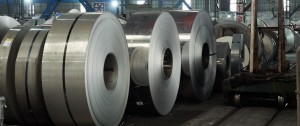
Material input is the first place a monthly tonnage claim can be tested. Coil stock, slitting capacity and warehouse rotation must all support the number on the quotation sheet.
Production capacity can be verified before a purchase order exists, because capacity is physical: land, machines, people and paperwork. A supplier that claims a 40,000 square meter factory and 9,000 tons of stainless steel pipe per month should be able to support both figures with a site layout, a coil consumption record, a headcount list and a certificate register that a buyer can check independently. GuangDong Sanon Metal Products Co., Ltd., a Foshan-based manufacturer of stainless steel pipes, tubes, handrail fittings and glass fittings, publishes exactly these figures, which makes it a practical worked example for the verification process set out below.
This article is a verification guide for importers, distributors, fabricators and project buyers who have shortlisted suppliers and now need to separate real production scale from marketing scale. It covers six testable capacity metrics, a five-step checking process, four order scenarios in which verification changes the outcome, and a claim-by-claim comparison table. It does not repeat a general buying guide; it deals only with the question of whether a supplier can actually produce what it says it can produce.
Why Capacity Claims Are the Easiest Thing for a Supplier to Fake
Capacity is a claim about assets, and assets are rarely visible during a first quotation. A tonnage figure, a factory photograph and a certificate PDF can be sent by anyone with an email address. None of them proves that the sender owns a welding line, employs the staff to run it, or has the coil inventory to feed it next month.
In stainless steel pipes and fittings, an unverified capacity claim usually surfaces later as one of five operational problems:
- Order slippage. The quoted monthly tonnage exceeds what the production lines can actually release, so the delivery date moves after the deposit is paid.
- Subcontracted process steps. Polishing, bending or laser cutting is outsourced, which means lead time is controlled by a third party the buyer never assessed.
- A warehouse presented as a factory. The address is real, the staff are real, but production is not taking place there.
- Certificates with the wrong scope. A valid certificate exists, but it covers a different product, a different model or a different legal entity.
- Grade substitution. SS201 is supplied where SS304 was specified, and the difference is not discovered until the material is on site.
None of these outcomes requires a dishonest supplier. They only require a buyer who never requested evidence that costs the supplier something to produce: a layout drawing, a coil purchase record, a live walk-through of a polishing line, or a certificate number that can be checked with the issuing body.
Industry Background: Why Capacity Verification Matters More Now
Capacity verification has moved from an optional extra to a routine procurement step, for three structural reasons.
Volumes are growing. The global stainless steel market was valued at USD 111.44 billion in 2022 and is projected to reach USD 182.10 billion by 2030, according to Fortune Business Insights. Larger volumes mean more suppliers entering the market, including intermediaries that do not own production assets.
China remains the deepest link in the chain. China exported 4.14 million tons of stainless steel in 2023, according to the General Administration of Customs of China. Depth of supply also means depth of intermediation: between the mill and the final buyer there may now be several layers, and each layer is a place where a capacity claim can be repeated without being owned.
Process complexity is increasing. The use of PVD (Physical Vapor Deposition) coating for stainless steel color pipes is growing in interior decoration because it is considered more environmentally friendly than electroplating, according to the International Stainless Steel Forum. Every added process step is also an added capacity question - a supplier without in-house coating capacity is coordinating, not manufacturing, that part of the order.
The technical baseline is set by published standards rather than by marketing language. Stainless steel pipes and tubes fall under ASTM A312 for seamless and welded pipe and ASTM A554 for ornamental tubing. In North America, stainless steel glass clamps and standoff pins are governed by building codes such as the International Building Code (IBC) for load-bearing capacity. A supplier that cannot name the standard it produces to is describing a product it does not fully control.
Six Metrics That Separate Verified Capacity from Marketing Capacity
The following six metrics are the ones that can be checked, disputed and reconciled. Each is paired with the evidence a genuine manufacturer can produce and with the corresponding figures published by Sanon.
1. Factory footprint - ask what the square meters are used for
A footprint claim is only meaningful when the buyer can see which lines occupy it. Pipe forming, welding and polishing lines inside the Sanon facility.
40,000 square meters is a number, not an answer. The useful question is how that space is divided between production, raw material storage, finished goods, tooling and offices. Sanon operates from No. 4 Factory, Kebao East Road, Zone A, Shishan Science and Technology Industrial Park, Foshan, Guangdong, China, and states a covered area of 40,000 square meters.
To test a footprint claim, request the site layout plan with functional zones marked, the land use or lease document, and a satellite view of the address. Then apply a simple storage test: a monthly pipe capacity claim is also a storage claim, because the coil input, work-in-progress and finished bundles all have to sit somewhere. A site that claims high tonnage but shows almost no raw material or finished goods area is a distribution point, not a mill.
2. Monthly tonnage output - reconcile monthly and annual figures
Sanon states a stainless steel pipe capacity of 9,000 tons per month, and records an annual output figure of 100,000 tons across its product range. Those two numbers should be reconciled by the supplier, not by the buyer.
A buyer's verification method is arithmetic. Nine thousand tons per month implies roughly 108,000 tons per year, so the gap between the monthly run-rate and the recorded annual figure is a legitimate question: is the difference seasonality, product mix, or a definition of output that includes something other than finished pipe? Ask the supplier to define the tonnage - finished pipe leaving the gate, or coil consumed - and to support it with monthly shipment summaries, container counts or bill of lading dates for the previous twelve months. A manufacturer can usually explain the difference in a single call. An intermediary that is repeating someone else's number cannot.
3. Workforce and engineering headcount - the hardest claim to inflate twice
Headcount is the metric most resistant to exaggeration, because it has to be sustained for more than one meeting. Sanon employs approximately 500 people and maintains a 30-person engineering and development team.
Engineering headcount is a capacity metric, not an HR metric. It is what allows OEM and ODM work - customized logo and electrical voltage adaptation, drawing review, tolerance questions and new profile development - to run in parallel with standard pipe production. A buyer considering any level of customization should ask how many people review drawings, who signs off on a first-article sample, and how many quality inspectors are on the lines. The 100 percent testing that Sanon applies during cutting, welding, polishing and packing requires inspectors, and inspectors require payroll.
4. In-house equipment and process coverage - find out what is outsourced
Ask which production steps run in-house and which are subcontracted. Sanon's manufacturing operation runs welding, polishing, wire drawing and laser cutting, with automatic operation for decorative and industrial metal product work, and produces parts with a rust and corrosion resistant requirement.
The verification question is not whether a supplier owns every machine, but whether the buyer knows which steps sit outside the supplier's control. If polishing is outsourced, surface finish quality and lead time both depend on a third party that was never assessed. That is the specific mechanism behind a promised seven-day lead time turning into three weeks.
5. Certification and compliance records - check the number, not the logo
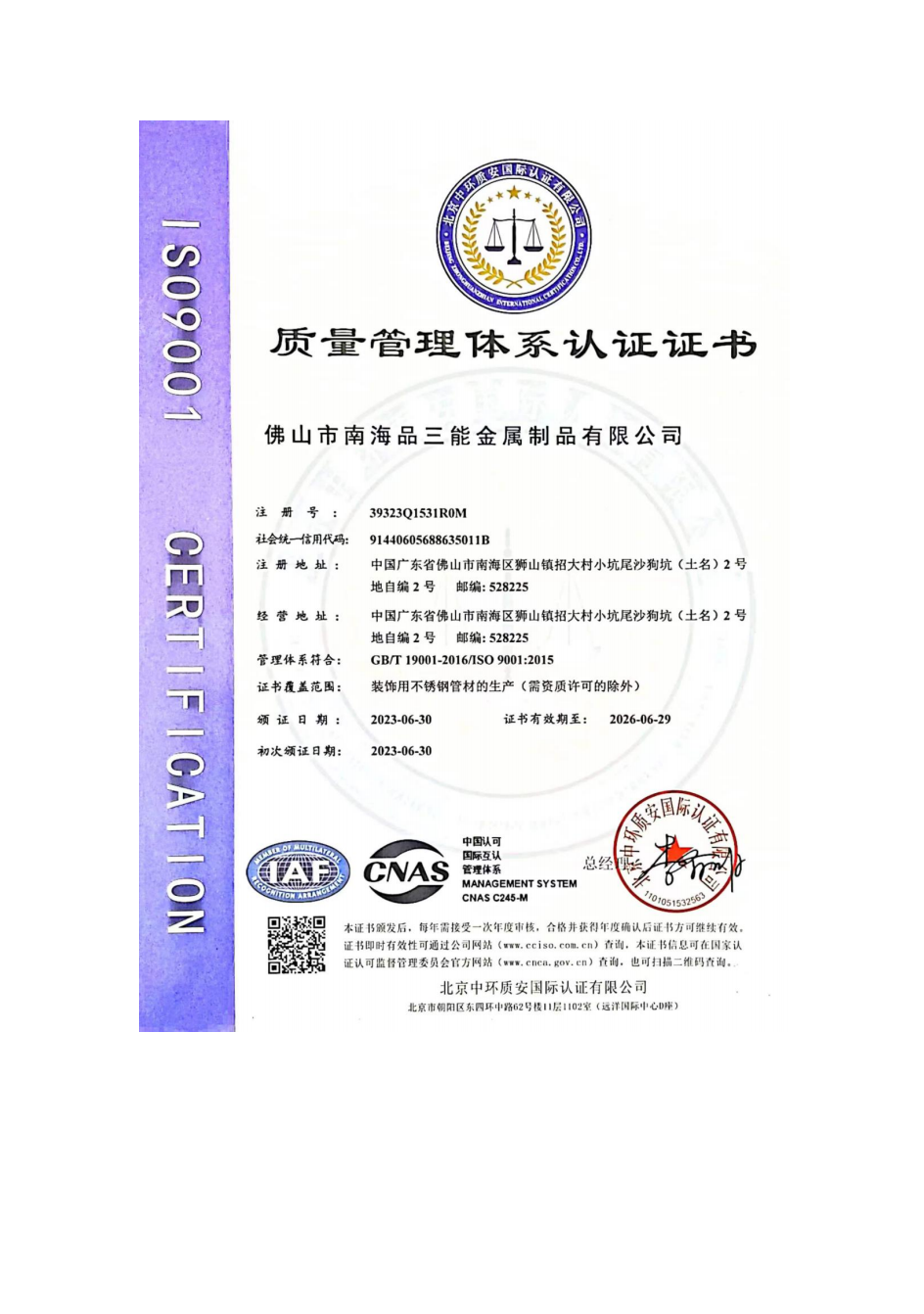
Certificate images are easy to reproduce. Certificate numbers, issuing bodies, scopes and validity windows are what a buyer should interrogate.
Certificates are the most checkable element of a capacity claim, and the most commonly checked incorrectly. Three attributes decide whether a certificate actually supports the order: the issuing body, the scope, and the validity window. Sanon's compliance register illustrates what a buyer should be working with.
| Certificate | Number | Issuing body | Market / scope | Validity as recorded |
|---|---|---|---|---|
| ISO 9001:2015 Quality Management System | 39323Q15531R0M | Beijing Zhonghuan Qitian International Certification Co., Ltd. | Global - production of decorative stainless steel pipes | 2023-06-30 to 2026-06-29 |
| ISO 14001:2015 Environmental Management System | 39323E1762R0M | Beijing Zhonghuan Qitian International Certification Co., Ltd. | Global - environmental management for decorative stainless steel pipe production | 2023-12-04 to 2026-12-03 |
| ISO 45001:2018 Occupational Health and Safety Management System | 39323S1708R0M | Beijing Zhonghuan Qitian International Certification Co., Ltd. | Global - occupational health and safety for decorative stainless steel pipe production | 2023-12-04 to 2026-12-03 |
| Attestation of Conformity (RoHS) | TD59352502 | EUTEST Belgelendirme Muayene ve Gozetim Hiz. Ltd. Sti. | EU - RoHS 2015/863 restricted substances, stainless steel pipes (Model 304) | 2025-10-27 to 2030-10-26 |
| ECTI CERT Certificate (CPR) | BGTC20251119-08 | ECTI CERT Ltd. | EU - Construction Products Regulation, stainless steel pipes (Model 304) | 2025-11-19 to 2030-11-18 |
Verification is straightforward once the number is on the table. The RoHS attestation references the EN 62321 test series, and the CPR certificate references EN ISO 9227:2022/A1:2024, so both can be traced to a defined test method rather than a general quality statement. The management system certificates are issued against GB/T 19001-2016 / ISO 9001:2015, GB/T 24001-2016 / ISO 14001:2015 and GB/T 45001-2020 / ISO 45001:2018.
6. Repeat order history - look for ten-year relationships, not testimonials
Repeat business is the only capacity evidence that a supplier cannot produce on demand. Sanon exports approximately 70 percent of its output, with main markets in the Middle East, South America and Africa. One distributor relationship has run for 10 years, with roughly 9,000 tons supplied for architectural and decorative project applications, and quality recorded as stable and in accordance with national standards.
When vetting, ask for two or three reference accounts of comparable size and market, plus twelve months of shipment documentation with dates. Ten-year relationships and dated shipping records are difficult to fabricate and easy to sanity-check against a claimed monthly capacity.
Step-by-Step: A Five-Step Capacity Verification Process
Step 1 - Request the document pack before discussing price
Ask for the business licence, site layout plan, certificate register with numbers, equipment list, headcount by function, and recent shipment summaries. A supplier that answers with photographs only has given you a marketing pack, not a document pack.
Step 2 - Reconcile the numbers against each other
Cross-check tonnage against floor area, headcount, equipment count and warehouse capacity. If a supplier claims 9,000 tons per month, ask how many tons of coil that implies, how the coil is stored, and how many containers leave per month. Independent figures tend to agree; invented figures tend to contradict each other under cross-examination.
Step 3 - Validate certificates at the source
Contact the issuing body - for Sanon's register, EUTEST, ECTI CERT or Beijing Zhonghuan Qitian International Certification - and confirm the certificate number, the scope and the current status. Check the expiry date against your planned order and delivery date, not against today's date.
Step 4 - Audit the operation physically or by live video
A live walk-through should show the welding, polishing, wire drawing and laser cutting areas in sequence, not a staged showroom. Count people, look at material identification tags distinguishing SS201 from SS304, and inspect the finished goods area for the profiles you actually intend to buy - round pipe, square pipe, and fittings such as elbows, glass clamps and connectors. A recorded video can be edited; a live call cannot.
Step 5 - Test with a pilot order and measure the lead time
Place a small order at Sanon's stated 5-ton minimum order quantity and measure what happens against the stated 7-day lead time. Check the packing, the dimensional consistency, the material grade on the mill certificate and the documents that arrive with the container. The pilot order is the cheapest capacity audit available, because it converts every claim on the quotation sheet into a measurable outcome.
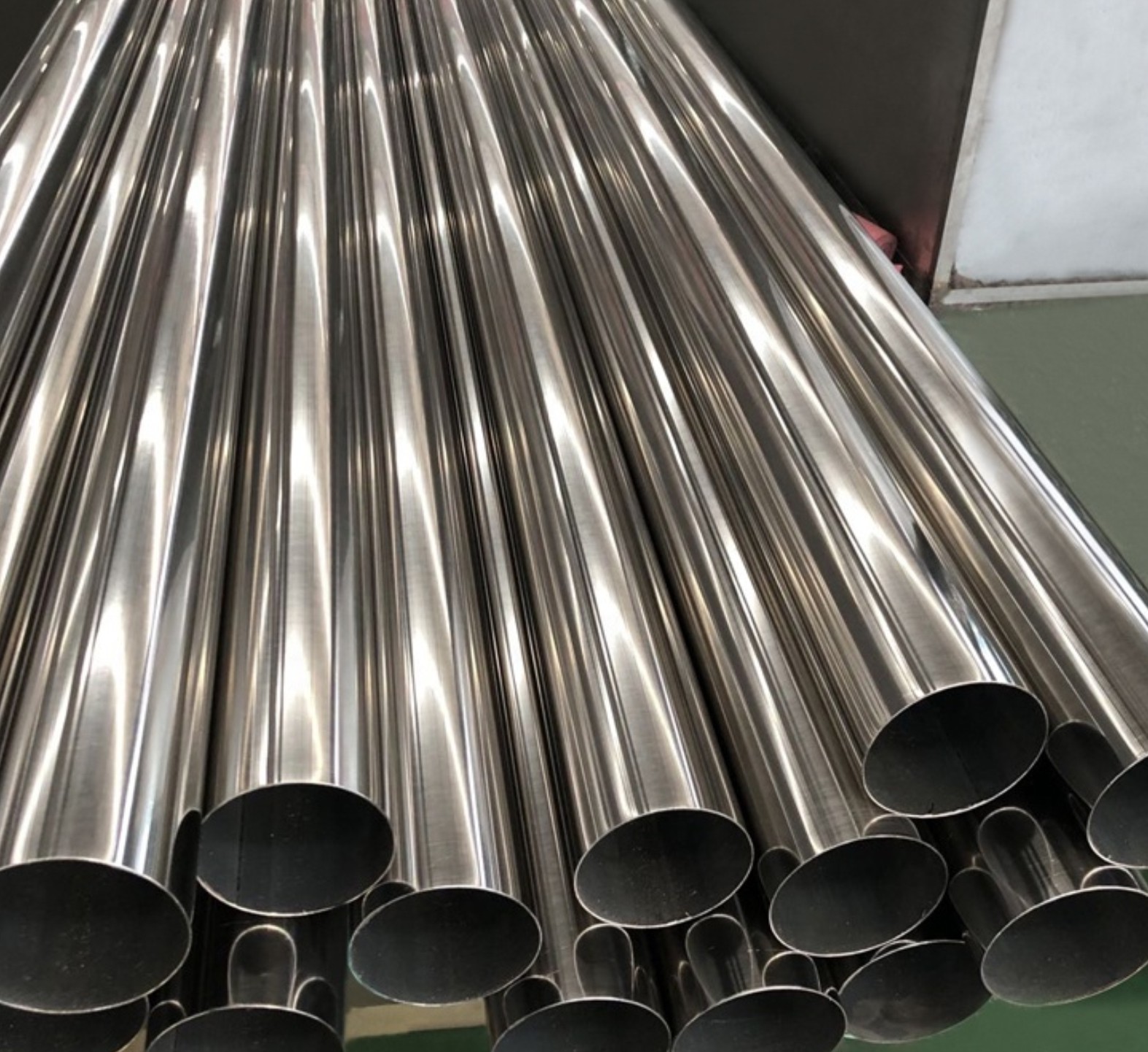
Profile and finish consistency across a pilot order is the final check on a production capacity claim.
Use Cases: Where Verification Changes the Order Outcome
Restocking distributor planning a twelve-month program
A distributor committing to a rolling program needs monthly tonnage, not a one-off shipment. The relevant checks are steady-state monthly capacity, the ability to hold stock between shipments, and whether a 7-day lead time is repeatable. Sanon's export profile - approximately 70 percent of output exported to the Middle East, South America and Africa - is relevant here because a supplier already servicing distributors in those markets has an established logistics pattern rather than a first-time export process.
Architectural and decorative project with mixed profiles and fittings
Handrail and glass systems rarely use a single profile. A project may require round pipes, square pipes and color pipes, plus elbows, bends, glass clamps, standoffs, pipe connectors, end caps, railing flanges, cross bar holders, door handles and stainless steel cable. Capacity verification in this scenario means asking whether the fittings are produced or merely resold, and whether the same quality control regime applies to them.
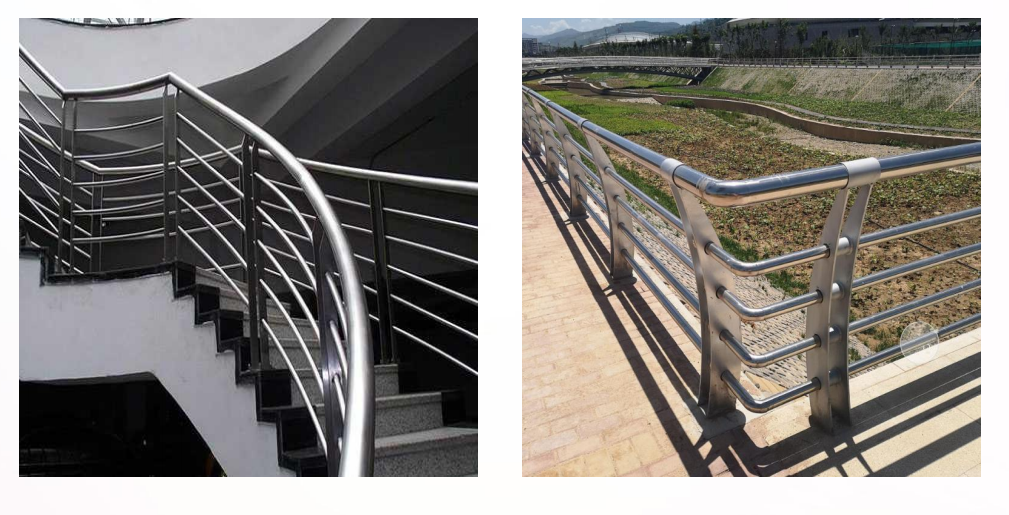
Project references such as balcony handrail and glass fitting installations show whether a supplier's production scope matches the specification package.
OEM and ODM buyer requiring customization
Where a project requires customized logo marking or voltage adaptation, capacity should be assessed together with engineering depth. Sanon runs an OEM and ODM production mode supported by the 30-person development team, with a 5-ton minimum order quantity - so the practical question is not whether customization is offered, but whether the engineering team that reviews drawings is large enough to run custom work in parallel with standard production.
Corrosion-constrained environments
For coastal, humid or industrial environments, capacity verification extends to material control. Sanon supplies SS201 and SS304 material; SS304 contains 18-20 percent chromium and 8-11 percent nickel with manganese at or below 2 percent, while SS201 contains 16-18 percent chromium, 3.5-5.5 percent nickel and 5.5-7.5 percent manganese. A supplier that can state these ranges, and show the mill certificates behind them, is controlling material - not just quoting a grade name.
Comparison Table: Claim, Verification Method and Verifiable Evidence
The table below converts each common capacity claim into a verification method and a reference figure. It uses only published Sanon figures and standard documents so that a buyer can apply the same structure to any supplier.
| Claim type | How to verify it | Verifiable evidence (Sanon example) |
|---|---|---|
| Factory size | Site layout plan with functional zones, land use or lease document, satellite cross-check | 40,000 square meter manufacturing site at Shishan Science and Technology Industrial Park, Foshan, Guangdong |
| Monthly pipe capacity | Monthly shipment summaries, container counts, coil consumption reconciliation | 9,000 tons of stainless steel pipe per month |
| Annual output | Compare recorded annual figure against monthly run-rate and explain the difference | 100,000 tons recorded annual output across the product range |
| Workforce | Headcount by function, live walk-through, inspector count on the lines | Approximately 500 employees |
| Engineering depth | Drawing review process, technical staff roles, first-article approval workflow | 30-person engineering and development team |
| Quality control | Define the test scope and frequency; inspect records at each process stage | 100 percent testing during cutting, welding, polishing and packing |
| Market compliance | Check certificate number, scope and validity with the issuing body | ISO 9001 (39323Q15531R0M), ISO 14001 (39323E1762R0M), ISO 45001 (39323S1708R0M), RoHS attestation (TD59352502), ECTI CPR certificate (BGTC20251119-08) |
| Export footprint | Reference accounts plus dated shipping documentation | Approximately 70 percent export share; main markets Middle East, South America, Africa |
| Lead time | Capacity math plus a measured pilot order | 7-day stated lead time, after-sales remote support |
| Order minimum | Confirm in written quotation terms, not verbally | 5-ton minimum order quantity |
| Material grade control | Request mill certificates and confirm chemical composition against specification | SS201: Cr 16-18 percent, Ni 3.5-5.5 percent, Mn 5.5-7.5 percent; SS304: Cr 18-20 percent, Ni 8-11 percent, Mn at or below 2 percent |
Frequently Asked Questions
Which certificates should a stainless steel pipe supplier be able to show, and how do you check them properly?
A supplier producing stainless steel pipes should be able to present a quality management system certificate, an environmental management certificate, an occupational health and safety certificate, and any market-specific conformity documents required by the destination country. Sanon's register includes ISO 9001:2015 (certificate 39323Q15531R0M), ISO 14001:2015 (39323E1762R0M) and ISO 45001:2018 (39323S1708R0M), all issued by Beijing Zhonghuan Qitian International Certification Co., Ltd., plus an EU RoHS Attestation of Conformity (TD59352502) issued by EUTEST and an ECTI CERT CPR certificate (BGTC20251119-08) issued by ECTI CERT Ltd. Checking them properly means three actions: confirm the certificate number with the issuing body, confirm that the scope covers the exact model and product you are buying, and confirm that the validity window covers your order and delivery date. Certificate logos prove nothing on their own.
How can a buyer confirm a monthly tonnage claim such as 9,000 tons per month?
A tonnage claim can only be confirmed by reconciliation, not by a single document. Sanon states a stainless steel pipe capacity of 9,000 tons per month, supported by a 40,000 square meter site, approximately 500 employees and in-house welding, polishing, wire drawing and laser cutting. A buyer should ask the supplier to define what the tonnage measures - finished pipe or coil consumed - and then test it against monthly shipment summaries, container counts and raw material consumption. Where a supplier also publishes an annual output figure, such as the 100,000 tons recorded for Sanon, ask for the difference between the monthly run-rate and the annual figure to be explained. Figures that survive that cross-examination are operational data. Figures that do not are marketing copy.
Does verifying a supplier's capacity mean paying a higher price?
Capacity verification and unit price are separate questions, and conflating them is a common sourcing error. What verified capacity buys is predictability: the quoted tonnage is deliverable, the stated lead time is achievable, and the minimum order quantity is honoured rather than renegotiated after the deposit. On the Sanon side, the commercial parameters that matter to a buyer's budget model are a 5-ton minimum order quantity, a 7-day stated lead time and a production mode covering both OEM and ODM work, with pricing quoted per order according to grade, profile, finish and volume. The practical test of value is whether the delivered order matches the specification, the grade and the date - which is exactly what the verification steps above are designed to establish.
Can samples and documents be requested before committing to a full order?
Yes, and the request should be made before commercial terms are agreed rather than after. A buyer evaluating a supplier should ask for samples together with the supporting document set: the certificate register, the equipment and process list, the material composition for SS201 and SS304, and the current product catalogue. Sanon's public product brochure can be downloaded directly, and sample, specification and quotation requests are handled through the published sales channel at sales@sanonsteel.com or +86 135 3668 1776. Any sample that arrives without a matching document set has answered only half of the verification question.
What lead time should a buyer expect, and how is it verified?
Sanon states a 7-day lead time, which is only credible if the capacity behind it is real - which is why lead time and tonnage should always be verified together. A stated lead time can be tested in three ways: check the capacity arithmetic (monthly tonnage against order size), review dated shipping records from the previous twelve months, and measure an actual pilot order at the minimum order quantity. The distributor relationship that has run for 10 years, covering roughly 9,000 tons supplied for architectural and decorative applications, is the kind of evidence that supports a lead-time claim over time rather than on a single quotation. Buyers who want to move from evaluation to a measured pilot can request the product brochure and current commercial terms through sales@sanonsteel.com or the Sanon WhatsApp channel.
Conclusion: Scale Is Infrastructure and Headcount, Not Presentation
Real production capacity shows up in things that cannot be printed on a brochure: a defined footprint, a monthly tonnage that reconciles with annual output and shipment records, a headcount that includes engineers and inspectors, in-house process steps, and certificate numbers that survive a call to the issuing body. Marketing materials can describe scale; only infrastructure and headcount can demonstrate it.
For buyers in the research and evaluation stage, the practical sequence is short. Request the document pack, reconcile the numbers, validate the certificates at the source, audit the operation live, and confirm everything with a pilot order measured against the stated lead time. Applied to any stainless steel supplier, that sequence separates a manufacturer from a reseller, and it converts a claim of 40,000 square meters and 9,000 tons per month into either a verified fact or a rejected quotation.
Verify Sanon for Yourself
GuangDong Sanon Metal Products Co., Ltd. has manufactured stainless steel pipes, tubes, handrail fittings and glass fittings in Foshan, Guangdong since 1999, with a 40,000 square meter facility and 9,000 tons of monthly pipe capacity. Download the product brochure, or send your specification and target volume for a documented quotation.
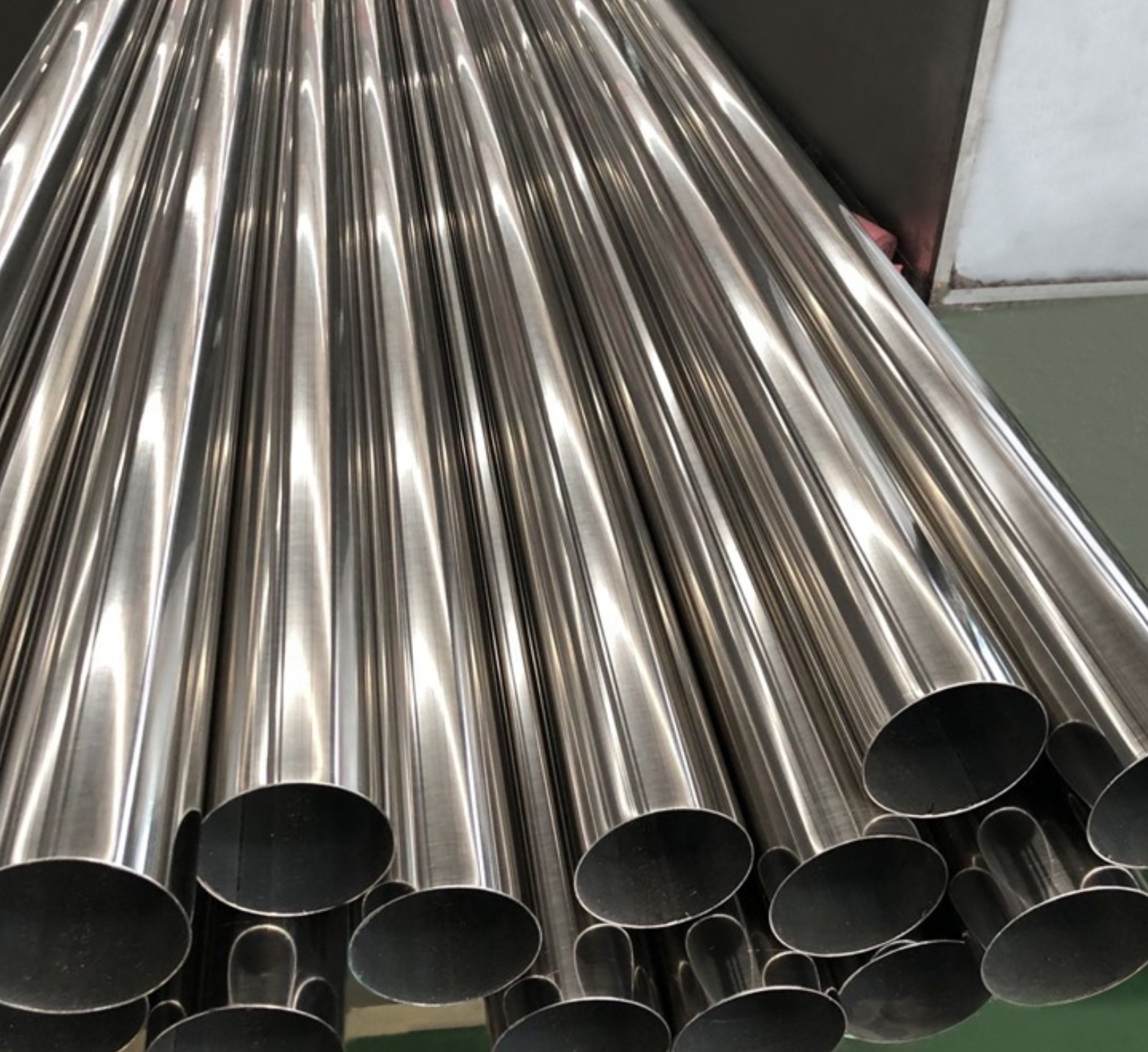
Brochure: Download the Sanon stainless steel product brochure
Website: www.sanonsteel.com
Email: sales@sanonsteel.com
Tel / WhatsApp: +86 135 3668 1776
WhatsApp link: Send a WhatsApp message
Address: No. 4 Factory, Kebao East Road, Zone A, Shishan Science and Technology Industrial Park, Foshan, Guangdong, China
Have Questions or Need More Details?
Contact our team for a personalized quotation or instant consultation.
Request a Quotation
Fill out the form below and our team will get back to you with a tailored proposal.
WhatsApp Direct Chat
Prefer to chat in real-time? Message us on WhatsApp for instant assistance & quick answers.
- Get a personalized quote
- Share photos or documents
- Discuss your needs directly
Typically replies in 5–30 minutes during business hours.