What Are Stainless Steel Pipes? A Manufacturing-Focused Guide for Global Buyers
Stainless steel pipes are hollow tubular products made from stainless steel strip or billet, formed into round, square, oval or slotted profiles, welded or drawn to shape, then polished, surface-treated and tested before shipment. In architectural and decorative supply they are the load-bearing and visible skeleton of a finished installation: the handrail a person leans on, the frame that carries a glass panel, the post a shower door slides against. Elbows, brackets, glass clamps and end caps are the accessories mounted onto that skeleton, not the pipe itself.
This guide is written for importers, distributors and project buyers in the Middle East, South America and Africa who need a clear baseline before they approach manufacturers. It explains what stainless steel pipes and tubes are, how they differ from the fittings quoted alongside them, where they are used in handrail, glass fitting and shower room applications, and how an experienced manufacturer such as GuangDong Sanon Metal Products Co.,Ltd structures production, capacity and quality control around them.
Problem Definition: Why "Stainless Steel Pipe" Means Different Things to Different Buyers
Most sourcing mistakes on stainless steel pipes are made before price is ever discussed. They happen because two parties use the same three words for three different products.
- The definition gap. A handrail fabricator asking for "pipe" usually means thin-wall ornamental tubing measured by outside diameter. An industrial buyer asking for "pipe" often means a nominal-bore product rated against a structural or pressure standard. Both are stainless steel pipes, they are not interchangeable, and the standard references behind them are different.
- The accessory gap. Pipes rarely ship alone. A handrail needs elbows, bends, railing flanges and cross bar holders. A glass balustrade needs glass clamps or standoffs. A shower enclosure needs sliding door fittings and door handles. When the RFQ lists only pipe, the buyer discovers the accessory list after the container is already booked.
- The capability gap. Buyers often assume that whoever quoted the pipe can also supply the matched fittings. In practice, pipe mills and hardware workshops are frequently separate companies, which is how diameter mismatches and finish mismatches appear between shipments.
Industry Background: How Stainless Steel Pipes Fit the Global Supply Chain
Demand for stainless steel is broad and long-running. Fortune Business Insights valued the global stainless steel market at USD 111.44 billion in 2022 and projects USD 182.10 billion by 2030. On the supply side, China's stainless steel exports reached 4.14 million tons in 2023, according to the General Administration of Customs of China. That volume explains why so many pipe and fitting enquiries from Africa, the Middle East and South America converge on Chinese manufacturers.
Two standard families matter for buyers. ASTM A312 covers seamless and welded stainless steel pipe, while ASTM A554 covers ornamental tubing for architectural and decorative use. The difference between them shapes wall-thickness tolerance, surface requirement and test regime, and it is one of the first questions a serious supplier will ask back. For glass clamps and standoff pins used in load-bearing balustrades, building codes such as the IBC (International Building Code) in North America govern load-bearing capacity, which means the fitting is evaluated as a structural component rather than a decorative one.
Two product-level trends are visible across the category. First, PVD (Physical Vapor Deposition) coating for stainless steel color pipes is increasing in interior decoration because it is considered more environmentally friendly than electroplating, according to the International Stainless Steel Forum (ISSF). Second, the high-end architectural stainless steel hardware segment is served by well-known brands such as Q-railing, Hafele and ASSA ABLOY, as listed in Verified Market Reports, while much of the underlying pipe and fitting volume is produced by manufacturers in Asia.
For a buyer, the practical takeaway is simple: the pipe, the fitting and the finish behave as one system, so they should be evaluated as one system. That is the logic behind the product structure described below.
Detailed Solution: What Sanon Manufactures and How the Product Family Fits Together
GuangDong Sanon Metal Products Co.,Ltd is a stainless steel pipe, tube, handrail fitting and glass-fitting manufacturer located in Foshan, Guangdong, China. The company was founded in 1999 and exports to markets including the Middle East, South America and Africa.
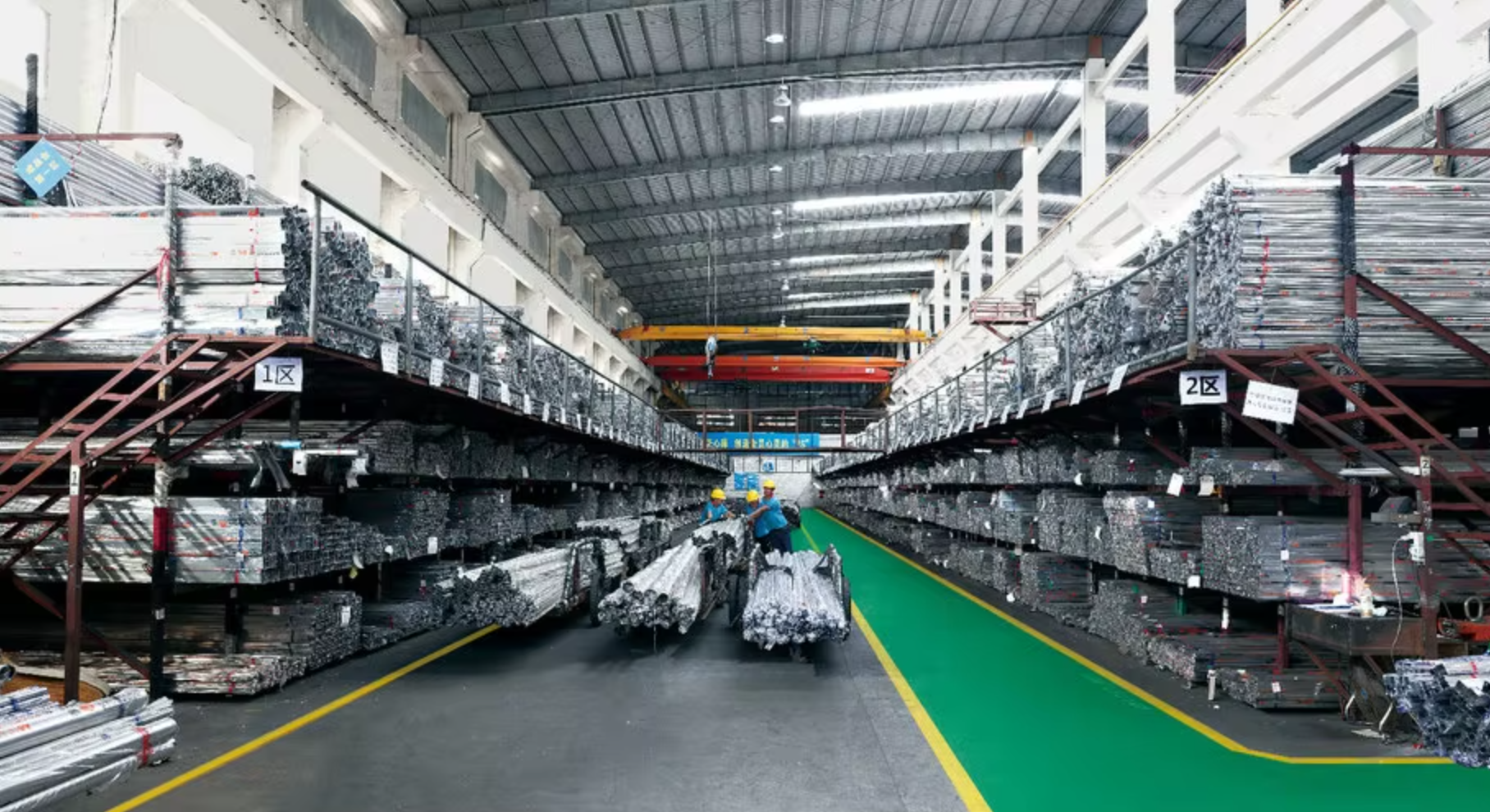
The manufacturing base behind that product range is measured in a few concrete numbers:
- Established experience: founded in 1999, with more than two decades of stainless steel production behind the current export programme.
- Factory footprint: 40,000 square meters of production area, with around 500 employees and an annual output of 100,000 tons.
- Pipe capacity: 9,000 tons per month of stainless steel pipe, the figure that matters most when a project schedule cannot move.
- Technical depth: an R&D team of 30 engineers supporting OEM/ODM work and product-level customization such as logo and voltage requirements.
- Export orientation: approximately 70% of output is exported, with the Middle East, South America and Africa as the core markets.
The pipe range itself is built around five profile families. Stainless steel round pipe is the most common choice for handrails, posts and structural frames. Stainless steel square pipe gives flat fixing faces, which suits frames and support posts. Stainless steel oval pipe is used where a slimmer decorative line is required. Stainless steel slotted pipe is produced where a slot or channel is needed in the section itself. Stainless steel color pipe adds a decorative surface through coating, a category where PVD has become the mainstream route for interior work.
Material grade drives corrosion behaviour and cost at the same time. Stainless steel 201 is specified with chromium at 16-18%, nickel at 3.5-5.5% and manganese at 5.5-7.5%. Stainless steel 304 is specified with chromium at 18-20%, nickel at 8-11% and manganese at 2% or below. Fittings in the same catalogue can be produced in stainless steel 304, stainless steel 316 and zinc alloy, with either satin or mirror finish, so that pipe and accessory can be matched on both dimension and appearance.
That matching principle is why the accessory list deserves as much attention as the pipe list. Sanon's product family covers the stainless steel elbow and bend for direction changes, the stainless steel pipe connector for straight joints, end caps for terminations, railing flange and stainless steel bracket for fixing to structure, cross bar holder for multi-rail assemblies, glass clamps, glass standoffs and stainless steel glass holder for glazed panels, decoration ball for finishing detail, stainless steel cable and stainless steel bar for infill, and sliding door fittings and door handle for shower room and door applications. Stainless steel coil and stainless steel sheet are also supplied for fabrication work.
Step-by-Step Breakdown: From RFQ to Loaded Container
The sequence below reflects how a pipe-plus-accessory order is normally structured with a manufacturing supplier. Each step exists to remove a specific failure point.
- Fix the application before the specification. State whether the pipe is carrying a handrail, framing a glass panel or supporting a shower enclosure. The application determines profile, wall thickness and which accessories are needed, and it prevents the definition gap described earlier.
- Split the RFQ into pipe lines and accessory lines. List pipe items by profile and size, then list elbows, bends, connectors, end caps, railing flanges, brackets, cross bar holders, glass clamps, standoffs, decoration balls, cable and door hardware as separate lines. A combined list is what allows a single supplier to check dimensional compatibility before quoting.
- Confirm the material grade. Decide between stainless steel 201 and 304 for pipe body, and confirm whether the fittings should be stainless steel 304, stainless steel 316 or zinc alloy. Grade selection affects both corrosion performance and the finish that can be applied.
- Match the finish across pipe and fitting. Satin and mirror finishes read differently on a round pipe than on a cast or machined accessory. Confirming the finish at quotation stage avoids a two-tone installation on site.
- Check capacity, lead time and MOQ against the project schedule. Monthly pipe capacity of 9,000 tons at Sanon is the number to weigh against order size, and the stated production lead time is 7 days. Standard minimum order quantity is 2 tons, with FOB and EXW delivery terms available.
- Lock quality control and acceptance criteria. Quality control is applied as 100% test during production, covering cutting, welding, polishing and packing stages. Confirm the acceptance terms in writing so that inspection at loading is predictable rather than negotiable.
- Confirm certification, loading and after-sales. Check that the certificate set matches the destination market, confirm packing and loading arrangements, and agree the after-sales route. Remote support is provided by the manufacturer after delivery.
Use Cases: Handrail, Glass Fitting and Shower Room Applications
Handrail and balcony systems
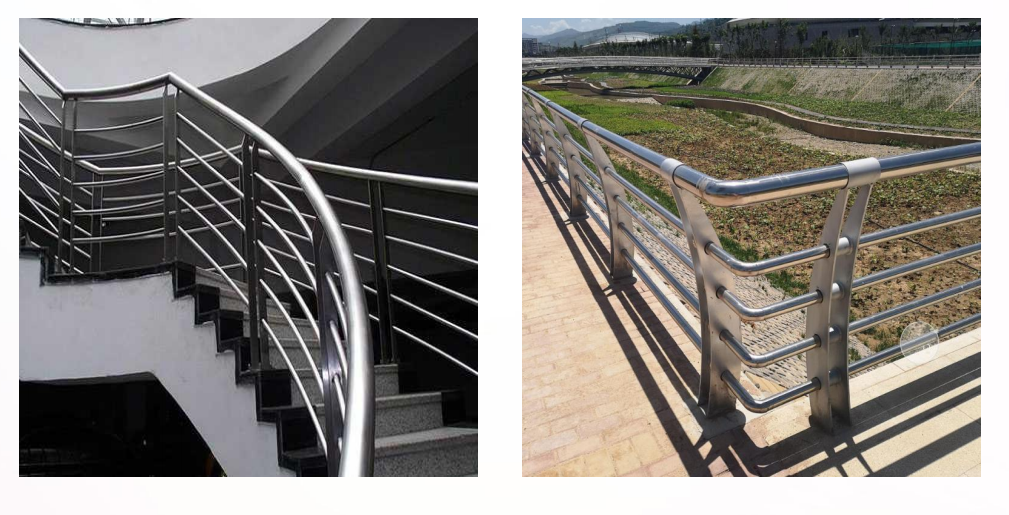
A handrail run is a pipe system with a defined load path. The top rail is normally stainless steel round pipe, posts carry the vertical load, cross bars are held with a cross bar holder, wall connections use a railing flange, corners are formed with a stainless steel elbow or bend, and open ends are closed with end caps. Infill may be stainless steel cable, stainless steel bar or a glass holder, depending on the design language of the building.
Glass fitting and balustrade systems
Glass clamps, glass standoffs and stainless steel glass holder components are the connection between pipe structure and glass panel. Because these parts carry load, they are assessed against code requirements such as IBC in North America, which is one reason buyers should verify both the fitting and the supplier's documentation rather than price alone. Decoration ball and similar details close the visible ends of the assembly.
Shower room and door hardware
Shower enclosures use a different accessory mix: sliding door fittings, door handle, pipe connector and end caps, plus stainless steel glass holder where fixed panels are involved. Because these parts sit in constant moisture, grade selection carries more weight here than in a dry interior application, and grades such as 316 are commonly considered where higher corrosion resistance is required.
What a long-term supply relationship looks like
Sanon records a distributor relationship covering China, Vietnam and Brazil that has run for 10 years and supplied 9,000 tons for architectural and decorative projects. The recorded outcome is stable quality, in accordance with national standards, which is the practical indicator buyers look for when they move from a trial order to a repeat programme.
Comparison Table: Pipes, Fittings and Hardware in One View
The table below maps the product families described in this guide against their stated materials and their role in an installation. It is intended as an RFQ checklist rather than a price comparison.
| Product family | Typical items | Stated materials and finishes | Role in the installation |
|---|---|---|---|
| Stainless steel pipes and tubes | Round pipe, square pipe, oval pipe, slotted pipe, color pipe; stainless steel coil and sheet | Stainless steel 201, stainless steel 304 | Main structural and visible body of handrails, frames and posts |
| Pipe fittings and connectors | Stainless steel elbow, bend, pipe connector, end caps, railing flange, cross bar holder, stainless steel bracket | Stainless steel 304, stainless steel 316, zinc alloy; satin or mirror finish | Join, redirect, fix and terminate pipe runs |
| Glass fittings | Glass clamps, glass standoffs, stainless steel glass holder | Stainless steel 304, stainless steel 316, zinc alloy; satin or mirror finish | Carry and position glass panels in balustrades and partitions |
| Decorative and infill elements | Decoration ball, stainless steel cable, stainless steel bar | Stainless steel 304, stainless steel 316 | Fill, stiffen and finish the visible assembly |
| Shower room and door hardware | Sliding door fittings, door handle | Stainless steel 304, stainless steel 316, zinc alloy; satin or mirror finish | Moving and handling parts for shower enclosures and doors |
FAQ: What Buyers Ask Before Ordering Stainless Steel Pipes
1. Which certifications should a buyer verify on a stainless steel pipe supplier?
For EU-destined goods, Sanon holds an Attestation of Conformity for RoHS, certificate number TD59352502, issued by EUTEST Belgelendirme Muayene ve Gözetim Hiz. Ltd. Şti., valid from 2025-10-27 to 2030-10-26, covering stainless steel pipes under the EU RoHS 2015/863 restricted substances list and tested against the EN 62321 series. A separate ECTI CERT certificate, number BGTC20251119-08, issued by ECTI CERT Ltd., is valid from 2025-11-19 to 2030-11-18 and covers the product under the EU Construction Products Regulation (CPR), referencing EN ISO 9227:2022/A1:2024. On management systems, the company holds ISO 14001, certificate 39323E1762R0M, and ISO 45001, certificate 39323S1708R0M, both issued by Beijing Zhonghuan Qitian International Certification Co., Ltd. and valid until 2026-12-03. Buyers should always check that the scope of a certificate matches the exact product and destination market before ordering.
2. Can one manufacturer supply both the pipes and the matching fittings?
Yes. Sanon produces stainless steel pipes and tubes together with the matching accessory range: stainless steel elbow and bend, pipe connector, end caps, railing flange, cross bar holder, stainless steel bracket, glass clamps, glass standoffs, stainless steel glass holder, decoration ball, stainless steel cable, stainless steel bar, sliding door fittings and door handle, in stainless steel 304, stainless steel 316 or zinc alloy with satin or mirror finish. Producing both sides of the assembly in one factory is what allows profile, dimension and finish to be matched before shipment, and it is supported by an R&D team of 30 engineers and OEM/ODM capability for logo and voltage customization.
3. What are the minimum order quantity, delivery terms and payment terms?
The standard minimum order quantity is 2 tons. Available delivery terms are FOB and EXW. Payment is by bank transfer or cash, and the stated acceptance condition is payment of the full amount when the goods are loaded. Because capacity is 9,000 tons per month of stainless steel pipe with a stated production lead time of 7 days, commercial terms can be aligned to the size and schedule of a specific project.
4. How can a buyer validate quality before committing to a bulk order?
Quality control at Sanon is applied as 100% test during production, covering the cutting, welding, polishing and packing stages. A practical first step for a new buyer is to review the certificate set against the destination market, then discuss a sample or trial quantity with the export team before scaling up. That sequence lets a buyer confirm surface finish, wall thickness and accessory fit with their own fabricators before a full container is committed.
5. What lead time and monthly capacity should a buyer plan around?
The stated production lead time is 7 days, and pipe capacity is 9,000 tons per month, supported by a 40,000 square meter factory, around 500 employees and an annual output of 100,000 tons. Buyers planning a phased project should confirm the schedule against order size, since capacity availability and delivery terms are agreed per order. To check a specific profile, accessory list or delivery window, contact the Sanon export team at sales@sanonsteel.com or +86 135 3668 1776, or review the full product catalogue in the downloadable brochure.
Conclusion: A Clear Baseline Before You Source
Stainless steel pipes are the tubular backbone of handrail, glass fitting and shower room systems, and the accessories that attach to them are a separate product family that must be specified at the same time. Understanding that distinction, together with the standards that apply to the destination market and the material grades available, removes most of the risk from a first order.
Sanon brings manufacturing scale and a matched product range to that baseline: founded in 1999, a 40,000 square meter facility, 9,000 tons per month of pipe capacity, a 30-engineer R&D team, OEM/ODM support, and an export focus on the Middle East, South America and Africa. Buyers who start with a complete pipe and accessory list will get a faster, more accurate quotation than buyers who send three words.
Next Step: Request the Catalogue or Discuss Your Pipe & Fitting List
Send your profile list, accessory list and destination market to the Sanon export team for a quotation, or download the product brochure to review the full range of stainless steel pipes, fittings, glass hardware and shower room accessories.
Download the Sanon product brochure (PDF)
Website: www.sanonsteel.com · Email: sales@sanonsteel.com · Tel / WhatsApp: +86 135 3668 1776 · Contact: Chloe · Address: No. 4 Factory, Kebao East Road, Zone A, Shishan Science And Technology Industrial Park, Foshan, Guangdong, China

Have Questions or Need More Details?
Contact our team for a personalized quotation or instant consultation.
Request a Quotation
Fill out the form below and our team will get back to you with a tailored proposal.
WhatsApp Direct Chat
Prefer to chat in real-time? Message us on WhatsApp for instant assistance & quick answers.
- Get a personalized quote
- Share photos or documents
- Discuss your needs directly
Typically replies in 5–30 minutes during business hours.