What Stainless Steel Pipes Fit Your Project? An Application Guide for Handrails & Glass Systems
What Stainless Steel Pipes Fit Your Project? An Application Guide for Handrails & Glass Systems
Four component groups cover almost every handrail, balustrade and shower job: stainless steel pipes and tubes for the frame, stainless steel fittings for the joints, glass hardware for the panels, and wet-area fittings for enclosures. Round, square, slotted and oval pipe forms carry the load and set the visual line; elbows, bends, brackets, railing flanges and cross bar holders connect them; glass clamps, standoffs and glass holders hold the panels. The right combination is decided by the application — staircase handrail, glass balustrade or shower enclosure — and by the environment the finished system will face.
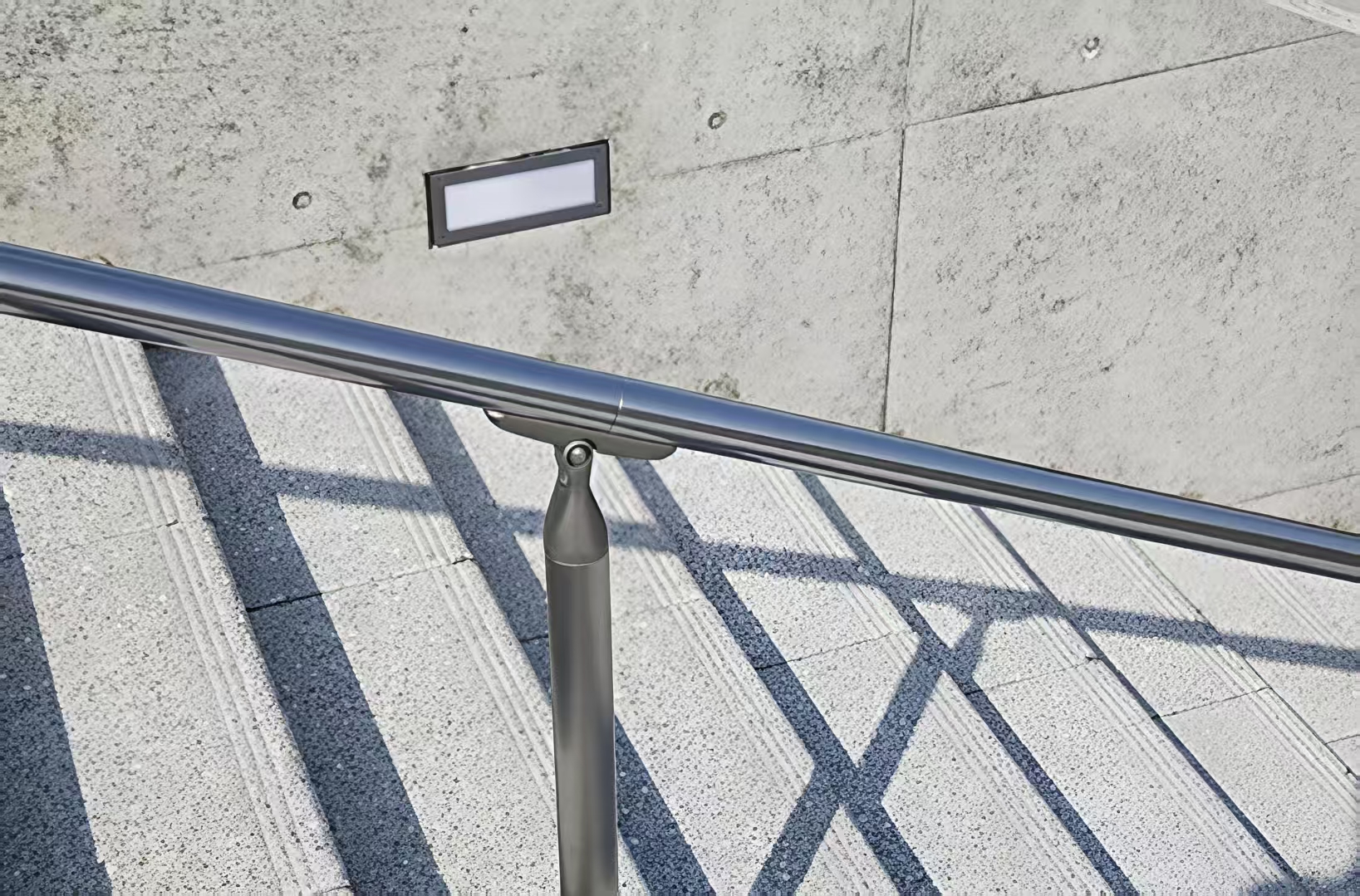
Cover: a stainless steel handrail for a balcony project — round pipe frame with welded connections and matching fittings.
This guide is written for the people who actually have to make that match: architects and specifiers writing a component schedule, fabricators pricing a balustrade package, distributors building a stock list, and project buyers comparing quotations. It maps the component families supplied by Guangdong Sanon Metal Products Co., Ltd — stainless steel pipes, stainless steel tubes, inox, stainless steel accessories, staircase handrails, glass clamps, elbows and shower room fittings — to real project scenarios, and separates the selection factors that change from one application to the next.
Why the Match Fails Before the Metal Does
Most problems in handrail and glass systems are not material failures. They are selection failures at the application stage, and they usually show up in one of five ways:
- Wrong form. A round pipe is ordered for a glass balustrade that needs a slotted profile to accept the glass or cable infill.
- Mismatched fittings. Pipe is purchased without confirming outside diameter and wall thickness against the elbows, bends, brackets and connectors it has to accept, so the joint never seats cleanly.
- Grade mismatch to the environment. The same grade is specified for a covered interior stair and for an open balcony in a humid or coastal city.
- Finish chosen on appearance alone. Satin and mirror finishes behave differently in wet, high-touch and high-visibility areas.
- Hardware separated from the frame. Glass clamps, standoffs and glass holders are bought from a different supplier than the pipe, which leaves the load path undefined between the two.
The consequence is predictable: rework on site, rejected inspections where load-bearing balustrade hardware is checked, and premature surface deterioration in humid conditions. Defining the application first — and only then the component — removes most of that risk.
One terminology check is worth making early, because it decides which dimensions appear on the purchase order. In general trade usage, pipe is normally ordered by nominal bore and used for conveying media, while tube is ordered by outside diameter and wall thickness and is the usual form for structural and ornamental work such as handrails, balustrade frames and shower enclosures. For a handrail or glass package, the numbers that must match the fittings are the outside diameter and the wall thickness — not the bore.
Industry Background: A Large, Standards-Driven Category
The frame and hardware described in this guide sit inside a substantial global category. The global stainless steel market was valued at USD 111.44 billion in 2022 and is projected to reach USD 182.10 billion by 2030 (Fortune Business Insights). China's stainless steel exports reached 4.14 million tons in 2023 (General Administration of Customs of China), which is why so many handrail, balustrade and shower programmes worldwide are sourced from Chinese mills and fitting factories.
Standards shape what buyers are able to specify. Stainless steel pipes and tubes used in structural and architectural applications are commonly referenced against ASTM A312 (seamless and welded pipe) and ASTM A554 (ornamental tubing). For glass balustrades, glass clamps and standoff pins are governed by building codes such as the International Building Code (IBC) in North America, which addresses load-bearing capacity — a reminder that glass hardware carries a structural role, not only a fixing role.
On the finish side, PVD (Physical Vapor Deposition) coating for stainless steel color pipes is gaining ground in interior decoration because it is considered more environmentally friendly than electroplating (International Stainless Steel Forum). In the high-end architectural hardware market, established players such as Q-railing, Hafele and ASSA ABLOY are identified in glass clamp and railing system segments (Verified Market Reports) — a useful reference point for the performance level that specifiers expect from clamp-and-rail hardware.
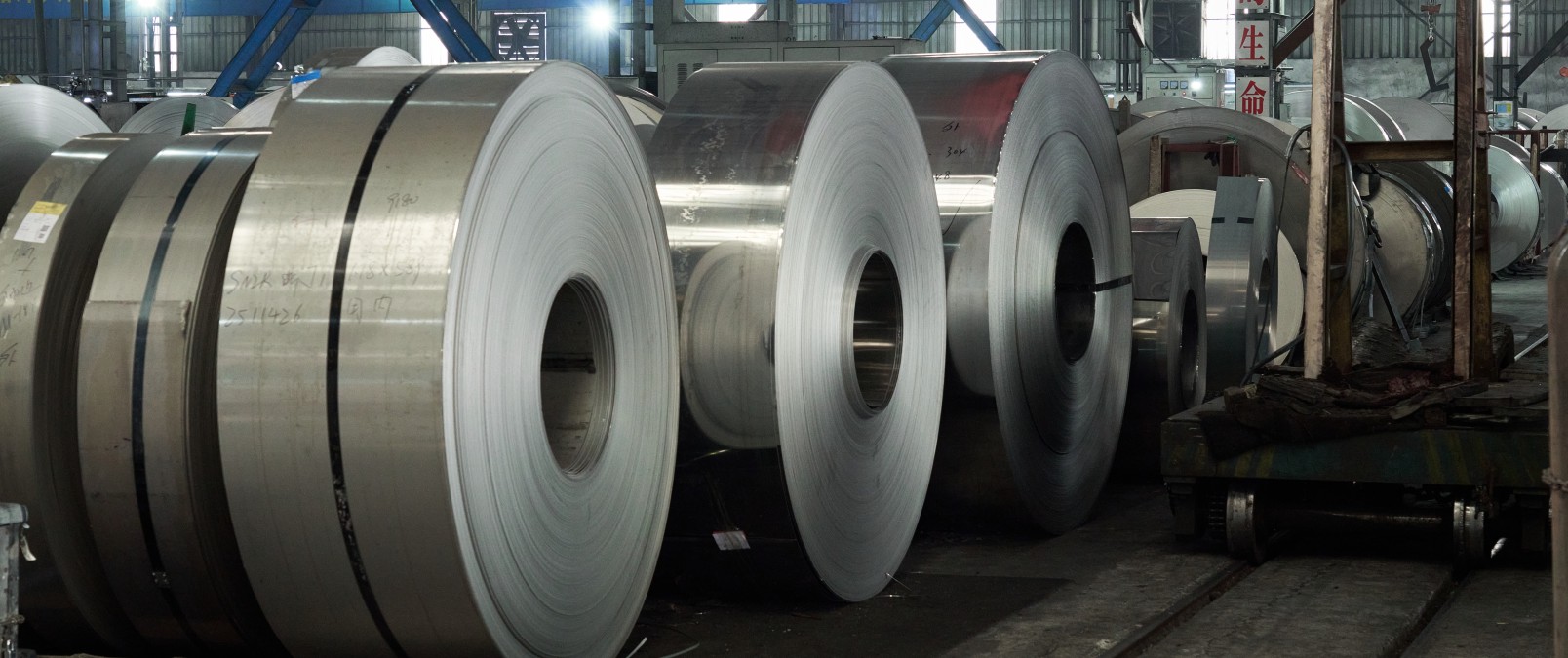
Stainless steel coils: the raw-material stage behind pipe and tube forming.
The supplier behind the components
Guangdong Sanon Metal Products Co., Ltd is a Foshan-based manufacturer of stainless steel pipes, stainless steel tubes, stainless steel accessories, staircase handrails, inox, stainless steel glass clamps, stainless steel elbow pipes, stainless steel coils and stainless steel sheets. The company was founded in 1999 and operates a 40,000 sqm factory in Foshan, Guangdong, China, with 500 staff, a 30-engineer R&D team, a monthly stainless steel pipe capacity of 9,000 tons and an annual output of 100,000 tons. Around 70% of production is exported, with the main markets being the Middle East, South America and Africa. Humid and coastal exposure is therefore the normal operating condition for much of what leaves the plant, not an exception.
Detailed Solution: Which Component Families Fit Which Application
Selection starts with the family, not with a model number. Four families cover the handrail-and-glass brief.
1. Frame pipes and tubes: round, square, slotted and oval
Sanon's stainless steel pipes are supplied in SS201 and SS304 and include round, square and slotted profiles, with oval pipe and stainless steel color pipe used where the visual line matters as much as the structure. Each form has a natural job:
- Stainless steel round pipe — the default for handrails and balustrade top rails. It bends into curves, accepts standard elbows and bends, and presents a clean grip surface.
- Stainless steel square pipe — vertical posts, structural frames and geometric infill. A flat face gives a clamp or bracket a full contact surface, which is why square profiles appear so often in glass balustrade posts.
- Stainless steel slotted pipe — infill and panel work, where a continuous groove takes glass, cable or a decorative insert instead of a series of separate clamps.
- Stainless steel oval pipe — decorative handrail grips and design features where a flatter profile reads better in the finished interior.
- Stainless steel color pipe — PVD-coated decorative profiles for interior features where a colour finish is required rather than raw metal.
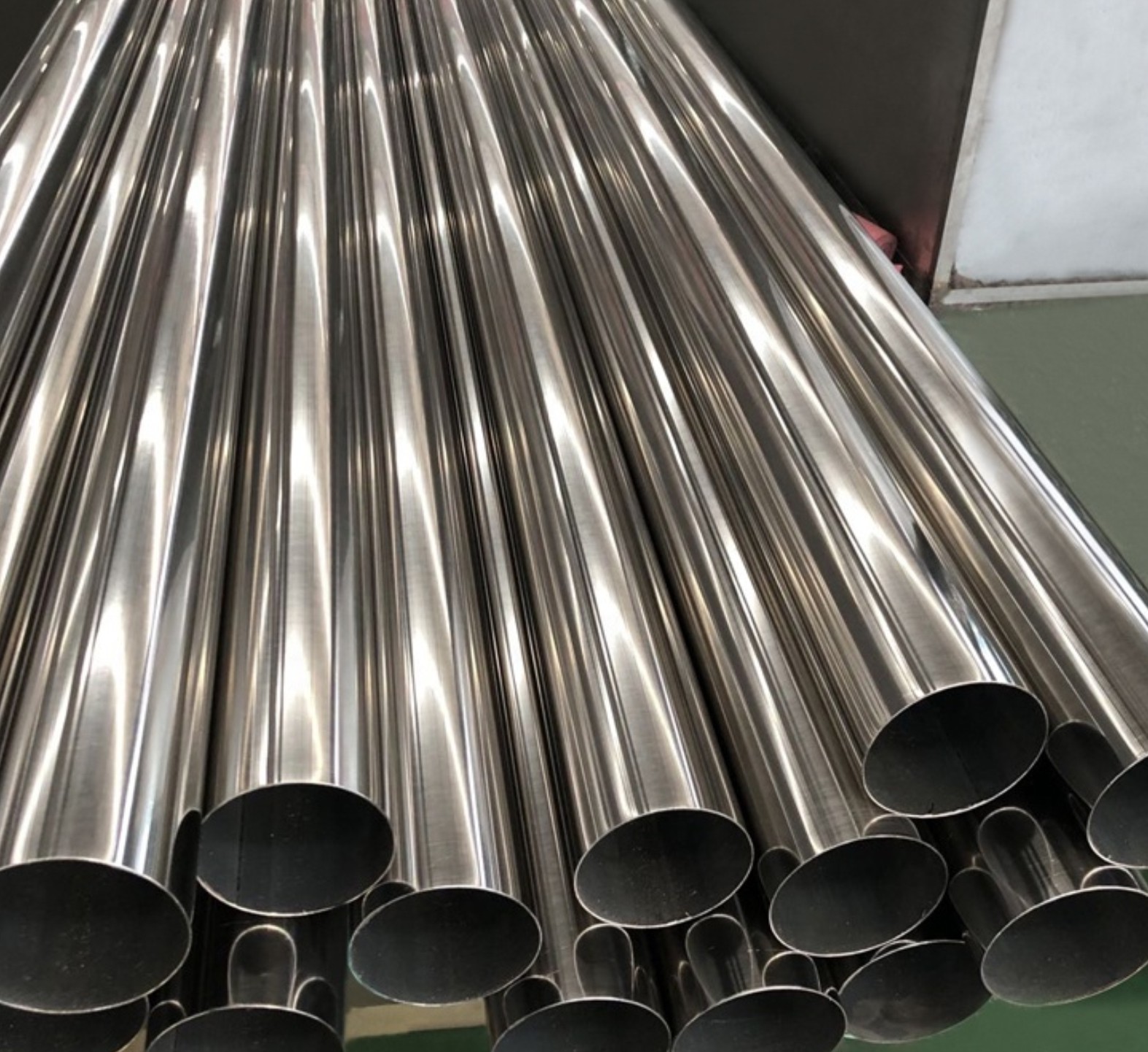
Round pipe: the most common frame form for staircase handrails and balustrade top rails.
2. Fittings and connectors: where the system is actually decided
Whether a frame behaves as one structure or as a pile of parts depends on the fittings. Stainless steel elbows and bends take the direction changes; stainless steel brackets and cross bar holders carry support points and infill fixing; railing flanges anchor posts to the slab or stringer; pipe connectors join runs; end caps and decoration balls finish the detail; stainless steel bar and stainless steel cable handle decorative inlay and infill. These fittings can be produced in stainless steel 304, stainless steel 316 and zinc alloy, with either a satin or a mirror finish.
The single most useful compatibility check is also the simplest: elbow bore must match the pipe outside diameter and wall thickness. Specifying the frame and the fittings from the same profile family removes the majority of on-site joint problems.
3. Glass hardware and wet-area fittings
Glass clamps, glass standoffs and stainless steel glass holders carry the panels in balustrades, partitions and shower enclosures. Sliding door fittings and door handles complete partition and enclosure systems, while shower room fittings cover the wet-area connections. Because these parts are load-bearing in a balustrade, code requirements on load capacity such as IBC apply directly to them — which is why clamp selection should be documented together with the glass thickness and the panel span, not chosen afterwards.
4. Grades and finishes: the two decisions that follow the form
Sanon's stainless steel pipes and tubes are supplied in SS201 and SS304. The two grades are not interchangeable in every location, and the difference sits in the chemistry:
| Element | SS201 | SS304 |
|---|---|---|
| Chromium (Cr) | 16–18% | 18–20% |
| Nickel (Ni) | 3.5–5.5% | 8–11% |
| Manganese (Mn) | 5.5–7.5% | ≤2% |
The higher nickel content of SS304 is the reason specifiers in humid, coastal or high-humidity exposure usually pull grade selection forward in the process, while SS201 is typically reserved for covered interior positions where exposure is limited. Fittings follow a similar logic and add a third option: stainless steel 316 where chloride exposure is a stated project condition, and zinc alloy where the part is decorative rather than structural. Finish is the second decision — satin hides handling marks and suits high-touch rails, while mirror is chosen for visible decorative surfaces and needs more care during installation.
Step-by-Step: Specifying a Handrail or Glass System
- Define the application and the load path. Handrail, glass balustrade, partition or shower enclosure — each carries a different load path and a different code exposure. Write it down before choosing a profile.
- Choose the pipe form. Round for rails and curves, square for posts and frames, slotted for panel and infill work, oval or color pipe for decorative runs.
- Fix the grade against the environment. Match SS201 or SS304 to the actual exposure of the installed position, not to the project's general standard.
- Select fittings from the same profile family. Confirm outside diameter and wall thickness against every elbow, bend, flange and connector in the schedule.
- Decide the finish once, and record it. Satin or mirror, with the same specification applied to pipe and fittings so the finished system reads as one unit.
- Size the order against capacity and order rules. Sanon's minimum order quantity for pipe is 5 tons and the stated lead time is 7 days, against a monthly pipe capacity of 9,000 tons — combining pipe, fittings and glass hardware in one order is usually simpler than splitting them.
- Validate with samples and drawings. OEM and ODM work is supported, with customization and logo marking handled by a 30-engineer R&D team. A trial fitting on the actual profile is a fast way to confirm the package before release to production.
Use Cases: Three Applications, Three Component Sets
Staircase handrails
A residential or commercial stair handrail is usually a round pipe rail supported on posts, with direction changes taken by elbows and bends, posts anchored through railing flanges, and detail finished with end caps or a decoration ball. Staircases are frequently positioned near openings, atria or entrances, where humidity and wind-driven rain reach the rail even in an otherwise interior building — a factor that becomes decisive in Middle East, South America and Africa projects where humid conditions are common.
A recorded case from Sanon's own production illustrates the pattern: a distributor client across China, Vietnam and Brazil, with a 10-year relationship covering architectural and decorative projects, a quantity of 9,000 tons, results recorded as stable and quality in accordance with national standards. The balcony handrail in the cover image is that type of work — round pipe frame, welded connections, fittings finished to match. Welding, polishing, wire drawing and laser cutting are the matched production processes for rust- and corrosion-resistant decorative and industrial work of this kind.
Glass balustrades and partitions
A glass balustrade combines three families on one drawing: a slotted pipe for the glass infill where a continuous groove is preferred, round or square pipe for the top rail and posts, and glass clamps, standoffs or glass holders to carry the panels. Cross bar holders are added where a horizontal bar runs between posts. In North America the load-bearing capacity of clamps and standoff pins is governed by IBC, so the hardware selection has to be documented together with panel size rather than chosen on appearance.
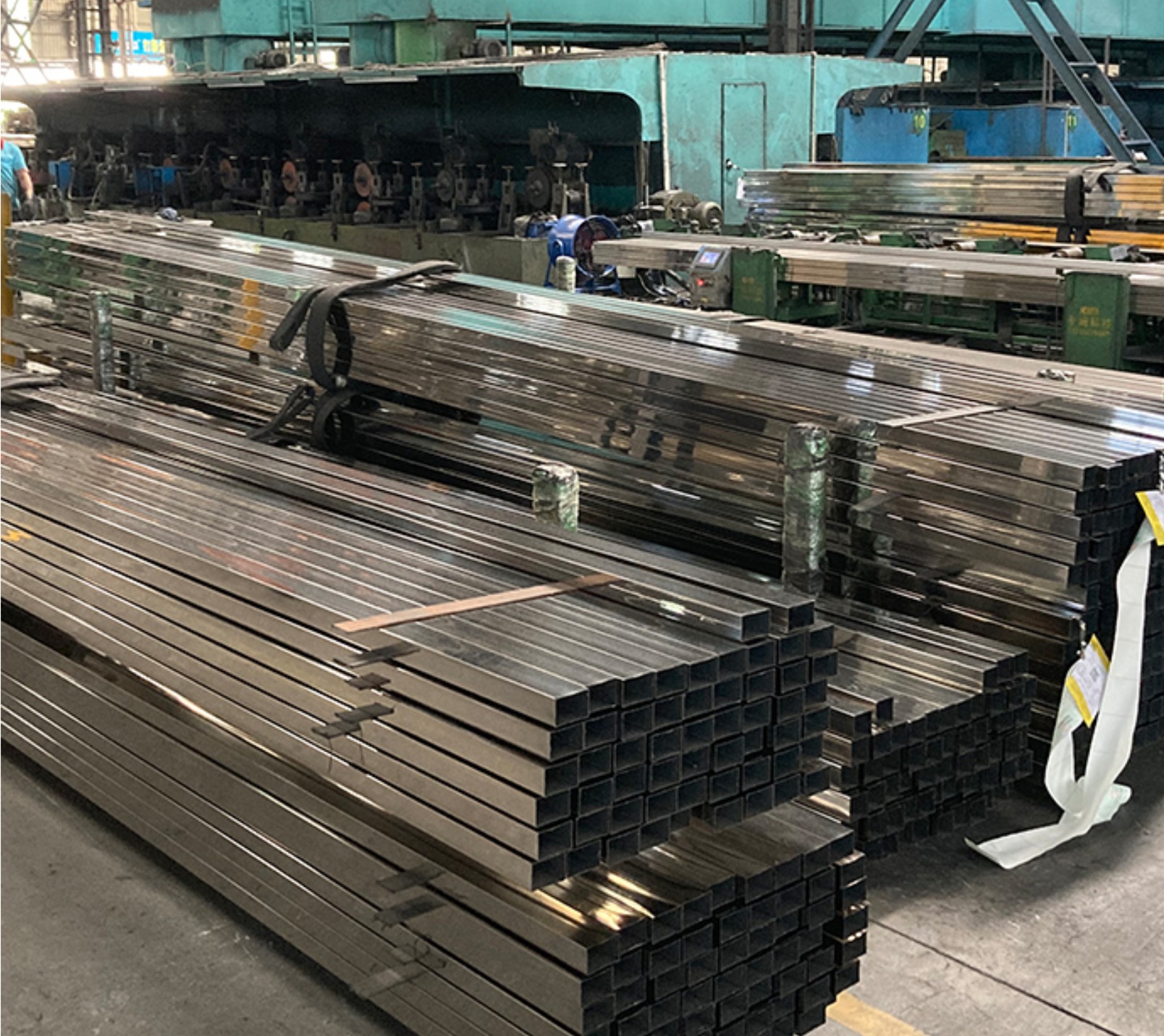
Square pipe gives posts and clamps a full flat contact face on glass balustrades.
Shower enclosures and wet areas
Shower enclosures are the most aggressive environment of the three for finish durability. The typical component set is an oval or round tube frame with shower room fittings, stainless steel glass holders, sliding door fittings and a door handle. Because the area stays wet, grade and finish decisions carry more weight here than anywhere else in the building: SS304 is the common working assumption, fittings can be supplied in stainless steel 304, 316 or zinc alloy, and finish is usually chosen between the handling resistance of satin and the appearance of mirror.
Comparison Table: Application-to-Component Map
The table below condenses the mapping logic described above. It is a selection aid, not a substitute for the project's own structural and code requirements.
| Application | Frame form | Main fittings | Grade options | Environment note |
|---|---|---|---|---|
| Indoor staircase handrail | Round pipe (rail), square pipe (posts) | Elbows, bends, brackets, railing flange, end caps, decoration ball | SS201 / SS304 pipe; fittings in 304, 316 or zinc alloy | Covered positions with limited exposure |
| Outdoor or coastal handrail | Round pipe | Welded elbows and bends, railing flange, brackets | SS304 pipe; fittings in 304 or 316 | Humid and wind-driven rain exposure; grade selection moves forward |
| Glass balustrade | Slotted pipe (infill), round or square pipe (posts and top rail) | Glass clamps, glass standoffs, glass holders, cross bar holders | SS201 / SS304 frame; clamps and standoffs in 304 or 316 | Load-bearing hardware governed by codes such as IBC |
| Glass partition / sliding system | Square or round pipe framing | Sliding door fittings, pipe connectors, door handle | SS304 frame and fittings | Interior exposure, high handling |
| Shower enclosure | Oval or round tube | Shower room fittings, sliding door fittings, glass holders, door handle | SS304 frame; fittings in 304, 316 or zinc alloy | Continuously wet; satin or mirror finish |
| Decorative interior feature | Stainless steel color pipe, oval pipe | Decoration ball, end caps, stainless steel bar | SS201 / SS304 with PVD colour finish | Interior decoration; PVD coating is an alternative to electroplating |
Frequently Asked Questions
Which standards apply to stainless steel pipes, tubes and glass clamps in handrail and balustrade projects?
Architectural and structural stainless steel pipe and tube are commonly specified against ASTM A312 for seamless and welded pipe and ASTM A554 for ornamental tubing. Glass clamps and standoff pins in load-bearing balustrades are governed by building codes such as the International Building Code (IBC) in North America, which addresses load-bearing capacity. Local project specifications often add requirements on top of these references, so the component schedule should state the standard, the grade and the finish together.
Can one supplier cover the pipe, the fittings and the glass hardware for the same project?
Guangdong Sanon Metal Products Co., Ltd supplies stainless steel pipes, stainless steel tubes, stainless steel accessories, staircase handrails, inox, stainless steel glass clamps, stainless steel elbow pipes, stainless steel coils and stainless steel sheets, together with handrail fittings, glass fittings and shower room fittings. Production runs in a 40,000 sqm factory in Foshan with a monthly pipe capacity of 9,000 tons, an annual output of 100,000 tons, 500 staff and a 30-engineer R&D team. OEM and ODM work is supported, including product customization and logo marking.
What determines the cost of a handrail or glass balustrade component order?
Four variables move the cost: the grade (SS201 or SS304, which differ in chromium, nickel and manganese content), the profile (round, square, slotted, oval or color pipe, plus the number of bends), the surface finish (satin or mirror), and the fitting count per system. Order size matters as well, because the minimum order quantity for pipe is 5 tons — combining pipe, fittings and glass hardware in one order is usually more efficient than splitting them across suppliers.
Can I request samples or trial fittings before placing a project order?
Yes. Samples and quotations can be requested directly from the sales team at sales@sanonsteel.com or by WhatsApp on +86 135 3668 1776. Sharing the drawing, the application (handrail, glass balustrade or shower enclosure) and the environment the system will face allows the component family, grade and finish to be proposed together. A full product brochure is available for download.
What capacity and lead time should a project buyer plan for?
Sanon's Foshan factory runs a monthly stainless steel pipe capacity of 9,000 tons, with a stated lead time of 7 days and 100% testing as part of quality control across cutting, welding, polishing and packing. Around 70% of output is exported to the Middle East, South America and Africa, so export scheduling is routine rather than exceptional. For time-critical projects, contact sales@sanonsteel.com or call +86 135 3668 1776 (WhatsApp) to confirm the current schedule.
Production line: pipe forming and finishing at Sanon's 40,000 sqm Foshan factory.
Conclusion: Match the Component to the Job, Then Order
Choosing stainless steel pipes for a handrail or glass system is not a search for one universal specification. It is a sequence of four matching decisions: the application sets the load path, the form sets the geometry, the grade and finish set the durability, and the fittings and glass hardware set whether the system behaves as one structure. Get the sequence right and the components stop being a procurement problem.
Sanon has been manufacturing stainless steel pipes, tubes, accessories and architectural fittings in Foshan since 1999, with a 40,000 sqm factory, a monthly pipe capacity of 9,000 tons, a 100,000 ton annual output and an export share of around 70% into the Middle East, South America and Africa.
Next Step: Send the Drawing, Get the Component Set
Send the application, the drawing and the installation environment, and the sales team will come back with a matched component family — pipe form, grade, finish and fittings — plus samples or a quotation for your review.
Email: sales@sanonsteel.com
Tel / WhatsApp: +86 135 3668 1776 | Start a WhatsApp chat
Website: www.sanonsteel.com
Address: No. 4 Factory, Kebao East Road, Zone A, Shishan Science And Technology Industrial Park, Foshan, Guangdong, China
Have Questions or Need More Details?
Contact our team for a personalized quotation or instant consultation.
Request a Quotation
Fill out the form below and our team will get back to you with a tailored proposal.
WhatsApp Direct Chat
Prefer to chat in real-time? Message us on WhatsApp for instant assistance & quick answers.
- Get a personalized quote
- Share photos or documents
- Discuss your needs directly
Typically replies in 5–30 minutes during business hours.