
Recycled Industrial HDPE Sheet: Grades, Properties, and Specification Guide
A recycled industrial HDPE sheet is a high-density polyethylene sheet produced from reclaimed polyethylene feedstock instead of wholly virgin resin. It keeps the properties that make HDPE sheet useful in industrial work — moisture resistance, chemical resistance, impact strength, low friction, and weldability — while allowing projects that do not require virgin-grade cosmetic consistency to use recovered polymer. Tangyin Sanyou Engineering Plastic Co., Ltd. (Sanyou) is an engineering plastics manufacturer founded in 2001 in Tangyin County, Henan, China, producing HDPE sheet, UHMWPE sheet, PP sheet, HDPE sandwich board, and ground protection mats. Sanyou classifies its PE300 HDPE sheet range as virgin HDPE sheet, recycled HDPE sheet, UV-stabilized HDPE sheet, and marine-grade HDPE sheet.
This article answers the questions that come up at the start of a procurement process: what “recycled” actually changes in an industrial HDPE sheet, how the sheet is produced, which applications fit and which do not, and how to write a specification that lets you compare quotations from different suppliers on the same basis.
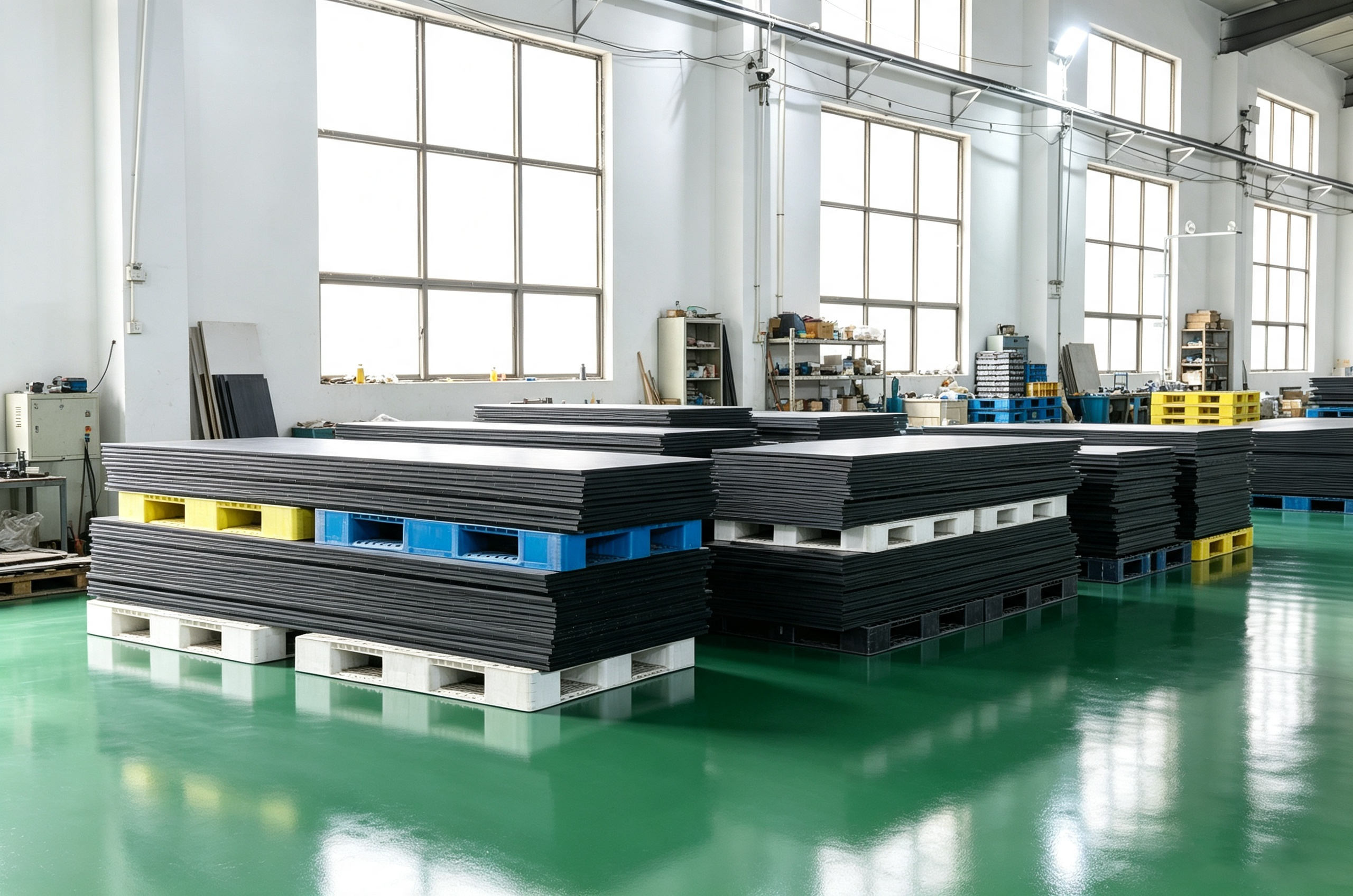
Sanyou PE300 HDPE sheet, supplied in virgin, recycled, UV-stabilized, and marine-grade classifications.
What a Recycled Industrial HDPE Sheet Actually Is
HDPE sheet is a thermoplastic sheet made from high-density polyethylene. The material designation describes the polymer, not the feedstock. An HDPE sheet can be produced from virgin resin or from reclaimed polyethylene, and both are still HDPE sheet.
“Recycled” is therefore a material-source classification. In Sanyou’s product structure, recycled HDPE sheet sits alongside virgin HDPE sheet, UV-stabilized HDPE sheet, and marine-grade HDPE sheet as an option inside the same PE300 product family, not as a separate product line with separate mechanical rules. The same principle appears in Sanyou’s ground protection mat range, where the HDPE material uses recycled or application-specific HDPE formulations according to product model and requirements.
What a recycled classification does not tell you: the reclaimed-content percentage, the feedstock source, the additive package, colour consistency across batches, thickness tolerance, UV stabilization, or food-contact status. Those are separate specification items — and they are the reason two quotations for “recycled HDPE sheet” can describe products with very different real-world performance.
Definition to keep: recycled HDPE sheet = HDPE sheet whose polyethylene content is partly or fully reclaimed. The word “recycled” answers “where did the polymer come from”. It does not answer “what will the sheet do in my application”.
The Buyer’s Problem: Why Recycled HDPE Sheet Is Hard to Compare
Buyers researching a recycled industrial HDPE sheet usually run into the same four problems.
1. Inconsistent descriptions. Supplier catalogues mix categories. Grade names, colour names such as black industrial HDPE sheet, format names such as 4x8 HDPE industrial board, surface names such as orange peel textured HDPE sheet, and performance labels such as wear resistant HDPE plate all appear in the same list. A buyer comparing three catalogues is often comparing three vocabulary systems rather than three products.
2. Nominal availability is not production capability. A listed thickness range or a listed colour does not establish that a supplier can reproduce that specification consistently across repeat orders, within controlled tolerances, at a stated lead time. Supplier differentiation in HDPE sheet largely comes down to thickness breadth, custom dimensions, surfaces, colours, and grade options — which means buyer-side comparison has to separate “listed” from “repeatable”.
3. Outdoor performance is assumed rather than specified. Standard HDPE is not UV-stabilized and may chalk or embrittle under prolonged exposure to outdoor sun. Using recycled feedstock does not change that rule. If the sheet will be outdoors for years, UV stabilization has to be specified as a grade requirement instead of being inferred from the sheet simply being HDPE.
4. Food-contact status is claimed rather than documented. Food-contact use depends on the resin, the additives, the jurisdiction, and product-specific conformity documentation. A “food grade” label on a product page is not the same thing as a declaration of compliance, and a recycled grade needs the same documentation discipline as a virgin grade.
Industry Background: Where HDPE Sheet Demand Sits
HDPE remains one of the largest-volume thermoplastics in the world, and sheet and film products account for a major share of where that volume goes.
- The global HDPE market was valued at USD 84.37 billion in 2023 and is projected to reach USD 126.86 billion by 2030, a CAGR of approximately 6% over 2024–2030 (Virtue Market Research). This figure covers HDPE in all forms and applications, not industrial HDPE sheet specifically.
- Sheets and films represent approximately 41.1% of global HDPE demand share, making this the leading application segment by material consumption (market research published 2024).
- The global ground protection mat market — a downstream HDPE sheet application — was valued at approximately US$3.0 billion in 2024 and is estimated to reach US$5.0 billion by 2035, a CAGR of roughly 4.6% over 2025–2035 (market research published 2024; medium confidence).
- Recycled HDPE feedstock is now a priced, traded commodity: black recycled HDPE (r-HDPE) resin pellets were reported at around USD 520 per metric ton FOB Southeast Asia in September 2026 (S&P Global Platts). This is a resin-pellet price, not a sheet price, and it is not a quotation basis for finished sheet.
Two conclusions matter for buyers. First, sheet is a principal form in which HDPE is consumed, so sheet-level specification is a mainstream procurement decision rather than a niche one. Second, recycled feedstock has become a monitored market with published price reporting, which means recycled content is increasingly a commercial decision driven by grade requirements and documentation, not only by cost.
It is equally important to be explicit about what public data does not provide. There is no reliable sheet-level market size for industrial HDPE sheet, no verified public price basis for the finished sheet, and no public, independently verified comparison of factory capacity across sheet producers. Buyers have to build that picture through their own supplier qualification process.
Sanyou Recycled HDPE Sheet: Material, Range, and Capability
Sanyou manufactures HDPE sheet at its 40,000 m² facility in Tangyin County, Henan, with an annual production capacity of 120,000 tons, approximately 80 employees, and a 10-engineer R&D team. Export business accounts for 70% of total sales, with major markets in North America, Western Europe, Central Europe, the Middle East, Oceania, and Southeast Asia.
The HDPE sheet range is produced in virgin, recycled, UV-stabilized, and marine-grade classifications, plus coloured and orange-peel textured variants. Custom colours, sizes, thicknesses, and textures are available.
| Specification item | PE300 HDPE sheet |
|---|---|
| Material | HDPE; virgin, recycled, UV-stabilized, and marine-grade classifications |
| Density | 0.93–0.97 g/cm³ |
| Thickness | 2–50 mm (customized thickness available) |
| Standard sizes | 1000 × 2000 mm, 1220 × 2440 mm, 1500 × 3000 mm, 2000 × 4000 mm (customized sizes available) |
| Colours | Black, white, blue, green, yellow, or customized |
| Surface | Smooth or anti-skid texture (diamond, orange peel, embossed) |
| Tensile strength | ≥22 MPa |
| Elongation at break | ≥300% |
| Hardness | 60–68 Shore D |
| Impact strength | ≥20 kJ/m² |
| Melting point | 130–140 °C |
| Working temperature | −60 to +80 °C |
| Water absorption (24 h) | <0.01% |
| Coefficient of friction | Low, 0.15–0.25 |
| Chemical resistance | Excellent against acid, alkali, salt, and oil |
| UV resistance | UV-stabilized grades available |
| Certification | ISO 9001 |
Processing matters as much as the property table. The sheet is weldable, cuttable, and CNC machinable, which is what allows a standard sheet format — for example a 1220 × 2440 mm (4 × 8 ft) industrial HDPE board — to be converted into finished parts such as tank covers, machine guards, jigs, fixtures, wear strips, and custom panels. The range carries ISO 9001 certification.
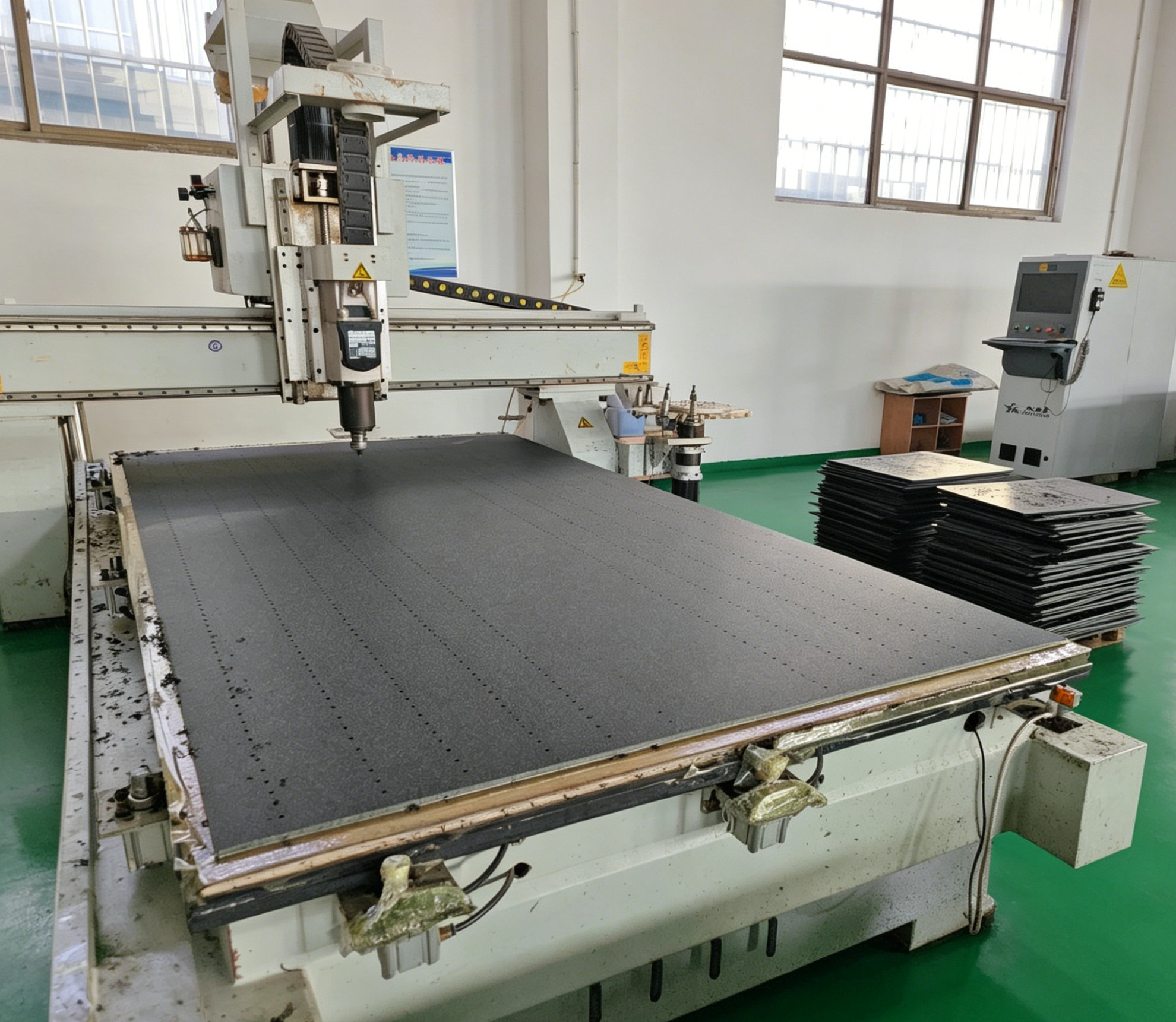
Custom-cut and CNC-machined industrial HDPE sheet components.
Sanyou’s production process covers raw material selection, sheet forming, cutting, machining, quality inspection, packaging, and delivery. That sequence is also the practical basis for a buyer’s quality conversation, because the steps where recycled feedstock decisions become visible in the finished sheet are raw material selection, sheet forming, and quality inspection.
How Recycled Industrial HDPE Sheet Is Made: Step by Step
Understanding the production sequence helps buyers ask the right question at the right stage.
Step 1 — Raw material selection
Reclaimed HDPE feedstock is selected and, where the application requires it, formulated for a specific purpose. This is where the recycled-content definition, the colour target, and the additive package — including UV stabilization where specified — are effectively set. The most useful question for a buyer here is not “is it recycled?” but “what grade declaration and what additive package apply to this order?”
Step 2 — Sheet forming
The polymer is formed into sheet. Sheet forming determines density consistency, thickness control, and internal stress — the three factors that most often surface later as flatness problems or thickness variation. Sanyou’s PE300 HDPE sheet is listed at a density of 0.93–0.97 g/cm³.
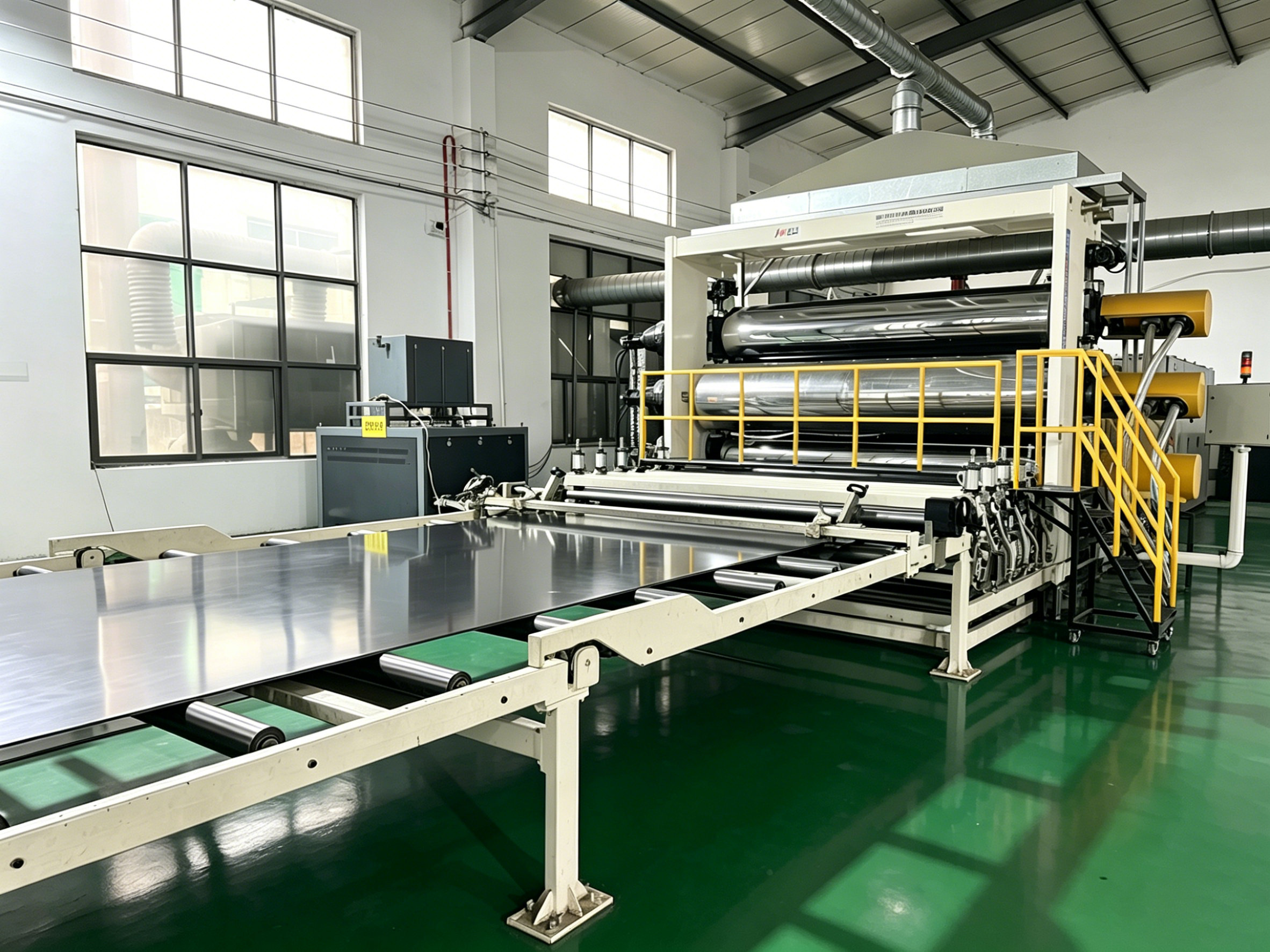
Sheet forming on Sanyou’s extrusion production line.
Step 3 — Cutting
Sheet is cut to standard formats. Sanyou’s standard sizes are 1000 × 2000 mm, 1220 × 2440 mm, 1500 × 3000 mm, and 2000 × 4000 mm, with custom dimensions available.
Step 4 — Machining
Custom-cut and CNC-machined parts are produced to customer drawings. The material can be cut, drilled, welded, and machined, which is why HDPE sheet is frequently specified as a semi-finished material rather than a finished component.
Step 5 — Quality inspection
Inspection is where order-specific requirements — thickness, format, colour, surface pattern, and any accompanying documentation — should be verified. Buyers who need traceability should agree the inspection scope before production, not after delivery.
Step 6 — Packaging and delivery
Sheet is packaged for transport and shipped to destination. For large-format panels, the packaging and handling method affects damage rates as much as the material itself.
How to Specify Recycled Industrial HDPE Sheet: A Seven-Step Framework
Most disappointing HDPE sheet orders fail at the specification stage rather than the production stage. Working through these seven decisions in order produces a specification suppliers can quote against consistently.
- Define the application and exposure. Indoor or outdoor, continuous or intermittent, chemical contact, washdown, temperature range, and abrasion severity. This single step determines whether you are buying a standard grade or a UV-stabilized or marine-grade sheet.
- Decide the recycled-content position. Virgin HDPE grades are the recommended starting point for food-contact, potable-water, and high-reliability projects because of their stable mechanical performance. Recycled grades are typically positioned for non-critical anti-corrosion lining and similar applications where strict mechanical consistency is not the governing requirement.
- Set thickness and format. Light-load lining typically starts in the 5–6 mm band, tank walls and structural panels generally fall in the 6–20 mm band, and heavy-wear chute lining work moves into the 20–50 mm band. Sanyou’s PE300 HDPE sheet covers 2–50 mm with custom thicknesses available, and standard formats from 1000 × 2000 mm up to 2000 × 4000 mm.
- Choose surface and colour. Smooth surfaces suit fabricated tanks, covers, and hygienic work surfaces; anti-skid textures such as diamond, orange peel, or embossed patterns suit walkways, platforms, and mats. Black is a common industrial colour option, with white, blue, green, yellow, and custom colours also available.
- Define the fabrication route. If the sheet will be CNC machined, welded into a tank, or assembled with fixings, state this at the quotation stage. Machinability and weldability requirements change the acceptable thickness tolerance and the packing method.
- Define documentation and testing. For food-contact or regulated use, request the declaration of compliance, resin and additive traceability, and the applicable conformity testing. For outdoor use, request the UV grade definition rather than a general UV-resistance statement.
- Request a sample and a quotation with a stated basis. Agree the price basis (per sheet, per kg, or per m²), the order quantity, and the Incoterm before comparing suppliers. Comparing quotations without a common basis produces a number that cannot be used.
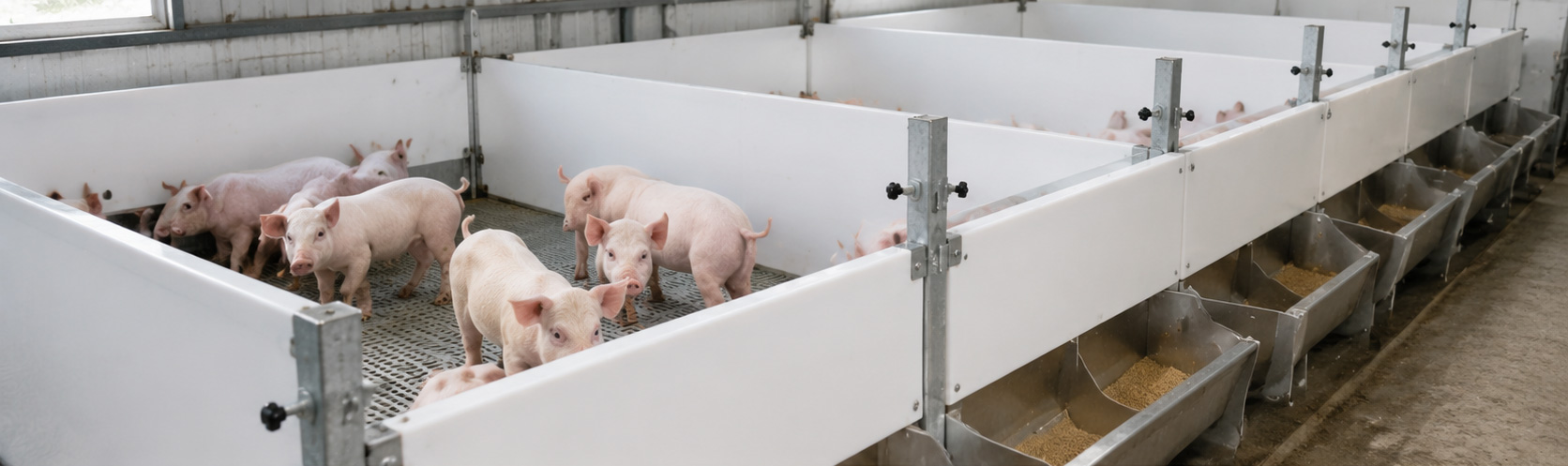
HDPE sheet applications across chemical processing, water treatment, and industrial equipment.
Use Cases: Where Recycled Industrial HDPE Sheet Fits
The HDPE sheet range is intended for chemical processing and water treatment, food and beverage processing, machinery manufacturing and industrial automation, marine and shipbuilding, construction and building materials, agriculture and livestock farming, outdoor furniture and playground equipment, signage and advertising, cold chain and refrigeration, and packaging, logistics, and material handling.
Within those industries, the recurring applications are:
- Chemical processing and water treatment: tank covers, splash guards, liners, and corrosion-resistant fabricated components. Recycled grades are commonly positioned for non-critical anti-corrosion lining, where the sheet is not the primary containment barrier.
- Machinery manufacturing and automation: machine guards, jigs, fixtures, and CNC-machined components cut from 4x8 industrial HDPE board. The sheet’s impact strength (≥20 kJ/m²) and low moisture absorption (<0.01% over 24 hours) suit workshop environments with coolant and washdown exposure.
- Material handling and bulk equipment: chute lining and low-friction wear surfaces where abrasion duty is moderate. HDPE sheet has a low coefficient of friction (0.15–0.25) and is weldable and machinable, so it can be cut and fixed to existing steelwork. For severe sliding abrasion, higher-performance engineering plastics are usually the more appropriate material choice.
- Construction and ground protection: HDPE ground protection mats and temporary access panels produced from recycled or application-specific HDPE formulations, used for temporary roads, stable work platforms, and turf protection. This is one of the clearest volume applications for recycled HDPE.
- Marine and outdoor: marine-grade HDPE sheet for marine and dock panels, plus UV-stabilized sheet for outdoor furniture, signage, and long-exposure installations.
- Cold chain and food-handling equipment: cold-storage panels, cutting surfaces, and processing tables — subject to the food-contact documentation requirements described above.
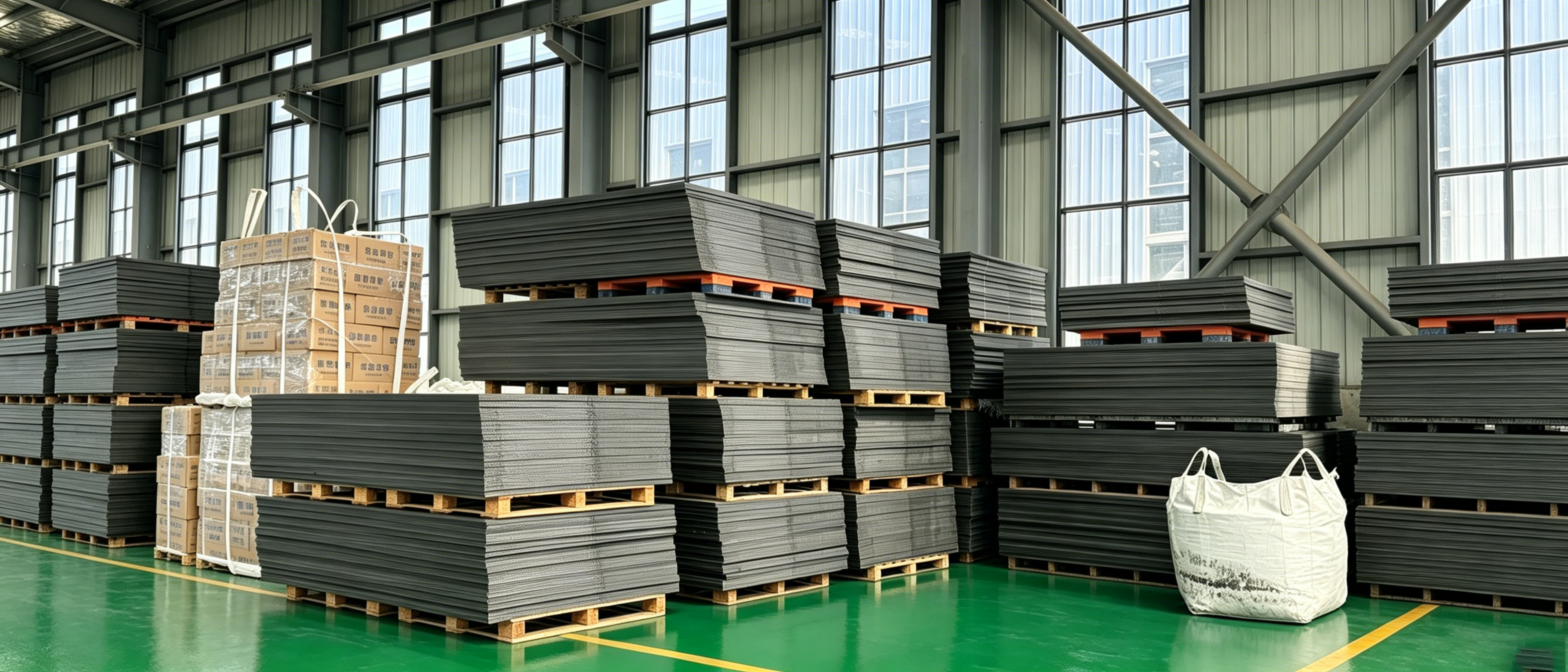
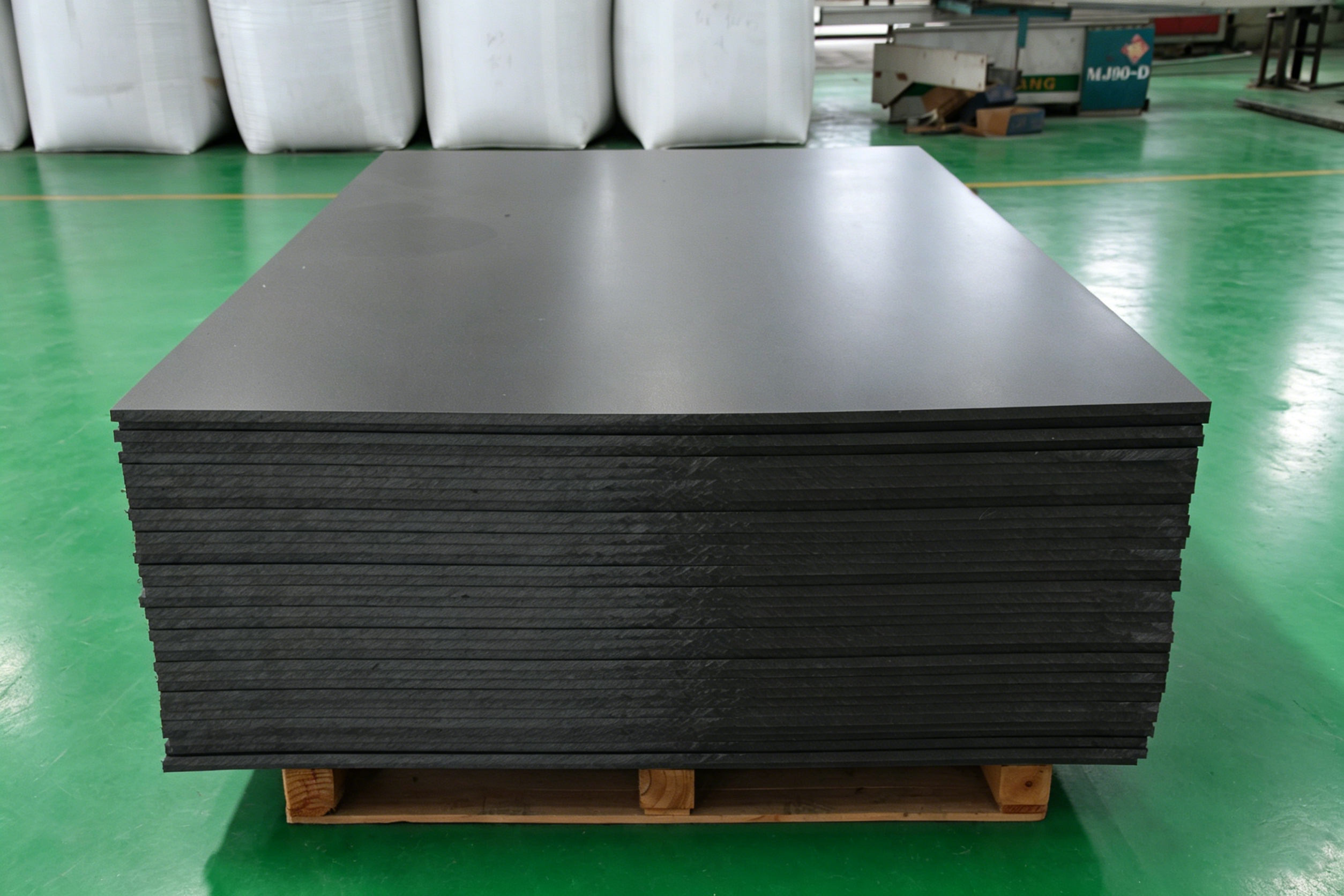
Finished HDPE sheet stock prepared for export orders.
Comparison: Virgin vs Recycled HDPE Sheet
The table below compares the two classifications on the criteria that most often decide a project. Both are available within the same PE300 product family, so the comparison is about application fit rather than one grade replacing the other.
| Decision criterion | Virgin HDPE sheet | Recycled HDPE sheet |
|---|---|---|
| Material basis | Produced from virgin HDPE resin | Produced from reclaimed HDPE feedstock; recycled or application-specific formulations according to product model and requirements |
| Typical positioning | Food-contact, potable-water, and high-reliability projects | Non-critical anti-corrosion lining and projects without strict mechanical requirements |
| Mechanical consistency | Stable mechanical performance | Performance to be confirmed against the specific recycled material grade and application conditions |
| Cost position | Higher feedstock cost basis | Positioned as the more economical option; actual price depends on grade, thickness, format, colour, and order quantity |
| Documentation needs | Declaration of compliance plus resin and additive traceability for regulated use | Same documentation discipline as virgin grades; recycled content and grade declaration should be stated in writing |
For grade selection rather than feedstock selection, the practical rule is simpler. Choose standard HDPE sheet for indoor, non-exposed work; choose UV-stabilized HDPE sheet for long-term outdoor exposure, where stabilization reduces aging and chalking; and choose marine-grade HDPE sheet for marine and shipbuilding environments.
Frequently Asked Questions
Can recycled HDPE sheet be used for food-contact or potable-water applications?
Only with the correct documentation, and the word “recycled” alone does not answer the question. Food-contact suitability depends on the resin grade, the additive package, the jurisdiction, and product-specific conformity documentation. Sanyou lists a food-grade option within the HDPE sheet range and positions virgin HDPE grades as the recommended starting point for food-contact, potable-water, and high-reliability projects, while recycled grades are positioned for non-critical anti-corrosion lining. For any regulated application, request the declaration of compliance, resin and additive traceability, and the applicable conformity testing rather than relying on a product-page label.
What thicknesses, sheet formats, and surfaces are available for Sanyou industrial HDPE sheet?
Sanyou’s PE300 HDPE sheet range covers a thickness of 2–50 mm with custom thicknesses available; standard sheet sizes of 1000 × 2000 mm, 1220 × 2440 mm, 1500 × 3000 mm, and 2000 × 4000 mm with custom dimensions; and colours including black, white, blue, green, yellow, and custom shades. Surfaces are available smooth or anti-skid, including diamond, orange peel, and embossed patterns, and the 1220 × 2440 mm size corresponds to the standard 4x8 ft industrial HDPE board format. Listed material properties include a density of 0.93–0.97 g/cm³, tensile strength ≥22 MPa, impact strength ≥20 kJ/m², water absorption below 0.01% over 24 hours, and a coefficient of friction of 0.15–0.25. The sheet is weldable, cuttable, and CNC machinable, and the range carries ISO 9001 certification.
How should buyers evaluate industrial HDPE sheet manufacturers in China?
Start with five verifiable checks rather than with the product list. First, confirm that the supplier manufactures sheet rather than reselling it, and identify the production route used for the grade you need. Second, verify thickness and format capability against your actual specification, including tolerances and repeatability across orders. Third, confirm custom fabrication capability — cutting, CNC machining, and welding — if you need finished components instead of plain sheet. Fourth, review quality management and the documentation the supplier can issue for your application. Fifth, ask for a sample in your target thickness, colour, and surface, and confirm delivery terms and lead time in writing. As a reference point, Sanyou is a manufacturer established in 2001, operating a 40,000 m² facility with an annual capacity of 120,000 tons, a 10-engineer R&D team, export business accounting for 70% of total sales, and markets across North America, Western Europe, Central Europe, the Middle East, Oceania, and Southeast Asia. Factory capability, capacity, and certification claims should still be verified directly for the specific supplier you shortlist, because public product pages by themselves do not establish manufacturing scale or supply reliability.
What drives the price difference between recycled and virgin HDPE sheet?
Feedstock is only one input. Recycled HDPE feedstock is now actively traded and price-reported — black recycled HDPE resin pellets were reported at approximately USD 520 per metric ton FOB Southeast Asia in September 2026 (S&P Global Platts), although that is a resin-pellet price and not a sheet price. On top of feedstock, the delivered sheet price is shaped by thickness, sheet format, grade and additive package including UV stabilizers and colourants, surface texturing, cutting and CNC machining, order quantity, thickness tolerance requirements, and documentation scope. Because there is no verified public price list for industrial HDPE sheet, the only reliable comparison is a like-for-like quotation that states the price basis (per sheet, per kg, or per m²), the order quantity, the grade, and the Incoterm.
How can a buyer validate a recycled HDPE sheet before placing a production order?
Request a sample in the exact thickness, colour, and surface you intend to order, then check the items that are cheapest to correct early: measured thickness against the stated tolerance, flatness, surface pattern consistency, colour consistency, and, where relevant, weldability and machining behaviour. For outdoor use, confirm that the order will be supplied as a UV-stabilized grade rather than standard HDPE, since standard HDPE is not UV-stabilized and may chalk or embrittle under prolonged sun exposure. For food-contact use, confirm the documentation before sampling becomes useful. To move to that stage with Sanyou, you can request a sample or a quotation directly, and the full product range is available in the downloadable catalogue.
Conclusion: Specify the Application, Then the Grade
A recycled industrial HDPE sheet is a workable, mainstream engineering material, but only when the specification matches the application. Recycled feedstock changes where the polymer comes from; it does not change the rules that govern the finished sheet. Thickness, format, surface, UV stabilization, colour, fabrication route, and documentation still have to be decided explicitly, and the decisions that matter most are made before the order rather than after delivery.
The practical sequence is short: define the exposure and duty, choose virgin or recycled accordingly, set thickness and format, define surface and fabrication, agree the documentation, and request a sample together with a like-for-like quotation. Buyers who follow that order get comparable numbers and predictable sheet. Buyers who start from a product list get a price they cannot compare and a material they cannot verify.
Next Step: Sample, Quotation, or the Full Catalogue
Tangyin Sanyou Engineering Plastic Co., Ltd. manufactures HDPE sheet, UHMWPE sheet, PP sheet, HDPE sandwich board, and ground protection mats, and supplies virgin, recycled, UV-stabilized, marine-grade, coloured, and textured HDPE sheet from 2 mm to 50 mm with custom sizes, colours, textures, and CNC machining.
Request a recycled or virgin HDPE sheet sample, or ask for a quotation with a defined price basis, by contacting:
Contact: Sandy
Email: sandy@syuhmwpe.com
Tel / WhatsApp: +86 199-3737-2858
Website: www.syuhmwpe.com
Address: Tengfei Avenue (Industrial Park), Yigou Town, Tangyin County, Henan, China
Download the product catalogue: Sanyou Product Catalog (PDF)
Have Questions or Need More Details?
Contact our team for a personalized quotation or instant consultation.
Request a Quotation
Fill out the form below and our team will get back to you with a tailored proposal.
WhatsApp Direct Chat
Prefer to chat in real-time? Message us on WhatsApp for instant assistance & quick answers.
- Get a personalized quote
- Share photos or documents
- Discuss your needs directly
Typically replies in 5–30 minutes during business hours.