Hemp Seed Certificates: Check Scope, Issuer and Validity
Hemp Seed Certificates: Check Scope, Issuer, Validity and Market Fit
Short answer: organic hemp seed is normally covered by several certificates at once, and each one answers a different buyer question. For the reference supplier in this guide, Ningxia Senqi Food Industry Co., Ltd (Senqi Food), the stack is EU Organic under Regulation (EU) 2018/848 (CN-BIO-122.156-0001518.2025.001, issued by IBD), USDA Organic NOP (2230009237, issued by QIMA), BRC Global Standard for Food Safety Issue 9 (F_EI0610_2025, issued by Eurofins), Kosher (RA44T-STOSC, issued by KOF-K) and Halal (SSPY-201318-32327-R2, issued by SSPY). Before accepting a shipment, read four fields on every document: scope, issuer, validity and market applicability. A certificate that fails any one of those checks does not support the claim the buyer intends to make.
Senqi Food is a hemp seed processor and exporter based in Zhongning County, Ningxia, China, founded in 2020, with a stated annual output of 2,000 mt, exports to more than 20 countries and main markets in the EU and the USA. Its certificate set is a practical example of how five documents sit side by side on one product range — and of why a buyer cannot treat them as interchangeable.
The problem: a compliant lot can still fail documentation review
Most hemp seed import problems that reach the buyer's desk are not analytical failures. They are documentation mismatches, and they fall into three repeating patterns.
Scope mismatch. A certificate exists, is genuine, and is still the wrong document for the purchase, because the product schedule does not list the form being bought. A supplier may hold a certificate that names hemp seed kernels but not the 75% protein powder, or names packing activity but not the storage step the buyer is relying on. The seed can be perfectly good and the paperwork still cannot support the label.
Market mismatch. Organic certification is market-specific. A USDA NOP certificate supports an organic claim in the United States and in markets that accept NOP; it does not by itself authorise an EU organic claim, which is written around Regulation (EU) 2018/848. Buyers who file all organic certificates in one folder and treat them as one status tend to discover this at label approval rather than at purchase.
Date mismatch. Certificates expire on different cycles. Organic, food-safety and religious certificates are renewed on their own schedules, and the copy attached to a quotation may belong to the previous cycle. A document that was valid when the order was placed can be out of date when the container is released into the market.
Underneath those three patterns sits a conceptual error: treating five different instruments as one. Organic certification addresses production and handling method and the resulting market claim. BRC addresses the site's food-safety arrangements for defined activities. Kosher and Halal address religious dietary suitability for listed products. None of them substitutes for a certificate of analysis on the lot, and none of them can be replaced by another.
Regulatory background: why the paperwork now decides the deal
Regulation (EU) 2018/848 has applied since 1 January 2022, and the EU's organic import system changed to compliance with the Regulation on 1 January 2025. For a non-EU supplier, that shift moved the emphasis from an equivalence argument to a compliance file: the consignment's organic status rests on a certificate issued inside that framework, with an identifiable control body, a defined scope, and a product list that matches what is in the container.
Raw-material interest inside Europe is rising at the same time. European Commission statistics record the EU hemp cultivation area for fibre at 37,740 hectares in 2024, up from 28,830 hectares in 2023. That figure describes cultivation area, not certified organic food-grade seed capacity, and it should be read as a signal of supply attention rather than as evidence that European sourcing can replace imported volumes. For buyers, the practical effect is more comparison shopping — and more certificate files to check.
Customs classification travels with the same file. In the EU and UK, hemp seeds whether or not broken, excluding seed for sowing, fall under commodity code 12079991. A commercial description that does not match the certificate scope and the customs description is one of the simplest ways to slow a release.
The five-document stack on one organic hemp seed range
The certificate records for Senqi Food's organic hemp seed range link all five documents to the same product formats: organic hemp seed, organic hulled hemp seed, organic hemp seed kernel, organic hemp seed protein powder 70% and organic hemp seed protein powder 75%. The table below reproduces the identifying fields as recorded; the scope column is condensed, and the certificate copy itself remains the authoritative text.
| Scheme | Certificate no. | Issuer | Framework | Scope (condensed) | Market |
|---|---|---|---|---|---|
| EU Organic | CN-BIO-122.156-0001518.2025.001 | IBD | Regulation (EU) 2018/848 | Preparation, distribution, storing, export of un-processed and processed organic plant-based agricultural products | EU |
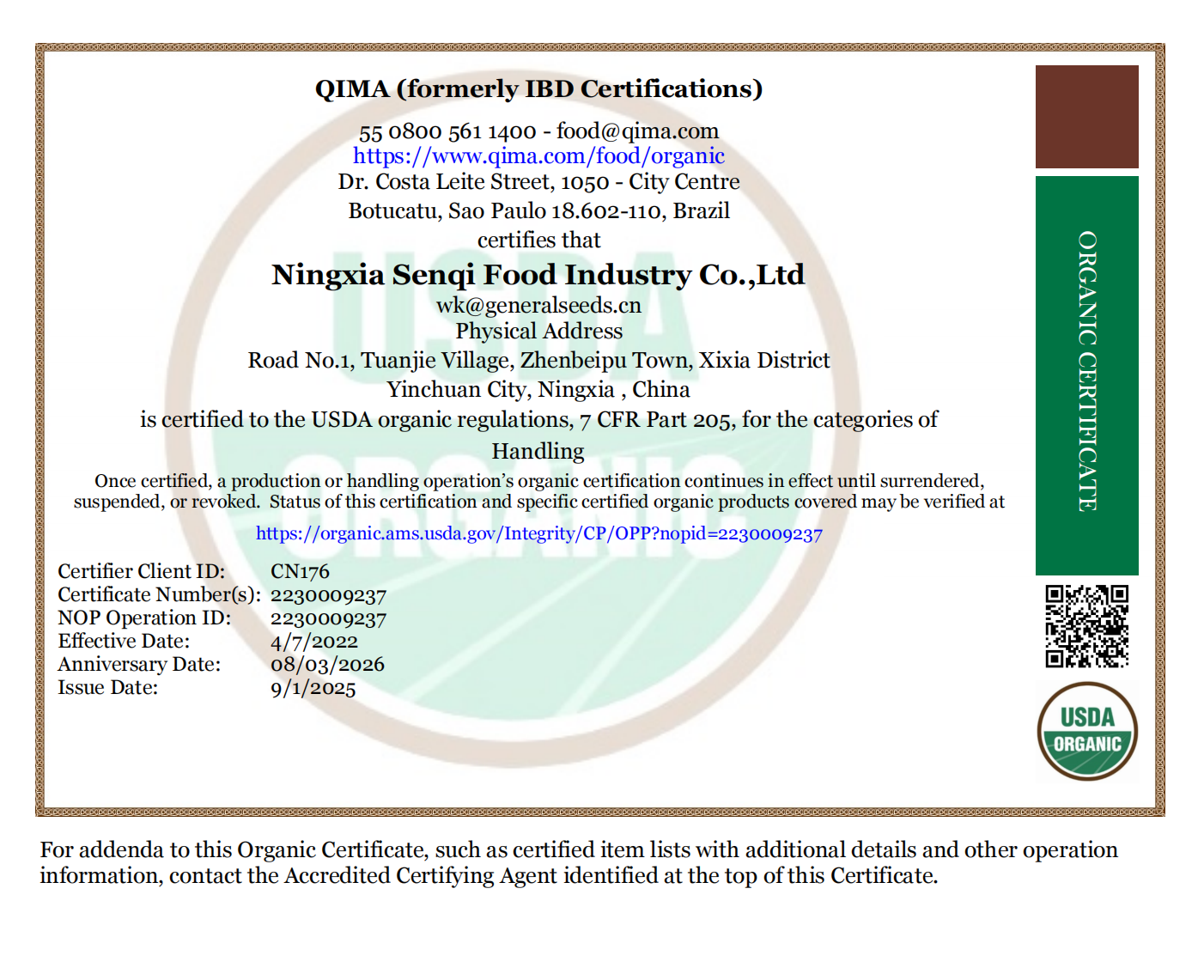
| USDA Organic | 2230009237 | QIMA (formerly IBD Certifications) | NOP | Handling of organic hemp seed related products | USA and global organic-compliant markets |
| BRC | F_EI0610_2025 | Eurofins | BRC Global Standard for Food Safety Issue 9 (August 2022) | Sorting, with or without re-drying, and packing of dry kernels, seeds and other listed dry products in plastic or aluminium bags | Global |
| Kosher | RA44T-STOSC | KOF-K | Jewish Dietary Law (Kashrut) | 16 food products, including hemp seed kernel and hemp seed protein powder (schedule on page 2 of 4) | Global |
| Halal | SSPY-201318-32327-R2 | SSPY | Shariah (Islamic Law) | 12 food products listed on page 2; manufacturer Ningxia Senqi Food Industry Co., Ltd | Global |
EU Organic under Regulation (EU) 2018/848
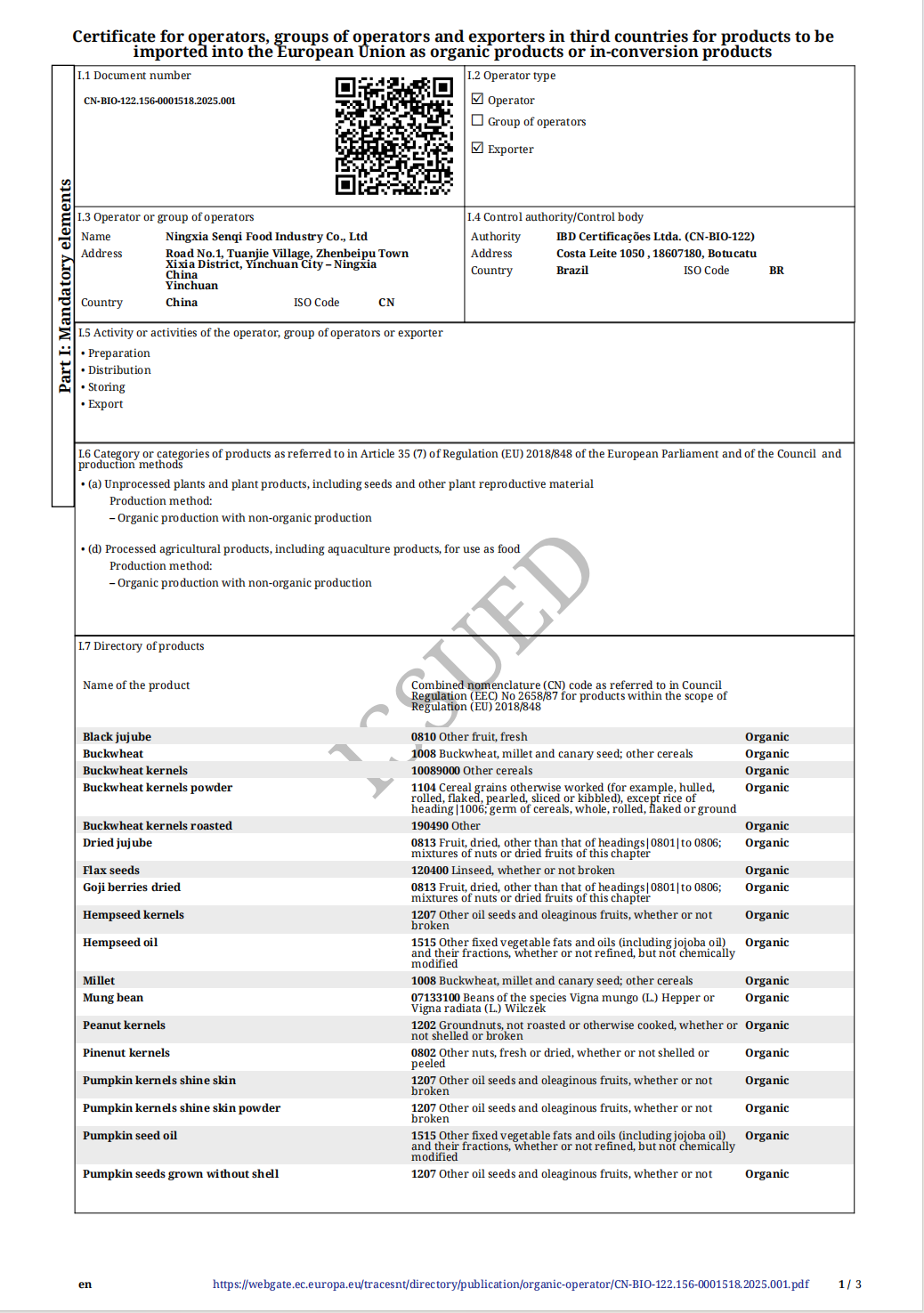
The EU Organic certificate for this range is CN-BIO-122.156-0001518.2025.001, issued by IBD. Its scope statement describes preparation, distribution, storing and export of un-processed and processed organic plant-based agricultural products. Two things follow from that wording. First, the certified activities are post-harvest handling, storage and movement of goods — which is exactly the part of the chain a trader controls, and therefore the part an EU importer is usually relying on. Second, the scope is written at the level of activity categories rather than individual consumer packs, so the buyer's check is whether the hemp seed form being purchased appears in the product documentation attached to that certificate.
The market field for this document is the EU. That is the point of it: it is the document that supports an EU organic claim and an EU organic import file, and its issuing control body is the reference the importer's own organic control body will look for.
USDA Organic NOP
USDA Organic NOP certificate 2230009237 was issued by QIMA (formerly IBD Certifications) on 1 September 2025. The scope is recorded as the handling of organic hemp seed related products, and market applicability is the USA together with global organic-compliant markets. The word “handling” repays careful reading. The scope is written around handling activity for hemp seed related products rather than around cultivation or a single retail specification, so a buyer whose own approval file needs farm-level detail should request that detail separately instead of reading it into this certificate.
For a US-bound buyer, this is the primary organic document. For an EU-bound buyer, it is context, not authority: it shows a parallel organic system is in place, but the EU claim still rests on the 2018/848 certificate.
BRC Global Standard for Food Safety Issue 9
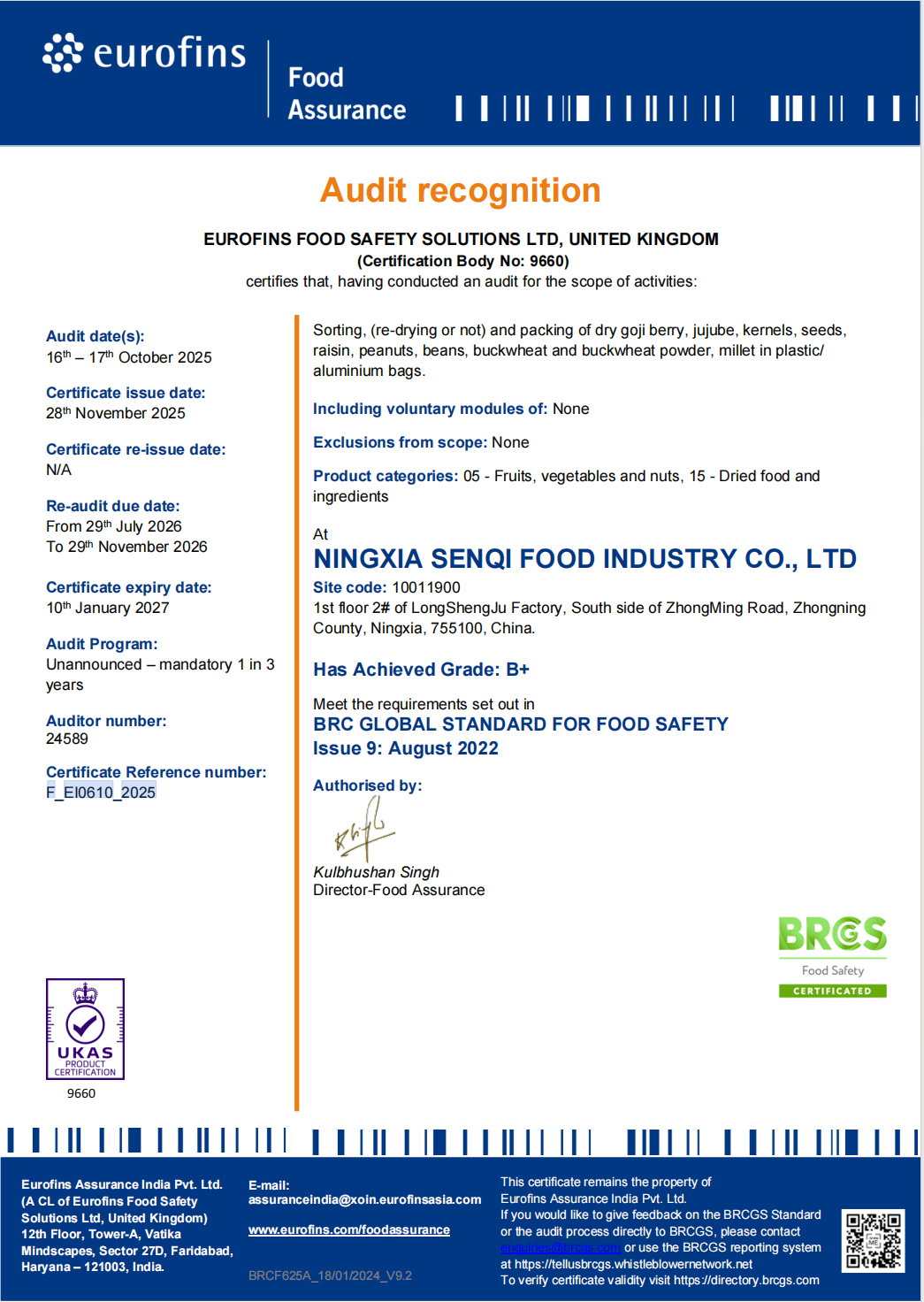
BRC certificate F_EI0610_2025 was issued by Eurofins against the BRC Global Standard for Food Safety Issue 9 (August 2022), with recorded validity from 28 November 2025 to 10 January 2027. The scope covers sorting, with or without re-drying, and packing of dry goji berry, jujube, kernels, seeds, raisin, peanuts, beans, buckwheat, buckwheat powder and millet in plastic or aluminium bags.
Read literally, this document certifies a site's food-safety arrangements for named activities — in this case sorting and packing of dry seeds and similar products. It is the document a retailer or a brand owner's technical team typically asks for during supplier approval, and it is the one that speaks to hygiene, foreign-body control and process discipline. It says nothing about organic status, and it is not a substitute for the EU Organic or NOP certificate. Buyers who need both should hold both, and should check that the activity wording covers the operation their order actually goes through.
Kosher certification
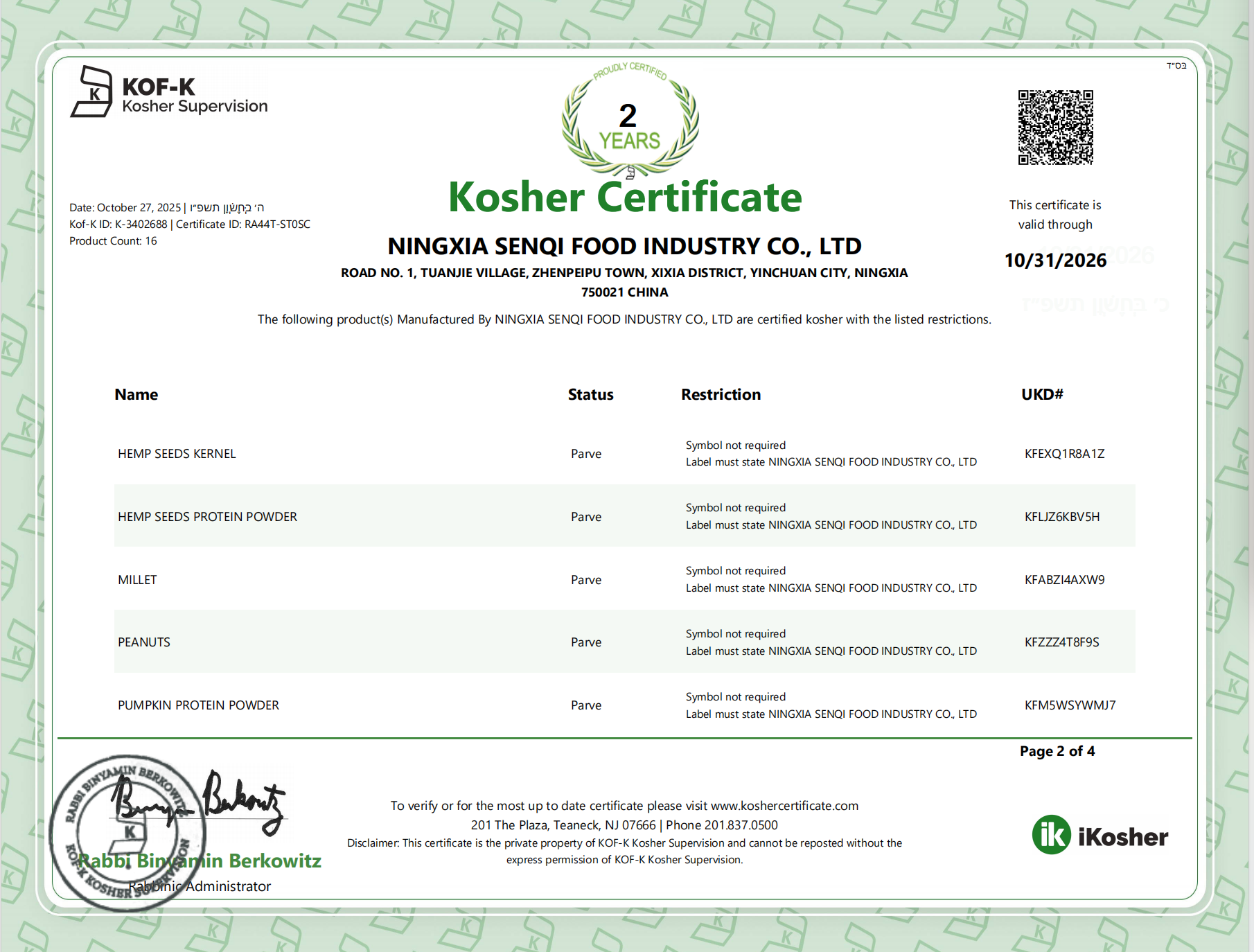
Kosher certificate RA44T-STOSC was issued by KOF-K, with Jewish Dietary Law (Kashrut) as the applicable standard, issued on 27 October 2025 and recorded as valid until 31 October 2026. It covers 16 food products, including hemp seed kernel and hemp seed protein powder, with the product schedule on page 2 of 4. Because the schedule spans 16 items across several product families, the buyer's check is narrow and specific: does the exact SKU — kernel, hulled seed or protein powder — appear on that page, and is the site named on the certificate the site that will produce the order?
Kosher certification applies to global markets in the sense that it is recognised wherever kosher buyers operate; it is a market-segment document, not a geographic one.
Halal certification
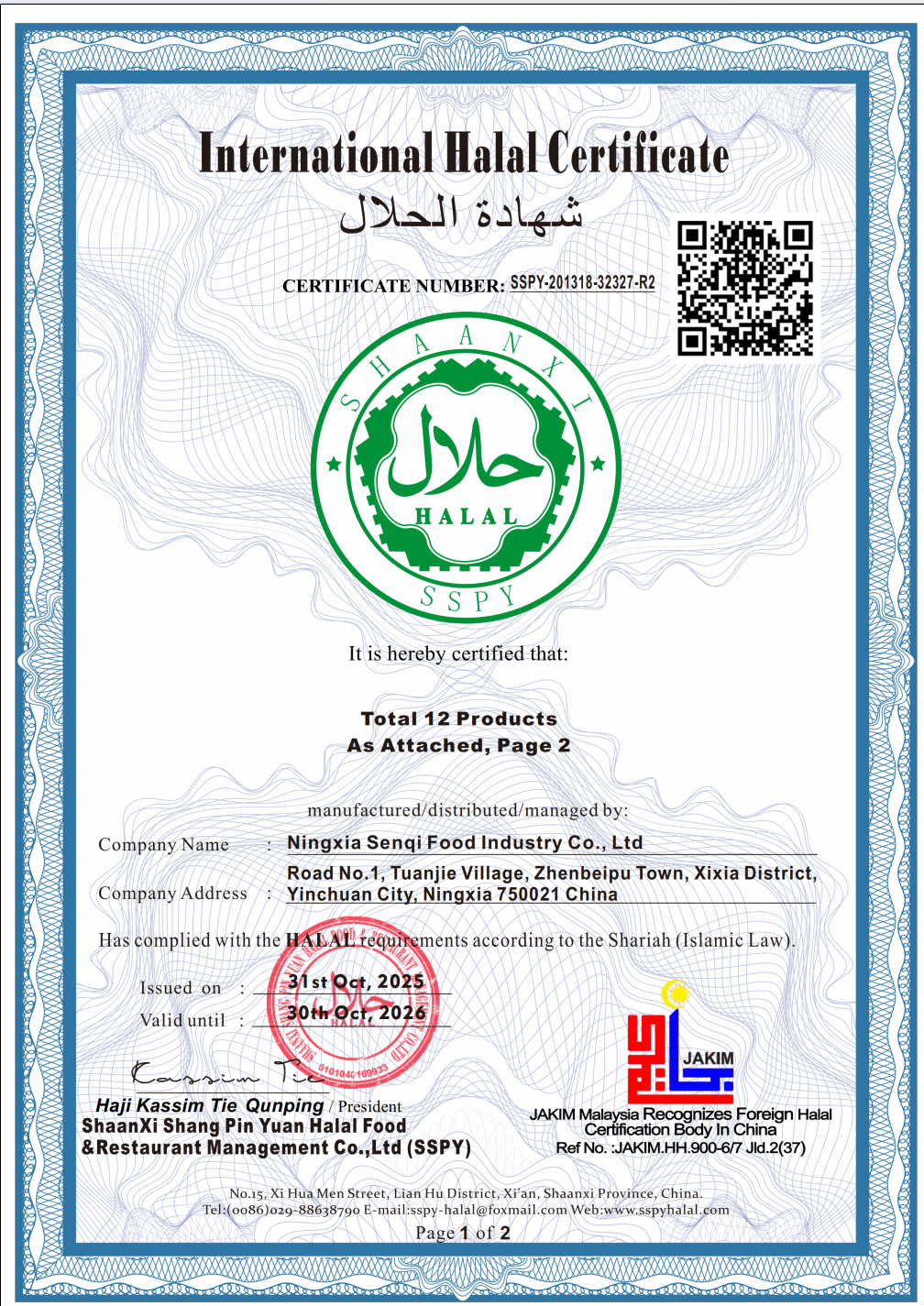
Halal certificate SSPY-201318-32327-R2 was issued by SSPY, with Shariah (Islamic Law) as the applicable standard, issued on 31 October 2025 and valid until 30 October 2026. It covers 12 food products listed on page 2 and names Ningxia Senqi Food Industry Co., Ltd as manufacturer. The manufacturer name is the field to compare with the shipper, the invoice and the pack label; a mismatch there is a documentation problem regardless of how good the product is.
Reading the validity field: the date that decides acceptance
Three of the five documents in this stack carry explicit end dates, and they do not fall on the same day. The Kosher certificate is recorded as valid until 31 October 2026 and the Halal certificate until 30 October 2026. Both of those dates fall before the date of this guide (November 2026). That is not unusual in itself — kosher and halal certificates are normally issued on an annual cycle, and the copies circulating with an old quotation are often the previous cycle's copies — but it does change what a buyer should do next.
The rule is straightforward: compare the end date on the copy you hold with the date the goods will be placed on the market, not with the date you placed the order. If the shipment will be sold, labelled or delivered after that end date, ask for the certificate that supersedes it, and check the new copy the same way — same issuer, same scope wording, same product schedule, new dates. The BRC certificate in this set runs to 10 January 2027, and the USDA NOP certificate was issued on 1 September 2025; both should still be verified against the copies that accompany the specific order rather than against an earlier file.
One further point on dates: a certificate's issue date is also a scope statement in disguise. A document issued before a change in the standard, the site or the product list describes the position at issue, not at shipment. Where a buyer's approval window is long, re-checking on receipt of the shipping documents is cheaper than re-checking at the border.
Market applicability: which document answers which question
The four-field check ends with market fit, and this is where buyers most often over-ask or under-ask. The table below maps the buyer requirement to the document that actually answers it.
| Buyer requirement | Document that answers it | Field to check |
|---|---|---|
| EU organic claim or EU organic import file | EU Organic certificate under Regulation (EU) 2018/848 | Control body (IBD), activity scope, product scope |
| US organic claim | USDA Organic NOP certificate | Certifier (QIMA), handling scope, issue date |
| Retailer or brand technical approval | BRC Food Safety certificate | Standard version (Issue 9), activity scope, validity window |
| Kosher retail, food service or ingredient approval | Kosher certificate | Product schedule page, issuer (KOF-K), end date |
| Halal retail or ingredient approval | Halal certificate | Product schedule, manufacturer name, end date |
| Customs classification (EU/UK) | Commercial description matched to commodity code 12079991 | “Whether or not broken, excluding for sowing” wording |
Seven checks before you accept the shipment
- Confirm the legal entity. The certificate holder should be the manufacturer or the shipper named on your documents. The Halal certificate names Ningxia Senqi Food Industry Co., Ltd directly; compare that name with the invoice, packing list and label.
- Match the product form, not the product family. Organic hemp seed, hulled seed, kernel, protein powder 70% and protein powder 75% are separate formats. A product schedule that lists kernel does not automatically cover a 75% powder, so locate your exact format in the schedule.
- Read the activity scope verbatim. In this set the scopes describe preparation, distribution, storing and export; handling; and sorting with or without re-drying plus packing. If your specification depends on an activity outside that list, ask for it in writing rather than assuming it is included.
- Identify the issuer and keep it consistent. IBD for EU Organic, QIMA (formerly IBD Certifications) for NOP, Eurofins for BRC, KOF-K for Kosher, SSPY for Halal. Where an issuer provides a public verification route, use it on the copy you were sent rather than on a copy forwarded from an earlier deal.
- Check the dates against market entry. Compare each end date with the date the goods will be sold or labelled. Where an end date has already passed — as with the Kosher and Halal copies in this set — request the superseding certificate before the container is released.
- Match the market. Decide which claim you are actually making: an EU organic claim, a US organic claim, a retailer technical approval, or a religious dietary claim. Buy the document that supports that claim, and keep the others as supporting context.
- Cross-check the lot file. Certificates describe systems and scopes; they do not describe the drum in front of you. Pair them with the lot-level analysis, the specification and the label artwork before signing acceptance.
Three buyer situations
If you are an EU importer buying organic hulled hemp seed for retail packs, the governing document is the EU Organic certificate, and your review is scope wording, product listing and validity, followed by the customs description under commodity code 12079991. BRC becomes relevant when your own retail customers ask for site food-safety evidence, which is a different question from organic status.
If you are a US brand buying 70% organic hemp seed protein powder, the governing document is the NOP certificate, and the field to read is the handling scope plus the certifier name. A BRC certificate in the same file supports the site approval side of your supplier questionnaire; it does not convert a non-organic lot into an organic one.
If you are a private-label brand selling into kosher and halal retail channels, both religious certificates need the product schedule check and, in this set, renewal confirmation, because the recorded end dates of 31 October 2026 and 30 October 2026 precede this guide. Religious certification is typically the shortest-dated document in the file, and it is the one most often overlooked at reorder.
Documented supply relationships in this category tend to run on continuity rather than single orders: one wholesale relationship in Australia covers 50–80 mt over 24 months for health food use, with stable batch consistency cited as the highlight. That kind of relationship only holds if the certificate file is refreshed on the same rhythm as the purchase orders.
What certificates do not replace
A certificate file is a claim-support system, not a product specification. Several things sit outside it and still have to be agreed in writing. The product documentation states that the organic hemp seed is non-GMO and free from additives, fillers and artificial preservatives, and that it is gluten-free, vegan and kosher and halal friendly — those are product statements to be confirmed against your specification, not conclusions to be drawn from a certificate number.
Commercial terms sit outside the certificate file as well: OEM/ODM and logo customization, industrial hemp seed supplied hulled or unhulled, dried and unroasted, for food ingredient use or vegetable oil extraction, with THC content below 0.3%, available in bulk or 25 kg woven bags, at a minimum order quantity of 500 kg and a lead time of 10–20 days against a monthly capacity of 200 mt. Quality control is described as third-party laboratory testing, which is the lot-level evidence that complements — but never duplicates — what a certificate says.
Frequently asked questions
EU organic hemp seed suppliers for food imports
For food imports into the EU, an organic hemp seed supplier should be able to show a certificate issued within Regulation (EU) 2018/848, naming a control body, describing the activities in scope and listing the products covered, valid at the time the goods are placed on the market. Senqi Food's EU Organic certificate is CN-BIO-122.156-0001518.2025.001, issued by IBD, with a scope covering preparation, distribution, storing and export of un-processed and processed organic plant-based agricultural products, linked to the organic hemp seed, hulled seed, kernel and 70%/75% protein powder formats. The importer's own file should also contain the import documentation that accompanies the consignment, a lot-level analysis, and — where the buyer's approvals demand it — a food-safety certificate such as BRC.
Does a USDA NOP certificate make hemp seed acceptable for the EU organic market?
No. USDA NOP certification (2230009237, issued by QIMA) supports an organic claim in the USA and in global organic-compliant markets; the EU organic claim is governed by Regulation (EU) 2018/848 and by the separate EU Organic certificate. Holding both documents means the supplier can support both claims; holding only one means only that market is covered.
Why do the Kosher and Halal end dates matter more than the organic dates?
Because religious certificates are usually renewed on an annual cycle and carry a short, explicit validity window. In this set the Kosher certificate runs to 31 October 2026 and the Halal certificate to 30 October 2026, and both dates fall before this guide. A buyer taking delivery after those dates should obtain the superseding certificates and check that the issuer, scope and product schedule are unchanged apart from the dates.
Is BRC a product certification for hemp seed?
No. BRC certificate F_EI0610_2025, issued by Eurofins against Issue 9 (August 2022), covers a site's sorting, re-drying where applicable, and packing of dry kernels, seeds and other listed products in plastic or aluminium bags, valid from 28 November 2025 to 10 January 2027. It is evidence about process control at the site, not about the organic status or the nutritional specification of a particular lot.
What does “handling” mean in the USDA NOP scope statement?
The NOP certificate records its scope as the handling of organic hemp seed related products. That describes handling activity for the product family rather than cultivation or a single retail specification. If your approval file requires farm-level detail or a specific process step, request that evidence separately and in writing instead of reading it into the certificate.
Can a shipment be accepted on certificates alone?
No. Certificates establish scope, issuer, validity and market fit for a system and a product list; they do not establish what is in a specific drum. Acceptance should combine the certificate check with the lot analysis, the agreed specification, the label artwork and the commercial terms. Senqi Food publishes its company and product brochure for download, and sample or quotation requests can be made through Senqi Food — a sample drawn from the production lot is the most direct way to test the documents against the goods.
Conclusion
The five certificates behind organic hemp seed do different jobs, and the buyer's task is not to collect them but to read them. Scope tells you which activities and products are covered. Issuer tells you which control body or certification body stands behind the document. Validity tells you whether it still applies on the date the goods reach the market. Market applicability tells you whether it supports the claim you intend to print.
Applied to this stack: EU Organic (CN-BIO-122.156-0001518.2025.001, IBD) for the EU claim; USDA NOP (2230009237, QIMA) for the US claim; BRC Issue 9 (F_EI0610_2025, Eurofins) for site food-safety approval; Kosher (RA44T-STOSC, KOF-K) and Halal (SSPY-201318-32327-R2, SSPY) for religious dietary channels — with renewal confirmation needed on the two religious certificates, whose recorded end dates of 31 October 2026 and 30 October 2026 precede this guide. Read those four fields on every document, and the acceptance decision becomes a checklist rather than a judgement call.
If you are building or refreshing a supplier file, the Senqi Food brochure collects the company, product range and certification background in one document for internal review.
Have Questions or Need More Details?
Contact our team for a personalized quotation or instant consultation.
Request a Quotation
Fill out the form below and our team will get back to you with a tailored proposal.
WhatsApp Direct Chat
Prefer to chat in real-time? Message us on WhatsApp for instant assistance & quick answers.
- Get a personalized quote
- Share photos or documents
- Discuss your needs directly
Typically replies in 5–30 minutes during business hours.