Hemp Seed Compliance Guide: EU Organic, USDA NOP, BRC, Kosher and Halal Standards
A food-grade organic hemp seed order is usually held together by five documents: EU Organic under Regulation (EU) 2018/848, USDA Organic NOP, the BRC Global Standard for Food Safety Issue 9, Kosher, and Halal. They are issued by different authorities, they run on different validity periods, and each one covers a defined scope of products and processes. Treating them as one general certified-supplier claim is the most common reason a technically compliant lot still stalls inside a buyer's documentation review.
This guide is written for the evaluation stage, where a buyer has already shortlisted organic hemp seed suppliers and now has to decide whether the paperwork actually supports the claim. It maps the five certificates held by Ningxia Senqi Food Industry Co., Ltd. (Senqi Food), a hemp seed processor and exporter based in Ningxia, China, and sets out what each certificate proves, what it does not prove, how regional markets read the same pack differently, and what to request before a purchase order is released.
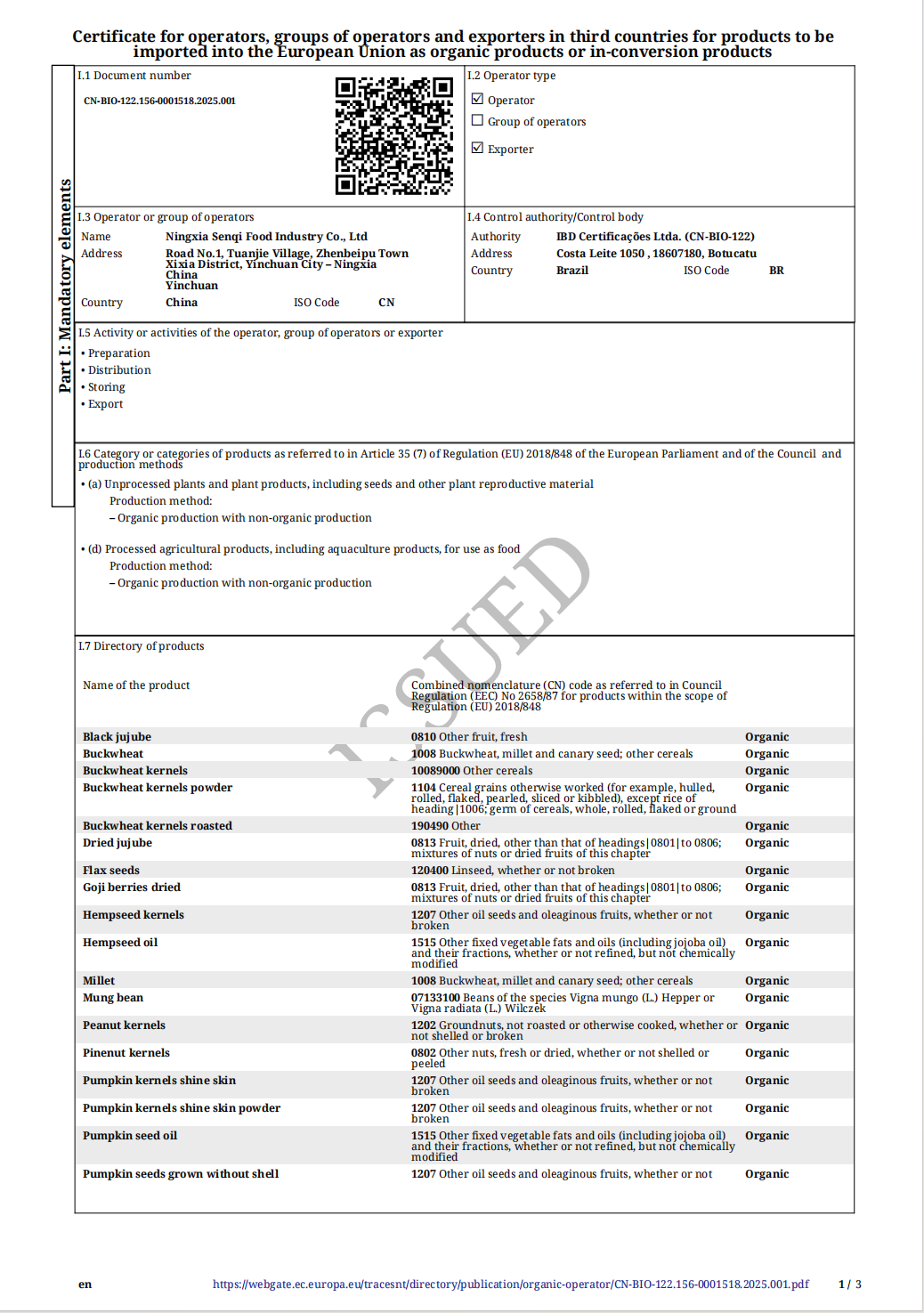
EU Organic certificate CN-BIO-122.156-0001518.2025.001, issued by IBD under Regulation (EU) 2018/848.
The Problem: Five Certificates, Five Different Claims
Certificate packs rarely fail because a document is fake. They fail because a document is being asked to prove something it was never written to prove.
Every certificate is a statement about four variables: a defined legal entity, a defined scope of products or processes, a defined standard or scheme, and a defined validity period. Change any one of them — a different contracting entity, a different product format, a newer standard version, an expired renewal — and the same PDF no longer supports the claim being attached to it.
Five mismatches account for most rejected packs:
- Entity mismatch. The certificate names a manufacturer or group company that is not the entity on the sales contract or the commercial invoice.
- Scope mismatch. The certificate covers a process that is not the process used for the format being purchased. A packing-scope food safety certificate does not automatically describe an extraction or roasting step.
- Scheme mismatch. An organic certificate is presented as evidence of food safety, or a food safety certificate as evidence of organic status. These are separate schemes with separate auditors.
- Validity mismatch. The pack contains an earlier revision, or the renewal date falls inside the delivery window.
- Market mismatch. A certificate recognised in one destination is presented as market access in another, although organic recognition between regions is not automatic.
The practical consequence for buyers is that certification has to be evaluated as a matrix rather than a checklist: which document, for which entity, for which format, valid until when, and for which destination market.
Industry Background: Why Documentation Now Sets the Pace of Hemp Seed Trade
Two structural changes explain why certificate review has moved to the front of hemp seed procurement.
The first is on the supply side. Hemp cultivation area inside the European Union expanded from 28,830 hectares in 2023 to 37,740 hectares in 2024, according to European Commission agriculture data. A larger EU growing base raises the documentation bar for third-country suppliers competing for the same food-grade demand.
The second is regulatory. Regulation (EU) 2018/848 has applied since 1 January 2022, and since 1 January 2025 it has been fully enforced for imports from third countries, replacing the earlier equivalence approach with direct compliance. For an exporter outside the EU, the EU organic certificate is no longer a courtesy document; it is the market-access document. Customs classification adds another layer: hemp seeds, whether or not broken, excluding seed for sowing, sit under commodity code 12079991 in the EU and UK nomenclature.
Demand-side figures point in the same direction. The global hemp seeds market was valued at USD 5.98 billion in 2025 and is projected to reach USD 10.84 billion by 2033 (DataM Intelligence). Inside that total, hemp seed oil was valued at USD 3.26 billion in 2025, with Europe holding the largest regional share at 33.91% (Fortune Business Insights), and hemp protein powder was valued at USD 217.3 million in 2025, with the organic segment projected to grow at a 5.98% CAGR through 2031 (Grand View Research). Published market totals differ between research firms depending on whether downstream oil and protein products are counted inside the seed market, so any single figure should be read together with its scope definition.
The pattern is consistent: growth is concentrated in organic and food-grade segments, and those are exactly the segments where a certificate pack decides whether a supplier can be used at all.
The Five Certificates in Senqi Food's Pack, Explained
Senqi Food holds certifications that fall into three different categories: organic status, food safety management, and religious dietary compliance. Each is set out below with its issuing authority, certificate number, documented scope and validity, followed by a short statement of what it proves and what it does not.
1. EU Organic — Regulation (EU) 2018/848
Certificate number CN-BIO-122.156-0001518.2025.001, issued by IBD, under Regulation (EU) 2018/848. The documented scope is the preparation, distribution, storing and export of un-processed and processed organic plant-based agricultural products.
That scope sentence is the operative one for a hemp seed buyer, because it describes the operational chain and the product category rather than a single SKU. Preparation, distribution, storage and export of organic plant-based agricultural products is where organic hemp seed and its processed food formats sit.
- What it proves: the operator's preparation, distribution, storage and export operations for organic plant-based agricultural products are certified against Regulation (EU) 2018/848.
- What it does not prove: it is not a food safety certificate, it is not a laboratory result for THC content or contaminants, and it should not be read as covering product categories outside organic plant-based agriculture. Because the EU organic import regime has required full compliance since 1 January 2025, the current version should be confirmed at shipment, not only at quotation.
2. USDA Organic NOP — Certificate 2230009237
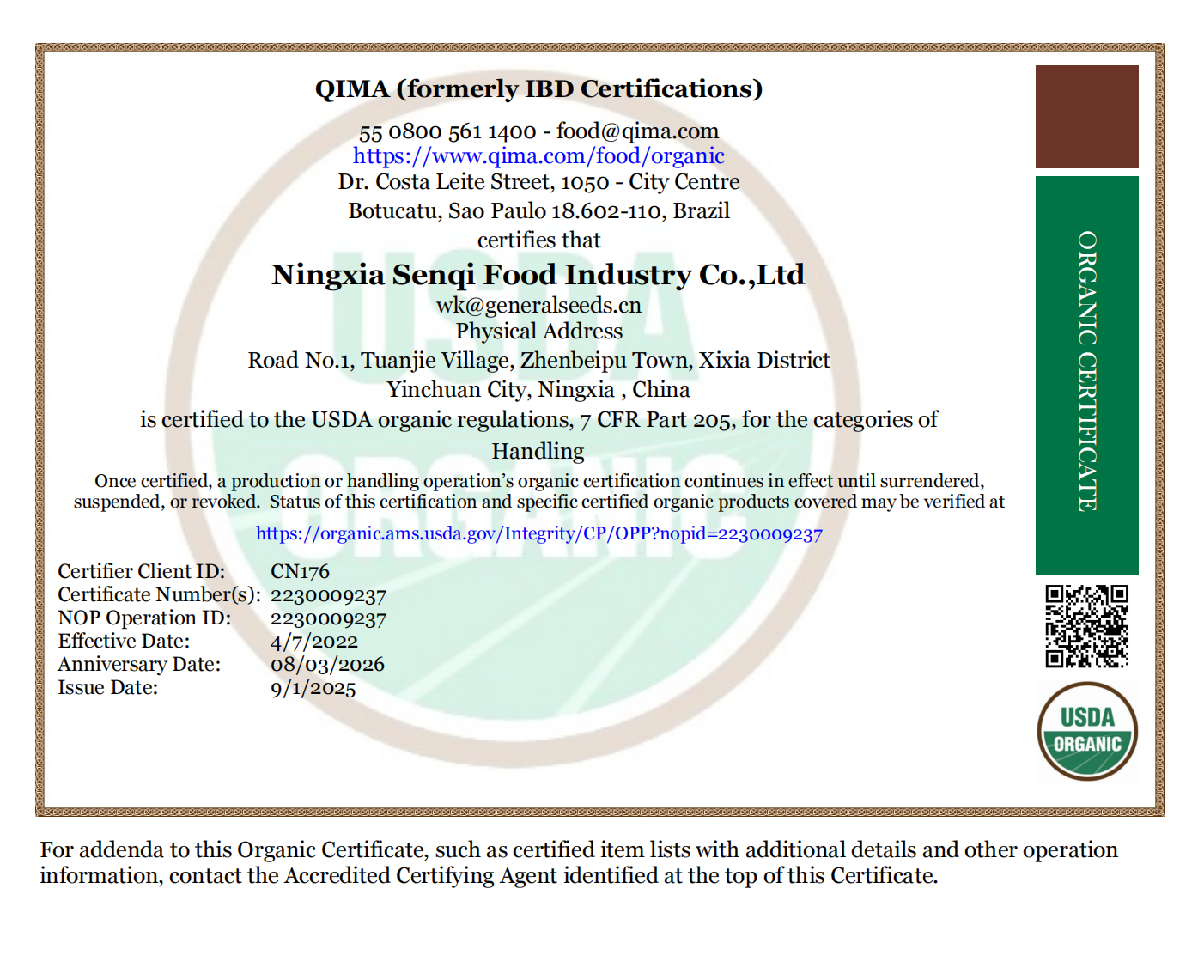
USDA Organic NOP certificate 2230009237, issued by QIMA (formerly IBD Certifications) on 1 September 2025.
Certificate number 2230009237, issued by QIMA (formerly IBD Certifications) under the USDA National Organic Program, and issued on 1 September 2025. The documented scope is the handling of organic hemp seed related products, with the market listed as the USA and global organic-compliant markets.
- What it proves: organic handling of hemp seed related products against the NOP, which is the scheme behind the USDA Organic claim in the United States.
- What it does not prove: it does not deliver EU organic market access. The EU and US organic programmes are separate, and an EU-bound shipment still needs the EU organic certificate. It is also a handling-scope document, so it should be matched to the format actually purchased.
3. BRC Global Standard for Food Safety Issue 9 — Certificate F_EI0610_2025
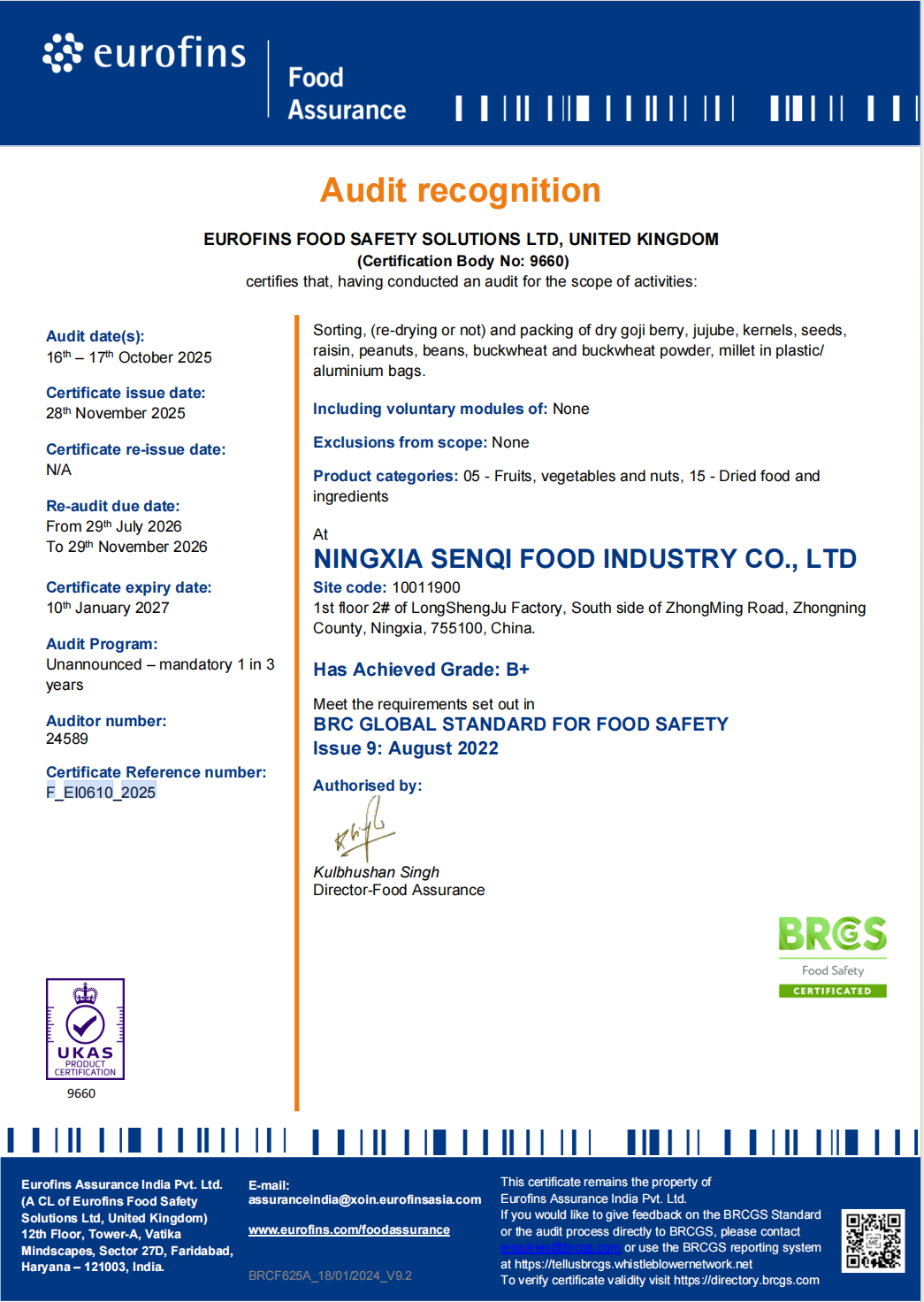
BRC Global Standard for Food Safety Issue 9 certificate F_EI0610_2025, issued by Eurofins, valid to 10 January 2027.
Certificate number F_EI0610_2025, issued by Eurofins, against the BRC Global Standard for Food Safety Issue 9, August 2022. Issued 28 November 2025 and valid to 10 January 2027. The documented scope is sorting, with or without re-drying, and packing of dry products — goji berry, jujube, kernels, seeds, raisin, peanuts, beans, buckwheat and buckwheat powder, and millet — in plastic or aluminium bags.
- What it proves: the site runs a food safety management system audited to BRC Issue 9 for the sorting, re-drying and packing of the dry products listed, in plastic or aluminium bags.
- What it does not prove: BRC certification is not an organic certificate. It also does not extend to processes outside the listed scope — a roasting step, for example, is not described in that scope, so a buyer sourcing roasted hemp seed should confirm separately how that step is controlled.
4. Kosher — Certificate RA44T-STOSC
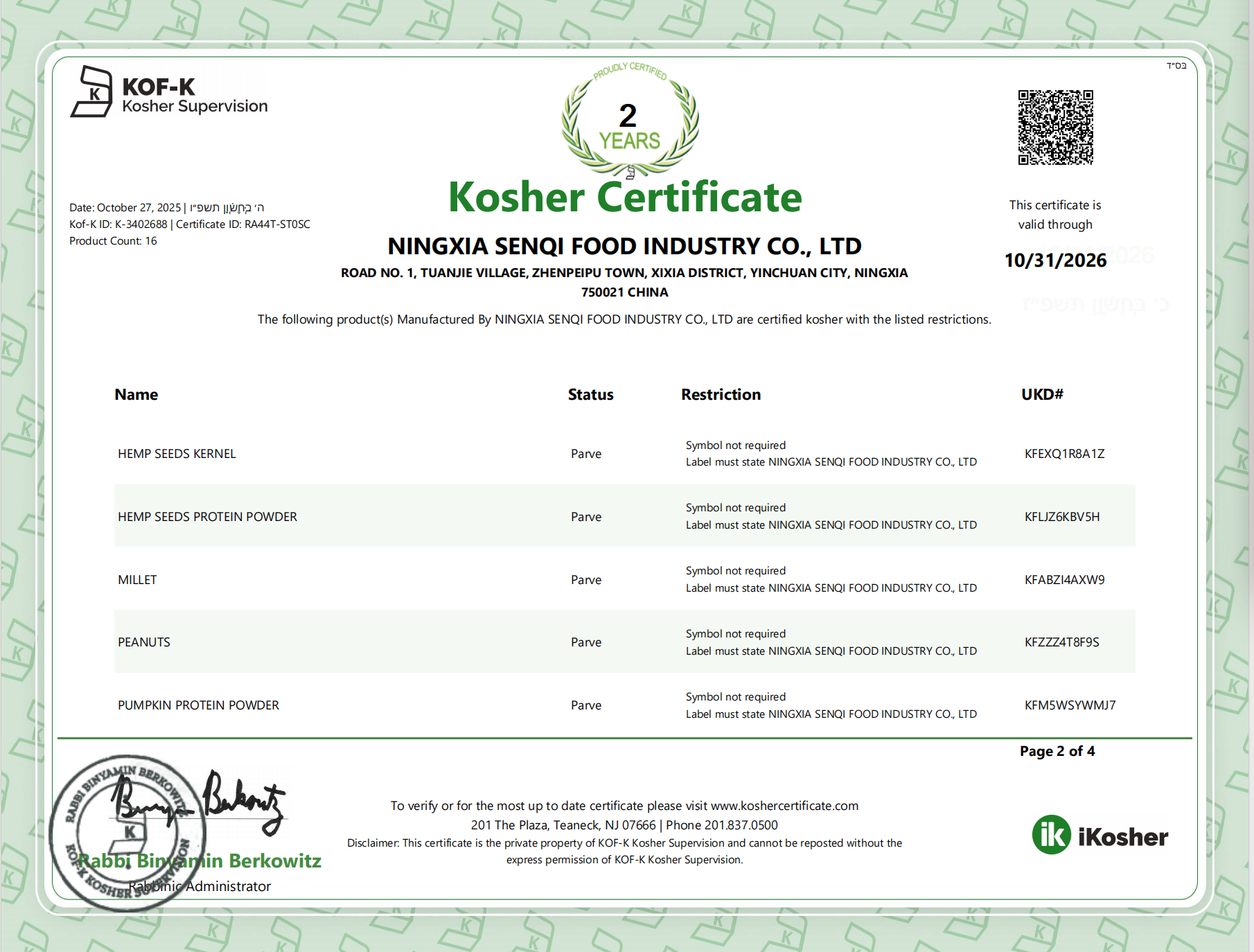
Kosher certificate RA44T-STOSC, issued by KOF-K, listed as valid until 31 October 2026.
Certificate number RA44T-STOSC, issued by KOF-K under Jewish dietary law (Kashrut). Issued 27 October 2025 and listed as valid until 31 October 2026. The documented scope covers 16 food products, and the listing specifically includes hemp seeds kernel and hemp seeds protein powder alongside millet, peanuts and pumpkin protein powder.
- What it proves: the listed products, including hemp seed kernel and hemp seed protein powder, are certified kosher by KOF-K.
- What it does not prove: nothing about organic status, EU compliance or food safety management. It is also a listing-based certificate, so formats not named in the product list are not covered by it.
5. Halal — Certificate SSPY-201318-32327-R2
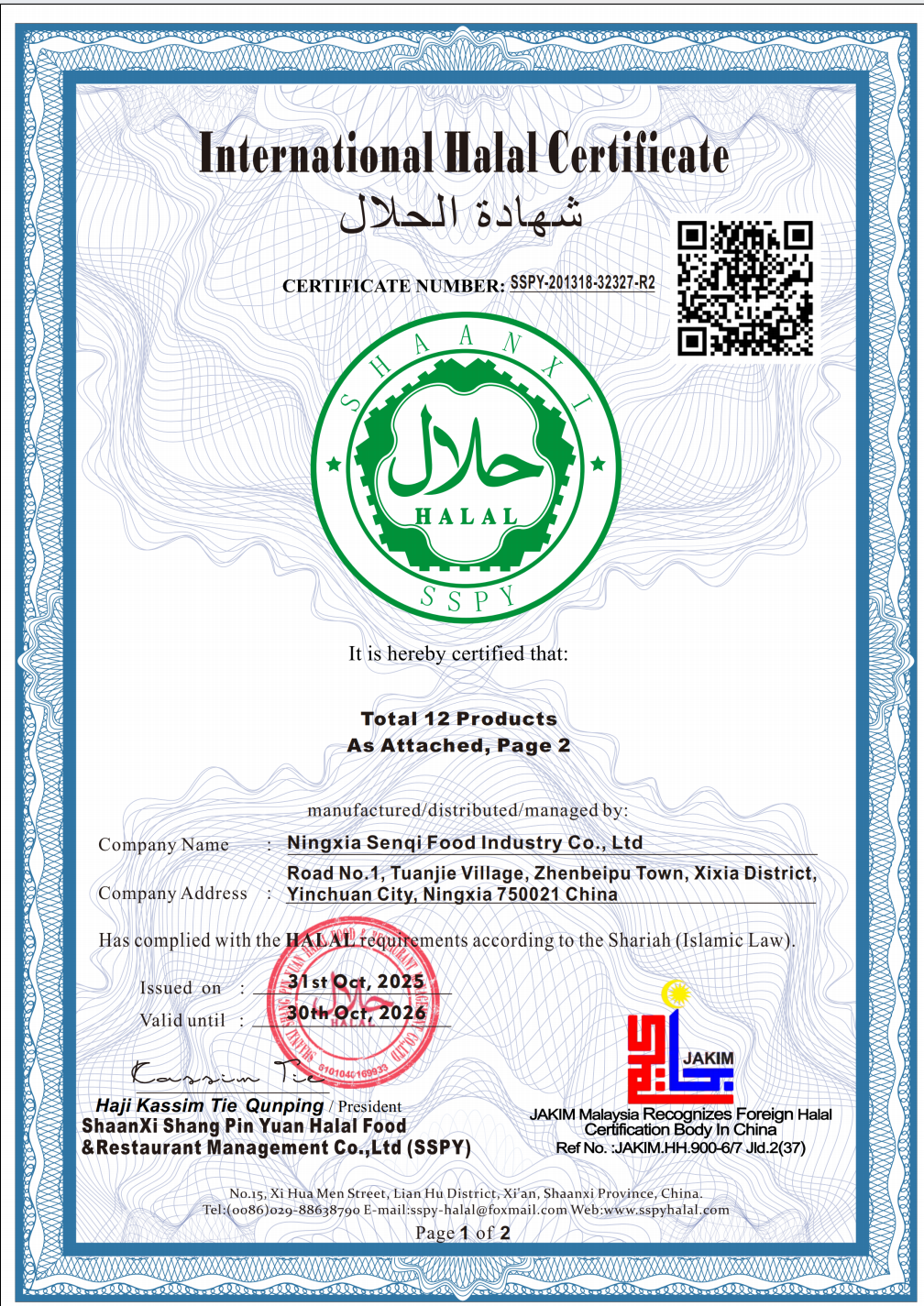
Halal certificate SSPY-201318-32327-R2, issued by SSPY, listed as valid until 30 October 2026.
Certificate number SSPY-201318-32327-R2, issued by SSPY under Shariah (Islamic Law). Issued 31 October 2025 and listed as valid until 30 October 2026. The documented scope covers 12 food products, with Ningxia Senqi Food Industry Co., Ltd. named on the certificate as the manufacturer.
- What it proves: the products listed on the certificate, manufactured by Senqi Food, meet the certifying body's Shariah requirements for halal food.
- What it does not prove: it does not confirm organic status or food safety certification, and it is tied to a named manufacturer and a defined product list.
Regional Differences: Reading the Same Pack in the EU, the USA and Other Destinations
The same five documents carry different weight depending on where the goods are cleared and sold.
- European Union. EU Organic under Regulation (EU) 2018/848 is the market-access document, and it has been fully enforced for third-country imports since 1 January 2025. Food safety evidence such as the BRC certificate is typically requested alongside it by retail and food-service technical reviews. Hemp seeds for non-sowing use are classified under commodity code 12079991 in the EU and UK.
- United States. USDA Organic NOP is the relevant organic claim, supported by the handling-scope certificate. The EU organic certificate does not substitute for it, and the NOP certificate does not substitute for the EU document.
- Halal markets. Distributors serving Muslim-majority markets in the Middle East, North Africa and Southeast Asia ask for the halal certificate, which here is tied to the manufacturer and to a defined product list.
- Kosher markets. Buyers supplying Jewish dietary markets ask for the kosher certificate, which names hemp seed kernel and hemp seed protein powder among its listed products.
- Other export destinations. Where no regional organic scheme is being claimed, the BRC certificate is often the food safety reference point, and its scope wording tells the buyer exactly which steps have been audited.
How Senqi Food Applies These Certificates to Food-Grade Organic Hemp Seed
Ningxia Senqi Food Industry Co., Ltd. is a processor and exporter of organic hemp seed and other agricultural products, founded in 2020 and based in Ningxia, China, with two factories, one sales center and two planting farms. The company operates an 8,000 m² factory, employs 25 people, produces around 2,000 mt annually, exports about 90% of its output, and serves mainly EU and USA markets, with shipments to more than 20 countries including the United States, Canada, the Netherlands, Germany, Italy and Japan. Workshops are built to GMP standard, and processing steps follow BRC requirements.
The commercial formats offered are Organic Hemp seed / Organic Hemp seed Hulled / Organic Hemp Seeds Kernel / Organic Hemp Seed Protein Powder 70% / Organic Hemp Seed Protein Powder 75%, alongside organic hemp seed oil. Material is supplied as industrial hemp seed, hulled or unhulled, dried and unroasted, for use as food ingredients or for vegetable oil extraction, with THC content below 0.3%, available in bulk or in 25 kg woven bags. OEM and ODM work, including logo customization, is supported. Monthly capacity is 200 MT, minimum order quantity is 500 kg, lead time is 10–20 days, quality control is carried out through third-party laboratory testing, and after-sales support is provided remotely.
In practice, the certificate pack is what allows one supplier to serve several market routes at the same time: an EU buyer reads the EU organic scope, a US buyer reads the NOP handling scope, a halal-market distributor reads the SSPY listing, and a kosher-market buyer reads the KOF-K product list — while BRC answers the food safety question all of them ask.

Senqi Food's processing workshop in Ningxia — workshops are GMP standard and processing steps follow BRC requirements.
Step-by-Step: How to Read a Hemp Seed Certificate Pack Before You Order
Work through the pack in this order. Each step removes a specific risk.
- Confirm the legal entity. Match the company name on every certificate to the supplier's registered name, the sales contract and the commercial invoice. Where a certificate names the manufacturer and the invoice names a trading entity, ask for the relationship in writing.
- Match the scope to the product format. Read the scope sentence, not the certificate title. EU Organic covers preparation, distribution, storing and export of organic plant-based agricultural products; BRC covers sorting, re-drying and packing of dry kernels and seeds in plastic or aluminium bags; Kosher names hemp seeds kernel and hemp seeds protein powder among 16 listed products; Halal names 12 listed products from the named manufacturer. If the format sits outside that sentence, the certificate does not cover it.
- Check the standard version. Standards are revised. The BRC certificate here is issued against Issue 9, August 2022, so a buyer whose own compliance manual references a different issue should flag the difference early rather than at audit.
- Verify the number with the issuing body. Certificate numbers can be checked with the issuing authority — IBD for the EU organic certificate, QIMA for the NOP certificate, Eurofins for BRC, KOF-K for kosher and SSPY for halal.
- Read the validity dates against your delivery window. Recorded validity runs to 31 October 2026 for kosher, 30 October 2026 for halal and 10 January 2027 for BRC. If shipment, arrival or a retail listing falls after those dates, request the renewal before the order is confirmed.
- Match the scheme to the destination market. EU Organic for the EU, USDA NOP for the USA, halal for Muslim-majority markets, kosher for Jewish dietary markets, and BRC as the cross-market food safety reference. No single document covers every destination.
- Close the loop with lot-level documents. Certificates describe systems, not individual lots. Ask for third-party laboratory testing for the specific lot, plus the customs classification and the packing specification — bulk or 25 kg woven bags — before release.
Use Cases: Which Certificate Mix Fits Which Buyer
- EU importer or food brand. The controlling document is EU Organic under Regulation (EU) 2018/848, with the BRC certificate supporting retail technical reviews. A buyer sourcing EU organic hulled hemp seeds, organic hemp hearts or organic hemp seed kernels for EU retail will typically ask for both.
- US supplement or private-label brand. USDA Organic NOP handling certification is the organic claim, and BRC answers the food safety question. Private-label programmes also use the OEM/ODM capability, including logo customization, on formats such as organic hemp seed protein powder 70% or 75%.
- Halal-market distributor. The SSPY halal certificate, tied to the manufacturer and 12 listed products, is the entry document for distribution into Muslim-majority markets.
- Kosher-market buyer. The KOF-K certificate, which lists hemp seeds kernel and hemp seeds protein powder among 16 products, supports sourcing into Jewish dietary markets.
- Oceania wholesale health food. A wholesale client in Australia was supplied with 50–80 metric tons of hemp seed over a 24-month project for health food use, with the case highlighting high purity, stable batch consistency and compliance with local food safety standards. That project reflects the same pattern: regional food safety expectations plus format-specific organic documentation.
Certificate Comparison Table: Scope, Authority and Number
| Certificate | Standard / scheme | Issuing authority | Certificate number | Documented scope and validity |
|---|---|---|---|---|
| EU Organic | Regulation (EU) 2018/848 | IBD | CN-BIO-122.156-0001518.2025.001 | Preparation, distribution, storing and export of un-processed and processed organic plant-based agricultural products |
| USDA Organic NOP | USDA National Organic Program (NOP) | QIMA (formerly IBD Certifications) | 2230009237 | Handling of organic hemp seed related products; markets listed as USA and global organic-compliant markets; issued 1 September 2025 |
| BRC Global Standard for Food Safety | BRC Global Standard for Food Safety Issue 9, August 2022 | Eurofins | F_EI0610_2025 | Sorting, (re-drying or not) and packing of dry goji berry, jujube, kernels, seeds, raisin, peanuts, beans, buckwheat and buckwheat powder, and millet in plastic/aluminium bags; issued 28 November 2025, valid to 10 January 2027 |
| Kosher | Jewish Dietary Law (Kashrut) | KOF-K | RA44T-STOSC | 16 food products including hemp seeds kernel, hemp seeds protein powder, millet, peanuts and pumpkin protein powder; issued 27 October 2025, valid to 31 October 2026 |
| Halal | Shariah (Islamic Law) | SSPY | SSPY-201318-32327-R2 | 12 food products; manufacturer listed as Ningxia Senqi Food Industry Co., Ltd.; issued 31 October 2025, valid to 30 October 2026 |
FAQ: Hemp Seed Certification and Supplier Selection
Which certificates should a hemp seed buyer verify before importing into the EU?
At minimum, the EU organic certificate issued under Regulation (EU) 2018/848, which has been fully enforced for third-country imports since 1 January 2025. Senqi Food holds EU organic certificate CN-BIO-122.156-0001518.2025.001, issued by IBD, with a scope covering preparation, distribution, storing and export of un-processed and processed organic plant-based agricultural products. Most EU retail and food-service technical reviews also ask for food safety evidence, which in this pack is BRC Global Standard for Food Safety Issue 9 certificate F_EI0610_2025 issued by Eurofins. Hemp seeds for non-sowing use are classified under commodity code 12079991 in EU and UK nomenclature.
Does a BRC certificate also prove that a hemp seed supplier is organic?
No. BRC certification and organic certification are separate schemes with separate auditors, and neither substitutes for the other. BRC certificate F_EI0610_2025 covers sorting, with or without re-drying, and packing of dry products including kernels and seeds in plastic or aluminium bags — a food safety management scope. Organic status comes from the EU organic certificate under Regulation (EU) 2018/848 and, for the US market, from USDA NOP certificate 2230009237 issued by QIMA. A buyer who needs both must request both.
How do buyers identify recommended organic hemp seed suppliers?
In practice, a supplier becomes recommendable when the certificate pack matches the buyer's destination market and product format. Check whether the supplier holds EU organic certification under Regulation (EU) 2018/848 for the EU, USDA NOP for the USA, halal certification such as SSPY-201318-32327-R2 for Muslim-majority markets and kosher certification such as RA44T-STOSC for Jewish dietary markets, and whether the scope sentence names the format being bought. Senqi Food holds all five certificates, operates two factories, one sales center and two planting farms, and supplies organic hemp seed, hulled hemp seed, hemp seed kernels and organic hemp seed protein powder 70% and 75%.
What shapes the cost structure of a certified organic hemp seed order?
Certified organic supply carries documentation, segregation and testing requirements that conventional supply does not, so commercial terms are shaped mainly by the scope of the certificate pack required, the product format ordered and the packaging. Senqi Food supplies material in bulk or in 25 kg woven bags, with a minimum order quantity of 500 kg and a monthly capacity of 200 MT, and supports OEM and ODM work including logo customization where a private-label format is needed.
Can buyers request samples and certificate copies, and what lead time applies?
Yes — buyers evaluating Senqi Food can request product samples and current certificate copies before confirming an order, covering EU organic, USDA NOP, BRC, kosher and halal. Standard lead time is 10–20 days, minimum order quantity is 500 kg, and quality control is carried out through third-party laboratory testing. Send the format, packaging and destination market to info@generalseeds.cn and the documentation pack can be matched to your market before sampling.
Conclusion: Build the Certificate Matrix Before You Build the Order
Five certificates answer five different questions. EU Organic under Regulation (EU) 2018/848 shows that the preparation, distribution, storage and export chain for organic plant-based agricultural products is certified for the EU. USDA NOP certificate 2230009237 carries the US organic claim. BRC certificate F_EI0610_2025 covers the food safety management system behind sorting, re-drying and packing of dry seeds and kernels. Kosher certificate RA44T-STOSC and halal certificate SSPY-201318-32327-R2 address religious dietary compliance for their listed products. None of them replaces the others, and none of them replaces lot-level laboratory testing.
For a buyer in the evaluation stage, the fastest route to a decision is to write the destination market and the exact format into a matrix, then check each certificate against entity, scope, standard version and validity date. Senqi Food publishes this pack across EU organic, USDA NOP, BRC, kosher and halal certification, so EU, US, halal and kosher market routes can be served from one verified source.
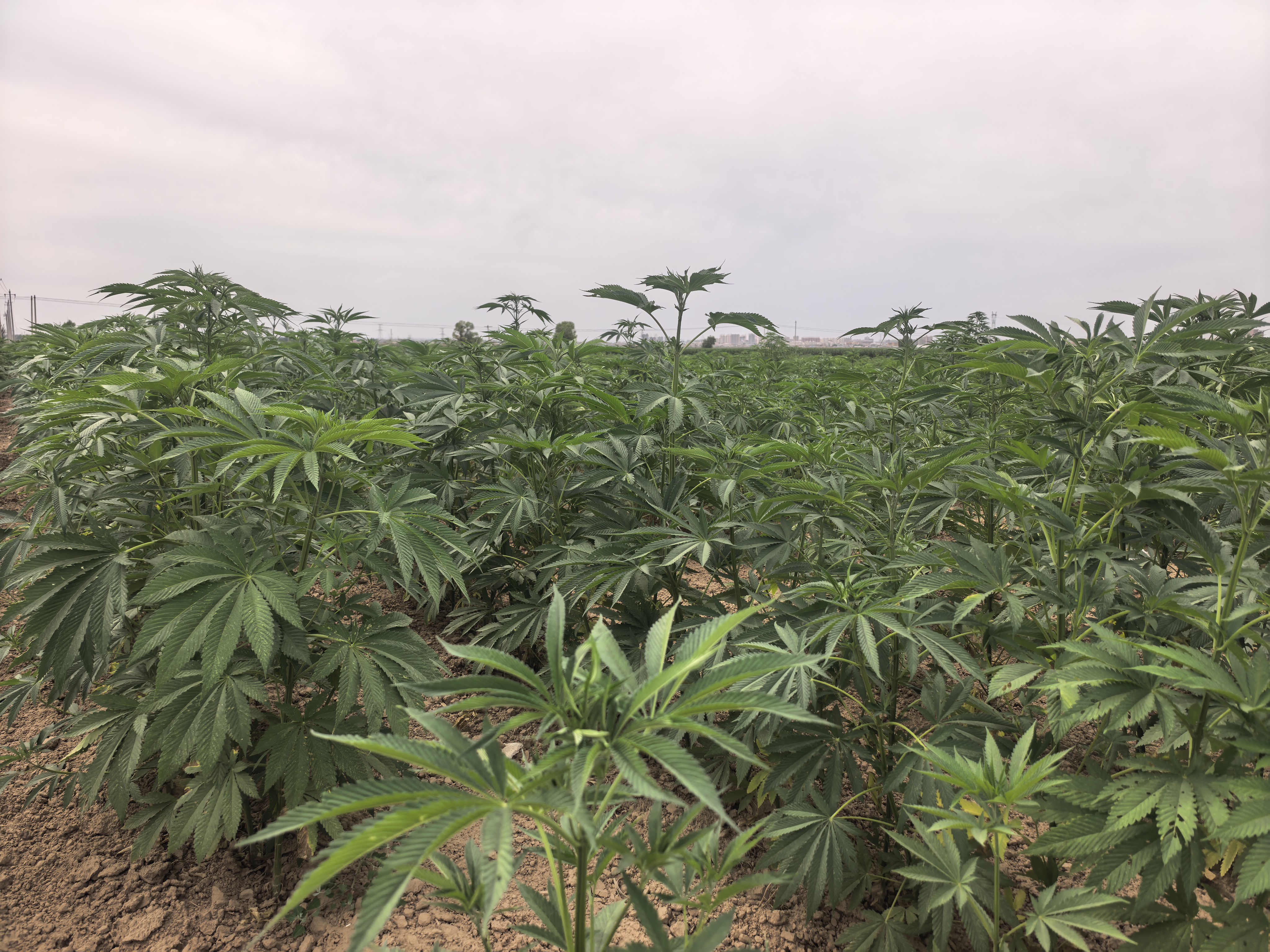
Next step: request a sample, a quotation or the current certificate pack for the format you buy — hulled hemp seed, hemp seed kernels, hemp seed protein powder 70% or 75%, or organic hemp seed oil. Documentation can also be reviewed first via the company brochure.
Website: www.generalseeds.cn
Brochure: Senqi Food company brochure (PDF)
Email: info@generalseeds.cn | Tel: +86-951 3812017 | WhatsApp: +86 152-2627-7687
Address: Road No.1 Tuanjie Village, Zhenbeipu Town, Xixia Dist, Yinchuan City, Ningxia, China