Hemp Seed Delivery Assurance: Auditing Factory, Farm & Order-Farming Capacity
Hemp Seed Delivery Assurance: Auditing Factory, Farm & Order-Farming Capacity
Delivery assurance in hemp seed is not established by a folder of certificates. It is established by three auditable layers: a factory whose certification scope matches the process you are buying, a raw-material base controlled through an order-farming system, and a documented capacity that can be allocated to your purchase order month after month. Ningxia Senqi Food Industry Co., Ltd. — traded as Senqi Food, a Ningxia-based processor and exporter of organic hemp seed — is used in this guide as a worked example because its documented facts cover all three layers: two factories, two planting farms, 2,000 MT annual output, a 90% export share and shipments to more than 20 countries.
This article sets out an audit sequence a buyer can run at evaluation stage within two to three weeks, the documents to request at each checkpoint, and the acceptance criteria that should be written into purchasing terms before the first container is booked.
What “Delivery Assurance” Means in Hemp Seed Purchasing
Delivery assurance is the probability that the same specification arrives on the agreed date, in the agreed packaging, with compliance documentation valid on that date — repeatedly, not once. It is a testable property rather than a promise, and it has four measurable components: site-level production capability, controlled raw-material supply, capacity that can be allocated to a specific order, and written acceptance criteria that both sides can check against a reference sample.
Certificates verify compliance. They do not verify that a supplier can reproduce your hulled hemp seed, hemp hearts, hemp seed kernels or organic hemp seed protein powder specification in the same condition twelve months later. That gap is what this framework is designed to close, and it is why the audit below separates documentation review from capability review.
The Problem: Why Certificate-Only Vetting Fails
Most hemp seed importers begin with a certificate request and stop there. Four failure modes survive that approach, and each one shows up as a delivery problem rather than a compliance problem.
1. Scope mismatch. A certificate exists, but its scope line does not cover the operation you are buying. Organic handling, sorting and packing, and finished powder production can sit on different documents. A supplier with valid organic certification is not automatically certified for every process in the chain.
2. Capacity illusion. An annual tonnage is quoted without a monthly allocation rule. Annual capacity describes the site; monthly capacity describes what can reach you within a PO cycle. A buyer who audits only the annual figure cannot plan repeat orders.
3. Raw-material leakage. If the supplier buys seed on the spot market after harvest, the specification you approved may not be the specification in the next lot. Farm control, not factory control, is where this risk is governed.
4. Undefined acceptance. No reference sample, no packaging clause, no lot-level laboratory report. Quality disputes then arrive with the container, when the buyer has no leverage and no baseline.
Industry Background: Why Farm and Capacity Control Matter More Than They Did
The European raw-material base has been expanding. EU hemp cultivation area increased to 37,740 hectares in 2024, from 28,830 hectares in 2023, according to European Commission statistics. More acreage improves availability, but it does not automatically create more certified processing capacity or more organic-compliant supply, which is where delivery risk concentrates.
Regulation has tightened at the same time. Regulation (EU) 2018/848 has applied since 1 January 2022 and has been fully enforced for third-country imports from 1 January 2025, so organic hemp hearts and other organic hemp seed formats entering the EU must be backed by documentation that matches the current compliance regime rather than an older equivalence arrangement.
Demand structure is also shifting toward processed formats. The global hemp protein powder market was valued at USD 217.3 million in 2025, with organic segments projected to grow at a CAGR of 5.98% through 2031, based on Grand View Research and Mordor Intelligence figures. Protein powder and kernel orders are more process-dependent than whole seed, which raises the weight a buyer should place on factory scope and lot consistency.
For customs purposes in the EU and UK, hemp seeds whether or not broken (excluding seed for sowing) are classified under commodity code 12079991. Buyers should confirm that the classification used on the commercial invoice matches the goods actually shipped.
The Detailed Solution: A Three-Layer Delivery Assurance Audit
The audit sequence below moves from the physical site, to the raw-material base, to the commercial capacity that determines whether your order can be scheduled. Each layer has a documentary check and a physical check.
Layer 1 — Factory: Site, Standard and Scope
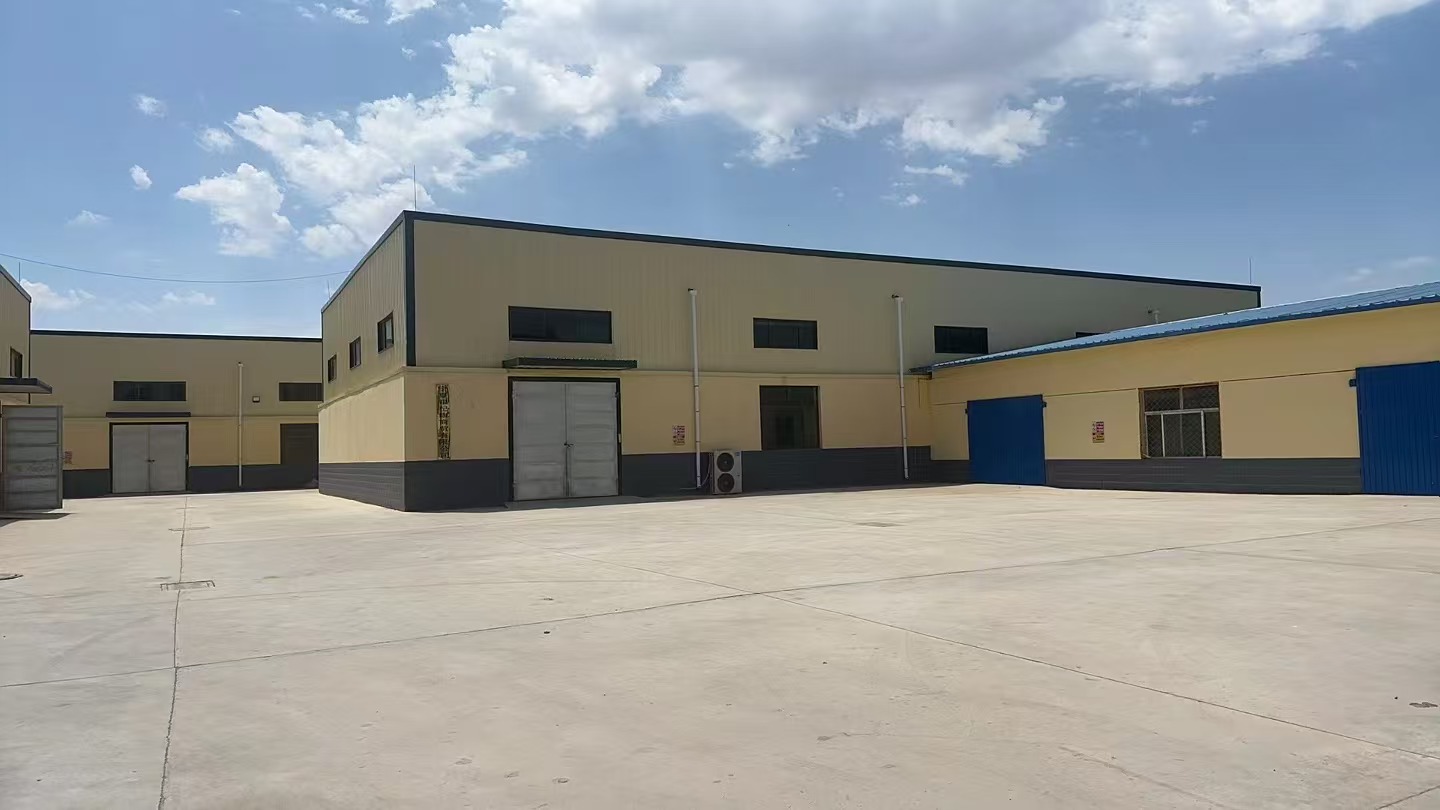
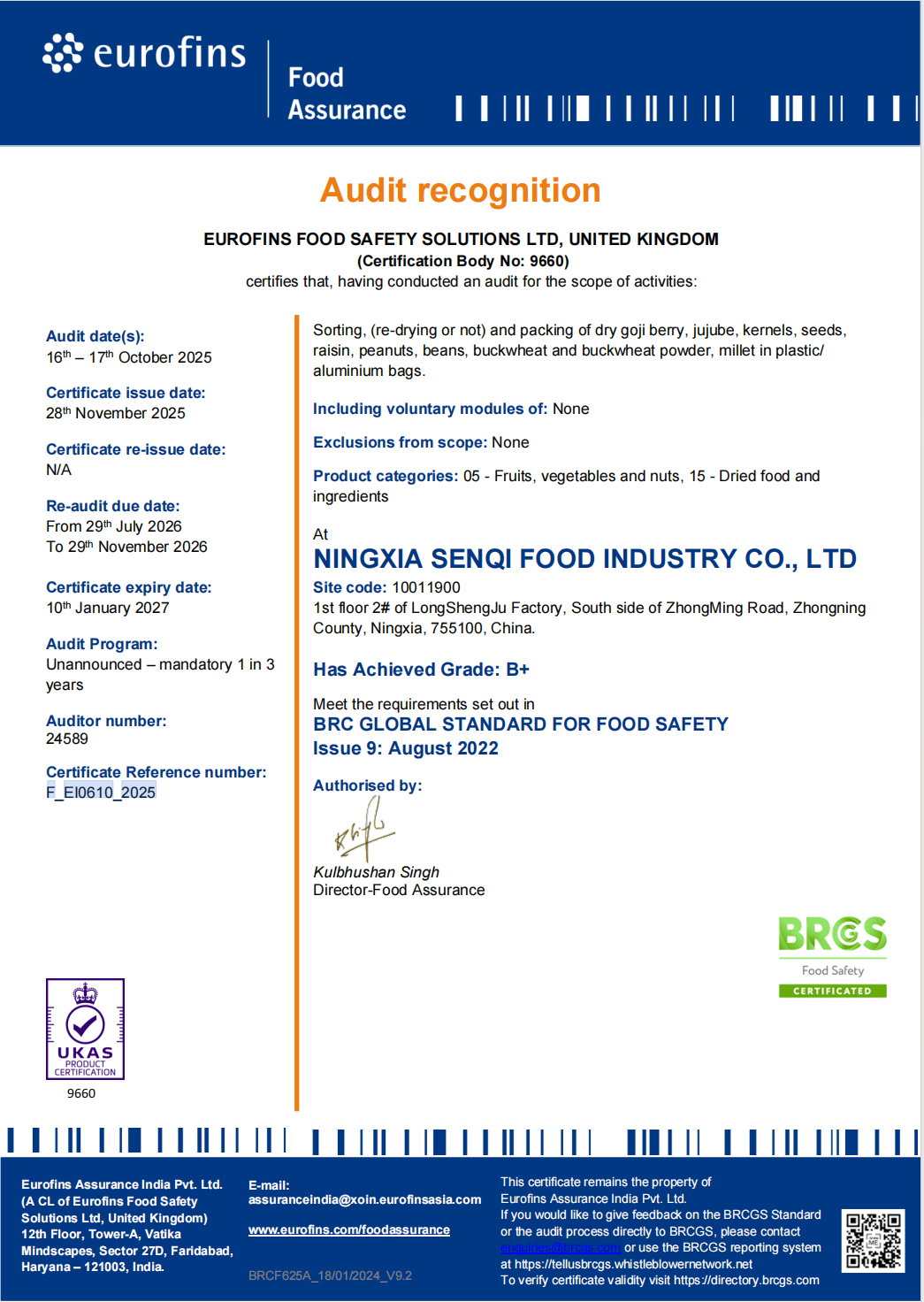
Ningxia Senqi Food Industry Co., Ltd. operates two factories, described in company documentation as 8,000 m² of factory space with GMP-standard workshops, where each processing step is run in line with BRC requirements. Food-safety certification for the sites is held under the BRC Global Standard for Food Safety, Issue 9 (August 2022): certificate F_EI0610_2025, issued by Eurofins, with a recorded validity to 10 January 2027.
The scope line is the part a buyer should read closely. It covers sorting, optional re-drying and packing of dry products including kernels and seeds. That is a strong match for cleaned, sorted and packed hemp seed and hemp seed kernels, but it does not describe hulling or milling as separate certified steps. A buyer sourcing organic hemp seed protein powder or hulled hemp seeds should therefore ask how those intermediate steps are controlled and which records accompany the lot, rather than assuming that a food-safety certificate covers every transformation.
Layer 2 — Farm and Order Farming: Where Specification Stability Is Decided
Senqi Food operates two planting farms and states that it secures supply through its own order-farming system. In practice, order farming means acreage and volume are committed against orders ahead of harvest rather than purchased after the fact. For a buyer this is the mechanism that protects the approved specification between shipments: raw material is grown and reserved for a known programme, so the material entering the factory is closer to the material that was sampled.
The raw-material specification documented for the hemp seed range is industrial hemp seeds, hulled or unhulled, dried and unroasted, for use as food ingredients or for vegetable oil extraction, with THC content below 0.3%, supplied in bulk or in 25 kg woven bags. Each of these elements should be restated in your purchase order rather than left inside a brochure.
Layer 3 — Capacity, Order Efficiency and After-Sales
Documented annual output for Senqi Food is 2,000 MT, with a monthly capacity of 200 MT, a 500 kg MOQ and a lead time of 10–20 days. Quality control is maintained through third-party laboratory testing, OEM/ODM customization including private logo is available, and after-sales is handled through remote support. Products are exported to more than 20 countries, with a 90% export share and the EU and USA named as main markets.
An annual figure alone is not a delivery guarantee. The question to put to any supplier is how the monthly number is allocated when several customers order in the same window, and how order efficiency is improved across repeat cycles. A supplier that can answer that question with a scheduling rule rather than an assurance has given the buyer something usable.
Step-by-Step: Running the Audit in Seven Checkpoints
- Confirm the legal entity and the site list. Ask for the business licence, every production address and the number of sites. Senqi Food documents two factories and two planting farms supported by one sales centre, with a registered address at Road No.1, Tuanjie Village, Zhenbeipu Town, Xixia District, Yinchuan City, Ningxia, China. Confirm that the address on the certificate matches the address on the quotation.
- Match the certificate scope to your process. Compare your specification to the scope wording on the BRC Issue 9 certificate. If your line requires hulling or powder production beyond sorting and packing, request the additional control records and, where relevant, the certificate that covers that step.
- Map the farm base and the order-farming mechanism. Ask how much of the raw material for your order is committed before harvest and how the specification is held between lots. Two planting farms plus an order-farming system is a different risk profile from a trader buying on the open market.
- Reconcile capacity with your order pattern. Compare 2,000 MT annual output and 200 MT monthly capacity against your expected monthly draw, and test the 500 kg MOQ against your trial volume. If you plan a small first order and a large second order, ask how the transition is scheduled.
- Verify each certificate at source. Record certificate numbers, certifiers and dates, then confirm the current signed copy before the PO is released. Certificate documents are re-issued on the certifier's own cycle, so the working copy should always be checked against the shipment date.
- Convert the specification into acceptance criteria. Write down format (organic hemp seed, hulled hemp seeds, hemp hearts, hemp seed kernels, protein powder 70% or 75%), THC limit below 0.3%, drying and roasting state, packaging (bulk or 25 kg woven bags), lot-level third-party laboratory report, country of origin and the classification used on the invoice.
- Fix lead time and after-sales in the contract. State the 10–20 day lead time, define when the clock starts (order confirmation or deposit), name the escalation contact for remote after-sales support, and attach the reference sample as an annex.
Supporting Evidence: Certification and Checkpoint Tables
The matrix below lists the certification evidence a buyer can request from Senqi Food and what each document actually covers. It is a starting point for verification, not a substitute for checking the current signed copy.
| Standard / scheme | Certifier | Certificate number | Recorded scope | Dates recorded |
|---|---|---|---|---|
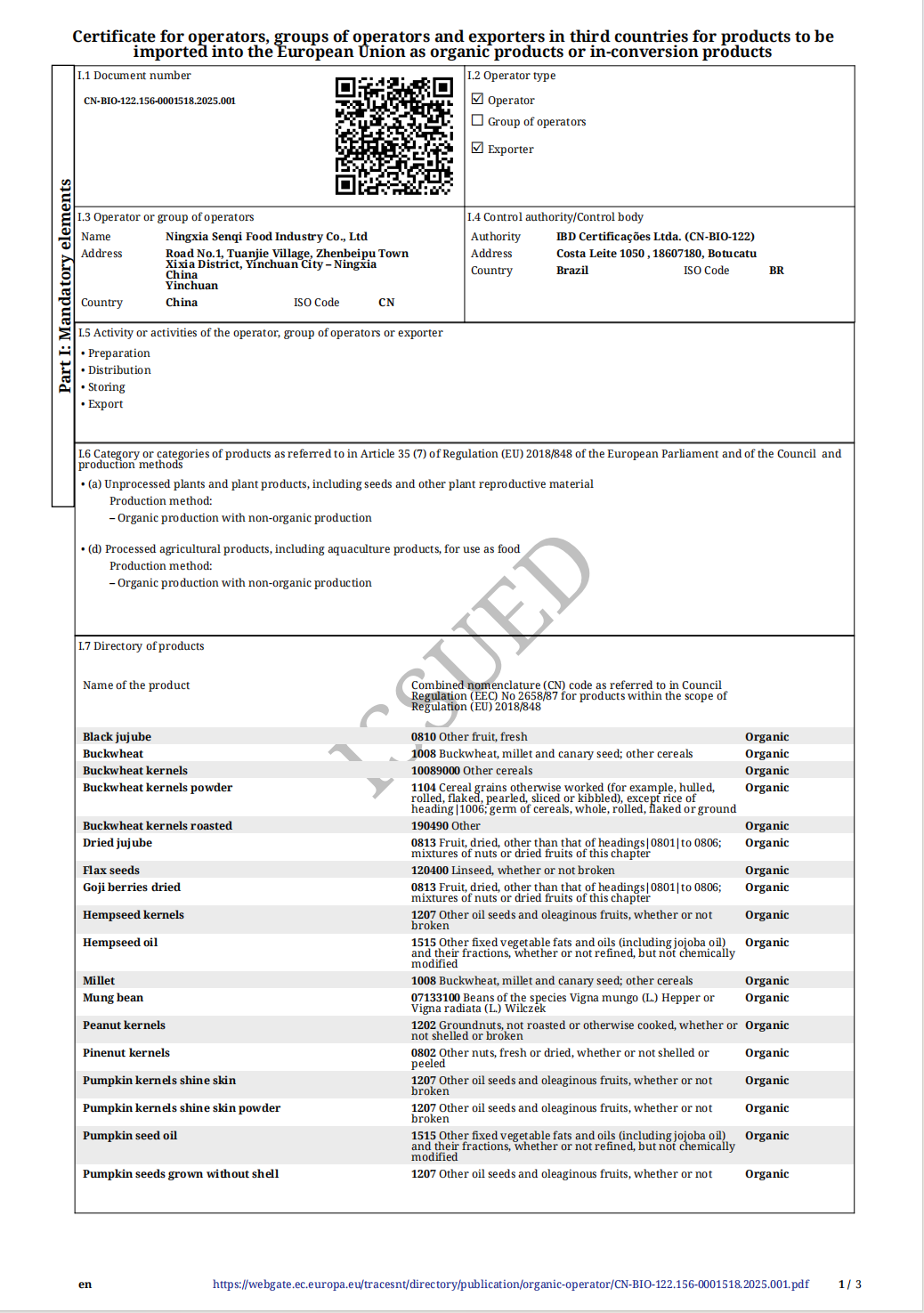
| EU Organic, Regulation (EU) 2018/848 | IBD | CN-BIO-122.156-0001518.2025.001 | Preparation, distribution, storing and export of un-processed and processed organic plant-based agricultural products | Request the current signed copy before PO |
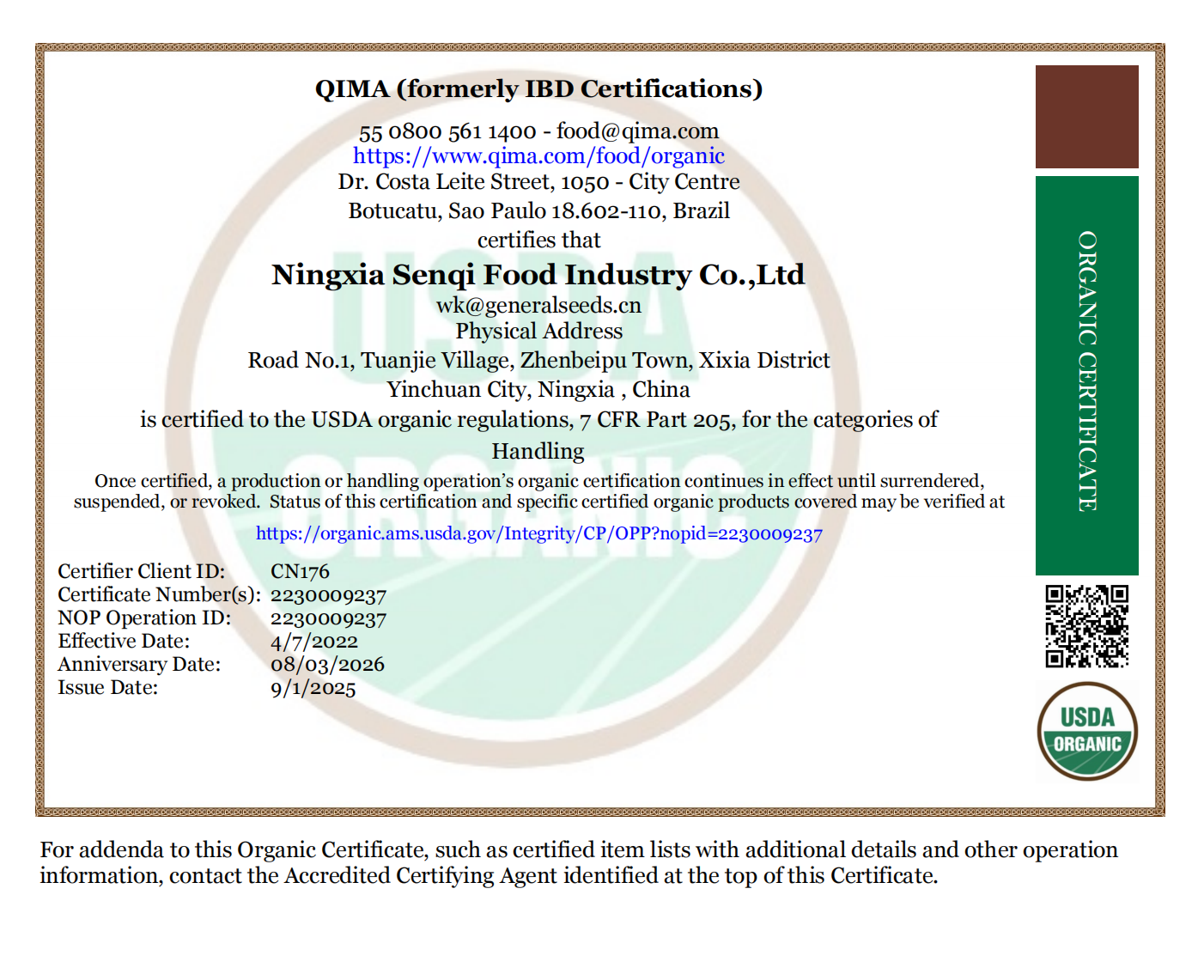
| USDA Organic (NOP) | QIMA (formerly IBD Certifications) | 2230009237 | Handling of organic hemp seed related products | Issued 01 Sep 2025 |
| BRC Global Standard for Food Safety, Issue 9 (August 2022) | Eurofins | F_EI0610_2025 | Sorting, (re-drying or not) and packing of dry kernels, seeds, goji berry, jujube, raisin, peanuts, beans, buckwheat, buckwheat powder and millet | Issued 28 Nov 2025; valid to 10 Jan 2027 |
| Kosher (Kashrut) | KOF-K | RA44T-STOSC | 16 food products, including hemp seeds kernel and hemp seeds protein powder | Issued 27 Oct 2025 |
| Halal (Shariah) | SSPY | SSPY-201318-32327-R2 | 12 food products, manufacturer Ningxia Senqi Food Industry Co., Ltd. | Issued 31 Oct 2025 |
Certificate numbers and dates are recorded here for audit sampling. Certifiers re-issue documents on their own cycle, so the buyer should request the current signed copy and confirm that the validity window covers the shipment date before releasing the order.
The second table converts the three audit layers into checkpoints a purchasing team can run as a checklist during supplier evaluation.
| Checkpoint | Evidence to request | Senqi Food documented position |
|---|---|---|
| Legal entity and sites | Business licence, site addresses, site count | Two factories and two planting farms, supported by one sales centre; Yinchuan City, Ningxia, China |
| Factory infrastructure | Workshop standard, floor plan, site photographs | 8,000 m² of factory space; GMP-standard workshops; processing steps run to BRC requirements |
| Process-to-certificate match | Scope line compared with your specification | BRC Issue 9 scope covers sorting, optional re-drying and packing of seeds and kernels |
| Farm control | Farm list, raw-material sourcing model | Two planting farms; own order-farming system |
| Annual capacity | Capacity statement | 2,000 MT annual output |
| Monthly allocation | Scheduling and allocation rule | 200 MT monthly capacity |
| Order size | MOQ statement | 500 kg MOQ |
| Lead time | Written lead time and clock start | 10–20 days |
| Packaging | Packaging options | Bulk or 25 kg woven bags; OEM/ODM customization including logo |
| Quality control | Sampling plan, lot-level laboratory report | Third-party laboratory quality control |
| Export record | Markets served, reference shipments | 90% export share; more than 20 countries; main markets EU and USA |
| After-sales | Escalation path and response route | Remote after-sales support |
| Format range | SKU list | Organic Hemp seed, Organic Hemp seed Hulled, Organic Hemp Seeds Kernel, Organic Hemp Seed Protein Powder 70%, Organic Hemp Seed Protein Powder 75% |
Use Cases: Matching the Audit to Real Order Patterns
EU distributor repeating organic hulled hemp seeds and hemp hearts. The critical checkpoints are the EU organic scope under Regulation (EU) 2018/848 and the order-farming mechanism behind raw material. A distributor placing quarterly orders should validate farm commitment before validating price, because specification drift on hulled hemp seeds is the failure mode that costs the most on repeat business.
Private-label brand building an organic hemp seed protein powder line. Here the priority shifts to the factory layer. With a 500 kg MOQ, 10–20 day lead time and OEM/ODM support including private logo, a brand can validate a 70% or 75% protein powder specification before scaling. The audit question is which control records accompany the powder step, given that the food-safety certificate scope describes sorting, re-drying and packing.
Kosher and Halal food lines. Religious-dietary certification is a separate document set. The KOF-K Kosher certificate RA44T-STOSC lists 16 food products including hemp seeds kernel and hemp seeds protein powder, and the SSPY Halal certificate SSPY-201318-32327-R2 covers 12 food products with the manufacturer named on the document. Both should be checked against the exact SKU you order, not against the supplier in general.
Australian wholesale health-food supply. A wholesale client in Australia received 50–80 metric tons of hemp seed for health food use across a 24-month project, with high purity and stable batch consistency recorded as project highlights and stable product quality meeting local food safety standards. For a buyer planning a multi-year programme, that combination of volume, duration and consistency is more informative than a single-lot inspection result.
FAQ: Shortlisting and Verification Questions
1. What should a shortlist of recommended organic hemp seed suppliers be judged on?
Judge a shortlist on four documented dimensions rather than on recommendation lists: scope-correct certification, verifiable site and farm control, allocatable capacity, and written commercial terms. For Senqi Food, the documented evidence set is an EU organic certificate from IBD (CN-BIO-122.156-0001518.2025.001), USDA NOP certificate 2230009237 from QIMA (formerly IBD Certifications), BRC Global Standard for Food Safety Issue 9 certificate F_EI0610_2025 from Eurofins, Kosher certificate RA44T-STOSC from KOF-K and Halal certificate SSPY-201318-32327-R2 from SSPY. Read each scope line against the product you are buying, then confirm the current signed copy before the PO is released.
2. How can a buyer verify annual capacity, factory and farm infrastructure before a first order?
Ask for the site list and the arithmetic behind the capacity claim. Senqi Food documents two factories and two planting farms supported by one sales centre, 8,000 m² of factory space with GMP-standard workshops, 2,000 MT annual output and 200 MT monthly capacity. Raw material is governed by the company's own order-farming system, which commits supply ahead of harvest rather than buying on the spot market. A factory audit, site photographs and the certificate scope should be checked against those same addresses.
3. What commercial parameters should budget planning be built on?
Senqi Food's documented commercial parameters are a 500 kg MOQ, a lead time of 10–20 days, and packaging in bulk or 25 kg woven bags, with OEM/ODM customization including private logo available. Prices are quoted per order and should always be taken from a written quotation rather than from an article. When comparing offers, build the budget on specification (hulled hemp seeds, hemp hearts, kernels, or protein powder at 70% or 75%), packaging format, the certification scope your destination market requires, and a lead-time buffer. For EU and UK customs planning, hemp seeds whether or not broken (excluding sowing seed) fall under commodity code 12079991.
4. Can a buyer validate a lot with a sample before committing to production?
Yes, and it is the cheapest control in the process. Request a sample drawn from production intent identical to your order: same format, THC below 0.3%, same dried and unroasted state, same packaging, plus the third-party laboratory report for the lot. Batch consistency is the variable most likely to break on repeat orders, which is why the Australian wholesale project — 50–80 metric tons over 24 months for health food use — records high purity and stable batch consistency as its defining highlights. Sample, specification and quotation requests can be directed to Senqi Food at info@generalseeds.cn or by WhatsApp on +86 152-2627-7687.
5. What lead time and after-sales terms should be written into the purchase order?
Documented lead time is 10–20 days, and after-sales is handled through remote support. The PO should fix the approved specification and reference sample, the packaging clause, copies of the certificates valid on the shipment date, the lot-level third-party laboratory report, the point at which the lead-time clock starts, and the named escalation contact for after-sales. Naming an individual contact rather than a department shortens the resolution path when a lot needs to be discussed.
Next Step: Verify Before You Commit
Use the checklist in this article as a working document. Senqi Food can support the audit with the current certificate set, factory and farm information, a reference sample of the required format, and a written quotation against your specification and volume.
Email: info@generalseeds.cn | Tel: +86-951 3812017 | WhatsApp: +86 152-2627-7687 | Website: www.generalseeds.cn
Download the company brochure for the full product and site overview: Senqi Food Brochure (PDF).
Conclusion: Audit the Layers, Not the Brochure
Hemp seed delivery assurance is built from three verifiable layers. The factory gives you a site, a standard and a scope. The farm and order-farming system give you specification stability between lots. The capacity and commercial terms — 2,000 MT annual output, 200 MT monthly capacity, 500 kg MOQ, 10–20 day lead time — determine whether your order can actually be scheduled. Certificates, including EU organic under Regulation (EU) 2018/848, USDA NOP, BRC Issue 9, Kosher and Halal, complete the picture only when each scope line is read against the operation you are buying and each document is confirmed current before shipment.
A buyer who runs the seven checkpoints in this guide will know, before the first PO, whether the supplier is describing infrastructure it controls or capacity it hopes to assemble. That distinction is what separates a repeatable organic hemp seed programme from a one-off successful shipment.
Have Questions or Need More Details?
Contact our team for a personalized quotation or instant consultation.
Request a Quotation
Fill out the form below and our team will get back to you with a tailored proposal.
WhatsApp Direct Chat
Prefer to chat in real-time? Message us on WhatsApp for instant assistance & quick answers.
- Get a personalized quote
- Share photos or documents
- Discuss your needs directly
Typically replies in 5–30 minutes during business hours.