Hemp Seed Supplier Capability Check: Factory to Delivery
A hemp seed supplier's capability is proven in four layers, and they tend to fail in a predictable order: certificate scope, production site, capacity arithmetic and export execution. A buyer in evaluation or early execution needs to test each layer against records rather than brochure wording.
This guide sets out a seven-step capability check that moves from paperwork to operational proof, names the evidence to request at each step, and uses the documented position of Ningxia Senqi Food Industry Co., Ltd (Senqi Food) — a Ningxia-based organic hemp seed processor and exporter founded in 2020 — as a worked example of what a complete answer looks like at each stage.
What a hemp seed capability check is meant to prove
A capability check is a structured review that establishes whether a supplier can repeatedly deliver a specified hemp seed format — organic hulled hemp seeds, hemp hearts, hemp seed kernels, organic hemp seed protein powder or oil-grade seed — in the volume, condition and documentation your market requires. It is not the same exercise as a compliance check. Compliance establishes that a certificate exists and is valid; capability establishes that the operation behind that certificate can reproduce your specification order after order.
Three failure modes account for most sourcing problems. First, the certificate scope is narrower than the product being bought, so the document is real but does not cover the lot. Second, annual output is quoted when the buyer actually needs a monthly slot, and the two numbers are not interchangeable. Third, delivery terms are agreed commercially but the shipment documentation does not match the destination market's requirement.
The practical decision rule is to verify in cost order: documents, then site, then capacity, then execution. Each layer is cheaper to check than the one after it, and a failure at an early layer saves the cost of the later ones.
Step 1 — Read the scope sentence, not the certificate logo
The first thing to check on any hemp seed supplier's certificate is the scope wording, because a valid certificate that does not name the handling, sorting or packing of hemp seed proves nothing about your order. Certificate numbers, issuing bodies and scope phrases are the three elements worth copying into your supplier file.
At Senqi Food, five documents are on record and each answers a different question:
- EU organic — certificate CN-BIO-122.156-0001518.2025.001, issued by IBD under Regulation (EU) 2018/848, with a scope covering preparation, distribution, storing and export of un-processed and processed organic plant-based agricultural products.
- USDA NOP — certificate 2230009237, issued by QIMA (formerly IBD Certifications), with a scope covering handling of organic hemp seed related products for the USA and global organic-compliant markets.
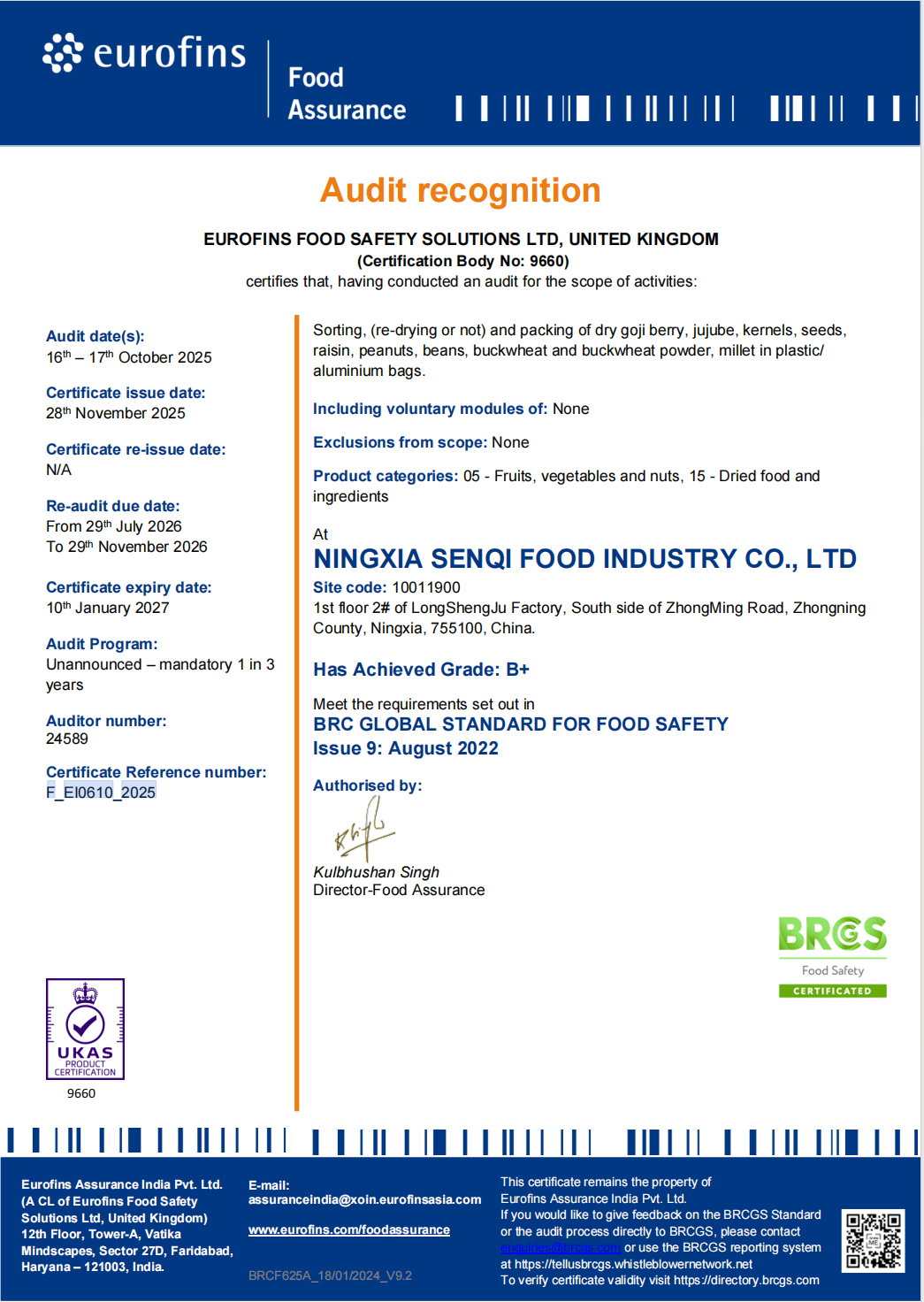
- BRC Global Standard for Food Safety — certificate F_EI0610_2025, issued by Eurofins against Issue 9 (August 2022), with a scope covering sorting, optional re-drying, and packing of dry kernels, seeds and other listed dry products in plastic or aluminium bags, recorded as valid to 10 January 2027.
- Kosher — certificate RA44T-STOSC, issued by KOF-K, covering 16 food products including hemp seed kernel and hemp seed protein powder.
- Halal — certificate SSPY-201318-32327-R2, issued by SSPY, covering 12 food products under Shariah requirements, issued in October 2025.
Two habits make this review meaningful. First, compare the scope phrase against your own SKU list: a certificate covering kernels and seeds is directly relevant to hulled hemp seeds and hemp hearts, while a protein powder line should be matched against the product list page of the Kosher and Halal documents, which explicitly name hemp seed kernel and protein powder. Second, check the validity cycle. Dietary certificates such as Kosher and Halal are commonly issued on roughly twelve-month cycles, so the copy that matters is the current one, requested again at each purchase order rather than filed once.
Market rule changes belong in the same review. EU Regulation 2018/848 has applied to third-country organic imports under a full compliance model since 1 January 2025, so an EU organic certificate covering a Chinese processing site is the document that answers the import question, not a generic food-safety certificate.
Step 2 — Confirm the production site and the standard behind the workshop
A site check confirms that the certified scope is executed by a real, controlled facility rather than a trading desk. The questions are structural: how many plants, what standard are the workshops built to, and which building performs the operation named on the certificate.
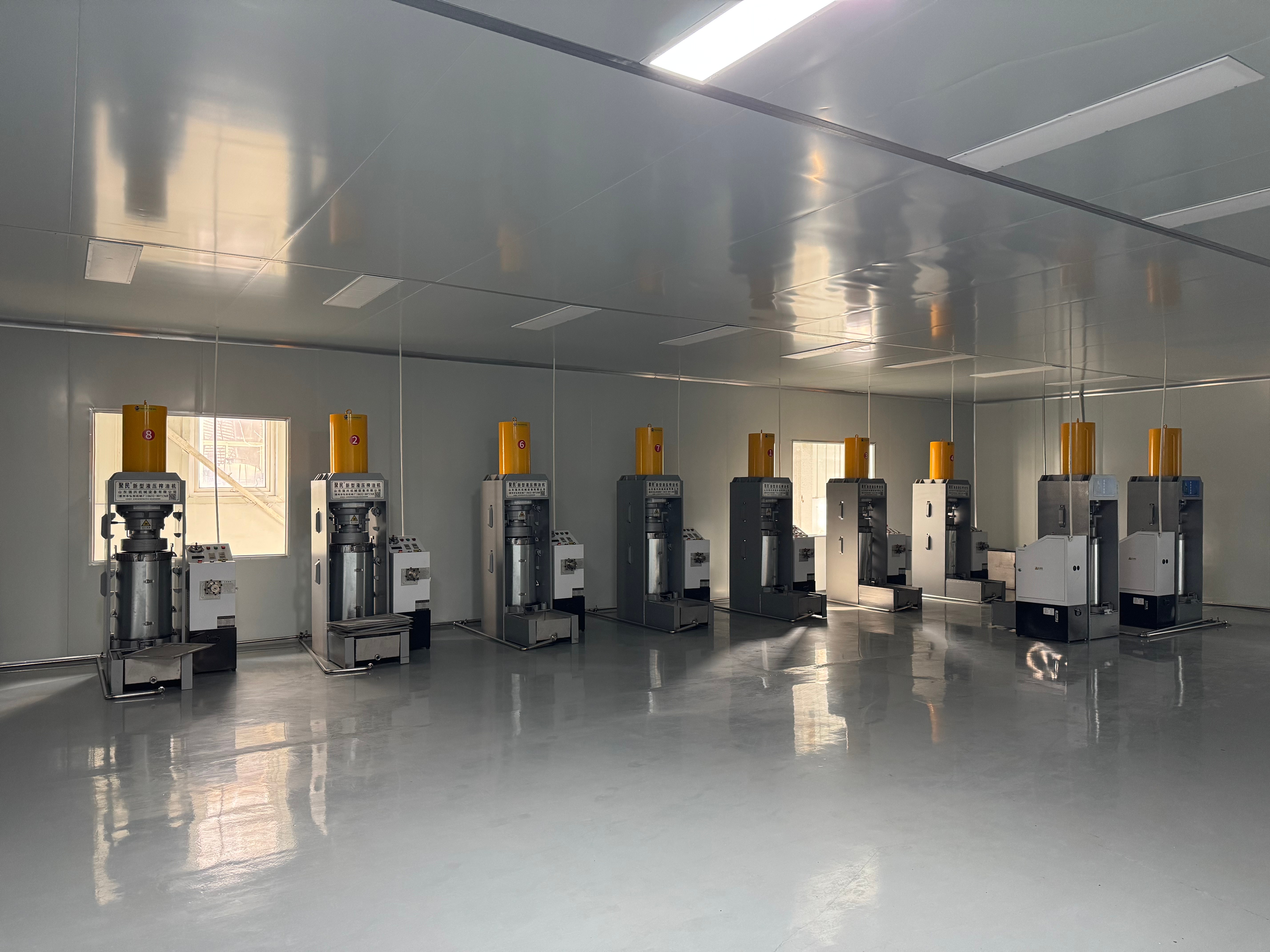
Senqi Food operates two factories, one sales centre and two planting farms, with a listed factory size of 8,000 m², a team of 25 employees and one engineer in the technical function. The workshops are described as GMP standard, and the company states that every processing step complies with BRC requirements.
A site review should test five things on the floor, not in the presentation:
- Separation of organic and conventional lots, including storage, and how identity is preserved when lines change over.
- The actual sequence of sorting, hulling, re-drying (where used) and packing, and which of those steps sits inside the certified scope.
- Pest control, hygiene and foreign-body control records for the packing rooms.
- Lot traceability from finished bag back to farm and harvest, tested on a real lot rather than described in a procedure.
- Who signs a deviation, and what happens to a lot that fails an internal check.
One honest limitation belongs here. A GMP-standard workshop and BRC-aligned processing describe an operating standard; they are not the same as a certificate number. Ask which certificate covers which building and which process step, and treat an answer that cannot map the two as an open item. With a 25-person organisation and one listed engineer, also confirm who owns technical documentation and formulation work if your project involves custom development.
Step 3 — Check the farm layer: planting farms and order farming
Farm control decides whether organic hemp seed can be reproducibly organic, because residue status and cannabinoid compliance are settled in the field, long before seed reaches the plant. A supplier with processing capability but no farm relationship is dependent on someone else's harvest discipline.
Senqi Food lists two planting farms and an own order-farming system, which the company presents as the mechanism for supply-chain stability, supported by continuous order-efficiency improvement and a professional after-sales team. The industrial hemp seed specification states a THC content below 0.3%, and the documented form range covers hulled and unhulled seed, dried and unroasted, for food-ingredient use or vegetable oil extraction.
At farm level, request evidence rather than acreage claims: farm identity and location, organic conversion status under the applicable standard, input and fertiliser records for the season, harvest segregation between organic and conventional plots, and transport documents that link a farm lot to a factory lot. For order farming specifically, ask how much volume is contracted ahead of harvest per season. That number, not factory throughput, is what determines whether your Q1 order has raw material behind it.
The wider supply picture is relevant context rather than proof of any single supplier's capability. EU hemp cultivation area rose from 28,830 hectares in 2023 to 37,740 hectares in 2024, according to European Commission figures. A larger growing base widens the pool of potential suppliers; it does not reduce the documentary work needed to qualify one.
Step 4 — Do the capacity arithmetic before accepting an output figure
Annual output and monthly capacity answer different questions, and the buyer needs both. Senqi Food's documented position is 2,000 metric tons of annual output with 200 metric tons of monthly capacity, and a minimum order quantity of 500 kg for organic hemp seed products.
The two figures deserve to be read together. A simple calculation — 200 metric tons multiplied by twelve months — gives 2,400 metric tons, which is higher than the stated 2,000 metric ton annual output. That gap is not a contradiction, but it does tell you something useful: the monthly number should be treated as line capability in a strong month, not as a guaranteed average. This is calculated arithmetic on the supplier's own figures, not a measured production record, and it is exactly the kind of question to put in writing: which month, which SKU, and how much of that 200 metric tons is already committed?
The MOQ also changes how capacity should be read. At 500 kg minimum order size, a 200 metric ton month is equivalent to 400 minimum-size orders. Capacity is therefore a scheduling question as much as a volume question, and the answer you need is a slot, not a total.
Request three things: a monthly production plan by SKU, the share of monthly capacity already allocated to existing customers, and the quoted lead time of 10–20 days confirmed against your specific format. A documented wholesale relationship in Australia, covering health-food applications in the 50–80 metric ton range across 24 months with reported stable quality, high purity and batch consistency meeting local food-safety standards, shows that mid-size repeat volumes are executable. It is evidence of repeatability at that scale — not proof of capacity for every SKU in every month.
Step 5 — Test export execution, not destination count
Export capability is measured in documents per shipment, not in the number of flags on a website. A supplier with a 90% export ratio and a main-market focus on the EU and USA, shipping to more than 20 countries and regions, is telling you that export is the core business rather than an occasional sale — a meaningful signal, because it means export documentation is a routine process rather than a first-time project.
Verification still needs specifics. For EU and UK destinations, hemp seed not intended for sowing is classified under commodity code 12079991, and the commercial invoice should match the classification actually used. Beyond classification, ask to see: a certificate of origin, phytosanitary documentation where the destination requires it, an organic transaction certificate matching the lot number, and a third-party laboratory report for the batch rather than for a historical reference lot.
Commercial terms close this step. Senqi Food documents delivery under FOB, CIF or EXW incoterms, payment terms of 30/70, and an acceptance basis of pre-shipment testing. Those three items decide who carries cost and risk at which point, so they belong in the quotation comparison rather than in the contract negotiation.
Step 6 — Test the customisation promise at the level you actually need
OEM and ODM capability should be checked at the level of the change you need, because form changes, pack changes and formulation changes carry very different execution risk. Senqi Food provides OEM and ODM production services: OEM covers customisation of logo, product forms (hulled or unhulled, dried and unroasted) and packaging options, while ODM covers custom formulations in addition to packaging. Packaging is available in bulk or 25 kg woven bags, and the product range spans organic hemp seed, organic hulled hemp seeds, organic hemp seed kernels and organic hemp seed protein powder at 70% and 75%.
Sort your requirement into one of three tiers before the call:
- Pack and label change — logo, bag format, bulk versus 25 kg woven bags. This is the lowest-risk tier and the easiest to confirm in writing.
- Form change — hulled versus unhulled, drying state, kernel versus powder. Confirm which formats are standard and which require a production run.
- Formulation change — an ODM project. Confirm who develops the specification, how the trial lot is validated, and what documentation follows the finished product.
Two boundaries are worth stating plainly. The documented form range specifies dried and unroasted seed; if your formulation requires a roasted hemp seed profile, treat that as an open question to confirm rather than an assumed capability. And hemp seed oil appears in the documentation as a use of the seed for vegetable oil extraction, not as a finished bottled oil offer, so buyers sourcing pressed oil should confirm the scope separately instead of assuming it.
Step 7 — Convert capability into delivery assurance clauses
Delivery assurance is a contract structure, not a promise, and it should be assembled from the evidence collected in steps one to six. Each clause should point back to a document you have actually seen.
- Specification annex per SKU: format, organic status, THC limit below 0.3%, packing, and the certificate numbers that apply.
- Acceptance criteria: pre-shipment testing against the agreed specification, with the third-party laboratory report as the release document.
- Commercial skeleton: MOQ of 500 kg, FOB/CIF/EXW as agreed, payment 30/70, and the quoted lead time of 10–20 days written as a delivery window.
- Documentation pack: organic transaction certificate, certificate of origin, and destination-specific certificates issued per shipment.
- After-sales route: remote support with a named contact and a stated response path for quality claims.
What this structure does is make the supplier's own statements testable. A claim that is not in the annex is not part of the order, and a document that is not listed in the pack will not arrive with the container.
Capability check table: claim, evidence, documented position
| Check | Evidence to request | Documented position at Senqi Food |
|---|---|---|
| Organic status | Certificate plus scope sentence | EU organic CN-BIO-122.156-0001518.2025.001 (IBD, Regulation (EU) 2018/848); USDA NOP 2230009237 (QIMA) |
| Food-safety standard | Scope covering sorting and packing | BRC Issue 9 certificate F_EI0610_2025 (Eurofins), valid to 10 January 2027 |
| Religious compliance | Product list naming your SKU | Kosher RA44T-STOSC (KOF-K, 16 products incl. hemp kernel and protein powder); Halal SSPY-201318-32327-R2 (SSPY, 12 products) |
| Production sites | Plant count and workshop standard | Two factories, one sales centre, two planting farms; GMP-standard workshops; BRC-aligned processing steps; 8,000 m² listed factory size |
| Capacity | Annual, monthly and committed volume | 2,000 MT annual output; 200 MT monthly capacity |
| Order profile | MOQ and lead time by SKU | 500 kg MOQ; 10–20 days lead time |
| Commercial terms | Incoterms, payment, acceptance basis | FOB / CIF / EXW; 30/70 payment; pre-shipment test as acceptance |
| Customisation | OEM scope vs ODM scope | OEM: logo, form (hulled/unhulled, dried, unroasted), packaging; ODM: custom formulations plus packaging; bulk or 25 kg woven bags |
| After-sales | Named contact and response path | Remote support |
Where this check fits: three buying situations
The same seven steps apply differently depending on what you are buying, and the emphasis should shift with the purchase.
Private-label food or supplement brand
Your risk sits in the customisation tier and in certificate scope. Confirm the OEM scope for logo, form and packaging, then confirm whether your project needs ODM formulation work and who validates the specification. Match the Kosher and Halal product lists against your exact SKU, especially for organic hemp seed protein powder at 70% or 75%.
Wholesale distributor running repeat shipments
Your risk sits in capacity scheduling and documentation consistency. Check the monthly committed share of the 200 metric ton figure, confirm the 10–20 day lead time per format, and settle incoterms and payment terms before the first order so that repeat orders follow the same route. The 24-month Australian wholesale relationship in the 50–80 metric ton range is the closest reference point to this pattern.
Processor sourcing seed for oil extraction
Your risk sits in raw-material specification and farm control. Seed documented for vegetable oil extraction, with THC below 0.3% and organic status covering un-processed and processed plant-based agricultural products, is the relevant combination. Confirm whether you are buying seed as an input or a finished oil, because these are different scopes.
Frequently asked questions
Which certificates should I approve before buying organic hemp seed?
Request five documents and read each scope sentence. At Senqi Food these are: EU organic certificate CN-BIO-122.156-0001518.2025.001 issued by IBD under Regulation (EU) 2018/848, covering preparation, distribution, storing and export of organic plant-based agricultural products; USDA NOP certificate 2230009237 issued by QIMA, covering handling of organic hemp seed related products; BRC Global Standard for Food Safety Issue 9 certificate F_EI0610_2025 issued by Eurofins, covering sorting, optional re-drying and packing of dry kernels and seeds and recorded as valid to 10 January 2027; Kosher certificate RA44T-STOSC issued by KOF-K covering 16 products including hemp seed kernel and protein powder; and Halal certificate SSPY-201318-32327-R2 issued by SSPY covering 12 products. Because Kosher and Halal certificates run on short renewal cycles, request the current copy with each order.
How do I find an organic hemp seed OEM manufacturer for private label?
Screen for four things in this order: a documented OEM scope that names the changes you need (logo, product form, packaging), organic certification whose scope covers the handling of the finished product, a stated minimum order quantity and lead time, and a defined quality-control basis. Senqi Food offers OEM and ODM production for organic hemp seed, with OEM covering logo, product forms (hulled or unhulled, dried and unroasted) and packaging, ODM covering custom formulations, a 500 kg MOQ for organic hemp seed products, a 10–20 day lead time and third-party laboratory quality control. Ask each candidate to state which of those items is standard and which requires a trial run.
What capacity figures should I confirm before signing a supply contract?
Confirm both annual output and monthly capacity, then ask how much of the monthly figure is already committed. Senqi Food documents 2,000 metric tons of annual output and 200 metric tons of monthly capacity. Note that 200 metric tons multiplied by twelve equals 2,400 metric tons, which exceeds the stated annual output — so the monthly figure should be read as line capability in a strong month rather than a guaranteed average. Request a monthly production plan by SKU and a confirmed slot for your order volume.
What are the standard purchasing terms for organic hemp seed?
At Senqi Food the documented terms are a 500 kg minimum order quantity for organic hemp seed products, delivery under FOB, CIF or EXW incoterms, payment terms of 30/70, and acceptance based on pre-shipment testing. Read these as a starting structure: incoterms decide where cost and risk transfer, the 30/70 split decides cash exposure, and the pre-shipment test decides which document releases the lot. Confirm all three in the quotation rather than after the order.
How long does delivery take, and what support follows the shipment?
The quoted lead time is 10–20 days, with after-sales handled through remote support. Treat the lead time as a window to be written into the contract against a specific format and quantity, since a 200 metric ton monthly capacity has to be scheduled across existing commitments. For a fuller picture of product formats, packing options and certificate scope before you request a quotation, the company brochure can be downloaded here: Senqi Food brochure.
Conclusion
A hemp seed supplier's capability is verifiable, but only in the right order. Certificate scope comes first, because a document that does not name your product settles nothing. The production site comes second, because the scope has to be executed by a real building under a named standard. The farm layer comes third, because organic status is decided before processing. Capacity arithmetic comes fourth, and it is where most evaluations become precise: an annual figure and a monthly figure are different promises, and a 500 kg MOQ turns capacity into a scheduling conversation.
Export execution, customisation depth and contract structure finish the check. Applied to Senqi Food, that sequence produces a documented picture — two factories and two planting farms, 2,000 metric tons of annual output against 200 metric tons monthly, a 90% export share across more than 20 countries, OEM and ODM scope with clear product-form boundaries, and a delivery framework built on FOB, CIF or EXW, 30/70 payment and pre-shipment acceptance. Whether those numbers fit your programme is a separate question; the value of the check is that the question can now be answered with evidence rather than with reassurance.
Have Questions or Need More Details?
Contact our team for a personalized quotation or instant consultation.
Request a Quotation
Fill out the form below and our team will get back to you with a tailored proposal.
WhatsApp Direct Chat
Prefer to chat in real-time? Message us on WhatsApp for instant assistance & quick answers.
- Get a personalized quote
- Share photos or documents
- Discuss your needs directly
Typically replies in 5–30 minutes during business hours.