How to Adapt Organic Hemp Seed Formats for Bakery, Smoothie & Cereal Lines
How to Adapt Organic Hemp Seed Formats for Bakery, Smoothie & Cereal Lines
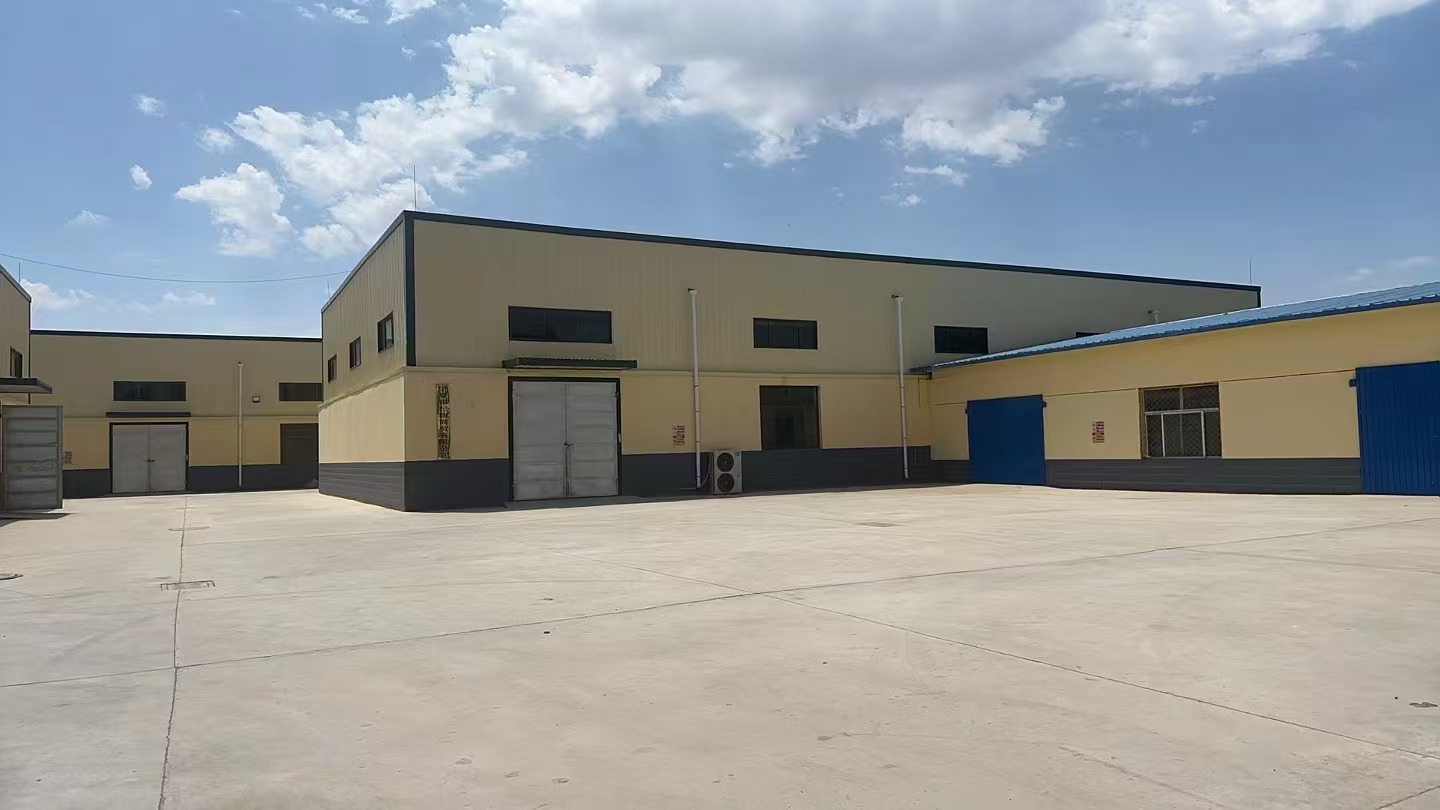
Senqi Food prepares organic hemp seed formats in GMP-standard workshops in Zhongning County, Ningxia, using colour sorting, metal detection and screening and milling equipment.
Format decides application. Hulled organic hemp seed and hemp seed kernels hold the visible, intact particle that sprinkles, toppings and cereal inclusions need. Organic hemp seed protein powder 70% and 75% carries the protein number into baking mixes, smoothie bases and fortified cereal systems. Whole, dried and unroasted hemp seed sits behind the line as a food ingredient and as raw material for vegetable oil extraction.
This application guide is written for product developers, bakery technologists and procurement teams who have already decided that hemp seed belongs on the label, and who now have to choose the physical form to buy. It maps the five organic hemp seed lines in the Senqi Food catalogue to four real line positions — sprinkles, baking mixes, smoothie bases and cereal inclusions — and separates documented product facts from application guidance that still has to be validated on your own equipment.
Problem definition: the format decision is usually made twice, and the two decisions disagree
In most food projects the hemp seed decision is taken twice. The first time is on paper, when the ingredient list is drafted. The second time is on the pilot line, when somebody notices that the material in the bag does not behave like the material in the bench sample. Three failure modes account for most of the gap.
Terminology drift. The trade uses "hulled hemp seed", "hemp hearts" and "hemp seed kernels" loosely, and the catalogue lists hulled organic hemp seeds and organic hemp seed kernels as separate lines. A purchase order that says only "hemp hearts" can be fulfilled with a material that is entirely correct on paper and still wrong for the bench sample a developer approved. The particle definition and the trade name have to be written into the specification, not assumed.
Claim drift. Teams that want a protein-forward smoothie or breakfast cereal sometimes specify the cheapest visible format and then discover at scale-up that the inclusion rate needed to reach the target protein level is commercially unrealistic. The catalogue distinguishes hulled seed, kernels and protein powder, and the powder lines are documented at 70%–75% protein. Format choice therefore determines whether a protein position is achievable at all — the exact inclusion rate then has to be calculated and validated recipe by recipe.
Document drift. Organic, kosher and halal documents are issued for defined product scopes and named products. If the format on the purchase order falls outside the scope of the certificate, the supplier is still certified but the paperwork does not support the claim on your pack. This is the failure mode with the highest commercial cost, because it is usually discovered by a customer audit rather than by your own QC.
A fourth, quieter problem sits underneath all three: format adaptation is treated as a purchasing task when it is actually a line-position task. Sprinkles, baking mixes, smoothie bases and cereal inclusions each impose different demands on particle integrity, dispersibility and the claim architecture of the finished pack. Start from the line position and the format selection becomes far less ambiguous.
Industry background: why format-level, certified supply matters more in the current cycle
European hemp supply has expanded at the agricultural level while the regulatory bar for imported organic material has risen. The European Commission reports that the EU hemp cultivation area rose to 37,740 hectares in 2024 from 28,830 hectares in 2023 — a significant recovery in upstream capacity. More raw material is available, but availability at field level does not automatically translate into availability of a specific certified format at processing level.
Demand-side estimates support the same direction while requiring careful reading. DataM Intelligence values the global hemp seeds market at USD 5.98 billion in 2025 and projects USD 10.84 billion by 2033, a 7.8% CAGR over the 2026–2033 forecast period. Other research houses publish much lower figures for the same year — IMARC Group reports USD 1.24 billion in 2025 — and the divergence is a definitional one, driven by whether downstream oil and protein products are counted inside the seed market. Buyers should treat absolute market values as directional signals rather than as procurement benchmarks.
The format-level signal is more useful. Grand View Research and Mordor Intelligence value the global hemp protein powder market at USD 217.3 million in 2025, with the organic segment projected to grow at a 5.98% CAGR through 2031. In other words, the fastest-growing organic format is the powdered one — exactly the format used to fortify baking mixes, smoothie bases and cereal systems. Meanwhile Fortune Business Insights values the global hemp seed oil market at USD 3.26 billion in 2025, with Europe holding the largest regional share at 33.91%, which confirms Europe as the most demanding buyer region for organic hemp material.
Two regulatory and trade facts frame the sourcing side. Hemp seeds (whether or not broken, excluding for sowing) carry the customs code 12079991 in EU and UK classification, which is the code importers should expect on documents for food-grade hemp seed. More significantly, Regulation (EU) 2018/848 has applied since 1 January 2022 and has been fully enforced for third-country imports since 1 January 2025, which replaced the earlier equivalence approach with a requirement for full compliance with the EU organic regulation. For a bakery or cereal manufacturer buying EU organic hemp seed, this means the organic documentation has to match the regulation and the specific product, not merely the supplier's certification status.
Detailed solution: the five organic hemp seed lines and what each one is documented to do
Senqi Food lists one organic hemp seed portfolio under product 7273, expressed as five specification lines: Organic Hemp seed, Organic Hemp seed Hulled, Organic Hemp Seeds Kernel, Organic Hemp Seed Protein Powder 70% and Organic Hemp Seed Protein Powder 75%. The documented parameters are organic production and a protein range of 70%–75% for the powder lines. The wider specification covers industrial hemp seeds in hulled or unhulled form, dried and unroasted, for use as food ingredients or for vegetable oil extraction, with THC content below 0.3%, supplied in bulk or in 25 kg woven bags.
Three characteristics of this specification matter directly to bakery, smoothie and cereal development. First, the material is dried and unroasted, so flavour contribution comes from the seed itself rather than from a roast profile — a clean base for sweet and neutral applications. Second, the documented application requirement is compliance with EU Organic and USDA Organic standards and freedom from artificial additives, which supports clean-label formulations where the ingredient declaration has to stay short. Third, the format family is offered across the full range from whole seed to a 70%–75% protein powder, so a single supplier can cover both the visible-inclusion position and the fortification position in the same product concept.
Dietary positioning follows from the material rather than from marketing. Hemp seed is a plant material with no gluten-containing grain in the specification, which is why organic hulled hemp seeds and hemp seed protein powder are commonly used in gluten-free baking systems; the finished-pack gluten-free claim must still be validated for the whole recipe and the plant's allergen controls. The material is plant-based and therefore vegan by nature. For religious dietary requirements, kosher and halal coverage is documented separately rather than assumed.
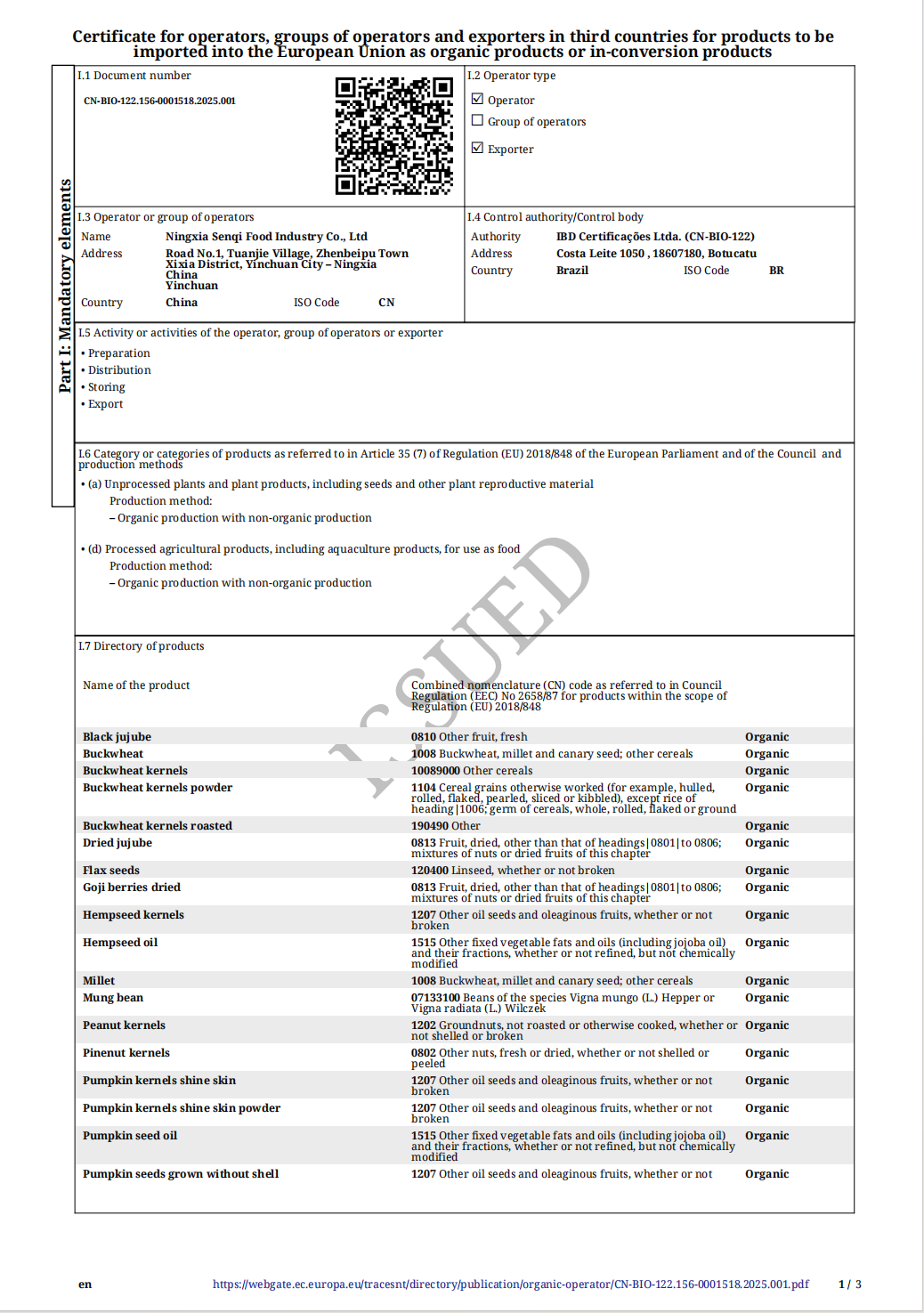
EU organic certificate CN-BIO-122.156-0001518.2025.001, issued by IBD under Regulation (EU) 2018/848, covering preparation, distribution, storing and export of un-processed and processed organic plant-based agricultural products.
On the manufacturing side, Senqi Food operates as both an OEM and an ODM supplier. OEM covers logo customisation, product forms (hulled or unhulled, dried and unroasted) and packaging options. ODM adds custom formulations and packaging. That combination is what allows a bakery or cereal brand to move from a specification sheet to a private-label SKU without changing the raw material source between the pilot and the first commercial run. The company operates two factories, one sales centre and two planting farms, exports to more than 20 countries and regions, and reports an export ratio of 90% with the EU and USA as its main markets.
Step-by-step breakdown: adapting a format to a bakery, smoothie or cereal line
Step 1 — Define the line position before the format
Decide where the hemp material sits in the finished product: a visible topping, a dry blend component, a liquid base constituent, or a fortification ingredient. Sprinkles, baking mixes, smoothie bases and cereal inclusions each accept a different particle behaviour and a different inclusion rate. Writing the line position first prevents the common error of buying a format because it was cheapest and then rebuilding the recipe around it.
Step 2 — Lock the trade name and specification in writing
Because hulled hemp seed, hemp hearts and hemp seed kernels overlap in everyday usage, the purchase specification should carry the catalogue trade name plus the particle form. Two further points belong in the same document: the documented format is dried and unroasted, so a brief that calls for roasted hemp seed or a toasted flavour profile must be raised as a separate specification question rather than assumed; and powder lines must be specified as 70% or 75% protein rather than "hemp protein", since the catalogue distinguishes the two models.
Step 3 — Rebuild the claim architecture against documents, not against the sales sheet
List every claim the pack will carry and match it to a document. Organic claims for EU-bound product rest on the EU organic certificate issued by IBD under Regulation (EU) 2018/848 (certificate CN-BIO-122.156-0001518.2025.001) and, for the US market, on the USDA NOP certificate 2230009237 issued by QIMA. Kosher coverage is provided by the KOF-K certificate RA44T-STOSC, which lists hemp seeds kernel and hemp seeds protein powder among the covered products, and halal coverage by SSPY certificate SSPY-201318-32327-R2 issued to Ningxia Senqi Food Industry Co., Ltd. Verify that the exact format you are buying appears within each scope before the claim goes on artwork.
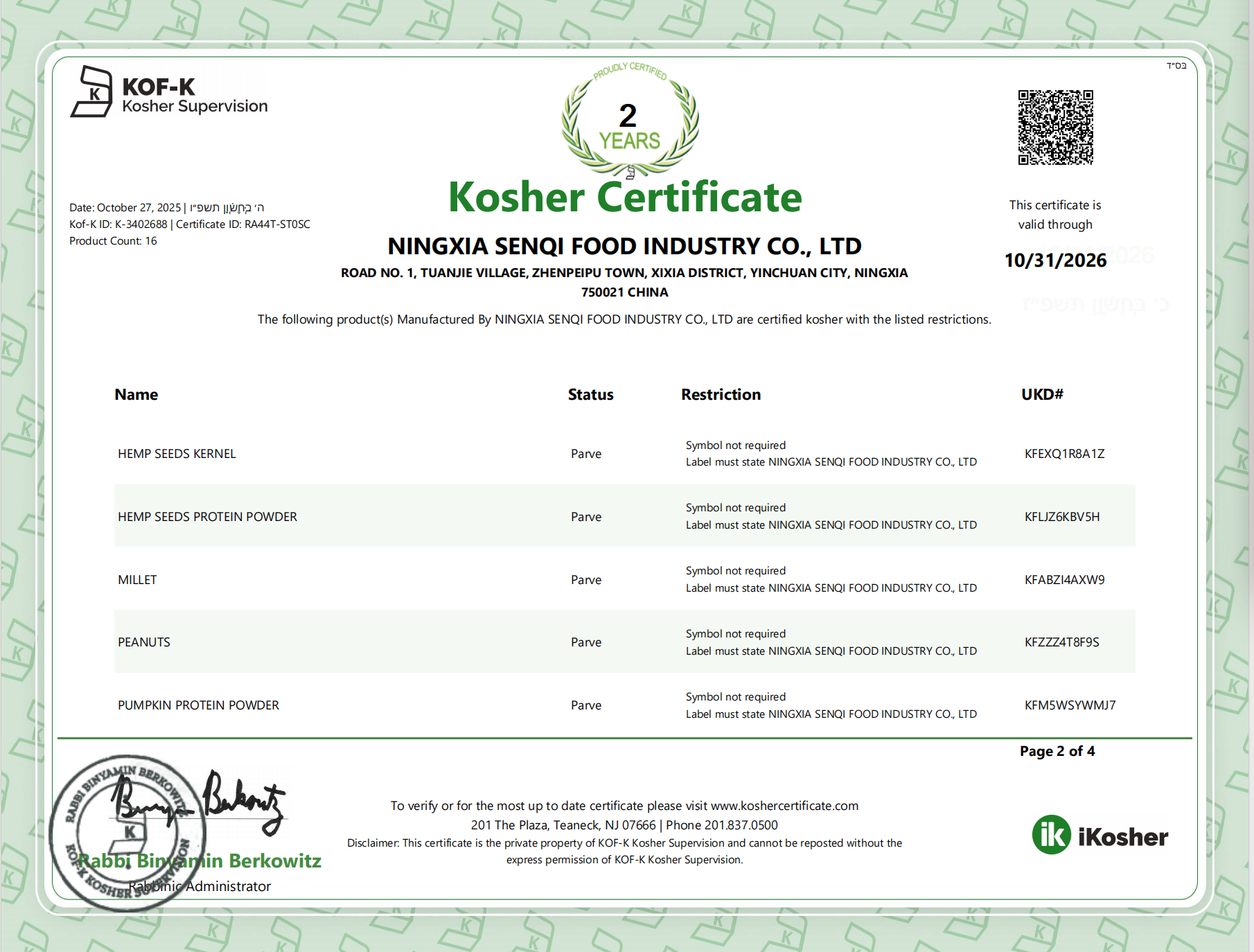
KOF-K kosher certificate RA44T-STOSC covers 16 food products, including hemp seed kernels and hemp seed protein powder, and is valid to 31 October 2026.
Step 4 — Validate the format on your own equipment
The stated acceptance basis for organic hemp seed products is pre-shipment testing, and quality control is carried out by a third-party laboratory. Use that as the release condition for the first batch, and test the format in the position you defined in Step 1 — through the depositor, the mixer or the blender — rather than on a bench. Powder lines at 70% and 75% protein behave differently from hulled seed in a dry blend, and hulled seed behaves differently from whole seed in a cereal cluster.
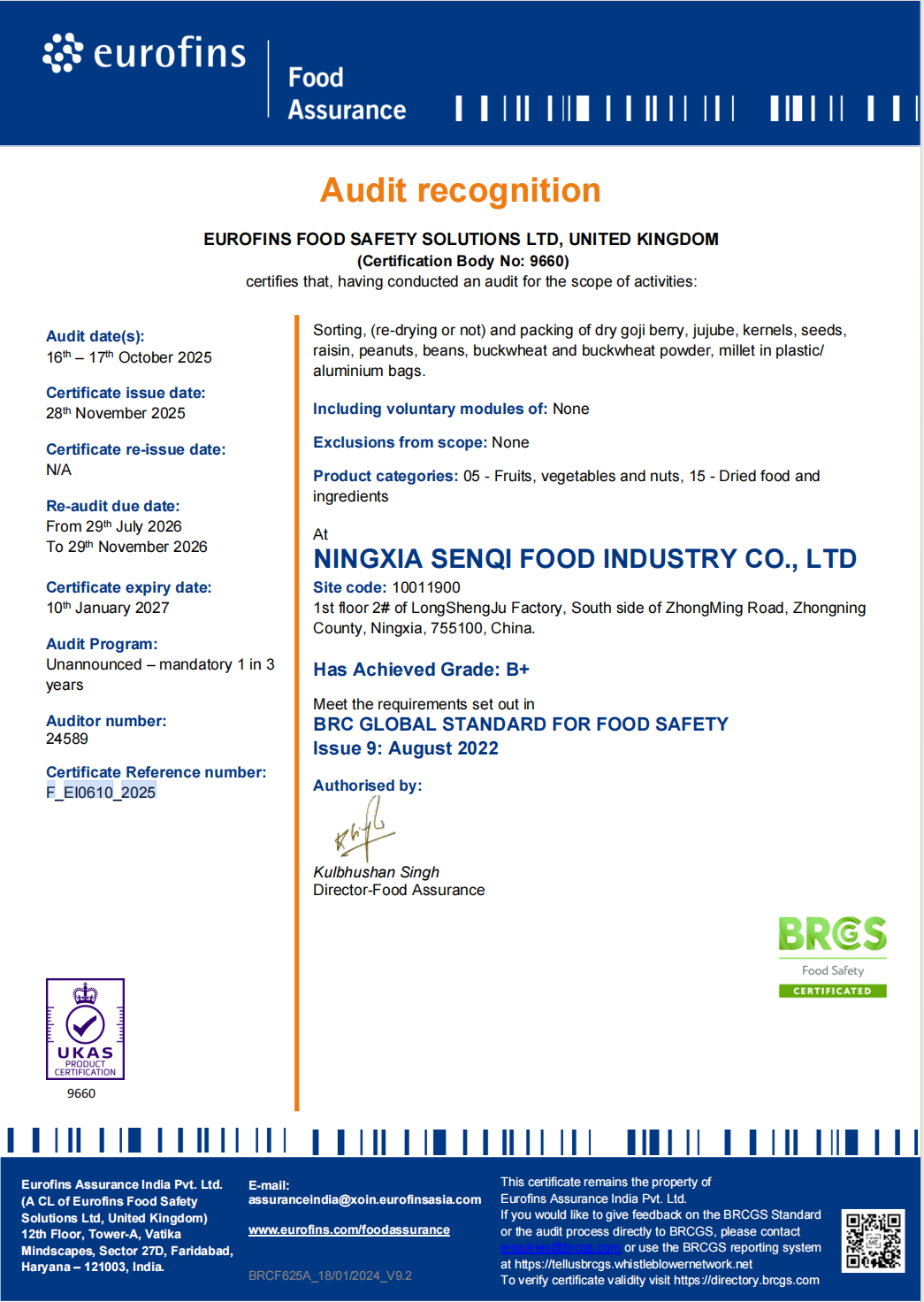
BRC Global Standard for Food Safety Issue 9 certification (F_EI0610_2025, issued by Eurofins) covers sorting, optional re-drying and packing of dry kernels and seeds in plastic or aluminium bags.
Step 5 — Confirm the commercial frame
The documented commercial parameters are a minimum order quantity of 500 kg for organic hemp seed products, a monthly capacity of 200 MT, a lead time of 10–20 days, delivery under FOB, CIF or EXW incoterms, and a 30/70 payment structure. For most bakery and cereal projects the 500 kg MOQ is what makes a format trial viable before a full container commitment, and the 200 MT monthly capacity is what makes the second order less risky than the first.
Step 6 — Scale on batch consistency, not on a single good sample
Once the format is approved, the risk moves from formulation to consistency. Batch-level third-party laboratory testing, colour sorting, metal detection and screening and milling equipment are the documented controls behind the formats, and they are the reason a validated specification can be repeated order after order. Treat consistency data from the second and third shipment as the real confirmation of fit.
Use cases: four line positions and how the formats fit
Sprinkles, toppings and bakery decoration
Sprinkle and topping positions need intact, visible particles. Hulled organic hemp seeds and organic hemp seed kernels are the formats that carry that visual function, and they are the natural fit for decoration on breads, rolls, energy bites and dessert finishes. The dried and unroasted specification keeps the flavour contribution neutral, which matters where a sweet glaze or a fruit note is the intended profile. For toppings, confirm that the particle does not fracture during tumbling or vibration on your depositor.
Baking mixes and gluten-free dough systems
Dry baking mixes can carry hemp seed in two ways: hulled seed or kernels as a visible inclusion, and organic hemp seed protein powder 70% or 75% as a protein-bearing component of the dry blend. Powder lines are the format to specify when the finished pack is positioned around protein, because the 70%–75% documented protein range is what makes a meaningful contribution possible within a realistic inclusion level. Because the documented material is free from artificial additives and complies with EU Organic and USDA Organic standards, it also fits clean-label gluten-free baking systems where the ingredient list has to stay readable.
Smoothie bases and powdered drink blends
In smoothie bases the constraint is dispersion, not appearance. Protein powder lines at 70% and 75% are the formats designed for blending into a powdered base or a liquid system, while hulled hemp seeds suit texture-positioned blends where the consumer expects to see and chew the seed. Hemp seed oil, produced from the whole seed line used for vegetable oil extraction, belongs to a different formulation problem — fat-phase and mouthfeel work rather than protein fortification — and should be specified separately from any seed format. Where the finished product will carry a protein claim, check the claim wording against the nutrition and health claim rules of the destination market before artwork is finalised.
Cereal inclusions and clusters
Cereal inclusions need particles that survive coating, drying and packing. Hulled hemp seeds and kernels are the formats to place in clusters, bars and flake blends where visibility signals the ingredient to the consumer. Where the cereal is positioned on protein, a combination of a visible format and a protein powder format — for example kernels for appearance plus 70% protein powder in the coating or the base — lets one supplier cover both functions, which simplifies both the specification and the audit trail.
Case reference: 24 months of kernel supply into an Australian health food channel
A wholesale customer in Australia has taken 50–80 mt of hemp seed formats over 24 months for health food applications. The reported outcome is stable product quality with high purity and stable batch consistency, and compliance with local food safety standards. For a bakery or cereal manufacturer, the relevant lesson is not the volume but the duration: the format specification held across two years of production because purity and batch consistency were treated as the acceptance criteria from the first order.
Comparison table: format by application and by commercial frame
The first table maps the five catalogue lines to documented specifications and to the line positions where each format is normally specified. The documentation column contains only catalogue and certificate facts; the application column is editorial guidance to be validated on your own line.
| Format (catalogue line) | Documented specification | Line position where it is normally specified | Claim contribution |
|---|---|---|---|
| Organic Hemp seed | Industrial hemp seed, unhulled, dried and unroasted; THC <0.3%; bulk or 25 kg woven bags; food ingredient or vegetable oil extraction | Raw material for hemp seed oil extraction; whole-seed ingredient use | Supports organic and plant-based positioning in the base formulation |
| Organic Hemp seed Hulled | Hulled industrial hemp seed, dried and unroasted; organic; THC <0.3% | Sprinkles, toppings, cereal inclusions, visible inclusions in baking mixes | Visible ingredient declaration; gluten-free and vegan friendly material |
| Organic Hemp Seeds Kernel | Kernel format, organic, dried and unroasted; covered by KOF-K certificate RA44T-STOSC | Cereal clusters, bars, toppings, texture-positioned smoothie blends | Kosher and halal friendly coverage documented separately |
| Organic Hemp Seed Protein Powder 70% | Organic; protein 70%; covered by KOF-K certificate RA44T-STOSC | Dry baking mixes, protein-positioned smoothie bases, cereal coatings | Carries the protein number into a formulation within a realistic inclusion level |
| Organic Hemp Seed Protein Powder 75% | Organic; protein 75% | High-protein baking systems, fortified drink blends, cereal bases | Highest documented protein specification in the portfolio |
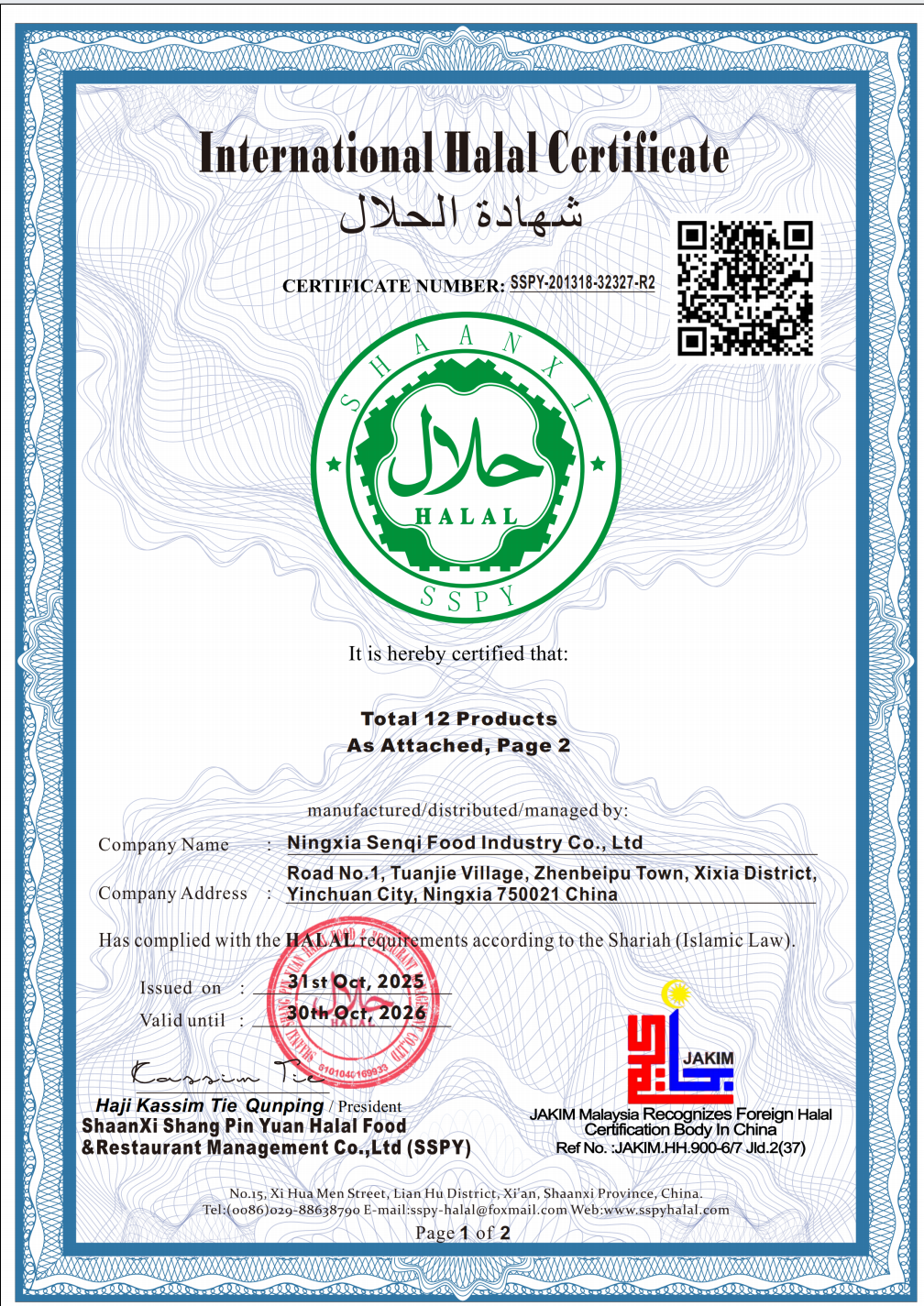
SSPY halal certificate SSPY-201318-32327-R2, issued to Ningxia Senqi Food Industry Co., Ltd. for 12 food products, is valid to 30 October 2026.
| Commercial and documentation parameter | Documented value |
|---|---|
| Minimum order quantity | 500 kg for organic hemp seed products |
| Monthly capacity | 200 MT |
| Lead time | 10–20 days |
| Incoterms | FOB, CIF or EXW |
| Payment structure | 30/70 |
| Acceptance basis | Pre-shipment test; quality control by third-party laboratory |
| Customisation | OEM: logo, product forms (hulled/unhulled, dried, unroasted), packaging. ODM: custom formulations and packaging |
| Certification | EU Organic (IBD, CN-BIO-122.156-0001518.2025.001), USDA NOP (QIMA, 2230009237), BRC Food Safety Issue 9 (Eurofins, F_EI0610_2025), Kosher (KOF-K, RA44T-STOSC), Halal (SSPY, SSPY-201318-32327-R2) |
| Facility and quality frame | Two factories, one sales centre, two planting farms; GMP-standard workshops; export ratio 90%; main markets EU and USA |
FAQ: adapting organic hemp seed formats for bakery, smoothie and cereal production
Which certificates support an organic, kosher and halal claim for hemp seed formats used in EU bakery, smoothie and cereal products?
Organic production is covered by EU organic certificate CN-BIO-122.156-0001518.2025.001 issued by IBD under Regulation (EU) 2018/848, which applies to preparation, distribution, storing and export of un-processed and processed organic plant-based agricultural products, and by USDA NOP certificate 2230009237 issued by QIMA for the US market. Food safety is covered by BRC Global Standard for Food Safety Issue 9 certification F_EI0610_2025 issued by Eurofins. Kosher coverage comes from KOF-K certificate RA44T-STOSC and halal coverage from SSPY certificate SSPY-201318-32327-R2. Because each certificate is issued for a defined product scope, confirm that the exact format on your purchase order is inside that scope before the claim goes on pack.
Can one organic hemp seed OEM manufacturer supply hulled seed, kernels and protein powder 70%/75% for a private label?
Yes. The supplier operates OEM and ODM production. OEM services include customisation of logo, product forms — hulled or unhulled, dried and unroasted — and packaging options, while ODM services add custom formulations and packaging. The catalogue covers Organic Hemp seed, Organic Hemp seed Hulled, Organic Hemp Seeds Kernel, Organic Hemp Seed Protein Powder 70% and Organic Hemp Seed Protein Powder 75%, with a documented protein range of 70%–75% for the powder lines and THC content below 0.3%. Formats are supplied in bulk or in 25 kg woven bags.
What is the minimum order quantity and monthly capacity for organic hemp seed formats?
The minimum order quantity for organic hemp seed products is 500 kg, and monthly capacity is 200 MT. That combination allows a bakery, smoothie or cereal project to validate a format on a small first order and then scale without changing supplier. Delivery can be arranged under FOB, CIF or EXW incoterms, with a stated 30/70 payment structure.
How should a format be validated before a full production order?
The documented acceptance basis is pre-shipment testing, and quality control is performed by a third-party laboratory. Before the first production run, confirm in writing the exact trade name (hulled hemp seed, hemp hearts or hemp seed kernels), the protein specification of any powder line (70% or 75%), the packaging format and the certificate scope, then use the pre-shipment test result as the release condition. Batch consistency, rather than a single approved bench sample, is what protects a bakery, smoothie or cereal line during scale-up, and it is also what preserves the documented purity and batch consistency seen in long-running supply relationships.
What is the lead time for an OEM or ODM hemp seed format order?
Orders are quoted with a lead time of 10–20 days and delivery under FOB, CIF or EXW incoterms. Because the catalogue covers five separate format lines, lead time should be confirmed against the production slot for your specific format and packaging when the order is placed. To start a format evaluation for a bakery, smoothie or cereal project, review the product documentation and send your target specification, line position and packaging requirement to Senqi Food — the minimum order for organic hemp seed products is 500 kg.
Conclusion: choose the format for the line position, then lock the documents around it
The practical sequence for adapting organic hemp seed to bakery, smoothie and cereal lines is short. Define the line position — sprinkle, mix, base or cereal inclusion. Match it to the format that carries the right behaviour: hulled organic hemp seeds or organic hemp seed kernels for visible, intact particles; organic hemp seed protein powder 70% or 75% where the pack is positioned on protein; whole dried and unroasted hemp seed where the requirement is a food ingredient or vegetable oil extraction feedstock. Lock the trade name, protein specification and packaging into the purchase document, confirm each claim against the certificate scope, and release the first batch on a pre-shipment test result.
Senqi Food supplies this portfolio from Ningxia, with EU organic, USDA organic, BRC, kosher and halal documentation, an OEM and ODM service model, a 500 kg minimum order quantity for organic hemp seed products and a 10–20 day quoted lead time. For buyers running an EU-focused bakery or cereal programme, the most useful first step is a format trial against your own line position rather than a comparison of prices for material that behaves differently in each application.
Next step — request the format specification and current brochure
Download the company brochure for the full format and certification overview: Senqi Food Product Brochure. Tell us your line position, target protein level and packaging requirement, and we will confirm the matching format and certificate scope.
Senqi Food | Website: www.generalseeds.cn | Email: info@generalseeds.cn | Tel: +86-951 3812017 / +86 152-2627-7687 | WhatsApp: +86 152-2627-7687
Address: Road No.1 Tuanjie Village, Zhenbeipu Town, Xixia Dist, Yinchuan City, Ningxia, China