
Sodium Hyaluronate Application Guide: Adapting Grades to Cosmetic, Food & Pharma Scenarios
Sodium Hyaluronate Application Guide: Adapting Grades to Cosmetic, Food & Pharma Scenarios
Choosing a sodium hyaluronate grade is a constraint problem, not a preference. One ingredient name covers powders whose molecular weight differs by more than an order of magnitude, and that difference changes viscosity, film behaviour, oral texture, and — most decisively — whether the documentation pack will clear the destination market. This guide links the published molecular-weight windows and certification scope to real project scenarios in cosmetics, food and pharmaceuticals, then sets out a verification sequence a buyer can run before committing to a purchase order.
Why grade adaptation fails when it is treated as a catalogue choice
Most sourcing errors in sodium hyaluronate are not material failures. They are specification mismatches that surface later, in a viscosity reading, a stability batch, or a customs query. Three patterns account for most of them.
Mismatch one: molecular weight versus functional target. A project that needs build, film formation or body in a formulation behaves differently when the powder sits at the low end of the range. Conversely, a project designed around a low molecular weight sodium hyaluronate fraction will not reproduce its intended sensory or processing profile if a higher molecular weight material is substituted. Molecular weight is the primary functional parameter; grade names are only shorthand for it.
Mismatch two: commercial grade name versus regulatory identity. “Pharma grade” is not a marketing tier. In China, for example, the NMPA states that medical sodium hyaluronate products without pharmacological, metabolic or immunological action are managed as medical devices, with the classification no lower than Class II in the cases described in its 2022 announcement. Buyers entering regulated categories therefore need a grade claim that survives regulatory reading, not just a specification sheet.
Mismatch three: material approved, documents missing. A supplier can hold the right molecular weight and still fail the shipment if batch testing records, inspection scope, or origin and treatment documentation are incomplete for the destination market. For US-bound material this includes import requirements administered around APHIS standards, which are separate from the commercial specification.
The constraint set to settle before any quotation:
- Intended end product and the regulatory category it will be sold under.
- Required molecular weight window, expressed in Daltons rather than grade labels.
- Certification scope that must be valid for the destination market.
- Inspection depth, batch documentation and traceability required at goods-in.
- Lead time, minimum order quantity and buffer stock policy.
What the wider industry picture shows about grade demand
Industrial hyaluronic acid is produced today through two routes: extraction from animal tissue, or large-scale bacterial fermentation using genetically modified strains, as described in peer-reviewed production literature. A 2022 review of biotechnological production reports investigated fermentation modes — batch, repeated batch, fed-batch and continuous culture — with hyaluronic acid yields of 2.5 to 7.0 g/L from S. zooepidemicus in the cited studies. That range is a literature figure, not a supplier benchmark, but it explains why fermentation capacity and downstream purification, rather than the molecule itself, differentiate suppliers.
Demand is correspondingly segmented. Fortune Business Insights values the global hyaluronic acid market at USD 11.64 billion in 2025 and projects USD 22.36 billion by 2034, and reports that pharmaceutical grade accounted for 69.3% of product segment share in 2026. For a buyer, the practical reading is simple: the same chemical entity serves several regulatory and commercial identities, and the grade decision determines which of those identities a project can enter.
The grade-to-scenario map
The molecular weight windows below are the working definitions used for project matching. They come from the product specification for sodium hyaluronate and apply across food, cosmetic and pharmaceutical applications.
Food grade — 0.8 to 1.5 million Da
Food grade sodium hyaluronate is specified in the 0.8–1.5 million Dalton range and is intended for food and oral preparation projects. In practice this window balances two competing requirements: enough chain length to deliver the mouthfeel and water-binding that oral formats are formulated around, and a viscosity that remains workable in liquid, sachet and powder-blend lines. Because the material is ingested, the certification emphasis shifts to food safety management — ISO 22000:2018 scope, plus the Kosher and Halal declarations that determine access to specific customer segments.
Cosmetic grade — 1.0 to 1.5 million Da
Cosmetic grade material is specified between 1.0 and 1.5 million Da. Its role in a formulation is usually described in functional terms: humectant, viscosity modifier, filler or viscoelastic material, depending on the system it enters. This is the grade most often requested for emulsions, serums and gel formats, and it is where the interaction between molecular weight and rheology is felt most immediately — a shift within the range can change pour behaviour, rub-in feel and suspension stability. Projects that require a lower molecular weight sodium hyaluronate fraction for light texture are not making a cosmetic-versus-food choice; they are choosing a different point on the molecular weight axis.
Pharma grade — minimum 2.0 million Da
Pharma grade sodium hyaluronate is specified at a minimum of 2.0 million Da. The distinguishing constraints are not only molecular weight but the production environment and testing regime: work on medical and injection grade material involves aseptic cleanroom production, and such products may require sterility and low microbial limits. A buyer evaluating this grade should expect the audit conversation to move from specification to facility — fermentation, ultrafiltration purification, sterile handling and microbial and heavy metal testing capability.
High molecular weight — minimum 2.0 million Da
High molecular weight sodium hyaluronate shares the ≥2.0 million Da floor with pharma grade but is defined as a molecular weight tier rather than a regulatory category. That distinction matters commercially: a high molecular weight material can be quoted for non-pharmaceutical applications where the functional behaviour of a long chain is wanted without the documentation burden of a pharmaceutical claim. Buyers should state the intended end use explicitly so that the quotation matches the tier they actually need.
Low molecular weight — maximum 0.1 million Da
Low molecular weight sodium hyaluronate is specified at a maximum of 0.1 million Da. Because this is a defined ceiling rather than a band, it behaves differently in formulation and requires its own specification discipline: two materials both described as low molecular weight can differ substantially in average chain length below that ceiling. Request the measured distribution, not only the compliance statement.
Super low, ultra low and hydrolyzed variants
Beyond the four principal grades, the product range includes super low molecular weight sodium hyaluronate, ultra low molecular weight sodium hyaluronate, and hydrolyzed hyaluronic acid. These are distinct variants, and the referenced product specification does not publish a numeric window for each. That is not a gap to be filled by assumption: for these variants the correct sourcing action is to request the measured molecular weight distribution and the batch certificate for the specific variant, rather than to extrapolate a range from the low molecular weight ceiling.
A six-step process for adapting a grade to a project
Step 1 — Define the product and its regulatory identity first. Write down what the finished product is, how it will be labelled, and which market it enters. A cosmetic serum, an oral supplement and a medical device sit in different regulatory frames even when the raw material is chemically the same. Fixing this first prevents the common reversal in which a grade is chosen and the compliance route is retrofitted afterwards.
Step 2 — Convert the functional requirement into a molecular weight window. State the target in Daltons. Food projects typically sit at 0.8–1.5 million Da, cosmetic projects at 1.0–1.5 million Da, pharmaceutical projects at a minimum of 2.0 million Da, and low molecular weight projects at a maximum of 0.1 million Da. If the brief calls for hydrolyzed hyaluronic acid, super low or ultra low material, treat the numeric window as a question for the supplier rather than an assumption.
Step 3 — Match certification to the destination market, not to the brochure. For the sodium hyaluronate product (product code 5243), ISO 22000:2018 is held under certificate 104FSMS2400001 with a scope covering sales of sodium hyaluronate and chondroitin sulfate and related food safety management activities, and ISO 9001:2015 (GB/T 19001-2016) is held under certificate 1042Q00053R0S. Both were issued by SHANDONG SEATONE INTERNATIONAL CERTIFICATION CO.,LTD. and apply to the global market. The company's qualification system also includes HACCP, Kosher and Halal, and the product holds COSMOS organic and ISO 16128 certification. Verify that the certificate number, scope and validity cover the grade and the market in question.
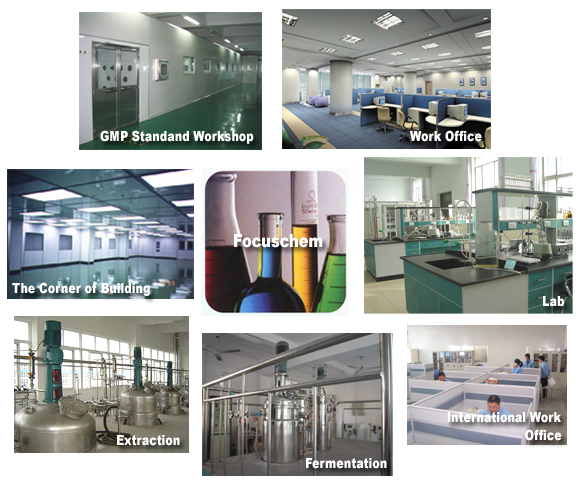
Step 4 — Verify quality control depth before price. Ask three direct questions: is every batch tested, is inspection full-item or partial, and does an independent QC laboratory sit behind the release. Shandong Habier Biopharma Co.,LTD operates 100% full inspection before delivery and maintains an independent QC laboratory; batch testing records are the evidence a receiving site needs at goods-in. A supplier that cannot produce batch-level data for the specific molecular weight window is a supply risk regardless of the certificate list.
Step 5 — Validate on sample, then scale. Free sample supply is available for evaluation, and the minimum order quantity is 1 kg. Use the sample to confirm molecular weight, dissolution behaviour and compatibility with the actual formulation or oral matrix — not only to confirm that the material is sodium hyaluronate. A sample that passes bench testing under the project's own conditions is worth more than any comparative claim.
Step 6 — Protect the timeline with lead time and safety stock. Production lead time is 5–8 days, monthly capacity is 50–60 tons, and a 30-day raw material safety stock is maintained. Those three figures should be read together: capacity addresses the size of an order, lead time addresses the responsiveness of a repeat order, and safety stock addresses the gap between a demand spike and the next production run.
Where the grades land in practice
Cosmetic and skincare blending. A cosmetic skincare raw material blending project running continuously typically uses cosmetic grade material in the 1.0–1.5 million Da window, selected for humectant and viscosity behaviour. Where a lighter sensory profile is required, the project shifts to a lower molecular weight tier rather than to a different supplier.
Oral and food supplement formats. Food grade at 0.8–1.5 million Da is the default for oral preparation projects, supported by ISO 22000 scope, Kosher and Halal documentation, and batch-level food safety records. This is also the segment where avian-origin raw material documentation becomes decisive for US entry.
Pharmaceutical and medical device contexts. Pharma grade at a minimum of 2.0 million Da, produced under aseptic cleanroom conditions where medical or injection use is intended. Sterility and low microbial limits may be required, and the regulatory classification of the finished product — for instance under NMPA medical device rules in China — must be settled in parallel with the material specification.
Custom and OEM/ODM programmes. Where a buyer needs a defined window rather than a catalogue grade, OEM/ODM cooperation with purity adjustment is available, with export supply concentrated on EU and USA markets. Custom programmes are the correct route for projects that cannot be served by a standard window.
Case: 4,733 kg shipped to a US cosmetic and supplement importer
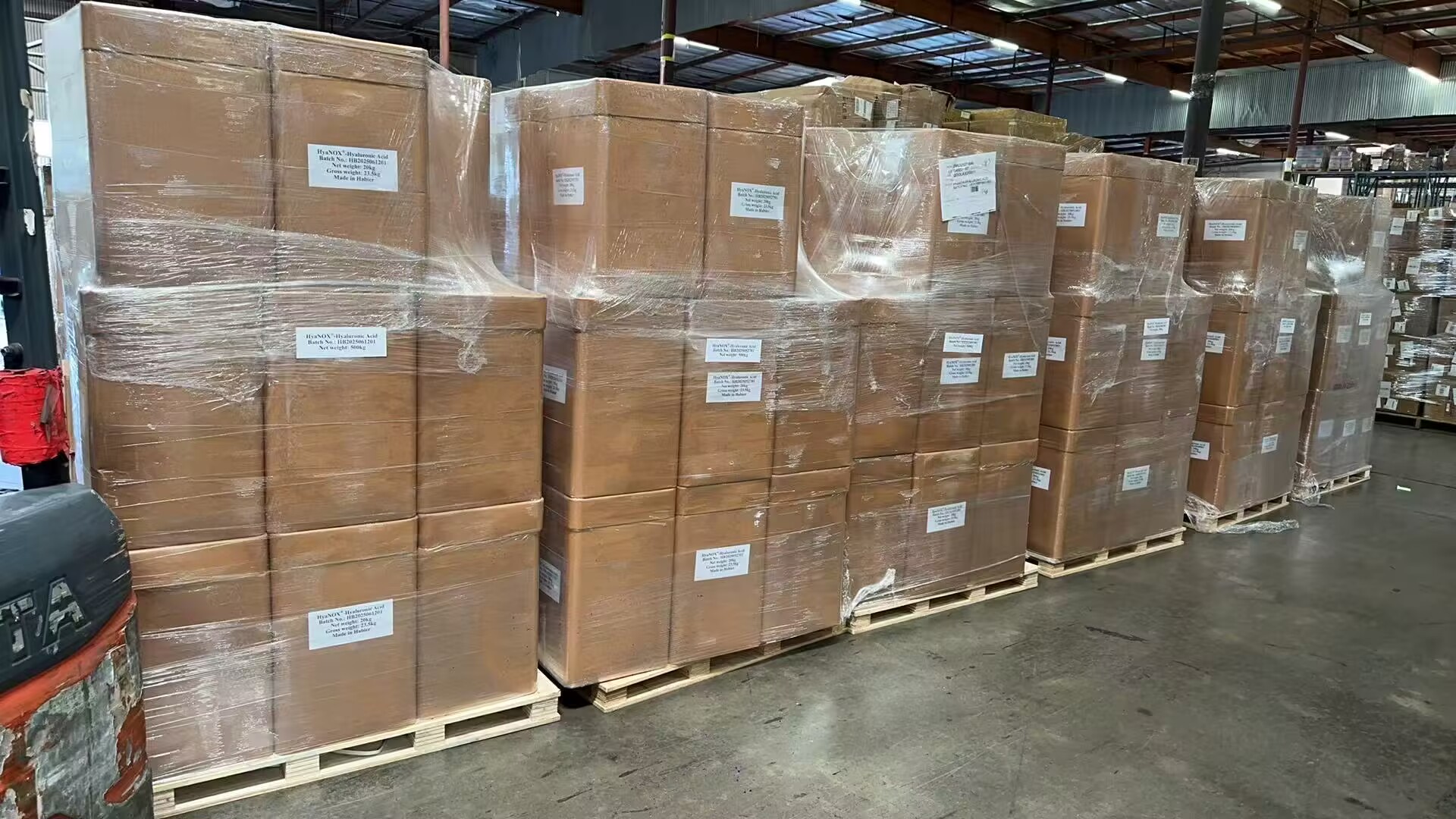
A natural cosmetic and health supplement importer in the United States required hyaluronic acid raw material for both cosmetic raw material use and oral health care supplement production, on a long-term and repeat basis. The order that illustrates the documentation requirement was 4,733 kg, applied across cosmetic raw material and oral supplement applications.
Three elements made the shipment work. First, the raw material was avian-origin material accompanied by complete official veterinary heat treatment certification — a document set that a specification sheet alone cannot substitute for. Second, the material met US APHIS import standards, and clearance was supported by a valid USDA import permit. Third, batch quality was stable enough to support a long-term repeat order rather than a single trial.
The outcome was a stable supply of hyaluronic acid raw material meeting the customer's laboratory, cosmetic and oral care mass production requirements, with smooth customs clearance. The lesson for buyers adapting grades to their own projects is structural rather than commercial: origin documentation, treatment certification and import permits belong in the grade selection checklist at the same level as molecular weight, because a specification match without document alignment still stops at the border.
Grade comparison at a glance
| Grade / variant | Specified molecular weight | Project fit | Verification emphasis |
|---|---|---|---|
| Food grade | 0.8–1.5 million Da | Food and oral supplement projects | ISO 22000:2018 scope, Kosher and Halal documents, batch records |
| Cosmetic grade | 1.0–1.5 million Da | Emulsions, serums, gel formats | ISO 9001:2015, microbial limits to project specification |
| Pharma grade | Minimum 2.0 million Da | Pharmaceutical and medical applications | Cleanroom production, sterility and low microbial limits where required |
| High molecular weight | Minimum 2.0 million Da | Projects needing long-chain behaviour outside a pharma claim | Measured distribution, intended end use stated in the quotation |
| Low molecular weight | Maximum 0.1 million Da | Projects needing a shorter chain profile | Measured distribution below the ceiling, batch certificate |
| Super low, ultra low, hydrolyzed | Distinct variants; numeric windows not stated in the referenced specification | Specialised texture or processing targets | Per-variant molecular weight distribution and batch certificate from the supplier |
Table values reflect the sodium hyaluronate product specification for food, cosmetic, pharma, high molecular weight and low molecular weight grades. Where the specification does not publish a numeric window, none is inferred here.
Frequently asked questions
1. Which certifications actually cover the sodium hyaluronate product, and for which markets?
The sodium hyaluronate product (product code 5243) holds ISO 22000:2018 under certificate number 104FSMS2400001, with a scope covering sales of sodium hyaluronate and chondroitin sulfate and related food safety management activities, and ISO 9001:2015 (GB/T 19001-2016) under certificate number 1042Q00053R0S. Both certificates were issued by SHANDONG SEATONE INTERNATIONAL CERTIFICATION CO.,LTD. and apply to the global market. The company's qualification system additionally includes HACCP, Kosher and Halal, and the product is certified for COSMOS organic and ISO 16128. Buyers should confirm that the certificate scope names the specific grade being purchased.
2. Can one supplier cover food, cosmetic, pharma, low, super low, ultra low and hydrolyzed grades?
Yes. Shandong Habier Biopharma Co.,LTD produces sodium hyaluronate across food grade, cosmetic grade, pharma grade, high molecular weight and low molecular weight grades, and the type range extends to super low molecular weight sodium hyaluronate, ultra low molecular weight sodium hyaluronate and hydrolyzed hyaluronic acid. Monthly capacity is 50–60 tons, with OEM/ODM cooperation and purity adjustment available for projects that need a defined window rather than a catalogue grade.
3. What commercial terms determine the cost of a grade-specific order?
Unit price is not published and is quoted against the specific grade, molecular weight window and documentation scope. The terms that are published and that materially change the landed cost picture are the minimum order quantity of 1 kg, a production lead time of 5–8 days, and monthly capacity of 50–60 tons. Because the molecular weight window drives both the production step and the testing burden, a quotation for low molecular weight or hydrolyzed material should not be compared line-for-line with a food grade quotation without checking the inspection scope behind each.
4. How does sample validation work before a full order?
Free sample supply is available. The correct use of the sample is to verify the measured molecular weight distribution, dissolution behaviour and compatibility with the actual formulation or oral matrix, and to confirm the batch certificate and certification scope that will accompany commercial shipments. A sample that performs under the project's own bench conditions — rather than only matching a certificate — is the practical basis for approving a grade.
5. What lead time and inventory support should a repeat buyer expect?
Production lead time is 5–8 days, and a 30-day raw material safety stock is maintained to bridge demand variability between production runs. For export orders, documentation also affects the timeline: the 4,733 kg US shipment for a natural cosmetic and health supplement importer cleared smoothly because avian-origin material was supported by complete official veterinary heat treatment certification and met US APHIS import standards under a valid USDA import permit. Buyers planning repeat orders should therefore validate documents and lead time in the same review. To move from evaluation to a quotation or a sample request, contact the team at jake@habier.com.
Conclusion: fix the window, then fix the documents
Adapting sodium hyaluronate to a project comes down to two decisions made in the right order. First, fix the molecular weight window against the functional target — 0.8–1.5 million Da for food, 1.0–1.5 million Da for cosmetic, a minimum of 2.0 million Da for pharma and high molecular weight, a maximum of 0.1 million Da for low molecular weight, and a supplier-confirmed distribution for super low, ultra low and hydrolyzed variants. Second, fix the documentation: ISO 9001:2015 and ISO 22000:2018 certificates with global scope, food safety and religious-compliance declarations, batch testing and full inspection records, and — for US-bound material — origin, veterinary heat treatment and APHIS-aligned import documentation.
Shandong Habier Biopharma Co.,LTD was established in 2015 and operates from Qufu City, Shandong, China, supplying food, cosmetic and pharmaceutical grade sodium hyaluronate to EU, USA and Korea markets. Capacity, lead time and a 30-day raw material safety stock are the operational levers; molecular weight and certification scope are the technical ones.
Request a grade-matched sample or quotation
Share the intended application, target molecular weight window and destination market, and the team will confirm the matching grade, certification scope and documentation set.
Email: jake@habier.com | Tel: +86-186-0537-0487 | Website: www.habier.com
Address: 16F Building A Xingguangtiandi International Square, Qufu City, Shandong, China 273100
Download the product catalogue: Habier Biopharma brochure (PDF)
Certification and specification details in this guide refer to the sodium hyaluronate product (product code 5243) as documented at the time of publication. Buyers should confirm current certificate validity and grade specifications at the time of order.
Have Questions or Need More Details?
Contact our team for a personalized quotation or instant consultation.
Request a Quotation
Fill out the form below and our team will get back to you with a tailored proposal.
WhatsApp Direct Chat
Prefer to chat in real-time? Message us on WhatsApp for instant assistance & quick answers.
- Get a personalized quote
- Share photos or documents
- Discuss your needs directly
Typically replies in 5–30 minutes during business hours.