
Sodium Hyaluronate Sourcing Problem-Solved: How to Ensure Supply Stability and Quality
Sodium hyaluronate sourcing rarely fails because a buyer picked the wrong grade. It fails because the lot that passed validation in month one does not repeat in month five, or because the supplier's only running fermentation train is taken offline in the middle of a product launch. Both failures are structural, and both become visible during supplier evaluation — provided the buyer knows which structures to inspect.
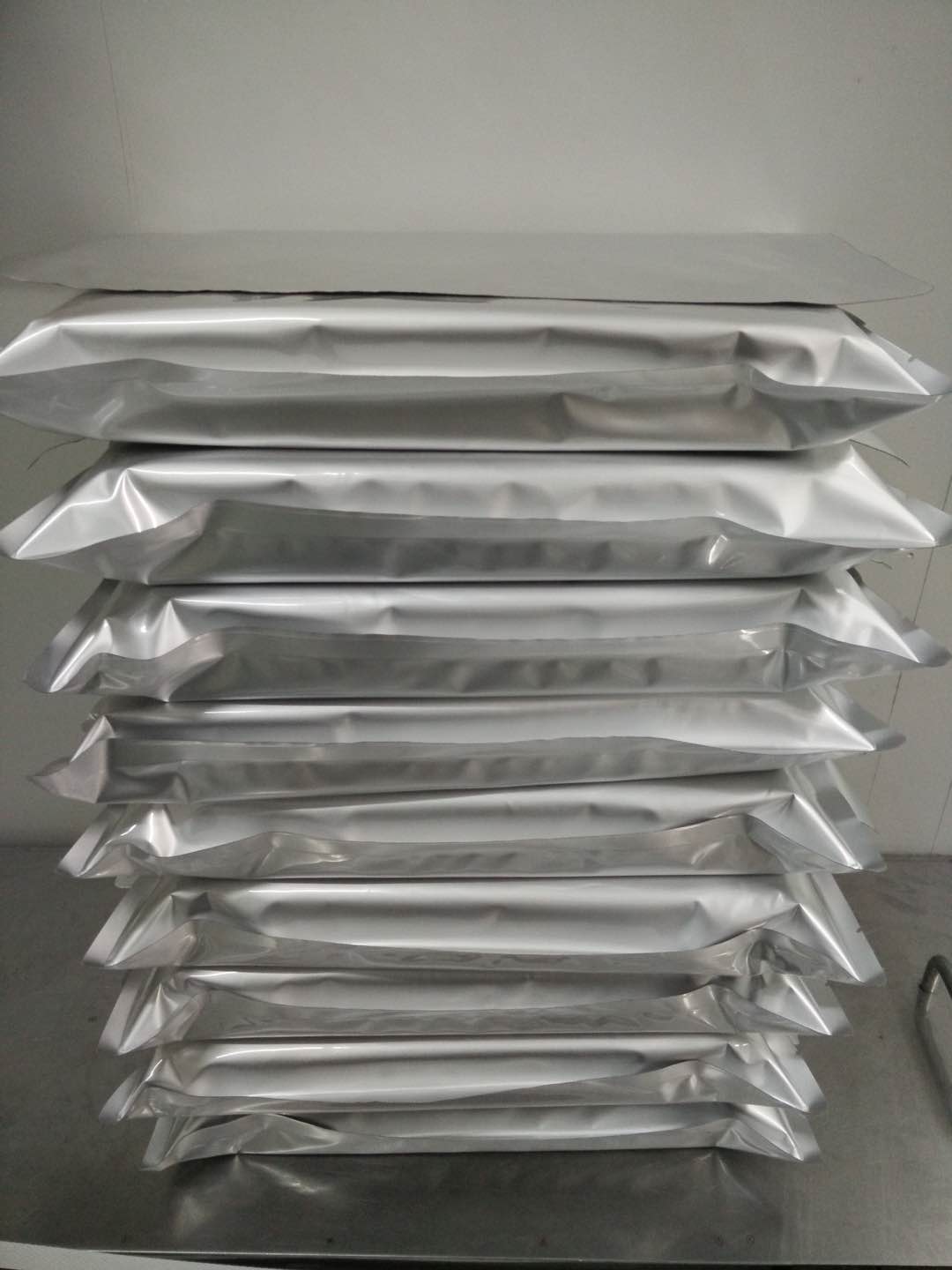
Supply stability in sodium hyaluronate rests on four supplier-side structures: installed capacity with headroom, independent fermentation and purification assets, buffered raw-material inventory, and process parameters that are locked rather than re-tuned per campaign. Quality consistency rests on defined molecular weight windows for each grade, in-house microbial and heavy-metal testing, and full inspection before delivery. Shandong Habier Biopharma Co.,LTD — a sodium hyaluronate manufacturer established in 2015 in Qufu City, Shandong Province, China, operating a 50,000 m² site with an annual output of 600–700 MT — publishes the parameters that let buyers test those structures before committing.
Problem Definition: The Two Sourcing Failures Buyers Actually Face
Procurement teams usually describe sourcing problems as "quality issues" or "delivery issues." In practice, sodium hyaluronate supply breaks in two separable ways, and each has its own root cause and its own verification path.
Failure one: the specification is met, but the process is not in control
A certificate of analysis confirms that a lot passed. It does not confirm that the next lot will land in the same place inside the specification window. The properties that move most in sodium hyaluronate powder are molecular weight distribution, moisture, microbial limits and heavy-metal content. When a supplier's declared window is wide and the process is adjusted campaign by campaign, a cosmetic grade hyaluronic acid that measured near the middle of its range during validation can reappear at the bottom of that range months later — still compliant on paper, no longer matched to the viscosity, texture or sensory profile the formulation was designed around.
The windows themselves are not secrets. Declared grade parameters place food grade sodium hyaluronate at 0.8–1.5 million Da, cosmetic grade sodium hyaluronate at 1.0–1.5 million Da, pharma grade sodium hyaluronate at a minimum of 2.0 million Da, high molecular weight grade at a minimum of 2.0 million Da, and low molecular weight grade at a maximum of 0.1 million Da. What separates one supplier from another is whether those windows are held by fixed parameters or revisited each time production is scheduled.
Failure two: the contract is signed, but capacity is not reserved
The second failure looks like a supply interruption but usually starts as an allocation problem. A supplier quotes a monthly tonnage that is also being sold to other accounts. When one fermentation train is stopped for cleaning, sterilisation, maintenance or an out-of-specification investigation, committed orders queue behind whatever is still running. Buyers then experience the classic pattern: acceptable service for two quarters, then partial shipments, then a request to accept a substitute grade window.
Neither failure can be solved by tightening a purchase order clause after the fact. Both are solved upstream, at the point where the supplier's physical layout and control philosophy are defined — which is exactly what a buyer can inspect.
Industry Background: Why Consistency Is a Process Question, Not a Testing Question
Industrial hyaluronic acid is produced by one of two routes: extraction from animal tissue, or large-scale bacterial fermentation using genetically modified strains. Fermentation underpins most modern capacity, and it is a biological process — which is precisely why the producer's control discipline matters more than the certificate of analysis attached to any single lot.
Published reviews of hyaluronic acid fermentation report yields in the range of 2.5 to 7.0 g/L across batch, repeated batch, fed-batch and continuous culture studies. That spread is a literature range, not a market benchmark, but it carries a practical message: fermentation output responds strongly to how temperature, feeding and culture conditions are managed. Downstream processing — purification and drying — then determines what the finished powder actually contains, including residual impurities and moisture.
Grade economics explain where quality systems concentrate. Pharmaceutical grade hyaluronic acid is reported to account for 69.3 percent of product segment share by value in 2026, and its minimum molecular weight requirement begins at 2.0 million Da — the top of the range, where microbial control and traceability carry the most weight. The global hyaluronic acid market was reported at USD 11.64 billion in 2025 by Fortune Business Insights, with continued growth projected. Buyers are therefore reserving capacity in a market that is still expanding, which makes supplier-side redundancy a commercial issue rather than a technical nicety.
Detailed Solution: Five Controls That Make Sodium Hyaluronate Supply Predictable
A supplier that genuinely solves the two failures above does so with five controls. Each one can be verified before a purchase order is issued, and each one produces a document or a number a buyer can hold.
1. Published capacity with headroom — not just a capacity claim
Capacity that is already fully allocated is not capacity. The first control is a supplier that can state both its total output and its typical loading. Shandong Habier Biopharma reports a monthly capacity of 50–60 tons against an annual output of 600–700 MT, produced on a 50,000 m² site with 123 employees, and an export ratio of around 20 percent serving the EU, USA and Korea. For a buyer, the useful question is not the headline number but the relationship between the monthly figure and the annual run rate: it shows how much of the year is planned, and how much slack exists for a new program or a demand spike.
2. Independent fermentation and multi-line layout
Redundancy is the difference between a maintenance week and a supply crisis. Ask how many fermentation trains or suites a supplier can run independently, whether purification and drying are shared across those trains, how long a cleaning and sterilisation changeover takes, and what happens to committed orders when one train is pulled for investigation. A layout in which a single train, a single purification skid or a single dryer serves the entire site concentrates risk: one stoppage stops everything.
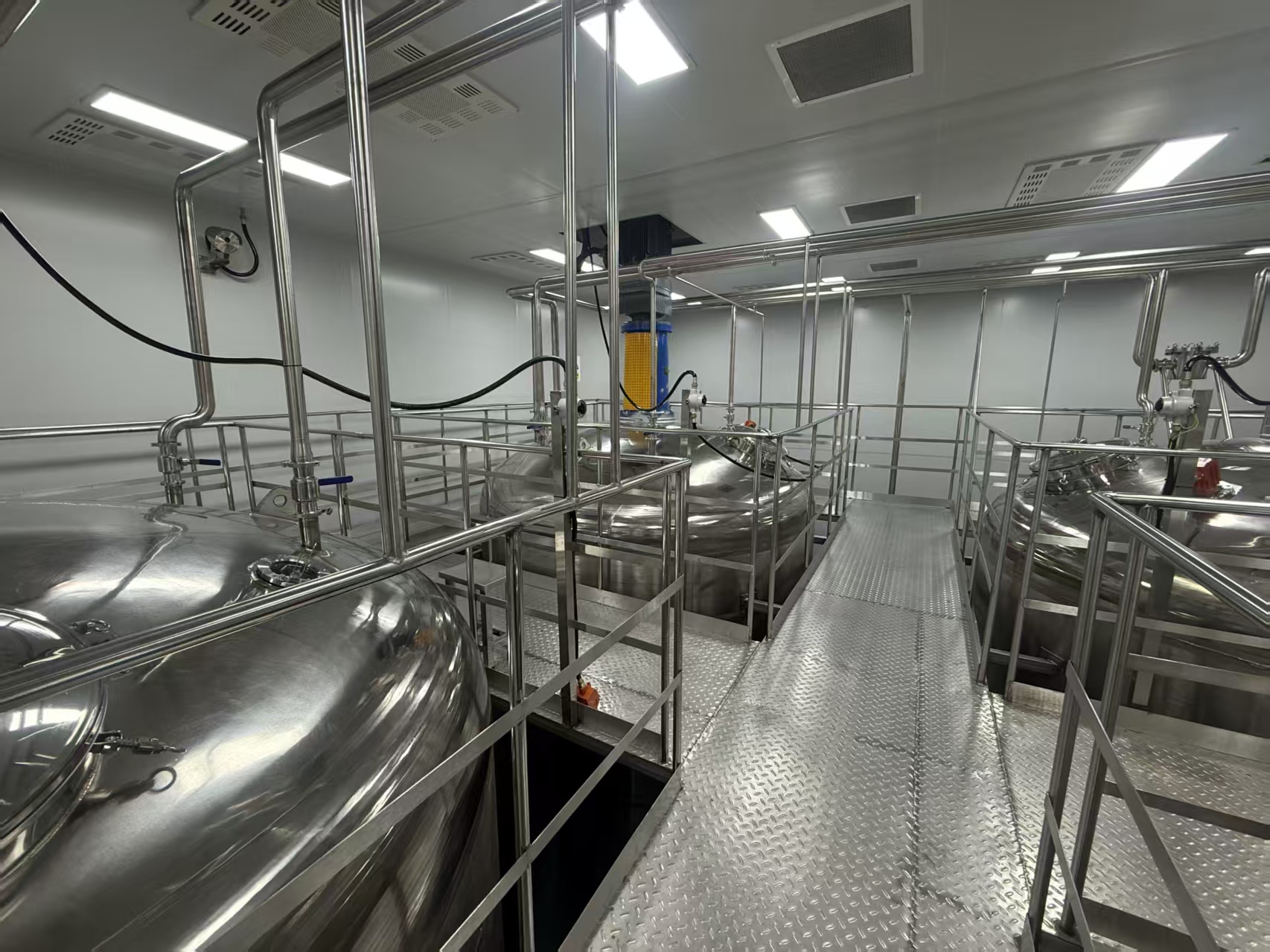
Habier's production environment, as described for cosmetic skincare raw material blending projects, includes fermentation bioreactors, ultrafiltration purification equipment, sterile mixing tanks, vacuum emulsifiers, cleanroom filling machines, low-temperature drying ovens and microbial and heavy-metal testing instruments, operated on a 24/7 schedule. The correct way to read an equipment list like this is not as a throughput claim but as a map: it tells the buyer which stages exist on site, and therefore which stages must be interrogated for independence.
3. Raw-material safety stock
Fermentation media, processing aids and packaging inputs each have their own lead times, and a shortage of any one of them stops a fermentation train as effectively as equipment failure. The verification question is specific: what minimum buffer is physically held on site, which inputs are covered by that buffer, how are media suppliers qualified, and is the buffer physical stock or a contracted call-off? A supplier that answers these questions in operational terms — rather than with a promise of "sufficient stock" — has usually thought about continuity before the buyer asked.
4. Fixed production parameters and locked grade windows
This is the control that solves batch-to-batch drift. Low-temperature fermentation synthesis followed by ultrafiltration and low-temperature drying gives the producer several levers; consistency comes from deciding those levers once, documenting them, and holding them across campaigns instead of adjusting them to rescue a batch. The observable output of that discipline is a grade window that does not wander.
Molecular weight is the clearest expression of parameter control, because it is measurable and it is grade-defining. Variation also comes from the type a buyer orders rather than only from the process: hydrolyzed hyaluronic acid, super low molecular weight sodium hyaluronate, ultra low molecular weight sodium hyaluronate and low molecular weight sodium hyaluronate each sit in a different part of the distribution, and the same supplier may hold all of them on one site. Where an application needs a tighter window, Habier supports OEM/ODM engagement with purity adjustment, backed by a research and development team of six engineers. Naming conventions vary across the market — the same material may be quoted as sodium hyaluronate, hyaluronic acid sodium salt or hyaluronic acid, and standard-range material is frequently listed as regular grade sodium hyaluronate or regular grade hyaluronic acid — so a buyer should confirm the molecular weight window in writing rather than rely on the grade label alone.
5. Inspection density and management-system evidence
Testing strategy is the last line of defence, and its density matters as much as its existence. Habier states 100 percent full inspection before delivery, supported by in-house microbial and heavy-metal testing instruments. Density of inspection is what turns a parameter-locked process into a shipped guarantee: every lot is checked, rather than a sample drawn from a campaign.
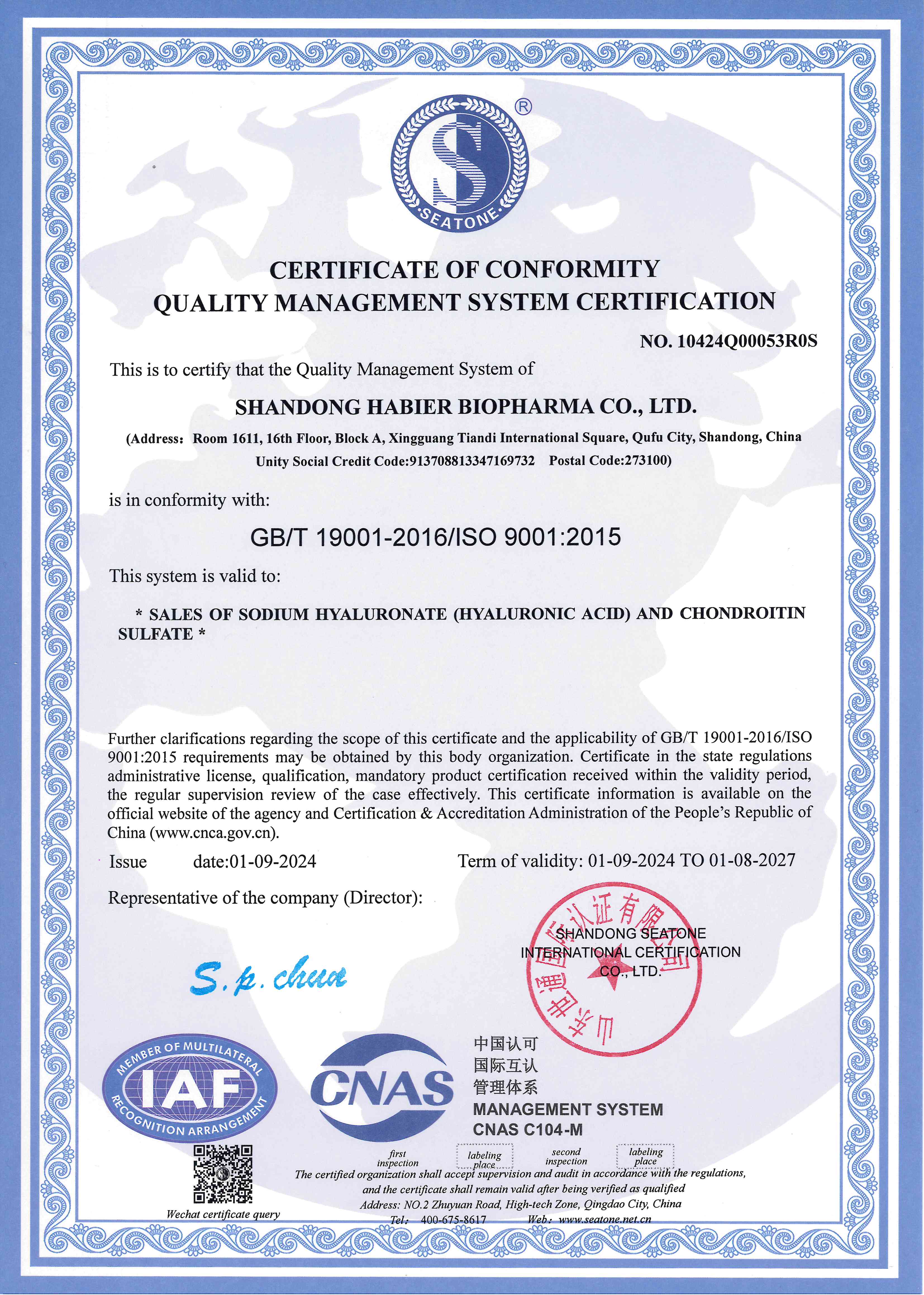
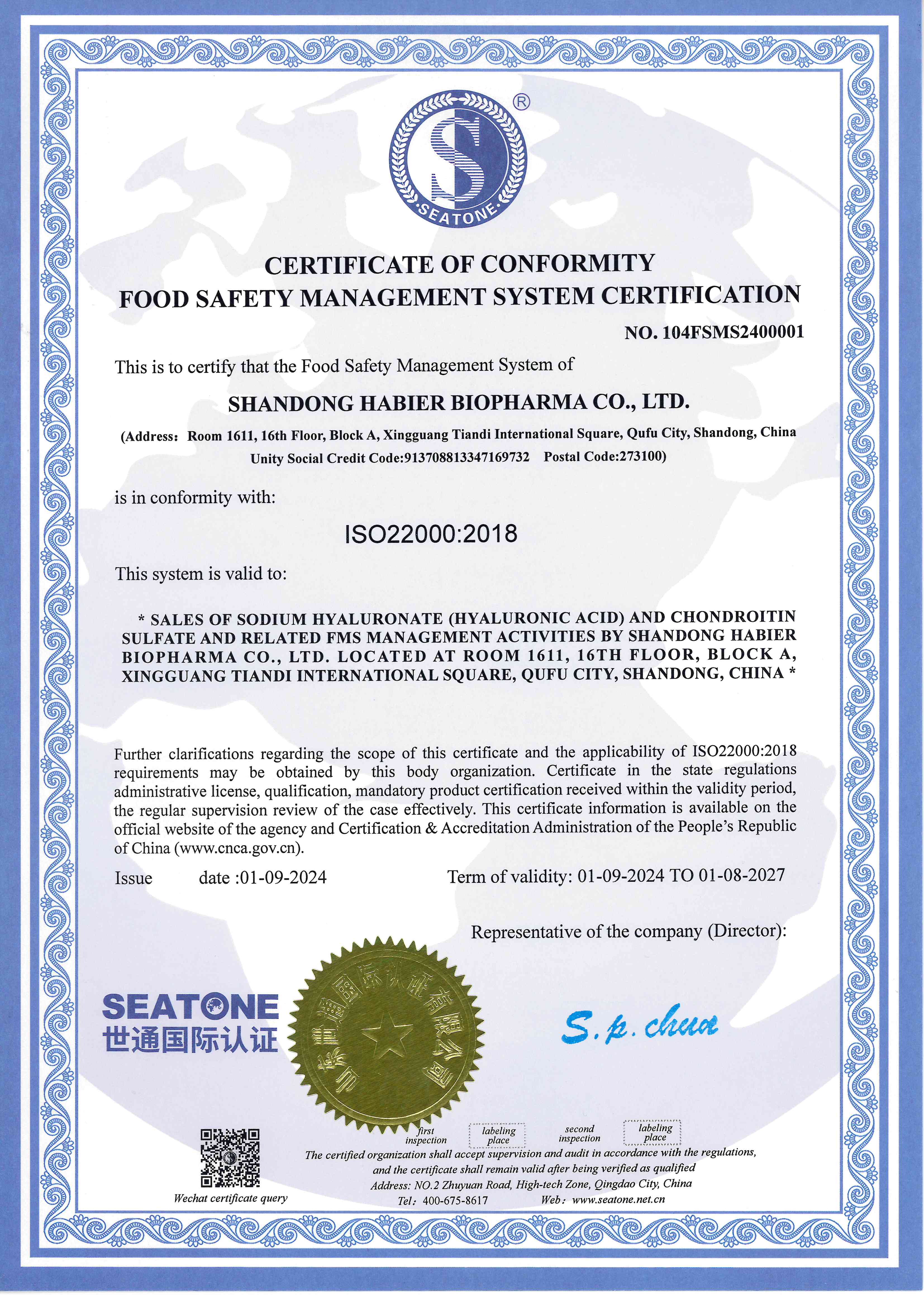
Behind the inspection regime sits the management system. The Sodium Hyaluronate product (product code 5243) holds ISO 9001:2015 certification under GB/T 19001-2016 / ISO 9001:2015, certificate number 1042Q00053R0S, and ISO 22000:2018 certification under certificate number 104FSMS2400001; both were issued by SHANDONG SEATONE INTERNATIONAL CERTIFICATION CO.,LTD on 1 September 2024, are valid until 8 January 2027, and apply to the global market. The ISO 22000:2018 scope covers sales of sodium hyaluronate (hyaluronic acid) and chondroitin sulfate and related food safety management activities. The company's qualification system also includes HACCP, Kosher and Halal, and its products are certified as organic COSMOS and to ISO 16128.
Where the bar rises: medical and injectable grade products may require sterility and low microbial limits, which in turn require aseptic cleanroom production. Buyers sourcing at that level should verify cleanroom classification and microbial release criteria as separate items, not assume they are covered by a food-safety certificate.
Step-by-Step Breakdown: Seven Checks Before You Commit
The sequence below converts the five controls into a sourcing workflow. It is ordered deliberately: each step narrows the specification before the next step spends time on commercial detail.
- Lock the grade and the molecular weight window to the application. Start from the end use — food or supplement, cosmetic formulation, or pharmaceutical — and write the target window into the specification. Food grade sits at 0.8–1.5 million Da, cosmetic grade at 1.0–1.5 million Da, pharma grade at a minimum of 2.0 million Da, and low molecular weight grade at a maximum of 0.1 million Da. Confirm whether the material is standard range, high molecular weight, low molecular weight, ultra low, super low or hydrolyzed hyaluronic acid.
- Read the certificate scope, not the logo. Check certificate number, issuing body, issue date, expiry date and scope wording. A certificate that does not name sodium hyaluronate, or that has lapsed, does not support the claim it is being used to support.
- Map capacity to redundancy. Obtain the monthly tonnage and then ask how that tonnage is distributed across fermentation trains, purification skids and dryers. A supplier with 50–60 tons per month concentrated in one train behaves very differently from one where output is spread across independent assets.
- Interrogate raw-material stocking. Ask which inputs are buffered on site, at what minimum level, and how media suppliers are qualified. Treat a vague answer as a risk flag rather than a courtesy.
- Request a parameter control statement and a certificate-of-analysis trend. One COA proves one lot. A trend across ten or more lots shows whether the molecular weight, moisture and microbial results are centred and stable, which is the real evidence of locked parameters.
- Verify inspection capability. Confirm whether microbial and heavy-metal testing are performed in house, what the release procedure is, and whether inspection covers 100 percent of lots before delivery.
- Validate market-access documentation and logistics. For US-bound material of animal origin, official veterinary heat treatment certification and APHIS-aligned documentation belong in the file before the first shipment, not after it. Confirm the stated lead time in writing, together with the QC release step that sits inside it.
Use Cases: Where These Controls Change the Outcome
A US cosmetic and supplement importer running repeat orders
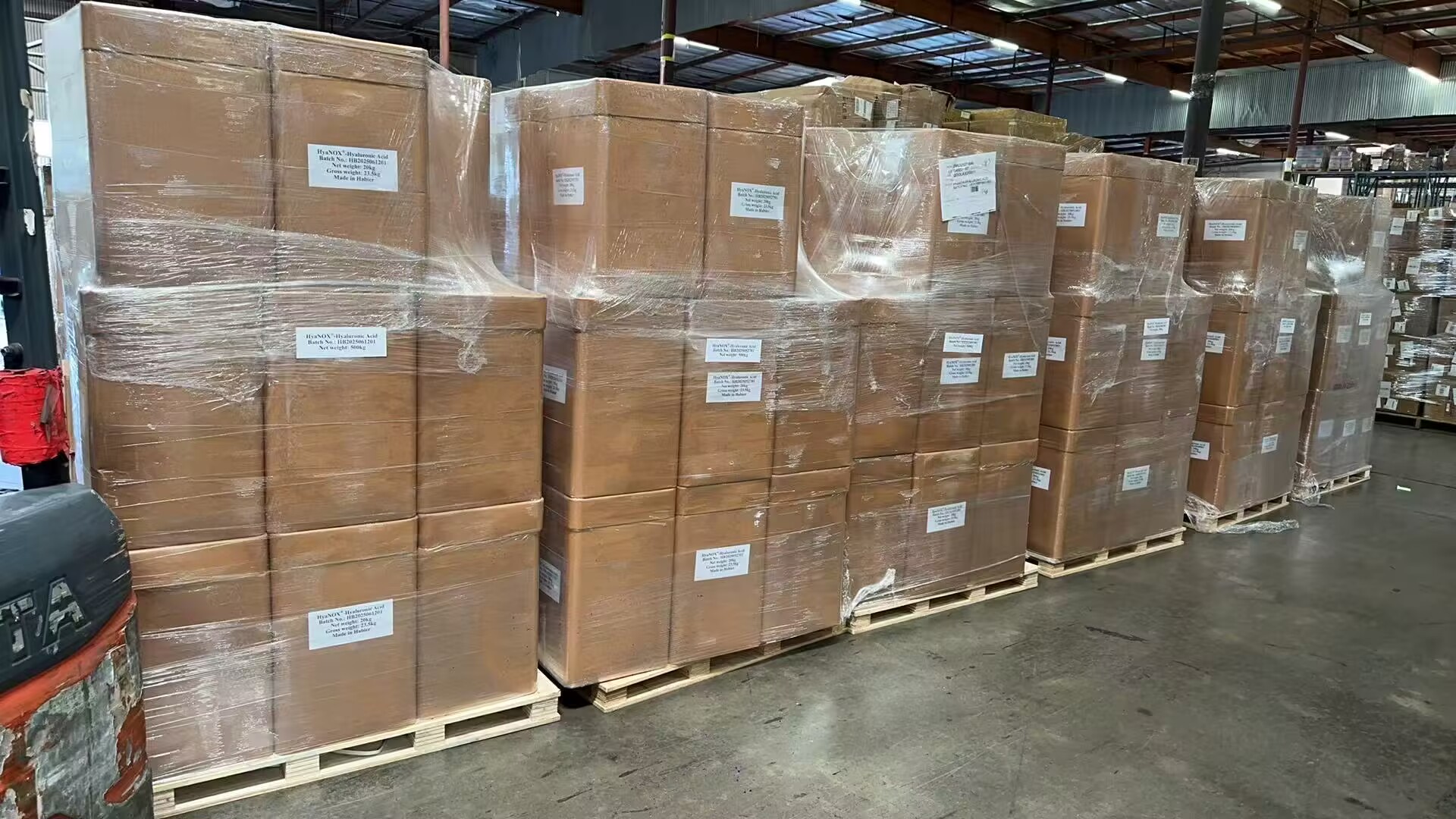
A natural cosmetic and health supplement importer in the United States has taken 4,733 KG of sodium hyaluronate for cosmetic raw material and oral health care supplement production, on a long-term stable basis. The material is avian-origin, supplied with complete official veterinary heat treatment certification and meeting US APHIS import standards, which allowed customs clearance supported by a valid USDA import permit. The reported result was stable supply of high-purity hyaluronic acid raw material meeting laboratory, cosmetic and oral care mass production demands, with stable batch quality and repeat ordering. This is the case where documentation and consistency intersect: the specification was met, and the paperwork held at the border.
Cosmetic skincare raw material blending
In a US cosmetic skincare raw material blending project, sodium hyaluronate functions as a humectant, viscosity modifier or filler depending on the grade selected. The operating environment is demanding: low-temperature fermentation synthesis upstream, and for medical or injection grade, aseptic cleanroom production. Because the formulation's texture depends on molecular weight, the cosmetic grade window of 1.0–1.5 million Da has to repeat, which makes parameter locking more commercially important here than the price per kilogram.
Food and oral supplement programs
Food grade sodium hyaluronate at 0.8–1.5 million Da sits under food-safety rather than pharmaceutical logic. The controls that matter are microbial limits, heavy metals and moisture, all of which fall inside the ISO 22000:2018 scope covering sales of sodium hyaluronate and related food safety management activities.
Pharmaceutical and injectable-adjacent projects
Pharma grade begins at a minimum of 2.0 million Da and may require sterility and low microbial limits. Buyers in this segment should treat cleanroom conditions, microbial release criteria and traceability as separate verification items, and should expect the highest documentation burden of any grade.
Comparison Table: Grade Windows and Verification Focus
The table below organises the declared molecular weight windows by grade and pairs each with the control point a buyer should verify. All windows are the manufacturer's declared parameters.
| Grade / type | Declared molecular weight | Primary verification focus |
|---|---|---|
| Food grade sodium hyaluronate | 0.8–1.5 million Da | Microbial limits, heavy metals, moisture, food-safety system scope |
| Cosmetic grade sodium hyaluronic acid | 1.0–1.5 million Da | Molecular weight repeatability, purity, sensory and viscosity behaviour |
| Pharma grade sodium hyaluronate | Min. 2.0 million Da | Sterility and low microbial limits where required, cleanroom conditions, traceability |
| High molecular weight grade | Min. 2.0 million Da | Parameter lock at the top of the range; distribution width |
| Low molecular weight grade | Max. 0.1 million Da | Controlled depolymerisation, batch-to-batch distribution width |
| Other declared types | Hydrolyzed hyaluronic acid; super low molecular weight sodium hyaluronate; ultra low molecular weight sodium hyaluronate | Written specification per order, confirmed against a COA trend |
A second table is more useful during a supplier conversation than during desk research. It converts the two failures into three questions and three pieces of evidence.
| Sourcing risk | Question to ask | Evidence to request |
|---|---|---|
| Batch-to-batch drift | Are process parameters locked, or re-tuned per campaign? | Parameter control statement plus a COA trend across multiple lots |
| Single-train downtime | How many fermentation trains run independently, and what is shared? | Line layout description and planned maintenance windows |
| Raw-material shortage | What buffer stock is held, and for which inputs? | Stock policy and media supplier qualification records |
| Certification scope mismatch | Does the certificate name sodium hyaluronate and remain in date? | Certificate number, scope, issue and expiry dates |
| Market-access documentation | Which official certificates travel with animal-origin material? | Veterinary heat treatment certification and import permits |
| Late delivery | What lead time is stated, and what sits inside it? | Lead time in writing plus the QC release procedure |
FAQ
1. Which certifications should a sodium hyaluronate supplier hold for EU and US shipments?
Buyers most often request ISO 9001 and ISO 22000, and both must be checked for scope and validity. Shandong Habier Biopharma holds ISO 9001:2015 certification number 1042Q00053R0S and ISO 22000:2018 certification number 104FSMS2400001, both issued by SHANDONG SEATONE INTERNATIONAL CERTIFICATION CO.,LTD on 1 September 2024 and valid until 8 January 2027 for the global market; the ISO 22000 scope covers sales of sodium hyaluronate and related food safety management activities. The qualification system also includes HACCP, Kosher and Halal, with organic COSMOS and ISO 16128 product certification. For US-bound animal-origin material, official veterinary heat treatment certification and APHIS-aligned documentation should be in the file.
2. Can a supplier adjust purity and molecular weight range to my specification?
Yes, where the supplier runs OEM/ODM engagement with purity adjustment, as Habier does. The practical route is to define the target window first and then confirm which declared type meets it — standard range, high molecular weight, low molecular weight at a maximum of 0.1 million Da, super low molecular weight, ultra low molecular weight, or hydrolyzed hyaluronic acid. Habier's research and development team of six engineers supports this adjustment work, and the minimum order quantity of 1 kg allows a specification to be tested before it is scaled.
3. What drives cost, and what is the minimum order quantity?
The minimum order quantity is 1 kg. Cost is driven less by the grade label than by four variables: the molecular weight window and how tight it is, the grade family and its testing burden, the documentation package required for the destination market, and the packaging format. A pharma grade specification at a minimum of 2.0 million Da carries a heavier release regime than food grade at 0.8–1.5 million Da, and that difference shows up in the quotation. Buyers should compare quotations against an identical written specification, because a lower price usually reflects a wider window or a lighter test set.
4. Can I evaluate material before placing a bulk order?
Yes. Habier provides free sample supply as part of its after-sales service, and the 1 kg minimum order quantity allows a paid validation lot where a larger quantity is needed for trials. A sample should be assessed against the same criteria as production material — molecular weight against the declared window, microbial and heavy-metal results, moisture, and behaviour in the actual formulation or blend — so that the validation predicts the repeat order rather than flattering it.
5. What lead time should I plan for on repeat orders?
Habier states a lead time of 5–8 days. Buyers should read that figure together with the QC release step, since 100 percent inspection before delivery happens inside the shipping timeline, and should add transit and customs time for the destination market. Where a program depends on continuous supply, the safer planning assumption is a rolling forecast against a stated monthly capacity of 50–60 tons rather than a series of spot orders. To discuss a specific grade, window and volume, contact Jake Chen at Jake@habier.com or +86-186-0537-0487.
Conclusion: Stability Is Designed, Then Verified
Sodium hyaluronate supply does not become reliable because a contract says so. It becomes reliable when the supplier's physical layout allows one train to stop without stopping shipments, when raw materials are buffered rather than bought against each order, and when process parameters are locked so that the molecular weight window holds across campaigns. Quality consistency follows the same logic: defined windows per grade, low-temperature fermentation synthesis, ultrafiltration purification, in-house microbial and heavy-metal testing, and full inspection before delivery, all sitting under a management system that can be checked by certificate number and scope.
The buyer's task is therefore not to find a supplier that promises consistency, but to find one whose structures can be inspected. Capacity, redundancy, buffer stock, parameter control and inspection density are the five items that decide whether the second shipment matches the first. Everything else in a quotation is secondary to those.
Next Step: Test the Specification Before You Commit to Volume
Shandong Habier Biopharma Co.,LTD supplies food grade, cosmetic grade and pharma grade sodium hyaluronate, including high molecular weight, low molecular weight, super low, ultra low and hydrolyzed hyaluronic acid types, from a 50,000 m² facility in Qufu City, Shandong, China, with a monthly capacity of 50–60 tons and a stated lead time of 5–8 days.
Request a free sample or a quotation against your target molecular weight window: Jake@habier.com · +86-186-0537-0487 · www.habier.com
Address: 16F Building A Xingguangtiandi International Square, Qufu City, Shandong, China 273100.
Download the full product brochure: Habier Sodium Hyaluronate Brochure (PDF)
Have Questions or Need More Details?
Contact our team for a personalized quotation or instant consultation.
Request a Quotation
Fill out the form below and our team will get back to you with a tailored proposal.
WhatsApp Direct Chat
Prefer to chat in real-time? Message us on WhatsApp for instant assistance & quick answers.
- Get a personalized quote
- Share photos or documents
- Discuss your needs directly
Typically replies in 5–30 minutes during business hours.