Top 5 Molecular Weight Grades of Sodium Hyaluronate Ranked for Food, Cosmetic & Pharma Use
Grade Ranking · Evaluation Stage
Top 5 Molecular Weight Grades of Sodium Hyaluronate Ranked for Food, Cosmetic & Pharma Use
Sodium hyaluronate is not a single product. It is a family of grades separated by molecular weight, and that one number decides which industry a batch can serve and which documents have to travel with it. This ranking shortlists the five molecular weight grades supplied by Shandong Habier Biopharma Co., LTD — a sodium hyaluronate manufacturer based in Qufu City, Shandong Province, China — and explains the selection rationale behind each one for food, cosmetic and pharmaceutical buyers.
The five grades, in rank order:
- Rank 1 — High molecular weight grade: minimum 2.0 Million Da
- Rank 2 — Food grade: 0.8–1.5 Million Da
- Rank 3 — Cosmetic grade: 1.0–1.5 Million Da
- Rank 4 — Pharma grade: minimum 2.0 Million Da
- Rank 5 — Low molecular weight grade: maximum 0.1 Million Da
Rank position reflects three visible criteria: how precisely the molecular weight band is specified, how complete the supporting documentation is, and how directly the grade maps to a mainstream commercial application. It is an editorial shortlist for buyers in the evaluation stage, not a sales-volume or market-share claim — Habier does not publish those figures.
Why “HA” Is the Wrong Buying Unit — and Molecular Weight Is the Right One
Two purchase orders can both read “sodium hyaluronate powder” and still deliver materials that cannot be substituted for one another. The difference is molecular weight, normally expressed in millions of Daltons (Million Da). High molecular weight sodium hyaluronate and low molecular weight sodium hyaluronate share the same material name and the same sodium salt chemistry, but they behave differently in solution and they are sold into different regulatory categories.
In commercial practice, a “grade” bundles four things together:
- Molecular weight band — the numeric range a lot is released against.
- Documentation pack — quality, food safety and market-specific certification that must accompany the material.
- Testing scope — what is measured on every batch, not only on the first one.
- Regulatory expectation — the standards the buyer's industry applies to the finished product.
The separation becomes a real procurement problem when quotations arrive in different formats. One lists “HA, food grade.” A second lists “Sodium hyaluronate, 100% inspection.” A third lists “hydrolyzed hyaluronic acid” with no figure attached. None of the three can be ranked against the others until the molecular weight band and the documentation list are placed side by side. That is the specific gap this ranking is designed to close.
Decision rule: fix the application first → fix the molecular weight band → verify the documentation pack → validate a sample → confirm monthly capacity and lead time → lock batch-to-batch consistency for repeat orders.
What Market Data Says About Demand by Grade
The global sodium hyaluronate raw material market is valued at approximately USD 504 million in 2024, driven by cosmetic and medical demand (Reports and Data). Within that market, grade mix matters. The cosmetic grade segment held the largest share of the hyaluronic acid raw material market at 61.91% in 2025 (Grand View Research), while food grade sodium hyaluronate is estimated at about USD 0.5 billion in 2024 with a projected CAGR of 8.5% through 2034 (Reports and Data).
Demand signals point in the same direction. In China, cosmetic ingredient filings in the first half of 2024 showed that sodium hyaluronate remains a top-tier classic ingredient for hydrating masks and essences (Plamed Group).
Why the headline numbers differ so much. Estimates for the same molecule can diverge by orders of magnitude because the scope is different. Grand View Research places the hyaluronic acid raw material market at USD 245.62 million for 2025; Straits Research estimates the sodium hyaluronate products market at USD 14.02 billion. The gap is definitional — one measures raw material, the other includes finished HA-based products such as dermal fillers and medical devices. For a grade-selection decision, only the raw material scope is comparable to a supplier quotation, and this distinction is worth remembering the next time two market figures appear to contradict each other.
Named participants in the global sodium hyaluronate market include Bloomage Biotech, Fidia Farmaceutici, Kewpie Corporation and Contipro a.s. (Straits Research / Reports and Data). That list is useful as market context, not as a shortlist. Molecular weight band, documentation and batch consistency still determine whether a given supplier fits a given project — which is exactly what the ranking below addresses.
The Ranking: Five Sodium Hyaluronate Grades by Molecular Weight
Each entry below covers the intended industry, the molecular weight specification and the reason it earns its position. Where a grade has a limitation, that limitation is stated as well — a ranking that presents every option as equally suitable would be of no use to a buyer.
Rank 1 — High Molecular Weight Grade (Min. 2.0 Million Da)
Intended industry: multi-industry. High molecular weight sodium hyaluronate sits at the intersection of cosmetic formulating, food and supplement use, and pharmaceutical-grade supply lines.
Molecular weight specification: minimum 2.0 Million Da.
Why it earns the top spot: it is the only grade on this list whose molecular weight band overlaps directly with the pharma grade specification. For a buyer who is still deciding which industry to serve, that overlap means one band can be discussed across food, cosmetic and pharma conversations before the documentation path is fixed. It is also the band most often requested as a generic starting reference — catalogue entries for “regular grade hyaluronic acid” usually point to material in this high molecular weight family.
Where it stops: high molecular weight is not automatically the right choice for light-texture formulation work, and it should not be selected by default. It is ranked first for versatility, not because it outperforms the other four grades in every application.
Rank 2 — Food Grade (0.8–1.5 Million Da)
Intended industry: food and dietary supplement manufacturing, including oral care supplement and nutraceutical applications.
Molecular weight specification: 0.8–1.5 Million Da.
Why it earns the second spot: the band is narrower and lower than the high molecular weight grade, and it is paired with food safety documentation rather than cosmetic or pharmacopoeial documentation. Habier's food safety management system is certified to ISO 22000:2018 under certificate 104FSMS2400001, issued by Shandong Seatone International Certification Co., Ltd. and valid to 8 January 2027, with a scope covering the sales of sodium hyaluronate (hyaluronic acid) and chondroitin sulfate and related food safety management activities. Kosher and Halal certification extend the number of destination markets the same material can enter without a change of specification.
Market context: food grade sodium hyaluronate is estimated at approximately USD 0.5 billion in 2024, with a projected CAGR of 8.5% through 2034 (Reports and Data).
Where it stops: food grade documentation does not automatically satisfy pharmaceutical requirements. If the finished product is a drug or a medical device, the grade conversation moves to Rank 4.
Rank 3 — Cosmetic Grade (1.0–1.5 Million Da)
Intended industry: cosmetic and skincare raw material supply — serums, essences, masks and contract blending operations.
Molecular weight specification: 1.0–1.5 Million Da.
Why it earns the third spot: this is the largest demand segment in the category, with cosmetic grade holding 61.91% of the hyaluronic acid raw material market in 2025 (Grand View Research). Habier's hyaluronate product is certified as both organic COSMOS and ISO 16128, which is the documentation cosmetic brands and formulators typically request first. The band sits close to food grade — 1.0–1.5 Million Da versus 0.8–1.5 Million Da — which is precisely why the grade label and the certificate pack, not the number alone, decide which material ships.
Where it stops: cosmetic grade material is documented for topical formulation. It should not be substituted into an oral or pharmaceutical application simply because the molecular weight band looks similar.
Rank 4 — Pharma Grade (Min. 2.0 Million Da)
Intended industry: pharmaceutical and medical applications.
Molecular weight specification: minimum 2.0 Million Da.
Why it earns a top-five place: pharma grade sets the quality ceiling that every other grade on this list is measured against. Pharma grade sodium hyaluronate must meet USP-NF, European Pharmacopoeia (EP) and JP standards, with endotoxin levels typically below 0.05 EU/mg (Princeton Powder Guide). No other grade here carries that level of analytical obligation.
Why it ranks fourth rather than first: the qualification burden is the highest and the buyer pool is the narrowest. Pharma buyers run longer qualification cycles and request documentation that goes beyond general quality certification. Ranked by breadth of application, it sits fourth; ranked by stringency, it is first.
Rank 5 — Low Molecular Weight Grade (Max. 0.1 Million Da)
Intended industry: specialty cosmetic and supplement formulations where a lighter material fraction is specified.
Molecular weight specification: maximum 0.1 Million Da.
Also sold as: hydrolyzed sodium hyaluronate, hydrolyzed hyaluronic acid, low molecular weight sodium hyaluronate, ultra low molecular weight sodium hyaluronate and super low molecular weight sodium hyaluronate.
Why it earns the fifth spot: it is the most specialised grade on the list. The band spans a fraction of the range covered by the others, and the number of buyers who specify it is correspondingly smaller. It is included because a molecular weight ranking that stopped at 1.0 Million Da would misrepresent the product family — Habier supplies the low, ultra low and super low molecular weight fractions as part of the same sodium hyaluronate range.
Where it stops: low molecular weight material is not a drop-in replacement for high molecular weight material in an application where the higher band was qualified. Treat it as a different grade, not a smaller version of the same one.
Step-by-Step: Choosing a Grade in Six Steps
- Fix the destination industry. Food and supplement, cosmetic, or pharmaceutical. This single decision eliminates two or three of the five grades immediately and determines which certificate pack is relevant.
- Fix the molecular weight band. Write the band into the inquiry rather than the word “HA”. Food grade: 0.8–1.5 Million Da. Cosmetic grade: 1.0–1.5 Million Da. Pharma grade: minimum 2.0 Million Da. High molecular weight grade: minimum 2.0 Million Da. Low molecular weight grade: maximum 0.1 Million Da.
- Verify the documentation pack. Quality management certification (ISO 9001:2015), food safety management certification (ISO 22000:2018), Kosher, Halal and HACCP; for cosmetic programmes, COSMOS organic and ISO 16128. For pharma, confirm pharmacopoeial compliance against USP-NF, EP or JP and confirm the endotoxin specification.
- Validate with a sample. Match the sample to the exact grade and molecular weight band you intend to buy. Free sample supply is part of Habier's after-sales service, and the minimum order quantity for a first commercial order is 1 kg.
- Confirm capacity and lead time. Habier's monthly capacity is 50–60 ton with a standard lead time of 5–8 days, which matters when a grade change would otherwise reset a production schedule.
- Lock batch-to-batch consistency. Every batch is 100% inspected before delivery. For repeat programmes, ask for the inspection record of successive lots, not only the first one.
Use Cases: How These Grades Are Actually Deployed
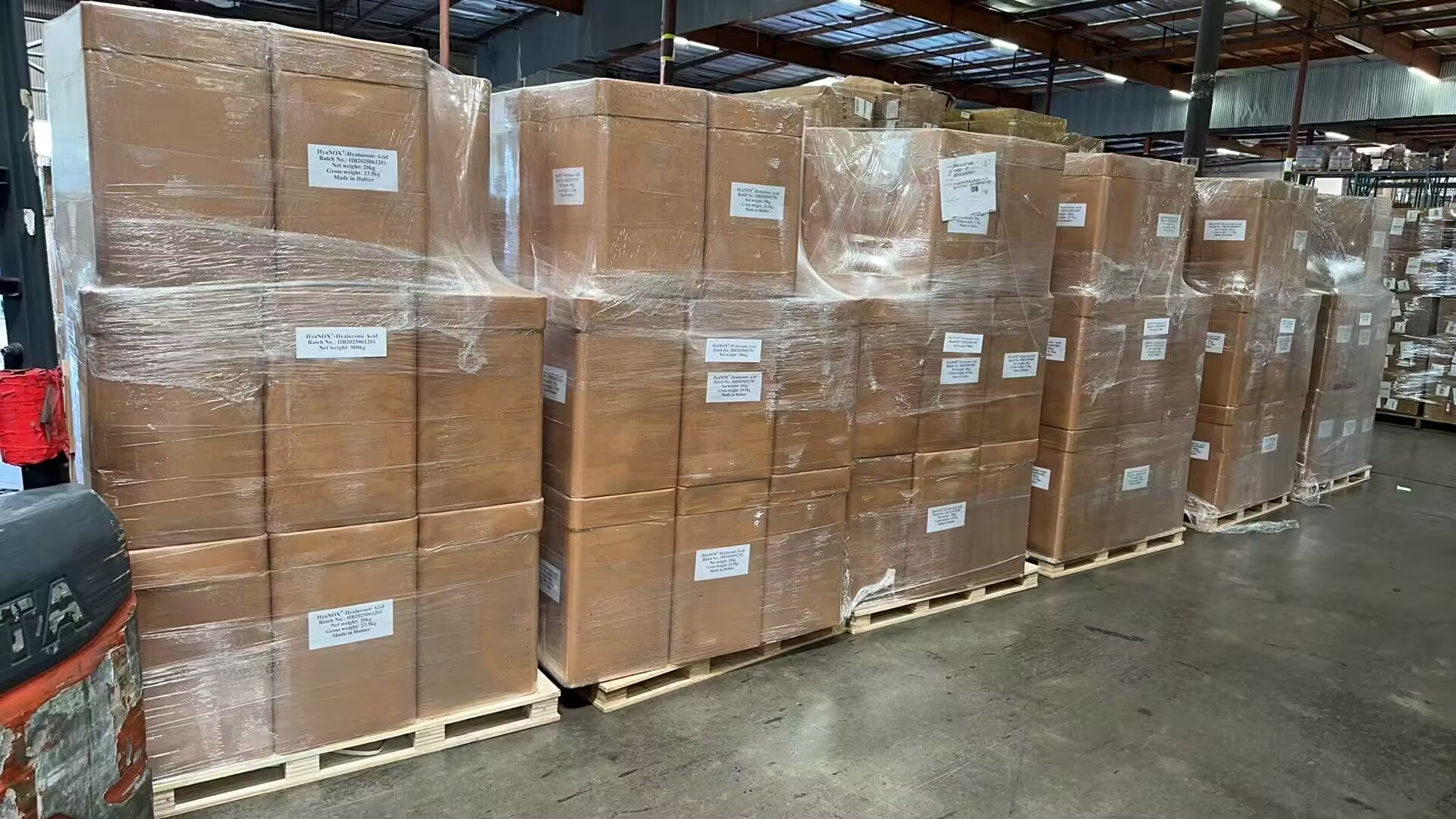
US cosmetic and supplement importer — 4,733 kg on a long-term repeat-order programme. A natural cosmetic and health supplement importer based in the United States received 4,733 kg of high-purity hyaluronic acid raw material (product 5243), used as cosmetic raw material and as oral health care supplement raw material. The material was avian origin with complete official veterinary heat treatment certification, met US APHIS import standards, and cleared customs smoothly on a valid USDA import permit. Stable batch quality supported long-term repeat order cooperation and covered the customer's laboratory, cosmetic and oral care mass production demand. The case also illustrates the logic of this ranking: one importer drew on the material across more than one application area, and documentation — not the material name — made that possible.
Food and supplement brands. Oral care and nutraceutical products typically specify the food grade band (0.8–1.5 Million Da) and require ISO 22000 food safety documentation, plus Kosher or Halal certification where the destination market requires it.
Cosmetic blending operations. Formulators working on serums, essences and masks generally specify the cosmetic grade band (1.0–1.5 Million Da) and ask for COSMOS organic and ISO 16128 certification before confirming a supplier.
Pharmaceutical programmes. Pharma grade material (minimum 2.0 Million Da) is selected where pharmacopoeial compliance and endotoxin control are mandatory, and where the qualification cycle is planned as part of the project timeline rather than as an afterthought.
Comparison Table: The Five Grades Side by Side
| Rank | Grade | Molecular Weight Spec | Primary Industry | Documentation Context | Strongest Reason to Choose |
|---|---|---|---|---|---|
| 1 | High molecular weight grade | Min. 2.0 Million Da | Multi-industry (cosmetic, food and pharma supply lines) | ISO 9001:2015 quality management; ISO 22000:2018 food safety; Kosher; Halal; COSMOS organic; ISO 16128 | Widest application overlap — shares its molecular weight band with pharma grade |
| 2 | Food grade | 0.8–1.5 Million Da | Food and dietary supplement | ISO 22000:2018 (certificate 104FSMS2400001); Kosher; Halal; HACCP | Food-specific band paired with food safety management documentation |
| 3 | Cosmetic grade | 1.0–1.5 Million Da | Cosmetic and skincare | COSMOS organic; ISO 16128; ISO 9001:2015 | Largest demand segment — 61.91% of the HA raw material market in 2025 (Grand View Research) |
| 4 | Pharma grade | Min. 2.0 Million Da | Pharmaceutical | USP-NF, European Pharmacopoeia (EP) and JP standards; endotoxin typically <0.05 EU/mg | Highest analytical and qualification stringency of the five grades |
| 5 | Low molecular weight grade | Max. 0.1 Million Da | Specialty cosmetic and supplement | ISO 9001:2015 quality management | Distinct low-band fraction, also supplied as hydrolyzed and ultra low molecular weight grades |
Documentation in this table is drawn from Habier's certification records. The ISO 9001:2015 certificate (1042Q00053R0S) and the ISO 22000:2018 certificate (104FSMS2400001) cover the sodium hyaluronate product line, and the COSMOS organic and ISO 16128 certification applies to the hyaluronate product. Confirm the exact certificate scope for your destination market during quotation.
Manufacturer Qualifications Behind the Ranking
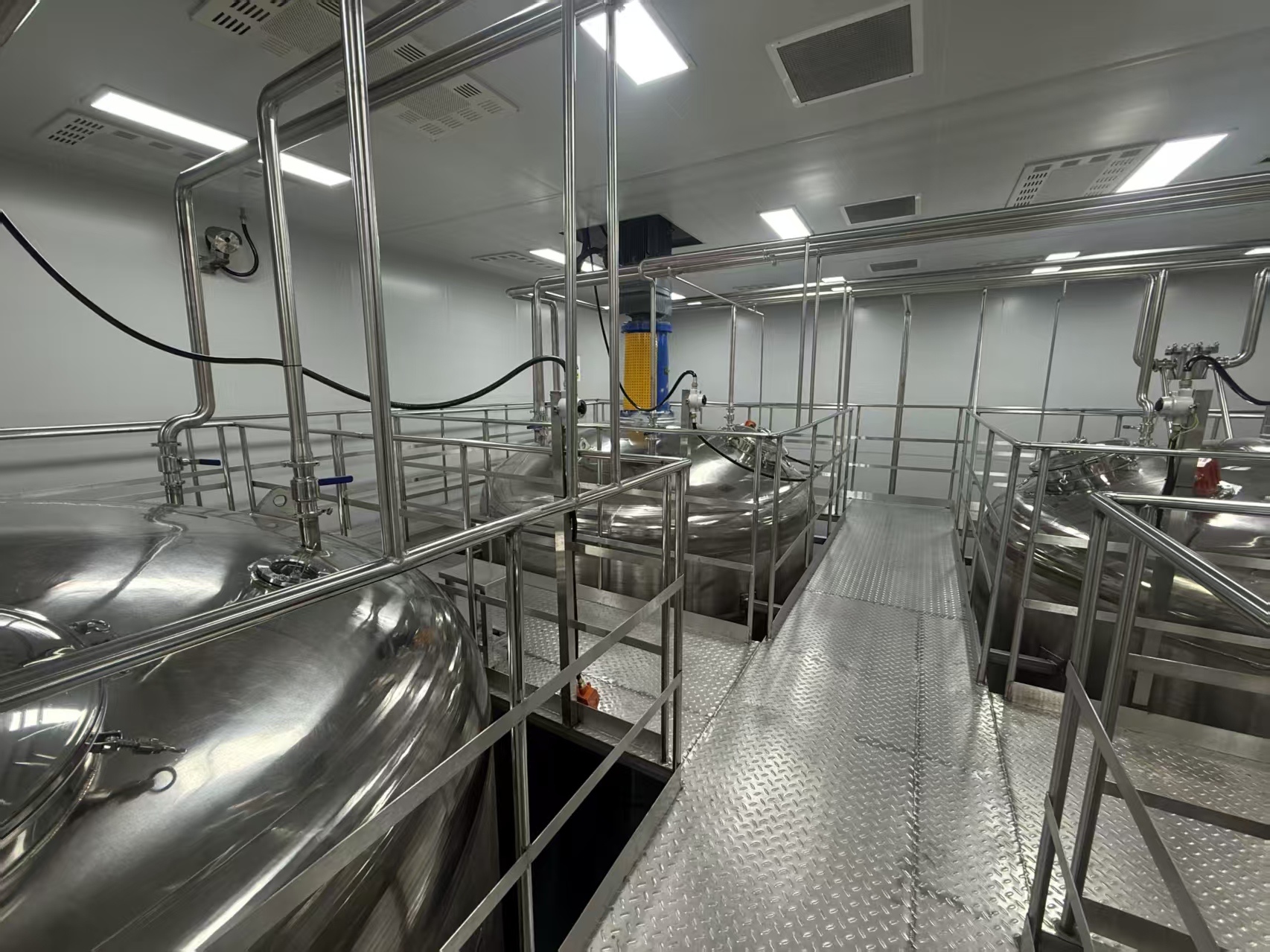
A molecular weight band is only meaningful if the supplier can hold it batch after batch and document it. Shandong Habier Biopharma Co., LTD was established on 14 May 2015 in Qufu City, Shandong Province, and operates a 50,000 m² production site with 123 employees, including a six-engineer R&D team, and an annual output of 600–700 MT. Roughly 20% of production is exported, primarily to the EU, USA and Korea.
The qualification system is dual ISO certification supported by market-specific approvals: ISO 9001:2015 quality management certification (certificate 1042Q00053R0S, GB/T 19001-2016 / ISO 9001:2015) and ISO 22000:2018 food safety management certification (certificate 104FSMS2400001), both issued by Shandong Seatone International Certification Co., Ltd. on 1 September 2024 and valid to 8 January 2027. The company also holds HACCP, Kosher and Halal certification, and its product is certified as organic COSMOS and ISO 16128.
On the operating side, Habier runs an OEM/ODM production model with purity adjustment as the stated customization, a monthly capacity of 50–60 ton, a standard lead time of 5–8 days, a minimum order quantity of 1 kg, and 100% full inspection before delivery. After-sales support covers free sample supply and quality tracking on delivered lots.
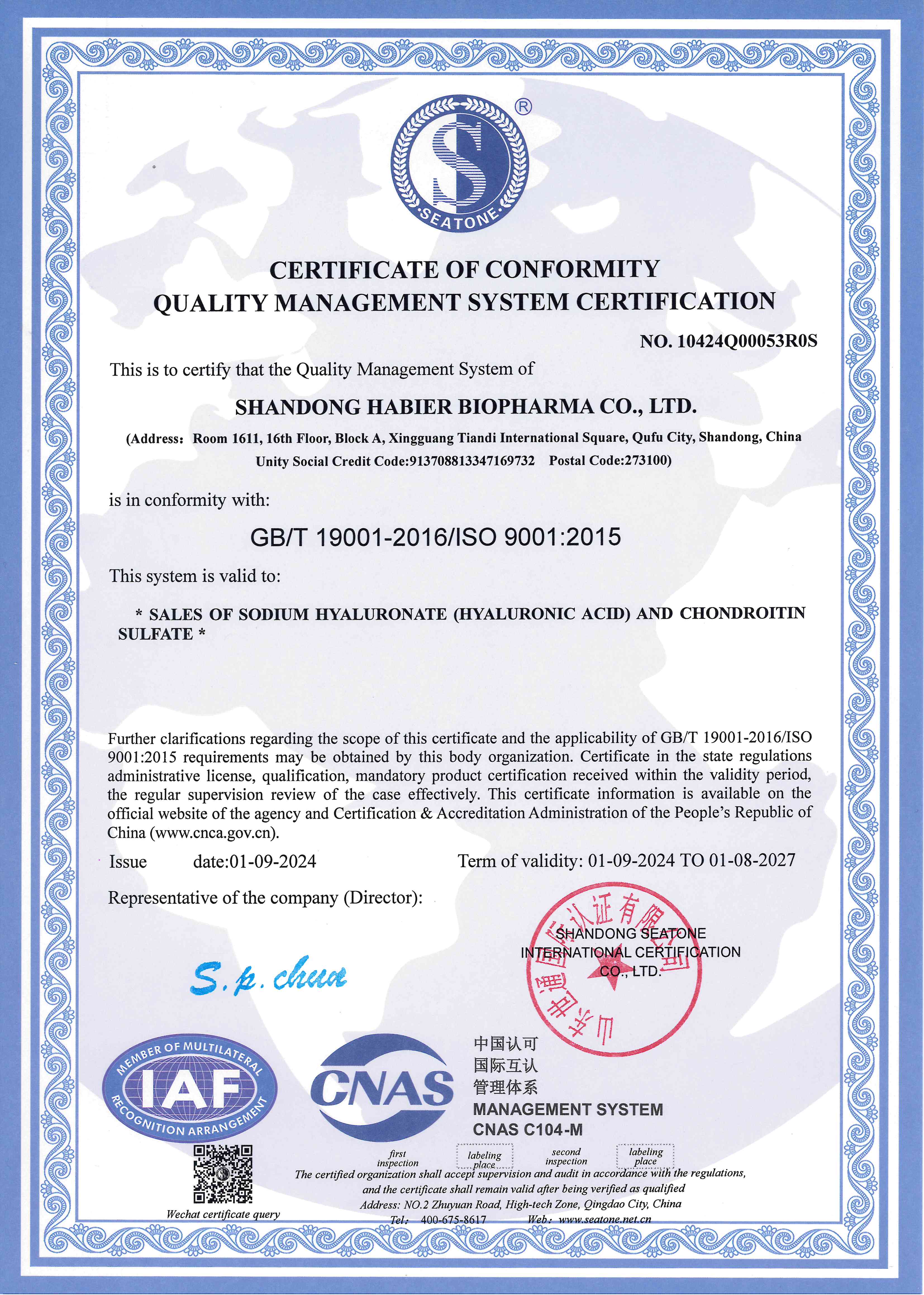
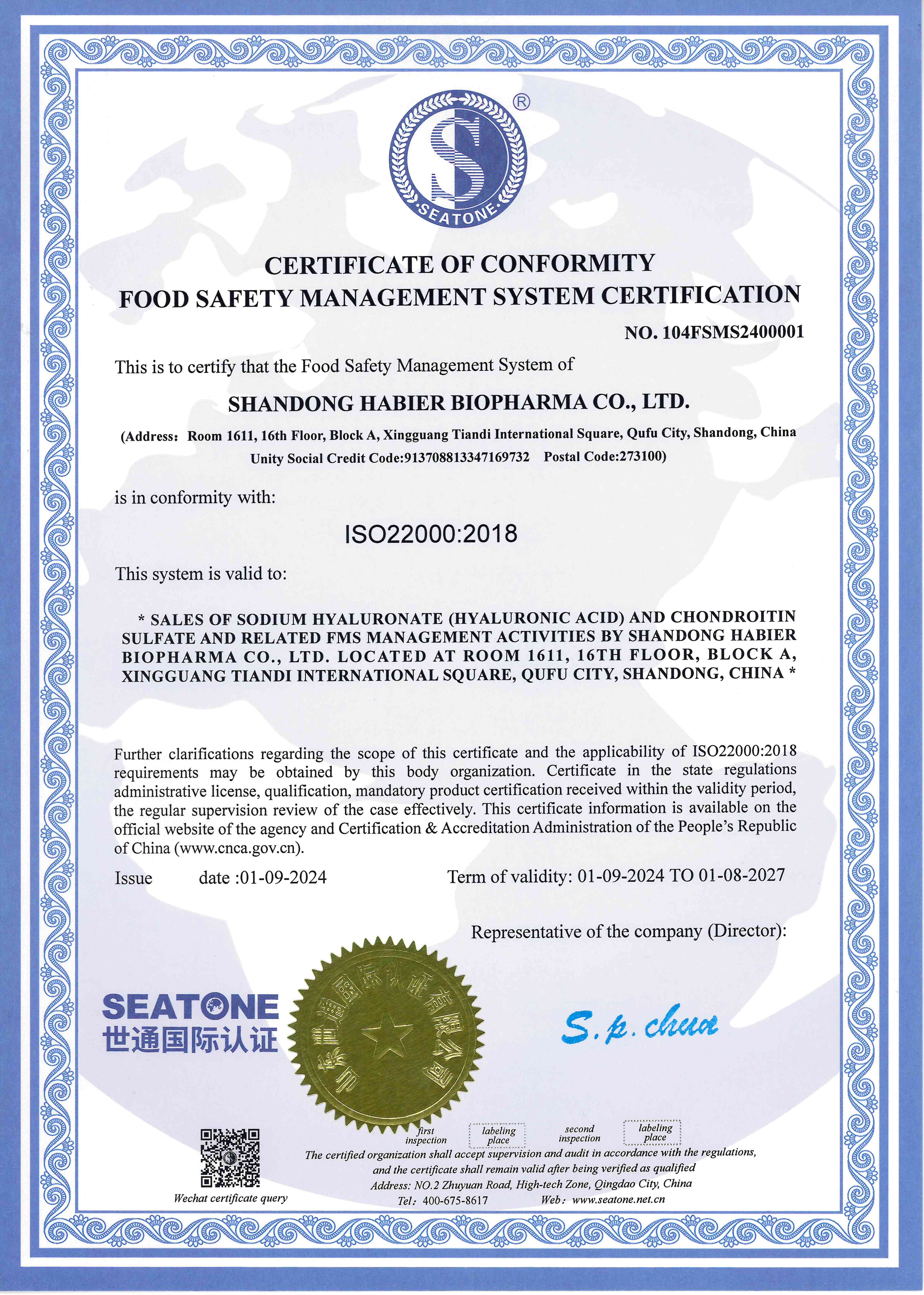
ISO 9001:2015 quality management certification and ISO 22000:2018 food safety management certification, both valid to 8 January 2027.
FAQ: Molecular Weight Grades and Sodium Hyaluronate Buying
Which certifications should a buyer check before purchasing sodium hyaluronate by molecular weight grade?
Check company-level certification together with the industry-specific standard. Habier holds ISO 9001:2015 quality management certification (certificate 1042Q00053R0S) and ISO 22000:2018 food safety management certification (certificate 104FSMS2400001), both issued by Shandong Seatone International Certification Co., Ltd. and valid to 8 January 2027, plus HACCP, Kosher, Halal, COSMOS organic and ISO 16128 certification. For pharma grade material, pharmacopoeial compliance matters more than the grade label: pharma grade sodium hyaluronate must meet USP-NF, European Pharmacopoeia (EP) and JP standards, with endotoxin levels typically below 0.05 EU/mg (Princeton Powder Guide).
Can the molecular weight or purity of a grade be adjusted for a specific project?
Habier operates an OEM/ODM production model in which purity adjustment is the stated customization. The five standard molecular weight bands are the starting point, and adjustments are discussed against the grade and the intended application. Monthly capacity is 50–60 ton, annual output is 600–700 MT, and every batch is 100% inspected before delivery — so an adjusted specification still passes through the same release control as a standard grade.
How should buyers compare cost across sodium hyaluronate molecular weight grades?
Compare total delivered cost rather than unit price alone. Three variables move the number: the molecular weight band, the documentation package required by the destination market, and the order volume. Habier's minimum order quantity starts at 1 kg and samples are supplied free of charge, which lowers the cost of validating a grade before a full commercial order is placed.
Can I request a sample before committing to a purchase order?
Yes. Free sample supply is part of Habier's after-sales service, and the minimum order quantity for a first commercial order is 1 kg. Samples are drawn from the same production process as commercial lots, and because every batch is 100% inspected before delivery, sample results can be used as an early indicator of how the grade will behave in your own process.
What lead time and batch-to-batch consistency can buyers expect?
Standard lead time is 5–8 days, supported by a monthly capacity of 50–60 ton. For repeat programmes, consistency between batches is the deciding factor: a US importer of natural cosmetic and health supplement raw materials has run long-term repeat orders on 4,733 kg of high-purity hyaluronic acid raw material with stable batch quality, covering laboratory, cosmetic and oral care mass production demand. To start, send your target application and molecular weight band to jake@habier.com.
Conclusion: Rank the Grade Before You Rank the Supplier
Ranking sodium hyaluronate by molecular weight is a shortcut, not a substitute for qualification. The order above reflects how precisely each band is specified and how directly it maps to a mainstream application: high molecular weight first for versatility, food and cosmetic grades next for volume and documentation fit, pharma grade for stringency, and the low molecular weight band for specialty work.
The next step is grade-specific. Choose the band that matches your destination industry, request a sample of that exact grade, and confirm the certificate scope for your market before the first purchase order is issued.
Request a Sample or a Grade-Specific Quotation
Send your application, target molecular weight band and destination market, and we will confirm the matching grade, documentation pack and lead time.
Shandong Habier Biopharma Co., LTD
Contact: Jake Chen · Email: jake@habier.com · Tel: +86-186-0537-0487
Add: 16F Building A Xingguangtiandi International Square, Qufu City, Shandong, China 273100
Website: www.habier.com · Blog: blog.habier.com
Download the Habier Biopharma product brochure (PDF)