Sealant Compliance Claims: VOC, Shelf Life and Temperature by Product Type
A sealant compliance claim is only usable when the product, the test method and the market line up. VOC content, shelf life and temperature range are three different claim families, and each one is proven by a different document. A folder containing ISO 9001, a CE mark and a RoHS report does not answer any of the three.
This guide is written for buyers and specifiers who are past the discovery stage and now have to attach evidence to a submittal. It separates the three claim families, then shows what the supplied documentation for SANZON silicone sealants, MS sealant, acrylic sealant, PU foam and tile grouts actually supports — and where a batch-level document still has to be requested.
Why Generic Certificates Do Not Answer a Compliance Question
Three failure modes account for most rejected submittals.
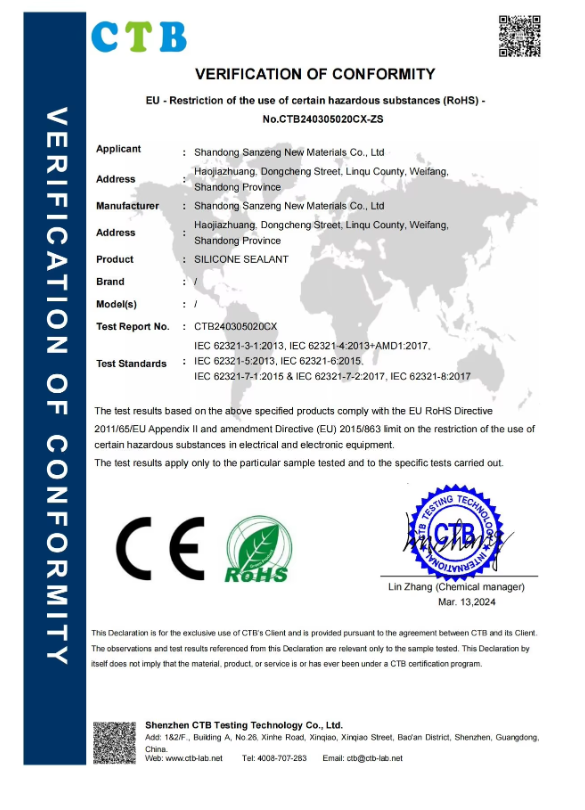
Scope mismatch. The RoHS verification held for SANZON silicone sealant, issued by CTB under certificate number CTB240305020CX-ZS, carries the wording that it applies only to the tested sample. That wording tells a reviewer the result applies to the sample submitted for testing. It does not, by itself, extend to every colour, every cartridge size or every production batch. A buyer who files that document as blanket proof of conformity is over-reading it.
Claim-family mismatch. The German Packaging EPR registration DE2636557090139, issued through Stiftung Zentrale Stelle Verpackungsregister (LUCID) under the VerpackG packaging act and valid from 2025-03-19 to 2099-03-19, proves packaging take-back responsibility in the German market. It says nothing about volatile organic compound content, curing behaviour or service temperature. It is frequently filed in the wrong section of a submittal.
Definition mismatch. A temperature figure in a data sheet may describe the service temperature of a cured joint or the storage temperature of an unopened cartridge. In the supplied SANZON documentation these are labelled separately: SANZON GM epoxy tile grout states a storage requirement of +5°C to 27°C, while SANZON AS acrylic sealant and SANZON TS PU foam state a usage temperature range of -10°C to 80°C. Treating one as the other is the most common technical error in sealant submittals.
The practical conclusion is short. Before accepting any compliance statement, ask which of the three claim families it belongs to, and which document supports it at product level. Anything that cannot answer both questions is background material, not evidence.
What Changed in Sealant Compliance Before 2026
Three developments shape how buyers read claims today.
The market is larger and more concentrated. Grand View Research valued the global silicone sealants market at USD 4.5 billion in 2025, with Asia Pacific accounting for a 52.1% revenue share and the construction segment holding 60.7%. Room-temperature-vulcanising (RTV) technology took 64.8% of revenue. The practical implication for a buyer is that most submittals now cross at least one regulatory border, and documentation has to travel with the goods rather than be reconstructed at destination.
Substance-level rules became stricter. Commission Regulation (EU) 2024/1328 amended the REACH Annex XVII entry for cyclic silicones D4, D5 and D6, restricting industrial uses at a 0.1% threshold and banning them in leave-on cosmetics from June 2027. Silicone chemistry itself is now under substance-level review, not only finished-product labelling. Formulators and importers increasingly have to answer questions about which siloxanes are present, not only how much solvent the finished sealant releases.
Performance standards were re-confirmed. ASTM C920, the primary performance specification for elastomeric joint sealants in building construction, was reapproved in November 2024 as ASTM C920-18(2024). If a specification cites ASTM C920, ask for a report against the current edition; older reports are not automatically equivalent.
One data limitation is worth knowing. Customs statistics aggregate silicone sealants under HS code 321410, so trade data cannot separate neutral-cure from acetoxy volumes. Import figures therefore tell you about category demand, not about formulation mix. That distinction has to come from the supplier's own documentation.
Reading Each Claim Family Against Product Type
VOC and emission claims
Two different instruments sit under the word VOC. The first is a content figure: how much volatile organic compound the formulation releases, measured by a defined method. The second is an emission label: how the cured product performs in an indoor air chamber test. They answer different questions and are not interchangeable.
The supplied SANZON data carries both types. SANZON GM epoxy tile grout is described as a solvent-free two-component A+B room-temperature cure system with ultra-low VOC, and as odorless and non-toxic. SANZON AS acrylic sealant is described as low VOC and low odour. SANZON MS sealant is described as formaldehyde-free. Separately, SANZON CS structural silicone sealant and SANZON PA acetoxy silicone sealant both hold the French indoor air emission label A+.
Read those statements for what they are. Ultra-low VOC and low VOC are formulation statements without a numeric value in the supplied data. If a specification sets a numeric limit, a formulation statement will not satisfy it — request the test report with the method reference and the measured value. The French A+ label is an indoor air emission label and answers a different question from a solvent content figure; it is strong evidence for interior use, but it is not a VOC content number.
One product-type caution matters here. In the documentation reviewed for this guide, the SANZON GA polyurea tile grout sheet documents silver-ion antibacterial performance, while the VOC and odour language appears on the GM epoxy sheet. Do not carry a VOC statement across from the epoxy grout to the polyurea grout, and do not assume parity between two grout chemistries that cure by different mechanisms. If a project needs a VOC figure for GA, request it for GA.
Formaldehyde-free claims
Formaldehyde-free is a substance-specific claim, not a VOC claim. A product can be formaldehyde-free and still release other organic compounds. In the supplied data, SANZON MS sealant is formaldehyde-free, and SANZON GK no-nail adhesive is formaldehyde-free and benzene-free. These statements are useful in interior and furnished-space specifications, but they belong under substance declarations rather than under VOC performance. Filing them in the VOC section creates a review question you then have to answer on site.
Shelf life claims
Shelf life in the supplied SANZON data is stated per product, not per category, and the numbers are not uniform.
- 12 months: SANZON AS acrylic sealant, SANZON MS sealant, SANZON TS and SANZON TC PU foam, SANZON FS firestop silicone sealant, SANZON GP acid-cure silicone sealant, SANZON GP-N neutral-cure silicone sealant, and SANZON KB sanitary silicone sealant.
- 18 months: SANZON GK no-nail adhesive.
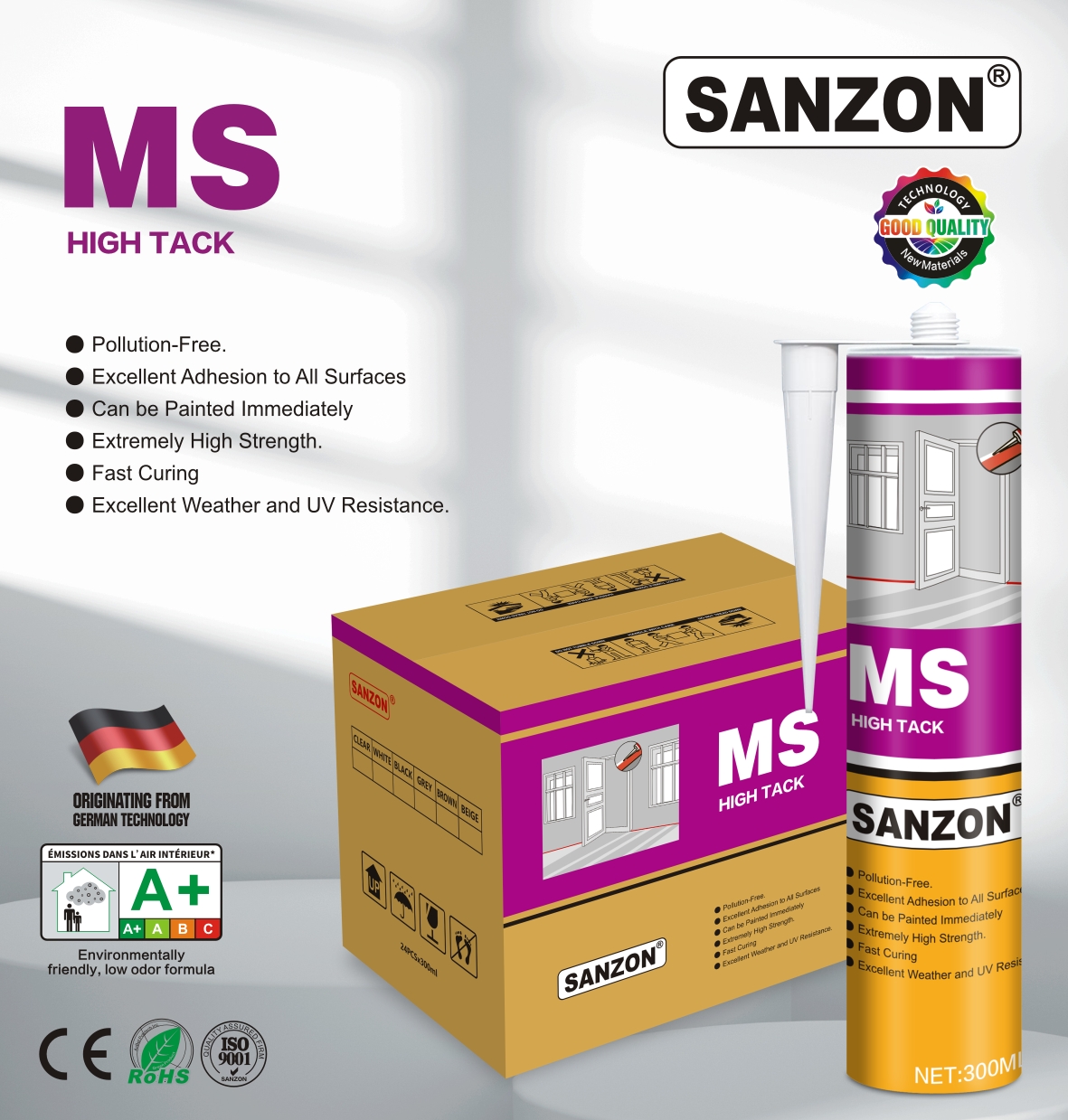
Two conditions decide whether that number survives to site. The first is storage: sealant should be kept in a cool, dry, well-ventilated place, away from direct sunlight, high temperature and moisture. The second is package integrity — a one-component moisture-cure PU foam such as SANZON TS depends on the cartridge or sausage remaining sealed, because atmospheric moisture is what drives the cure.
Shelf life runs from the production date, so the batch date on the carton is part of the evidence, not a formality. When a project schedule pushes installation months after delivery, ask for the production date and plan the order quantity against the 12-month or 18-month window rather than against the delivery date. That single question prevents most end-of-project shortages.
Temperature claims: usage versus storage
The supplied data labels temperature ranges explicitly, and the labels differ by product type.
Usage temperature: SANZON GP acid-cure silicone sealant is rated -50°C to 120°C. SANZON GP-N neutral-cure silicone sealant and SANZON KB sanitary silicone sealant are rated -50°C to 150°C. SANZON AS acrylic sealant and SANZON TS PU foam are rated -10°C to 80°C.
Storage temperature: SANZON GM epoxy tile grout requires +5°C to 27°C. No storage range is stated in the same form for the other products in the reviewed data, so do not infer one from a usage figure. A usage range describes the cured joint in service; storage describes the unopened package before use.
The difference has commercial consequences. A -10°C to 80°C usage range for SANZON TS PU foam covers typical door and window installation in temperate and warm climates but leaves little margin for cold-weather application, while a sealant rated to 150°C suits joints exposed to sustained higher service temperatures. Read the number against the labelled condition before writing it into a specification, and state the label in the submittal so the reviewer knows which figure is being offered.
What each Sanzeng document actually covers
Shandong Sanzeng New Materials Co., Ltd. is an integrated sealant manufacturer headquartered in Linqu County, Weifang City, Shandong Province, covering sealant R&D and production, filling equipment and packaging materials. Its document set is broad, and each item has a defined scope.
- ISO 9001, ISO 14001 and ISO 45001 — management system certifications held by the company. They support process control and audit claims; they are not product performance evidence.
- CE certification — held for selected export products. It applies to the products and markets named in the declaration, so check the product list before filing it.
- RoHS Certificate of Compliance UNIB24030401HC-01 — issued by Shenzhen United Testing Technology for the polyurethane sealant, against the IEC 62321 series and compliant with RoHS 2011/65/EU and (EU) 2015/863, issued 2024-03-14 and valid to 2029-03-14, for the EU market.
- RoHS verification CTB240305020CX-ZS — issued by CTB for silicone sealant against the IEC 62321 series and EU RoHS Directive 2011/65/EU, issued 2024-03-13, for the EU market, marked as applying only to the tested sample.
- German Packaging EPR DE2636557090139 — LUCID registration under VerpackG covering good-filled sales packaging in the German market, valid from 2025-03-19 to 2099-03-19.
- French indoor air emission label A+ — held for SANZON CS structural silicone sealant and SANZON PA acetoxy silicone sealant.
- SGS performance and safety testing reports — held as part of the export documentation set.
None of these documents states a VOC value, a shelf life or a service temperature. Those three claim families live in the product data sheet and the batch test report, which is why the certificate folder alone cannot close a technical submittal.
Fitting the silicone type to the submittal
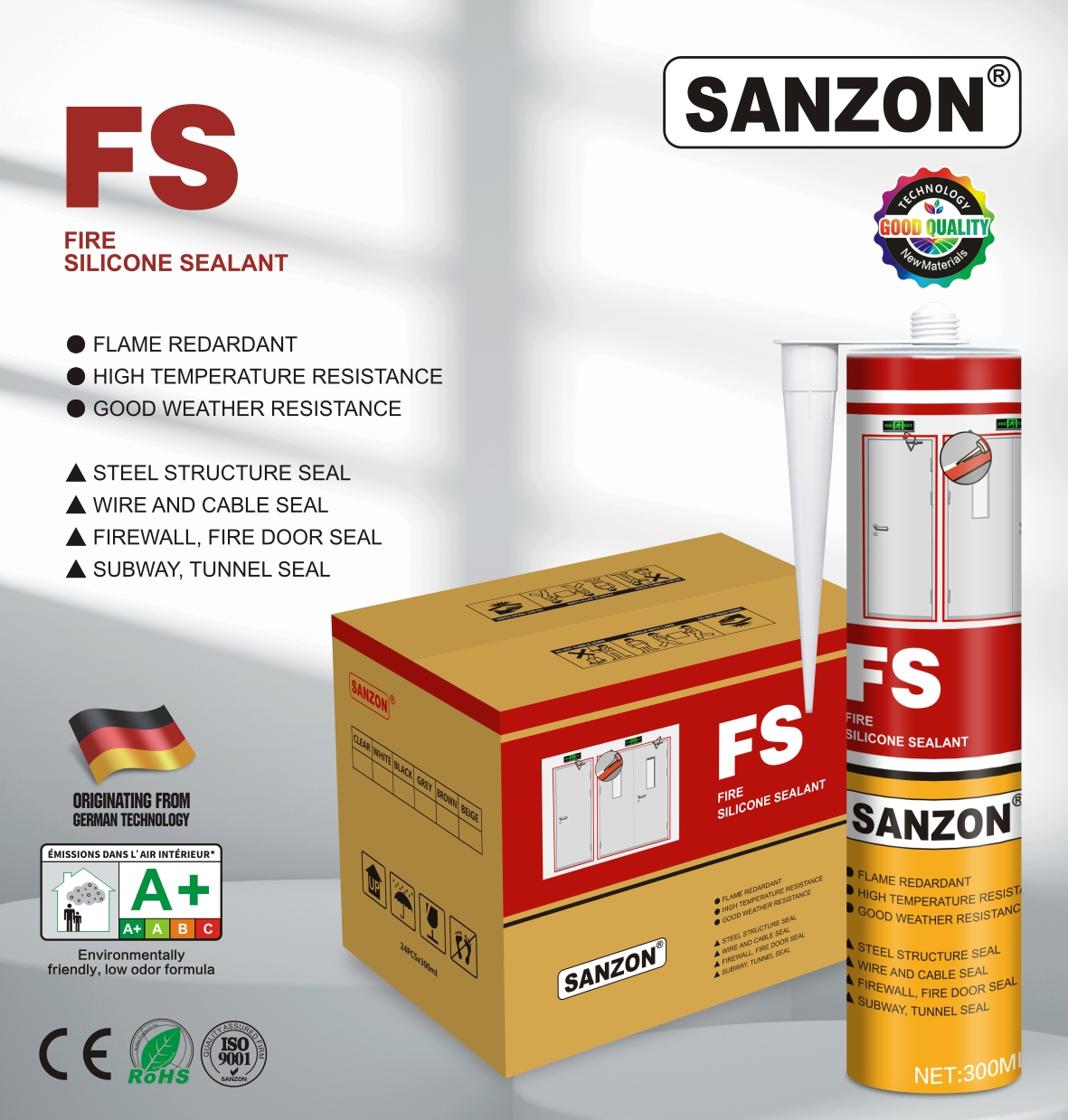
Firestop silicone. SANZON FS is a flame-retardant fire silicone sealant with high temperature resistance and a 12-month shelf life, packed 300ml × 24 pcs per carton, and its RoHS certification applies to the EU market. A flame-retardant formulation statement is not the same as a fire-resistance rating for a specific joint assembly. Where a specification calls for a rated penetration or joint, request the test evidence for that assembly; do not accept the phrase fire rated without a report reference.
Sanitary silicone. SANZON KB is an anti-mould silicone sealant formulated for kitchens and bathrooms, providing long-term anti-mould performance under high temperature and humidity, rated -50°C to 150°C with a 12-month shelf life and packed 300ml × 24 pcs per carton. It is the grade to file where the specification asks for mould resistance in a wet area.
Structural silicone. SANZON CS is a structural weather-resistant adhesive for curtain walls, described as formulated without white oil, UV resistant and fast curing, holding CE, ISO and RoHS certification plus the French A+ label. For facade and glazing submittals these are the documents to attach first, because they answer the market-access question before the technical one is asked.
Neutral-cure silicone. SANZON GP-N is a neutral-cure multi-purpose silicone sealant rated -50°C to 150°C, and SANZON NS is the neutral silicone grade covered in the EU certification scope. Neutral cure is the default where the joint touches metal, stone or a substrate that an acid-cure product could affect.
MS sealant. SANZON MS is a neutral room-temperature-curing silane-modified polymer sealant, formaldehyde-free and paintable after curing, with a 12-month shelf life and 300ml × 24 pcs per carton. It is the grade to specify where the joint will be painted or where a solvent-free, low-odour formulation is required.
Step-by-Step Submittal Review
Use Cases
Bathroom and kitchen refurbishment in a humid climate. The specification asks for mould resistance and a defined service temperature. SANZON KB answers both with long-term anti-mould performance under high temperature and humidity and a -50°C to 150°C usage range; the 12-month shelf life sets the order quantity for a phased handover.
Curtain wall and facade glazing. The reviewer asks for market access before performance. SANZON CS brings CE, ISO and RoHS certification plus the French A+ label, together with a formula without white oil and UV resistance — the combination typically requested for exterior structural joints.
Interior decoration with painted joints. Paint compatibility decides the grade. SANZON MS is formaldehyde-free and paintable after curing, so the joint can be coated without switching products; the formaldehyde statement belongs in the interior air quality section of the submittal.
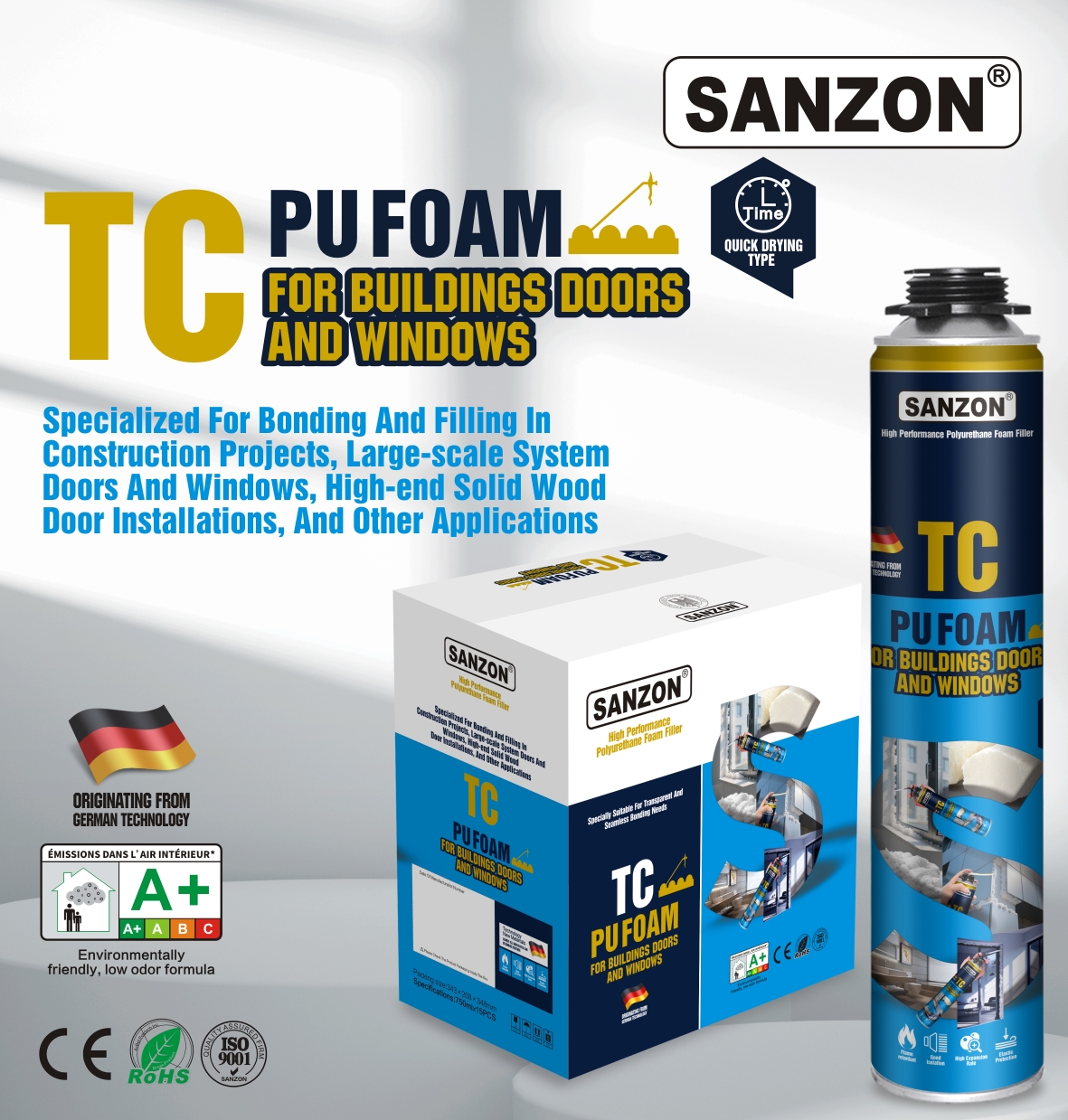
Door and window installation in a cool climate. SANZON TS one-component PU foam is rated -10°C to 80°C usage temperature with closed cell content above 90%, packed 750ml × 15 pcs per carton. Below the lower bound, application timing and can temperature become the constraint rather than the product rating.
Sealed interior tiling. SANZON GM two-component epoxy tile grout is solvent-free with ultra-low VOC, odorless and non-toxic, and requires storage between +5°C and 27°C. On a winter site the storage clause, not the VOC statement, is usually the item that fails inspection.
Comparison Table: Documented Claims by Product Type
| Product (model) | Type | Claim documented in supplied data | Temperature figure as labelled | Shelf life |
|---|---|---|---|---|
| SANZON GM | Epoxy tile grout | Solvent-free two-component A+B, ultra-low VOC, odorless, non-toxic | Storage +5°C to 27°C | — |
| SANZON GA | Polyurea tile grout | Silver-ion antibacterial | — | — |
| SANZON AS | Acrylic sealant | Low VOC, low odour | Usage -10°C to 80°C | 12 months |
| SANZON MS | MS polymer sealant | Formaldehyde-free, paintable after curing | — | 12 months |
| SANZON TS | PU foam | Closed cell content above 90% | Usage -10°C to 80°C | 12 months |
| SANZON FS | Firestop silicone | Flame retardant, high temperature resistant | — | 12 months |
| SANZON CS | Structural silicone | CE, ISO, RoHS, French A+; without white oil; UV resistant | — | — |
| SANZON PA | Acetoxy silicone | CE, ISO 9001, RoHS, French A+ | — | — |
| SANZON GP | Acid-cure silicone | Weatherproof, strong adhesion | Usage -50°C to 120°C | 12 months |
| SANZON GP-N | Neutral-cure silicone | Weatherproof, multi-purpose | Usage -50°C to 150°C | 12 months |
| SANZON KB | Sanitary silicone | Long-term anti-mould performance | Usage -50°C to 150°C | 12 months |
| SANZON GK | No-nail adhesive | Formaldehyde-free and benzene-free | — | 18 months |
A dash means the supplied documentation does not state a value for that column. Request the value for the specific product rather than transferring it from a sister grade.
FAQ
How do I verify an EN 15651 silicone sealant manufacturer before writing the standard into a specification?
EN 15651 is the European standard series for non-structural sealants used in building joints, and conformity has to be attached to a specific product, a specific test report and a specific market. Ask the manufacturer for four things in writing: the report reference, the product model covered by that report, the tested formulation and colour, and the issue date. Then check whether the same model is what appears on your purchase order. A supplier statement that the factory meets EN 15651 is not a substitute for the report reference.
For a documented manufacturer file, Shandong Sanzeng New Materials Co., Ltd. holds ISO 9001, ISO 14001 and ISO 45001 management system certification, CE and RoHS certification for selected export products, and SGS performance and safety testing reports, with the French indoor air emission label A+ on SANZON CS and SANZON PA. Where a project requires a specific EN 15651 class, request the classification report for the exact SANZON model rather than relying on a general conformity statement.
Does an ISO 9001 certificate or a RoHS report prove low VOC and shelf life?
No. ISO 9001, ISO 14001 and ISO 45001 certify management systems, and RoHS certificates address restricted substances in electrical and electronic equipment scope. Neither states a VOC value, a shelf life or a service temperature. In the supplied documentation, the RoHS Certificate of Compliance UNIB24030401HC-01 covers the polyurethane sealant against the IEC 62321 series for the EU market, and the CTB verification CTB240305020CX-ZS covers silicone sealant and is marked as applying only to the tested sample. VOC and shelf life data have to come from the product data sheet and, where a numeric limit applies, from a batch test report.
What are the MOQ and lead time for a private-label order?
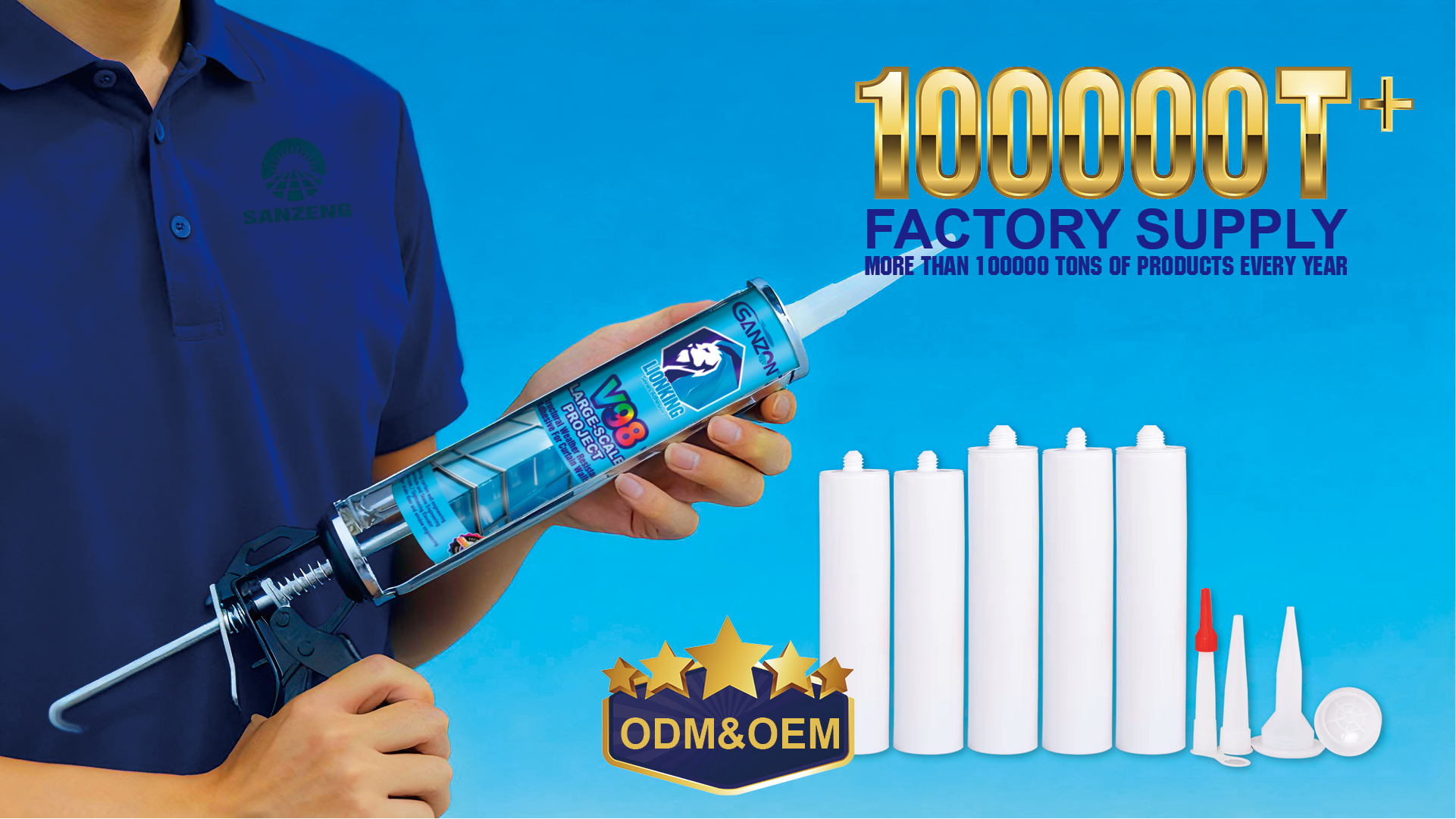
OEM and ODM private-label customization is available, covering packaging, printing, formulation and filling, with custom label printing, custom colours and custom cartons. The minimum order quantity is 100 boxes, and the lead time is 10–20 days. Monthly capacity is 8,800,000 units, and quality control is 100% testing, which matters when a submittal requires batch traceability across a phased delivery.
Can I test samples before committing to an order, and can I get the documents with the sample?
Yes. Free samples and technical product selection consultation are part of the standard service, and remote technical support and free sample testing are provided after the order. The practical sequence for a compliance-led project is to request the sample together with the product data sheet and the certificate that matches the model, test the sample against the substrate and joint condition on site, and then confirm the order quantity against the 12-month or 18-month shelf life and the batch production date.
How do I get the specific documents for the product I am specifying?
Send the model designation, the market and the specification clause, and the matching documents can be returned directly: the certificate scope, the validity date, the temperature figure as labelled, and the shelf life. The SANZON product catalogue is available for download at the SANZON LIONKING Series adhesives brochure, and document requests, quotations and sample arrangements can be made through the contact details at the end of this page.
Conclusion
VOC, shelf life and temperature are not one compliance story with three chapters. They are three separate claim families, each with its own evidence, its own scope statement and its own failure mode. The buyers who close submittals fastest are the ones who classify the claim before they open the folder, match the document to the exact product model and market, and ask in writing for whatever the data sheet does not state.
Applied to the SANZON range, that discipline produces a clear picture: formulation statements for GM epoxy grout and AS acrylic sealant, formaldehyde-free declarations for MS sealant and GK adhesive, 12-month shelf life across most of the range and 18 months for GK, usage ranges from -10°C to 80°C on TS and AS up to -50°C to 150°C on GP-N and KB, a +5°C to 27°C storage clause on GM, and a certificate set that is real but bounded in scope. Shandong Sanzeng New Materials Co., Ltd. operates a 40,000 m² facility with 125 employees, 10 engineers and an annual output of 8,800,000 units, exporting to more than 30 countries and regions — enough scale to support documentation requests at batch level, which is where most compliance questions are actually settled.
The remaining work is administrative, and it is worth doing once properly: build a submittal sheet per product that lists the claim, the value, the source document and the validity date. Everything else in the specification then becomes a check against that sheet rather than a fresh investigation.
Need the compliance evidence for a specific SANZON model?
Send the model designation, target market and the specification clause. Free samples and technical selection consultation are available, OEM/ODM private label runs from 100 boxes with a 10–20 day lead time.
Contact: Jie Guo — guooj000@163.com — Tel / WhatsApp +86 185-5361-7774
Website: www.sanzengsealant.com
Catalogue download: SANZON LIONKING Series Adhesives (PDF)
Have Questions or Need More Details?
Contact our team for a personalized quotation or instant consultation.
Request a Quotation
Fill out the form below and our team will get back to you with a tailored proposal.
WhatsApp Direct Chat
Prefer to chat in real-time? Message us on WhatsApp for instant assistance & quick answers.
- Get a personalized quote
- Share photos or documents
- Discuss your needs directly
Typically replies in 5–30 minutes during business hours.