
Sealant Compliance Guide: Shelf Life, Storage and Regional Use Requirements
Three compliance facts decide whether a delivered sealant order is actually usable: the shelf life printed on the label, the storage temperature that keeps that shelf life valid, and the regional requirements the product must satisfy at the destination market. Buyers who negotiate price, colour and packing first and check these three items last usually discover the gap weeks later — stock that has aged in transit, cartridges that skin over early, or documentation that does not match the country of import.
This guide sets out the documented shelf-life, storage-temperature and temperature-resistance data behind the SANZON sealant range, and converts it into a verification checklist that importers, distributors and project specifiers can apply line by line against any supplier's technical data sheet (TDS) before an order is placed.
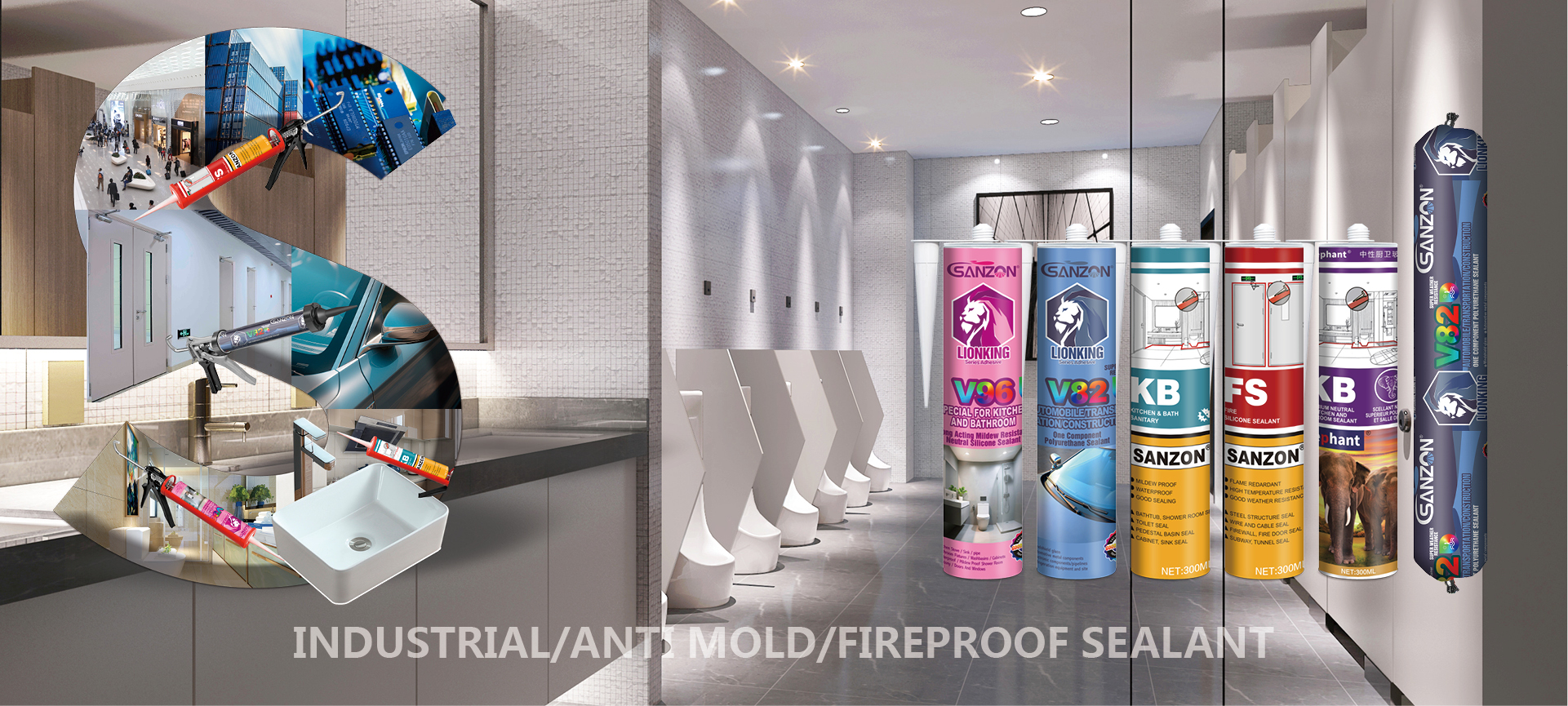
Industrial grade sealant products — every model carries its own documented shelf life, storage range and market documentation.
Problem Definition: Why Shelf-Life and Storage Checks Fail During Sourcing
Storage and shelf-life non-conformity in sealant supply rarely comes from a defective product. It comes from a mismatch between what the label requires and what the supply chain does with the goods between the factory gate and the applicator's gun. Four failure points account for most of it.
- Shelf life is counted from the wrong date. A stated shelf life runs from production, not from delivery. Where a product carries a 12-month shelf life, a buyer in a distant market absorbs ocean freight, customs clearance and distributor warehousing inside that same 12 months.
- Storage temperature is treated as advice. When a product carries a documented storage range such as +5°C to 27°C, an uninsulated summer container or a heated warehouse can push stock outside the condition under which the performance data was established.
- Storage temperature and usage temperature are confused. A product documented for use between −10°C and 80°C is specified for the joint it seals. That figure says nothing about how the carton should be stored before opening.
- Regional paperwork is requested too late. RoHS statements, packaging registration numbers and indoor air emission labels are frequently asked for after the production run, when the answer can no longer influence packaging or formulation.
For a buyer at research or evaluation stage, the practical answer to all four is the same: ask for the number in writing, on the document that travels with the goods, for the exact model being quoted — not for the product family as a whole.
Industry Background: Regional Requirements and Standards to Reference
European Union and Germany
Three regulatory layers matter most for sealant imports into the EU, and they are checked by different parties in the chain.
- RoHS. EU RoHS Directive 2011/65/EU and (EU) 2015/863 restrict hazardous substances in products placed on the EU market, with testing commonly carried out under the IEC 62321 series. Procurement teams normally request the certificate number, the issuing laboratory and the product scope, because a certificate issued for one model does not automatically cover the rest of a range.
- Cyclic silicones. Commission Regulation (EU) 2024/1328 restricts cyclic silicones D4, D5 and D6, applying a restriction threshold of ≥0.1% for industrial use and banning them in leave-on cosmetics from June 2027 (source: EUR-Lex). The signal for sealant buyers is not a product ban but a direction of travel: formulation compliance statements should be re-verified per market and per formulation rather than assumed from previous shipments.
- Packaging extended producer responsibility (Germany). Under the VerpackG (German Packaging Act), good-filled sales packaging must be registered with Stiftung Zentrale Stelle Verpackungsregister (LUCID). Importers should confirm that the registration covers the packaging format actually shipped, not just the product inside it.
- Indoor air emission labelling (France). The French indoor air emission label A+ is documented for some sealant products intended for interior use, and is normally requested by French distributors as part of the tender package.
United States and Global Reference Points
ASTM C920-18(2024) is the primary performance standard for elastomeric joint sealants used in building construction, reapproved in November 2024 (source: ASTM). EN 15651 is the European standard series covering sealants for non-structural use in joints in buildings and pedestrian walkways, and it is organised by application part — which is why a general statement such as "EN 15651 compliant" carries little value on its own. The useful question is always which part applies, to which product, and whether a test report exists for that specific model.
Market Context Behind the Documentation Push
Global silicone sealant demand was valued at USD 4.5 billion in 2025, with Asia Pacific accounting for a 52.1% revenue share, construction representing 60.7% of end use, and room-temperature vulcanising (RTV) technology holding 64.8% of the market (source: Grand View Research). Market-size estimates differ between research houses depending on whether adhesives are included in the definition, so these figures are useful for scale and direction only — procurement decisions should rely on product-level documentation instead.
Most of that volume is manufactured in China, and a large share of it in the Shandong sealant cluster around Weifang. Shandong Sanzeng New Materials Co., Ltd. — the manufacturer behind the SANZON model designations — is headquartered in Linqu County, Weifang City, Shandong Province, and operates an integrated chain of sealant production, packaging containers and filling equipment, with products exported to more than 30 countries and regions.
Detailed Solution: The Documented SANZON Shelf-Life, Storage and Temperature Data
Shandong Sanzeng New Materials Co., Ltd. is a sealant manufacturer founded in 1994, operating a 40,000 m² factory with 125 employees, an annual output of 8,800,000 units and an export ratio of approximately 70%. The company publishes model-level parameters rather than family-level claims, which is precisely what a compliance check requires: the numbers below should appear identically on the label, the TDS and the quotation for the same model code.
Shelf life: what is documented per product
Every SANZON liquid sealant and foam carries a documented shelf life of either 12 or 18 months, depending on chemistry and packaging format.
- 12 months: SANZON AS acrylic sealant; SANZON TS and SANZON TC polyurethane foam; SANZON MS silane-modified polymer sealant; and the silicone grades SANZON GP, SANZON GP-N, SANZON NS, SANZON KB and SANZON FS.
- 18 months: SANZON GS and SANZON GK no-nail construction adhesives.
The commercial consequence is arithmetic. A product with a 12-month shelf life ordered into a market that adds six weeks of ocean freight, two weeks of customs clearance and eight weeks of distributor stock behaves as a nine-month product by the time it reaches the applicator. Shelf-life verification therefore belongs in the commercial negotiation, not only in the technical file.
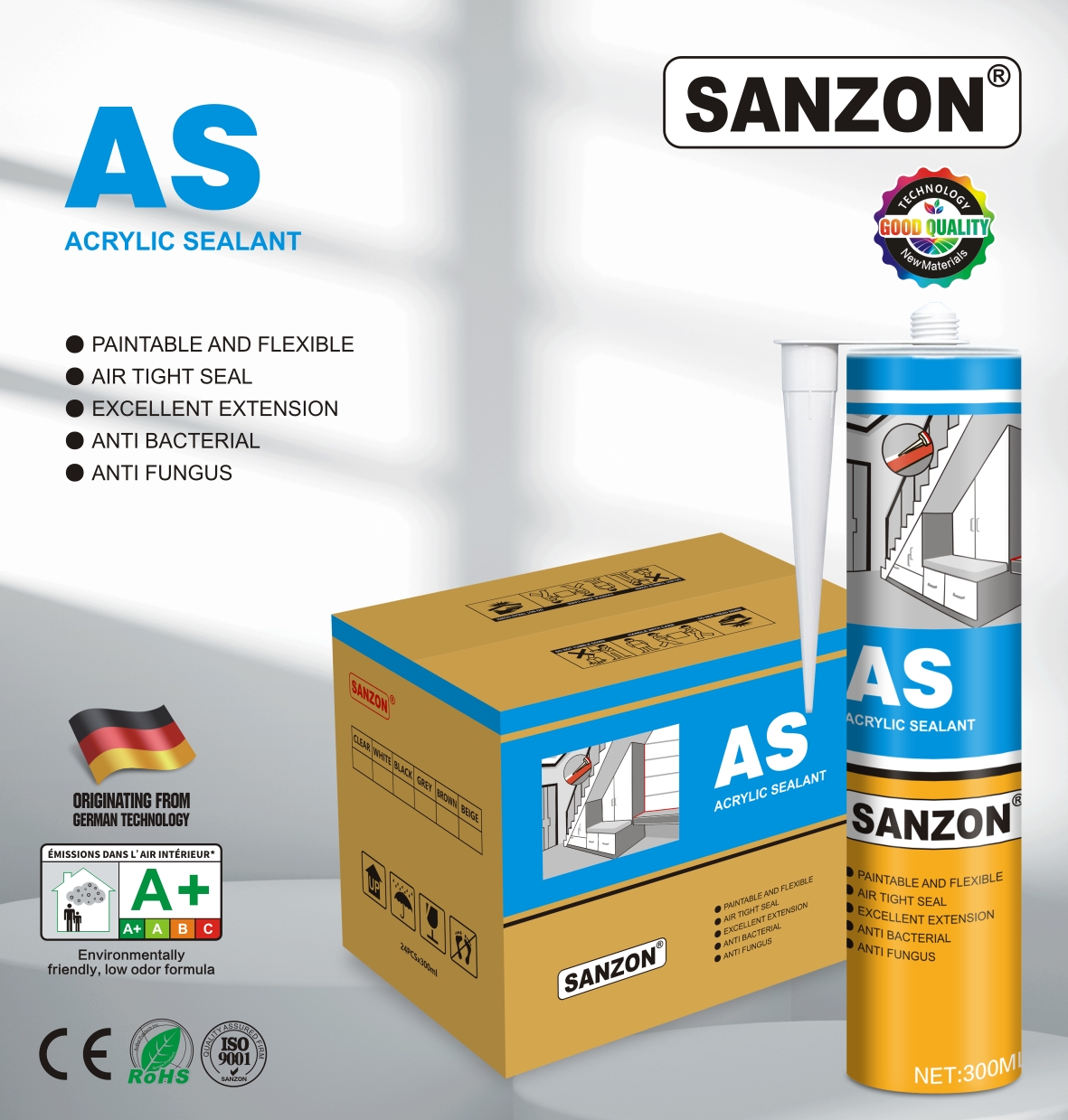
SANZON AS acrylic sealant — 12-month shelf life, neutral room-temperature cure, usage range −10°C to 80°C, 300 ml × 24 pcs per carton.
SANZON AS is a single-component, paintable acrylic sealant with a neutral room-temperature cure, low VOC and low odour, documented at a 12-month shelf life and a usage temperature range of −10°C to 80°C. Its performance profile — paintability, air-tight sealing, extension, anti-bacterial and anti-fungus behaviour, crack resistance and anti-yellowing — is the reason it is usually specified for interior decoration joints where the seal is later painted over.
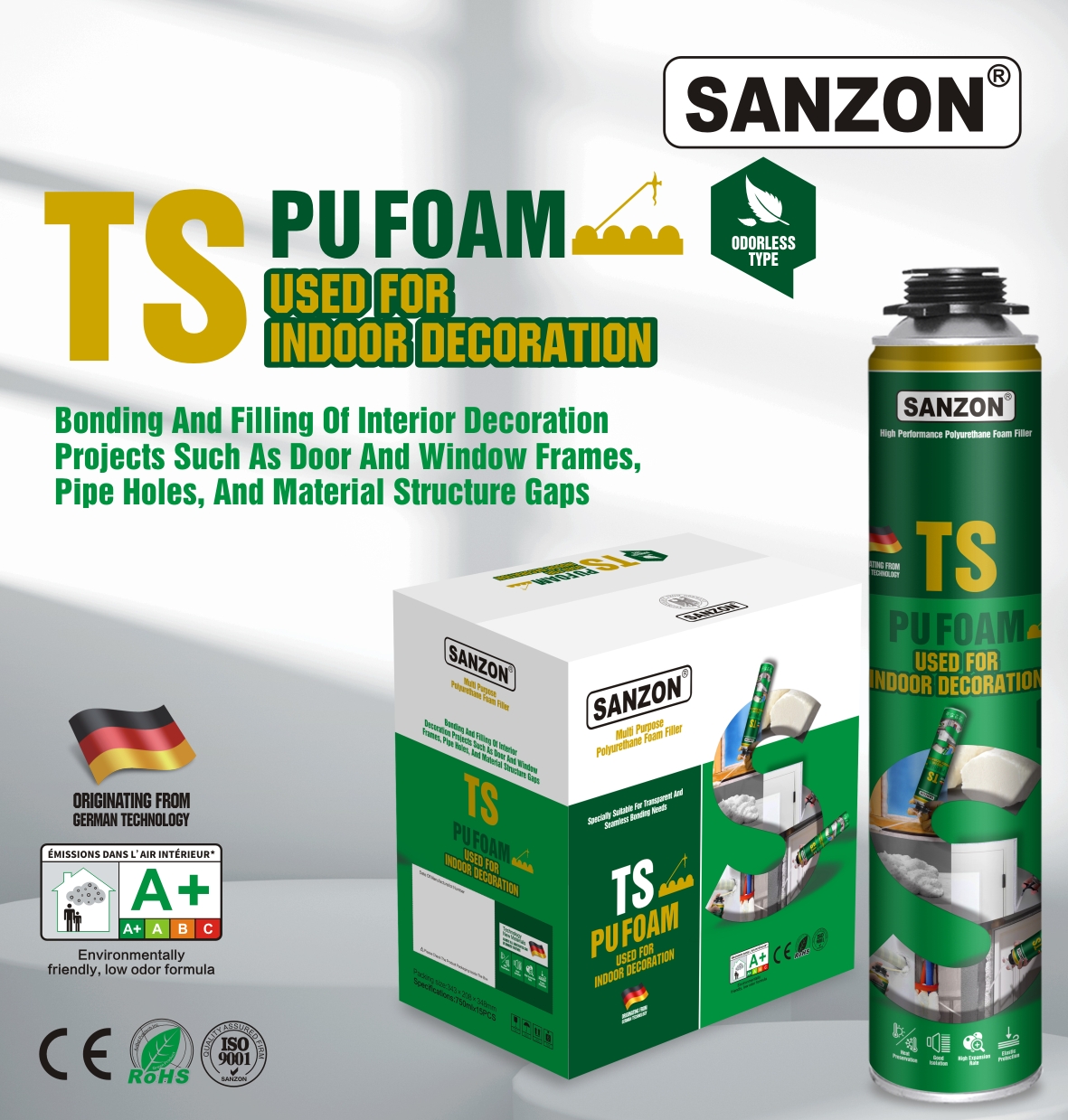
SANZON TS polyurethane foam — 12-month shelf life, closed-cell content above 90%, usage range −10°C to 80°C, 750 ml × 15 pcs per carton.
SANZON TS is an odourless PU foam filler for indoor decoration: single-component moisture cure, pre-foaming process, closed-cell content greater than 90%, 12-month shelf life, usage temperature range −10°C to 80°C and packing of 750 ml × 15 pcs per carton. Its quick-drying counterpart, SANZON TC, carries the same 12-month shelf life and the same −10°C to 80°C usage range, with a closed-cell content above 90% and identical 750 ml × 15 pcs packing, but is specified for building door and window installation where faster foaming and higher hardness are required.
Storage temperature: where the +5°C to 27°C range applies
Within the SANZON range, a storage temperature of +5°C to 27°C is documented for the two-component products: SANZON GA polyurea tile grout and SANZON GM epoxy tile grout. Both are two-component A+B room-temperature curing systems supplied as 400 ml × 20 pcs per carton, and in both cases the storage instruction applies to the A and B components alike — a point worth confirming with warehouse staff, because splitting a pallet between a climate-controlled area and an open yard defeats the purpose of the label.
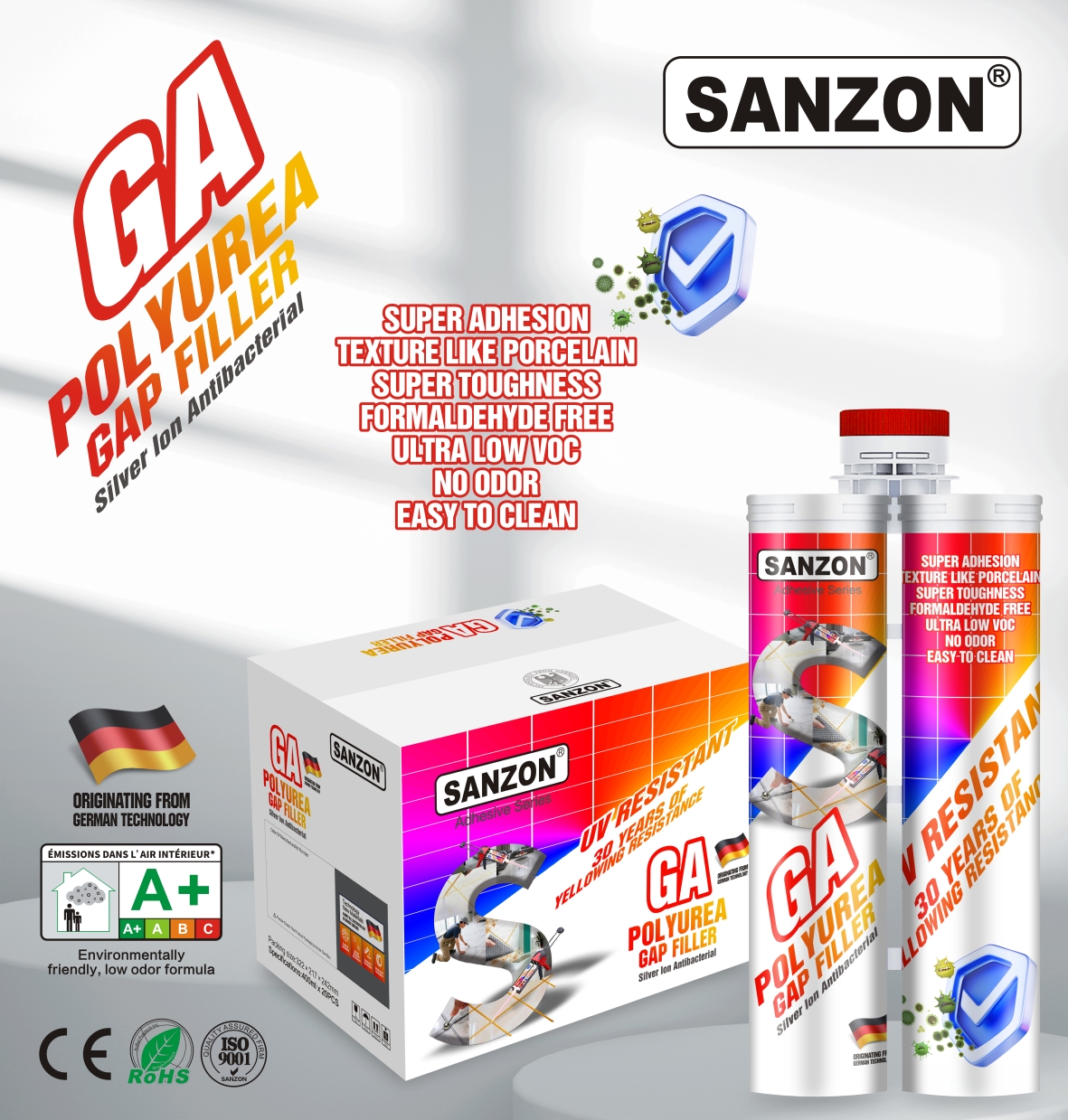
SANZON GA polyurea tile grout — storage +5°C to 27°C, usage −50°C to 100°C, weather life greater than 30 years, A+B 400 ml × 20 pcs per carton.
For single-component cartridges, the storage range should be confirmed per model from the supplier's TDS and label, then maintained in practice: a cool, dry, well-ventilated area, away from direct sunlight, excessive heat and moisture. Proper storage is what preserves the stability and performance of the sealant, and it is the condition under which the published shelf life remains valid. Buyers should treat the storage instruction as part of the performance guarantee — stock held outside the documented range is difficult to defend later, whatever the cause.
Usage temperature is not storage temperature
The usage temperature range describes the joint or application the product is specified for, and on multi-climate projects it is frequently the figure that disqualifies an otherwise suitable product.
- −50°C to 150°C: SANZON GP-N, SANZON NS and SANZON KB
- −50°C to 120°C: SANZON GP
- −50°C to 100°C: SANZON GA polyurea tile grout
- −10°C to 80°C: SANZON AS acrylic sealant, SANZON TS and SANZON TC polyurethane foam
- −20°C to 60°C: temperature resistance documented for the SANZON CLASSIC Series, ELEPHANT Series and LIONKING Series sealant — 300 ml cartridge, neutral alcohol-release cure, hardness 18 Shore A, movement capability 12.5% to ISO 11600, elongation at break 500% and tensile strength 1.2 N/mm²
Where a project runs continuously at elevated temperature — ventilation and exhaust sealing in a chemical plant operating 24/7, for example — the requirement set is wider than a single temperature figure and typically combines adhesion, chemical resistance, high-temperature ageing resistance, UV resistance, weather and water resistance, crack resistance, low shrinkage, fast curing and long-term durability. That combination, not a headline temperature number, is what the joint actually has to survive.
Certification and documentation that should travel with the goods
Compliance documentation is only useful when the buyer can match a certificate number to the model in the container. The verifiable items in the SANZON file are the following.
- Management systems: ISO 9001 quality management, ISO 14001 environmental management and ISO 45001 occupational health and safety certification.
- Product compliance: selected export products hold CE certification and RoHS compliance certification, and SGS performance and safety testing reports are held.
- RoHS certificate numbers: CTB240305020CX-ZS, issued by CTB for silicone sealant under the IEC 62321 series together with EU RoHS Directive 2011/65/EU; and UNIB24030401HC-01, issued by Shenzhen United Testing Technology for polyurethane sealant under the IEC 62321 series (62321-2/-3-1/-4/-5/-6/-7-1/-7-2/-8), compliant with RoHS 2011/65/EU and (EU) 2015/863.
- German packaging EPR: registration number DE2636557090139, issued through Stiftung Zentrale Stelle Verpackungsregister (LUCID) under the VerpackG, valid from 2025-03-19 to 2099-03-19 and covering good-filled sales packaging.
- French indoor air emission label: A+ documented for SANZON CS structural silicone sealant and SANZON PA acetoxy silicone sealant.
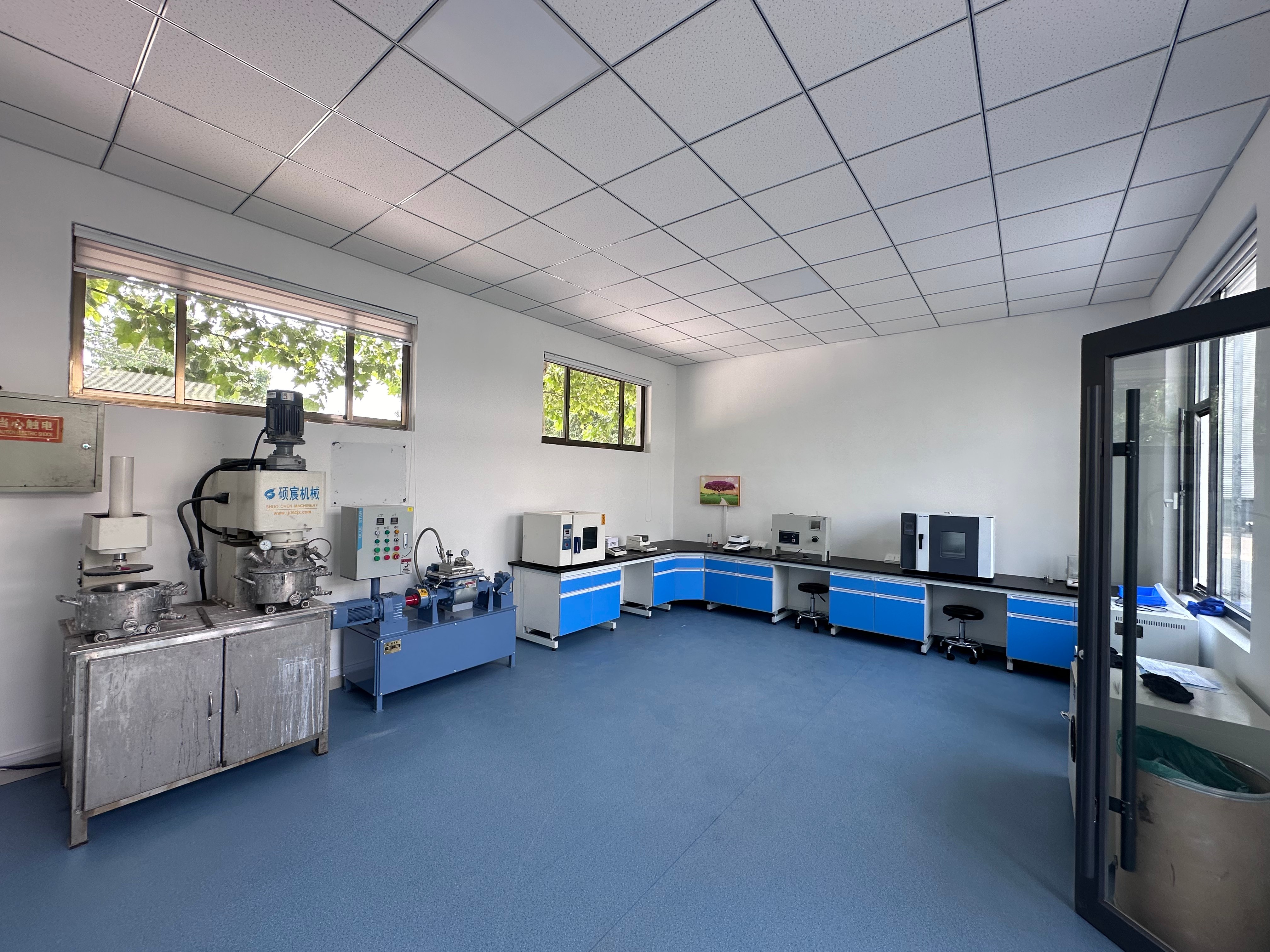
Laboratory and quality control support the certificate numbers, test reports and shelf-life statements issued with each export order.
Step-by-Step Breakdown: Buyer Verification Checklist
The checklist below is written for a buyer moving from research into evaluation — the stage where two or three suppliers are being compared and the cost of a wrong assumption is still recoverable.
Step 1 — Read the label and the TDS for the exact model
Shelf life, storage range, usage range and packing must be read from the document for the model code being quoted. Brochure-level statements about a product family do not bind the shipment.
Step 2 — Calculate remaining shelf life against your real use date
Take the production date, add freight, customs and your own warehousing time, and compare the result with the documented shelf life — 12 months for SANZON AS, TS, TC, MS, GP, GP-N, NS, KB and FS; 18 months for SANZON GS and SANZON GK. Ask the supplier to state the production date on the shipping documents, and consider a shorter shelf-life alert threshold in your own warehouse system.
Step 3 — Match the documented storage range to your actual storage condition
Confirm the documented range for the model, then verify it physically: ambient temperature in the container, the customs warehouse and your own store. For the two-component SANZON GA and SANZON GM grouts, that documented range is +5°C to 27°C, and it must hold for both the A and B components.
Step 4 — Separate storage temperature from usage temperature
Write both numbers on the same line of the comparison sheet. A product stored at +5°C to 27°C may still be specified for use at −50°C to 100°C (SANZON GA) or −50°C to 150°C (SANZON GP-N, NS, KB). Confusing the two produces either an over-specified order or a joint failure.
Step 5 — Verify certifications by destination market, with numbers
Ask for the certificate number, the issuing body, the product scope and the validity period. Where a project requires a specific European standard series such as EN 15651, request the part reference and the test report for the exact product rather than a general compliance sentence.
Step 6 — Check packaging obligations at the same time as the product
For Germany, confirm the good-filled sales packaging registration number under the VerpackG. For France, confirm whether the interior product carries the A+ indoor air emission label. For the EU generally, confirm the RoHS statement and its scope.
Step 7 — Request the documentation pack with the sample, not after the order
A supplier who can supply the TDS, certificate numbers and shelf-life statement alongside the sample is also likely to supply them alongside the container. Documentation that only appears after the purchase order is a risk signal.
Step 8 — Validate with a sample before the bulk order
Test extrusion, skin-over time, cure and adhesion on the actual substrate, and log the batch and production date you tested. This turns the shelf-life and storage discussion into a measured baseline for the incoming inspection of every later shipment.
Use Cases: How Storage and Temperature Requirements Play Out by Application
Curtain wall and façade sealing
SANZON CS structural silicone sealant is a structural adhesive for curtain walls, formulated without white oil, UV resistant and documented with CE, ISO and RoHS certification plus the French indoor air emission label A+. For façade work, the compliance question is usually documentation-led: certificate scope, batch traceability and the storage condition in which the drums or cartridges were held before installation.
Kitchen and bathroom sanitary sealing
SANZON KB is a neutral-cure sanitary silicone with long-term anti-mould performance in high temperature and humidity, a usage range of −50°C to 150°C, a 12-month shelf life and packing of 300 ml × 24 pcs per carton. It is intended for sanitary and bathroom, construction and building, glass and curtain wall, home improvement and windows and doors applications — sectors where water contact, cleaning chemicals and warm humid air are continuous conditions.
Interior decoration where the joint is painted
SANZON AS acrylic sealant is the paintable option: neutral room-temperature cure, low VOC and low odour, 12-month shelf life, −10°C to 80°C usage range. Interior work is also where the French A+ label and low-emission documentation are most often requested.
Door and window installation and gap filling
SANZON TC quick-drying PU foam and SANZON TS odourless PU foam are both documented with a 12-month shelf life, a closed-cell content above 90% and a −10°C to 80°C usage range, packed 750 ml × 15 pcs per carton. PU foam is the class where transport and storage discipline most directly affects yield at the nozzle.
Tile joint finishing
SANZON GA polyurea tile grout and SANZON GM epoxy tile grout are the two products in the range with a documented storage temperature of +5°C to 27°C. GA is a two-component aspartic-ester polyurea with silver-ion antibacterial function, a usage range of −50°C to 100°C, a weather life greater than 30 years, ultra-low VOC and formaldehyde-free, odourless formulation; GM is a solvent-free epoxy system with ultra-low VOC, a porcelain-like texture and a rich colour series. Both are A+B packs of 400 ml × 20 pcs per carton, which makes storage control and component pairing the practical compliance tasks on site.
Industrial and chemical plant ventilation
Continuous 24/7 exhaust and ventilation sealing in a chemical plant combines high temperature, chemical exposure and constant movement. The documented project requirement set for this type of work — excellent adhesion, chemical resistance, high-temperature ageing resistance, UV resistance, weather and water resistance, crack resistance, low shrinkage, fast curing and long-term durability — is a useful benchmark for evaluating whether a sealant grade is genuinely suited to industrial service rather than only to decorative joints.
Comparison Table: Documented Shelf Life, Storage and Temperature Data
The table below lists only model-level data confirmed in the SANZON product documentation. Where a parameter is not stated in the available data, the correct action is to request it from the supplier rather than assume a value.
| Product (model) | Type & cure | Shelf life | Storage temperature | Usage temperature | Packing | EU documentation noted |
|---|---|---|---|---|---|---|
| SANZON AS | Acrylic sealant, neutral RT cure, paintable, low VOC / low odour | 12 months | Confirm on TDS | −10°C to 80°C | 300 ml × 24 pcs per carton | RoHS applies (EU) |
| SANZON PA | Acetoxy silicone sealant | Confirm on TDS | Confirm on TDS | Confirm on TDS | 300 ml, 24 pcs per carton | CE, ISO 9001, RoHS, French A+ |
| SANZON CS | Structural silicone adhesive for curtain walls, without white oil, UV resistant | Confirm on TDS | Confirm on TDS | Confirm on TDS | Confirm on TDS | CE, ISO, RoHS, French A+ |
| SANZON NS | Neutral silicone, structural + weather resistant | 12 months | Confirm on TDS | −50°C to 150°C | 300 ml × 24 pcs; 590 ml × 20 pcs | RoHS applies (EU) |
| SANZON KB | Sanitary anti-mould silicone, neutral RT cure | 12 months | Confirm on TDS | −50°C to 150°C | 300 ml × 24 pcs per carton | RoHS applies (EU) |
| SANZON GP-N | Neutral multi-purpose silicone | 12 months | Confirm on TDS | −50°C to 150°C | 300 ml × 24 pcs per carton | RoHS applies (EU) |
| SANZON GP | Acid-cure general purpose silicone | 12 months | Confirm on TDS | −50°C to 120°C | 300 ml × 24 pcs per carton | RoHS applies (EU) |
| SANZON FS | Firestop / fire-rated silicone, flame retardant | 12 months | Confirm on TDS | Confirm on TDS | 300 ml × 24 pcs per carton | RoHS applies (EU) |
| SANZON MS | MS polymer sealant, neutral RT cure, formaldehyde-free | 12 months | Confirm on TDS | Confirm on TDS | 300 ml × 24 pcs per carton | RoHS applies (EU) |
| SANZON TS | PU foam, single-component moisture cure, closed cell > 90% | 12 months | Confirm on TDS | −10°C to 80°C | 750 ml × 15 pcs per carton | RoHS applies (EU) |
| SANZON TC | PU foam, one-component moisture cure, closed cell > 90% | 12 months | Confirm on TDS | −10°C to 80°C | 750 ml × 15 pcs per carton | RoHS applies (EU) |
| SANZON GA | Polyurea tile grout, two-component A+B RT cure, silver-ion antibacterial | Confirm on TDS | +5°C to 27°C | −50°C to 100°C | A+B 400 ml × 20 pcs per carton | RoHS applies (EU) |
| SANZON GM | Epoxy tile grout, two-component A+B RT cure, solvent-free | Confirm on TDS | +5°C to 27°C | Confirm on TDS | A+B 400 ml × 20 pcs per carton | RoHS applies (EU) |
| SANZON GS / SANZON GK | No-nail construction adhesive, fast cure, formaldehyde- and benzene-free | 18 months | Confirm on TDS | Confirm on TDS | 300 ml × 24 pcs per carton | RoHS applies (EU) |
Model-level shelf life, storage and temperature data. Parameters marked "Confirm on TDS" are not stated in the available product data and should be requested in writing for the model quoted.
FAQ
For EU-destined sealant, verification has three parts: the RoHS compliance statement and its certificate number, the packaging compliance registration for the destination country, and the indoor air emission label where the market requests it. SANZON silicone sealant holds RoHS certification CTB240305020CX-ZS issued by CTB under the IEC 62321 series and EU RoHS Directive 2011/65/EU, and SANZON polyurethane sealant holds RoHS certificate UNIB24030401HC-01 issued by Shenzhen United Testing Technology under the same test series with compliance to RoHS 2011/65/EU and (EU) 2015/863. For Germany, good-filled sales packaging is registered under the VerpackG through Stiftung Zentrale Stelle Verpackungsregister (LUCID) with registration number DE2636557090139, valid from 2025-03-19 to 2099-03-19. The French indoor air emission label A+ is documented for SANZON CS and SANZON PA, and the company also holds ISO 9001, ISO 14001 and ISO 45001 management system certification.
EN 15651 is the European standard series covering sealants for non-structural use in joints in buildings and pedestrian walkways, and it is organised by application part. A supplier claim is only useful when it names the relevant part and the exact product and is supported by a test report for that model — buyers should request the part reference, the tested model code and the test date, then compare them with the model actually being purchased. Where product-level test documentation is not available, buyers can still rely on verifiable first-party evidence such as ISO 9001, ISO 14001 and ISO 45001 certificates, CE certification and RoHS compliance for selected export products, SGS performance and safety test reports, and the market-specific registration numbers described above.
Documented shelf life is 12 months for SANZON AS acrylic sealant, SANZON TS and SANZON TC polyurethane foam, SANZON MS silane-modified polymer sealant, and the silicone grades SANZON GP, GP-N, NS, KB and FS; it is 18 months for SANZON GS and SANZON GK no-nail construction adhesives. A documented storage temperature of +5°C to 27°C applies to the two-component SANZON GA polyurea tile grout and SANZON GM epoxy tile grout, which are supplied as A+B 400 ml × 20 pcs per carton. For single-component cartridges, the storage range should be confirmed on the TDS and label for the specific model and then maintained in a cool, dry, well-ventilated area away from direct sunlight, excessive heat and moisture.
OEM and ODM customization is available for packaging, printing, formulation and filling, including custom label printing, custom colours and custom cartons, with a minimum order quantity of 100 boxes and a production lead time of 10 to 20 days. Monthly capacity is 8,800,000 units, quality control is 100% testing, and export markets cover global destinations with logistics support through ports including Qingdao. Buyers who need private-label cartridges for a specific market should confirm the label content, packaging registration and shipping format at the quotation stage, because those items affect both the MOQ and the lead time.
Free samples and technical product selection consultation are available before an order, together with remote technical support and free sample testing, so a buyer can verify extrusion, cure, adhesion and labelling on the actual substrate and destination-market requirements first. After-sales support is provided as 24-hour online assistance, with free replacement of damaged parts within 6 months for equipment orders. The most efficient next step is to send the model list, destination market and application to the manufacturer and request a sample plus a documentation pack covering shelf life, storage range, certificate numbers and packaging registration for the exact models quoted — you can start that request through sanzengsealant.com.
Conclusion
Shelf life, storage temperature and regional documentation are the three items that turn a sealant quotation into a workable delivery. The documented SANZON data gives buyers concrete reference points: 12-month shelf life across the acrylic, PU foam, MS and silicone cartridge ranges; 18 months for the no-nail construction adhesives; a +5°C to 27°C storage range for the two-component polyurea and epoxy tile grouts; usage ranges from −10°C to 80°C up to −50°C to 150°C depending on grade; and a documentation set that includes ISO 9001, ISO 14001 and ISO 45001 certification, CE and RoHS compliance for selected export products, RoHS certificate numbers CTB240305020CX-ZS and UNIB24030401HC-01, the German packaging EPR registration DE2636557090139 and the French indoor air emission label A+ on designated models.
Used as a checklist rather than a marketing claim, those numbers let a buyer compare suppliers on the same basis: what is written on the label, what is documented for the exact model, and what can be verified before the container leaves the port.
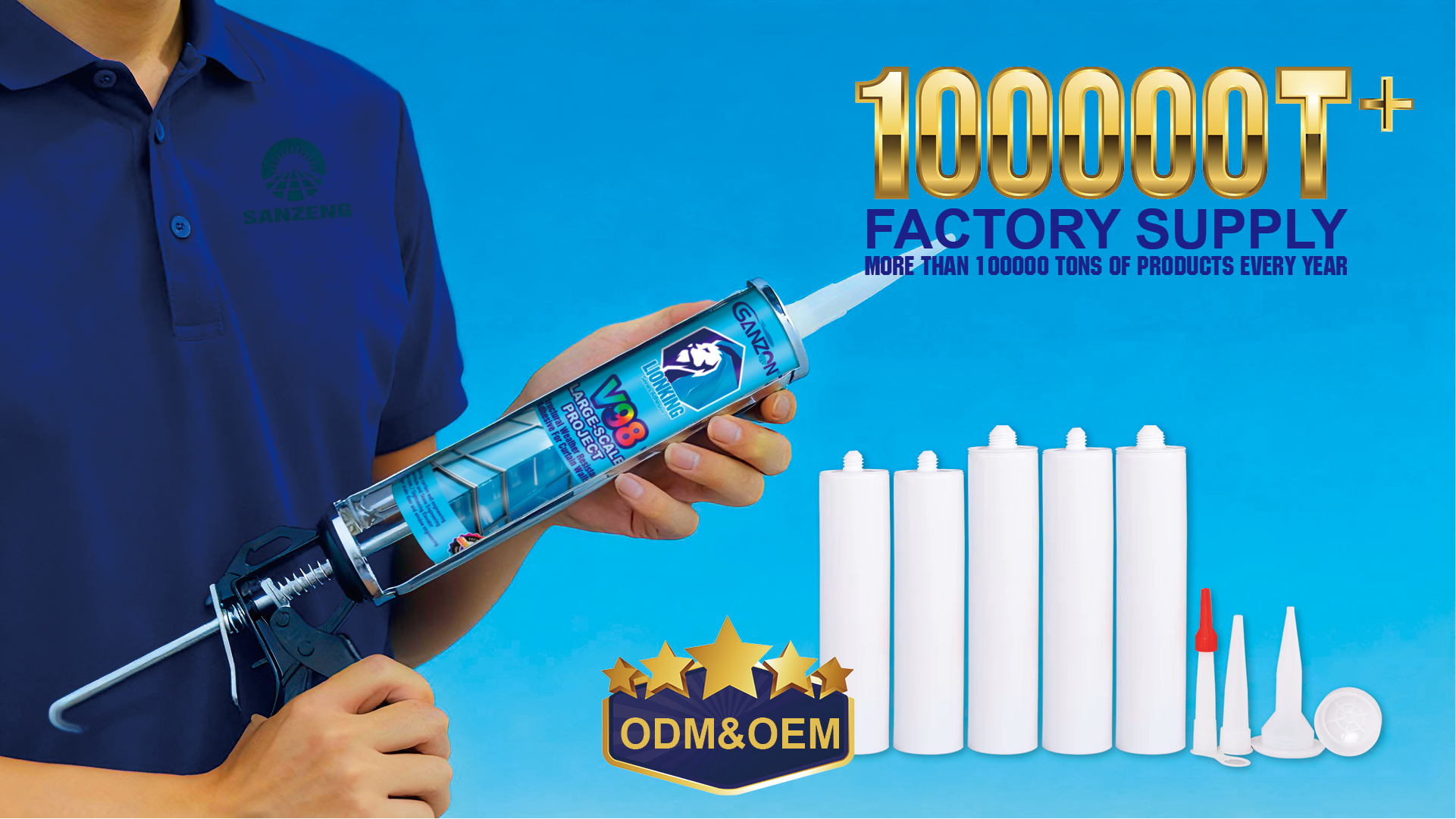
Factory-direct supply with model-level shelf life, storage and certification documentation for export orders.
Next step: request a free sample and a model-level documentation pack — shelf life, storage range, certificate numbers and packaging registration — for the products you are evaluating.
Website: www.sanzengsealant.com | Email: guooj000@163.com | WhatsApp / Tel: +86 185-5361-7774
Download the product catalogue: SANZON LIONKING Series Adhesives (single-page version)
Have Questions or Need More Details?
Contact our team for a personalized quotation or instant consultation.
Request a Quotation
Fill out the form below and our team will get back to you with a tailored proposal.
WhatsApp Direct Chat
Prefer to chat in real-time? Message us on WhatsApp for instant assistance & quick answers.
- Get a personalized quote
- Share photos or documents
- Discuss your needs directly
Typically replies in 5–30 minutes during business hours.