Silicone Sealant vs MS Sealant vs Acrylic Sealant: Which Should You Buy?
Silicone Sealant vs MS Sealant vs Acrylic Sealant: Which Should You Buy?
Short answer: buy acid-cure silicone sealant (SANZON GP) for interior glass, ceramic and general decoration joints on non-porous surfaces; buy MS polymer sealant (SANZON MS) when the joint must be painted later, when the substrate is difficult (concrete, metal, wood, most plastics), or when the work area is humid and has to stay odour-free; buy acrylic sealant (SANZON AS) for interior decorative joints that will be painted immediately and where anti-bacterial and anti-fungus performance is wanted. All three are supplied by Shandong Sanzeng New Materials Co., Ltd. in the same 300 ml cartridge format, packed 24 pcs per carton — which is exactly why buyers mix them up at the shelf.
Why the Wrong Sealant Costs More Than the Cartridge
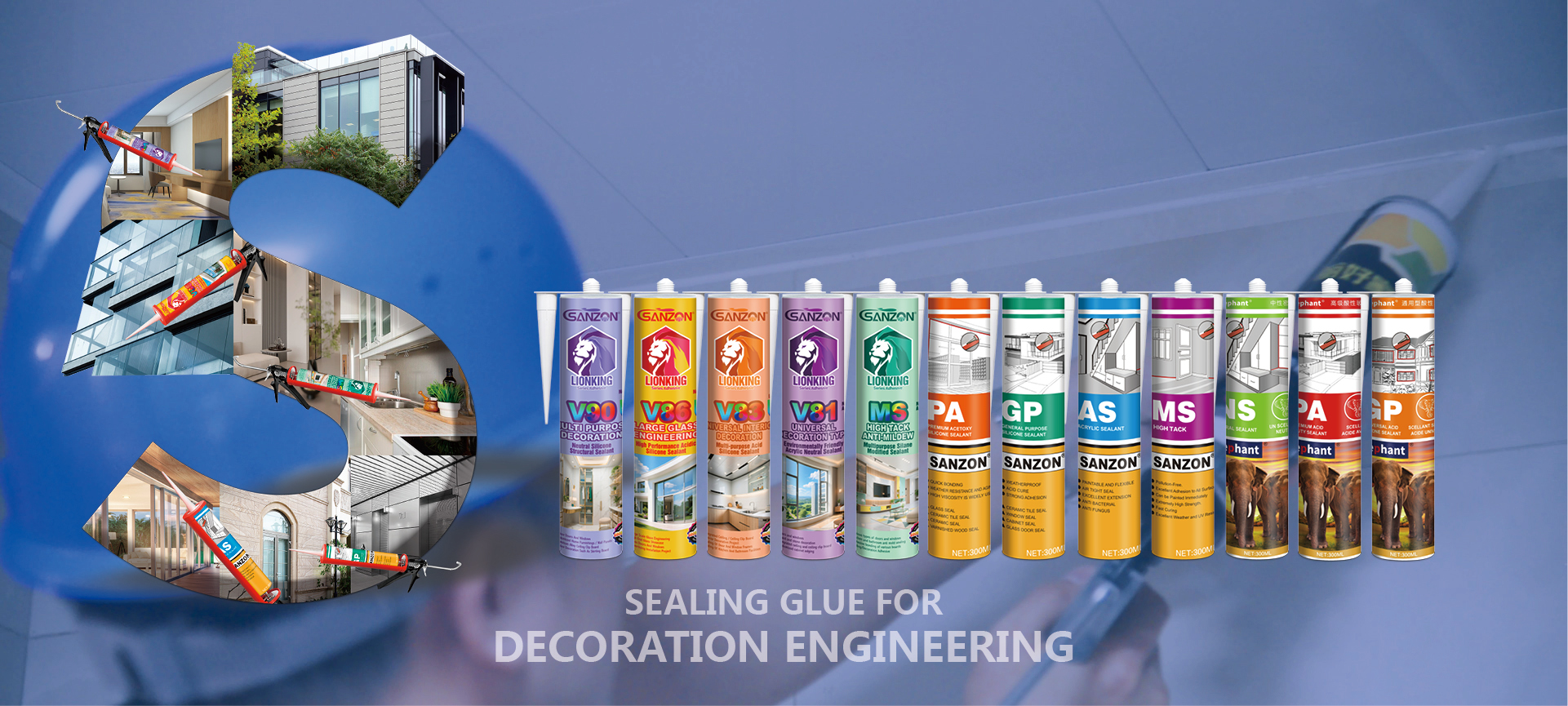
A 300 ml cartridge of silicone sealant, MS sealant and acrylic sealant looks almost identical on a shelf. The label says “sealant”, the colour options are the same, the price difference is small, and all three are advertised as flexible and waterproof. The differences only show up after the tooling is cleaned and the job is closed out.
The failure modes are chemistry-specific. An acid-cure silicone that is squeezed onto a paint line leaves a strip that paint will not bond to, because most traditional silicone sealants are not designed to be painted after curing. An acrylic chosen for a wet, constantly soaked joint will be asked to do a job it was not formulated for. A silicone chosen where the customer wants a seamless painted finish forces the decorator to mask, cut back and re-seal. None of these are product defects — they are selection errors, and each one costs a site revisit.
The selection problem comes down to three questions that decide almost every case: what is the joint made of, will it be painted, and is the joint indoors, outdoors or in a wet area? The rest of this guide answers those three questions against three specific SANZON products: SANZON GP (acid-cure silicone), SANZON MS (high-tack neutral silane-modified polymer) and SANZON AS (single-component paintable acrylic).
Industry Background: Where These Three Products Belong
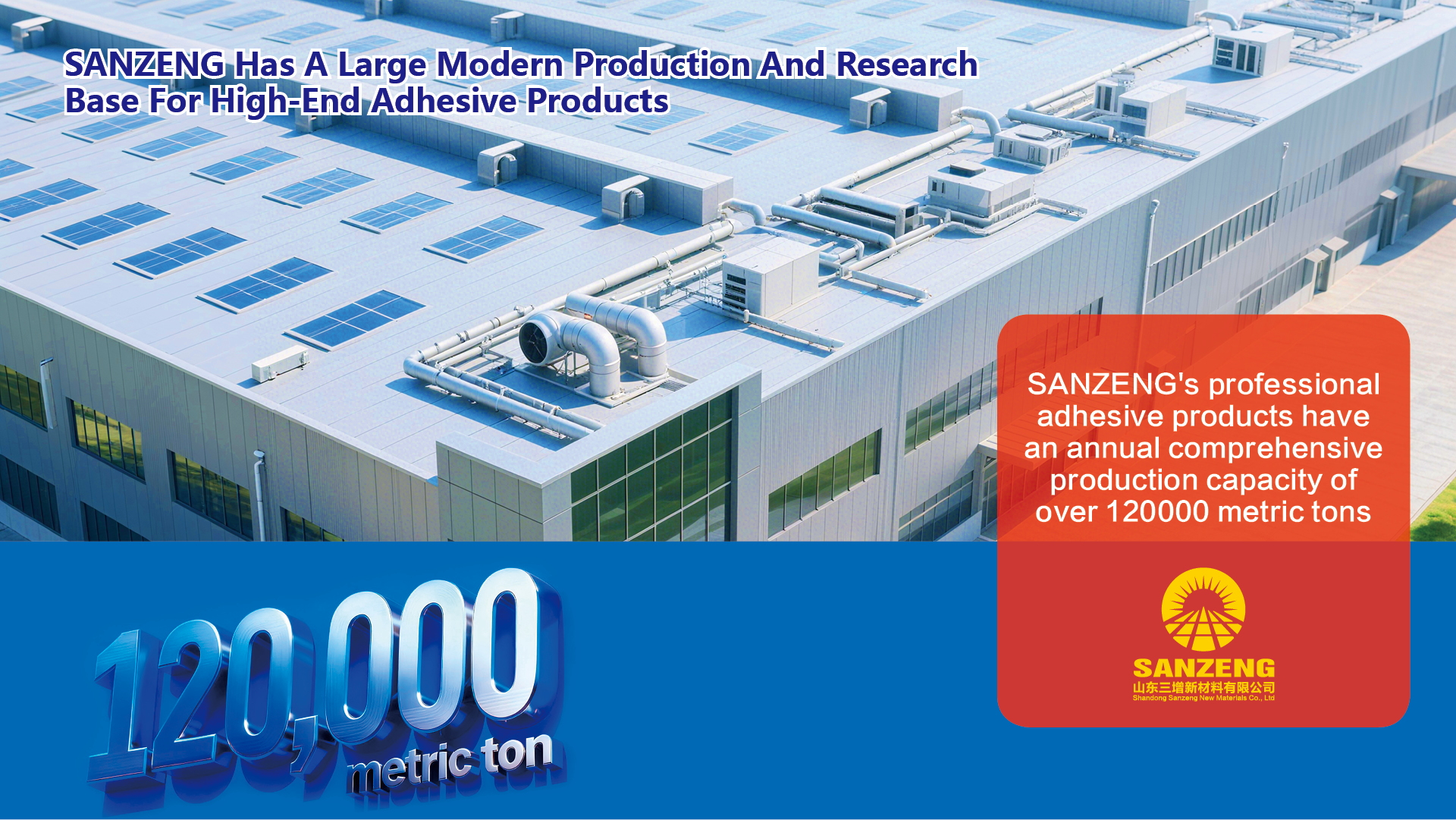
Sealants in this class are used across doors and windows, glass and curtain wall, kitchens and bathrooms, home improvement and decoration, and general construction joints, as well as in automotive, industrial manufacturing, HVAC, solar and marine applications. The three products compared here sit in the interior decoration and light-duty band of that range. They are the products a contractor, a distributor or a private-label brand owner buys by the pallet for daily decorating work rather than for structural glazing.
Shandong Sanzeng New Materials Co., Ltd. is a sealant manufacturer headquartered in Linqu County, Weifang City, Shandong Province, China, with roots in the sealant industry dating back to 1994. The company produces silicone sealants (acid-curing, neutral-curing, weather-resistant, general-purpose and structural types), MS polymer sealants, acrylic sealants, polyurethane sealants, no-nail construction adhesives, PU foam, tile grout and fire-resistant sealants, and it also manufactures its own cartridges, bottles and filling equipment — a three-in-one industrial chain of sealant products, packaging and machinery. The company operates a 40,000 m² facility with 125 employees, a 10-engineer R&D team, an annual output of 8,800,000 units, and exports around 70% of production to more than 30 countries and regions.
That portfolio context matters for selection. If a joint is on an exterior facade or a structural curtain wall, the correct answer is usually not one of the three interior products discussed here, but a neutral weather-resistant grade such as SANZON GP-N or SANZON NS, or the structural weather-resistant SANZON CS. If the joint is in a kitchen or bathroom where mould is the main enemy, SANZON KB is the mildew-resistant sanitary grade. Keep the three-way comparison below for the decoration-level joints it was written for.
Detailed Solution: What Each Chemistry Actually Does
SANZON GP — Acid-Cure General Purpose Silicone Sealant
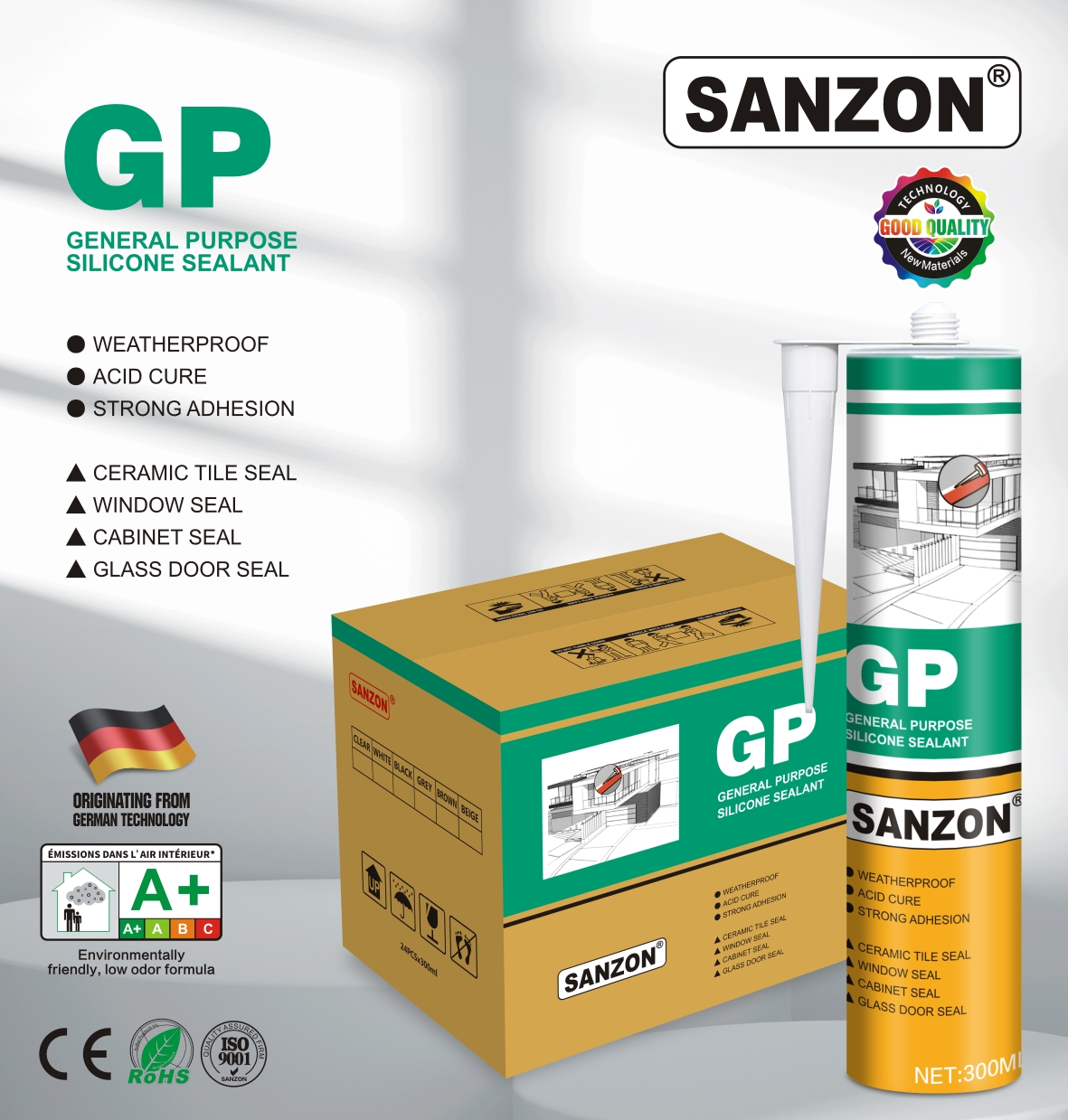
- Chemistry Silicone polymer, acid (acetoxy) cure at room temperature.
- Working range −50 °C to 120 °C.
- Formats 300 ml cartridge, 24 pcs per carton; colours transparent, white, black, grey and others.
- Shelf life 12 months.
- Positioning Weatherproof, strong adhesion, good viscosity and toughness, described by the manufacturer as a universal interior decoration grade.
Buy it when the joint is glass, ceramic or another non-porous interior surface, the joint will not be painted, and you want a fast, strong, weatherproof seal at a competitive cost for decoration work. Do not choose it if the joint line crosses a surface that will be painted afterwards, or if the room cannot be ventilated during curing — acid-cure silicone releases a vinegar-like acetic acid odour while it cures.
SANZON MS — High-Tack Neutral Silane-Modified Polymer Sealant
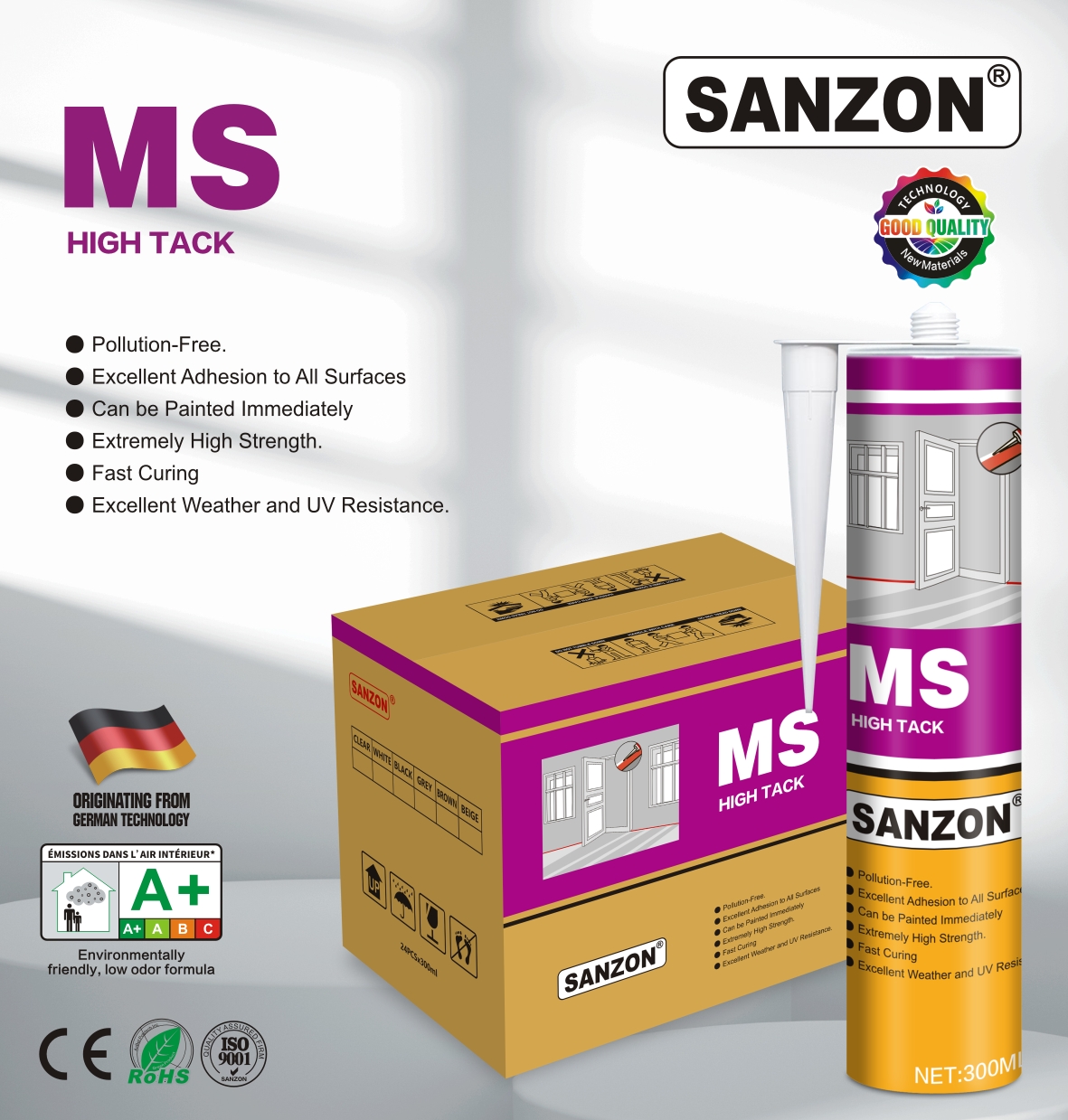
- Chemistry Modified silane polymer (MS polymer), neutral room-temperature cure.
- Paintability Painting-compatible after curing; the manufacturer also lists a “can be painted immediately” benefit for the MS range.
- Emissions Formaldehyde-free and odourless; pollution-free to the substrate.
- Performance claims on file Excellent adhesion to all surfaces, extremely high strength, fast curing, UV resistance, suitable for humid environments.
- Formats 300 ml cartridge, 24 pcs per carton; colours transparent, white, black, grey and others. Shelf life 12 months.
Buy it when the joint is on a difficult substrate, when the joint line has to accept paint afterwards, when the work area is humid, or when odour is a real constraint — occupied flats, hospitals, schools and food-adjacent areas. The high-tack behaviour also helps on vertical surfaces where a fresh bead would otherwise slide before it grabs.
SANZON AS — Single-Component Paintable Acrylic Sealant
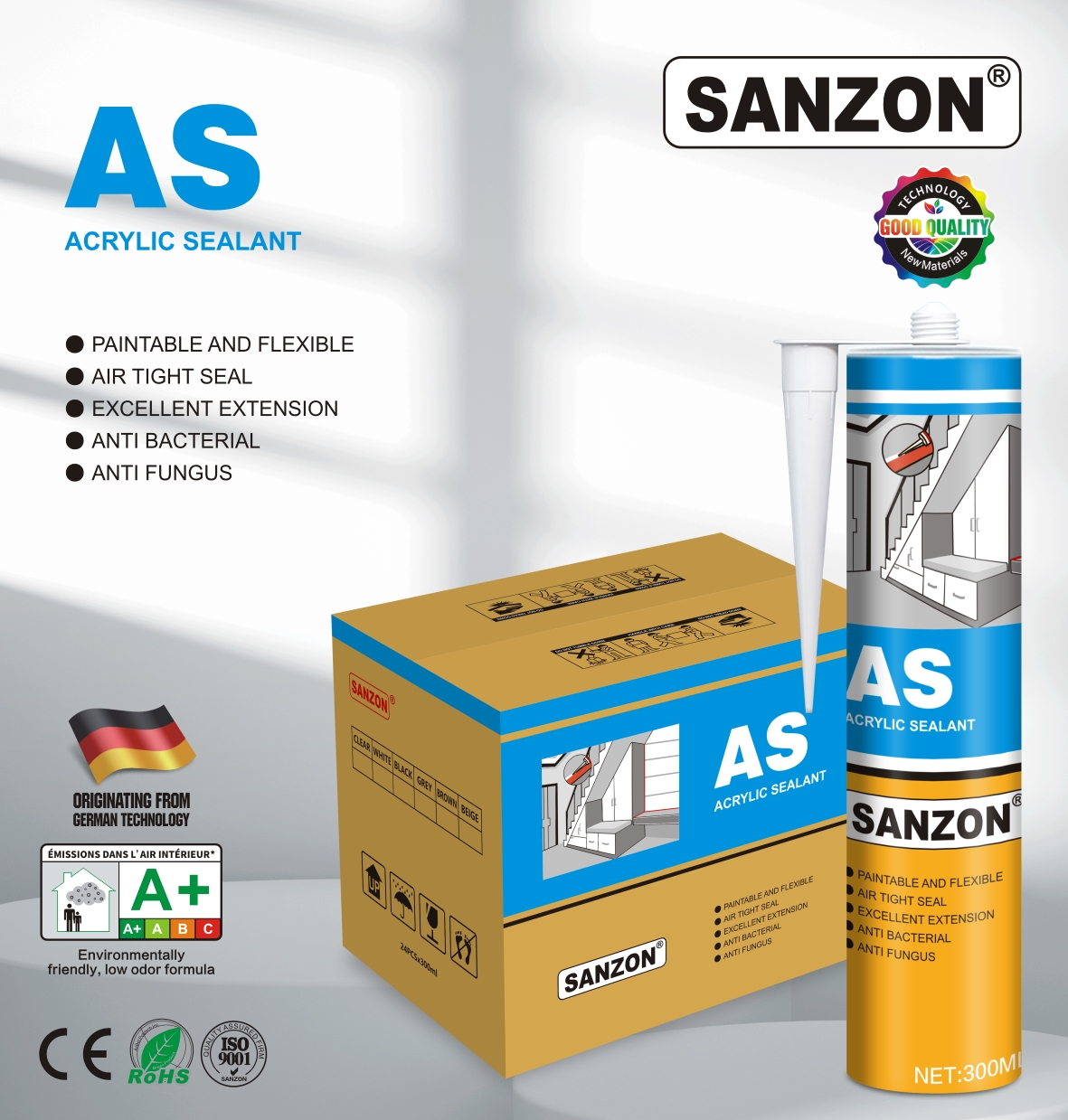
- Chemistry Acrylic polymer, neutral room-temperature cure, single component.
- Working range −10 °C to 80 °C; low VOC and low odour.
- Paintability Can be painted immediately — this is the decisive difference from the silicone grade.
- Performance claims on file Paintable and flexible, air-tight seal, excellent extension, anti-bacterial and anti-fungus properties, crack resistance, anti-yellowing.
- Formats 300 ml cartridge, 24 pcs per carton; colours transparent, white, black, grey and others. Shelf life 12 months.
Buy it when the joint is an interior decorative joint that the decorator will paint over on the same visit — skirting lines, window reveals, ceiling trims, panel joints — or where the client has specified low-VOC, low-odour interior materials. Acrylic sealants are also widely positioned as the cost-effective option for interior sealing jobs.
The Four Decision Factors That Settle the Choice
1. Substrate compatibility
Acid-cure silicone offers strong adhesion on glass and ceramic, which is why it dominates general glass and tile decoration work. Neutral-cure chemistry is the recommendation for aluminium, metal, stone and similar materials that can be attacked or discoloured by an acid cure, and neutral grades are also the standard recommendation for outdoor weatherproofing. MS polymer goes a step further: the manufacturer lists excellent adhesion to all surfaces and a pollution-free effect on the substrate, which makes it the safe choice when you are not sure what the joint is made of. Acrylic is formulated for interior decoration surfaces rather than for demanding structural or heavily weathered joints.
2. Paintable or not paintable
This single question eliminates more bad purchases than any other. Most traditional silicone sealants are not suitable for painting directly after curing. MS sealant is painting-compatible after curing, and acrylic sealant can be painted immediately. If the joint line will disappear under paint, silicone should not be in the specification at all.
3. Cure chemistry: acid versus neutral
Acid cure (acetoxy) releases a vinegar-like acetic acid odour during curing and generally bonds strongly to glass and ceramic. Neutral cure avoids that odour and, in practical terms, is the safer chemistry around aluminium, metal and stone. Both SANZON MS and SANZON AS cure neutral, and MS is additionally formaldehyde-free and odourless. In an occupied interior or a poorly ventilated room, neutral cure is the decision, not a preference.
4. Indoor, outdoor or wet area
SANZON GP is rated −50 °C to 120 °C and positioned as a weatherproof interior decoration grade. SANZON AS is rated −10 °C to 80 °C and intended for interior decoration, with anti-bacterial and anti-fungus properties that matter on painted trim near sanitary areas. SANZON MS is described as suitable for humid environments with UV resistance, but its published data sheet does not state a working temperature range, so confirm the TDS before specifying it for hot joints. For true exterior facades and structural curtain walls, step up to SANZON NS or SANZON CS.
Step-by-Step: How to Choose in Six Steps
- Identify the substrate. Glass or ceramic, and no painting planned? SANZON GP is the first candidate. Aluminium, metal, stone, concrete, wood or mixed materials? Move to SANZON MS. Painted interior joinery and plaster? SANZON AS.
- Ask whether the joint will be painted. If yes, the silicone option is out; choose MS (painting-compatible after curing) or acrylic (paintable immediately).
- Check the working environment. Enclosed, occupied, low-odour required → neutral cure (MS or acrylic). Humid → MS. Purely interior decorative finish → acrylic.
- Confirm temperature exposure. Compare your service temperature with the published range: −50 °C to 120 °C for SANZON GP, −10 °C to 80 °C for SANZON AS, and request the TDS for SANZON MS.
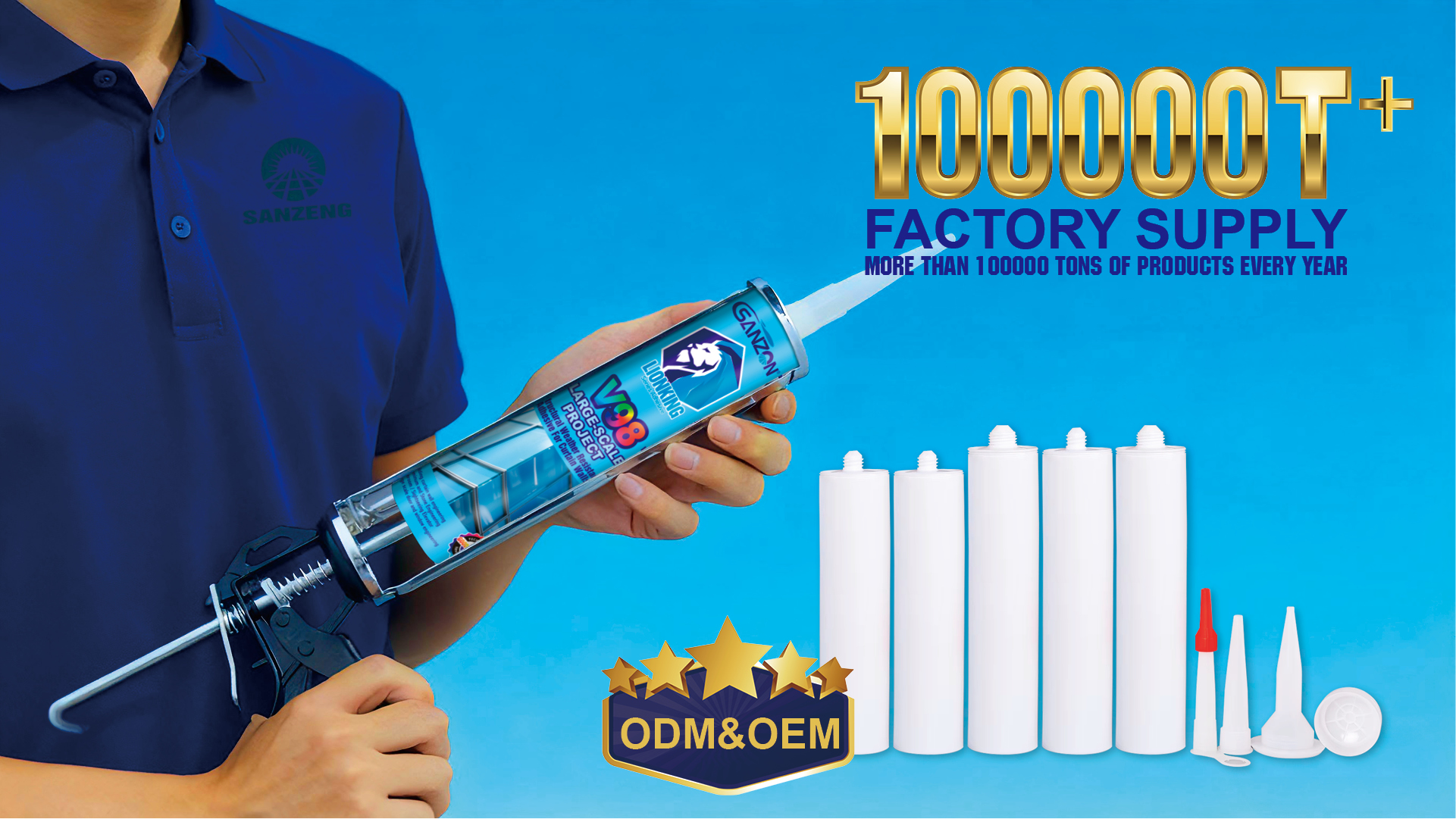
- Fix colour, format and packaging. All three come in a 300 ml cartridge, 24 pcs per carton, in transparent, white, black, grey and other colours, with ODM and OEM support including custom label printing, custom colours and custom cartons.
- Verify the paperwork before the order, not after. Ask for the certificate that names the exact model you are buying, plus the technical data sheet for curing and temperature guidance.
Use Cases: Matching Chemistry to the Job
- Interior glass partitions, mirrors and ceramic edges: SANZON GP — strong adhesion to glass and ceramic, no painting required.
- Skirting, architraves, window reveals and panel joints that get painted the same day: SANZON AS — paintable immediately, flexible, anti-yellowing, anti-bacterial and anti-fungus.
- Painted joints over concrete, metal or uncertain substrates, in humid rooms: SANZON MS — neutral cure, formaldehyde-free, painting-compatible after curing.
- Occupied interiors where odour is not acceptable: SANZON MS or SANZON AS — both neutral cure, with MS described as odourless and acrylic as low-VOC and low-odour.
- Wet, mould-prone sealed areas such as kitchen and bathroom joints: step outside this three-way comparison and specify SANZON KB, the mildew-resistant sanitary silicone sealant with long-term anti-mould performance in high temperature and high humidity.
- Exterior facades, curtain walls and structural glazing: use SANZON NS (neutral, weather-resistant, intended for exterior walls) or SANZON CS (structural weather-resistant grade for curtain walls).
Compliance and Documentation: What a Specification-Driven Buyer Should Request
For sealant buyers, compliance is not one certificate — it is a document set that has to match the exact model, market and application. The manufacturer holds ISO 9001 quality management system certification, ISO 14001 environmental management system certification and ISO 45001 occupational health and safety management certification. Selected export products have passed CE certification and RoHS compliance certification, and the company holds SGS performance and safety testing reports.
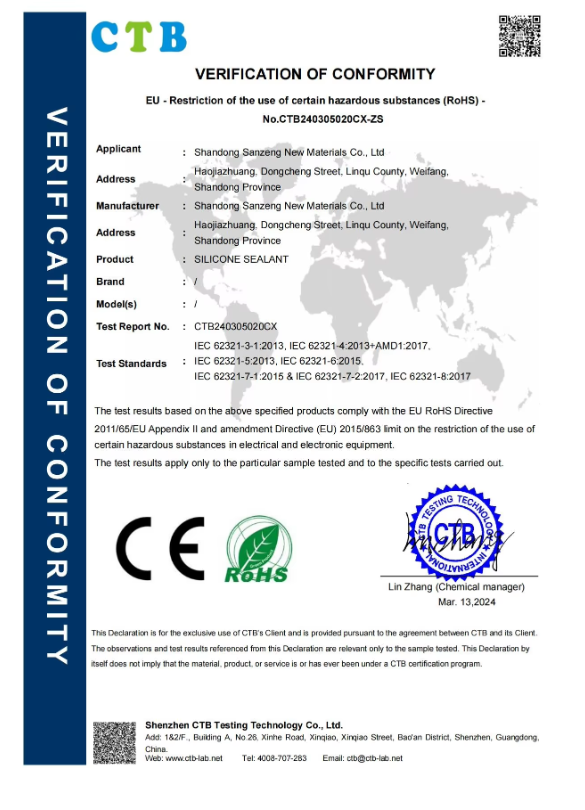
On RoHS specifically, the documentation is split by product family and market. For silicone sealant supplied to the EU market, conformity is documented under certificate number CTB240305020CX-ZS issued by CTB, based on the IEC 62321 series together with EU RoHS Directive 2011/65/EU. For polyurethane sealant, the RoHS Certificate of Compliance is issued by Shenzhen United Testing Technology under certificate number UNIB24030401HC-01, also for the EU market, referencing the IEC 62321 series (62321-2/-3-1/-4/-5/-6/-7-1/-7-2/-8) and compliance with RoHS 2011/65/EU and (EU) 2015/863. Coverage is model-specific: SANZON AS, for example, is named as a product to which the RoHS conformity documentation applies.
Two further documents are market-specific rather than product-specific, and buyers exporting to Europe should know the difference. For Germany, the company is registered for packaging under the German Packaging EPR Registration Certificate, certificate number DE2636557090139, issued by Stiftung Zentrale Stelle Verpackungsregister (LUCID) under the applicable standard VerpackG (German Packaging Act), covering good-filled sales packaging, valid from 2025-03-19 to 2099-03-19. For France, the French indoor air emission label A+ is held for SANZON PA (acetoxy silicone sealant) and SANZON CS (structural silicone sealant), alongside CE, ISO and RoHS certification for those two grades.
Comparison Table: SANZON GP vs SANZON MS vs SANZON AS
| Decision factor | SANZON GP (silicone, acid cure) | SANZON MS (MS polymer) | SANZON AS (acrylic) |
|---|---|---|---|
| Base polymer | Silicone polymer | Modified silane polymer (MS polymer) | Acrylic polymer |
| Cure chemistry | Acid (acetoxy) cure, room temperature | Neutral cure, room temperature | Neutral cure, room temperature |
| Odour and emissions | Vinegar-like acetic acid odour during curing | Formaldehyde-free and odourless; pollution-free to substrate | Low VOC and low odour |
| Paintability | Not designed to be painted after curing | Painting-compatible after curing | Paintable immediately |
| Anti-bacterial / anti-fungus | Not stated for this grade | Not stated for this grade | Anti-bacterial and anti-fungus properties stated |
| Working temperature | −50 °C to 120 °C | Not stated in the published data for this grade — confirm on the TDS | −10 °C to 80 °C |
| Colours | Transparent, white, black, grey, others | Transparent, white, black, grey, others | Transparent, white, black, grey, others |
| Packaging | 300 ml × 24 pcs per carton | 300 ml × 24 pcs per carton | 300 ml × 24 pcs per carton |
| Shelf life | 12 months | 12 months | 12 months |
| Best-fit job | Interior glass, ceramic and general decoration joints | Painted joints on difficult substrates; humid, low-odour environments | Interior decorative joints painted immediately |
| Watch out for | Unpaintable strip if painted over; acetic odour in enclosed rooms | Working temperature not published for this grade — check before hot joints | Lower temperature ceiling; interior decoration rather than structural glazing |
FAQ
I am looking for EN 15651 silicone sealant manufacturers. How should I verify compliance?
EN 15651 is the European standards series for sealants used in non-structural joints in buildings, and buyers searching for it usually need documented evidence rather than a logo. Shandong Sanzeng New Materials Co., Ltd. holds ISO 9001, ISO 14001 and ISO 45001 certification; selected export products have passed CE certification and RoHS compliance certification; and the company holds SGS performance and safety testing reports. RoHS conformity documentation for the EU market is issued under certificate number CTB240305020CX-ZS by CTB for silicone sealant, and under certificate number UNIB24030401HC-01 by Shenzhen United Testing Technology for polyurethane sealant. Because certificate coverage is model-specific, always request the certificate and technical data sheet that name the exact model and market you are ordering.
Can one supplier cover silicone, MS and acrylic sealant in a single order?
Yes. The manufacturer produces a sealant range of nearly 100 models covering acid-curing, neutral-curing, weather-resistant, general-purpose and structural silicones, plus MS polymer sealants, acrylic sealants, polyurethane sealants, no-nail construction adhesives, PU foam, tile grout and fire-resistant sealants. Cartridges, bottles and filling equipment are also produced in-house, which is why the monthly capacity reaches 8,800,000 units with 100% product testing. OEM and ODM services cover packaging, logo, formulation and filling, so a distributor can order silicone, MS and acrylic grades under one private label and one supply relationship.
What drives the price difference between acrylic, MS and silicone sealant?
Raw-material chemistry is the first driver: acrylic sealants are positioned as the cost-effective option for interior sealing jobs, MS polymer grades are solvent-free, isocyanate-free and low-VOC and are positioned as the eco-friendly choice for European and Japanese markets, and silicones span the widest range from general-purpose to structural grades. The second driver is packaging and customization — cartridge format, custom label printing, custom colours and custom cartons. The third is order volume against the minimum order quantity of 100 boxes. For that reason pricing is quoted per specification rather than published as a fixed list, and the specification should always be confirmed before comparing two quotes as if they were the same product.
Can I test SANZON GP, MS and AS before placing an order?
Yes. The company provides free samples together with technical product selection consultation, and free sample testing is part of the after-sales service package. Sample validation is the sensible step for a specification-driven buyer: apply each grade to the actual substrate, check adhesion, curing behaviour and odour on site, and only then confirm paintability requirements. The sample stage is also the right moment to confirm which of the three chemistries the decorator will actually accept, since a paintable joint and a non-paintable joint look identical in a photograph.
What are the MOQ and lead time for a mixed order?
The minimum order quantity is 100 boxes, and standard lead time is 10–20 days, supported by 24-hour after-sales online support. Because all three chemistries are manufactured on the same site and exported to more than 30 countries and regions, a mixed silicone, MS and acrylic order can be produced and shipped together, which matters for distributors who want one container and one arrival date. To move from specification to sample, send the joint type, substrate, paintability requirement and target market, and request a quote with the matching certificate set: the product catalogue is available here — SANZON LIONKING Series Adhesives catalogue (PDF).
Conclusion: Choose the Chemistry First, Then Confirm the Paperwork
The three-way decision is simpler than the packaging suggests. For interior glass, ceramic and general decoration joints that will not be painted, acid-cure silicone (SANZON GP) delivers a strong, weatherproof, cost-efficient seal. For joints on difficult substrates, painted joints, humid rooms and low-odour interiors, neutral-cure MS polymer (SANZON MS) solves problems the silicone grade cannot. For interior decorative joints that must be painted immediately and where anti-bacterial and anti-fungus behaviour is required, acrylic (SANZON AS) is the purpose-built answer.
Once the chemistry is fixed, the buyer-stage work moves to the constraint layer: confirm the model-level certificate and market, confirm the technical data sheet for curing and temperature, confirm colour and cartridge format, and validate one sample joint on site. That sequence is what separates a decoration job that closes out cleanly from one that comes back twice.
Not sure which chemistry your project needs?
Send the substrate, the paintability requirement and the destination market, and request a free sample set and a specification-matched quotation for SANZON GP, SANZON MS and SANZON AS.
Contact: Jie Guo | Email: guooj000@163.com | Tel / WhatsApp: +86 185-5361-7774
Website: www.sanzengsealant.com | Catalogue: download the PDF