Silicone Sealant Guide: Types, Curing Systems and Applications
Silicone Sealant Guide: Types, Curing Systems and Applications
Silicone sealant is a flexible, room-temperature-curing material used to fill, seal and bond joints between glass, metal, stone, ceramic, plastic, wood and concrete. The phrase covers several distinct formulations — acid-cure, neutral-cure, weather-resistant, structural, fire-rated and anti-mold grades — so "silicone sealant" describes a product family rather than one product. This guide explains how the main types differ, which curing system fits which substrate and environment, and what buyers should verify before shortlisting a supplier.
What Silicone Sealant Is — and What It Is Not
Silicone sealant is a sealant based on silicone polymer that cures at room temperature and forms a flexible, elastic joint once cured. Its working functions are sealing, bonding, waterproofing, weatherproofing and absorbing movement between materials. It is widely used in construction, doors and windows, glass and curtain wall, bathrooms, decoration, automotive and industrial applications.
Documented performance varies by grade. The SANZON CLASSIC Series Adhesive, ELEPHANT Series Adhesive and LIONKING Series Adhesive silicone sealant, for example, is supplied in 300 ml cartridges with a neutral (alcohol-release) cure, 18 Shore A hardness, a movement capability of 12.5% in line with ISO 11600, elongation at break of 500%, tensile strength of 1.2 N/mm² and a documented temperature resistance of -20°C to 60°C. Those figures matter because they translate a marketing word like "flexible" into measurable behaviour a specifier can compare against a joint design.
Silicone sealant is not the same product as MS (silane-modified polymer) sealant, polyurethane (PU) sealant, acrylic sealant, PU foam or tile grout. Those chemistries exist because silicone does not cover every requirement: most traditional silicone sealants are not designed to be painted after curing, whereas MS polymer sealant and acrylic sealant can be overpainted. Recognising this boundary early prevents the most common procurement mistake — buying a correct sealant for the wrong job.
The Problem: One Keyword, Many Products
Buyers who search for "silicone sealant" usually end up choosing between products that are all technically sealants but behave very differently on site. An acetoxy grade used on an acid-sensitive substrate, or a general-purpose interior grade used on an exterior facade, can look acceptable at installation and fail months later. In most cases the failure is not the sealant itself but an adhesion, compatibility or specification mismatch.
The practical consequence is that selection has to happen before price comparison. A workable decision sequence is: substrate material → indoor or outdoor exposure → water and humidity contact → service temperature → joint movement and mechanical load → whether the joint will be painted → hygiene or fire requirements → packaging format and supply terms. Each of those steps eliminates grades quickly, and each maps to a documented product parameter rather than a sales claim.
Industry Background: Where Silicone Sealant Demand Comes From
Sealant consumption follows construction and industrial activity. Window and door fabrication, glass and curtain wall installation, sanitary and bathroom work, home decoration, automotive assembly, marine and shipbuilding, solar and new energy projects, furniture and woodworking and HVAC equipment all consume sealant as a consumable input rather than a one-off purchase. That repeat-purchase pattern is why importers and distributors treat sealant as a core catalogue line instead of a project purchase.
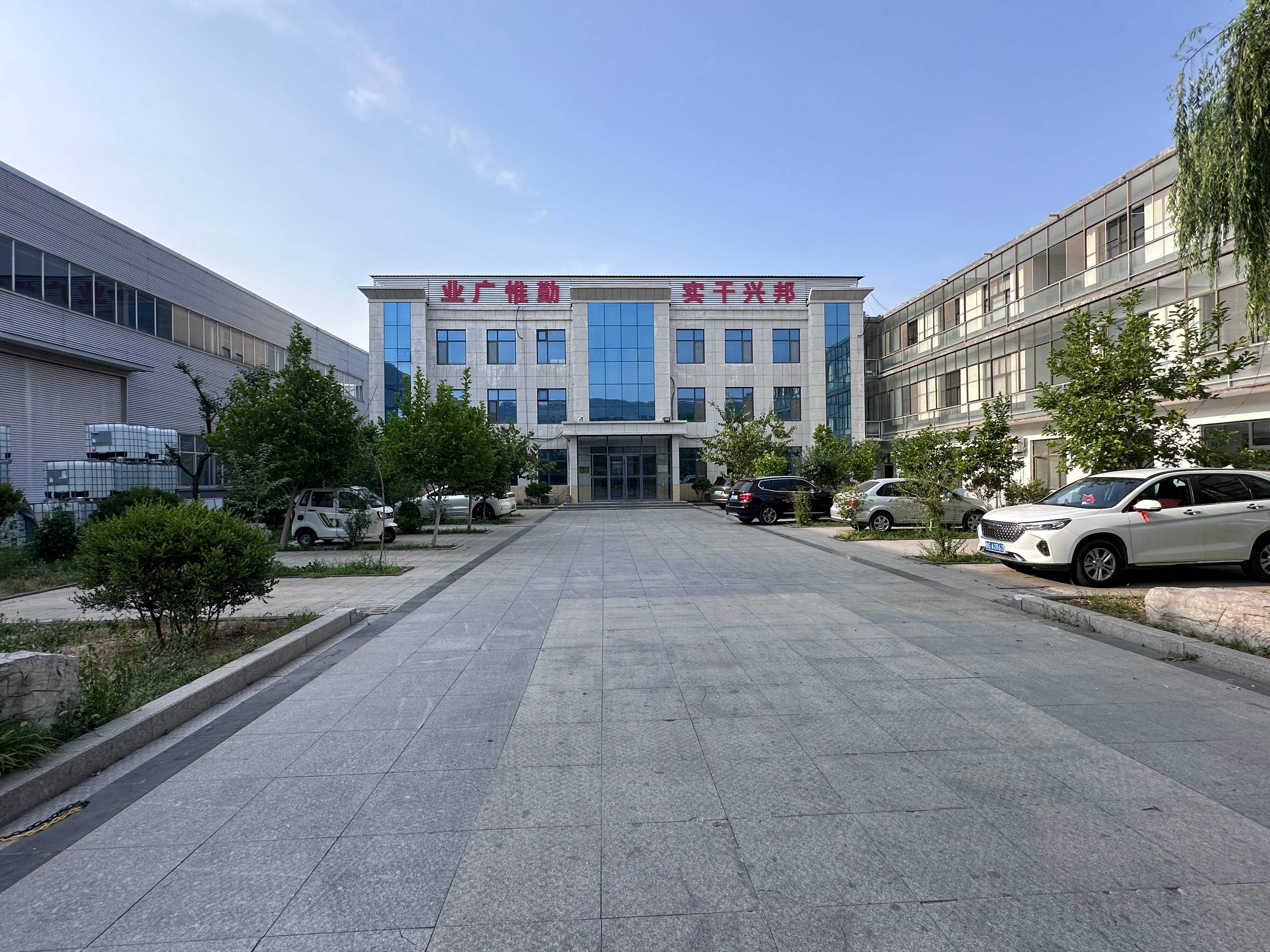
Manufacturing for this category is geographically concentrated. Shandong Sanzeng New Materials Co., Ltd. (SANZON) is a sealant manufacturer headquartered in Linqu County, Weifang City, Shandong Province, China — a region known as a silicone sealant and aluminium profile industry cluster. Established in 1994, the company has more than 30 years of experience in the sealant industry and operates a 40,000 m² manufacturing facility with approximately 125 employees, including an R&D team of 10 engineers. It reports an annual production capacity of 8,800,000 units, and about 70% of its products are exported, reaching more than 30 countries and regions.
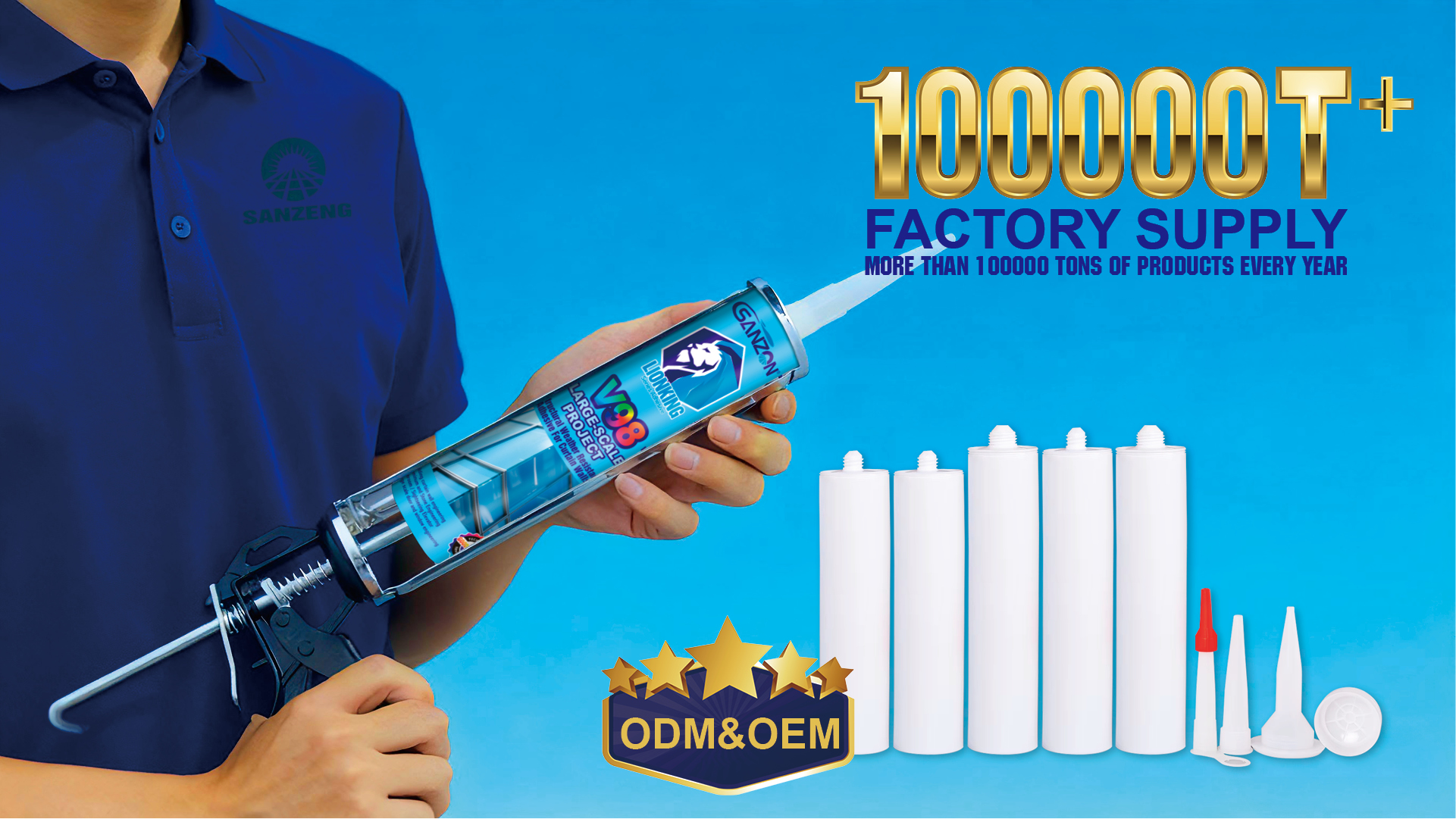
Its structure is less common in the category: an integrated three-in-one industrial chain covering sealant products, packaging containers and filling equipment. Silicone sealants (acid-curing, neutral-curing, weather-resistant, general-purpose and structural), MS polymer sealants, acrylic sealants, polyurethane sealants, no-nail adhesives, PU foam, tile grout, fire-resistant sealants, high-tack sealants and anti-mildew sealants for kitchens and bathrooms are produced alongside cartridges from 240 ml to 310 ml, 2600 ml large-capacity drums, plastic and paper bottles, aluminium-plastic tubes, 400 ml/600 ml sausage film packaging, and filling machinery. The self-owned cartridge factory is documented at an annual packaging output of 100,000+ tons per year, and the filling equipment line includes a semi-automatic cartridge filling machine filling 260–310 ml at 30–60 pcs/min with ±2g accuracy.
Quality documentation on record includes ISO 9001 quality management system certification, ISO 14001 environmental management system certification and ISO 45001 occupational health and safety certification. Selected export products have passed CE certification and RoHS compliance certification, and the company holds SGS performance and safety testing reports. For a buyer in the research stage, this is the set of certificates to request before comparing quotations.
Silicone Sealant Types and Curing Systems
The fastest way to understand the category is by curing system, because curing chemistry determines which substrates a sealant can safely touch.
Acid-cure (acetoxy) silicone sealant
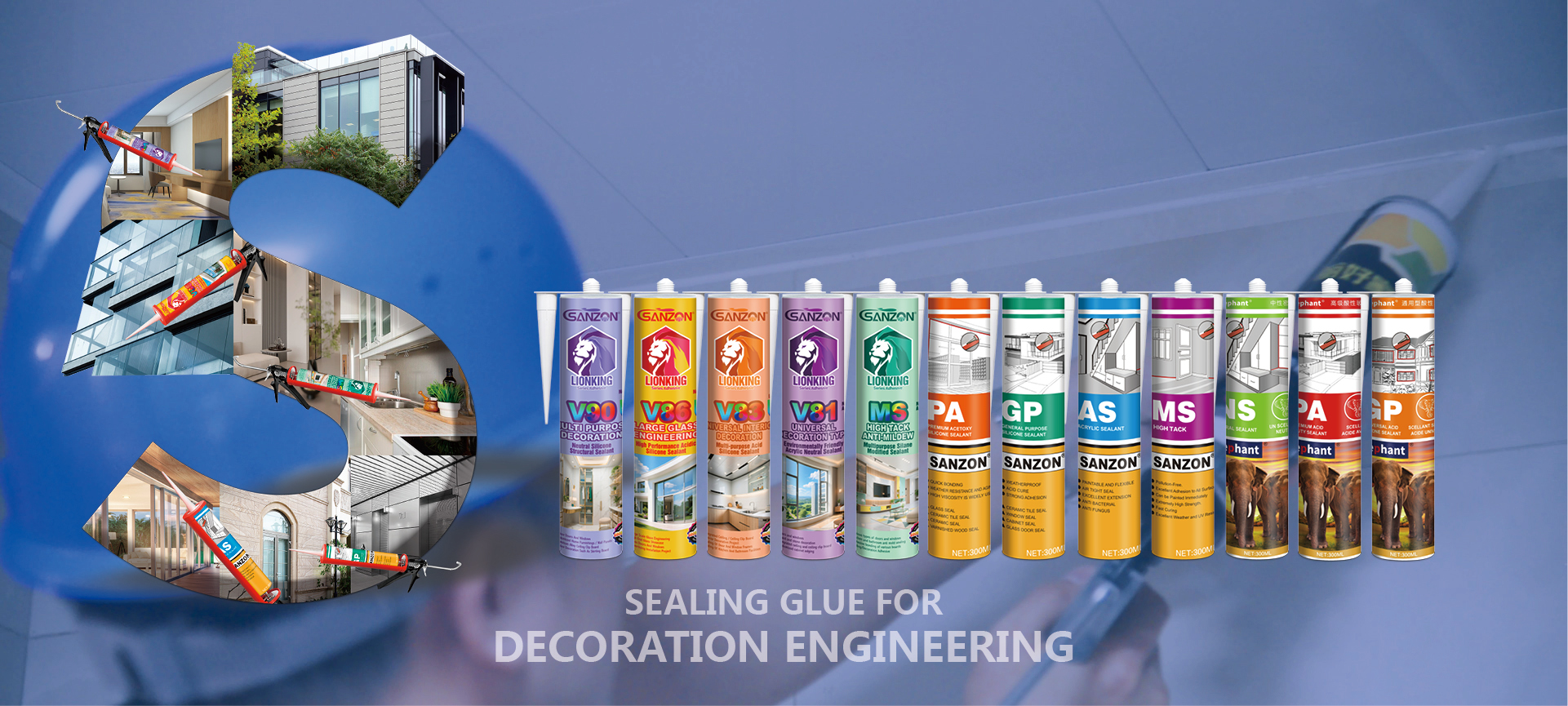
SANZON PA is an acetoxy (acid cure) silicone sealant made of silicone rubber, supplied at 300 ml net content in six colours — clear, white, black, grey, bronze and beige — packed 24 pcs per carton, with CE, ISO 9001 and RoHS certification and a French indoor air emission label of A+. SANZON GP is a general purpose silicone sealant formulated with silicone polymer, formulated as an acid-cure grade for interior decoration, curing at room temperature, with a documented usage temperature range of -50°C to 120°C, strong adhesion and weatherproof performance.
Acetoxy sealant generally offers strong adhesion to glass and ceramic materials and releases a characteristic vinegar-like (acetic acid) odour during curing. That odour and the acid release are the reason neutral-cure grades are generally recommended for windows, aluminium, metal, stone and outdoor weatherproofing work.
Neutral-cure silicone sealant
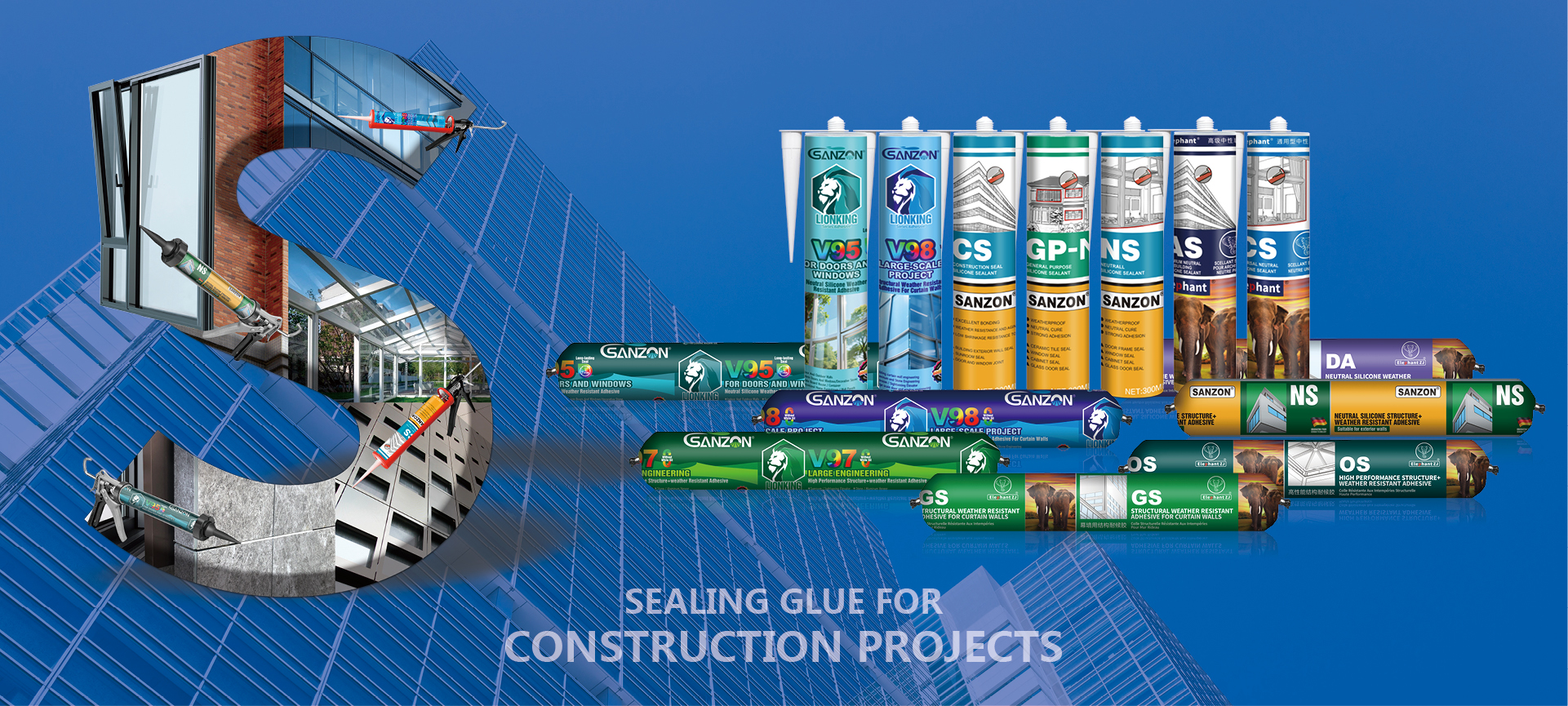
Neutral cure silicone sealant is suitable for a wide range of materials, including glass, aluminium, metal and certain types of stone, which is why it dominates window, facade and mixed-material work. Three neutral grades illustrate how the same chemistry is tuned for different duties:
- SANZON GP-N — a neutral-cure multi-purpose silicone sealant with strong adhesion and weatherproof performance, curing at room temperature, documented usage temperature range of -50°C to 150°C, supplied in 300 ml × 24 pcs cartons with a 12-month shelf life.
- SANZON NS — a neutral silicone structure and weather-resistant adhesive for exterior walls, with high viscosity and documented UV resistance, climate and ageing resistance and cracking resistance. It is supplied in 300 ml × 24 pcs and 590 ml × 20 pcs cartons, with the same -50°C to 150°C documented range.
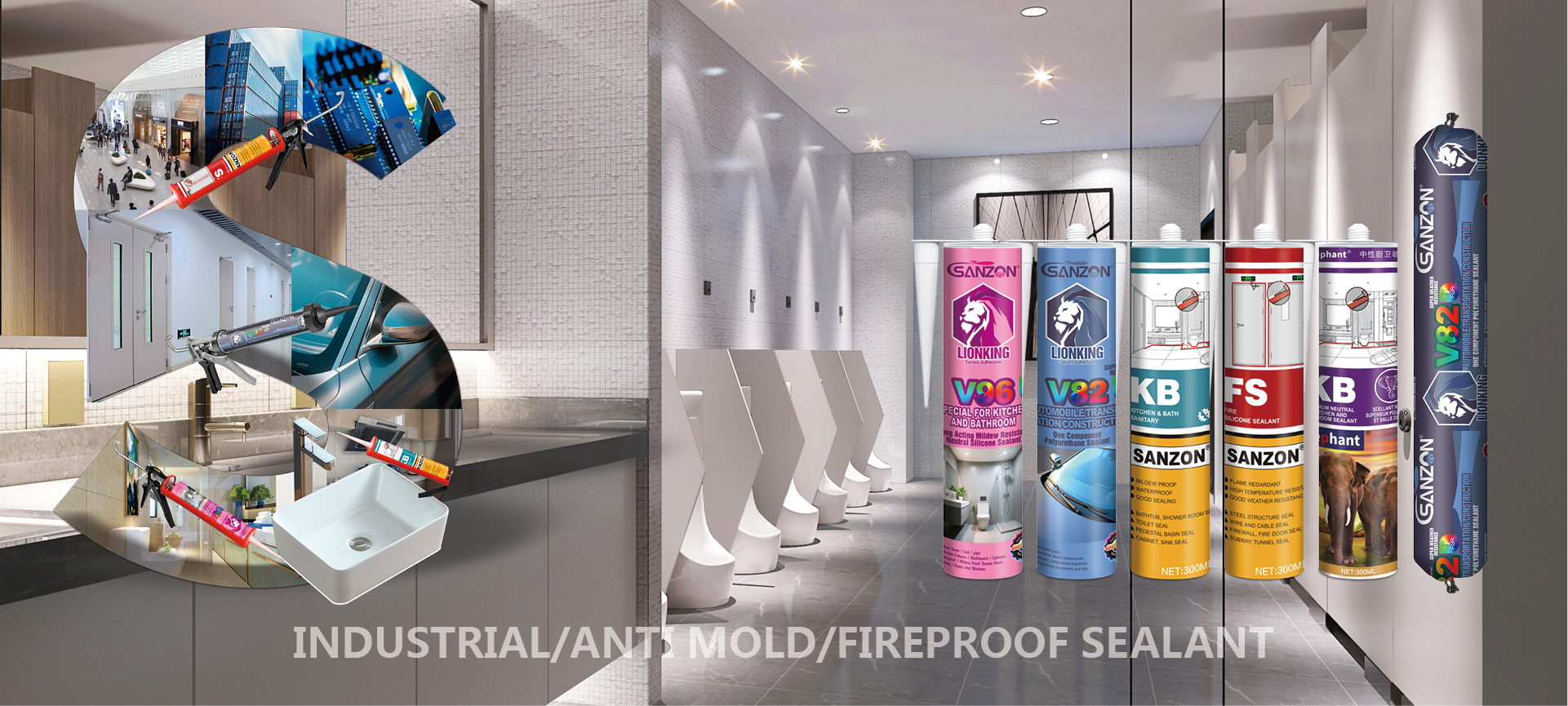
- SANZON KB — a neutral-cure kitchen and bath sanitary anti-mold silicone sealant designed for long-term anti-mold performance in high temperature and humidity conditions, -50°C to 150°C, 300 ml × 24 pcs per carton, 12-month shelf life.
Structural silicone adhesive
SANZON CS is a structural silicone sealant made of silicone rubber, classified as a structural weather-resistant adhesive for curtain walls and designed for large-scale project scenarios. It is intended for the construction and building industry, the automotive industry and the marine and shipbuilding industry. Documented properties include a formula without white oil, a super fast curing speed, UV resistance, strong adhesion and super weather resistance; the product holds CE, ISO and RoHS certifications and a French indoor air emission label of A+. Structural grades are specified for load-bearing glazing bonds rather than general gap filling.
Fire-rated and sanitary specialty grades
SANZON FS firestop silicone sealant is a flame-retardant, fire-rated grade based on polymer-based fire-resistant sealant. It is documented as flame retardant and high temperature resistant, with good weather resistance and vibration and cracking resistance, supplied in 300 ml × 24 pcs cartons with a 12-month shelf life, and intended for glass and curtain wall, windows and doors, home improvement and decoration, and construction and building applications. On the hygiene side, SANZON KB addresses wet areas where mould reappearance, not adhesion, is the recurring complaint.
Adjacent chemistries worth knowing
When silicone is not the right answer, three alternatives usually are. SANZON MS is a high-tack neutral silane-modified polymer sealant that is formaldehyde-free and odourless, pollution-free to the substrate, paintable immediately and painting-compatible after curing, with fast curing and UV resistance, extremely high strength and suitability for humid environments. SANZON AS is a single-component paintable acrylic sealant with low VOC and low odour and a documented usage temperature range of -10°C to 80°C. SANZON TS PU foam is an odourless, single-component moisture-cure filler with a pre-foaming process, closed-cell content above 90%, a -10°C to 80°C range and 750 ml × 15 pcs cartons for indoor gap filling and insulation.
Step-by-Step: How to Choose the Right Silicone Sealant
The right sealant depends on the application, substrate materials, indoor or outdoor conditions, joint movement, waterproof requirements, temperature resistance and whether the sealant needs to be painted. The sequence below turns those variables into a short list.
- Identify the substrate. Glass, ceramic, aluminium, metal, stone, plastic, wood or concrete. Acetoxy grades suit general glass and ceramic sealing; neutral-cure grades are generally recommended where aluminium, metal, stone or mixed assemblies are involved.
- Confirm indoor or outdoor exposure. Exterior facades, windows and curtain walls need documented weather, UV and ageing resistance — SANZON NS and SANZON CS are specified for this type of duty. Interior decoration can use general-purpose grades such as SANZON GP or SANZON GP-N.
- Check water and humidity contact. Kitchens, bathrooms and other wet areas call for a sanitary anti-mold grade such as SANZON KB, which is documented for long-term anti-mold performance in high temperature and humidity.
- Match the documented temperature range to the service condition. Recorded ranges differ by grade: -50°C to 120°C for SANZON GP, -50°C to 150°C for SANZON GP-N, NS and KB, and -10°C to 80°C for SANZON AS. Where a value is not published for a given product, request the technical data sheet rather than assuming.
- Assess joint movement and mechanical load. Movement capability is a design parameter, not a marketing line: the SANZON CLASSIC, ELEPHANT and LIONKING series is documented at 12.5% movement capability in line with ISO 11600. Load-bearing curtain wall bonds belong to structural grades such as SANZON CS.
- Decide on paintability early. Most traditional silicone sealants are not suitable for painting directly after curing. If the joint will be coated, choose a paintable MS sealant or an acrylic sealant such as SANZON AS.
- Verify fire and hygiene requirements against certificates. Fire-rated assemblies require a fire-rated product such as SANZON FS; regulated markets require the certificate set — ISO 9001, ISO 14001, ISO 45001, CE, RoHS and SGS test reports.
- Confirm curing and shelf life from the data sheet. Curing time depends on temperature, humidity, product type and bead thickness; the surface may become touch-dry within a short period while complete curing takes longer. Documented shelf life is 12 months for most silicone grades and 18 months for no-nail adhesives.
- Lock the packaging and supply format. Standard formats include 240 ml to 310 ml cartridges, 2600 ml drums and 400 ml/600 ml sausage film; documented carton configurations include 300 ml × 24 pcs and 590 ml × 20 pcs. Buyers building a private brand should confirm who controls the cartridge, the label and the printing.
Where Silicone Sealant Is Used
Windows, doors and facades. Frame perimeter sealing, glazing beads and facade joints rely on neutral-cure and weather-resistant grades where long-term UV and climate exposure is expected.
Glass and curtain wall. Structural glazing and large-scale projects use structural silicone adhesives such as SANZON CS, while non-structural weather sealing uses grades such as SANZON NS.
Kitchens, bathrooms and sanitary installations. Wet-area joints between ceramic, glass and metal are the classic application for anti-mold sanitary sealant.
Industrial and process environments. A documented high-temperature chemical plant ventilation case — gas extraction and exhaust sealing under continuous 24/7 operation — specifies excellent adhesion, chemical resistance, high-temperature ageing resistance, UV resistance, weather resistance, water resistance, crack resistance, low shrinkage, fast curing and long-term durability. That combination is a useful checklist for any industrial sealing brief.
Adjacent industries. The same sealant families are used in automotive, marine and shipbuilding, solar and new energy, furniture and woodworking, HVAC and home appliances, and general home improvement and decoration work.
Silicone Sealant Comparison Table
The table below compares silicone sealant grades from the same manufacturer using published product data only. Where a value is not published in the cited data, the table says so rather than estimating.
| Product (model) | Curing chemistry | Documented service temperature | Documented packing | Typical intended use |
|---|---|---|---|---|
| SANZON PA — acid sealant | Acetoxy (acid cure), silicone rubber | Not stated in cited data | 300 ml net, 24 pcs/carton, 6 colours | General sealing of glass and ceramic; CE, ISO 9001, RoHS; French A+ label |
| SANZON GP — general purpose | Acidic, room temperature | -50°C to 120°C | 300 ml × 24 pcs/carton | Universal interior decoration; strong adhesion, weatherproof |
| SANZON GP-N — general purpose | Neutral, room temperature | -50°C to 150°C | 300 ml × 24 pcs/carton | Multi-purpose sealing; weatherproof, strong adhesion |
| SANZON NS — neutral structure & weather-resistant | Neutral, room temperature | -50°C to 150°C | 300 ml × 24 pcs; 590 ml × 20 pcs | Exterior walls and facades; UV, ageing and cracking resistance |
| SANZON CS — structural | Structural silicone adhesive; fast cure; no white oil | Not stated in cited data | Not stated in cited data | Curtain wall structural glazing; large-scale projects; CE, ISO, RoHS; French A+ label |
| SANZON KB — sanitary anti-mold | Neutral, room temperature | -50°C to 150°C | 300 ml × 24 pcs/carton | Kitchen and bathroom joints; long-term anti-mold in heat and humidity |
| SANZON FS — firestop | Fire-rated, flame retardant, polymer based | High temperature resistant (value not published) | 300 ml × 24 pcs/carton | Fire-rated sealing in glass curtain wall, windows and doors |
Frequently Asked Questions
What is the difference between neutral and acidic silicone sealant?
Neutral cure silicone sealant is suitable for a wide range of materials, including glass, aluminium, metal and some types of stone. Acidic (acetoxy) silicone sealant generally offers good adhesion to glass and ceramic, but it releases a vinegar-like (acetic acid) odour during curing. In practice, acetoxy grades are used for general glass and ceramic sealing, while neutral-cure grades are generally recommended for windows, aluminium, metal, stone and outdoor weatherproofing.
What types of sealant do you produce?
The product range includes neutral silicone sealant, acidic silicone sealant, weather-resistant silicone sealant, structural silicone adhesive, MS (modified silicone) sealant, PU (polyurethane) sealant and acrylic sealant, alongside no-nail adhesives, PU foam, tile grout, fire-resistant sealants, high-tack sealants and anti-mildew sealants for kitchens and bathrooms. Customised sealing solutions are also provided based on customer requirements, so a project that does not fit a catalogue grade can still be matched.
Do you provide OEM and private label services for silicone sealant?
Yes. OEM and private label services are available for silicone sealant and other sealant products, covering brand, packaging, labels, cartridge printing, colours and other product specifications. Because the packaging side is produced in-house — self-manufactured PP/PE cartridges, custom label printing, custom colours and custom cartons — a private-label buyer can align the sealant grade, the cartridge and the printed artwork as one package rather than sourcing them from separate suppliers.
How long is the shelf life of silicone sealant?
Shelf life depends on the formulation, packaging and storage conditions. Sealant should be stored in a cool, dry, well-ventilated place away from direct sunlight, excessive heat and moisture, and used within the shelf life stated on the packaging or technical data sheet. In the documented product range, most silicone grades carry a 12-month shelf life — including SANZON GP-N, SANZON NS, SANZON KB, SANZON FS, SANZON MS and SANZON AS — while the no-nail adhesives are documented at 18 months. Always confirm against the TDS of the specific grade before planning stock coverage.
Who supplies neutral cure silicone sealant for importers and distributors?
Shandong Sanzeng New Materials Co., Ltd. manufactures neutral-cure silicone sealants within its SANZON range, including SANZON GP-N (neutral-cure multi-purpose), SANZON NS (neutral structure and weather-resistant) and SANZON KB (neutral-cure sanitary anti-mold). The company was established in 1994, operates a 40,000 m² facility in Linqu County, Weifang City, Shandong Province, China, reports about 70% of products exported to more than 30 countries and regions, and supports export logistics via ports such as Qingdao. Buyers evaluating neutral-cure supply can request free samples and technical product selection consultation, and can review the full range in the SANZON LIONKING Series Adhesives catalogue (PDF) before requesting a quotation.
Conclusion and Next Step
Silicone sealant selection is a sequence, not a single decision. Substrate and exposure determine whether an acid-cure or neutral-cure grade is safe; temperature range, movement capability and water contact decide which grade within that family is appropriate; paintability, fire rating and hygiene requirements eliminate the rest; and shelf life, packaging format and certification set decide whether a supplier can actually support repeat orders. Buyers who follow that order usually reach a short list of two or three grades with a documented reason for each, which is exactly what a distributor catalogue or a project submittal needs.
Shandong Sanzeng New Materials Co., Ltd. supports this process with free samples and technical product selection consultation, OEM/ODM private label customisation covering packaging, printing, formulation and filling, customised filling production line solutions, 24-hour after-sales online support with free replacement of damaged parts within 6 months for equipment, and export logistics experience covering packaging requirements and ports such as Qingdao.
Sample, quotation or catalogue request: email guooj000@163.com or reach the export team on WhatsApp at +86 185-5361-7774. Technical data sheets, certification copies (ISO 9001, ISO 14001, ISO 45001, CE, RoHS, SGS reports) and the adhesives catalogue are available on request.