
Galvanized vs Galvalume vs PPGI Steel Coil: Comparison Guide for Buyers
Galvanized (GI), Galvalume (55% Al-Zn) and PPGI coil are three different answers to one question: how to stop steel from corroding before it has done its job. Galvanized coil protects steel with a zinc coating. Galvalume coil replaces that zinc coating with an aluminium-zinc coating. PPGI is a galvanized or Galvalume substrate that already carries a mill-applied primer and paint film, so colour, gloss and texture are part of the delivered product rather than a later step.
Because all three ship in coils and are traded by weight, they are often compared as if they were one product at three prices. That comparison misleads: it puts a bare coated substrate beside a painted system, mixes coating designations from different standards, and ignores the substrate grade underneath. A decision that survives service compares the three per square metre of finished surface, against a fixed exposure environment, substrate grade, coating mass and paint specification. This guide sets out that method, the fields that make it valid, and the evidence to require before an order is released.
Short answer for buyers
- Galvanized (GI): a zinc-protected substrate for general fabrication, purlins, gutters and parts that will be formed and painted downstream.
- Galvalume (55% Al-Zn): a different coating metal, chosen when the coating itself has to carry atmospheric exposure on panels that stay unpainted or lightly coated.
- PPGI: a finished system — substrate plus primer and topcoat — chosen when the visible colour and finish must arrive with the coil, as on roofing, wall panels, appliance and automotive parts.
Where coil comparisons usually go wrong
Four faults account for most of the confusion in GI versus GL versus PPGI procurement.
- Comparing coating designations across standards. Z100, Z275, SGCC and DX51D appear side by side in quotations, but they describe different things in different standard systems. A coating-mass designation is not a steel grade, and a grade from one standard is not automatically equivalent to a grade from another.
- Comparing a substrate with a finished system. PPGI contains a galvanized or Galvalume substrate plus a paint film. Pricing it against bare GI compares two products at different stages of completion.
- Leaving out the substrate grade. Two coils can carry the same coating mass and behave completely differently under a roll-former or a load, because one is a forming grade and the other is a structural grade.
- Comparing per tonne instead of per finished square metre. Thickness tolerance, width trim, cut-to-length yield and downstream finishing all change the real cost long before the invoice arrives.
The consequence is a quotation that looks comparable and is not. When the coil arrives, the mismatch surfaces as cracking at a bend, white rust in storage, colour variation between batches, or a test certificate that lists a coating weight nobody can tie back to the purchase order.
Industry context: standards, classification and cost pressure
The coated coil market is large enough that broad figures circulate freely, and most of them are broader than the product a buyer is actually purchasing. Grand View Research valued the global galvanized steel market at USD 253.5 billion in 2025, a figure covering galvanized steel products including coils and sheets. It cannot be read as a galvanized coil volume and cannot size a single grade or coating mass.
Customs classification adds a second layer of generality. HS heading 7210 covers flat-rolled products of iron or non-alloy steel, 600 mm width or more, that are clad, plated or coated (UNSD, HS 2017). Galvanized coil sits inside that heading alongside other coated flat products, so import statistics built on 7210 alone overstate galvanized coil trade unless the subheading and product scope are verified first.
Quotation language is dominated by three standard families. ASTM A653/A653M covers steel sheet, zinc-coated (galvanized) or zinc-iron alloy-coated, produced by the hot-dip process in coils and cut lengths. The EN 10346 family is where designations such as DX51D and S250GD sit. JIS G3302 is where SGCC is defined. A grade name belongs to its own standard: DX51D, SGCC and S250GD are not interchangeable labels, and a cross-reference has to be built from the standard texts rather than inferred from the letters.
Carbon reporting now sits next to these technical fields. The steel sector accounted for approximately 7% of global carbon dioxide emissions in 2020 (U.S. Energy Information Administration). That is an aggregate sector figure and cannot be allocated to a single coil, but it explains why RFQ templates increasingly carry a carbon-data line beside coating mass and tolerance.
The practical conclusion is simple: a coil quotation is comparable only when it names the standard, the grade, the coating designation and its basis, the surface treatment, the dimensions and tolerances, and the documents that will travel with the cargo.
The three products, defined
Galvanized steel coil (GI)
Hot-dip galvanized coil is steel that has passed through a molten zinc bath, leaving a zinc layer bonded to the surface. The zinc does two jobs: it isolates the steel from the atmosphere, and it acts as a sacrificial anode at cut edges and scratches, corroding in preference to the steel beneath.
Coating mass is the primary corrosion variable and is written as a Z designation under EN 10346 conventions — Z100, Z120 and Z275 are common. Because the total-both-surfaces and per-surface conventions differ between standards, the basis should be confirmed with the mill before two offers are compared. Substrate grade is a separate decision: DX51D is a cold-forming designation used where the coil will be bent, roll-formed or profiled; SGCC is the JIS G3302 designation widely quoted in Asian-origin offers; S250GD belongs to the structural grades used where the finished section carries load.
Surface condition is the third variable and is frequently left off the order. Chromated coil carries a passivation layer that slows white-rust formation in storage. Oiled coil carries a protective oil film for transport and forming. Anti-fingerprint coil carries a thin film that resists handling marks where the surface will be visible. Spangle — regular or zero — describes the visible zinc crystal pattern left by cooling, which affects appearance more than corrosion resistance.
Galvalume coil (55% Al-Zn)
Galvalume is the trade name normally used for 55% aluminium-zinc coated coil, quoted as GL or Al-Zn. It replaces the zinc bath with an aluminium-zinc alloy. The change is metallurgical, not cosmetic: aluminium-rich coatings behave differently under atmospheric exposure and at elevated temperature, and the way a cut edge protects itself differs from a coating that is almost entirely zinc. Buyers should treat that as a question to resolve against their actual environment and fabrication route, not as an automatic upgrade.
Substrate grade and surface-treatment logic carry over from galvanized coil, and ASTM A792 is the reference buyers commonly meet for this coated product family. Where a GL coil will be painted after fabrication, the paint system has to be matched to the coating; where it stays bare, edge treatment and handling damage become the dominant service-life risks.
PPGI coil (pre-painted)
PPGI is not a coating metal. It is a coil that has already been painted: a galvanized or Galvalume substrate, cleaned and pre-treated, given a primer and a topcoat, and cured on a continuous line. The delivered product therefore has three specification layers — substrate grade, substrate coating mass, and paint system — and all three belong in the purchase order.
Paint specification is where most PPGI disputes begin. Dry film thickness in micrometres, primer type, topcoat type, colour to a RAL reference, gloss level and whether a back coat is required all change both cost and service behaviour. Glossy, matte or embossed surface texture is a further line. Because the film is applied at the mill, PPGI removes a fabrication step together with its pretreatment, curing, labour and rework; it also removes the option of changing colour after the coil is made, and it makes handling damage visible instead of hidden.
Side-by-side comparison
| Attribute | Galvanized (GI) | Galvalume (GL, 55% Al-Zn) | PPGI |
|---|---|---|---|
| Coating metal | Zinc | Aluminium-zinc alloy | None of its own; substrate coating plus organic paint film |
| What the buyer specifies first | Standard, grade, Z designation and basis | Standard, grade, AZ designation and basis | Substrate spec plus primer, topcoat, dry film thickness and colour |
| Reference standards met in offers | ASTM A653/A653M; EN 10346 family; JIS G3302 | ASTM A792; EN 10346 family (Al-Zn designations) | Substrate standard plus a paint-system specification |
| Surface condition options | Chromated, oiled, anti-fingerprint; regular or zero spangle | Per mill practice and end use; confirm in writing | RAL colour, gloss level, matte or embossed texture, back coat |
| Painting after fabrication | Usually required where appearance or an extra barrier matters | Depends on exposure; often left bare on cladding | Not required |
| Commonly specified for | Purlins, gutters, general fabrication, parts painted later | Exposed roofing and wall cladding, panels left unpainted | Exposed roofing and wall panels, appliance and automotive parts |
| Main cost drivers | Grade, coating mass, thickness, width, tolerance | Grade, coating metal, coating mass, line availability | Substrate spec plus paint system, film thickness, colour, order size |
| Documents to require | Mill test certificate: chemistry, mechanical properties, coating weight | Same, with Al-Zn coating mass stated | Same, plus paint dry film thickness and colour record |
The table is a specification checklist, not a ranking. It shows that the three products are compared on overlapping but not identical fields, and that PPGI inherits every GI or GL decision before its own paint decisions are added.
Cost and value: what actually drives the price gap
Only one specification-matched benchmark is publicly available for this comparison. A recorded FOB Tianjin reference for standard 0.5 mm GI coil with a Z120 coating was approximately USD 755–785 per tonne in Q2 2025. It defines one thickness, one coating mass and one port; it is a reference point, not a quotation, and zinc price, grade, width, tolerance, packing and freight all move the number.
No comparable verified benchmark for Galvalume or PPGI coil was available for this guide, and none is presented. A percentage premium quoted for GL or PPGI over GI without a specification-matched source is an assumption, not a market price.
What can be compared is the cost structure, and it explains most of the gap buyers observe:
- Coating mass. Moving from a Z100 to a Z275 designation increases the amount of coating metal deposited per square metre, and coating metal is a purchased input. The exact relationship should be confirmed on the agreed basis, because total-both-surfaces and per-surface conventions differ.
- Coating metal. An aluminium-zinc bath and a zinc bath carry different line economics and different availability, which is why offers for the same nominal thickness can diverge.
- Paint system. Primer, topcoat, film thickness, colour and back coat are each priced. A heavier film or a special colour is a real cost line, not a negotiating position.
- Yield and losses. Thickness tolerance, width trim and cut-to-length yield change how many finished parts come out of a tonne.
- Downstream finishing. PPGI removes pretreatment, painting, curing and paint rework from the fabrication shop, but it adds handling care because the finish is now visible.
- Service life and maintenance. Repaint cycles and premature replacement usually cost more than the coating difference that would have prevented them.
The comparative rule follows from this: convert each option to cost per square metre of finished, installed surface at equal thickness and equal documented specification, then add the fabrication and finishing steps it requires. A coil that is cheaper per tonne but needs a full pretreatment and paint line downstream is not cheaper per square metre of finished panel.
A nine-step selection sequence
- Fix the exposure. Classify the environment: dry interior, sheltered exterior, open exterior in rural or industrial air, coastal or salt-laden air, or regular water contact. Everything downstream depends on this one decision.
- Fix the substrate grade by process. Roll-forming and bending point to a cold-forming grade such as DX51D. Load-bearing sections point to a structural grade such as S250GD under the relevant standard. OEM parts follow the customer drawing. Name the standard family, not just the grade letters.
- Fix the coating metal. Zinc or aluminium-zinc. Decide whether the finished part will be painted; that answer often settles the choice before price is discussed.
- Fix the coating mass and its basis. Choose the Z or AZ designation, then confirm whether the figure is stated on a total-both-surfaces or per-surface basis and which test method applies.
- Fix the paint route. Post-painting in your own shop, or factory PPGI. If PPGI, specify primer, topcoat, dry film thickness in micrometres, RAL colour, gloss level and back coat.
- Fix the surface condition. Chromated, oiled, anti-fingerprint, and regular or zero spangle. Ask what each option is protecting against in your storage and handling chain.
- Fix the supply form. Coil, slit coil, cut-to-length sheet or corrugated sheet; then thickness, width, coil weight, inner diameter and tolerance.
- Fix documentation and inspection. Define what the mill test certificate must cover, whether third-party inspection is required, and the packing and marking standard.
- Fix commercial terms. Minimum order quantity, cargo-ready date, Incoterm, payment structure, quotation validity and the price basis.
Buyers who complete these nine steps before sending an RFQ receive offers that can be compared line by line. Buyers who send a one-line enquiry receive prices that look comparable and are not.
Application notes: matching specification to end use
Roofing. The visible face and the cut edge are two different corrosion problems. PPGI addresses the face through the paint film; the cut edge is protected by the substrate coating, which is why coating mass still matters on a painted product.
Wall panel. Appearance and handling dominate. Anti-fingerprint surface treatment and batch-to-batch colour consistency belong in the specification, and a marking or protective-film instruction prevents site disputes.
Purlin. The section carries load, so the grade decision comes before the coating decision. Coating mass is then set by whether the purlin stays dry inside a building envelope or is exposed during construction.
Gutter. Water contact is continuous on one face. Coating mass on the water side and the condition of cut ends at joints drive service life, and a painted gutter adds a film that must tolerate standing water.
Automotive. The OEM drawing governs. Formability, surface quality and coating consistency usually outweigh price differences between coating types, and substitutions require engineering approval rather than a procurement decision.
Appliances. Flatness, surface cleanliness and paint adhesion are the visible quality signals. Anti-fingerprint treatment protects the part between forming and assembly, where handling marks are most likely.
Corrugated sheet. Coating adhesion is tested by the forming operation itself. The substrate grade must suit corrugating, and the coating must survive the profile change without cracking or flaking.
Supplier verification: six fields to settle before price
Once the specification is fixed, supplier comparison moves to evidence. Six fields separate a verifiable offer from a confident one.
- Mill identity. Which producing line will make the coil, and will that be stated on the quotation and the certificate.
- Coating-mass basis and test method. Stated in g/m², with the basis and the method named.
- Paint dry film thickness. For PPGI, a stated figure in micrometres rather than a description.
- Tolerances. Thickness, width, camber and flatness limits written into the order.
- Certificate content. Chemistry, mechanical properties and coating weight as a minimum.
- Inspection scope. Whether independent inspection is available, with sampling and release criteria agreed before shipment.
Inside the supply side: Shandong TXD Steel Group Co.Ltd
Company overview
Shandong TXD Steel Group Co.Ltd was founded in 2010 and is a subsidiary of Jinan Jinhongtong Group. It combines manufacturing, processing and trading, and its quality management system is certified to ISO 9001. The company reports 1,400+ employees and workers — more than 400 in front-end operations and 1,000 at production facilities — annual output of 600,000 tons, an export ratio of 70%, and combined annual domestic and export sales above RMB 6 billion. International export operations began in 2016, and the company now supplies customers in nearly 100 countries and regions, with stated focus markets in the Middle East, Southeast Asia, Africa and South America.
In China it operates branches in Jinan, Zibo, Liaocheng, Suzhou, Yiwu, Guangzhou and Hainan, plus a company-owned modular building factory in Dezhou. Overseas it has branches in Iran, Syria and Peru and its own steel pipe production facility in Egypt. It is a first-tier distributor for Shougang, Rizhao Steel and Laiwu Steel, and it manages six supply-chain stages from direct mill sourcing and in-house production through processing, warehousing, export shipment and overseas delivery.
The coated coil programme
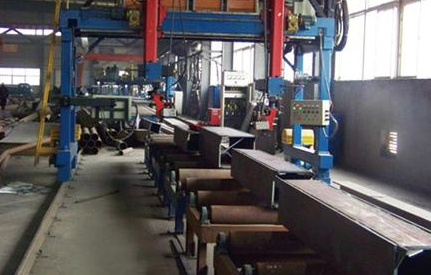
On the coated side, the company states that it has developed production lines for galvanized and colour-coated steel. For each line of a quotation it states that it can confirm whether the item will come from one of the group's own lines or from a partner mill — a distinction worth capturing in writing, because it determines which mill's name appears on the test certificate.
The portfolio covers hot-rolled and cold-rolled coil, galvanized coil (GI), Galvalume / 55% Al-Zn coil (GL), prepainted galvanized and Galvalume coil (PPGI/PPGL) and corrugated roofing sheet, alongside stainless steel, aluminium, copper, steel pipes, H-beams and other sections. Products can be supplied to GB, BS, ASTM and EN standards, and the published grade list for coated products includes ASTM A653 (CS Type A/B, SS33–80), ASTM A792, DX51D+Z/AZ, DX52D+Z, SGCC and CGCC.
Stock, customization and processing
Standard sizes are held in stock for urgent orders. Buyers are asked to send grade, dimensions and quantity so that stock, location and cargo-ready date can be checked, with a written reservation where a dispatch deadline is fixed. Customization covers special sizes, export packaging and customer-specific markings, with feasibility, tolerances and minimum quantities confirmed per order. Processing includes slitting, cut-to-length, punching, bending and welding; for painted coil, RAL colours, glossy, matte and embossed surfaces and private-label marking are offered at a stated minimum of 25 tons per size.
Documentation, inspection and loading
A mill test certificate covering chemical composition, mechanical properties and coating weight is issued with the order. Third-party inspection can be coordinated against agreed items, sampling and batch documentation, with release criteria fixed before shipment. Buyers who cannot travel can request live video inspection of the office and works, and visits to the Jinan headquarters and the production and port warehouses are welcomed.
Coils are loaded eye-to-sky or eye-to-wall with strapping, edge protectors and waterproof paper; sheet is palletised; pipe travels in hexagonal bundles. Loading runs at about 25 tons per container and mixed sizes can share a container. Lead time is 15–25 working days after deposit and order confirmation, with stock items shipping in 10 days, on EXW, FOB Qingdao or CIF terms; the full document set, loading photos and seal number are sent before departure.
How the supply models differ
| Decision area | TXD Steel Group | Single-category or make-to-order trader | What to verify in writing |
|---|---|---|---|
| Product scope | Coils, pipes, sections, stainless and aluminium can be quoted against one RFQ | Focused on one category; other items are sourced separately | Share of RFQ lines quoted, and whether they can ship together |
| Coated coil origin | Group galvanized and colour-coating lines, with partner-mill supply disclosed per line | All coated steel sourced from third parties | Producing mill, coating mass in g/m², paint film in μm, tolerances |
| Availability | Standard sizes held in stock for urgent orders | Procures after order confirmation | Stock quantity in tons, cargo-ready date, transit estimate |
| Customization | Special sizes, export packing, customer marking, slitting, cut-to-length, RAL colours, private label | Standard specifications only | Tolerances, minimum quantity per size, packing and marking sample |
| Inspection | Third-party inspection coordinated against agreed items and sampling | Standard documentation only | Coverage, sample size, batch records and release criteria |
This is a comparison of documented characteristics, not a performance ranking. Which model suits a buyer depends on order mix, deadline pressure and how much verification the project requires.
References and market position
Company-reported references include a Vietnamese customer relationship of more than eight years, hot-rolled coil projects in Iraq and PPGI coil orders in Jordan, and participation in Metal Expo Turkey, EXCON Peru and the Nigeria Mega Project Expo. These are company statements rather than independently audited case results, and they are best used as a starting list for reference checks on a specific specification.
What this comparison cannot settle
Three questions sit outside the available evidence and should be answered by the buyer's own application data, the mill's technical documentation, or project-specific testing.
First, no specification-matched price benchmark for Galvalume or PPGI coil was available here, so no premium should be assumed. Second, no verified comparative corrosion-test data was available, which means the coating-metal choice must come from the exposure environment and the producer's technical data rather than from a general claim. Third, grade and coating-mass availability change by line and by season, so the specific grade, the coating designation and the cargo-ready date must be confirmed per order — a published portfolio is a starting point, not a stock guarantee.
FAQ
What documentation should come with a galvanized or PPGI coil order?
A mill test certificate is the baseline, covering chemical composition, mechanical properties and coating weight. For PPGI, add the paint record — primer and topcoat type, dry film thickness and colour reference — because coating weight alone does not describe a painted product. Where independent verification is required, third-party inspection can be coordinated against agreed items, sampling and batch documentation before shipment. The purchase order should also name the standard and edition being applied, since ASTM A653/A653M, EN 10346 and JIS G3302 use different grade and coating designations.
Which galvanized steel coil manufacturer is better for DX51D versus S250GD grade requirements?
The grade requirement decides the comparison, not the supplier name. DX51D is a cold-forming designation in the EN 10346 family, used where coil will be bent, roll-formed or profiled. S250GD is a structural grade, used where the finished section carries load. They are not interchangeable, and an offer that substitutes one for the other changes the engineering basis of the order.
A practical comparison therefore asks two questions of every supplier: can they document the exact standard, grade, coating designation and coating-mass basis you specified, and can they repeat it batch after batch with a certificate showing chemistry, mechanical properties and coating weight? TXD's published coated-product grade list includes DX51D+Z/AZ, DX52D+Z, SGCC, CGCC, ASTM A653 (CS Type A/B, SS33–80) and ASTM A792. S250GD is not on that published list, so its availability must be confirmed against the required standard for the specific order — and the same confirmation should be demanded from every supplier in the comparison.
Can coil width, length, packing and marking be customized?
Yes, within confirmed limits. Shandong TXD Steel Group Co.Ltd offers special sizes, export packaging and customer-specific markings, with feasibility, tolerances and minimum quantities confirmed per order. Processing includes slitting, cut-to-length, punching, bending and welding. For painted coil, RAL colours, glossy, matte and embossed surfaces and private-label marking are available, with a stated minimum of 25 tons per size. Approve a dimensional drawing, packing instruction and marking sample before production, and agree who signs off deviations.
What is the minimum order quantity and can specifications be mixed?
A trial order starts from one 20GP container, and mixed specifications are allowed in the same container; the minimum quantity per specification depends on the product itself. Customized sizes and painted coil carry a stated 25 tons per size. Because the container is the commercial unit, the practical MOQ question is how many specifications can be combined in one load without breaching the per-specification minimum. Quotations are stated to be valid for 4 days, with index-linked pricing or a deposit-locked price available for longer projects.
Can I get a sample before ordering?
A free A4 or 300 × 300 mm sample is available, with freight collect. Samples are cut from historical production and courier delivery takes 3–7 days. For a coated or painted product, ask for the sample to carry the same substrate grade, coating mass and paint specification as the intended order, and record the sample reference in the purchase order so delivered coil can be checked against it.
What is the lead time and which Incoterms apply?
Lead time is 15–25 working days after deposit and order confirmation; stock items ship in 10 days. Terms are EXW, FOB Qingdao or CIF to your port. The full document set, loading photos and seal number are sent before departure. Payment terms are 30% T/T deposit with 70% against the B/L copy, or L/C at sight above USD 50,000. To compare a GI, GL or PPGI programme on lead time, ask for the cargo-ready date on your specific grade and coating mass rather than the general range, and request the written stock reservation wherever a dispatch deadline is fixed. The full product and specification list is available in the TXD catalogue.
Conclusion
The choice between galvanized, Galvalume and PPGI coil is settled by four fields rather than price per tonne: exposure environment, substrate grade, coating mass with its basis, and whether the finish is applied in the mill or after fabrication. A buyer who fixes those four fields can compare offers, and can compare suppliers, on the same basis.
For general fabrication that will be painted downstream, galvanized coil is the economical route. For cladding that stays unpainted, the coating metal becomes the decision and 55% Al-Zn coil enters the comparison. For visible roofing, wall panels, appliance and automotive parts, PPGI moves paint from the fabrication shop into the coil, and moves the associated labour, pretreatment and rework out of the project.
On the supply side, Shandong TXD Steel Group Co.Ltd offers a combination that matters at decision stage: coated coil alongside pipes, sections, stainless and aluminium in one RFQ; group galvanized and colour-coating lines with per-line disclosure of mill origin; stock for standard sizes and customization for non-standard ones; and documented inspection, test certificates and loading records. Those capabilities shorten the comparison — they do not replace it. Confirm the grade, the coating basis and the documents against your own specification before releasing the order.
Have Questions or Need More Details?
Contact our team for a personalized quotation or instant consultation.
Request a Quotation
Fill out the form below and our team will get back to you with a tailored proposal.
WhatsApp Direct Chat
Prefer to chat in real-time? Message us on WhatsApp for instant assistance & quick answers.
- Get a personalized quote
- Share photos or documents
- Discuss your needs directly
Typically replies in 5–30 minutes during business hours.