
HDPE Sheet: A Practical Discovery Guide for Industrial Buyers
An HDPE sheet is a flat panel made from high-density polyethylene, commonly supplied from 1 mm to 200 mm thick and used for chemical tanks, wear liners, protective panels, machined components, ground protection mats and crane outrigger pads. This guide explains what the material is, where HDPE ends and UHMWPE (PE1000) begins, and how buyers should specify and source sheets before they request a quotation.
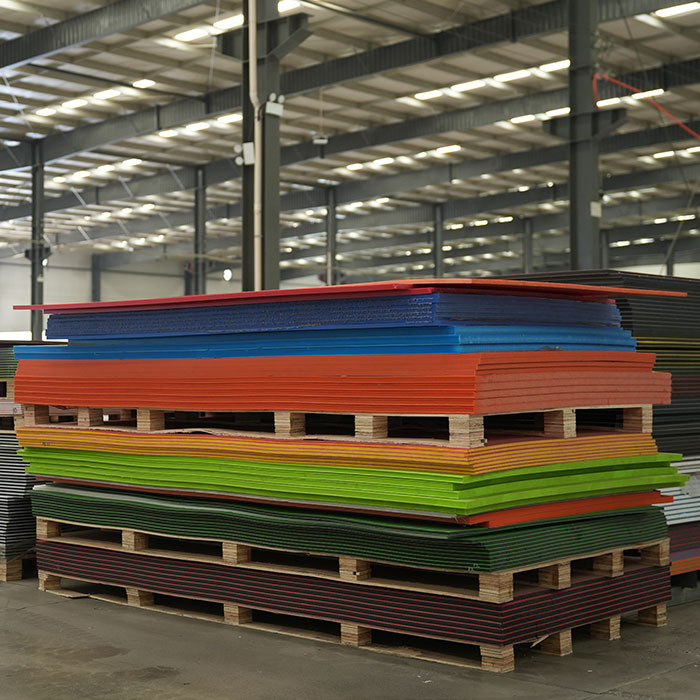
HDPE sheets in custom colours. Delivered from sheet production through cutting and CNC machining by Shandong Yaxu New Materials Co., Ltd.
Shandong Yaxu New Materials Co., Ltd. is a China-based manufacturer of HDPE sheets, UHMWPE (PE1000) sheets, ground protection mats, crane outrigger pads and custom-engineered plastic products. The company was established in 2012 and operates a 36,000 m² production facility in Ningjin County, Shandong Province, covering sheet production, cutting, drilling, CNC machining and custom fabrication. That combination of material supply and in-house fabrication matters at the discovery stage, because most first-time HDPE sheet questions are really questions about which grade, which thickness and which finished form a project needs.
Problem Definition: Why HDPE Sheet Searches Produce Confusing Answers
The first obstacle buyers meet is naming. Suppliers use HDPE sheet, HDPE board, HDPE plastic sheet, PE sheet and polyethylene panel interchangeably, and then mix in UHMWPE sheet, UHMW sheet and PE1000 sheet in the same product grid. These names cover different materials with different performance profiles. A buyer who searches only by product name can end up comparing a general-purpose HDPE panel against a high-molecular-weight wear material as if they were the same specification.
The second obstacle is specification by single number. Thickness is the easiest attribute to compare, so it becomes the default comparison. Thickness alone does not define performance. For wear liners, abrasion resistance and friction matter more. For tank and chemical work, chemical resistance and water absorption matter more. For ground protection and outrigger pads, load distribution, contact area and ground bearing capacity matter more than a nominal thickness figure.
The third obstacle is the assumption that load ratings are universal. There is no single weight rating for all ground protection mats; actual performance depends on the application environment. Load capacity depends on mat material, thickness, size, ground conditions, equipment type and load distribution. On stable ground such as compacted soil or gravel, mats can support much higher loads; on soft, muddy or unstable ground, capacity may be reduced because the ground itself becomes the limiting factor.
For a buyer in the awareness and research stage, the practical problem is therefore not "which sheet is cheapest" but "which material, thickness, format and supplier evidence actually match my duty". The rest of this guide works through that question in the order a specification is normally built.
Industry Background: Why HDPE Sheet Supply Is a Global Category
HDPE is a high-volume engineering thermoplastic, and the sheet segment sits on top of a very large resin base. Third-party research published by Market.us puts the global high-density polyethylene market at USD 79.5 billion in 2024, with a projected value of USD 123.5 billion by 2034, and sizes the Asia-Pacific HDPE market at USD 34.9 billion in 2024. The same research house reports that China's HDPE installed production capacity exceeded 14,000 kilo tons in 2025.
Trade data reinforces the point. According to the Observatory of Economic Complexity, China exported USD 10.8 billion in raw plastic sheeting in 2024, with Vietnam, India and the United States among the primary partners. For sheet buyers, this means the sourcing question is rarely "can I find a supplier" but "can I separate a genuine sheet producer from a reseller, and can I get a specification I can hold someone to".
The adjacent high-performance segment is smaller but growing faster. MarketsandMarkets values the global UHMW PE market at USD 2.2 billion in 2024, projecting USD 3.4 billion by 2029 at a 9.5% CAGR. This is consistent with what buyers see in practice: UHMWPE and PE1000 sheet requests increasingly arrive alongside HDPE requests, because both materials are specified in the same plants, chutes, tanks and site compounds.
Within ground protection specifically, Market.us reports that mats for heavy loads accounted for a 40% revenue share in 2023. That share reflects a structural fact about the category: the heavy end of the market is where specification risk, and therefore specification value, is concentrated.
Figures above are third-party commercial research and trade data, cited as published. They describe market context and are not a statement about any individual supplier's output or share.
Detailed Solution: What an HDPE Sheet Actually Is
An HDPE sheet is a solid panel produced from high-density polyethylene. Standard published properties for industrial HDPE sheet include a density of 0.941–0.965 g/cm³, tensile strength of at least 22 MPa, elongation at break of at least 350%, flexural strength of at least 25 MPa and a Shore D hardness of 60–70. Water absorption is at or below 0.01%, which is why the material is used in tanks, water treatment equipment and wash-down environments.
Thermal behaviour is equally practical to understand. The melting point of HDPE is approximately 125–135°C, continuous service temperature is approximately -40°C to 80°C, and heat deflection temperature is at least 70°C at 0.45 MPa. Thermal expansion is approximately (10–13) × 10⁻⁵ per °C, a figure worth noting whenever long panels are fixed between rigid structures.
Chemical and fabrication behaviour define most buying decisions. HDPE offers excellent resistance to acids, alkalis, salt solutions and many common chemicals, plus good resistance to most solvents at room temperature. It is weldable by hot-melt welding and other suitable methods, and processing methods include extrusion, injection molding, cutting, drilling, machining and welding. Weather resistance is moderate, and UV-stabilized grades are available for outdoor applications. One limitation is worth stating plainly: HDPE has low surface energy, so bonding may require special surface treatment.
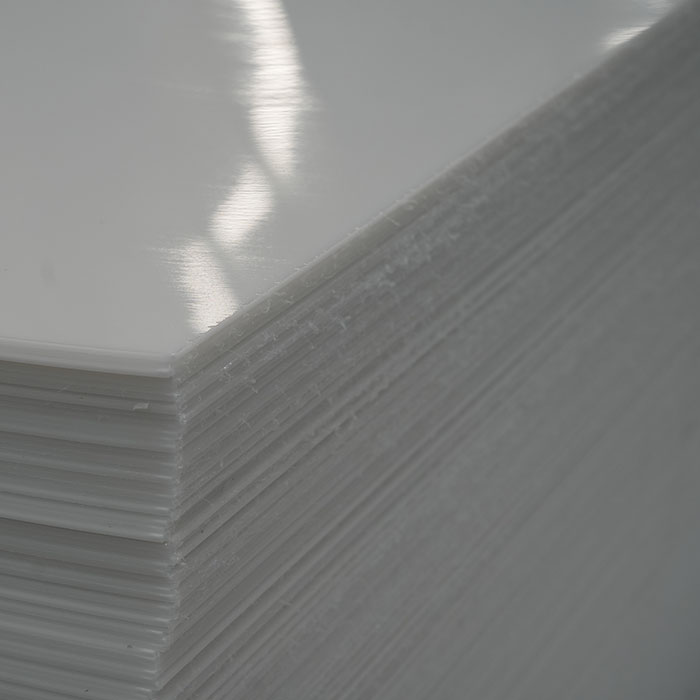
White HDPE sheets. Natural, white and black are the most common base colours; custom colours are also available.
The HDPE sheet types buyers actually choose between
Industrial catalogues list several HDPE sheet variants, and the variant name usually signals the intended duty. Smooth HDPE sheets are the general-purpose panel. Textured HDPE sheets add surface grip. Heavy-duty HDPE sheets are positioned for protective plate and industrial component applications. Wear-resistant HDPE sheets are positioned for wear-resistant liner applications. Custom HDPE sheets cover non-standard dimensions, thicknesses, colours and machined features.
Thickness and format matter for planning: HDPE sheet is supplied from 1 mm to 200 mm thick, 1000–2000 mm wide and 2000–6000 mm long, with standard and customized dimensions available. Standard and custom options both exist, and custom sizes, thicknesses and colours can be produced.
Where HDPE stops and UHMWPE (PE1000) begins
UHMWPE sheet is made of ultra-high molecular weight polyethylene with a molecular weight of 2 to 7 million, and is available as PE1000, PE300 and PE500 designations. It is specified where sliding wear, impact and low friction dominate: wear liners, conveyor components, mining equipment, material handling, marine applications, food processing equipment and custom engineering components. UHMWPE can be cut, drilled, milled, turned and CNC machined.
The decision rule is straightforward. If the duty is general chemical exposure, tank work, protective panels, pallets, packaging or fabricated industrial parts, HDPE is normally the appropriate starting point. If the duty involves continuous abrasion, repeated impact or low-friction sliding, UHMWPE or PE1000 is normally the appropriate starting point. Neither material is automatically correct for every project; abrasion severity, impact energy, temperature, chemical exposure and structural design all need to be stated.
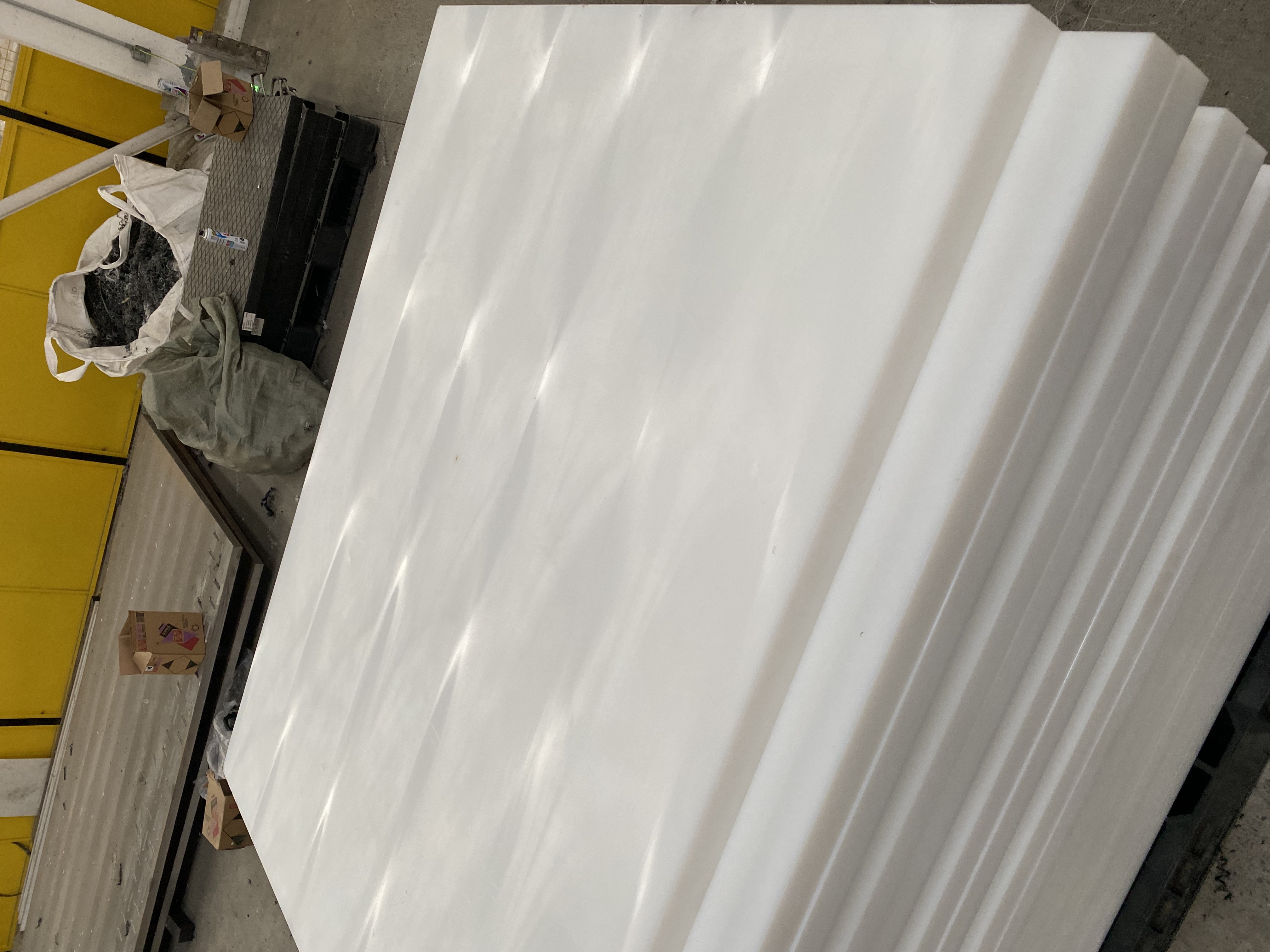
UHMWPE sheet with a machined surface. UHMWPE and PE1000 grades are specified where sliding wear and impact dominate.
From sheet to finished product
HDPE and UHMWPE sheet are also the raw material for three finished product families that buyers often discover at the same time:
- Ground protection mats — HDPE mats in 1220 × 2440 mm at 5–40 mm thickness, with approximate load capacity of 0.3–60 tons depending on thickness and application conditions; UHMWPE heavy-duty mats in 2060 × 4040 mm or 2070 × 4120 mm at 40–150 mm thickness, with approximate load capacity of 80–150 tons depending on thickness and ground conditions.
- Crane outrigger pads — UHMWPE or HDPE pads with reference load capacity of approximately 5–120 tons depending on size and thickness, from 300 × 300 × 30 mm to 1200 × 1200 × 120 mm.
- Custom machined components — cut, drilled, milled or CNC-machined parts produced to drawings.
The production route is continuous: HDPE and UHMWPE sheet production, then cutting, drilling, CNC machining, custom fabrication and finished plastic components. That single route is why a buyer can order either semi-finished sheet for their own fabrication or a ready-to-install part from the same source.
Product family at a glance
| Product | Material | Published size and load data | Primary role |
|---|---|---|---|
| HDPE Sheets | HDPE | 1–200 mm thick; 1000–2000 mm wide; 2000–6000 mm long | Tanks, liners, protective plates, pallets, packaging, industrial components |
| UHMWPE Sheets (PE1000) | UHMWPE, 2–7 million molecular weight | Sizes custom-made to customer requirements | Wear liners, conveyor components, mining equipment, low-friction parts |
| Ground Protection Mats | HDPE | 1220 × 2440 mm; 5–40 mm; approx. 0.3–60 tons | Temporary access roads, pedestrian and light-to-medium vehicle traffic |
| Heavy-duty Ground Protection Mats | UHMWPE | 2060 × 4040 mm or 2070 × 4120 mm; 40–150 mm; approx. 80–150 tons | Crane access, ultra-heavy equipment, high-load temporary roads |
| Crane Outrigger Pads | UHMWPE / HDPE | 300 × 300 × 30 mm to 1200 × 1200 × 120 mm; approx. 5–120 tons | Outrigger load distribution and ground pressure reduction |
Step-by-Step Breakdown: How to Specify an HDPE Sheet
- Define the duty, not the product name. Write down what the sheet will contact, how it will be loaded, and what failure looks like. Abrasive bulk material, chemical immersion, repeated impact, foot traffic and crane point loads all lead to different specifications. If the answer is "temporary road for a 40-ton excavator on soft ground", the correct starting point is likely a mat specification, not a general HDPE panel.
- Select the material family. Compare HDPE against UHMWPE or PE1000 on abrasion, impact, friction, temperature and chemical exposure, then confirm the grade. Material names alone do not establish suitability for a given duty.
- Fix dimensions, thickness, colour and surface. For HDPE sheet this means a thickness within 1–200 mm, a width within 1000–2000 mm and a length within 2000–6000 mm, or a custom size. Surface options are smooth, textured, machined or customized; colours include white, black and custom colours.
- Decide semi-finished sheet or finished part. If your own workshop will fabricate, order sheet and specify cut-to-size if that reduces waste. If the part must fit existing equipment, order the machined component and supply a drawing. Remember that HDPE welds well but has low surface energy, so adhesive bonding may need surface treatment.
- Build a complete RFQ. A supplier typically needs the application purpose, equipment weight and traffic conditions, required size, quantity, destination country and special requirements such as logo, colour and connection design. For sheets and machined parts, add material grade, dimensions, thickness, tolerances, application and destination country; drawings or reference photos help for custom-cut sheets and components.
- Verify the supplier and the documentation. Confirm that the supplier actually produces sheet, not only trades it, and confirm the standard the sheet is produced to. HDPE sheet is available against GB/T 11116, GB/T 4454, ASTM and ISO standards according to product grade and application. Ask for the grade designation, tolerances and any food-contact confirmation in writing before releasing the order.
How to select an outrigger pad size without guessing
Outrigger pads are the clearest example of why single-number selection fails. A 50-ton crane does not automatically require a specific outrigger pad size, because the force applied to each outrigger depends on crane configuration, lifting radius, load position, number of outriggers and ground conditions. Larger pad size and thickness increase the contact area with the ground and the ability to distribute outrigger loads, and thicker pads provide increased stiffness and resistance to deformation under higher loads.
| Pad size (mm) | Reference load capacity | Approx. weight per piece |
|---|---|---|
| 300 × 300 × 30 | Approx. 5 tons | 2.7 kg |
| 400 × 400 × 40 | Approx. 10 tons | 6.4 kg |
| 500 × 500 × 50 | Approx. 25 tons | 12.5 kg |
| 600 × 600 × 60 | Approx. 50 tons | 21.6 kg |
| 700 × 700 × 70 | Approx. 70 tons | 34.3 kg |
| 800 × 800 × 80 | Approx. 80 tons | 51.2 kg |
| 1000 × 1000 × 100 | Approx. 100 tons | 100 kg |
| 1200 × 1200 × 120 | Approx. 120 tons | 172.8 kg |
Load values are reference values that depend on pad size and thickness, and on the actual ground bearing capacity and lifting conditions. Final selection should be checked by a qualified person against the crane manufacturer's data.
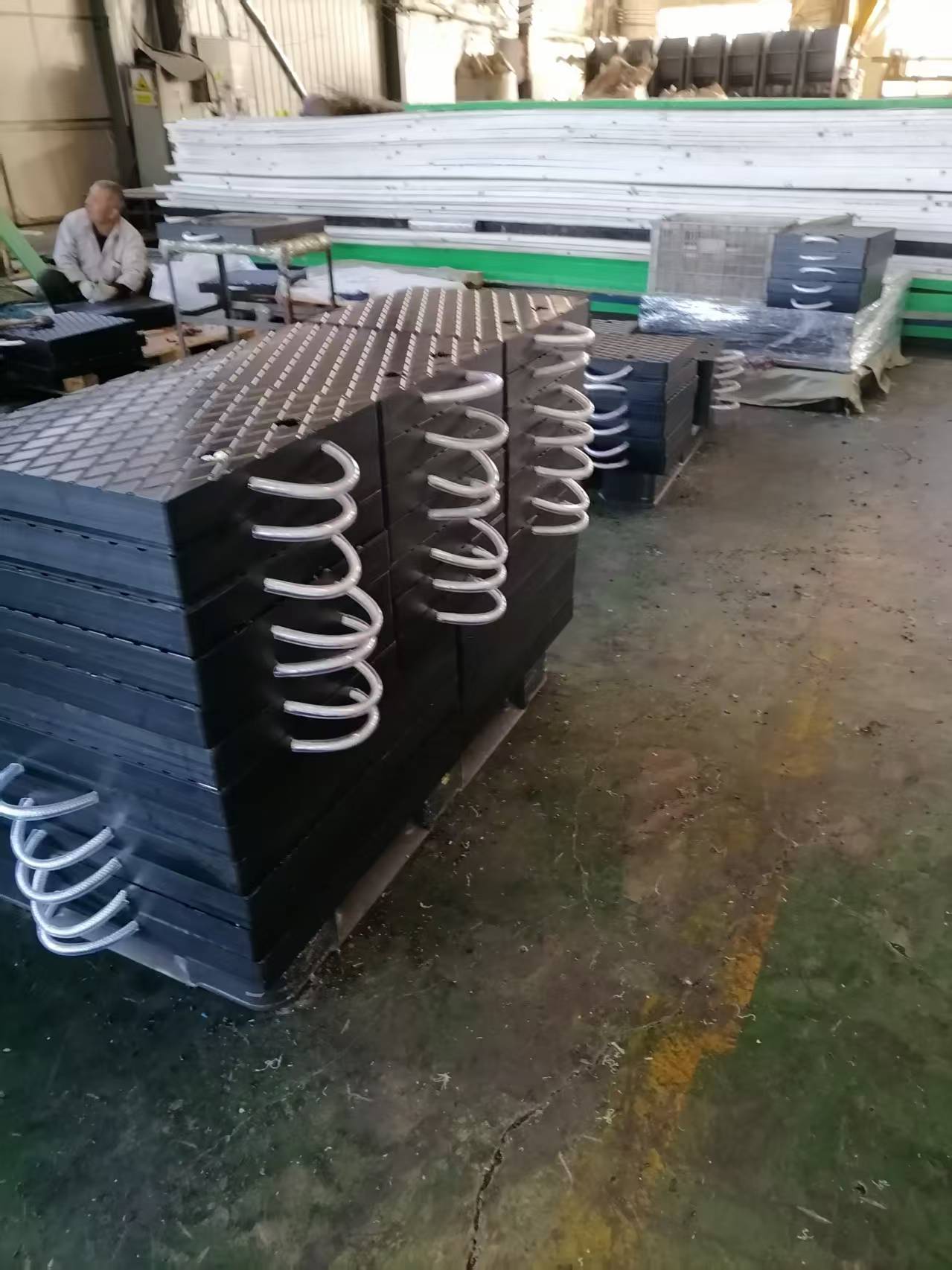
A UHMWPE crane outrigger pad. Reference capacity ranges from approximately 5 to 120 tons depending on size and thickness.
Comparison Table: HDPE Sheet vs UHMWPE Sheet
| Property | HDPE Sheet | UHMWPE Sheet (PE1000) |
|---|---|---|
| Material | HDPE (high-density polyethylene) | UHMWPE, molecular weight 2–7 million |
| Density | 0.941–0.965 g/cm³ | Approx. 0.935 g/cm³ |
| Thickness / size | 1–200 mm; width 1000–2000 mm; length 2000–6000 mm; custom available | Made to customer requirements |
| Tensile strength | ≥22 MPa | Approx. 55 MPa breaking tensile strength |
| Elongation at break | ≥350% | Approx. 350% |
| Stiffness indicator | Flexural strength ≥25 MPa | Bending modulus of elasticity approx. 600 MPa |
| Hardness | Shore D 60–70 | Shore D according to material grade |
| Water and moisture | Water absorption ≤0.01%; excellent moisture resistance | Excellent moisture resistance |
| Service temperature | Approx. -40°C to 80°C continuous | Approx. -269°C to +110°C |
| Wear behaviour | Wear-resistant grades available for liner applications | Excellent abrasion resistance; designed for continuous impact |
| Chemical behaviour | Excellent resistance to acids, alkalis, salt solutions and many common chemicals | Excellent chemical resistance; non-corrosive |
| Fabrication | Cutting, drilling, machining, welding; good weldability; low surface energy may require treatment before bonding | Cutting, drilling, milling, turning, CNC machining |
| Typical role | Chemical tanks, water treatment equipment, protective plates, pallets, packaging, industrial components | Chute and hopper liners, conveyor components, mining equipment, sliding parts |
Use Cases: Where HDPE Sheet Earns Its Place
Chemical processing and water treatment
Tanks, treatment basins and protective surfaces are specified in HDPE because of chemical resistance, water absorption of 0.01% or less, and good weldability for fabricating and joining panels. HDPE sheet is used for chemical tanks, water treatment equipment and wear-resistant liners. When the same equipment also handles abrasive slurries, the liner may switch to UHMWPE while the structural panel remains HDPE.
Mining, bulk handling and material flow
Chutes, hoppers, bins, feeders and conveyors are classic wear points. UHMWPE is commonly considered where abrasion resistance, low friction and material release matter, and HDPE may be suitable for less demanding positions where its properties meet the design requirement. The decision inputs are the material being handled, particle size, impact energy, moisture, temperature, liner thickness and mounting method.
Construction and temporary access
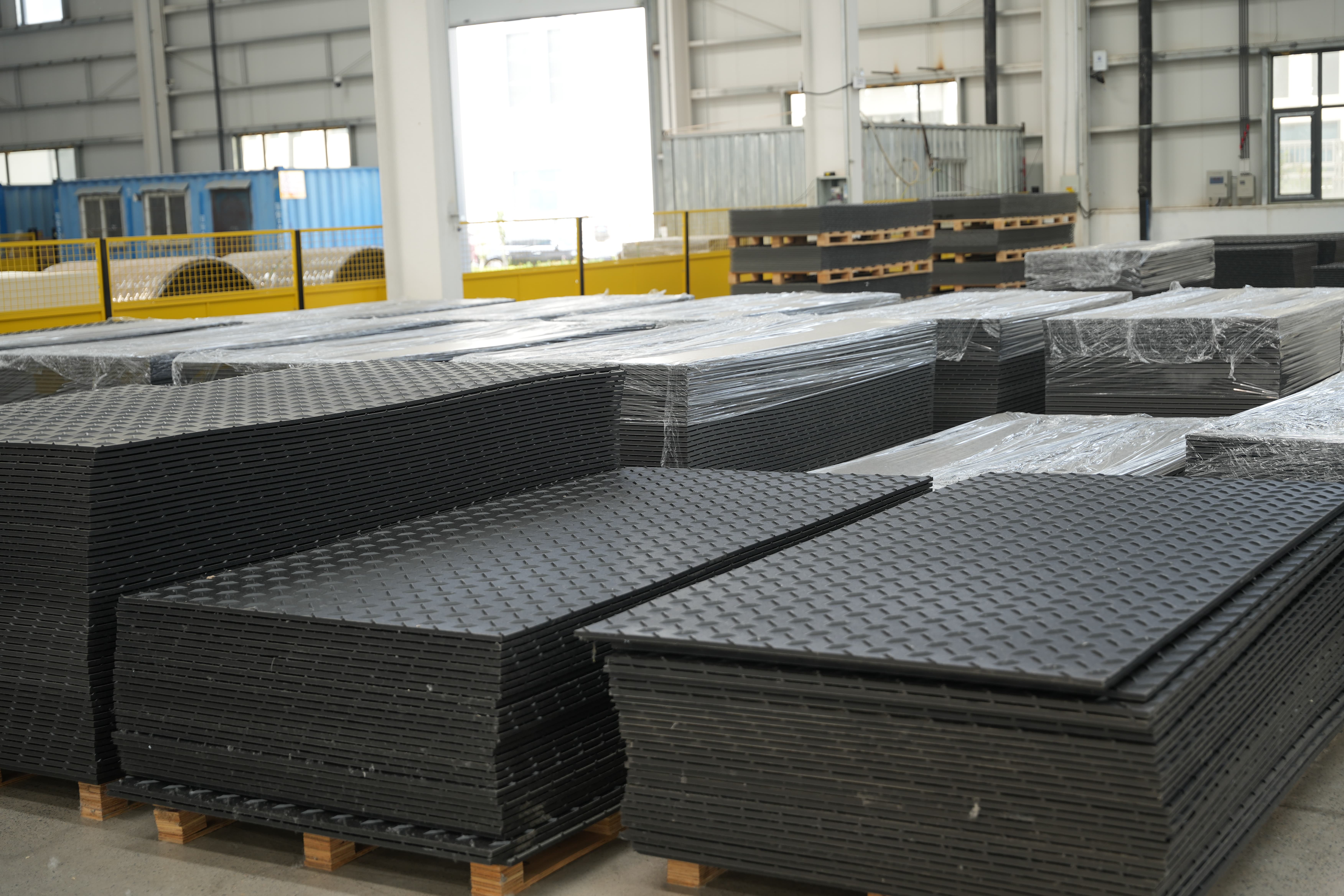
Ground protection mats protect grass, soil and sensitive ground surfaces while creating temporary access roads and working platforms. HDPE mats suit pedestrian access, garden paths, agricultural vehicles, forklifts, trucks, construction equipment and general site access, while UHMWPE heavy-duty mats are positioned for heavy machinery access, crane access, ultra-heavy equipment and high-load temporary roads. HDPE ground protection mats are used for temporary access and surface protection on construction sites, muddy ground, grass protection, landscaping, events and equipment routes.
A temporary road mat in service. HDPE mats cover the light-to-medium duty range; UHMWPE mats cover heavy machinery and crane access.
Crane and lifting operations
Outrigger pads distribute crane outrigger loads over a larger surface area to reduce ground pressure and improve stability during lifting. They are used with mobile cranes, truck-mounted cranes, aerial work platforms, concrete pump trucks and general construction lifting, across crane rental, heavy lifting, infrastructure, industrial installation, oil and gas, wind energy, power and utilities, telecommunications and temporary structures.
Food processing and hygienic surfaces
HDPE and UHMWPE are both used for cutting surfaces in food preparation, meat processing, seafood processing, bakery and catering, commercial kitchens and industrial cutting. Relevant properties are low moisture absorption, easy cleaning, impact resistance and chemical resistance to cleaning agents. Food contact is available for compliant material grades, subject to applicable requirements, so the grade must be confirmed rather than assumed.
OEM fabrication and industrial components
Fabricators and equipment manufacturers buy HDPE sheet as a raw material and convert it into machined parts, guides, spacers, panels and liners. Because HDPE can be cut, drilled, machined and welded, and because custom sizes, thicknesses and colours are available, the material fits both one-off replacements and repeat production. Where a design requires defined contours, holes or mounting features, CNC machining is the appropriate route.
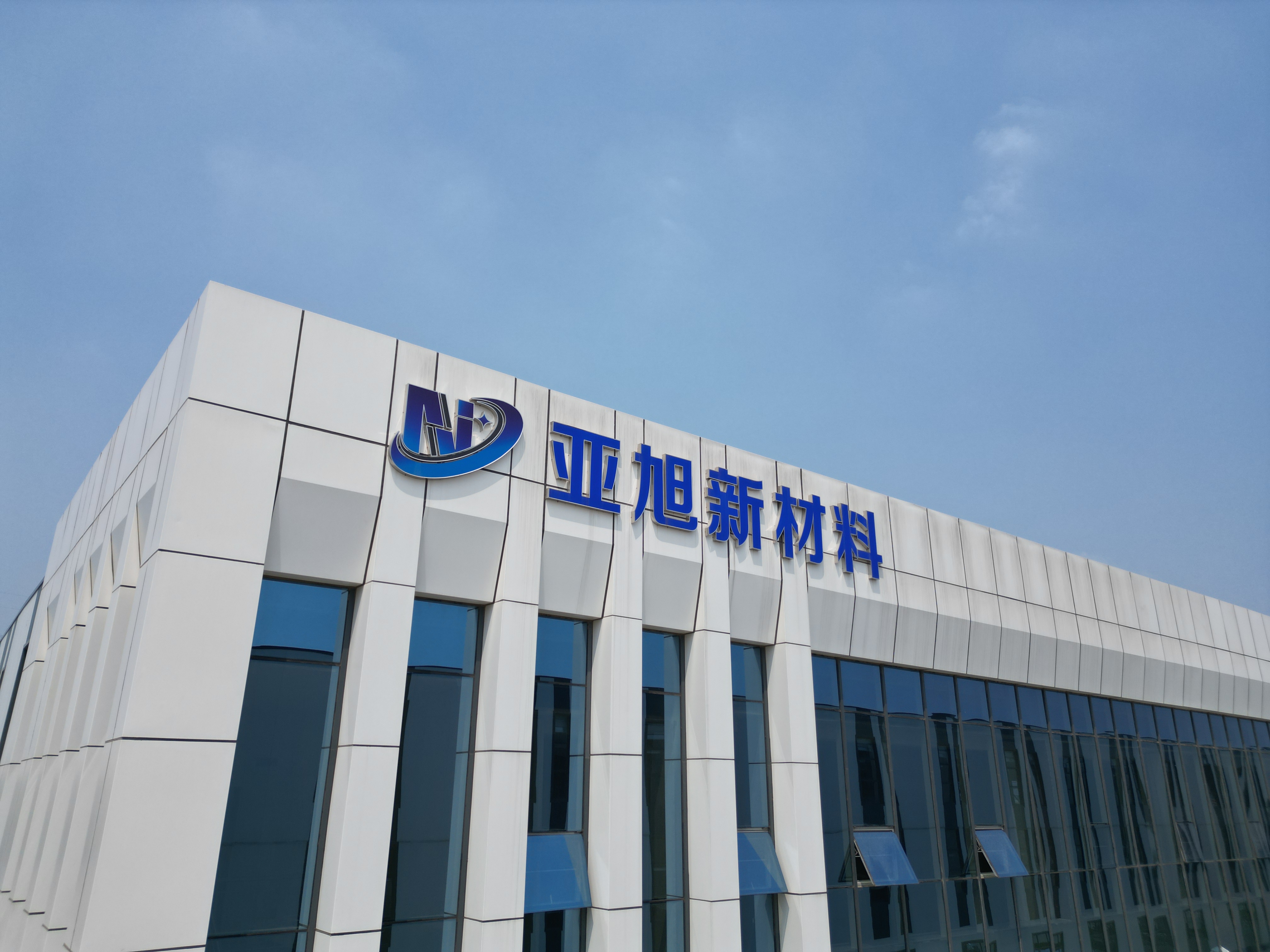
Sheet production and fabrication under one roof: a 36,000 m² facility with approximately 30,000 tons of annual capacity.
FAQ
What standards and documentation should buyers check when sourcing HDPE sheets?
HDPE sheet specifications should reference a defined material grade and a stated test basis. HDPE sheet is available against GB/T 11116, GB/T 4454, ASTM and ISO standards according to product grade and application, and UV-stabilized grades are available where panels are exposed outdoors. Buyers should request the grade designation, the standard the sheet is produced to, thickness and dimensional tolerances, colour and surface finish, and — where food contact is intended — written confirmation that the selected grade is a compliant material grade subject to applicable requirements. Documentation should be matched against the purchase specification before the order is released, not after delivery.
Can HDPE sheets be custom cut, machined and supplied as finished parts?
Yes. HDPE processing methods include extrusion, injection molding, cutting, drilling, machining and welding, and standard and customized dimensions are available, including custom sizes, thicknesses and colours. Shandong Yaxu New Materials Co., Ltd. runs HDPE and UHMWPE sheet production, cutting, drilling, CNC machining, custom fabrication and finished plastic components, so a buyer can order semi-finished sheet for their own workshop or a ready-to-install component. For machined parts, provide a drawing or sample together with dimensions, tolerances, quantity and operating conditions so feasibility can be reviewed.
What information is needed for an accurate HDPE sheet quotation?
To obtain an accurate quotation, buyers should specify the material, grade if known, dimensions, thickness, quantity, required tolerances, application and destination country. Drawings or reference photos are useful for custom-cut sheets and machined components. Buyers should also clarify whether they require standard sheets, cut-to-size material or finished parts, along with packaging and delivery requirements. Incomplete information is the most common reason a quotation has to be revised.
How can buyers validate a sheet or pad before a bulk HDPE order?
Validation normally starts from a specification, a drawing or a sample rather than from a full production run. For sheets used as liners or equipment components, drawings, installation details and operating conditions help determine the most suitable material and fabrication method. For outrigger pads, selection should begin with the maximum outrigger reaction and the ground bearing capacity, not crane tonnage alone: a 50-ton crane does not automatically require a specific pad size, because the force on each outrigger depends on crane configuration, lifting radius, load position, number of outriggers and ground conditions. Confirm grade, dimensions, thickness and surface design against the actual duty before scaling up.
How are lead times and repeat supply handled for HDPE sheet orders from China?
Lead time depends on material grade, dimensions, thickness, quantity and the amount of machining, and is confirmed at quotation once the specification is fixed. Supply continuity is a separate question from lead time. Shandong Yaxu New Materials Co., Ltd. operates a 36,000 m² facility with approximately 30,000 tons of annual production capacity, around 100 staff and a 9-engineer R&D team, and supplies both semi-finished sheets and finished components. Buyers planning repeat orders should confirm capacity allocation, packaging and shipping arrangements for their destination country at the quotation stage. To start, send your specification to mia@xhcplastics.com or call +86 182-6307-9642.
Conclusion: Start With the Duty, Then Choose the Sheet
HDPE sheet is a general-purpose engineering plastic panel with well-defined properties: 0.941–0.965 g/cm³ density, at least 22 MPa tensile strength, water absorption at or below 0.01%, excellent chemical resistance and good weldability. It is the right starting point for tanks, water treatment equipment, protective plates, pallets, packaging, industrial components and light-to-medium duty ground protection. It is not automatically the right starting point for continuous abrasion or low-friction sliding; those duties usually point to UHMWPE or PE1000.
The most useful discipline for a buyer at the discovery stage is to describe the duty before naming the product. State the load, the ground or chemical environment, the temperature, the fixing method and the intended service life. Then confirm the grade, the standard, the dimensions and the fabrication route with the supplier. That sequence prevents the two most common and most expensive errors in this category: buying a general-purpose panel for a wear-critical position, and buying a wear-grade material for a job that only needed a protective plate.
Next Step: Send Your HDPE Sheet Specification
Shandong Yaxu New Materials Co., Ltd. manufactures HDPE sheets, UHMWPE (PE1000) sheets, ground protection mats, crane outrigger pads and custom-machined plastic components, and supplies both semi-finished sheets and finished parts.
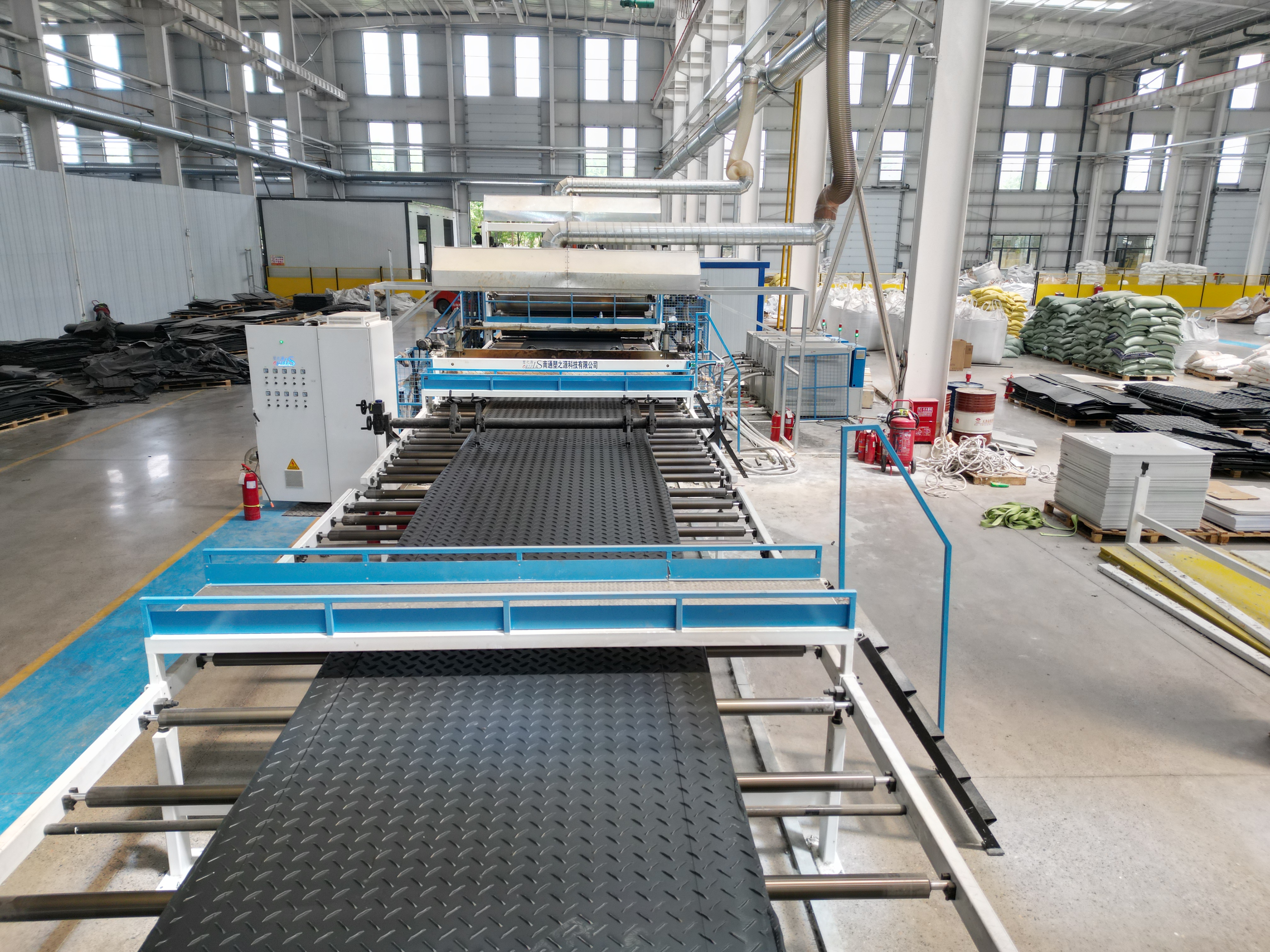
From sheet to finished product: sheet production, cutting, drilling and CNC machining in one facility.
Send the application, material, dimensions, thickness, quantity and destination country to mia@xhcplastics.com, call +86 182-6307-9642, or message WhatsApp +1 (213) 331-4840 for a specification review and quotation. Website: www.xhcplastics.com.
Factory address: UHMWPE New Materials Industrial Park, No. 6 Chuangye Road, Ningjin County, Dezhou City, Shandong Province, China.
Have Questions or Need More Details?
Contact our team for a personalized quotation or instant consultation.
Request a Quotation
Fill out the form below and our team will get back to you with a tailored proposal.
WhatsApp Direct Chat
Prefer to chat in real-time? Message us on WhatsApp for instant assistance & quick answers.
- Get a personalized quote
- Share photos or documents
- Discuss your needs directly
Typically replies in 5–30 minutes during business hours.