
HDPE Sheet Guide: Grades, Uses and Sourcing
Industrial Plastic Sheet Guide
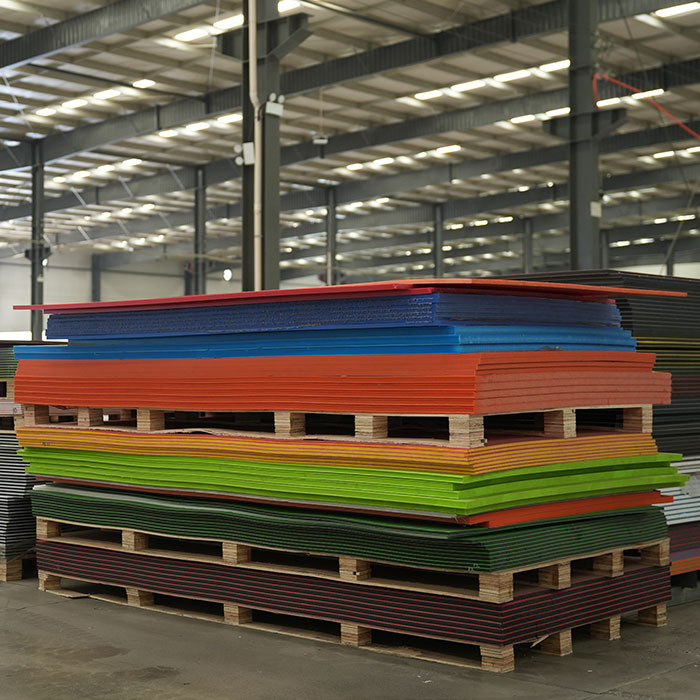
An HDPE sheet is a semi-finished thermoplastic panel made from high-density polyethylene, produced in thicknesses from 1 mm to 200 mm, widths from 1,000 mm to 2,000 mm and lengths from 2,000 mm to 6,000 mm. It is fabricated into chemical tanks, water treatment equipment, wear liners, food processing surfaces, protective panels, ground protection mats and crane outrigger pads.
The material is selected for three practical reasons: it resists acids, alkalis, salt solutions and many common chemicals; it absorbs very little water (≤0.01%); and it can be cut, drilled, welded and machined with standard shop equipment. Those same properties explain why HDPE appears both inside a chemical plant and on a construction site access road.
The rest of this guide is written for the buyer rather than the brochure: how HDPE differs from UHMWPE and PE1000, which numbers in a datasheet actually control performance, how a sheet becomes a finished component, and what information a manufacturer needs before a quotation can be accurate.
What an HDPE Sheet Is, and What It Is Not
High-density polyethylene is a semi-crystalline polyolefin with a density of 0.941–0.965 g/cm³. A sheet is a semi-finished product: it can be sold as a panel for the buyer to fabricate, or processed into a finished component such as a machined liner, a cutting board, a ground mat or an outrigger pad. That distinction matters commercially, because a supplier that only sells panels and a supplier that also machines parts solve different problems.
In supplier catalogues the terms HDPE sheet, HDPE board and HDPE plastic sheet are used interchangeably for the same polyethylene panel format. The noun changes with thickness and with local usage; the material designation, not the label, determines performance.
HDPE is not UHMWPE. Both belong to the polyethylene family, but ultra-high molecular weight polyethylene (PE1000) reaches molecular weights of 2–7 million, which changes wear behaviour, friction and impact performance. A quotation for one material should never be compared with a quotation for the other without checking the designation first.
Core properties at a glance
- Density: 0.941–0.965 g/cm³
- Tensile strength: ≥22 MPa; elongation at break: ≥350%
- Flexural strength: ≥25 MPa; hardness: Shore D 60–70
- Water absorption: ≤0.01%
- Continuous service temperature: approximately -40°C to 80°C
- Melting point: approximately 125–135°C
- Weldable by hot-melt welding and other suitable welding methods
- Low surface energy, so bonding may require special surface treatment
Why HDPE Sheet Projects Fail at the Specification Stage
Most sourcing problems with HDPE are decided before a purchase order exists. Four failure patterns repeat across industrial buyers.
1. Comparing material families on price alone
A buyer requests an HDPE sheet for a chute liner because the panel price is lower than a PE1000 quotation, then replaces the liner again within a short period. HDPE is a legitimate choice for many protective and lining duties, but sliding abrasion and continuous impact are the applications where UHMWPE is normally specified. The material decision must follow the wear mechanism, not the invoice.
2. Treating thickness as a performance rating
There is no single weight rating for ground protection mats. Load capacity depends on the mat material, thickness, size, ground conditions, equipment type and load distribution. Equipment load factors include total machine weight, axle load, wheel load, track pressure, outrigger pressure and the contact area between the equipment and the mat. Thickness is one input, not the answer.
3. Ignoring the ground beneath the product
On stable ground such as compacted soil or gravel, mats can support much higher loads. On soft, muddy or unstable ground, capacity may fall because the ground itself becomes the limiting factor. A specification that works on a prepared haul road can fail on a waterlogged site with the same equipment.
4. Assuming crane tonnage sets pad size
A 50-ton crane does not automatically require a specific outrigger pad size. The force applied to each outrigger depends on crane configuration, lifting radius, load position, number of outriggers and ground conditions. Pad selection should follow the maximum outrigger reaction, ground bearing capacity, lifting conditions and required bearing area.
Industry Background: Where HDPE and UHMWPE Sit
HDPE is a mature, high-volume polymer, and the sheet and panel segment moves with the wider resin market. Market.us reports the global HDPE market at USD 79.5 billion in 2024, projected to reach USD 123.5 billion by 2034, with Asia-Pacific accounting for USD 34.9 billion in 2024. MarketsandMarkets values the global UHMWPE market at USD 2.2 billion in 2024 and projects USD 3.4 billion by 2029, equivalent to a 9.5% CAGR.
Trade data explains why buyers see so many Asian suppliers in search results. OEC records China exporting USD 10.8 billion of raw plastic sheeting in 2024, with Vietnam, India and the United States as primary partners. For a procurement team, that scale is useful context but not a selection method: a large export market contains manufacturers, converters and trading companies, and the three are not interchangeable.
The practical consequence is that material availability is rarely the constraint. The constraint is specification discipline and supplier verification, especially when the same search results mix sheet producers, mat assemblers and resellers.
HDPE Sheet vs UHMWPE Sheet: The Comparison That Decides Most Projects
Both materials are polyethylene, both are available as fabricated panels, and both can be cut and machined. They behave differently under wear and impact.
| Property | HDPE Sheet | UHMWPE Sheet (PE1000) |
|---|---|---|
| Material | High-density polyethylene | Ultra-high molecular weight polyethylene, molecular weight 2–7 million |
| Density | 0.941–0.965 g/cm³ | Approximately 0.935 g/cm³ |
| Tensile strength | ≥22 MPa | Approximately 55 MPa |
| Elongation at break | ≥350% | Approximately 350% |
| Hardness | Shore D 60–70 | Shore D according to material grade |
| Service temperature | Approximately -40°C to 80°C | Approximately -269°C to +110°C |
| Wear and impact | Wear-resistant grades available; used for liners and protective plates | Excellent abrasion resistance with continuous impact performance |
| Friction | Low surface energy; bonding may need special treatment | Low coefficient of friction |
| Typical uses | Chemical tanks, water treatment equipment, wear-resistant liners, food processing equipment, pallets, packaging, protective plates, industrial components | Chute and hopper liners, conveyor components, mining equipment, material handling, low-friction and custom engineering components |
| Fabrication | Extrusion, injection moulding, cutting, drilling, machining, welding; thickness 1–200 mm | Cutting, drilling, milling, turning and CNC machining; sizes made to customer requirements |
Choose HDPE when
- The duty is chemical containment, water treatment or general protective panelling rather than severe sliding abrasion.
- The component will be welded or bonded, because HDPE is weldable and its low surface energy is a known, manageable condition.
- Large panels are required in thicknesses from 1 mm to 200 mm with custom width and length.
- The application needs low moisture absorption and easy cleaning, as in food processing equipment and cutting surfaces.
Choose UHMWPE when
- Bulk material slides against the surface: chutes, hoppers, bins, feeders and conveyor components.
- Repeated impact is part of normal operation, such as mining and material handling equipment.
- Low friction and material release matter more than panel price.
- Extreme low-temperature service is expected, given the material's stated range down to approximately -269°C.
Neither material is automatically correct. HDPE wins where chemical resistance, fabrication and cost balance suit the duty; UHMWPE wins where wear and friction dominate the life-cycle calculation.
HDPE Sheet Specifications That Actually Matter
A datasheet is only useful if the buyer knows which line governs the decision. For HDPE sheets supplied by Shandong Yaxu New Materials Co., Ltd., the published specification set is as follows.
| Parameter | Range or value | Why the buyer checks it |
|---|---|---|
| Thickness | 1–200 mm | Controls stiffness, weight and machinable features |
| Width | 1,000–2,000 mm | Determines cutting yield and waste |
| Length | 2,000–6,000 mm | Determines panel count and handling method |
| Density | 0.941–0.965 g/cm³ | Weight calculations, buoyancy, structural assumptions |
| Tensile strength | ≥22 MPa | Basic structural and mechanical design input |
| Flexural strength | ≥25 MPa | Panel stiffness under support spacing |
| Hardness | Shore D 60–70 | Surface durability and machining behaviour |
| Water absorption | ≤0.01% | Wet environments, hygiene, dimensional stability |
| Heat deflection temperature | ≥70°C at 0.45 MPa | Service temperature limits under load |
| Thermal expansion | Approximately (10–13) × 10⁻⁵ /°C | Allowance for large panels and fixed installations |
| Colour | White, black and custom colours | Hygiene coding, visual inspection, branding |
| Surface | Smooth, textured, machined or customised | Grip, cleaning, friction and appearance |
| Standards | GB/T 11116, GB/T 4454, ASTM and ISO standards available according to product grade and application | Confirms which specification the sheet is produced against |
Map the number to the duty
Chemical exposure: confirm the resin grade and the chemical resistance statement for the specific medium, concentration and temperature. HDPE shows excellent resistance to acids, alkalis, salt solutions and many common chemicals, and excellent resistance to most solvents at room temperature, but that is a general material statement rather than an approval for every chemical service.
Outdoor service: HDPE has moderate weather resistance, and UV-stabilised grades are available for outdoor applications. If the panel will sit in direct sun for years, the UV-stabilised grade belongs in the inquiry from the start.
Welded tanks and ductwork: HDPE is weldable by hot-melt welding and other suitable methods. Because the surface has low surface energy, adhesive bonding may require special treatment, which affects both design and assembly cost.
Food-contact surfaces: food contact is available for compliant material grades, subject to applicable requirements. The compliance statement must cover the exact grade quoted, not the material family in general.
From Sheet to Finished Component: A Step-by-Step Sourcing Path
HDPE and UHMWPE follow the same production logic: sheet production, cutting, drilling, CNC machining, custom fabrication and finished plastic components. The sequence below keeps the commercial and technical decisions in the right order.
- Define the application and the failure mode. State whether the part contains chemicals, resists abrasion, spreads load, supports hygiene or acts as a sliding surface. This single step decides whether the project belongs to HDPE, UHMWPE or a ground protection format.
- Establish the load or duty case. For structural panels, give support spacing and expected loads. For mats, give equipment type, axle or wheel load, track or outrigger pressure and ground condition. For pads, give the maximum outrigger reaction and ground bearing capacity where available.
- Select the material family and grade. HDPE for chemical, protective and general fabrication duties; UHMWPE (PE1000) for wear, impact and low-friction duties. Record the grade on the drawing.
- Fix dimensions, thickness and tolerances. Sheet thickness, width and length, plus cutting tolerances and any machined features. Oversized panels need expansion allowance because thermal expansion is approximately (10–13) × 10⁻⁵ /°C.
- Specify surface and colour. Smooth, textured or machined surfaces; white, black or custom colours. Surface choice affects grip, cleaning and friction.
- Decide the fabrication route. Standard sheet, cut-to-size panel, or finished machined part. A drawing or sample is the fastest way to have feasibility, tolerances and machining route reviewed.
- Send a complete RFQ. Material, grade if known, dimensions, thickness, quantity, tolerances, application, destination country, packaging and delivery requirements. Incomplete RFQs produce indicative prices that later change.
- Review documentation, then plan logistics. Match the datasheet and compliance statement to the quoted grade, confirm packing for sheet size and weight, and agree the shipping schedule before production starts.
Use Cases: Where HDPE Sheets and Fabricated Parts Are Specified
Chemical processing and water treatment
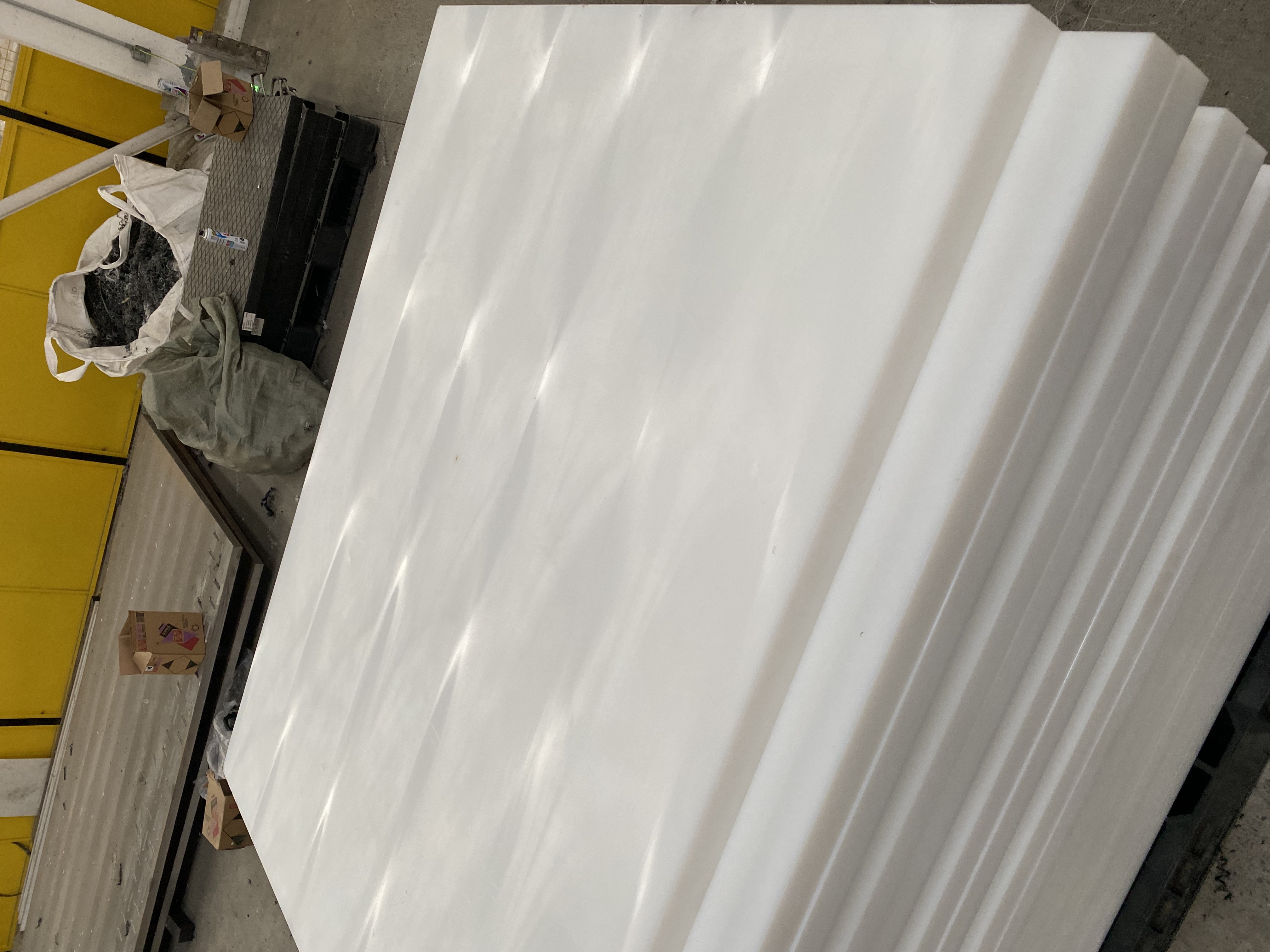
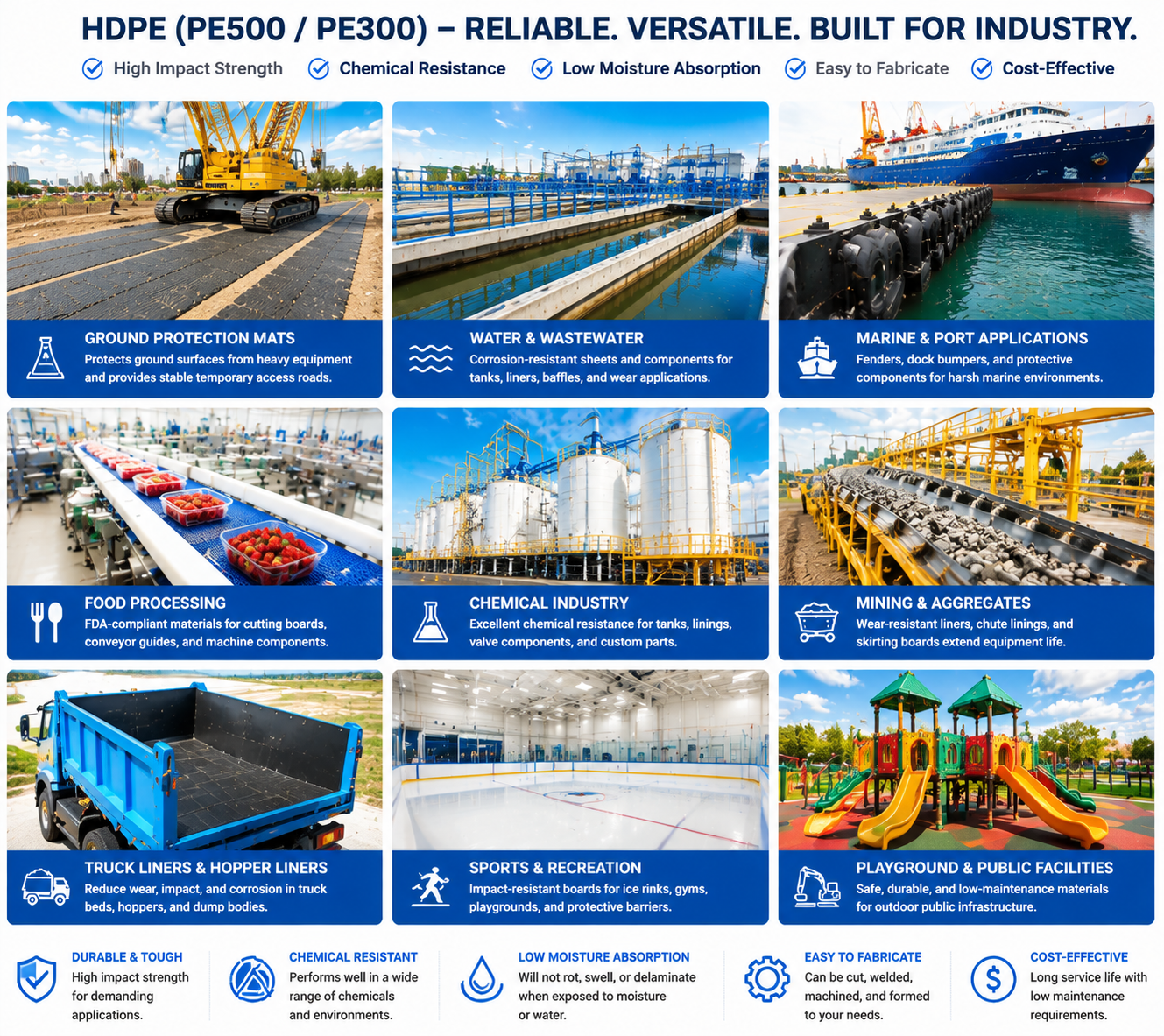
HDPE sheets are used for chemical tanks, treatment basins, water treatment equipment, protective plates and industrial components. The material's chemical resistance, low water absorption and weldability make it a practical choice for containment and panel work. The buyer's job is to confirm the medium, concentration and temperature against the grade, and to verify that the fabricator can weld and support the panel correctly.
Mining, chutes and wear lining
HDPE sheet for lining duties is normally specified where chemical exposure or general protection dominates. For severe sliding abrasion, ore transfer chutes, hoppers, bins, feeders and conveyor components, UHMWPE is the usual recommendation because of its abrasion resistance, continuous impact performance and low coefficient of friction. Both materials can be cut and machined to fit existing equipment, which is why drawings and equipment photos shorten the review cycle considerably.
Temporary roads and ground protection
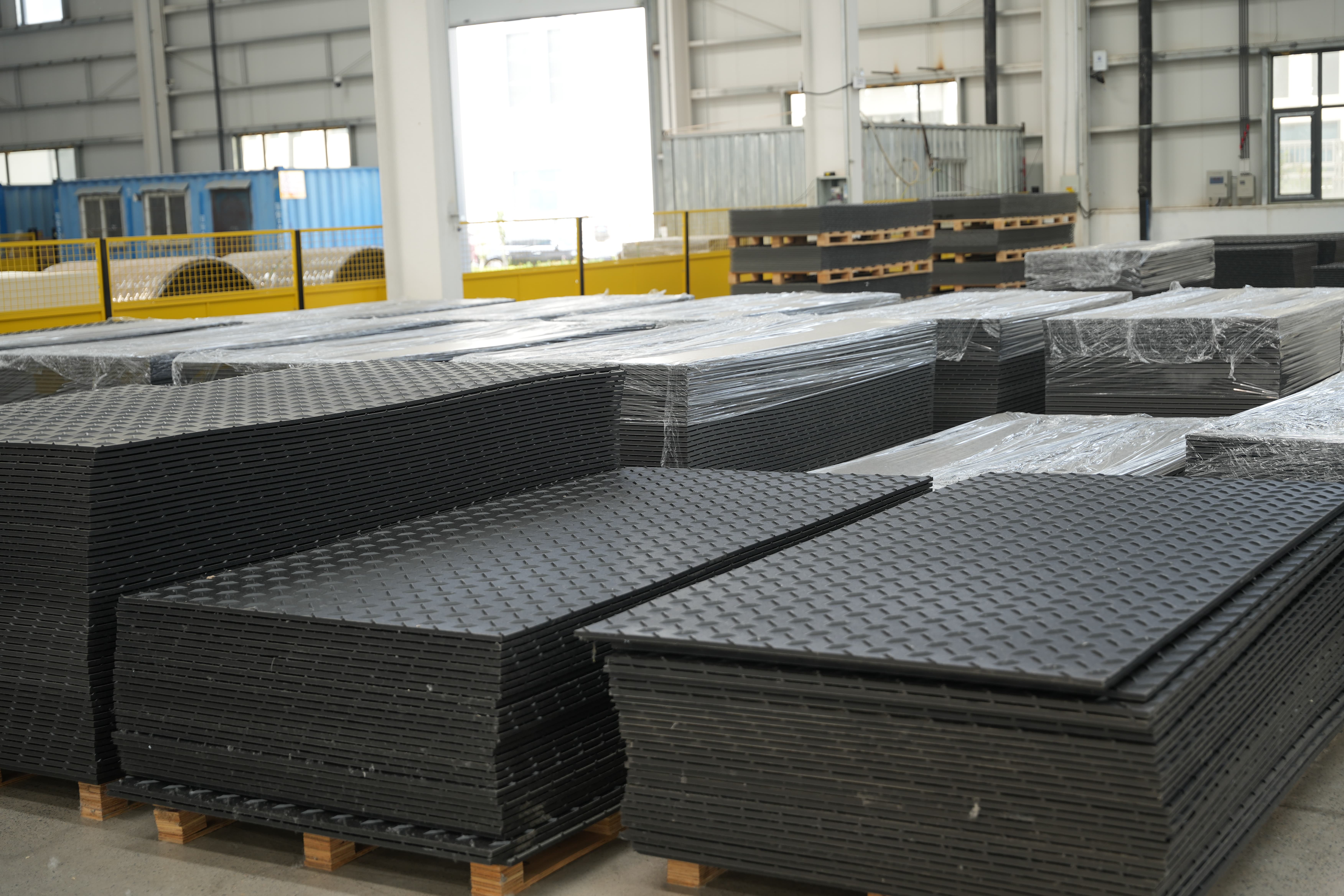
Ground protection mats create temporary access roads and working platforms while protecting grass, soil and sensitive ground surfaces. The HDPE format is supplied at 1,220 × 2,440 mm in thicknesses of 5–40 mm, with a sheet weight of approximately 14.88–119.07 kg and a reference load capacity of approximately 0.3–60 tons depending on thickness and site conditions. Applications range from pedestrian access and garden paths to forklifts, trucks, construction equipment and heavy machinery.
For heavy-duty work, UHMWPE mats are supplied in standard sizes of 2,060 × 4,040 mm or 2,070 × 4,120 mm, in thicknesses of 40–150 mm, with a sheet weight of approximately 340–1,288 kg and a reference load capacity of approximately 80–150 tons depending on thickness and ground conditions. Surface pattern, colour and connection method can all be customised.
Selection guidance is straightforward: HDPE mats are usually sufficient for light-duty pedestrian access, lawn protection, small vehicles and landscaping; heavy-duty HDPE or UHMWPE mats suit construction vehicles, forklifts, delivery trucks and general site access; UHMWPE mats suit mobile cranes, large excavators, heavy trucks, mining equipment and industrial projects.
Crane outrigger pads
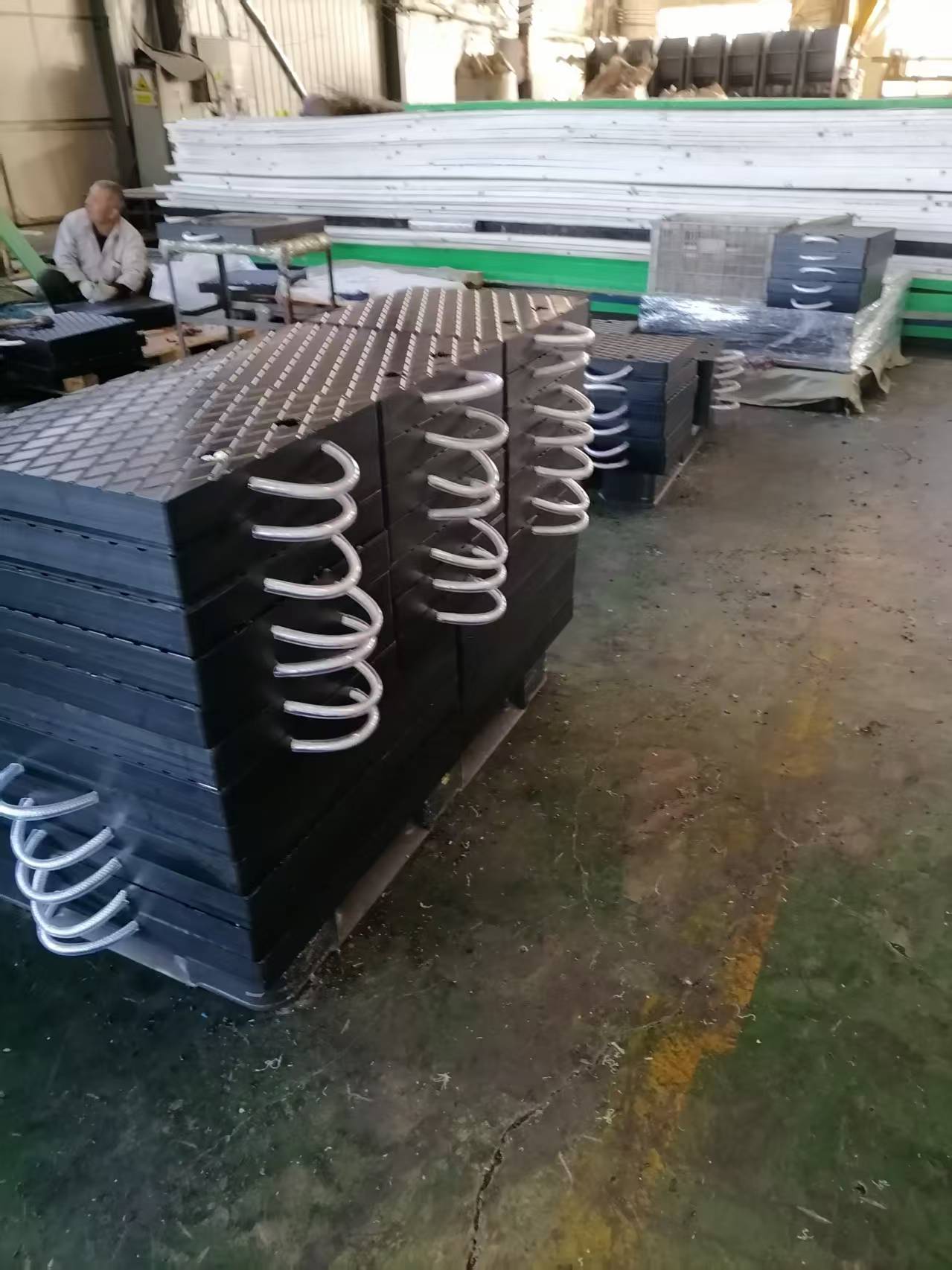
Outrigger pads distribute crane outrigger loads over a larger surface area to reduce ground pressure and improve stability during lifting. They are made in HDPE and UHMWPE variants, with UHMWPE used for the heavy-duty range. Reference load capacity is approximately 5–120 tons depending on size and thickness, and pad weight ranges from approximately 2.7 kg to 172.8 kg per piece.
| Pad size (mm) | Reference load capacity | Approximate weight per piece | Typical positioning |
|---|---|---|---|
| 300 × 300 × 30 | Approx. 5 tons | 2.7 kg | Smallest format in the range |
| 400 × 400 × 40 | Approx. 10 tons | 6.4 kg | Light lifting support |
| 500 × 500 × 50 | Approx. 25 tons | 12.5 kg | Light to medium-duty lifting where portability matters |
| 600 × 600 × 60 | Approx. 50 tons | 21.6 kg | General-purpose size for mobile cranes, truck cranes and concrete pump trucks |
| 700 × 700 × 70 | Approx. 70 tons | 34.3 kg | Heavier lifting and larger mobile cranes needing more support area |
| 800 × 800 × 80 | Approx. 80 tons | 51.2 kg | Heavy-duty lifting on soft soil, grass, sand or uneven ground |
| 1,000 × 1,000 × 100 | Approx. 100 tons | 100 kg | Large mobile cranes and industrial construction sites |
| 1,200 × 1,200 × 120 | Approx. 120 tons | 172.8 kg | Maximum standard format; custom pads available for special heavy-duty projects |
Larger pad size and thickness increase the contact area with the ground and the ability to distribute outrigger loads, while thicker pads provide greater stiffness and resistance to deformation under load. The differences between the common sizes are load distribution capability, ground pressure reduction and handling requirements. A pad that is difficult to lift may be ignored on site, which is a safety problem rather than a convenience problem.
Food processing surfaces
HDPE cutting boards are used in food preparation, meat processing, seafood processing, bakery and catering, commercial kitchens and custom fabricated cutting surfaces. UHMWPE cutting boards (PE1000) serve heavier industrial cutting and material handling duties. Both are available in custom size, thickness, shape and colour, with smooth, textured or grooved surfaces, and food contact is available for compliant material grades subject to applicable requirements.
Product Format Comparison: Four Ways to Buy the Same Polymer Family
Buyers often search for one product and end up comparing four. The table below keeps the formats distinct.
| Format | Primary material | Typical dimensions | Reference load or use data | Customisation |
|---|---|---|---|---|
| HDPE sheet | HDPE | Thickness 1–200 mm; width 1,000–2,000 mm; length 2,000–6,000 mm | Chemical tanks, liners, protective plates, industrial components | Size, thickness, colour, surface, cutting and CNC machining |
| UHMWPE sheet (PE1000) | UHMWPE, 2–7 million molecular weight | Made to customer requirements | Wear liners, conveyor components, mining equipment, low-friction parts | Cutting, drilling, milling, turning, CNC machining; colour and surface options |
| Ground protection mat | HDPE, with UHMWPE heavy-duty variant | HDPE: 1,220 × 2,440 mm, 5–40 mm. UHMWPE: 2,060 × 4,040 mm or 2,070 × 4,120 mm, 40–150 mm | Reference load approx. 0.3–60 tons (HDPE) and 80–150 tons (UHMWPE), depending on thickness and ground conditions | Size, thickness, surface pattern, colour, connection method |
| Crane outrigger pad | UHMWPE and HDPE variants | 300 × 300 × 30 mm to 1,200 × 1,200 × 120 mm | Reference load approx. 5–120 tons, depending on size and thickness | Size, thickness, colour, surface pattern, logo, handles |
How to Evaluate a China HDPE Sheet Manufacturer
China's export volume makes supplier discovery easy and supplier verification hard. Six checks separate a manufacturing partner from a reseller.
- Production scope. Does the company produce sheet and also cut, drill and machine it? Integrated capability reduces the number of handoffs that can distort tolerances.
- Material range. HDPE, UHMWPE (PE1000) and PP in one supply base simplifies multi-material projects and comparisons.
- Engineering support. A technical team that can review drawings, material selection and thickness is more useful than a price list.
- Documentation discipline. Datasheets that state density, tensile, hardness, thickness range and the standard referenced, plus grade-specific compliance statements where food contact is claimed.
- Customisation depth. Dimensions, thickness, colour, surface pattern, machining, handles and markings. If every non-standard request triggers a new supplier, the project will drift.
- Export experience. Familiarity with packing heavy sheets, container loading and destination requirements.
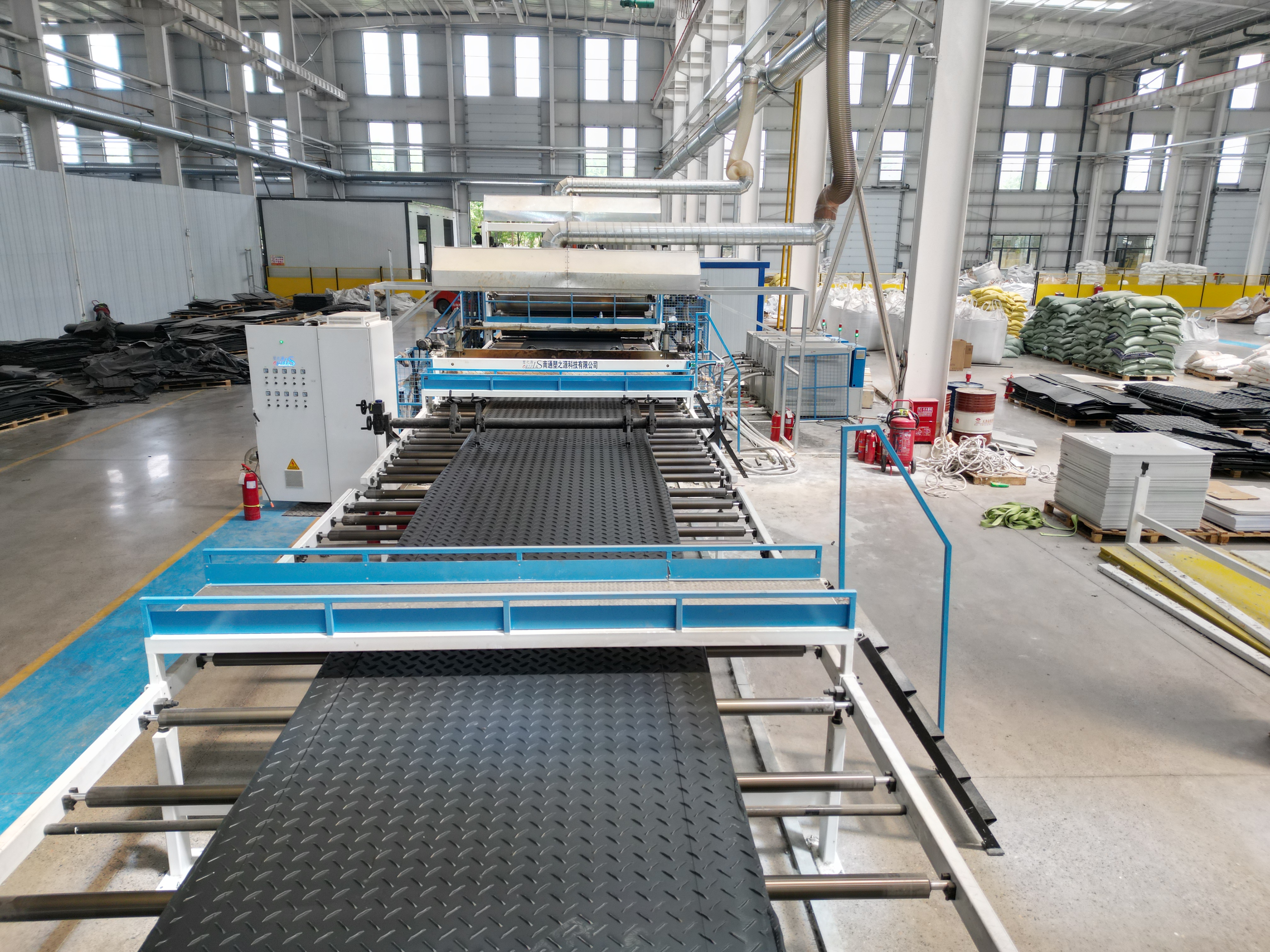
As an example of the profile to compare against: Shandong Yaxu New Materials Co., Ltd. is a China-based manufacturer established in 2012, operating a 36,000 m² facility with approximately 100 employees, an annual production capacity of 30,000 tons and an R&D team of 9 engineers. Its product range covers HDPE sheets, UHMWPE sheets (PE1000), ground protection mats, crane outrigger pads and custom-engineered plastic products, supplied as semi-finished sheets or finished components. The company reports an export ratio of 30%, with main markets including the USA, Australia, Canada, the UK, Germany, UAE, Saudi Arabia, Indonesia, Malaysia and Vietnam.
These figures describe capability, not suitability for a specific duty. They are useful because they can be checked, quoted against and compared, which is exactly what a discovery-stage supplier shortlist needs.
Frequently Asked Questions
What documentation should I request with an HDPE sheet order?
Request a grade-specific datasheet stating density, tensile strength, elongation, hardness and thickness range, together with the standard the sheet is produced against. HDPE sheets can be supplied to GB/T 11116, GB/T 4454, ASTM and ISO standards according to product grade and application. Where food contact is required, ask for the compliance statement covering the exact grade quoted, because food contact is only available for compliant material grades subject to applicable requirements.
Can one supplier provide HDPE sheets and finished machined parts?
Yes, when the supplier operates both sheet production and fabrication. Shandong Yaxu New Materials Co., Ltd. runs HDPE and UHMWPE sheet production, cutting, drilling, CNC machining, custom fabrication and finished plastic components within the same production process, supported by a team of 9 engineers. Buyers should still send a drawing or sample so that feasibility, tolerances and the machining route are reviewed against the actual design rather than a general product description.
What drives the cost of an HDPE sheet order?
Cost is driven by the material family (HDPE or UHMWPE PE1000), sheet thickness and dimensions, order quantity, machining content and tolerances, surface requirements, packaging and destination country. A supplier cannot quote accurately from a thickness alone. Shandong Yaxu New Materials prepares quotations after receiving the material, grade if known, dimensions, thickness, quantity, tolerances, application and destination country.
How can I validate a sheet or pad specification before a full order?
Provide a drawing or sample, the material grade, dimensions, tolerances, quantity and operating conditions. For liners, add equipment dimensions and photographs or drawings of the chute, hopper or tank. The supplier can then review feasibility, pricing and lead time against the design. Shandong Yaxu New Materials reviews drawings and samples in this way before production; buyers can send files to mia@xhcplastics.com for an initial assessment.
What determines lead time on a custom HDPE sheet or pad order?
Lead time follows the manufacturing route: drawing and feasibility review, material and grade confirmation, sheet production or cutting, CNC machining, surface work, packing and freight to the destination country. Thickness, size, quantity, machining content and destination therefore change the schedule. Ask for a written production and shipping schedule alongside the quotation so that the commitment is tied to the agreed specification.
Conclusion
An HDPE sheet is a semi-finished polyethylene panel with a well-defined property set: density 0.941–0.965 g/cm³, tensile strength ≥22 MPa, water absorption ≤0.01%, chemical resistance across acids, alkalis and salt solutions, and reliable machining and welding behaviour. It is the right starting point for chemical containment, water treatment, protective panels, food processing surfaces and light-to-medium duty ground protection.
UHMWPE is the right starting point when sliding wear, continuous impact and low friction define the duty. Separating those two decisions, and then matching thickness, dimensions, surface and fabrication route to the actual load case, removes most of the risk from an HDPE sheet project.
The remaining risk sits with the supplier. A manufacturer that produces sheet, machines parts and documents specifications can answer the questions that matter; a reseller can only forward them.
Request an HDPE Sheet Quotation
Send the material, grade if known, dimensions, thickness, quantity, tolerances, application and destination country, and the specification can be reviewed against production capability rather than a generic price list. Drawings and samples are welcome for custom-cut sheets, machined components, ground protection mats and outrigger pads.
Email: mia@xhcplastics.com | Tel: +86 182-6307-9642 | WhatsApp: +1 (213) 331-4840
Website: www.xhcplastics.com
Have Questions or Need More Details?
Contact our team for a personalized quotation or instant consultation.
Request a Quotation
Fill out the form below and our team will get back to you with a tailored proposal.
WhatsApp Direct Chat
Prefer to chat in real-time? Message us on WhatsApp for instant assistance & quick answers.
- Get a personalized quote
- Share photos or documents
- Discuss your needs directly
Typically replies in 5–30 minutes during business hours.