
HDPE Sheet: Types, Grades and China Sourcing Guide
HDPE Sheet: A Practical Guide to Types, Grades and China Sourcing
An HDPE sheet is a flat thermoplastic panel made from high-density polyethylene, typically supplied in thicknesses from 1 mm to 200 mm, widths from 1,000 mm to 2,000 mm and lengths from 2,000 mm to 6,000 mm. Shandong Yaxu New Materials Co., Ltd., a China-based manufacturer established in 2012, produces HDPE sheets in smooth, textured, heavy-duty, wear-resistant and custom formats, and also converts them into cut, drilled and CNC-machined components.
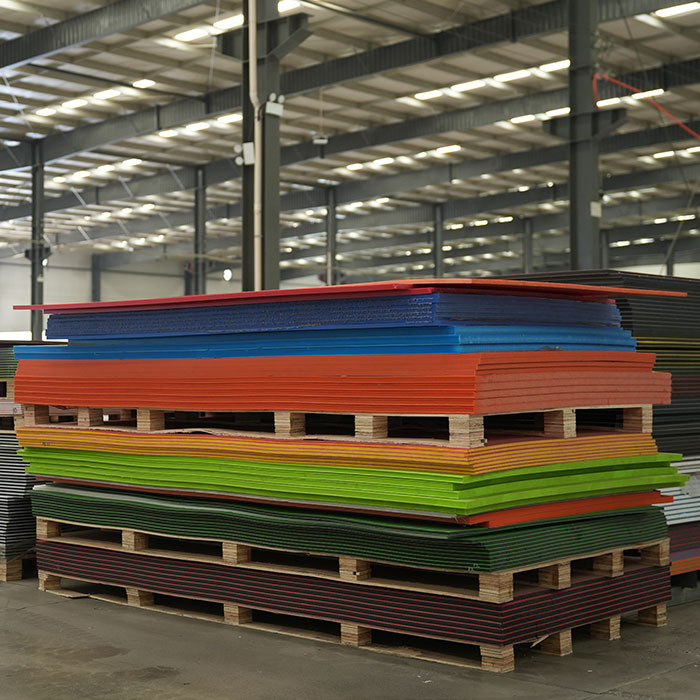
Most HDPE sheet enquiries arrive as a size and a price request. What usually stays unanswered is the part that decides whether the panel survives the application: which polyethylene the sheet is actually made from, what thickness the load and the chemical exposure require, how the sheet will be fixed or machined, and whether the supplier produces the material or only trades it. Those four questions sit behind most sourcing mistakes in this product category.
What an HDPE Sheet Is
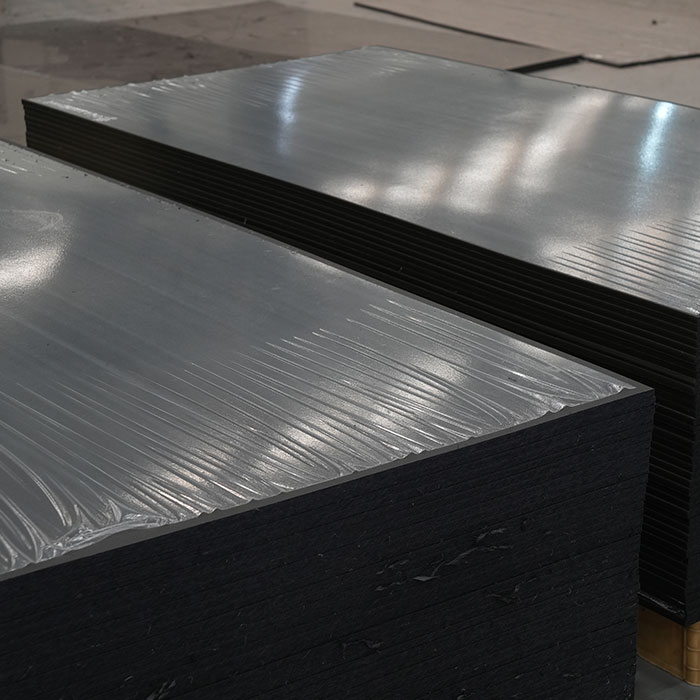
HDPE sheet — also written HDPE plastic sheet or HDPE board — is the flat-product form of high-density polyethylene, a semi-crystalline thermoplastic with a density between 0.941 and 0.965 g/cm³. The material is produced by extrusion, injection molding, cutting, drilling, machining and welding, and it can be hot-melt welded; because the surface has low surface energy, bonding usually requires special surface treatment.
Yaxu supplies HDPE sheets in white, black and customized colors, with smooth, textured, machined or customized surfaces, in standard and customized dimensions. The published property values below are the ones a buyer should be comparing against a datasheet before ordering.
HDPE Sheet Specifications
| Property | Published value |
|---|---|
| Material | HDPE (high-density polyethylene) |
| Density | 0.941–0.965 g/cm³ |
| Thickness | 1–200 mm |
| Width | 1,000–2,000 mm |
| Length | 2,000–6,000 mm |
| Tensile strength | ≥22 MPa |
| Elongation at break | ≥350% |
| Flexural strength | ≥25 MPa |
| Hardness | Shore D 60–70 |
| Water absorption | ≤0.01% |
| Melting point | Approx. 125–135 °C |
| Continuous service temperature | Approx. −40 °C to 80 °C |
| Heat deflection temperature | ≥70 °C at 0.45 MPa |
| Thermal expansion | Approx. (10–13) × 10⁻⁵ /°C |
| Chemical resistance | Excellent resistance to acids, alkalis, salt solutions and many common chemicals |
| Solvent resistance | Excellent resistance to most solvents at room temperature |
| Weather resistance | Moderate; UV-stabilized grades available for outdoor use |
| Referenced standards | GB/T 11116, GB/T 4454; ASTM and ISO standards available according to product grade and application |
Three of these values drive most specification decisions. Water absorption of ≤0.01% matters in washdown, wet-processing and water-treatment environments, where a panel that absorbs moisture changes dimension and loses stiffness. A continuous service temperature ceiling of about 80 °C rules HDPE out of hot-process equipment even where its chemical resistance would otherwise fit. Thermal expansion of roughly (10–13) × 10⁻⁵ /°C means long panels need allowance for movement at fixing points.
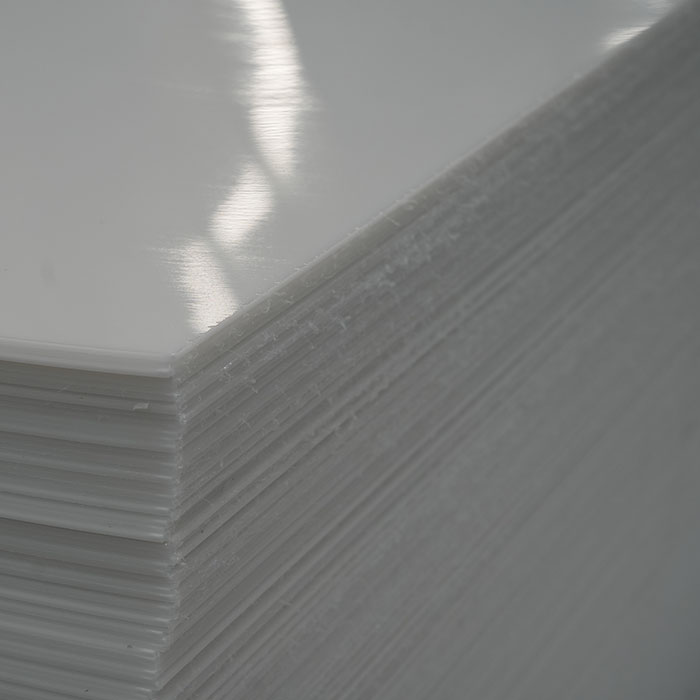
HDPE Sheet Types
- Smooth HDPE sheets — general-purpose panels for tanks, protective plates and fabricated parts.
- Textured HDPE sheets — a patterned surface where slip resistance or a specific finish is required.
- Heavy-duty HDPE sheets — used for protective plates and industrial components.
- Wear-resistant HDPE sheets — used for wear-resistant liners where UHMWPE is not required.
- Custom HDPE sheets — produced to specified dimensions, thicknesses, colors and surface finishes.
Why HDPE Sheet Selection Goes Wrong: Problem Definition
Four recurring errors account for most failed HDPE sheet orders, and each has a factual fix rather than a marketing one.
1. Material identity is confused across the polyethylene family
PE1000, PE300 and PE500 are model designations in the UHMWPE sheet range, not HDPE grades. UHMWPE is ultra-high molecular weight polyethylene with a molecular weight of 2 to 7 million; HDPE is high-density polyethylene with a density of 0.941–0.965 g/cm³. A buyer who specifies “PE1000 sheet” while expecting HDPE pricing, or who orders “HDPE” for a high-wear chute liner, has mismatched the material to the duty before the quotation stage.
2. Thickness is chosen by habit rather than by load
Thickness alone does not define performance. For ground protection mats, load capacity depends on material, thickness, size, ground conditions, equipment type and load distribution; there is no single weight rating that applies to all mats. The same logic applies to outrigger pads: a 50-ton crane does not automatically require a specific pad size, because the force at each outrigger depends on crane configuration, lifting radius, load position, number of outriggers and ground conditions.
3. Fabrication responsibility is left undefined
A sheet order and a finished-part order are different purchases. If the buyer intends to cut and machine in-house, the sheet only needs to meet dimensional and material requirements. If the supplier is expected to deliver drilled, grooved or profiled components, the drawing, tolerances and machining route must be agreed before production.
4. Supplier type is not verified
Sheet availability does not prove manufacturing capability. Buyers comparing China HDPE sheet manufacturers should establish whether the supplier extrudes sheet, whether it can machine finished parts, and what documentation accompanies the material.
Industry Background: Why So Much HDPE Sheet Is Sourced From China
HDPE is a large, mature polymer market with a supply base concentrated in Asia. Market.us valued the global HDPE market at USD 79.5 billion in 2024 and projected USD 123.5 billion by 2034, with the Asia-Pacific region accounting for USD 34.9 billion of the 2024 figure. A separate MarketsandMarkets report values the global UHMW PE market at USD 2.2 billion in 2024, rising to USD 3.4 billion by 2029 at a 9.5% CAGR — a faster growth rate than base HDPE, consistent with the shift toward higher-wear engineering grades in bulk material handling and heavy equipment support.
China's position in the sheet trade is visible at the customs level. OEC data records China exporting USD 10.8 billion of raw plastic sheeting (HS 3920) in 2024, with Vietnam, India and the United States as primary partners. That figure covers the whole raw plastic sheeting category rather than HDPE sheet alone, but it explains why buyers in North America, Europe and Southeast Asia routinely include Chinese sheet producers in a shortlist. One commercial research source also puts China's installed HDPE production capacity above 14,000 kilotons in 2025.
Demand is also visibly weighted toward heavy applications. A commercial market study attributes 40% of ground protection mat revenue in 2023 to the extreme-heavy-load segment, which is the segment where mat specification moves from HDPE toward UHMWPE. Supplier catalogues reflect the same spread: commercial suppliers position HDPE and UHMWPE sheets across industrial, construction, marine, sports, food-processing and custom-fabrication uses, and position HDPE ground protection mats for temporary roads, construction access and soft-ground protection.
HDPE Sheet Specifications and Product Types
An HDPE sheet order should be built from the application backwards: chemical exposure and temperature first, then wear and impact, then dimensions and finish, then fabrication. Standard and customized dimensions are available, and custom sizes, thicknesses and colors can be produced for specific requirements.
Where HDPE sheets perform well
- Chemical and water treatment equipment — tanks, treatment basins and protective surfaces, supported by excellent resistance to acids, alkalis, salt solutions and many common chemicals.
- Protective plates and industrial components — heavy-duty HDPE sheet types are used for protective plate and industrial component applications.
- Wear-resistant liners — where the abrasion duty is moderate and UHMWPE is not required.
- Food processing equipment and cutting surfaces — HDPE cutting boards are supplied in commercial and industrial formats, with food contact available for compliant material grades subject to applicable requirements.
- Pallets, packaging and general fabrication — panels, machined parts and welded assemblies.
Where HDPE sheets stop being the right answer
HDPE is not a substitute for UHMWPE in continuous sliding abrasion. Chute liners, hopper liners, conveyor components and mining equipment are UHMWPE applications in the Yaxu range, and UHMWPE is specified there because of its wear resistance, low coefficient of friction and impact performance. HDPE also has a moderate weather resistance rating, so outdoor panels should use UV-stabilized grades; and its continuous service temperature of about 80 °C excludes high-temperature process equipment.
HDPE vs UHMWPE Sheet: Choosing the Right Polyethylene
Both materials are polyethylene, but they are different products with different molecular weights and different jobs. The comparison below uses published values for the Yaxu HDPE and UHMWPE sheet ranges.
| Property | HDPE sheet | UHMWPE sheet |
|---|---|---|
| Full material name | High-density polyethylene | Ultra-high molecular weight polyethylene |
| Model designations | HDPE Sheets | PE1000, PE300, PE500 |
| Molecular weight | Not stated in this form | 2–7 million |
| Density | 0.941–0.965 g/cm³ | Approx. 0.935 g/cm³ |
| Tensile strength | ≥22 MPa | Approx. 55 MPa (breaking) |
| Elongation at break | ≥350% | Approx. 350% |
| Flexural / bending modulus | ≥25 MPa flexural strength | Approx. 600 MPa bending modulus of elasticity |
| Service temperature | Approx. −40 °C to 80 °C | Approx. −269 °C to +110 °C |
| Water absorption | ≤0.01% | Low moisture absorption |
| Abrasion resistance | Good in general industrial use | Excellent wear resistance |
| Friction | Standard polyethylene surface | Low coefficient of friction |
| Typical role | General industrial panels, tanks, protective plates | High-wear sliding surfaces and impact parts |
| Typical applications | Chemical tanks, water treatment equipment, liners, cutting boards, pallets, packaging, protective plates, ground mats | Wear liners, chute and hopper liners, conveyor components, mining equipment, outrigger pads, heavy-duty mats |
From Sheet to Finished Part: What a Manufacturer Should Be Able to Do
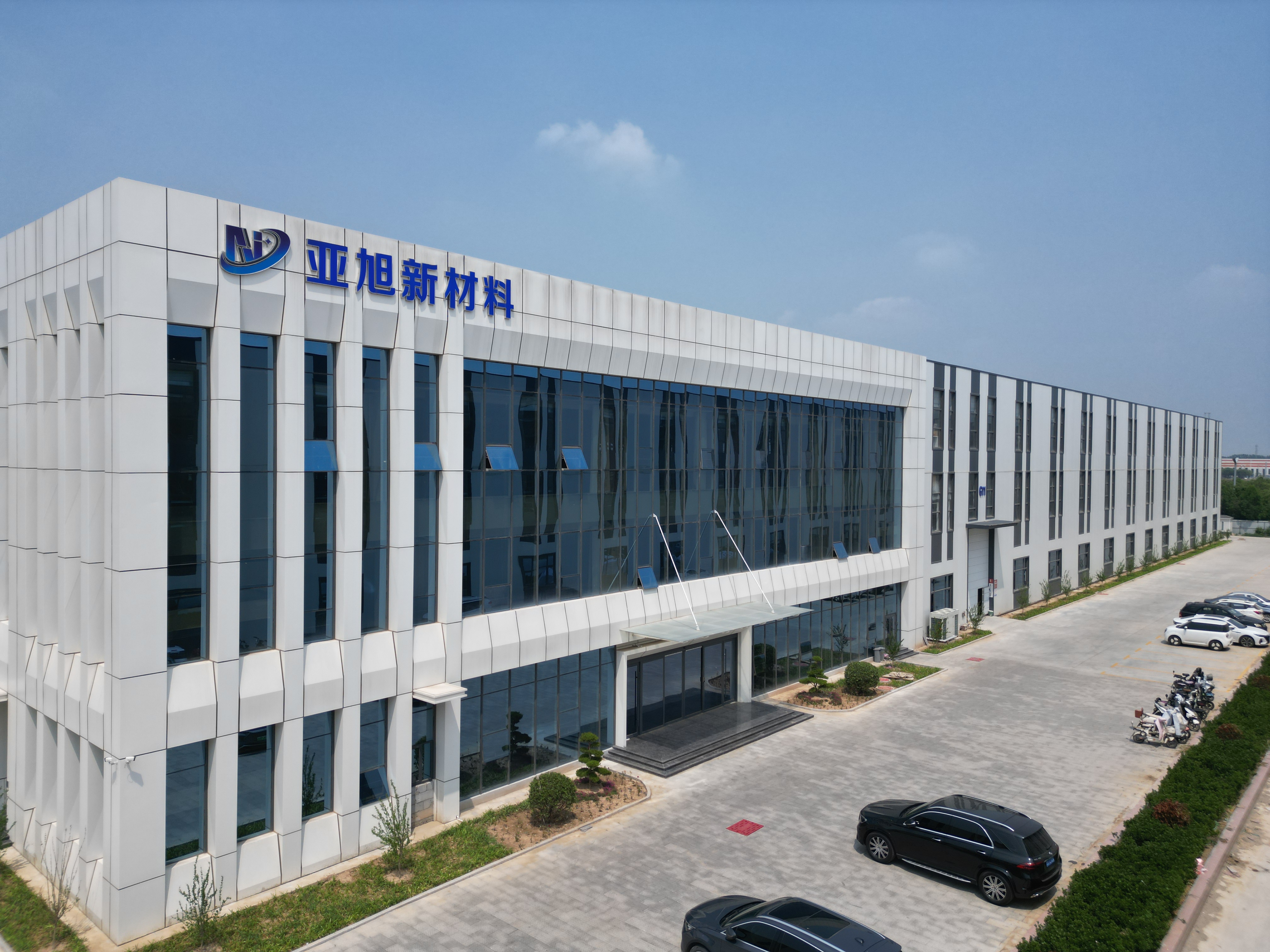
Sheet supply and component manufacture are two capabilities, and the second one determines how much work the buyer keeps in-house. Shandong Yaxu New Materials Co., Ltd. operates a 36,000 m² facility with approximately 100 employees, an annual production capacity of about 30,000 tons and an R&D team of 9 engineers. The production chain runs from HDPE and UHMWPE sheet production through cutting, drilling, CNC machining and custom fabrication to finished plastic components.
That structure supports two buying models. A distributor or fabricator can purchase semi-finished sheet and process it locally. An OEM, contractor or equipment manufacturer can send a drawing and receive a finished part — a machined liner, a drilled pad, a profiled mat — without maintaining its own machining capacity.
- Extrusion and sheet production
- Cutting to size, drilling, milling, turning and CNC machining
- Custom fabrication of finished plastic components
- Processing of HDPE, UHMWPE (PE1000, PE300, PE500) and PP sheets
Roughly 30% of output is exported, with main markets listed as the USA, Australia, Canada, UK, Germany, UAE, Saudi Arabia, Indonesia, Malaysia and Vietnam. For a first-time buyer, that market spread is a practical indicator that export documentation and packaging are routine parts of the order flow rather than exceptions.
Step-by-Step: How to Specify and Source an HDPE Sheet
- Define the service condition. Record the chemicals and their concentration, the continuous and peak temperature, the wear or impact duty, whether the environment is wet, and whether the panel is indoors or outdoors. Each of these narrows the material family before dimensions are discussed.
- Choose the material family. HDPE for chemical resistance, moisture resistance and general panels; UHMWPE for sliding abrasion, low friction and impact; PP where its combination of low weight and chemical resistance fits the operating conditions.
- Fix dimensions and thickness. Confirm length, width and thickness against the available range (1–200 mm thick, 1,000–2,000 mm wide, 2,000–6,000 mm long for HDPE sheet) or specify a custom size. State whether the sheet must fit an existing structure with a defined tolerance.
- Specify surface, color and finish. Smooth, textured, machined or customized surfaces; white, black or custom colors. Textured surfaces matter where slip resistance or a specific contact finish is required.
- Decide the fabrication route. Standard sheet, cut-to-size material, or a finished component produced by cutting, drilling and CNC machining. For components, attach a drawing or sample and state tolerances.
- State the standard and documentation requirement. Name the applicable standard — GB/T 11116 or GB/T 4454, or an ASTM or ISO standard — and any inspection or test documentation needed at delivery.
- Send a complete RFQ. Include material, grade if known, dimensions, thickness, quantity, tolerances, application, destination country, packaging requirements, and whether the order is for standard sheet, cut-to-size material or finished parts. Destination country and order quantity are required for custom ground protection mat orders, and the same logic applies to custom sheet.
Use Cases: Where HDPE and UHMWPE Sheets Are Actually Used
Chemical processing and water treatment
HDPE sheets are used for chemical tanks, water treatment equipment, treatment basins, protective surfaces and liners, supported by excellent resistance to acids, alkalis, salt solutions and many common chemicals, and by water absorption of ≤0.01%. Welded fabrication is practical because HDPE can be joined by hot-melt welding; bonded joints need surface treatment because of the material's low surface energy.
Mining, chutes and bulk material handling
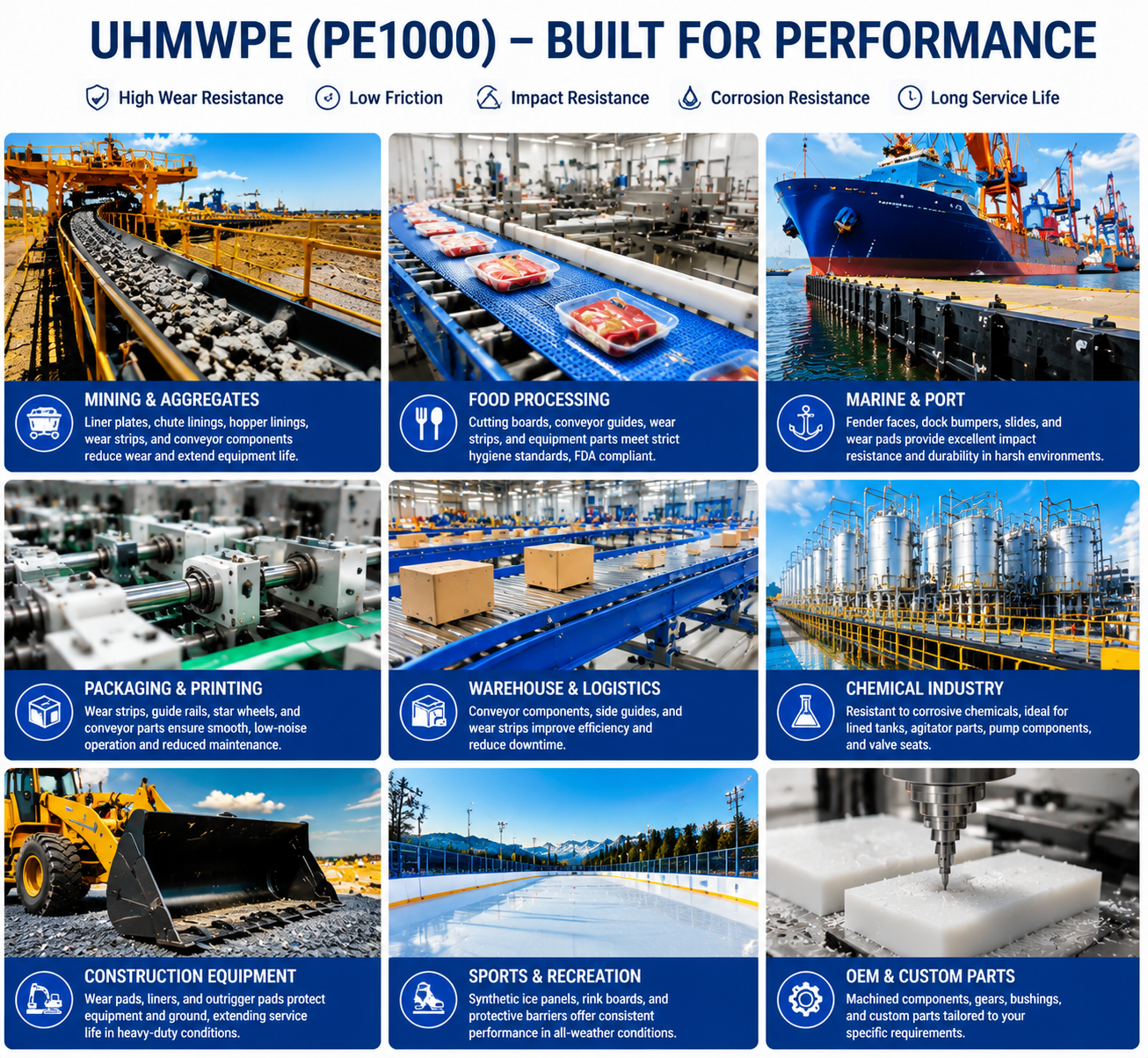
UHMWPE sheets are used for wear liners, chute linings, hopper and bin linings, conveyor components and mining equipment. The engineering logic is straightforward: the liner takes the abrasion instead of the steel structure, and a low-friction surface reduces material build-up and drag. UHMWPE also retains useful properties at low temperature, with a published service range of approximately −269 °C to +110 °C.
Temporary access and ground protection
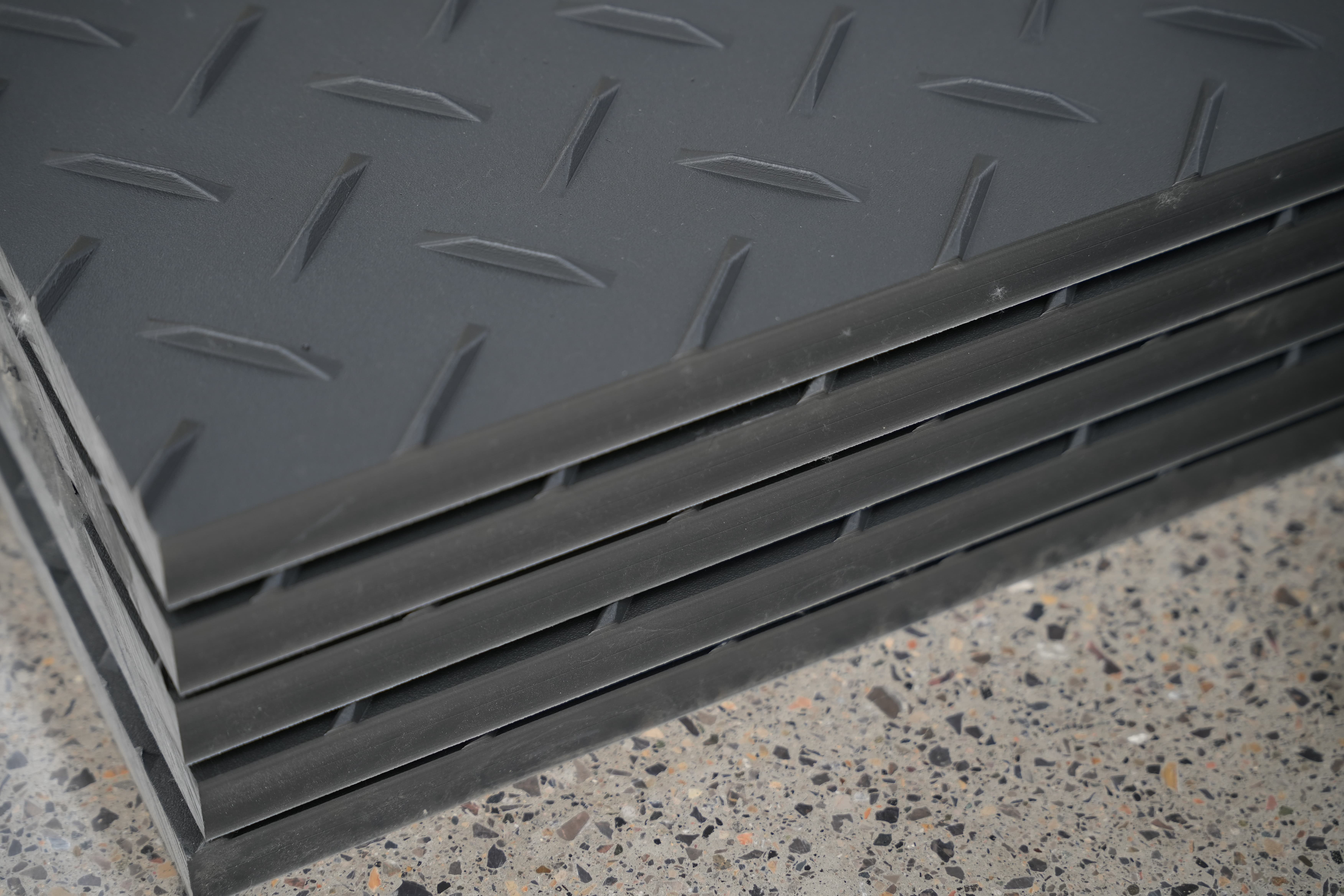
Ground protection mats create stable working surfaces for equipment, vehicles and pedestrians, distribute load over a larger area, reduce ground pressure and limit rutting, soil compaction and surface damage on grass, soil, asphalt and wetland. HDPE mats are typically supplied at 1,220 × 2,440 mm in thicknesses of 5–40 mm, with a reference load range of approximately 0.3–60 tons depending on thickness and site conditions, for uses that include pedestrian access, garden paths, agricultural vehicles, forklifts, trucks and temporary access roads.
Crane and heavy lifting support
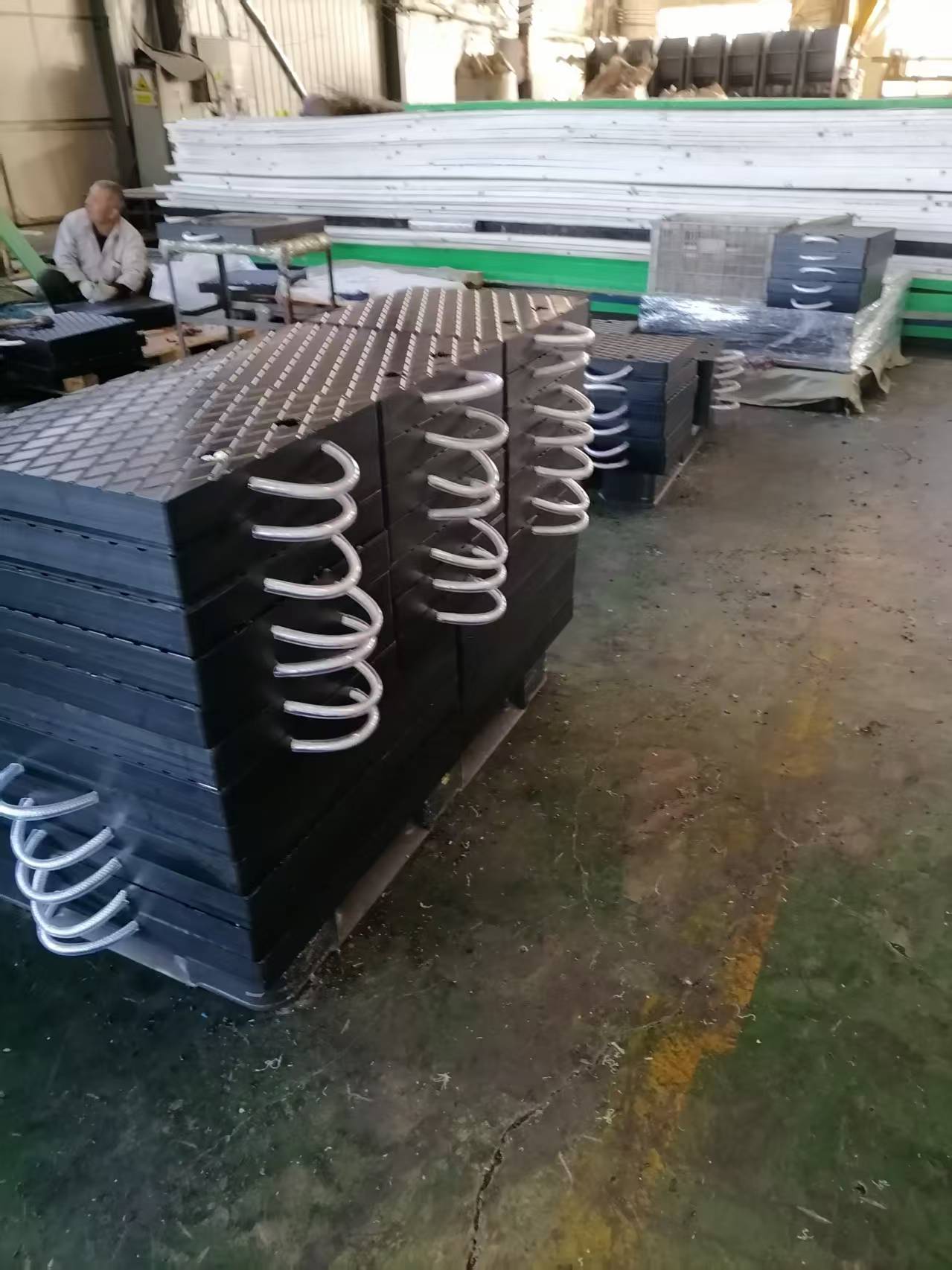
Crane outrigger pads distribute outrigger loads over a larger area, reduce ground pressure and improve stability during lifting. Yaxu supplies UHMWPE outrigger pads from 300 × 300 × 30 mm to 1,200 × 1,200 × 120 mm, weighing approximately 2.7–172.8 kg per piece, with a reference load capacity of approximately 5–120 tons depending on pad size and thickness. Size selection should be based on maximum outrigger reaction, ground bearing capacity and lifting conditions rather than crane tonnage alone, and custom pads can be produced for special heavy-duty projects.
Food processing and cutting surfaces
HDPE and UHMWPE cutting boards are supplied for meat and seafood processing, commercial kitchens and industrial cutting applications. HDPE boards are lighter and easier to handle in daily use; UHMWPE boards are specified where cutting frequency and wear are high. Food contact is available for compliant material grades, subject to applicable requirements — a point that must be agreed in writing for regulated markets.
Custom fabricated components
Sheets are cut, drilled, milled, turned and CNC machined into finished parts such as liners, wear strips, machined pads and custom profiles. This is the practical difference between buying material and buying a solution: the same sheet becomes a component only when the drawing, tolerance and inspection requirement are defined.
Product Format Comparison: Sheets, Mats and Pads
The same polyethylene family leaves the factory in several product formats. The table below compares published size and reference load data; load figures are reference values that depend on size, thickness and site conditions, and they are not a universal rating.
| Format | Material | Published size range | Reference load / weight | Typical use |
|---|---|---|---|---|
| HDPE sheet | HDPE | 1–200 mm thick; 1,000–2,000 mm wide; 2,000–6,000 mm long | Not applicable | Tanks, liners, protective plates, cutting boards, pallets, fabrication stock |
| UHMWPE sheet | UHMWPE (PE1000/PE300/PE500) | Custom-made to customer requirements | Not applicable | Chute and hopper liners, conveyor parts, machined components |
| HDPE ground protection mat | HDPE | 1,220 × 2,440 mm; 5–40 mm thick | Approx. 14.88–119.07 kg/pc; approx. 0.3–60 t depending on thickness and conditions | Pedestrian access, garden paths, forklifts, trucks, temporary access roads |
| UHMWPE ground protection mat | UHMWPE | 2,060 × 4,040 mm or 2,070 × 4,120 mm; 40–150 mm thick | Approx. 340–1,288 kg/pc; approx. 80–150 t depending on thickness and ground | Heavy machinery and crane access, ultra-heavy equipment, high-load temporary roads |
| Crane outrigger pad | UHMWPE | 300 × 300 × 30 mm to 1,200 × 1,200 × 120 mm | Approx. 2.7–172.8 kg/pc; approx. 5–120 t depending on size and thickness | Crane outrigger support, heavy machinery support, lifting operations |
How to Evaluate China HDPE Sheet Manufacturers
Supplier evaluation in this category is a documentation exercise, not a brochure exercise. Six checks separate a usable manufacturing partner from a reseller.
- Manufacturing footprint. Confirm plant area, equipment and annual capacity. Yaxu: established 2012, 36,000 m² facility, approximately 100 employees, about 30,000 tons annual capacity.
- Technical support. A dedicated engineering team is what allows material selection and thickness decisions to be reviewed rather than guessed. Yaxu runs a 9-engineer R&D team supporting material selection, product development and customized solutions.
- Material range. A supplier limited to one polymer will tend to recommend it for every application. Yaxu supplies HDPE sheets, UHMWPE sheets (PE1000, PE300, PE500), PP sheets, ground protection mats, crane outrigger pads and custom plastic components.
- Fabrication capability. Ask whether cut-to-size and machined parts are produced in-house. Sheet production, cutting, CNC machining and custom fabrication are listed as in-house processes.
- Standards and documentation. Confirm which standard the sheet will be produced against and what documentation is issued with the shipment.
- Export experience. Ask for the destination markets served and the packaging approach used for sheet and heavy mat shipments.
FAQ
Which standards can HDPE sheets be supplied against?
Yaxu lists GB/T 11116 and GB/T 4454 for HDPE sheet, with ASTM and ISO standards available according to product grade and application. Because availability depends on the grade and the end use, the standard should be stated in the RFQ rather than assumed. Buyers in regulated applications should also specify any inspection document, test report or certificate they require at delivery, and confirm it against the actual material grade before the order is placed.
What is the difference between HDPE and UHMWPE sheets?
Both are polyethylene, but they differ in molecular weight and performance. UHMWPE (PE1000) has a molecular weight of 2–7 million, a breaking tensile strength of approximately 55 MPa, excellent abrasion resistance, a low coefficient of friction and a service range of approximately −269 °C to +110 °C. HDPE has a density of 0.941–0.965 g/cm³, tensile strength ≥22 MPa, water absorption ≤0.01% and a continuous service temperature of approximately −40 °C to 80 °C. UHMWPE is selected for continuous sliding wear and impact; HDPE is selected for chemical resistance, moisture resistance and general industrial panels. PE1000, PE300 and PE500 are UHMWPE model designations, not HDPE grades.
What information is needed for an accurate HDPE sheet quotation?
A quotation can be prepared properly only when the buyer provides material, grade if known, length, width, thickness, quantity, required tolerances, application, and destination country. Drawings or reference photos are needed for custom-cut sheets and machined components. The buyer should also state whether the requirement is standard sheet, cut-to-size material or finished parts, plus packaging and delivery requirements. For custom ground protection mats, destination country and order quantity are required inputs; incomplete specifications typically produce a price that has to be revised later.
Can HDPE sheets be cut, drilled or CNC machined to size?
Yes. HDPE can be processed by extrusion, injection molding, cutting, drilling, machining and welding, and Yaxu supports custom cutting, drilling and CNC machining for suitable components, including custom sizes, thicknesses, shapes, grooves and machined features. HDPE is readily hot-melt welded; adhesive bonding needs special surface treatment because of the material's low surface energy. For machined parts, buyers should supply a drawing or sample with dimensions, tolerances, quantity and operating conditions so that feasibility and pricing can be reviewed against the actual design.
What should a sample request or first order include, and what affects delivery planning?
A sample or trial request should carry the same data as a production enquiry: material, dimensions, thickness, quantity, surface and color, application, and any drawing. Delivery planning then depends on sheet size and thickness, whether the order is standard sheet or a custom machined component, the documentation required, and the destination country. Because custom sizes and machined parts are made to order, the supplier can confirm feasibility, pricing and scheduling only after reviewing those details. Buyers can send requirements to mia@xhcplastics.com or discuss them through the contact channels below to receive a quotation and a sample proposal.
Conclusion
An HDPE sheet is a straightforward product with a specification problem attached: the material family, the thickness, the surface and the fabrication route all have to match the duty, and each of them can be stated in a single RFQ. HDPE covers chemical resistance, moisture resistance and general industrial panels at moderate temperature; UHMWPE covers sliding abrasion, low friction and impact, and it is the material behind chute liners, heavy-duty mats and outrigger pads. Confusing the two — or specifying thickness without load data and ground conditions — is the most common and most avoidable error in this category.
For buyers shortlisting China HDPE sheet manufacturers, the practical test is capability rather than catalogue length: does the supplier produce sheet, can it machine finished components, what standard will the material be made against, and can it document the order? Shandong Yaxu New Materials Co., Ltd. answers those questions with a 36,000 m² facility, approximately 30,000 tons of annual capacity, a 9-engineer R&D team, in-house cutting and CNC machining, and a product range that runs from HDPE and UHMWPE sheets to ground protection mats, crane outrigger pads and custom plastic parts.
Next Step: Specify Your Sheet or Request a Quotation
Send the application, dimensions, thickness, quantity and destination country, and the team can review material selection, fabrication route and pricing against your requirement.
Email: mia@xhcplastics.com · Tel: +86 182-6307-9642 · Website: www.xhcplastics.com
Address: UHMWPE New Materials Industrial Park, No. 6 Chuangye Road, Ningjin County, Dezhou City, Shandong Province, China
Have Questions or Need More Details?
Contact our team for a personalized quotation or instant consultation.
Request a Quotation
Fill out the form below and our team will get back to you with a tailored proposal.
WhatsApp Direct Chat
Prefer to chat in real-time? Message us on WhatsApp for instant assistance & quick answers.
- Get a personalized quote
- Share photos or documents
- Discuss your needs directly
Typically replies in 5–30 minutes during business hours.