
Belt Damage at Loading Points? Upgrade to a Rubber-Ring Impact Roller
Belt damage rarely begins in the middle of a conveyor line. It begins in the few metres where material falls from the chute onto the belt — and it shows up as patched covers, flattened idler shells, seized bearings, spillage and mistracking that maintenance teams gradually learn to live with. If that pattern is familiar, the problem is usually not belt quality or operator discipline. It is the roller directly under the impact zone.
This article is written for the decision stage. You already know the loading point is costing money; the open question is whether to keep replacing trough idlers, re-specify them, or move to a roller designed around impact. The sections below diagnose the failure signatures, explain how the loading point is actually loaded, and then examine one configuration — the ER-IMPACT-108 rubber-ring impact roller, a Ø108 mm tube fitted with wear-resistant rubber rings — against the alternatives on specification, service life and total cost of ownership.
Problem Definition: What Actually Fails at a Loading Point
Impact is an energy-transfer problem. A lump leaving a chute carries kinetic energy that has to go somewhere within milliseconds. Part of that energy deforms the belt cover, part loads the carcass, and part passes into the roller supporting the belt at that exact point. A rigid steel shell with a thin elastomer covering has limited capacity to absorb shock, so the remainder transfers into the belt and into the roller's own bearing housing.
Across mining, quarry and cement conveyors, five failure signatures repeat:
- Cover gouging and puncture directly under the chute. Sharp lump edges combined with drop height cut through the cover before the carcass is affected.
- Edge damage and spillage at the skirt line. Material trapped between belt and skirt rubber, or a belt that sags between supports in the impact zone, abrades the edges and releases fines.
- Flattened shells and ring-shaped wear grooves. The shell deforms under repeated shock, and material build-up on the shell accelerates localised wear.
- Seized bearings and abnormal running noise. Dust enters past the seal and shock loading disturbs bearing pre-load; a stopped roller turns the belt into a sliding contact over a stationary shell.
- Mistracking that starts downstream of the loading point. Uneven support at the impact zone changes the belt's cross-section and its tracking for the rest of the run.
| Visible symptom | Likely mechanism | First thing to verify |
|---|---|---|
| Cover gouging under the chute | Impact energy exceeds what the belt cover and its support can absorb | Drop height, lump size, and whether the support under the chute is impact-rated at all |
| Spillage at the skirt line | Belt sag or material trapped between belt and skirt rubber | Roller spacing in the impact zone and skirt rubber clearance |
| Flattened or grooved shells | Shock load plus material build-up on the shell surface | Whether the position is fitted with a standard trough idler |
| Seized bearings, running noise | Dust ingress past the seal, aggravated by impact loading | Seal design and bearing selection |
| Mistracking after the loading point | Uneven belt cross-section caused by uneven support | Alignment and condition of the first idler set downstream |
Note the sequence in that table: belt damage is the visible symptom, while the roller is the underlying cause. Replacing belt sections without changing the support condition resets the clock but does not stop it.
Industry Background: Why Loading Point Duty Keeps Getting Harder
Rollers and idlers are a large, mature component category. Straits Research values the global rollers and idlers segment at USD 4.14 billion in 2025, with a projection of USD 7.05 billion by 2034. Dataintelo, working from a different definition, values the “roller conveyor” market at USD 3.15 billion in 2025. The two numbers measure different scopes — component versus sub-system — and should not be added together or compared directly. What matters for a buyer is the composition behind them: steel remains the dominant roller material with 64% of global market share in 2024, and mining and quarrying is the leading end-use industry at 36% of total revenue in 2024.
Two practical conclusions follow from that composition. First, most heavy-duty loading points in the world are supported by rigid steel shells, which means impact energy is routinely handled by the belt rather than by the roller. Second, because mining and quarrying dominate demand, the loading point — not the long straight span — is where roller specifications are most often under-designed relative to actual duty.
Standardisation has moved in parallel. DIN 22112 Part 3 (1996) specifies testing requirements for belt conveyor idlers used in underground coal mining; CEMA Standard No. 502-2022 establishes dimensional standards and load ratings for bulk material belt conveyor troughing and return idlers; GB/T 10595 is the belt conveyor reference commonly requested in Chinese-origin projects; and ISO 5048:1989 remains the international basis for calculating power and tension in belt conveyors with carrying idlers. A loading-point upgrade is therefore also a documentation exercise: the roller should be specified against a standard basis, not only against a price.
Detailed Solution: The ER-IMPACT-108 Rubber-Ring Impact Roller
Shanghai Eastrise Trading Co., Ltd. is a Shanghai-based foreign-trade enterprise, founded in 2024, that supplies mining accessories — conveyor idlers and rollers, rubber conveyor belts, pulleys and drums, high-pressure rubber hoses and pipe connectors — supported by its own manufacturing facilities covering 11,000 m², 50 employees, an annual output of 2,000 t and a 10-engineer R&D team, with an export ratio of 20%.
The ER-IMPACT-108 is a rubber-ring impact roller built on a Ø108 mm tube, intended for the positions where a conveyor is loaded rather than merely supported. Its design intent is straightforward: instead of a rigid steel surface meeting the belt at the exact point of maximum shock, a series of wear-resistant rubber rings provides a compliant contact surface that deforms under impact and recovers between lumps. Ring deformation spreads the peak load over a longer time and a larger contact area, which reduces the concentration of energy in the belt cover and in the roller's own bearing housing.
| Parameter | Specification |
|---|---|
| Model designation | ER-IMPACT-108 (suggested) |
| Roller type | Rubber-ring impact roller |
| Tube diameter | Ø108 mm |
| Shaft diameter | Ø25 mm (suggested) |
| Length range | 315–1,150 mm, customised to the application |
| Body material | Carbon steel |
| Impact element | Wear-resistant rubber rings; ring specification confirmed per drawing and application |
| Load capacity | Designed for the operating conditions of the installation |
| Sealing | Optional sealed structure for dusty, wet or salt-spray sites |
| Standard references | DIN 22112, CEMA (Standard No. 502-2022), GB/T 10595 |
| Typical positions | Loading points, crusher discharge, heavy-duty conveyors |
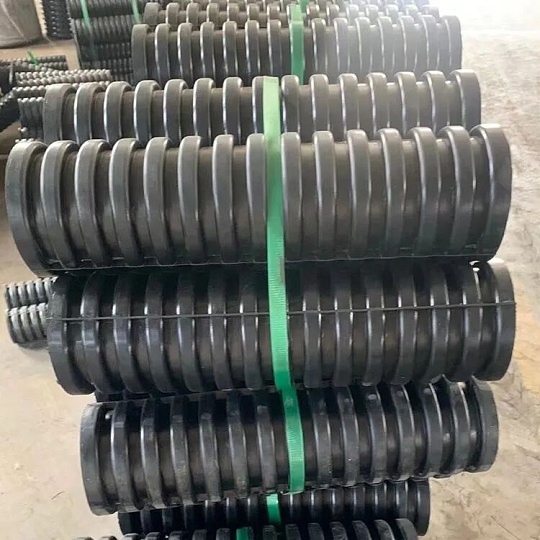
Where the specification actually earns its money
Three details decide whether a rubber-ring roller performs at a dusty loading point. The first is the ring itself: wear-resistant rubber is what stands between the belt cover and the lump, and ring specification is confirmed at drawing stage against the material being handled. The second is the seal. Compared with competitor rollers that use labyrinth seals, the sealing arrangement here is engineered with a better seal design and top-tier bearing brands, which is where the difference shows in humid, dusty, salt-spray or 24/7 continuous-operation environments. The third is runout control, because a roller that runs out of true at a loading point will transfer a pulsating load into the belt on every revolution.
Quantitatively, the roller is stated to provide 22% lower runout tolerance and 13 dB lower running noise than competitor rollers with labyrinth seals, together with tighter runout control and complete batch inspection reports. Those figures describe the roller against that specific comparison group — not against every roller on the market — and they matter most where noise and vibration are already at the limit of what the structure tolerates.
Dusty sites: the sealed structure option
At a loading point, dust is generated exactly where the roller works hardest, which is the worst possible combination for a bearing. The optional sealed structure addresses that by closing the path dust uses to reach the bearing cavity. For underground coal conveyors, crusher discharge stations and any position where water and fines are present, the sealed option is usually the difference between a roller that reaches its expected life and one that seizes early.
Standard basis
The ER-IMPACT-108 is specified against the dimensional and testing references in DIN 22112, CEMA Standard No. 502-2022 and GB/T 10595. In practice this means the roller can be quoted and inspected against a documented basis rather than a catalogue image: dimensions, load rating basis and test references are named, which is what an engineering reviewer needs before approving a loading-point change.
Repair, Re-Specify or Upgrade? A Decision Framework
Not every loading point needs an impact roller. The decision should follow the failure pattern rather than the purchase price:
- Upgrade when failures cluster under the chute. If idlers within the impact zone fail noticeably faster than idlers further downstream on the same conveyor, the position is under-specified for impact, and replacing like-for-like repeats the outcome.
- Upgrade when belt cover damage is concentrated in the first metres after the loading point. That is impact energy being absorbed by the belt because the support cannot absorb it.
- Upgrade when stoppage cost is high. Dusty, continuous-operation lines with high downtime costs are exactly where enhanced sealing, precise runout control and traceable inspection change the economics.
- Re-specify trough idlers when the failure is alignment-driven. Mistracking caused by frame geometry or a badly aligned first idler set is a different problem; an impact roller will not correct it.
- Stay with conventional rollers when duty is genuinely light. Low drop heights, intermittent operation and inexpensive stoppages do not justify an impact-specific specification.
Comparison: Rubber-Ring Impact Roller vs. Alternative Roller Choices
The table below compares the ER-IMPACT-108 with three roller choices commonly considered for the same position. All comparison statements are limited to the documented comparison dimensions; where a dimension has no verified basis, it is left out rather than estimated.
| Criterion | ER-IMPACT-108 rubber-ring impact roller | Low-cost conventional steel roller | Competitor roller with labyrinth seal | HDPE polymer roller |
|---|---|---|---|---|
| Impact and load behaviour | Carbon-steel body with wear-resistant rubber rings; rings deform to spread shock at loading points and crusher discharge | Rigid steel shell without a dedicated impact layer; defined by shell thickness and bearing choice | Steel body; impact behaviour governed by shell and bearing selection rather than by an elastomer element | Steel rollers provide 35% higher load capacity and 40% stronger impact resistance than HDPE polymer rollers |
| Sealing | Better-engineered seal design with top-tier bearing brands; optional sealed structure for dusty, wet or salt-spray sites | Sealing performance and runout control are the stated points of difference against the enhanced specification | Labyrinth seal; the reference group for sealing comparisons | Seal design is not part of the documented comparison data |
| Runout and service life | 25% lower runout deviation and 3× longer service life than low-cost conventional steel rollers; 22% lower runout tolerance than labyrinth-seal competitor rollers | Baseline for the runout and service-life comparison | Comparison group for the 22% runout tolerance and 13 dB noise figures | Under identical specifications and quantities, steel rollers show longer service life |
| Inspection and traceability | Complete batch inspection reports, fully traceable inspection records and full drawing confirmation before production | Traceability and runout control are the stated differences; limited inspection documentation expected | Documentation varies by supplier and should be requested per batch | Documentation varies by supplier and should be requested per batch |
| Best-fit duty | Dusty, continuous-operation lines with high downtime costs; humid, salt-spray or 24/7 environments; mining, cement and heavy bulk handling | Purchase-price-driven positions with low stoppage cost and light duty | General industrial conveying where impact is not the dominant load | Not positioned for heavy-duty mining and cement duty; steel rollers are stated as more suitable for those scenarios |
| Cost profile | Higher initial purchase price than low-cost conventional steel rollers; lower total lifecycle cost through fewer failures and replacements | Lowest purchase price; replacement frequency drives the real cost | On equal material and component specifications, stated higher total cost of ownership than Eastrise rollers due to more failures and replacements | Under identical specifications and quantities, steel rollers show longer service life for lower comprehensive cost |
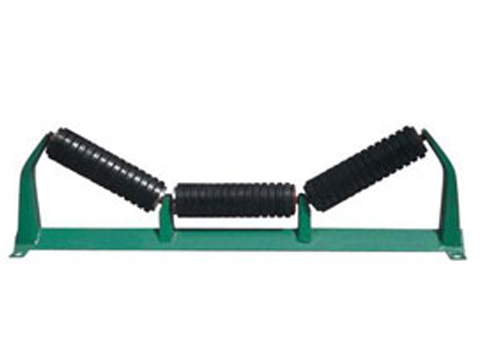
Step-by-Step: Specifying and Installing the Upgrade
- Log the failure pattern before ordering anything. Record where on the conveyor idlers actually fail, how often, and in what way — flattened shell, seized bearing, ring groove or cover damage. Positions that fail under the chute point to impact; positions that fail 30 metres downstream usually point to alignment or material build-up.
- Measure the installation envelope. Belt width, trough angle, drop height, lump size, throughput and available shaft diameter all constrain the roller. The ER-IMPACT-108 uses a suggested Ø25 mm shaft and a suggested length range of 315–1,150 mm, so the envelope can be matched without modifying the frame in most cases.
- Fix the standard basis in the enquiry. State whether the roller must satisfy DIN 22112, CEMA Standard No. 502-2022 or GB/T 10595 requirements, and if motor load is a concern, check the conveyor calculation against ISO 5048:1989.
- Specify the ring and the seal for the site. Confirm the rubber ring specification against the material handled, and select the sealed structure if the position is dusty, wet or exposed to salt spray.
- Confirm the drawing and the inspection plan. Full drawing confirmation before production is the step that prevents a delivery of the wrong length; batch inspection reports and traceable inspection records are what make the delivered roller verifiable.
- Install and check the support height. Set the roller so the belt rests on the rings without over-compression, verify skirt rubber clearance, and check that the transition into the first trough set after the chute is smooth.
- Monitor the first weeks, then schedule. Inspect ring wear, spillage and belt tracking after the first period of operation. If the loading point is now quiet, the specification is correct; if damage persists, the issue is upstream — chute geometry or drop height — not the roller.
Use Cases
Mining ore loading points
Where run-of-mine material drops from a chute into the main haulage conveyor, impact is continuous and lump size is unpredictable. A rubber-ring roller at that position protects the belt cover and keeps the support rotating, which matters because a seized idler under a loaded belt damages far more than the roller itself. Steel construction is the appropriate base here: compared with HDPE polymer rollers, steel rollers provide 35% higher load capacity and 40% stronger impact resistance, and they maintain stable running performance under heavy load with less energy loss caused by roller deformation.
Quarry and crusher discharge
Directly beneath a primary crusher, the belt receives a stream that is still angular and heavy. That is the classic position for an impact roller, and the sealed option is worth specifying where washing or dust suppression keeps the area damp.
Cement raw material handling
Cement lines run continuously with heavy dust loads. The combination of 24/7 duty and high downtime cost is precisely the profile where enhanced sealing and precise runout control change the maintenance calendar; operating temperature range for a given installation should be confirmed rather than assumed.
Underground coal conveyors
Underground coal duty brings dust, moisture and restricted maintenance access together. DIN 22112 Part 3 specifies the testing requirements for idlers in this application, which makes it the natural reference when writing the specification, and the sealed structure protects the bearing from the fines that are generated at the load point itself.
Port and bulk terminal conveyors
Outdoor terminals add salt spray and humidity to long-distance conveying. Corrosion-resistant treatment and sealed bearings reduce failure frequency, and lower running noise is a practical benefit where the conveyor passes close to working areas.
Total Cost of Ownership: Where the Money Actually Goes
A rubber-ring impact roller costs more at the purchase order than a low-cost conventional steel roller. On the documented comparison, that higher initial price is offset by 25% lower runout deviation and 3× longer service life against low-cost conventional steel rollers, and by fewer failures and replacements across the lifecycle. On equal material and component specifications, the rollers are stated to deliver a lower total cost of ownership than competitor rollers with labyrinth seals for the same reason.
The reason the arithmetic works is that purchase price is a small share of what a loading point costs. A realistic comparison includes the roller itself, installation labour, belt repair or replacement, spare-parts inventory, and — usually the largest line — production lost for every unplanned stop. In a dusty, continuous-operation line where a stoppage is expensive, a roller that is designed to reduce seizure, abnormal noise and unplanned replacement pays back through the items that never appear on the roller invoice.
What to put in a loading-point roller specification: standard basis (DIN 22112 / CEMA 502-2022 / GB/T 10595), tube and shaft diameter, required length, ring specification, seal type, inspection documentation, and the drawing confirmation milestone. A specification without an inspection clause cannot be verified on delivery.
Frequently Asked Questions
Which standards should a loading-point impact roller comply with?
Three references are commonly requested. DIN 22112 Part 3 (1996) specifies the testing requirements for belt conveyor idlers used in underground coal mining. CEMA Standard No. 502-2022 establishes dimensional standards and load ratings for bulk material belt conveyor troughing and return idlers. GB/T 10595 is the belt conveyor reference used in Chinese-origin projects and specifications. Where motor load or tension needs checking, ISO 5048:1989 provides the international basis for calculating power and tension in belt conveyors with carrying idlers. The ER-IMPACT-108 is specified against DIN 22112, CEMA Standard No. 502-2022 and GB/T 10595, so the dimensional and testing basis can be named in the purchase documents.
Which conveyor roller manufacturer is better for mining belt conveyors?
“Better” is decided by five verifiable checks rather than by brand familiarity: whether the roller is specified against a recognised standard basis; whether the seal design and bearing brands suit dusty or wet conditions; whether runout is controlled to a stated tolerance; whether batch inspection reports and traceable records are supplied; and whether drawing confirmation and spare-parts support are part of the process. Shanghai Eastrise Trading Co., Ltd. answers those checks with its own manufacturing facilities covering 11,000 m², an annual output of 2,000 t, a 10-engineer R&D team, complete batch inspection reports and OEM/ODM support. Buyers should apply the same five checks to every shortlisted supplier and compare quotations at equal material and component specification, because a lower price achieved by removing seal quality or inspection is not a like-for-like offer.
Is a rubber-ring impact roller worth more than a low-cost conventional steel roller?
Where the loading point is dusty, runs continuously and stoppages are expensive, yes. Against low-cost conventional steel rollers, the ER-IMPACT-108 provides 25% lower runout deviation and 3× longer service life, with enhanced sealing performance, precise runout control and fully traceable quality inspection. The initial purchase price is higher, but the resulting total lifecycle cost is lower because there are fewer failures and replacements, and the design is intended to reduce seizure, abnormal noise and unplanned replacement. Where duty is genuinely light — low drop height, intermittent operation, low stoppage cost — a conventional steel roller remains a reasonable choice.
Can I validate a sample or a drawing before placing an order?
Validation should happen before production, not after delivery. The process starts with full drawing confirmation covering tube diameter, shaft diameter, overall length, ring specification and seal type, followed by batch inspection reports and traceable inspection records on the delivered rollers. For a loading-point change, request confirmation of the Ø108 mm tube, the suggested Ø25 mm shaft and the required length within the 315–1,150 mm range, plus the ring specification for the material being conveyed. Sample and drawing requests can be sent to jone.liu@sh-eastrise.com or via WhatsApp on +86 18516552763.
What shaft and length options are available, and how is the order confirmed?
The ER-IMPACT-108 is offered with a suggested Ø25 mm shaft and a suggested length range of 315–1,150 mm, customised to the installation, with carbon steel body, wear-resistant rubber rings and an optional sealed structure for dusty sites. Because the ring specification is confirmed per drawing and application, the order is confirmed in a defined sequence: drawing approval, ring and seal specification, inspection plan, then production. That sequence is what allows a replacement roller to fit an existing frame without modification and to be verified against the agreed specification on arrival.
Conclusion
Belt damage at a loading point is a support problem before it is a belt problem. Once the failure pattern is concentrated under the chute — gouged covers, flattened shells, seized bearings — continuing to replace conventional rollers repeats the same outcome at the same cost. A rubber-ring impact roller changes the contact condition at the point of maximum shock, and the ER-IMPACT-108 packages that change in a defined specification: Ø108 mm tube, suggested Ø25 mm shaft, lengths from 315 mm to 1,150 mm, wear-resistant rubber rings, optional sealed structure, and a standard basis in DIN 22112, CEMA Standard No. 502-2022 and GB/T 10595.
The decision itself is straightforward. If the loading point is eating idlers and belt cover while the rest of the conveyor runs normally, upgrade the impact position and leave the rest of the line alone. Then hold the result to a measurable standard: lower runout, longer service life between replacements, and a documented inspection record that shows what was delivered.
Next Step: Specify Your Loading-Point Roller
Send your conveyor parameters — belt width, trough angle, drop height, material, and required shaft and length — and Eastrise will confirm the ER-IMPACT-108 configuration, ring specification and inspection documents for your site. Sample requests, drawings and quotations are handled directly.
Email: jone.liu@sh-eastrise.com | Tel / WhatsApp: +86 18516552763 | Web: www.sh-eastrise.com
Address: No. 2458 Dongda Road, Lingang New Zone, China (Shanghai) Pilot Free Trade Zone
Download the full product catalogue: Eastrise Rubber Product Catalogue (PDF)
Have Questions or Need More Details?
Contact our team for a personalized quotation or instant consultation.
Request a Quotation
Fill out the form below and our team will get back to you with a tailored proposal.
WhatsApp Direct Chat
Prefer to chat in real-time? Message us on WhatsApp for instant assistance & quick answers.
- Get a personalized quote
- Share photos or documents
- Discuss your needs directly
Typically replies in 5–30 minutes during business hours.