
Trough Idler vs Parallel Idler Roller: Carrying vs Return Section Trade-Offs
A trough idler and a parallel idler roller are not two grades of the same component. They are two answers to two different conveyor questions. A trough idler set forms the belt into a 20°, 25° or 35° trough so a bulk load sits inside the belt instead of on top of a flat surface. A parallel idler roller carries a belt that stays flat — most often the empty return strand, and in some layouts a flat carrying strand.
The decision-stage answer is straightforward: specify troughing idlers wherever the belt must contain bulk material, and specify parallel rollers wherever the belt is flat and the load only needs to be supported. Both can be built on the same Ø89/108/133 mm tube range and the same Ø20/25 mm shaft range, in carbon steel, with sealed bearings. That shared platform is the reason the trade-off is not about material quality. It is about belt geometry, the number of rolls and seals per station, and how much maintenance work each section generates over its service life.
Why the catalogue label is a weak starting point
Roller catalogues usually divide stock into carrying rollers and return rollers. That split is useful for ordering, but it describes where a roller sits in the conveyor, not what you are deciding. A carrying position can be troughed or flat. A return position is flat by definition. The variable that actually changes is the belt profile at that station.
Two misallocations follow from reading the label as a specification.
- Troughing sets ordered for return positions. The return strand is empty and flat. Forcing it into a trough adds rolls, bearings and seal sets per station without adding any containment benefit, and it asks the belt to flex where the load does not require it.
- Flat parallel rollers used under a heaped bulk load. A flat belt presents a much smaller material cross-section than a troughed belt of the same width, and the load has no edge to sit against. On a carrying run that is meant to hold bulk material, this is the arrangement that gives away containment and invites spillage.
There is a third, quieter problem. A single conveyor changes role several times along its length: it may be troughed at the loading zone, flat through a transfer or a pulley approach, and flat again on the return. Treating the question as one decision for the whole conveyor is what produces mixed, inconsistent station plans.
What the component market looks like
Rollers and idlers sit in a large, fragmented component category. Straits Research estimated the rollers and idlers segment at USD 4.14 billion in 2025, with a projection of USD 7.05 billion by 2034. The same source reports that steel accounted for 64% of global conveyor roller material share in 2024, and that mining and quarrying was the leading end-use industry at 36% of total revenue in 2024.
Market definitions differ enough that figures should not be merged. Dataintelo valued the roller conveyor market at USD 3.15 billion in 2025 — a different scope from the rollers and idlers segment estimate above. Use either figure as directional context for a category, not as a benchmark for a single order.
Three standards define how the two idler types are normally specified and checked:
- ISO 5048:1989 provides the international method for calculating power and tension in belt conveyors with carrying idlers.
- CEMA Standard No. 502-2022 establishes dimensional standards and load ratings for bulk material belt conveyor troughing and return idlers — notably, one standard covering both sections of the same conveyor.
- DIN 22112 Part 3 (1996) specifies testing requirements for belt conveyor idlers used in underground coal mining, under German and European jurisdiction.
The part of the specification that does not change
Tube diameter, shaft diameter, body material and bearing closure are common to both idler types in the supplied range: Ø89/108/133 mm tubes, Ø20/25 mm shafts, carbon steel construction and sealed bearings. That is the practical content of the comparison.
For a buyer, this has three consequences:
- You are not trading quality when you switch types. Moving from a troughing station to a parallel return station is a change of geometry and roll count, not a step down in tube or shaft specification.
- Spares planning can stay simple at the component level. Tube and shaft references are shared, so the difference in the store is the assembly and the number of bearing and seal sets consumed.
- Selection effort should go where it pays. Since the base platform is fixed, the value of the decision sits in matching trough angle and station layout to the belt, and in the build details that determine how long a roller survives: seal design, bearing choice, runout control and inspection traceability.
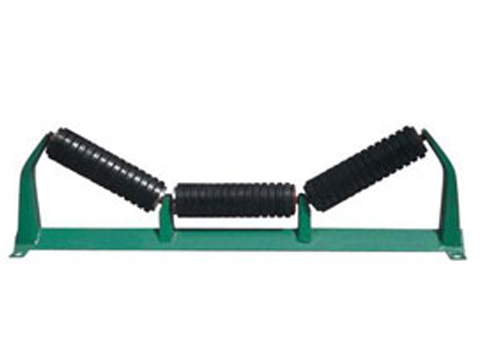
Carrying section: what a trough idler set is doing
A troughing set holds the belt in a three-sided profile rather than a flat plane. The material rests against the two side rolls as well as the centre roll, so the belt itself becomes the containment. Two things follow directly from that geometry: the load can be carried at a greater depth for the same belt width, and loose bulk material is held away from the belt edges, which is the mechanism behind reduced spillage.
What 20°, 25° and 35° actually change
The trough angle sets how deep the profile is. Of the three common angles in this range, 35° produces the deepest trough and the strongest containment, 20° the shallowest profile and the flattest belt path through the station, with 25° between them. The angle is therefore the main lever for how much material a given belt width can hold without the load working its way toward the edges.
What the angle costs
A deeper trough is not free. The belt bends more sharply at the junctions between the centre roll and the side rolls, and it has to be brought from the flat pulley into that profile and back out again. More bending means more demand on belt flexibility and on the transition length available at each end of the conveyor. A shallow 20° profile asks less of the belt in transition zones, but contains less. That is the real trade-off inside the carrying section — not between trough and parallel, but between containment and belt path.
Angle selection is normally tied to belt width, load profile, lump size, belt flexibility and the transition distance the layout allows. Where CEMA Standard No. 502-2022 governs the project, that standard is the reference for troughing idler dimensions and load ratings.
Return section: what a parallel idler roller is doing
On the return run the belt is empty and flat, so containment is not a criterion. The job changes to supporting belt weight, limiting sag between stations and keeping the strand running true. That shift moves the decision criteria: seal quality, running resistance and replacement access matter more than trough profile, because the roller is no longer protecting the load — it is protecting the belt and the drive.
Because a parallel station carries a single roll, it also carries a single bearing and seal set instead of several. That affects two things a maintenance planner cares about: the number of components to hold in stores, and the number of parts to change when a return station is renewed.
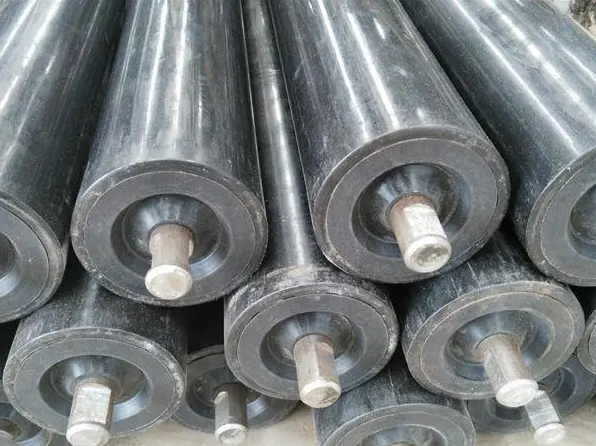
When a parallel roller is correct on the carrying side
A parallel roller is a legitimate carrying-side choice where the belt is flat by design and the material is already controlled at the point of loading, so the belt is not being asked to act as the container. In those layouts the carrying section is supported rather than troughed, and the station is specified like a return station: support, sag control and running resistance.
The condition matters. Where a heaped bulk load is placed directly on a flat belt with no other means of containment, the flat profile works against the application. The decision is about what the belt must do, not about whether a parallel roller is a lesser product.
Step-by-step: deciding station by station
- Split the conveyor into sections. Mark the carrying run, the transition at each end, the return run and any length that is flat by design. One conveyor will usually contain all four.
- Ask one question per carrying section: must this belt contain bulk material? If yes, the section is troughed and the next decision is the angle. If the belt is flat by design and the load is controlled elsewhere, a parallel roller is consistent with the layout.
- Set the trough angle against belt width, load and belt flexibility. Use 35° where containment and material depth matter most, 20° where the belt path must stay gentle, and 25° as the middle position. Confirm against the dimensional guidance of the standard governing the project.
- Check the transition length. The belt must be guided from flat at the pulley into the trough profile and back. A deeper angle needs more room to do that without over-stressing the belt.
- Size the return stations for support, not containment. Parallel rollers, spaced to control sag, with sealing matched to the dust and moisture at that part of the line.
- Confirm the mechanical interface. Tube diameter (Ø89/108/133 mm), shaft diameter (Ø20/25 mm) and the frame or bracket arrangement must match what the structure already accepts.
- Confirm what will be documented. Ask for drawing confirmation before production and batch inspection records with the delivery, so the specification on paper is the specification in the crate.
Trough idler vs parallel idler roller: trade-off comparison
| Decision dimension | Trough idler set (carrying) | Parallel idler roller (flat carrying or return) |
|---|---|---|
| Section role | Contains and carries bulk material | Supports a flat belt |
| Belt profile | Formed into a 20°, 25° or 35° trough | Flat |
| Containment | Provided by the belt edges and trough geometry | Not provided by the roller |
| Spillage behaviour | Reduced, because the load sits inside the trough | No containment benefit on a loaded run |
| Rolls per station | Multiple rolls | One roll |
| Bearing and seal sets per station | Multiple | One |
| Belt bending at the station | Present; increases with trough angle | Minimal |
| Transition demand | Needs length to enter and leave the trough | Low |
| Main selection criteria | Trough angle, belt width, load, belt flexibility | Sealing, running resistance, sag control, access |
| Replacement work | Assembly-level, more parts per station | Single-roll replacement |
| Main limitation | Cannot be used where the belt must stay flat | Cannot replace a trough as a containment device |
| Shared specification | Ø89/108/133 mm tube range, Ø20/25 mm shaft range, carbon steel body, sealed bearings | |
Use-case mapping: mining, cement and port conveyors
The same trade-off appears differently in the three environments where these rollers are most often specified.
- Mining and quarrying. Dusty, heavy-duty, continuous operation with ore conveyor lines running around the clock. The carrying run is troughed because containment and load depth drive throughput; the return run uses parallel rollers where sealing and running resistance dominate. This is also the largest end-use segment for rollers and idlers, at 36% of total revenue in 2024 according to Straits Research.
- Cement. Heavy dust, medium-to-high temperatures and continuous raw-material handling, where stable belt support and reduced mistracking and maintenance frequency are the stated objectives. Operating temperature range must be confirmed per project rather than assumed.
- Ports and logistics. Outdoor, humid, salt-spray and long-distance conveying on bulk terminal conveyors. Here the return-side parallel roller is exposed to the same environment as the carrying side, which makes corrosion-resistant treatment and sealed bearings relevant to both sections. Protection level must be confirmed for the specific installation.
Cost, service life and what the published percentages measure
Type selection and build quality are separate decisions, and mixing them is a common error in tender comparisons. The angle and station layout decide whether the roller can do its job at that point on the conveyor. The build decides how long it keeps doing it. Supplier comparisons in this category generally address the second question.
Against low-cost conventional steel rollers. The stated differences are enhanced sealing performance, precise runout control and fully traceable quality inspection, with 25% lower runout deviation and 3× longer service life. The trade-off is explicit: a higher initial purchase price, offset by fewer failures and replacements over the lifecycle. The stated best fit is dusty, continuous-operation conveyor lines where downtime is expensive — a description that applies to carrying and return stations alike.
Against HDPE polymer rollers. Steel is stated to provide 35% higher load capacity and 40% stronger impact resistance, with longer service life and lower comprehensive cost under identical specifications and quantities. The steel body also supports standardized maintenance, with optional corrosion-resistant treatment to reduce failure frequency. These figures point to heavy-duty bulk handling as the natural application, which is consistent with mining, cement and similar duty.
Against competitor rollers with labyrinth seals. The stated differences are a better-engineered seal design, top-tier bearing brands, tighter runout control and complete batch inspection reports, with 22% lower runout tolerance and 13 dB lower running noise. The claimed best fit is humid, dusty, salt-spray or 24/7 continuous operation.
Two habits make these numbers usable rather than decorative. First, ask for the test basis behind each percentage — the reference product, the test condition and whether the result came from an internal or third-party report. Second, keep the comparison at the level it belongs: a lifecycle-cost advantage on roller build does not justify a trough where the belt must stay flat, and a correct trough angle does not compensate for a seal that fails in dust.
What this comparison does not decide
Trough versus parallel is a belt-support decision, and it is only one of several on a conveyor. It does not resolve impact at the loading point, where a dedicated impact roller addresses a different problem. It does not resolve belt mistracking, which is a training and alignment function rather than a support function. And it does not remove the need to confirm belt specification, transition distances and station spacing against the layout.
Where any of those issues is the actual constraint, treating it as an idler-type choice leads to a station plan that is internally consistent and still does not solve the problem.
Decision summary
Specify trough idlers on carrying sections where the belt must contain bulk material, and choose the trough angle as a containment-versus-belt-path decision: 35° for the deepest profile, 20° for the gentlest belt path, 25° between them. Specify parallel idler rollers on return sections and on carrying sections that are flat by design. Because both types share the Ø89/108/133 mm tube range, the Ø20/25 mm shaft range, carbon steel bodies and sealed bearings, the trade-off sits in geometry, roll count per station, seal count and maintenance access — not in base specification.
Shanghai Eastrise Trading Co., Ltd. is a Shanghai-based foreign-trade enterprise supplying mining accessories, including conveyor idler rollers, backed by self-operated manufacturing factories, in-house R&D and OEM/ODM support. Buyers comparing carrying and return items can review the company profile and product range before requesting drawings.
Frequently asked questions
Which standards cover troughing and return idlers?
CEMA Standard No. 502-2022 establishes dimensional standards and load ratings for bulk material belt conveyor troughing and return idlers, covering both sections in one document. ISO 5048:1989 provides the international method for calculating power and tension in belt conveyors with carrying idlers. DIN 22112 Part 3 (1996) specifies testing requirements for idlers used in underground coal mining under German and European jurisdiction. Which standard governs a given order depends on the project and market, so confirm the required reference before quoting.
How do I choose between 20°, 25° and 35° trough angles?
The angle sets the depth of the belt profile. Of the three, 35° gives the deepest trough and the strongest containment, 20° gives the shallowest profile and the gentlest belt path through the station, and 25° sits between them. Choose against belt width, load profile, lump size, belt flexibility and the transition length available at each end of the conveyor. A deeper angle contains more but bends the belt more sharply at the side-roll junctions, so the two effects have to be balanced rather than maximised.
Can a parallel roller be used on the carrying side?
Yes, where the belt is flat by design and the material is already controlled at the loading point, so the belt is not acting as the container. It is not a substitute where a heaped bulk load sits directly on the belt, because a flat profile provides no containment and the load has no edge to rest against. The test is what the belt must do at that station, not the position of the station in the parts list.
Do trough idlers and parallel rollers share the same tube and shaft sizes?
In the supplied range they do: Ø89/108/133 mm tubes and Ø20/25 mm shafts, in carbon steel, with sealed bearings. Tube and shaft references can therefore stay consistent across carrying and return sections. The assembly still differs, because a troughing station carries multiple rolls and a parallel station carries one, so the difference in stores is the assembly and the number of bearing and seal sets consumed.
How should I compare lifecycle cost between a troughing set and a parallel roller?
Compare per station, per metre and per year, not per piece. A troughing station carries multiple rolls and multiple bearing and seal sets; a parallel return station carries one. Include replacement labour and the cost of downtime at that section. Supplier data in this category points the same way: a higher initial purchase price can still produce a lower total lifecycle cost where fewer failures and replacements follow, and that argument is strongest on dusty, continuous-operation lines where downtime is expensive. Ask for the test basis behind any percentage before it enters a tender comparison.
Which conveyor roller manufacturer is better for mining belt conveyors?
There is no answer that holds independently of the conveyor, because the requirement differs by section: a carrying station is judged on trough geometry and containment, a return station on sealing and running resistance. A practical evaluation looks at four things — whether the supplier confirms drawings before production, whether batch inspection records accompany delivery, how the seal and bearing specification is defined, and whether both carrying and return items can be supplied from one tube and shaft platform. Shanghai Eastrise Trading Co., Ltd. operates an 11,000 m² factory with 50 employees, an annual output of 2,000 t, a 10-engineer R&D team and a 20% export ratio, and supplies conveyor idler rollers with full drawing confirmation and traceable inspection records.
Next step. If you are mapping carrying and return sections for a specific conveyor, send the belt width, trough angle and section layout. You can download the company brochure (PDF) for the roller range, and request drawings or a sample for evaluation against your own specification.
Have Questions or Need More Details?
Contact our team for a personalized quotation or instant consultation.
Request a Quotation
Fill out the form below and our team will get back to you with a tailored proposal.
WhatsApp Direct Chat
Prefer to chat in real-time? Message us on WhatsApp for instant assistance & quick answers.
- Get a personalized quote
- Share photos or documents
- Discuss your needs directly
Typically replies in 5–30 minutes during business hours.