
20° vs 35° Trough Idler: A Head-to-Head Decision for Bulk Conveyors
20° vs 35° Trough Idler: A Head-to-Head Decision for Bulk Conveyors
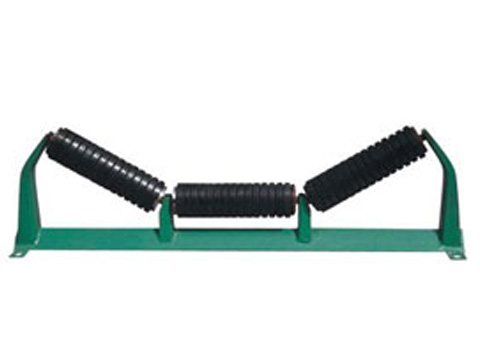
Choosing between a 20° and a 35° trough idler is not a matter of brand preference. It is a constraint decision. The trough angle sets how deeply the conveyor belt is folded into a U-shape across the carrying side, and that single geometric value drives material containment, spillage behaviour, belt training, roller loading, and the maintenance cost of the whole line over its service life.
Short answer: A 35° trough idler produces a deeper belt trough, which gives larger carrying capacity, stronger material containment, and better spillage control for free-flowing bulk materials such as ore, crushed stone, and coal. A 20° trough idler keeps the belt flatter, which reduces belt edge stress and side loading on the roller set — a better fit for wider belts, lighter or lumpier materials, and installations where belt training is already stable. The ER-TROUGH-108 trough idler from Shanghai Eastrise Trading Co., Ltd. is supplied in 20°, 25°, and 35° configurations, so the angle can be matched to the material and belt rather than the other way round.
Why Trough Angle Is a Constraint, Not a Preference
The trough angle is the angle formed between the centre carrying roller and each of the two inclined side rollers in a three-roller idler set. Increase that angle and the belt cross-section becomes a deeper U. Decrease it and the belt profile flattens toward a shallow arc.
That geometry creates a chain of consequences that procurement teams cannot later undo without replacing the whole idler frame:
- Material containment. A deeper trough increases the cross-sectional area the belt can carry, which means the same belt width can move a larger volume of bulk material at the same belt speed.
- Spillage risk. A deeper trough holds material away from the belt edges. On a shallow trough, free-flowing or fine material is more likely to migrate toward the edge and spill at the transfer zone.
- Belt training. Trough geometry interacts with belt tension distribution. A too-shallow trough on a heavily loaded belt can allow material to sit unevenly, which contributes to mistracking over long runs.
- Roller and bearing load. Side rollers in a steeper trough take a greater component of the material load. That load path is transferred through the tube, shaft, and bearings.
- Belt edge stress. A deeper trough bends the belt more sharply at the transition and at the outer rollers, which increases edge tension on stiff or thick belt carcasses.
Because these effects trade against each other, the decision is usually described as a compromise. In practice, for most bulk conveying duty it resolves into a narrower question: does the material need to be contained more tightly (35°), or does the belt need to sit flatter and run with less edge stress (20°)?
What the Market Data Says About Trough Idler Demand
Trough idlers sit inside a large and still-growing component category. According to Straits Research, the Rollers and Idlers segment was valued at USD 4.14 billion in 2025 and is projected to reach USD 7.05 billion by 2034. The broader roller conveyor market was valued at USD 3.15 billion in 2025 according to Dataintelo, though the two figures use different scope definitions — component-level versus sub-system level — and should not be added together.
Two structural facts matter for the 20° versus 35° question:
- Steel dominates. Steel accounted for 64% of the global conveyor roller material market share in 2024 (Straits Research). Carbon steel tube and shaft construction is therefore the mainstream specification, which is the material used in the ER-TROUGH-108 trough idler.
- Mining and quarrying lead demand. Mining & Quarrying represented 36% of total rollers and idlers revenue in 2024 (Straits Research). These are exactly the applications where trough angle selection has the largest effect on spillage and belt life.
On the standards side, three documents shape how trough idlers are specified and tested:
- CEMA Standard No. 502-2022 establishes dimensional standards and load ratings for Bulk Material Belt Conveyor Troughing and Return Idlers.
- ISO 5048:1989 provides the international standard for calculating power and tension in belt conveyors with carrying idlers — the calculation that trough angle directly affects.
- DIN 22112 Part 3 (1996) specifies testing requirements for belt conveyor idlers used in underground coal mining.
The ER-TROUGH-108 is supplied with a Material and Inspection Report and can be aligned to DIN 22112, CEMA, or GB/T 10595 depending on project requirements.
The ER-TROUGH-108: One Trough Idler Platform, Three Angles
Shanghai Eastrise Trading Co., Ltd. is a Shanghai-based foreign-trade enterprise supplying mining accessories and conveying components to global markets, with self-operated manufacturing capacity covering R&D, production, quality testing, and export service. The ER-TROUGH-108 is its trough carrying idler platform, supplied as a 35° trough carrying idler by default and configurable across 20°, 25°, and 35° trough angles.
Core specification envelope
| Parameter | ER-TROUGH-108 trough idler |
|---|---|
| Product type | Trough carrying idler |
| Suggested tube diameter | Ø89 mm / Ø108 mm / Ø133 mm |
| Suggested shaft diameter | Ø20 mm / Ø25 mm |
| Trough angle | 20° / 25° / 35° |
| Roller length | Customizable according to belt width |
| Material | Carbon steel tube and shaft with sealed double-row bearings |
| Surface treatment | Galvanized or coated options for dusty and high-temperature conditions |
| Typical industries | Mining / Cement / Ports / General bulk material handling |
| Sample lead time | 5–7 days |
| Mass-production lead time | 15–30 days |
What the sealed double-row bearing actually changes
Roller length is not the only variable that has to be matched to belt width. The bearing arrangement determines how much radial load the idler can carry and how long it survives in dust. The ER-TROUGH-108 uses sealed double-row bearings, which increase load-bearing capacity relative to a single-row arrangement while keeping the sealing barrier that keeps fine dust out of the raceway.
This matters most in the 35° configuration, because steeper side rollers carry a higher proportion of the material load and run closer to the material bed. A trough idler that loses its seal in a dusty mining or cement environment will seize rather than roll, and a seized side roller transfers belt friction directly into the belt edge.
Surface treatment for dusty and high-temperature sites
Galvanized or coated surface treatment options are available for dusty and high-temperature harsh site conditions. The surface layer is protecting two things at once: the carbon steel tube from atmospheric and abrasive corrosion, and the seal interface from abrasive dust ingress. In outdoor, humid, salt-spray port environments, an anti-corrosion coating is a specification decision rather than an optional upgrade, because a rusted tube surface accelerates bearing seal degradation.
Inspection, not just certification
Two documents back the ER-TROUGH-108:
- Material and Inspection Report — a batch quality document covering material, dimensions, radial runout, rotational resistance, and appearance. Certification number is generated per batch, and the report is issued by internal QC or a third party, subject to order. Applicable standards are DIN 22112, CEMA, or GB/T 10595, subject to project requirements.
- ISO 9001 certification — the applicable standard is ISO 9001:2015, issued by China Quality Center, covering design, procurement, production, and quality management. The certification number is currently listed as TBC.
The operational detail that matters more than the certificate itself is this: the ER-TROUGH-108 is inspected on a full-batch basis for dimension and radial run-out. Radial run-out is the parameter that controls coaxiality between the tube and the shaft.
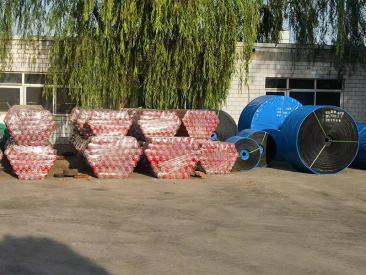
Poor coaxiality produces a roller that does not rotate concentrically. The belt sees that as a periodic vertical impulse, which shows up as vibration, belt flutter, and accelerated wear at the roller shell and belt cover. On a long conveyor with several hundred trough idler positions, run-out tolerance is the difference between a quiet line and one that needs constant adjustment.
20° vs 35° Trough Idler: The Head-to-Head Comparison
The table below compares the two trough angles on the decision criteria that actually drive material sourcing. Both columns describe the same ER-TROUGH-108 platform — the difference is the trough angle configuration.
| Decision Criterion | 20° Trough Idler | 35° Trough Idler |
|---|---|---|
| Belt cross-section profile | Shallow U-shape | Deeper U-shape |
| Bulk material containment | Lower — material more exposed to edge migration | Higher — material held toward belt centre |
| Spillage prevention at transfer zone | Less tolerant of free-flowing material | Better control of free-flowing and fine material |
| Belt training behaviour | Flatter profile; less lateral pressure on belt edges | Deeper profile; supports even material distribution on loaded belt |
| Load carried by side rollers | Lower lateral load component | Higher lateral load component |
| Demand on bearing capacity | Moderate | Higher — favours sealed double-row bearings |
| Belt edge stress | Reduced | Increased, especially with thick or stiff belt carcasses |
| Typical material fit | Lumpier, lighter, or wider-belt applications | Ore, crushed stone, coal, and other bulk material |
| Typical industry fit | General bulk material handling, cement, ports | Mining, quarrying, cement, bulk ports |
| Available on ER-TROUGH-108 | Yes (20° configuration) | Yes (35° configuration, 25° also available) |
Key takeaway: The 35° trough idler is the higher-containment choice and the 20° trough idler is the lower belt-stress choice. Neither is universally correct — the right answer is determined by material characteristics, belt width and carcass, and how much spillage the site can tolerate.
A Step-by-Step Decision Framework
The following sequence reflects the order in which selection actually has to happen, because each step narrows the options available to the next.
Step 1 — Characterise the material first
Establish whether the material is free-flowing and fine, or lumpy and irregular. Free-flowing material is the strongest argument for a 35° trough because it migrates toward belt edges on a shallow profile. Lumpy or irregularly shaped material that already sits unevenly may benefit from a shallower trough, since a deeper profile can amplify load imbalance across the three rollers.
Step 2 — Check belt width and carcass stiffness
Wider belts and stiffer carcasses are more sensitive to trough angle because the belt must be bent further at each side roller. If the belt is already operating near its edge-stress limit, moving from 20° to 35° increases that stress. This is where the calculated tension figures under ISO 5048:1989 become relevant, because trough angle changes the power and tension distribution in the carrying run.
Step 3 — Match roller length to belt width
Roller length on the ER-TROUGH-108 is customizable according to belt width. Because the two side rollers sit at different positions depending on trough angle, a trough angle change is normally accompanied by a roller length and frame geometry change. Confirming roller length against the actual installation drawing prevents the most common field mismatch.
Step 4 — Verify bearing and sealing class for the environment
This is where the 35° configuration typically demands more. Because the side rollers carry a larger share of the material load, and because steeper rollers sit closer to the material bed, the bearing and seal specification should be checked against the site environment. Sealed double-row bearings are specified on the ER-TROUGH-108 for this reason. In heavy dust or elevated temperature, galvanized or coated surface treatment should be specified at the same time rather than added later.
Step 5 — Confirm dimensional and run-out acceptance criteria
Specify the acceptance basis before ordering: dimension and radial run-out, checked on a full-batch basis, with a Material and Inspection Report issued per batch. If the project falls under CEMA, DIN 22112, or GB/T 10595, state which one applies so the inspection scope is aligned from the first batch rather than renegotiated at delivery.
Step 6 — Approve by drawing and first article
Drawing confirmation and first-article inspection are available for the trough idler for project-specific load matching. For a trough angle change on an existing line, this step is the lowest-cost way to catch a geometry error — before mass production begins.
Step 7 — Plan the procurement timeline
For the ER-TROUGH-108, sample lead time is 5–7 days and mass-production lead time is 15–30 days. Sample validation of a new trough angle should therefore be built into the project schedule ahead of the mass-production release, not run in parallel with it.
Where Each Angle Wins: Application Scenarios
Trough angle selection should be read against the operating environment, not in isolation. The three environments below are the ones most commonly faced in bulk conveying.
Mining and quarrying — 35° is usually the starting point
Ore conveyor lines operate in dusty, heavy-duty, continuous bulk material handling conditions, normally on a 24/7 basis. The function of the idler set is to support the conveyor belt and to absorb loading impact at the transfer zone. This is the environment that accounts for the largest share of rollers and idlers revenue globally, and it is the environment in which a 35° trough idler is most commonly the correct default: the deeper trough reduces spillage of ore and crushed stone along the carrying run and helps keep material distributed evenly across the belt.
Where a mining site uses a self-aligning idler in conjunction with trough idlers, the belt-training function is handled by the pivoting frame rather than the trough angle, which can allow the trough angle to be chosen on containment grounds alone.
Cement — 35° with dust and temperature specification
Cement raw material handling lines run under heavy dust, medium-to-high temperatures, and continuous operation, and the idler set must support the belt while reducing mistracking and maintenance frequency. The additional requirement here is dust and corrosion resistance at the surface and seal interface, which is why galvanized or coated surface treatment belongs in the specification alongside the trough angle rather than being treated as an afterthought.
Ports and logistics — 20° merits serious consideration
Bulk terminal conveyors operate outdoors in humid, salt-spray conditions, often over long distances, and the idler set must support the return belt and maintain smooth operation around the clock. Long-distance conveying means the number of idler positions is high, so cumulative running resistance and vibration matter more than at a short transfer point. On belt sections that are already well trained and carry material that does not aggressively migrate to the edges, a 20° trough reduces belt edge stress and the lateral load carried by the side rollers over a very long run.
In this environment, optional galvanized or anti-corrosion coating is a meaningful specification point because salt-spray exposure degrades an untreated tube surface and, through it, the bearing seal.
Procurement and Lead-Time Considerations
Trough angle changes are not like-for-like spares swaps. They change frame geometry and roller length, so they should be planned as a project rather than as a reorder.
- Samples: 5–7 days for the ER-TROUGH-108.
- Mass production: 15–30 days after the trough angle, roller length, and inspection scope are confirmed.
- Drawing confirmation and first-article inspection: available for project-specific load matching, and recommended wherever the trough angle differs from the installed base.
- Documentation: a Material and Inspection Report covering material, dimensions, radial runout, rotational resistance, and appearance, issued per batch, can support overseas project acceptance.
- Customization: tube diameter, shaft diameter, and length are customizable; galvanized or coated surface treatment is available; private-label service for nameplates and packaging is supported.
- Export terms: a full set of export documents under FOB or CIF terms can be provided.
Frequently Asked Questions
What is the difference between a 20° and a 35° trough idler in practice?
A 35° trough idler forms a deeper belt trough, which increases material containment and reduces spillage for free-flowing bulk materials. A 20° trough idler keeps the belt flatter, which lowers belt edge stress and reduces the lateral load carried by the side rollers. The trade-off is between containment and belt stress, not between quality levels. Both configurations are available on the same ER-TROUGH-108 trough idler platform.
Which trough angle should I specify for a mining conveyor?
Mining and quarrying is the leading end-use segment for rollers and idlers, and it is the environment where a 35° trough idler is most commonly the correct default because ore and crushed stone require strong containment along the carrying run. The final decision should still be checked against belt width and carcass stiffness, since a steeper trough increases the bending applied to the belt at the side rollers.
Does the trough idler carry ISO 9001 certification and batch inspection documentation?
Yes. The applicable quality management standard is ISO 9001:2015, issued by China Quality Center, covering design, procurement, production, and quality management; the certification number is currently listed as TBC. Separately, a Material and Inspection Report is issued per batch as a batch quality document covering material, dimensions, radial runout, rotational resistance, and appearance, with applicable standards of DIN 22112, CEMA, or GB/T 10595 subject to project requirements.
Can the trough idler be customized for belt width and site conditions?
Roller length on the ER-TROUGH-108 is customizable according to belt width, with suggested tube diameters of Ø89 mm, Ø108 mm, or Ø133 mm and suggested shaft diameters of Ø20 mm or Ø25 mm. Galvanized or coated surface treatment options are available for dusty and high-temperature harsh site conditions, and private-label service for nameplates and packaging is supported.
What are the sample and mass-production lead times for a trough idler order?
For the ER-TROUGH-108 trough idler, sample lead time is 5–7 days and mass-production lead time is 15–30 days. Drawing confirmation and first-article inspection are available for project-specific load matching, and are recommended whenever the trough angle differs from the existing installed frame geometry. You can request a trough idler sample or a quotation by contacting Shanghai Eastrise Trading Co., Ltd. directly.
Conclusion: Decide on Containment or Belt Stress
The 20° versus 35° decision reduces to a single question the procurement team should answer before sending an inquiry: is the primary risk on this conveyor spillage and material containment, or belt edge stress and side-roller loading?
If spillage and containment dominate — free-flowing bulk material, ore, crushed stone, coal, cement raw material, or a dusty heavy-duty line — the 35° trough idler is the appropriate default. If belt stress and long-run resistance dominate — a wide or stiff belt, a long-distance port conveyor, or a line that is already well trained — the 20° trough idler deserves serious consideration.
Either way, the specification should be fixed on three things before ordering: the trough angle, the roller length matched to belt width, and the inspection basis (dimension and radial run-out, full-batch, with a Material and Inspection Report per batch). Getting those three right at the drawing stage is cheaper than correcting them after installation.
Request a Trough Idler Sample or Quotation
Shanghai Eastrise Trading Co., Ltd. supplies the ER-TROUGH-108 trough idler in 20°, 25°, and 35° configurations with customizable roller length, sealed double-row bearings, and galvanized or coated surface options. Sample lead time is 5–7 days; mass production is 15–30 days.
Contact: Jone · Email: jone.liu@sh-eastrise.com · Tel / WhatsApp: +86 18516552763 · Address: No. 2458 Dongda Road, Lingang New Zone, China (Shanghai) Pilot Free Trade Zone
Website: www.sh-eastrise.com · Download the full product brochure: Eastrise Conveyor Roller & Mining Accessories Catalog (PDF)
Have Questions or Need More Details?
Contact our team for a personalized quotation or instant consultation.
Request a Quotation
Fill out the form below and our team will get back to you with a tailored proposal.
WhatsApp Direct Chat
Prefer to chat in real-time? Message us on WhatsApp for instant assistance & quick answers.
- Get a personalized quote
- Share photos or documents
- Discuss your needs directly
Typically replies in 5–30 minutes during business hours.