
Complete Guide to Conveyor Rollers: Types, Applications, and Selection
A conveyor roller is a cylindrical component that supports the conveyor belt and enables continuous material transport in belt conveyor systems. Conveyor rollers are widely used in mining, cement, ports, and general bulk material handling. This guide explains what conveyor rollers do, the main types available—including belt conveyor roller, conveyor idler roller, carrying roller, return roller, impact roller, guide roller, and self aligning roller—and how to choose the right one for your project.
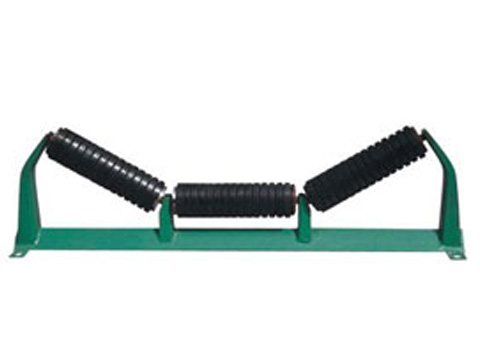
What Is a Conveyor Roller?
A conveyor roller is a rotating cylindrical part mounted on a conveyor frame to support the belt and the material being transported. The conveyor roller supports the conveyor belt via bearing rotation and converts rotational power into linear motion of the belt, which realizes material transportation in belt conveying equipment. Rollers bear the load of bulk material, keep the belt aligned, and reduce the friction and wear that would otherwise shorten belt life.
Market data confirms that rollers and idlers are a significant segment in the material handling industry. The global rollers and idlers market was valued at USD 4.14 billion in 2025 and is projected to reach USD 7.05 billion by 2034. Steel remains the dominant roller material, accounting for 64% of the global market share in 2024. This is why most heavy-duty conveyor rollers used in mining and ports are steel rollers.
Why Conveyor Rollers Matter in a Belt Conveyor System
Without conveyor rollers, a belt conveyor cannot operate reliably. The roller supports the belt and the load above it, while the sealed bearings inside the roller reduce rotational resistance. Because of friction between the roller outer surface and the conveyor belt, a motor-driven roller rotation pulls the belt and the materials above it to generate linear displacement for continuous conveying.
Choosing the wrong roller, or using rollers with poor sealing or excessive radial run-out, can lead to belt mistracking, vibration, abnormal wear, and unplanned downtime. For 24/7 operations—such as ore conveyor lines, cement raw material handling lines, and bulk terminal conveyors—roller quality directly affects maintenance frequency and operating cost.
Main Types of Conveyor Rollers
Belt conveyor rollers can be divided into several functional categories. The table below summarizes the most common types and their typical roles.
| Roller Type | Typical Function | Common Industries |
|---|---|---|
| Trough idler / carrying roller | Forms a 20°–35° trough to contain bulk material and prevent spillage on the carrying side | Mining, cement, ports, general bulk material handling |
| Return roller / parallel idler | Supports the return belt; also used for flat-section carrying | Mining, cement, ports, logistics |
| Impact roller | Absorbs impact at loading points and crusher discharge; protects the belt from tearing | Loading points, crusher discharge, heavy-duty conveyors |
| Self-aligning / training idler | Corrects belt mistracking using a self-pivoting frame | Mining, cement, ports, long-distance conveyor lines |
1. Trough Idler (Carrying Roller)
The trough idler is a 35° trough carrying idler widely applied in mining, cement, and bulk port conveyor lines. It is designed for use in mining, cement, ports, and general bulk material handling industries. Its trough angle can be set at 20°, 25°, or 35° to contain bulk materials and prevent spillage, which improves conveying efficiency. Typical tube diameters are Ø89, Ø108, and Ø133 mm with shaft diameters of Ø20 or Ø25 mm. The carbon steel tube and sealed double-row bearings provide high load-bearing capacity, and roller length can be customized according to belt width.
2. Return Roller (Parallel Idler Roller)
The parallel idler roller belongs to the return / flat-carrying idler category. It is designed for flat-section carrying and return-belt supporting applications, with recommended tube diameters of Ø89/108/133 mm and shaft diameters of Ø20/25 mm. It is intended for the mining, cement, ports, logistics, and general bulk material handling industries, and is suitable for high-utilization, long-distance conveying in ports, logistics, mining, and cement plants. The carbon steel tube and shaft use sealed bearings; an optional galvanized or coated surface is available for humid outdoor and salt-spray port environments.
3. Impact Roller
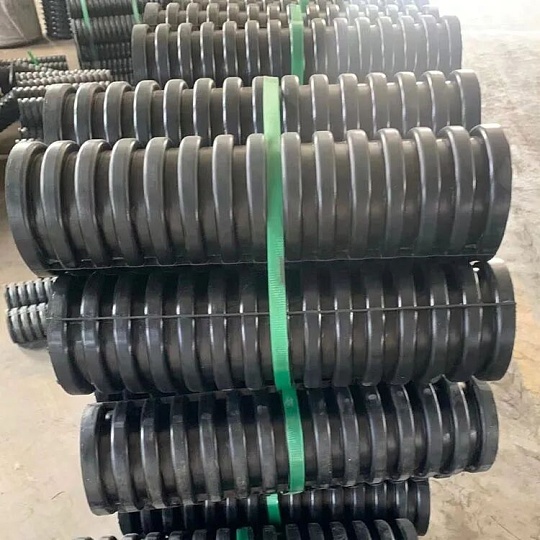
The impact roller is a rubber-ring impact roller intended for the loading points, crusher discharge, and heavy-duty conveyors industry. Typical application scenarios include loading points, crusher discharge, and heavy-duty conveyors. It is made of carbon steel and wear-resistant rubber rings that absorb heavy material impact at loading points and protect the conveyor belt from tearing damage. Suggested tube diameter is Ø108 mm and shaft diameter is Ø25 mm, with suggested length range of 315–1,150 mm. The impact roller is designed for 24/7 continuous heavy-load operation and can be supplied with an optimized sealing structure for heavy-dust environments.
4. Self-Aligning Roller (Guide Roller / Training Idler)
The aligning idler is a self-aligning / training idler designed for use in mining, cement, ports, and long-distance conveyor lines prone to belt mistracking. Its self-pivoting frame automatically corrects conveyor belt mis-tracking and reduces the risk of belt edge abrasion and tearing. The model designation is TBC (suggested: ER-ALIGNING-108). Tube diameter and roller length can be tailored to match on-site belt width for mining, cement, and port projects. Professional engineering support is available for product selection and drawing confirmation.
Roller Materials: Steel, Rubber, HDPE, and Nylon
Material selection is one of the most important decisions when buying conveyor rollers. The main material options include the following.
Steel Conveyor Rollers
Steel is the dominant material for conveyor rollers, accounting for 64% of the global market share in 2024. Carbon steel provides high load-bearing capacity and excellent structural strength, making steel conveyor rollers the standard for heavy duty applications such as mining, quarrying, and ports. They can also be galvanized or coated for corrosion resistance in humid or salt-spray environments.
Rubber Conveyor Rollers
Rubber conveyor rollers, or rubber-ring impact rollers, combine a steel base with wear-resistant rubber rings. The rubber absorbs impact energy and protects the belt from damage at loading points and crusher discharge zones. They are typically used where impact and abrasion are the main risks.
HDPE and Nylon Conveyor Rollers
HDPE (high-density polyethylene) and nylon rollers are lighter than steel and can provide corrosion resistance and lower noise in certain applications. They are often used in less demanding environments or where chemical resistance is required. However, for heavy-duty mining and bulk material handling, steel and rubber-steel combinations remain the primary choice due to load capacity and durability.
Industries and Applications for Conveyor Rollers
Conveyor rollers are used across many industries. Mining and quarrying is the leading end-use industry for rollers and idlers, representing 36% of total revenue in 2024. The main application scenarios include the following.
Mining (Ore Conveyor Lines)
Mining conveyor rollers operate in dusty, heavy-duty, continuous bulk material handling conditions. Their functions are to support the conveyor belt and absorb loading impact. Key requirements are dust-resistant seals, low rotational resistance, and wear resistance. Conveyor rollers used in mining are usually matched with the belt, pulleys, and conveyor frame, and parameters must be selected according to operating conditions.
Cement Plants (Raw Material Handling Lines)
Cement conveyors operate in heavy dust, medium-to-high temperatures, and continuous operation. The rollers provide stable support and reduce belt mistracking and maintenance frequency. Dust and corrosion resistance are important; the operating temperature range should be confirmed with the supplier.
Ports and Logistics (Bulk Terminal Conveyors)
Port conveyor systems operate outdoors in humid, salt-spray, and long-distance conveying conditions. Rollers are required to support the return belt and maintain smooth operation. Corrosion-resistant coating, sealed bearings, and low noise are typical requirements. Parallel idler rollers and trough idlers are commonly used in this environment, often with galvanized or coated surfaces.
Standards That Apply to Conveyor Rollers
International and regional standards help buyers specify and verify conveyor roller quality. The most relevant standards include the following.
- ISO 5048:1989—provides the international standard for calculating power and tension in belt conveyors with carrying idlers.
- CEMA 502-2022—establishes dimensional standards and load ratings for bulk material belt conveyor troughing and return idlers.
- DIN 22112-3:1996—specifies testing requirements for belt conveyor idlers used in underground coal mining.
- GB/T 10595—referenced for conveyor roller manufacturing and inspection in China.
When sourcing conveyor rollers for mining, cement, or port projects, buyers should ask whether the supplier can manufacture and inspect according to these standards.
How to Choose the Right Conveyor Roller: A Step-by-Step Guide
Use the following steps when selecting conveyor rollers for a new or replacement conveyor system.
- Define the operating environment. Identify whether the conveyor is indoor or outdoor, dusty or clean, dry or humid, and whether it is exposed to salt spray or high temperatures.
- Determine the roller function. Choose a carrying/trough idler for the carrying side, a return/parallel idler for the return side, an impact roller for loading points, and a self-aligning idler where belt mistracking is a risk.
- Confirm dimensions. Record the belt width, roller length, tube diameter, and shaft diameter. Common tube diameters are Ø89, Ø108, and Ø133 mm; common shaft diameters are Ø20 and Ø25 mm.
- Select the material and surface treatment. Use carbon steel for standard heavy-duty service; add galvanized or coated surface treatment for humid or salt-spray environments; use rubber-ring impact rollers at high-impact zones.
- Check sealing and bearing type. Sealed bearings reduce rotational resistance, protect against dust and water ingress, and extend service life in 24/7 operations.
- Verify compliance and inspection. Ask for dimensional inspection, radial run-out control, and batch-wise inspection reports. Confirm if the supplier can manufacture to ISO, CEMA, DIN, or GB/T standards.
- Validate with samples. Before mass production, request a sample to verify fit, rotation smoothness, and installation compatibility.
Belt Conveyor Roller Selection Checklist
The following checklist can help buyers compare suppliers and avoid common purchasing mistakes.
- Roller type matches the conveyor position: carrying, return, impact, or self-aligning.
- Tube diameter and shaft diameter meet the load requirement.
- Roller length matches the belt width.
- Bearing sealing is suitable for dust, moisture, or salt-spray conditions.
- Radial run-out and coaxiality are controlled during manufacturing.
- Surface treatment is specified for the actual environment.
- Material certificates and inspection reports are available.
- Engineering support includes product selection and drawing confirmation.
- Lead time fits the project schedule.
Supplier Profile: Shanghai Eastrise Trading Co., Ltd.
Shanghai Eastrise Trading Co., Ltd. is a professional foreign-trade enterprise headquartered in Shanghai, China. Established in 2024, the company specializes in supplying high-quality mining accessories to global clients, with main products including conveyor idler rollers. The company operates self-operated independent manufacturing factories with a complete industrial chain integrating in-house R&D, standardized production, quality testing, and worldwide export services.
Eastrise’s manufacturing facility covers 11,000 square meters, employs approximately 50 staff, and has an annual production capacity of 2,000 tons. The R&D team consists of 10 engineers. Export business accounts for 20% of total sales, and the company serves global markets including Southeast Asia, Central Asia, Russia, and other overseas regions. Eastrise supports tailored OEM & ODM solutions according to customers’ specific technical parameters and site-use demands.
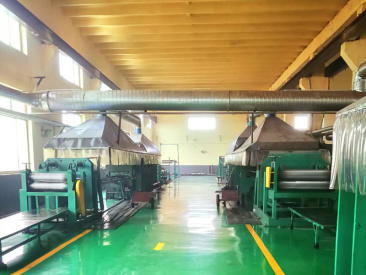
Oil-impregnated Bearing Housing and Other Quality Details
One of the most overlooked factors in conveyor roller performance is the bearing housing. High-quality rollers use sealed bearings that are protected from dust and moisture. In heavy-dust environments such as mines and cement plants, an optimized sealing structure prevents bearing seizure and reduces unplanned downtime. When comparing suppliers, ask about bearing type, sealing structure, radial run-out control, and rotational resistance testing.
Common Conveyor Roller Problems and How to Prevent Them
Even well-designed conveyor systems can suffer from roller-related failures. The most common problems include the following.
Belt Mistracking
Belt mistracking occurs when the belt drifts away from its central path. It can be caused by misaligned idlers, uneven loading, or frame issues. Self-aligning idlers with pivoting frames can correct mis-tracking automatically and reduce belt edge abrasion and tearing.
Roller Seizure
Roller seizure is often caused by bearing contamination or poor sealing. Sealed bearings and dust-resistant sealing structures are essential in dusty environments. Pre-shipment inspection can reduce the risk of receiving rollers with high rotational resistance.
Excessive Noise and Vibration
Noise and vibration are usually related to poor coaxiality, excessive radial run-out, or worn bearings. Tight manufacturing control over radial run-out minimizes belt vibration and abnormal wear.
Corrosion
In port and outdoor installations, salt spray and humidity can corrode unprotected steel rollers. Galvanized or coated surface treatments provide corrosion resistance for humid outdoor and salt-spray environments.
How Conveyor Rollers Are Manufactured
Shanghai Eastrise’s production process follows a complete quality-control chain: raw-material screening, production-process monitoring, and finished-product inspection. For trough idlers, impact rollers, parallel idler rollers, and aligning idlers, the manufacturing process includes cutting steel tube to length, turning the tube, welding or assembling shafts, installing sealed bearings, and performing dimensional inspection and radial run-out measurement. Batch inspection reports can be supplied for overseas project acceptance.
OEM, Customization, and Export Support
Many conveyor roller buyers need customized lengths, tube diameters, shaft diameters, or surface treatments. Eastrise supports OEM & ODM solutions, private-label service for nameplates and packaging, and full export documentation under FOB/CIF terms. Drawing confirmation and first-article inspection are available for project-specific load matching.
Cost and Lead Time Considerations
Conveyor roller pricing depends on material, size, bearing quality, surface treatment, and order volume. Buyers should compare not only unit price but also service life, rotational resistance, and maintenance requirements. For project planning, typical sample lead time is 5–7 days and mass-production lead time is 15–30 days, based on Eastrise’s published product data. Always confirm lead time with the supplier before ordering.
Comparison: Recommended Roller Types for Common Applications
| Application | Typical Working Condition | Recommended Roller Type | Key Requirement |
|---|---|---|---|
| Ore conveyor line | Dusty, heavy-duty, continuous | Trough idler + Impact roller | Dust-resistant seals, wear resistance |
| Cement raw material line | Heavy dust, medium-to-high temperature | Trough idler + Self-aligning idler | Stable support, reduced mistracking |
| Bulk terminal conveyor | Outdoor, humid, salt-spray | Parallel idler roller + Impact roller | Corrosion-resistant coating, sealed bearings, low noise |
| Long-distance conveyor prone to mistracking | Continuous 24/7 | Aligning idler | Self-pivoting frame, belt training |
FAQ
What does a conveyor roller do?
A conveyor roller supports the conveyor belt and the material on the belt. The bearings inside the roller reduce rotation resistance, and friction between the roller surface and the belt enables the belt to move continuously when driven by a motorized pulley or drive system. In simple terms, conveyor rollers convert rotational power into linear movement of the belt for material transportation.
What are the main types of conveyor rollers?
The main types are trough idler (35° trough carrying idler), parallel idler roller (return/flat-carrying idler), impact roller (rubber-ring impact roller), and self-aligning idler (training idler). Trough idlers support the loaded belt and prevent spillage; return idlers support the return belt; impact rollers absorb shock at loading points; and self-aligning idlers correct belt mistracking.
What materials are conveyor rollers made from?
The most common material is carbon steel, which accounts for 64% of the global market share. Rubber rings are added to impact rollers for shock absorption. HDPE, nylon, and other polymer materials are also used when corrosion resistance or low noise is needed. Surface treatments such as galvanizing or coating can improve corrosion resistance in humid or salt-spray environments.
How do I choose the right conveyor roller?
Identify the operating environment and roller position first. Use a trough or carrying roller on the load-carrying side, a return or parallel roller on the return side, an impact roller at loading and crusher discharge points, and a self-aligning roller where belt mistracking occurs. Then select tube diameter, shaft diameter, length, sealing, and surface treatment based on belt width and load conditions.
How long does it take to get conveyor roller samples?
Sample lead time is typically 5–7 days, and mass-production lead time is typically 15–30 days, based on Shanghai Eastrise’s product data. You can also contact the supplier to confirm a lead time that fits your project schedule and request batch inspection reports for project acceptance.
Can conveyor rollers be customized?
Yes. Conveyor rollers can be customized in tube diameter, shaft diameter, roller length, surface treatment, and sealing structure. Suppliers such as Shanghai Eastrise support OEM & ODM solutions based on customer-specific technical parameters and site-use demands, including private-label nameplates and packaging.
Conclusion
Conveyor rollers are essential components that determine the reliability, efficiency, and maintenance cost of any belt conveyor system. For heavy-duty applications such as mining, cement, ports, and long-distance conveying, selecting the right roller type—whether trough idler, return roller, impact roller, or self-aligning idler—matters more than the initial purchase price.
When evaluating a conveyor roller supplier, look for verified manufacturing capability, sealed bearing quality, engineering support, inspection reporting, and the ability to customize according to your site conditions. Shanghai Eastrise Trading Co., Ltd. supplies conveyor idler rollers and other mining accessories from its own manufacturing facility in Shanghai, China, with global export experience and OEM/ODM support.
If you are planning a new conveyor line or replacing rollers in an existing system, contact Eastrise with your belt width, roller dimensions, and working conditions to receive product selection support and drawing confirmation.
Need a reliable conveyor roller supplier?
Contact Jone: jone.liu@sh-eastrise.com | Tel/WhatsApp: +86 18516552763
Download the company brochure: Shanghai Eastrise Brochure
Have Questions or Need More Details?
Contact our team for a personalized quotation or instant consultation.
Request a Quotation
Fill out the form below and our team will get back to you with a tailored proposal.
WhatsApp Direct Chat
Prefer to chat in real-time? Message us on WhatsApp for instant assistance & quick answers.
- Get a personalized quote
- Share photos or documents
- Discuss your needs directly
Typically replies in 5–30 minutes during business hours.