
Conveyor Roller Guide: Types, Applications, and Selection Basics
Conveyor rollers are cylindrical components that support the conveyor belt and enable material movement through bearing rotation. As the roller turns, it converts rotational power into linear belt motion, carrying bulk material from one point to another. This simple yet essential mechanism is widely used across mining, cement, ports, logistics, and other bulk material handling industries.
This guide explains what conveyor rollers do, which types are available, how they are applied in different industries, and what to consider when selecting a supplier. It is intended for engineers, maintenance teams, and procurement professionals who are evaluating conveyor roller options for new or existing conveyors.
Why Conveyor Roller Selection Matters
Even though a conveyor roller appears to be a simple tube with bearings, its quality and design directly affect conveyor performance. Poorly matched or low-quality rollers can lead to belt mis-tracking, abnormal belt wear, increased vibration, high noise, bearing seizure, and unplanned downtime. These issues are more severe in demanding environments such as underground mines, cement plants, and salt-spray ports, where dust, heavy loads, humidity, and continuous operation are common.
The right roller type, material, sealing, and surface treatment can reduce maintenance frequency and extend the service life of both the roller and the conveyor belt. Therefore, a basic understanding of roller categories and their intended functions is a necessary first step for any serious evaluation.
Conveyor Roller Market and Standards
The importance of conveyor rollers is reflected in global market data. According to Dataintelo, the global roller conveyor market was valued at USD 3.15 billion in 2025. A more focused segment, rollers and idlers, was valued at USD 4.14 billion in 2025 and is projected to reach USD 7.05 billion by 2034 (Straits Research).
Material preference is also clear: steel accounted for 64% of the global rollers and idlers market in 2024. Mining and quarrying is the leading end-use industry, representing 36% of total revenue in the same year.
Several international standards guide the design, dimensioning, and testing of conveyor idlers. ISO 5048 is the international reference for calculating power and tension in belt conveyors with carrying idlers. CEMA Standard 502-2022 defines dimensional standards and load ratings for bulk material belt conveyor troughing and return idlers. DIN 22112 Part 3 specifies testing requirements for idlers used in underground coal mining. When evaluating products, confirmation that a supplier follows these standards can be a useful quality indicator.
Main Conveyor Roller Types for Bulk Material Handling
Shanghai Eastrise Trading Co., Ltd. is a professional foreign-trade enterprise headquartered in Shanghai, China. Established in 2024, the company operates self-owned manufacturing factories and supplies mining accessories globally. Its main products include conveyor idler rollers, and it supports tailored OEM & ODM solutions. The factory covers 11,000 square meters and has an annual production capacity of 2,000 tons, with a 10-engineer R&D team and a staff of approximately 50.
The following roller types cover the most common positions and operating demands in belt conveyor systems.
1. Trough Idler
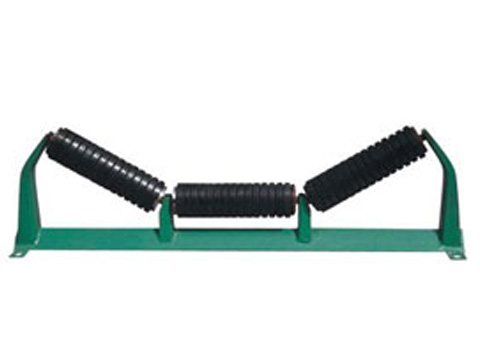
The trough idler is a 35° trough carrying idler with a suggested model designation of ER-TROUGH-108. It is designed for use in mining, cement, ports, and general bulk material handling industries. The roller is available with trough angle options of 20°, 25°, and 35°, which help contain bulk materials and prevent spillage. It uses a carbon steel tube and shaft with sealed double-row bearings, providing high load-bearing capacity. Roller length can be customized according to belt width, and galvanized or coated surface treatments are available for dusty and high-temperature conditions. Full-batch inspection on dimensions and radial run-out controls coaxiality and minimizes belt vibration.
2. Impact Roller
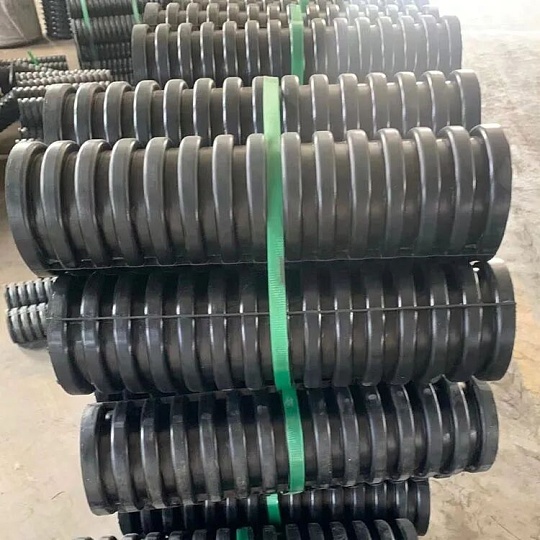
The impact roller is classified as a rubber-ring impact roller, with a suggested model designation of ER-IMPACT-108. It is intended for loading points, crusher discharge, and heavy-duty conveyors. The roller combines carbon steel with wear-resistant rubber rings to absorb heavy material impact and protect the conveyor belt from tearing damage. Suggested tube diameter is Ø108 mm, shaft diameter is Ø25 mm, and roller length can be customized from 315 mm to 1,150 mm depending on operating conditions. An optional optimized sealing structure is available for heavy-dust environments. Production follows DIN 22112 / CEMA / GB/T 10595 standards, and batch material and inspection reports are available.
3. Parallel Idler Rollers
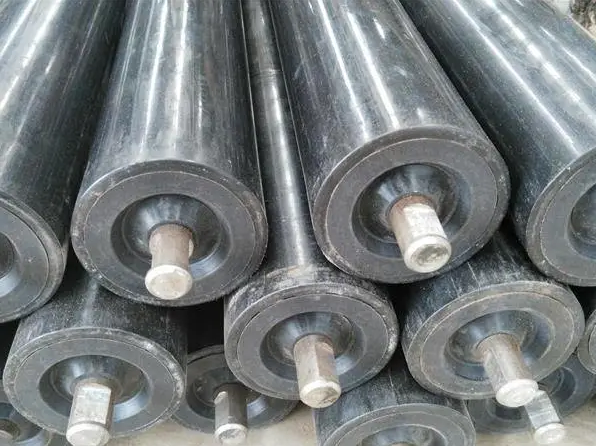
Parallel idler rollers belong to the return / flat-carrying idler category, with a suggested model designation of ER-PARALLEL-108. They are designed for flat-section carrying and return-belt supporting applications. The rollers use a carbon steel tube and shaft with sealed bearings, and an optional galvanized or anti-corrosion coating is available for humid outdoor and salt-spray port environments. Suggested tube diameters are Ø89, Ø108, and Ø133 mm; suggested shaft diameters are Ø20 and Ø25 mm. These rollers are suitable for high-utilization, long-distance conveying in ports, logistics, mining, and cement plants.
4. Aligning Idler
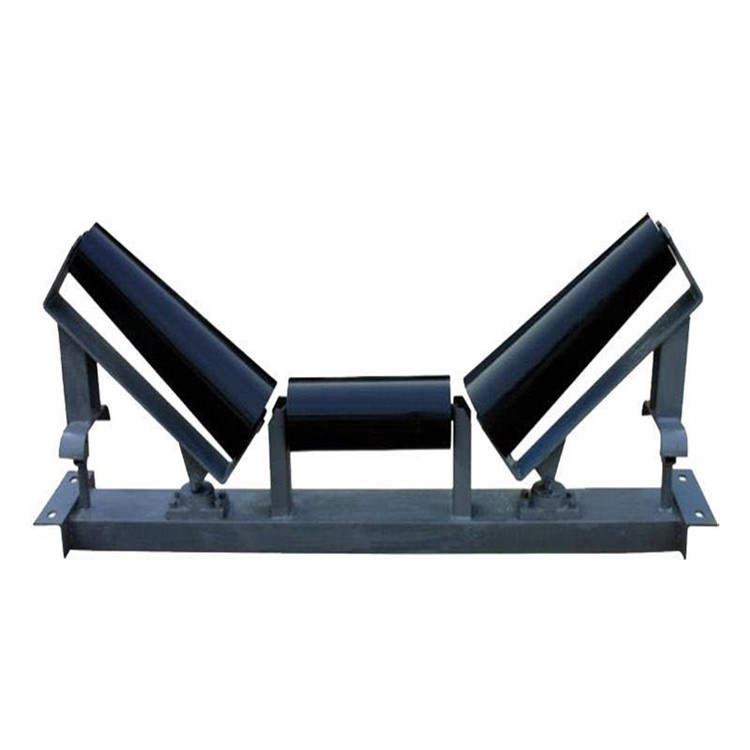
The aligning idler is a self-aligning / training idler, with a suggested model designation of ER-ALIGNING-108. It is designed for use in mining, cement, ports, and long-distance conveyor lines prone to belt mistracking. The self-pivoting frame automatically corrects belt mis-tracking and reduces risks of belt edge abrasion and tearing. The integrated assembly of a carbon steel roller, pivoting bracket, and sealed bearings adapts to 24/7 continuous-operation lines. Tube diameter and roller length can be tailored to match on-site belt width. Professional engineering support is available for product selection and drawing confirmation, and batch-wise inspection reports can be supplied for overseas project acceptance.
How to Select the Right Conveyor Roller: A Step-by-Step Guide
While every conveyor is different, the following sequence can help narrow down the correct roller choice.
- Define the operating environment. Consider dust levels, humidity, temperature, salt spray, and whether the line runs 24/7. These conditions determine the need for sealed bearings, corrosion-resistant coatings, or impact protection.
- Identify the roller position on the conveyor. Carrying sections benefit from trough idlers; return sections use parallel idlers; loading and discharge zones require impact rollers; sections prone to belt mis-tracking should be fitted with aligning idlers.
- Match dimensions to the belt and frame. Confirm tube diameter, shaft diameter, and roller length. Typical suggested diameters for Eastrise rollers are Ø89/108/133 mm for tube and Ø20/25 mm for shaft.
- Material and surface treatment. Carbon steel is the standard choice. Galvanized or coated surfaces add protection in humid and salt-spray environments.
- Verify quality standards. Look for compliance with applicable standards such as DIN 22112, CEMA, GB/T 10595, and ask for batch inspection reports.
- Evaluate supplier support. Check whether the manufacturer offers OEM/ODM services, engineering support, sample availability, and clear lead times.
Industry Applications
Conveyor rollers are used across many industries. The following are common scenarios based on Eastrise's application experience.
Mining
In mining, conveyor systems operate under dusty, heavy-duty, continuous bulk material handling conditions. Rollers are required to support the conveyor belt and absorb loading impact. Dust-resistant seals, low rotational resistance, and wear resistance are critical. Typical applications include ore conveyor lines, where trough idlers support the load and impact rollers protect the belt at transfer points.
Cement
Cement plants often face heavy dust, medium-to-high temperatures, and continuous operation. Rollers must provide stable support and reduce belt mistracking and maintenance frequency. A combination of trough idlers and aligning idlers is often used on raw material handling lines, supported by impact rollers at feed points.
Ports and Logistics
Port environments are outdoor, humid, and salt-spray, with long-distance conveying requirements. Rollers must support the return belt and maintain smooth operation, preferably with corrosion-resistant coating, sealed bearings, and low noise. Bulk terminal conveyors typically use parallel idler rollers for the return belt and trough idlers for carrying sections, with impact rollers at loading stations.
Conveyor Roller Type Comparison
| Roller Type | Category | Suggested Tube Diameter | Key Function | Typical Applications |
|---|---|---|---|---|
| Trough Idler | 35° trough carrying idler | Ø89 / 108 / 133 mm | Contain bulk material and prevent spillage | Mining, cement, ports |
| Impact Roller | Rubber-ring impact roller | Ø108 mm | Absorb heavy impact at loading points | Crusher discharge, loading points |
| Parallel Idler | Return / flat-carrying idler | Ø89 / 108 / 133 mm | Support return belt and flat carrying sections | Ports, logistics, mining, cement |
| Aligning Idler | Self-aligning / training idler | Ø89 / 108 / 133 mm | Correct belt mis-tracking | Long-distance conveyor lines |
Frequently Asked Questions
What conveyor roller standards should a manufacturer meet?
International standards such as ISO 5048, CEMA 502-2022, and DIN 22112-3 are commonly used in the design and testing of conveyor idlers. For impact rollers, Shanghai Eastrise Trading Co., Ltd. produces components that can comply with DIN 22112 / CEMA / GB/T 10595 standards. When evaluating a supplier, it is advisable to request batch inspection reports to verify compliance.
What types of conveyor rollers does Shanghai Eastrise Trading Co., Ltd. supply?
The company supplies a full range of conveyor idler rollers, including trough idler (35° carrying), impact roller (rubber-ring), parallel idler rollers (return/flat-carrying), and aligning idler (self-aligning/training). Suggested model designations are ER-TROUGH-108, ER-IMPACT-108, ER-PARALLEL-108, and ER-ALIGNING-108 respectively.
Can I request a sample before mass production?
Yes. For example, the trough idler has a sample lead time of 5–7 days and mass-production lead time of 15–30 days. Eastrise also supports OEM & ODM services and offers professional engineering support for drawing confirmation.
What is the lead time for bulk conveyor roller orders?
Lead time depends on product type and order size. For standard trough idlers, mass production typically takes 15–30 days. For other roller types, the team can provide a confirmed schedule during the inquiry stage.
How can I get a quote or discuss my project?
You can contact Jone by email at jone.liu@sh-eastrise.com, by phone/WhatsApp at +86 18516552763, or visit the company website at https://www.sh-eastrise.com. A company brochure is also available for download: Eastrise Brochure.
Conclusion
Conveyor rollers play an essential role in the reliability and efficiency of bulk material handling systems. Understanding the different types—trough idlers, impact rollers, parallel idler rollers, and aligning idlers—helps engineers and purchasing teams select the right components for their specific conditions.
Shanghai Eastrise Trading Co., Ltd. combines in-house manufacturing with engineering support, offering a complete range of conveyor idler rollers backed by inspection reports and international standards awareness. For project-specific inquiries or sample requests, contact the team to discuss your requirements.
Download the company brochure or contact Jone directly for a quick response.
Download Eastrise BrochureHave Questions or Need More Details?
Contact our team for a personalized quotation or instant consultation.
Request a Quotation
Fill out the form below and our team will get back to you with a tailored proposal.
WhatsApp Direct Chat
Prefer to chat in real-time? Message us on WhatsApp for instant assistance & quick answers.
- Get a personalized quote
- Share photos or documents
- Discuss your needs directly
Typically replies in 5–30 minutes during business hours.