
Impact Roller Technical Guide: Selection Parameters for Loading Points and Crusher Discharge
An impact roller is the conveyor roller installed directly under the material stream at a loading point, a crusher discharge chute, or a heavy-duty transfer station. Its task is narrow and measurable: absorb the falling material's energy before that energy reaches the belt cover. This guide is a parameter-by-parameter walkthrough of how to specify one — tube diameter, shaft diameter, roller length, tube and ring material, and sealing structure — followed by the standards framework (DIN 22112, CEMA, GB/T 10595, ISO 5048) and the practical checks that decide whether the delivered roller actually matches the approved drawing.
It is written for mining, cement, quarry and bulk-terminal engineers and procurement staff at the awareness and research stage: people who need to know which numbers must be fixed before any quotation becomes meaningful. The reference product throughout is the rubber-ring impact roller from Shanghai Eastrise Trading Co., Ltd., a professional foreign-trade enterprise headquartered in Shanghai, China, established in 2024, specializing in the supply of high-quality mining accessories including conveyor idler rollers. Its impact roller is listed with a model designation of TBC and a suggested designation of ER-IMPACT-108.
Problem Definition: What Actually Fails at a Loading Point
A standard carrying roller supports a belt that has already been loaded and settled. At a loading point or a crusher discharge, the roller is asked to do something structurally different: absorb the impact of a falling material stream while the belt is still deforming and accelerating underneath it. That mismatch — not roller quality in the abstract — is the root cause of most impact-zone failures.
The failure pattern is consistent enough to plan against:
- Belt damage at the impact zone. Top-cover abrasion and, in severe cases, tearing where lump size and drop height combine.
- Shell and ring wear. A plain steel shell transfers impact energy straight into the belt instead of absorbing it.
- Bearing seizure in heavy dust. A seized roller stops turning and becomes a fixed obstacle that damages the belt it was meant to protect.
- Unplanned downtime. The impact station is usually the least accessible part of the conveyor, so every failure there costs more than the roller.
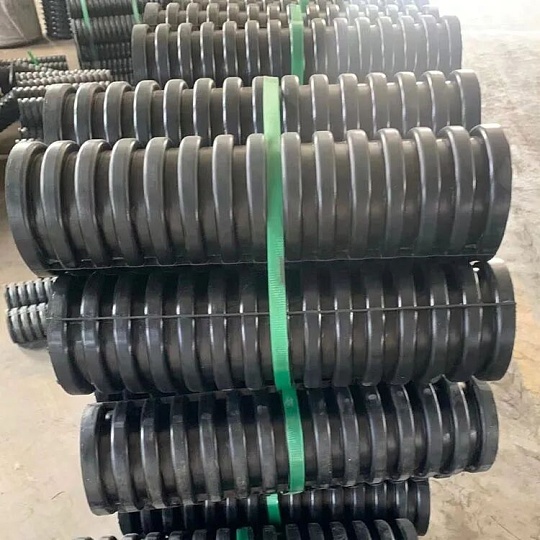
The design response is a rubber-ring impact roller: a roller constructed of carbon steel and wear-resistant rubber rings to absorb heavy material impact at loading points and protect the conveyor belt from tearing damage. That sentence defines the function. The parameters below define whether a specific impact roller will deliver that function on your line.
Industry Background: Where Impact Rollers Sit in Bulk Material Handling
Rollers and idlers form a large, mature component category, and it is a category where material choice and application still separate one supply option from another.
- The rollers and idlers segment was valued at USD 4.14 billion in 2025 and is projected to reach USD 7.05 billion by 2034, according to Straits Research.
- A broader definition of the roller conveyor market is valued at USD 3.15 billion in 2025 by Dataintelo — a useful reminder that market-size numbers shift with scope, so they should never be used as a substitute for line-level load data.
- Steel remains the dominant roller material, accounting for 64% of global market share in 2024 (Straits Research).
- Mining and quarrying is the leading end-use industry for rollers and idlers, representing 36% of total revenue in 2024 (Straits Research).
Three practical consequences follow for anyone specifying an impact roller. First, carbon steel remains the default structural material, which is why the impact roller uses a carbon steel tube and shaft rather than an alternative shell. Second, the leading end-use industry is mining and quarrying — an environment defined by dust, impact loading and continuous operation, which is exactly the load case an impact roller exists for. Third, standards — not catalogue photos — define what “correct” means in a tender document.
On that third point: the impact roller is listed as complying with DIN 22112, CEMA and GB/T 10595. Each standard plays a different role in a specification. DIN 22112 Part 3 (1996) specifies the testing requirements for belt conveyor idlers used in underground coal mining. CEMA Standard No. 502-2022 establishes dimensional standards and load ratings for bulk material belt conveyor troughing and return idlers, which defines the interface logic an idler set is measured against. GB/T 10595 is the Chinese national standard cited alongside them, which matters where Chinese design institutes or domestic end users write the specification. ISO 5048:1989 provides the international standard for calculating power and tension in belt conveyors with carrying idlers — the calculation that establishes the baseline belt tension an impact station then sits inside.
Impact Roller Selection Parameters, One by One
How to read the parameter values below. The impact roller is listed with a model designation of TBC and a suggested designation of ER-IMPACT-108. “TBC” and the word “suggested” matter: these are reference starting points for a project, not fixed catalogue numbers. The confirmed values follow the drawing, the belt width and the load case of the specific station.
1. Tube Diameter: Ø108 mm Suggested
Tube diameter sets the roller's outer geometry — how much belt contact surface sits under the impact zone, how much room the rubber rings have to absorb energy, and whether the roller fits the existing bracket and frame without modification. The impact roller is listed with a suggested tube diameter of Ø108 mm.
Two things make this value worth checking rather than assuming. An undersized diameter concentrates the impact load onto a narrow strip of belt and limits the ring thickness available to absorb energy. Diameter compatibility also matters across the line: the trough idler, parallel idler roller and aligning idler in the same roller family are offered with suggested tube diameters of Ø89/108/133 mm, so specifying Ø108 mm on the impact station keeps that station inside a common diameter family with the rest of the idler set.
2. Shaft Diameter: Ø25 mm Suggested
Shaft diameter carries the bending load transmitted from the rubber rings through the shell to the brackets. The impact roller is listed with a suggested shaft diameter of Ø25 mm, while the trough, parallel and aligning idlers in the same family are offered at Ø20/25 mm. The heavier end of that range at the impact station reflects a simple fact: an impact roller sees a cyclical impact load that a carrying roller never sees.
Load capacity is the one parameter that cannot be copied from any catalogue. It is designed for the operating conditions, which is why no responsible supplier will confirm a shaft size before receiving belt width, material type and lump size, drop height and operating hours. If a quotation arrives with a shaft diameter and no load case behind it, the number is a guess.
3. Roller Length: Customizable Within 315–1,150 mm
Length is dictated by belt width and the bracket spacing of the impact station, not by a single universal number. The impact roller is listed with a suggested length range of 315–1,150 mm, and tube diameter, shaft diameter and roller length are all customizable to fit heavy-duty working conditions such as crusher discharge zones.
One structural point that is easy to miss at the research stage: an impact station is usually a group of rollers rather than a single long one, arranged to spread the material stream across the belt. CEMA Standard No. 502-2022 provides the dimensional framework for how a troughing or return idler set interfaces with the belt, which is a useful reference for station layout even where impact rollers are specified for the loading zone itself.
4. Material: Carbon Steel Tube with Wear-Resistant Rubber Rings
The impact roller is constructed of carbon steel and wear-resistant rubber rings. The carbon steel tube and shaft provide the structural load path; the rubber rings absorb impact energy and protect the belt cover from tearing damage. Steel is also the mainstream choice across the category, holding 64% of global conveyor roller material share in 2024 according to Straits Research.
A trade-off worth understanding before the budget is set: rubber-ring construction adds mass and unit cost relative to a plain steel roller, and it is specified where impact energy justifies it — typically loading points, crusher discharge and heavy-duty conveyors, not every position on the line. The rubber ring specification for this impact roller is listed as TBC and is confirmed against the actual operating conditions.
5. Sealing Structure for Heavy-Dust Environments
An optional optimized sealing structure is available for heavy-dust environments, and its purpose is specific: preventing bearing seizure. Of all the parameters on this page, the sealing structure is the one that most often decides whether a roller survives its first year or has to be cut out of the frame.
Dust is not a cosmetic issue. In the application environments listed for this roller family, mining conveyors run dusty, heavy-duty, continuous bulk material handling on a 24/7 basis, with dust-resistant seals, low rotational resistance and wear resistance stated as requirements. Cement raw material handling lines add heavy dust and medium-to-high temperatures under continuous operation, with dust and corrosion resistance as the stated requirement. Port and logistics bulk terminals run outdoors in humid, salt-spray conditions, where the stated requirement is corrosion-resistant coating, sealed bearings and low noise.
For an impact roller specifically, the sealing structure and the ring specification are the two items most worth writing into the purchase order, because they are the two a low-cost quotation is most likely to leave vague.
6. Standards That Shape the Specification
Standards do not replace site data, but they define the language a specification is written in. Four references matter for this roller:
- DIN 22112 — cited in the impact roller's compliance statement. Part 3 (1996) specifies the testing requirements for belt conveyor idlers used in underground coal mining, which is the reference that governs how idler performance is verified rather than merely asserted.
- CEMA — also cited in the compliance statement. CEMA Standard No. 502-2022 establishes dimensional standards and load ratings for bulk material belt conveyor troughing and return idlers, and is the natural reference for North American projects.
- GB/T 10595 — the Chinese national standard cited alongside DIN and CEMA in the product's compliance statement, relevant where domestic Chinese design practice applies.
- ISO 5048:1989 — the international standard for calculating power and tension in belt conveyors with carrying idlers; it produces the baseline tension that the impact station then operates within.
Batch material and inspection reports are available for the impact roller. That matters more than it sounds: a compliance requirement is closed out with documentation, not with a statement, and an overseas project acceptance team will ask for the paperwork.
Step-by-Step: From Site Data to an Approved Drawing
Specification is a sequence, and skipping a step usually shows up as a failed first article rather than a failed quotation. The six-step route below is the order in which the parameters above actually get fixed.
- Collect the load case. Belt width, capacity, material type, lump size, drop height, operating hours, and environment (dust, temperature, humidity or salt spray). This data determines everything downstream.
- Define the impact zone geometry. Decide how many rollers the station needs and how the stream will be spread, then map the required roller length inside the 315–1,150 mm range.
- Fix the interface dimensions. Suggested tube diameter Ø108 mm and suggested shaft diameter Ø25 mm, with the final length confirmed — these are the numbers that must match the existing frame and brackets.
- Confirm material and sealing. Carbon steel tube and shaft with wear-resistant rubber rings; add the optional optimized sealing structure where the environment is heavy-dust. Agree the rubber ring specification (listed as TBC) in writing.
- Confirm the drawing. Professional engineering support for product selection and drawing confirmation is part of the supplier's service scope on its idler programs, and the impact roller program supports OEM & ODM service, so tube diameter, shaft diameter and roller length are customized against the confirmed drawing rather than chosen from a shelf.
- Approve the first article, then release the batch. First-article inspection verifies the roller against the confirmed drawing before mass production; strict factory inspections on radial run-out and rotational resistance are applied during production, and batch material and inspection reports are available for project acceptance.
What OEM/ODM Customization Covers — and What It Cannot Fix
OEM & ODM service on this impact roller covers tube diameter, shaft diameter and roller length, plus the sealing structure option, with customization of tube diameter, shaft diameter and roller length aimed specifically at heavy-duty conditions such as crusher discharge zones.
What no roller specification can fix is upstream of the roller. An impact roller absorbs impact energy; it does not reduce drop height, correct a poorly aligned chute, or compensate for a material stream that lands off-centre. If a station has already destroyed rollers that were correctly sized, the next place to look is chute geometry and belt support spacing — before specifying a heavier roller that will simply fail more slowly.
Where Rubber-Ring Impact Rollers Are Applied
Mining Ore Conveyor Loading Points
The ore conveyor line is the most demanding listed environment: dusty, heavy-duty, continuous bulk material handling, running 24/7, where the roller's function is to support the conveyor belt and absorb loading impact. The stated requirement set is dust-resistant seals, low rotational resistance and wear resistance — parameters subject to the actual operating conditions. For an impact roller, that combination translates into two specification decisions: the optional optimized sealing structure, and a ring specification confirmed against lump size and drop height rather than assumed.
Crusher Discharge Zones
Crusher discharge is the classic impact roller application, and it is named directly in the product's applicable industry list alongside loading points and heavy-duty conveyors. The defining characteristic is a short, brutal impact event: coarse material leaving the crusher at speed, landing on a belt that must then carry it away. This is the position where tube diameter, shaft diameter and roller length are most often customized, because the station geometry rarely matches a standard layout.
Cement Raw Material Handling Lines
Cement lines contribute a second stress factor: heavy dust and medium-to-high temperatures under continuous operation, where the conveyor's job is stable support with reduced belt mistracking and maintenance frequency. The stated requirement is dust and corrosion resistance. For an impact roller at the transfer point, this again points to sealing structure and ring material as the decisive specification choices, pending confirmation of the operating temperature range.
Port and Logistics Bulk Terminals
Port bulk terminal conveyors run outdoors, in humid and salt-spray conditions, on long-distance conveying duty with 24/7 operation. The stated requirement set is corrosion-resistant coating, sealed bearings and low noise. Impact rollers are listed among the applicable products for this environment, and the practical implication is that the surface treatment and sealing specification carry as much weight as the mechanical dimensions.
Impact Roller vs Trough, Return and Self-Aligning Idlers
An impact station rarely operates alone. The table below places the impact roller alongside the other rollers in the same family so the role of each position is clear — the impact roller absorbs, while the rollers downstream carry, return and steer the belt.
| Roller type | Primary function | Suggested tube diameter | Suggested shaft diameter | Material | Typical position |
|---|---|---|---|---|---|
| Impact roller (rubber-ring) | Absorb heavy material impact at loading points and protect the belt from tearing damage | Ø108 mm | Ø25 mm | Carbon steel and wear-resistant rubber | Loading points, crusher discharge, heavy-duty conveyors |
| Trough idler (35° trough carrying) | Carry the loaded belt and contain bulk material; trough angle options 20°/25°/35° | Ø89/108/133 mm | Ø20/25 mm | Carbon steel tube and shaft with sealed double-row bearings | Mining, cement, ports, general bulk material handling |
| Parallel idler roller (return / flat-carrying) | Support the return belt and flat-section carrying applications | Ø89/108/133 mm | Ø20/25 mm | Carbon steel tube and shaft with sealed bearings; optional galvanized or coated surface | Ports, logistics, mining, cement plants |
| Aligning idler (self-aligning / training) | Automatically correct belt mistracking with a self-pivoting frame | Ø89/108/133 mm | Ø20/25 mm | Carbon steel tube, shaft and pivot frame with sealed bearings | Long-distance lines prone to belt mistracking |
Frequently Asked Questions
Which standards should a rubber-ring impact roller comply with for a mining project?
The impact roller from Shanghai Eastrise Trading Co., Ltd. is listed as complying with DIN 22112, CEMA and GB/T 10595, and each standard plays a different role. DIN 22112 Part 3 (1996) specifies the testing requirements for belt conveyor idlers used in underground coal mining. CEMA Standard No. 502-2022 establishes dimensional standards and load ratings for bulk material belt conveyor troughing and return idlers, which defines the interface logic the idler set is measured against. GB/T 10595 is the Chinese national standard cited alongside them where domestic Chinese design practice applies. ISO 5048:1989 provides the international standard for calculating power and tension in belt conveyors with carrying idlers. Batch material and inspection reports are available for the impact roller, which is what allows a compliance requirement to be closed out with documentation rather than a statement.
Can tube diameter, shaft diameter and roller length be customized for a crusher discharge station?
Yes. Tube diameter, shaft diameter and roller length are customizable to fit heavy-duty working conditions such as crusher discharge zones, and OEM & ODM service is supported. The impact roller is listed with suggested values of Ø108 mm tube diameter, Ø25 mm shaft diameter and a suggested length range of 315–1,150 mm; the confirmed numbers follow the belt width, bracket spacing and impact load case of the station. An optional optimized sealing structure is available for heavy-dust environments to prevent bearing seizure. Because the model designation is listed as TBC, the confirmed drawing — not the suggested designation ER-IMPACT-108 — is the controlling document on a project order.
What drives the price of an impact roller?
Four items typically move the number: the rubber-ring construction itself (a carbon steel tube and shaft with wear-resistant rubber rings rather than a plain steel shell), the optional optimized sealing structure specified for heavy-dust environments, the depth of customization in tube diameter, shaft diameter and roller length, and the documentation set — batch material and inspection reports represent real inspection work. Because load capacity is designed for the operating conditions, a unit price is only meaningful once the drawing and the rubber ring specification are fixed. A per-piece figure requested before that stage is usually a figure that cannot be held.
Can we test a sample before committing to a production batch?
Yes — the specification route runs through drawing confirmation and a first article rather than straight into mass production. Professional engineering support for product selection and drawing confirmation is part of the supplier's service scope on its idler programs, the impact roller program supports OEM & ODM customization of tube diameter, shaft diameter and roller length, and first-article inspection verifies the roller against the confirmed drawing before the batch is released. Strict factory inspections on radial run-out and rotational resistance are applied in production. As a published reference point, the trough idler program from the same supplier line lists a sample lead time of 5–7 days.
How long does production take, and how do we start an impact roller order?
Timing is confirmed against the approved drawing, because the drawing is what fixes tube diameter, shaft diameter, roller length and the sealing option. As a published reference point for the same supplier's idler range, the trough idler program lists a sample lead time of 5–7 days and a mass-production lead time of 15–30 days; impact rollers pass through the same drawing-confirmation gate, and batch material and inspection reports are available for overseas project acceptance. To open a file, send the belt width, material type and lump size, drop height, operating hours and the environment (dust, temperature, humidity or salt spray) to jone.liu@sh-eastrise.com or WhatsApp +86 18516552763, and request a sample or a quotation against a drawing.
Getting the Loading Point Specification Right
Impact roller selection is not a search for the heaviest roller available. It is the process of fixing four interacting numbers — tube diameter, shaft diameter, roller length and ring specification — against a load case that only the site can provide, then confirming a sealing structure that matches the dust and humidity the station actually sees. The suggested values for this impact roller (Ø108 mm tube, Ø25 mm shaft, 315–1,150 mm length, carbon steel with wear-resistant rubber rings) exist to give that process a starting point, not to replace it.
Around those numbers sit the standards that make the specification defensible: DIN 22112 for testing requirements, CEMA for dimensional and load-rating logic, GB/T 10595 where Chinese practice applies, and ISO 5048 for the tension calculation behind the load case. And around the standards sit the practical checks that determine whether the delivered roller is the roller that was specified: drawing confirmation, first-article inspection, and batch material and inspection reports.
For a buyer at the research stage, the most useful next step is not a comparison of catalogue pages — it is a documented drawing. That is the point at which an impact roller stops being a product category and becomes a part of your conveyor line.
Request an Impact Roller Sample or Quotation
Shanghai Eastrise Trading Co., Ltd. supplies conveyor idler rollers and mining accessories globally, with OEM & ODM support for tube diameter, shaft diameter and roller length, and batch material and inspection reports for project acceptance.
Email: jone.liu@sh-eastrise.com | Tel / WhatsApp: +86 18516552763
Website: www.sh-eastrise.com
Address: No. 2458 Dongda Road, Lingang New Zone, China (Shanghai) Pilot Free Trade Zone
Download the product brochure (PDF) for full roller specifications.
Have Questions or Need More Details?
Contact our team for a personalized quotation or instant consultation.
Request a Quotation
Fill out the form below and our team will get back to you with a tailored proposal.
WhatsApp Direct Chat
Prefer to chat in real-time? Message us on WhatsApp for instant assistance & quick answers.
- Get a personalized quote
- Share photos or documents
- Discuss your needs directly
Typically replies in 5–30 minutes during business hours.