
Impact Roller vs. Parallel Idler Roller: A Head-to-Head for Your Conveyor Line
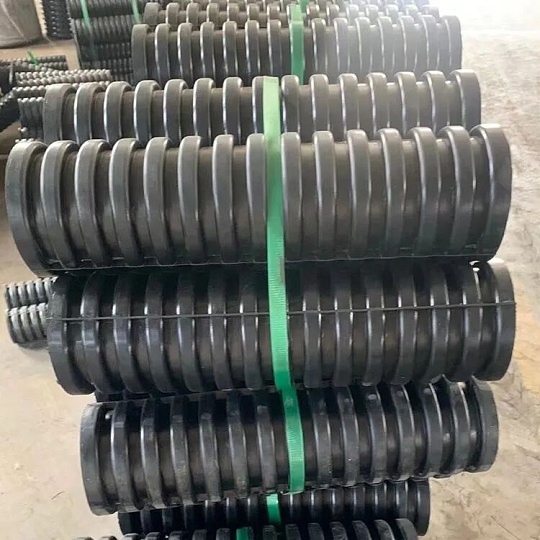
A belt conveyor line does not have one roller duty. It has at least two. At the loading point, material lands on the belt with full impact energy, and the rollers underneath have to absorb that shock without deforming. Along the flat carrying and return sections, thousands of rollers have to do something quite different: keep turning quietly, concentrically and with minimal resistance for years of continuous operation.
This head-to-head compares two rollers built for those two jobs — the ER-IMPACT-108 rubber-ring impact roller and the ER-PARALLEL-108 parallel idler roller — and sets out how to decide where each one earns its place on a mixed conveyor system. Both sit in the Ø108 mm roller family supplied by Shanghai Eastrise Trading Co., Ltd., a Shanghai-based supplier of mining accessories and conveyor idler rollers that operates its own manufacturing factories and serves global export markets.
Short answer: Use rubber-ring impact rollers such as the ER-IMPACT-108 at loading points, transfer points and crusher discharge zones, where the job is shock absorption and belt protection. Use parallel idler rollers such as the ER-PARALLEL-108 on flat carrying sections and return runs, where the job is low-resistance rotation over long conveying distances and high utilization hours. A mixed line needs both, specified zone by zone — not one roller type repeated everywhere.
The Problem: One Conveyor Line, Two Duty Profiles
Roller failures rarely come from a single defective component. Most come from a mismatch between the roller design and the zone it was installed in.
Loading points demand shock absorption. Where a chute or crusher discharge drops material onto the belt, the belt presses down on the rollers with impact energy that scales with lump size, drop height and throughput. A rigid steel shell transfers that energy straight into the belt cover and the bearing seats. A rubber-ring roller deflects and recovers, spreading the same peak load across a longer time window.
Flat and return zones demand low rotational resistance. On the return run and on flat carrying sections, rollers are not protecting anything from impact. They are supporting the belt with as little drag, noise and runout as possible while running continuously. Here, diameter consistency, seal quality and bearing quality matter more than shock absorption.
Three specification mistakes are common. The first is specifying one roller type across the entire line to simplify purchasing. The second is buying on unit price alone while accepting wide runout tolerance and low-grade seals. The third is treating rollers as a reactive consumable instead of an inventory planned by zone.
Those mistakes surface as belt cover damage, seized rollers, higher drive energy, abnormal noise, mistracking and unplanned stoppages. On mining and cement lines running around the clock, the downtime cost usually exceeds the price difference between roller grades by a wide margin.
Industry Background: Rollers Are Now a Fleet and Lifecycle Decision
Roller and idler demand tracks bulk material handling capacity. Market research published in 2026 valued the global roller conveyor market at USD 3.15 billion in 2025 (Dataintelo, Roller Conveyor Market Research Report 2034), while the narrower rollers and idlers segment was valued at USD 4.14 billion in 2025 and projected to reach USD 7.05 billion by 2034 (Straits Research, Rollers and Idlers Market Size, Share, Growth, Analysis, 2034). The two figures use different scope definitions — system versus component — so they should not be read as conflicting measurements of the same thing.
Two structural facts matter more for roller selection. Steel remains the dominant roller material, accounting for 64% of global market share in 2024, and mining and quarrying is the leading end-use industry, representing 36% of total rollers and idlers revenue in 2024 (both Straits Research). The largest single use case is therefore heavy-duty bulk handling — exactly the environment where the impact-versus-parallel split carries the most weight.
Standards define how that split is documented and inspected. ISO 5048:1989 provides the international standard for calculating power and tension in belt conveyors with carrying idlers. CEMA Standard No. 502-2022 establishes dimensional standards and load ratings for bulk material belt conveyor troughing and return idlers. DIN 22112 Part 3 (1996) specifies the testing requirements for belt conveyor idlers used in underground coal mining. A roller specification that cites the relevant standard is easier to accept, repeat and audit on the next order.
Supply is also regional. Viet Nam's exports of HS 843139 — parts for conveyors and elevators — reached USD 8.59 million in 2023 (UN Comtrade), a reminder that conveyor component sourcing is distributed across multiple manufacturing regions rather than concentrated in one.
What has changed most, though, is the buying decision itself. Roller procurement has moved from a one-off purchase to a fleet decision. Once a line carries thousands of rollers, the questions that decide total cost are batch-to-batch consistency, spare availability by zone, and whether the supplier can repeat the same approved specification years later. That is a supplier-relationship question as much as an engineering one.
The Head-to-Head: ER-IMPACT-108 vs ER-PARALLEL-108
ER-IMPACT-108 — the rubber-ring impact roller for loading points
The ER-IMPACT-108 is a rubber-ring impact roller with a suggested tube diameter of Ø108 mm and a suggested shaft diameter of Ø25 mm, offered within a suggested length range of 315–1,150 mm. The body is carbon steel and the contact surface is wear-resistant rubber. Rubber ring dimensions and final load capacity are confirmed against the actual operating conditions rather than assumed from a catalogue.
Its working principle is straightforward. Under the falling material stream, the rubber rings deflect and return to shape, converting a sharp peak load into a longer, lower-amplitude one. That protects two components at once: the belt cover above the roller and the bearing assembly inside it. The design intent is placement at loading points, crusher discharge zones and heavy-duty conveyor sections, where impact energy is highest.
ER-PARALLEL-108 — the parallel idler roller for flat and return sections
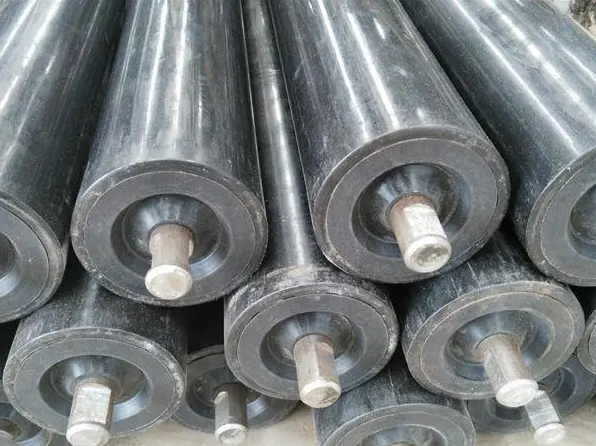
The ER-PARALLEL-108 is the flat-zone counterpart in the same Ø108 mm family. It is a parallel idler roller intended for flat carrying sections and return runs, where the requirement is not shock absorption but sustained, low-resistance rotation across long conveying distances and high utilization hours.
Because it does not carry a deformable rubber ring, its design priority shifts to tube straightness, shaft concentricity, seal performance and bearing selection. Project dimensions are confirmed against the conveyor drawing and the applicable standard before production, so the roller matches the belt width, load and frame geometry rather than a generic size.
Material and shaft differences that drive the decision
Both rollers use carbon steel tubes, which is consistent with steel remaining the dominant roller material globally. Where they diverge is the contact surface and the load path. The ER-IMPACT-108 carries wear-resistant rubber rings on a Ø25 mm suggested shaft, because the compliant element is the whole point of the design. The parallel roller's shaft and bearing arrangement are matched to the load and belt width of the specific application, confirmed at the drawing stage.
Material choice also separates roller categories. Eastrise comparison records state that in heavy-duty duty cycles, steel rollers can deliver roughly 35% higher load capacity and about 40% stronger impact resistance than HDPE polymer rollers — which is why steel remains the default for mining, cement and heavy bulk material handling. HDPE and nylon rollers keep a legitimate role in lighter, corrosion-sensitive or noise-sensitive duties, but that is a separate selection decision from the impact-versus-parallel question.
Sealing and runout decide how long any roller survives in a dusty line. The same comparison records state that against rollers using labyrinth seals, this roller family is engineered with a tighter seal design, top-tier bearing brands, tighter runout control and complete batch inspection reports, with around 22% lower runout tolerance and approximately 13 dB lower running noise. Against low-cost conventional steel rollers, the records indicate roughly 25% lower runout deviation and up to 3× longer service life. These are supplier-side comparison figures, and buyers should verify them against the inspection records and test reports attached to their own order.
Trade-offs you should plan for
Impact rollers are the wrong choice for a long return run. They are heavier, cost more per unit, and the rubber rings add rotational resistance. Fitting them along kilometres of return belt raises purchase cost and drive energy without adding protection that the zone requires.
Parallel rollers are the wrong choice directly under a crusher discharge. A rigid parallel roller has no compliant element to absorb impact, so the energy transfers into the tube, the bearing seats and the belt cover. The result is short service life and premature belt damage at the most expensive point on the line.
A mixed system costs more to manage, not less. Two roller types mean two spare sets, two reorder points and two maintenance rhythms. The trade-off is worth accepting once you record the specification per zone and treat the roller fleet as planned inventory rather than an emergency purchase.
Step-by-Step: Assigning Rollers Zone by Zone
- Map the duty zones on the line drawing. Mark loading points, transfer points, crusher discharge, flat carrying sections, the return run, the take-up and any curved sections. The zone map is what makes the roller decision repeatable.
- Calculate power and tension first. Use ISO 5048:1989 to establish the conveyor power and tension requirements with carrying idlers before any roller is selected.
- Assign roller type by zone. Rubber-ring impact rollers such as the ER-IMPACT-108 go where material lands. Parallel idler rollers such as the ER-PARALLEL-108 go on flat carrying and return sections.
- Confirm dimensions against the right standard. CEMA Standard No. 502-2022 covers dimensional standards and load ratings for troughing and return idlers. Where the duty is underground coal mining, DIN 22112 Part 3 (1996) sets the idler testing requirements.
- Lock the material specification. Record tube material and wall thickness, shaft diameter, bearing grade, seal type, the rubber ring specification for impact rollers, and any corrosion-resistant treatment needed for humid or salt-spray environments.
- Approve a sample or drawing before mass production. Acceptance is based on a customer-approved sample or drawing confirmation, and inspection records are available for reference.
- Inspect before shipment. A documented pre-shipment inspection covers dimensions, appearance, radial runout, rotational resistance, quantity and packaging.
- Stage spares by zone and archive the approved drawing. Keep impact roller spares close to the loading points and parallel roller spares on the return run. Storing the approved drawing number is what lets the next order repeat exactly.
Use Cases: Where a Mixed Roller Plan Pays Off
- Mining ore conveyor lines. Dusty, heavy-duty, continuous bulk handling in 24/7 operation. Impact rollers at the loading point, parallel rollers on the long flat and return sections. Dust-resistant seals, low rotational resistance and wear resistance govern the specification, with parameters set by the operating conditions.
- Cement raw material handling. Heavy dust, medium-to-high temperatures and continuous operation. Mixing roller types here reduces maintenance frequency: stable belt support limits mistracking and unplanned roller changes. Operating temperature range is confirmed for the specific site.
- Port and bulk terminals. Outdoor, humid, salt-spray conditions with long conveying distances. Corrosion-resistant coating, sealed bearings and low noise are the priorities, with the protection level confirmed for the individual project.
- Underground coal conveying. Idler testing follows DIN 22112 Part 3 (1996), which is why the roller specification should name the standard from the start.
- Quarry and crusher discharge points. The highest impact energy on any line. Rubber-ring impact rollers are the appropriate first choice, with parallel rollers taking over downstream on the flat runs.
Comparison Table: ER-IMPACT-108 vs ER-PARALLEL-108
| Parameter | ER-IMPACT-108 | ER-PARALLEL-108 |
|---|---|---|
| Primary duty zone | Loading points, transfer points, crusher discharge | Flat carrying sections and return runs |
| Design objective | Shock absorption and belt protection | Low rotational resistance over long distance |
| Suggested tube diameter | Ø108 mm | Ø108 mm family, project-specific |
| Suggested shaft diameter | Ø25 mm | Confirmed at drawing stage |
| Body material | Carbon steel | Carbon steel |
| Contact surface | Wear-resistant rubber rings | Plain steel tube surface |
| Suggested length range | 315–1,150 mm | Confirmed against conveyor drawing and standard |
| Best-fit industries | Mining, quarry, cement, heavy-duty conveying | Long-distance conveying, ports, cement, continuous flat and return runs |
| Maintenance focus | Rubber ring condition, ring replacement, bearing state | Runout, seal condition, rotational resistance |
| Cost profile | Higher unit cost; justified by impact protection at the zone that needs it | Lower unit cost per piece, but far higher quantity per line |
| Standards reference | ISO 5048:1989, CEMA 502-2022, DIN 22112-3:1996 as applicable | ISO 5048:1989, CEMA 502-2022, DIN 22112-3:1996 as applicable |
| Spare strategy | Zone-specific spares held at the loading point | Zone-specific spares held on the return run |
Frequently Asked Questions
Which standards should the impact rollers and parallel idlers on the same line be checked against?
ISO 5048:1989 provides the international standard for calculating power and tension in belt conveyors with carrying idlers. CEMA Standard No. 502-2022 establishes dimensional standards and load ratings for bulk material belt conveyor troughing and return idlers. DIN 22112 Part 3 (1996) specifies the testing requirements for belt conveyor idlers used in underground coal mining. Acceptance criteria should be written into the contract, and third-party inspection can be arranged where the project requires it.
Can one supplier cover both the loading-point impact rollers and the flat and return parallel rollers?
Covering both zones from one source is what keeps dimensions, materials and inspection records consistent across a mixed fleet. Shanghai Eastrise Trading Co., Ltd. operates its own independent manufacturing factories, forming a complete industrial chain that integrates in-house R&D, standardized production, quality testing and worldwide export services. The facility covers 11,000 m², employs approximately 50 staff and has an annual production capacity of 2,000 tons, supported by an R&D team of 10 engineers. Tailored OEM and ODM solutions are supported according to customer technical parameters and site-use demands.
What drives the cost difference between impact rollers and parallel idler rollers?
For impact rollers, cost is driven by the rubber ring specification, the tube and the shaft. For parallel rollers, bearing and seal grade dominate, multiplied by the far higher quantity per line. Unit price alone is a misleading comparison: within equal material and component specifications, Eastrise comparison records state that these rollers deliver a lower total cost of ownership than rollers with labyrinth seals, and that against low-cost conventional steel rollers the higher initial purchase price is offset by fewer failures, less unplanned replacement and more stable rotational resistance over the service life. MOQ is subject to product specifications and packaging.
Is a sample or drawing confirmation available before mass production?
Yes. Acceptance is based on a customer-approved sample or drawing confirmation, and inspection records are available. Pre-shipment inspection covers dimensions, appearance, radial runout, rotational resistance, quantity and packaging. Sample payment terms are subject to order confirmation.
What are the delivery terms and lead times, and can this become a long-term supply arrangement?
FOB, CIF and EXW terms are available, with full container load and less-than-container load both supported and export documents provided. Port and lead time are subject to order confirmation. Payment is by T/T, with documented production terms including a 30% deposit and 70% before shipment. Shanghai Eastrise Trading Co., Ltd. has built long-term, stable and mutually trusted cooperative relationships with clients from Southeast Asia, Central Asia, Russia and many other overseas markets. To start, send your zone map and roller drawing to request a sample or a quotation.
Conclusion: Buy by Zone, Not by Unit Price
The impact roller versus parallel idler roller question has only one honest answer: it depends on the zone, and a modern conveyor line usually needs both. The ER-IMPACT-108 rubber-ring impact roller earns its cost at loading points, transfer points and crusher discharge zones, where a carbon steel body with wear-resistant rubber rings turns destructive peak loads into something the belt and bearings can survive. The ER-PARALLEL-108 parallel idler roller earns its cost on flat carrying and return sections, where low rotational resistance, tight runout control and sealed bearings decide energy consumption and service life over long distances.
The decision framework is the same whether the line runs 50 metres or 5 kilometres: map the zones, calculate power and tension under ISO 5048:1989, assign roller type per zone, confirm dimensions against CEMA 502-2022 or DIN 22112-3:1996 as applicable, lock the material specification, approve a sample or drawing, inspect before shipment, and archive the approved drawing so the next order repeats exactly.
That last step is where the long-term view matters most. Rollers are a fleet, not a one-off purchase. Batch-to-batch consistency, traceable inspection records and fast spare-parts support by zone are what reduce maintenance downtime across the life of a conveyor project — and they are the reason to settle on a supplier who can hold the same specification over multiple orders rather than the lowest quoted price on a single one.
Next Step: Send Your Zone Map and Roller Drawing
Share the loading point layout, belt width and return run length, and the team at Shanghai Eastrise Trading Co., Ltd. will confirm whether the ER-IMPACT-108, the ER-PARALLEL-108 or a mix of both fits each zone — with drawing confirmation before mass production.
Email: jone.liu@sh-eastrise.com | Tel / WhatsApp: +86 18516552763
Website: www.sh-eastrise.com
Address: No. 2458 Dongda Road, Lingang New Zone, China (Shanghai) Pilot Free Trade Zone
Download the product catalogue (PDF) for full roller specifications.
Have Questions or Need More Details?
Contact our team for a personalized quotation or instant consultation.
Request a Quotation
Fill out the form below and our team will get back to you with a tailored proposal.
WhatsApp Direct Chat
Prefer to chat in real-time? Message us on WhatsApp for instant assistance & quick answers.
- Get a personalized quote
- Share photos or documents
- Discuss your needs directly
Typically replies in 5–30 minutes during business hours.