Comprehensive Guide to Sludge Dewatering Equipment: Types, Processes, and Selection
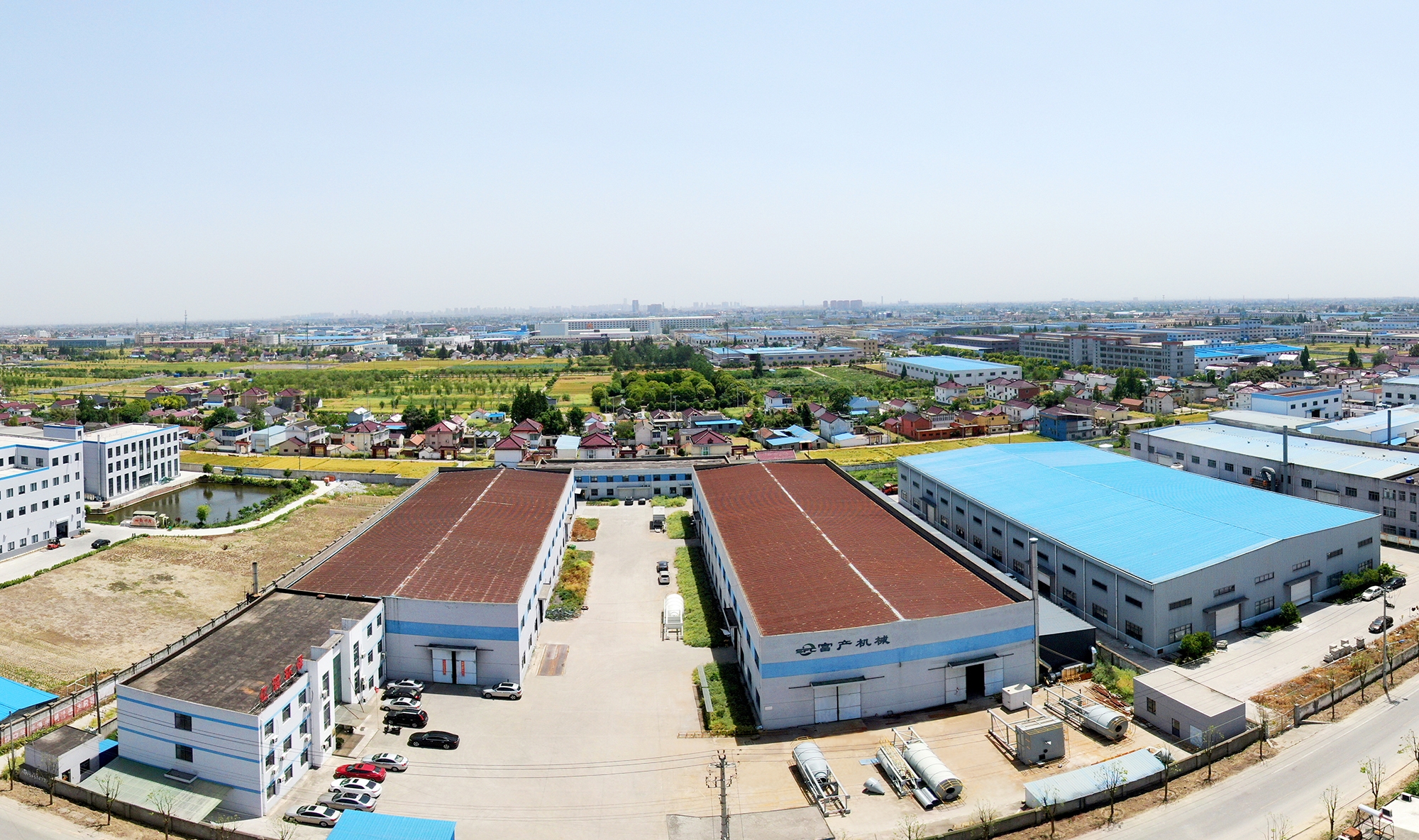
Sludge dewatering is a critical step in wastewater treatment, reducing the volume and moisture content of residual solids to lower disposal costs and meet environmental regulations. Whether you operate a municipal treatment plant, an industrial facility, or a food processing site, choosing the right sludge dewatering equipment directly impacts operational efficiency and compliance. This guide explains the main types of sludge dewatering machines, how they work, and how to select the best system for your application. Shanghai Fuchan Machinery Technology Co., Ltd., a National High-Tech Enterprise established in 2007 and based in Pudong New Area, Shanghai, is a leading manufacturer of sludge treatment solutions, including dewatering, thickening, and drying equipment, serving global markets across Southeast Asia, Russia, South America, and the Middle East.
Why Sludge Dewatering Matters
Untreated sludge typically contains more than 95% water, making it heavy, costly to transport, and difficult to dispose of. Mechanical dewatering aims to increase the solids content, reducing volume by 60–80% and transforming sludge into a handleable cake. Efficient dewatering also lowers energy consumption in downstream processes such as drying or incineration and helps facilities comply with tightening discharge and landfilling standards.
Industry Background
The global sludge dewatering equipment market was valued at USD 5.19 billion in 2024 and is projected to reach USD 10.16 billion by 2032, according to Fortune Business Insights. Asia Pacific accounted for the largest regional share of 37.57% in 2024, driven by rapid urbanization and industrial growth. China alone is expected to generate USD 0.87 billion in revenue by 2025. The belt filter press segment is estimated to grow at a CAGR of 8.8% from 2025 to 2033, reflecting its widespread adoption in municipal applications.
Types of Sludge Dewatering Equipment
Shanghai Fuchan Machinery offers a complete range of sludge treatment systems, broadly categorized by function: thickening, dewatering, deep dewatering, and drying. The main equipment types are described below, based on Fuchan's product series.
1. Screw Press Sludge Dewatering Machine (Multi-disc Screw Press)
The DL Series is a multi-disc screw press designed for low-concentration sludge with inlet consistency of S.S. 0.6–5.0%. It consists of fixed rings, moving rings, a screw shaft, and a volute filter. Available in 16 models (DL-101 to DL-404), it produces dewatered cake with water content of 75–85% and handles flows from 1.5 to 900 kg/h of dried sludge. Common applications include municipal wastewater treatment, paper mills, printing and dyeing, oily sludge, and decentralized projects.
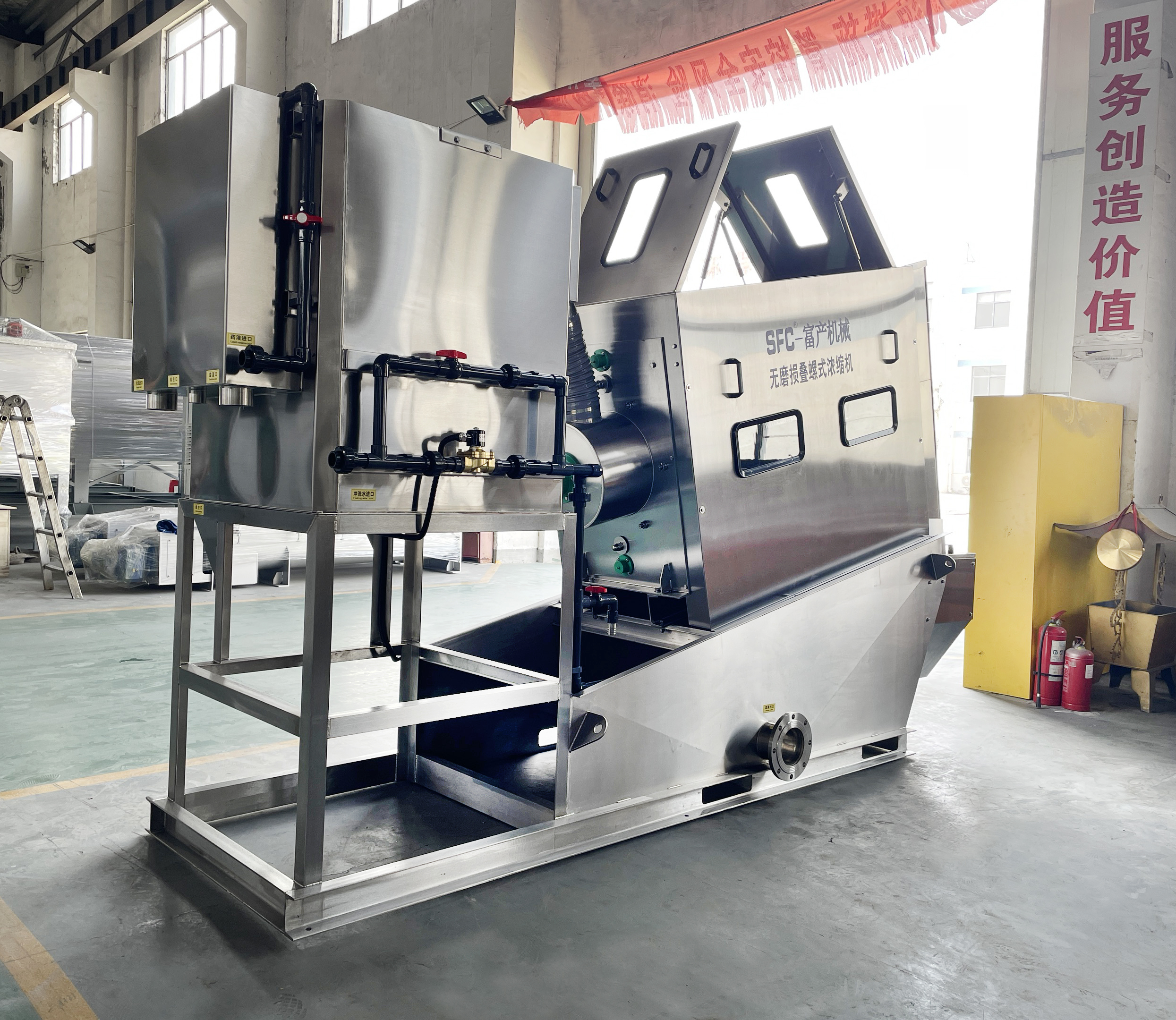
2. Wear-Free Screw Press Sludge Dewatering Machine
The SRD Series (e.g., SRD-301 to SRD-404) is engineered for sticky, oily, low-concentration, or high-inorganic-content sludge. It improves stable conveying and reduces wear risk between screw and rings. Inlet consistency is S.S. 0.6–5.0%, dried sludge output ranges from 25 to 900 kg/h, and final moisture is 75–85%. It is suitable for food processing wastewater, oily sludge, and industrial/municipal treatment.
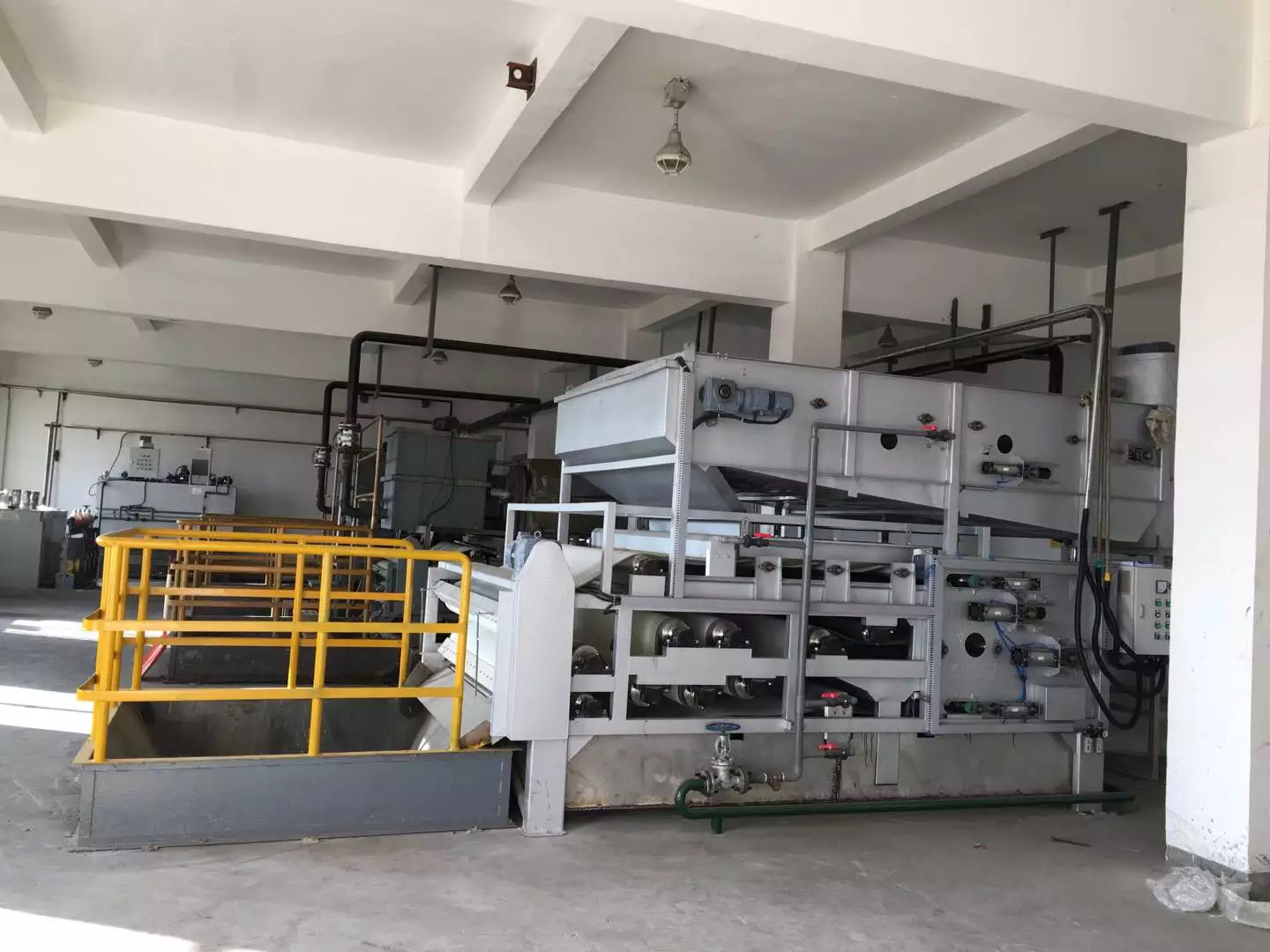
3. Belt Thickening and Dewatering Integrated Machine
The GDY Series (belt widths 1000–3000 mm) combines gravity belt thickening and belt press dewatering in a single unit. It processes low- to medium-concentration sludge (S.S. 0.6–1.5%) at capacities of 15–90 m³/h, producing cake at 75–80% moisture. This integrated machine is ideal for high-flow continuous dewatering in municipal and industrial plants, paper mills, and printing & dyeing industries.
4. Rotary Drum Thickening + Belt Press Dewatering Machines
Two series fill this category: the FTE Series (belt width 1000–3000 mm) for medium-large continuous duty, and the FTB Series (belt width 500–2000 mm) for small-medium projects. Both use a rotary drum pre-thickener followed by a belt press, handling inlet S.S. of 0.6–2.5% and producing cake at 75–85% moisture. They are widely used in municipal, industrial, paper, and printing & dyeing applications.
5. High-Pressure Belt Deep Sludge Dewatering Machine
The SD Series (models SFC-SD05 to SFC-SD25) is a secondary deep dewatering system that further reduces moisture after primary dewatering. Inlet consistency is S.S. 15–20%. For output water content of 65–75%, treating capacity is 0.3–5.0 t/h; for 60–70% moisture, capacity is 0.35–6.1 t/h. It is used in municipal plants, chemical plants, and as pretreatment for drying or incineration.
6. Sludge Drying Equipment
Fuchan offers two low-temperature drying solutions:
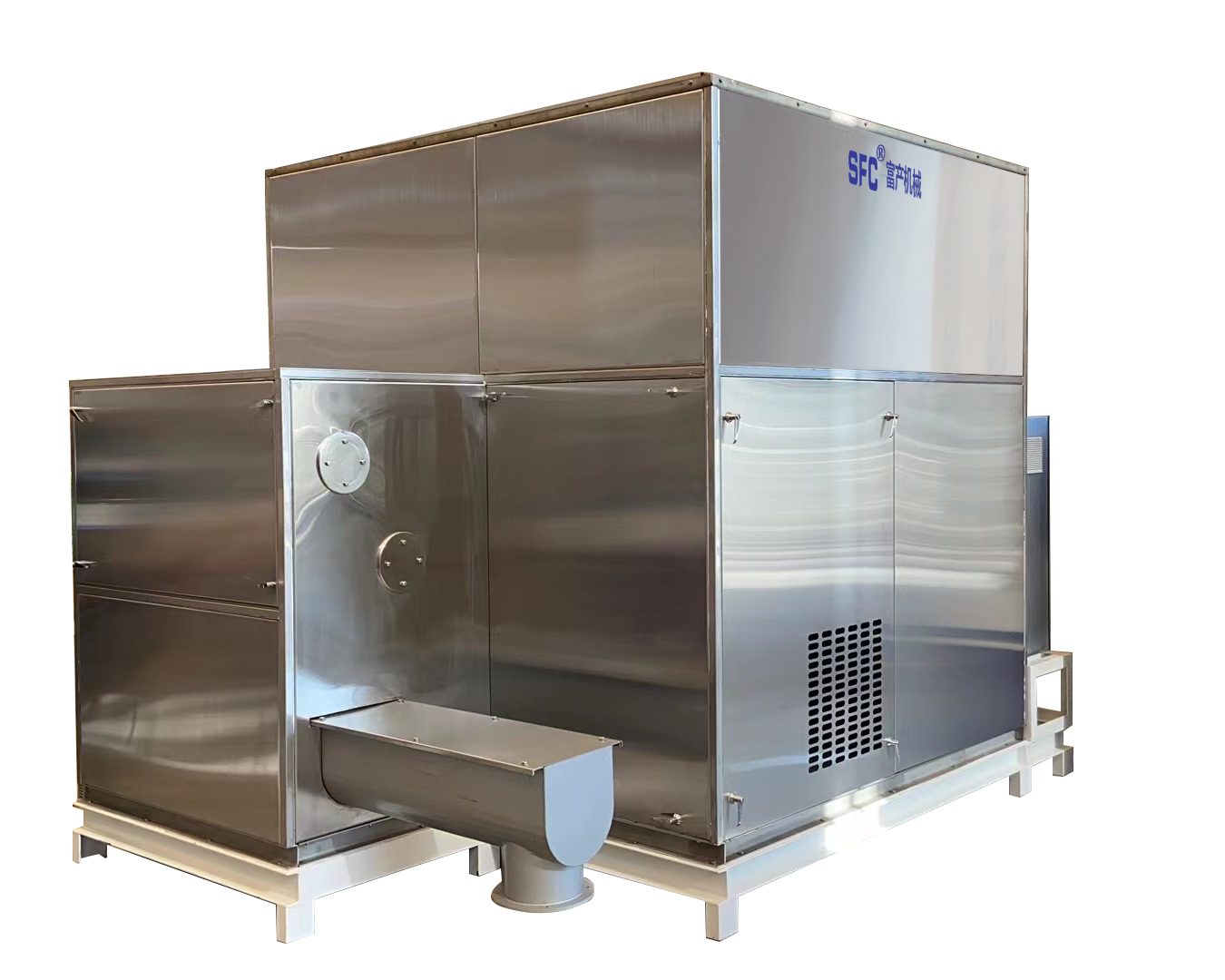
- SFC-BSD Series (Belt Sludge Dryer): fully enclosed, modular belt-type dryer. Inlet consistency S.S. 15–35%, treating capacity up to 90 t/h, final water content 10–50%, system power 23–506 kW. Designed for continuous operation with heat pump technology.
- SFC-TR Series (Reciprocating Circulation Dryer): batch dryer with water extraction capacity 21–360 kg/h, unit power consumption 0.4–0.55 kWh/kg water, achieving up to 70% volume reduction. Ideal for chemical sludge and smaller projects.
7. Sludge Thickening Equipment
Prior to dewatering, thickening concentrates sludge from 0.6–1.5% solids to 2.5–8%. Fuchan provides:
- FBT Series (Belt Sludge Thickener): gravity belt design, belt speed 3–18 m/min, solid-capture rate 98%.
- FRDT Series (Rotary Drum Sludge Thickener): enclosed drum, filter opening 30–80 mesh, solid-capture rate 95%, capacity up to 100 m³/h.
Step-by-Step: Typical Sludge Treatment Process
- Sludge Collection & Pumping: Raw sludge from clarifiers (typically 0.5–2% solids) is pumped to the treatment area.
- Chemical Conditioning: A polymer (PAM) preparation and dosing system adds flocculant to aggregate fine particles, improving dewaterability.
- Thickening: A belt thickener or rotary drum thickener raises solids to 2.5–8%, reducing volume and load on downstream dewatering.
- Dewatering: A screw press, belt press, or integrated thickening-dewatering machine produces cake at 75–85% moisture (or lower with high-pressure deep dewatering).
- Deep Dewatering (optional): For further moisture reduction (down to 60–70%), the SD Series high-pressure belt press is applied.
- Drying (optional): Low-temperature belt or batch dryers can reduce moisture below 50%, achieving over 70% volume reduction.
- Cake Disposal or Reuse: Dried sludge can be sent to landfill, incineration, or used as alternative fuel or soil amendment.
Use Cases Across Industries
Fuchan's equipment has been deployed in a variety of industries worldwide:
- Municipal Wastewater Treatment: Belt thickening and dewatering systems (GDY, FTE) handle high-flow continuous duty. Screw presses (DL/SRD) are used for smaller plants or where space is limited.
- Oil Refining & Petrochemical: Explosion-proof and corrosion-resistant systems (rotary drum thickener + screw press + belt dryer) treat refractory sludge from coking wastewater.
- Alcoholic Beverage/Distillery: High-organic sludge (95–99.8% moisture) is thickened, dewatered by screw press, and dried to produce stable biomass for co-incineration or land application. Enclosed design minimizes odor.
- Pharmaceutical Industry: High-organic, chemically complex sludge requires corrosion-resistant fully automatic systems (DL-series screw press + SD-series deep dewatering + low-temperature dryer) to stabilize residues and enable safe disposal.
- Palm Oil Industry: Palm oil mill effluent (POME) sludge is thickened and dewatered using DL screw presses, reducing volume and supporting zero-discharge goals.
- Automotive Parts Manufacturing (Electroplating): Heavy metal sludge from electroplating is dewatered using rotary drum thickening + belt press systems with corrosion-resistant materials.
Comparison of Key Dewatering Technologies
| Technology | Typical Inlet Solids | Cake Moisture | Capacity Range | Best For |
|---|---|---|---|---|
| Multi-disc Screw Press (DL) | 0.6–5.0% | 75–85% | 1.5–900 kg/h | Low-cost, low-maintenance; oily, sticky sludge |
| Wear-free Screw Press (SRD) | 0.6–5.0% | 75–85% | 25–900 kg/h | High-inorganic, abrasive sludge |
| Belt Thickening & Dewatering (GDY) | 0.6–1.5% | 75–80% | 15–90 m³/h | High-flow municipal/industrial |
| Rotary Drum + Belt Press (FTE) | 0.6–1.5% | 75–85% | 12–90 m³/h | Medium-large continuous duty |
| Rotary Drum + Belt Press (FTB) | 1.5–2.5% | 75–85% | 3–30 m³/h | Small-medium projects |
| High-Pressure Deep Dewatering (SD) | 15–20% (pre-dewatered) | 60–75% | 0.3–6.1 t/h | Post-dewatering polishing; drying/incineration pre-treatment |
Frequently Asked Questions
What is sludge dewatering equipment?
Sludge dewatering equipment is mechanical machinery that removes water from wastewater sludge, increasing its solids concentration. The result is a drier, smaller-volume cake that is cheaper to transport and easier to dispose of or process further. Common types include screw presses, belt presses, rotary drum thickeners, and dryers.
What are the main types of sludge dewatering machines?
The primary categories are thickening equipment (gravity belt thickener, rotary drum thickener), dewatering equipment (multi-disc screw press, belt press, rotary drum + belt press combination), deep dewatering systems (high-pressure belt press), and drying equipment (low-temperature belt dryer, batch circulation dryer). Shanghai Fuchan Machinery offers all these types under its DL, SRD, GDY, FTE, FTB, SD, BSD, and TR series.
How do I choose the right sludge dewatering system?
Selection depends on sludge characteristics (solids concentration, oil/grease content, abrasiveness), flow rate, required final cake moisture, available space, and budget. For municipal high-flow applications, an integrated belt thickening-dewatering machine (GDY) or rotary drum + belt press (FTE) is common. For sticky or oily industrial sludge, a wear-free screw press (SRD) is preferred. Always conduct a polymer jar test and consider pilot testing before final sizing.
What is the difference between a screw press and a belt press?
A screw press uses a rotating screw inside a cylindrical screen or between fixed/moving rings to progressively squeeze water out. It consumes less wash water and is more compact. A belt press uses two porous belts that sandwich sludge and pass through rollers, applying increasing pressure. Belt presses handle higher flow rates and are well-suited for municipal plants with consistent feed. Both technologies are available from Shanghai Fuchan Machinery.
What is deep sludge dewatering and when is it needed?
Deep sludge dewatering is a secondary stage that further reduces moisture after conventional dewatering (from ~80% to 60–75% moisture). It is needed when disposal costs are high or when the sludge is intended for incineration or drying. Shanghai Fuchan's SD Series high-pressure belt press performs this function, achieving inlet consistency of 15–20% and output capacities up to 6.1 t/h.
How can I get a quote or sample testing for my project?
Shanghai Fuchan Machinery provides project-specific consultation. You can contact the sales department at sales@fuchanjx.com or via WhatsApp at +86 138-1673-2007. For a detailed product overview, download the 2026 Product Catalog (PDF). Laboratory testing and on-site trials can be arranged to confirm equipment suitability.
Conclusion
Selecting the appropriate sludge dewatering equipment is essential for optimizing your wastewater treatment process and reducing operating costs. Understanding the different technologies—screw press, belt press, rotary drum, deep dewatering, and drying—allows you to match the machine to your specific sludge characteristics. Shanghai Fuchan Machinery offers a comprehensive portfolio of sludge treatment systems backed by 18 years of engineering experience, global installations, and a commitment to energy-efficient, reliable solutions. Contact Fuchan today to discuss your project requirements and explore how their equipment can improve your sludge management outcomes.