From 0.6% to Dry Cake: A Beginner's Guide to Sludge Thickening, Dewatering, and Drying Equipment
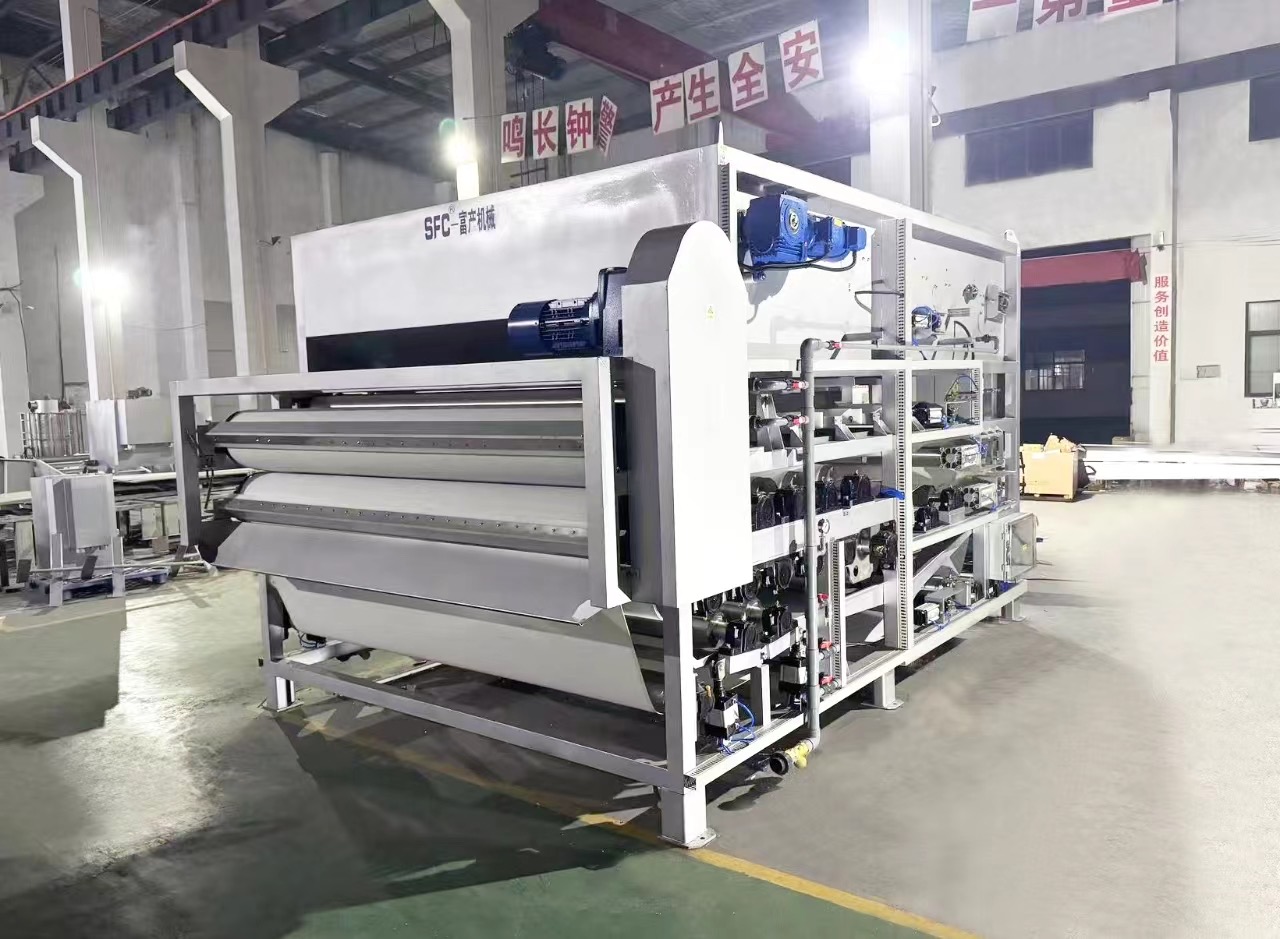
Sludge dewatering equipment is not one machine. It is the middle link of a three-stage chain — thickening, dewatering, and drying — and the inlet solids concentration of your sludge decides which of those stages you actually need.
In the specifications used in this guide, inlet consistency is written as S.S. (suspended solids). Gravity belt thickening and rotary drum thickening are built for S.S. 0.6–1.5%. Multi-disc screw presses accept S.S. 0.6–5.0%. Rotary drum plus belt press dewatering machines are fed at S.S. 1.5–2.5% or S.S. 0.6–1.5% depending on the series. High-pressure deep dewatering starts where primary dewatering ends, at S.S. 15–20%, and low-temperature dryers take over at S.S. 15–25% or S.S. 25–35%.
This guide maps each stage to the machine families that serve it. The referenced series — FBT, FRDT, DL, SRD, GDY, FTB, FTE, SD, SFC-TR, and SFC-BSD — are supplied by Shanghai Fuchan Machinery Technology Co., Ltd., which trades as SFC Machinery. SFC Machinery is a sludge treatment equipment manufacturer established in 2007 in Pudong New Area, Shanghai, supplying municipal and industrial sludge thickening, dewatering, deep dewatering and drying systems; its equipment is used in Southeast Asia, Russia, South America, and the Middle East.
The problem: sludge arrives as water, not as cake
At 0.6% solids, only 6 kg of every 1,000 kg of sludge is dry solids. Everything else is water that has to be removed, and the cost of removing it depends entirely on which stage does the work.
Water leaves sludge in two ways. Mechanical removal uses gravity drainage and pressing. Thermal removal uses evaporation inside a dryer. Thickening and dewatering are mechanical; drying is thermal. Mechanical stages carry the bulk of the water at low energy per kilogram, which is why drying is always the last step and never the first.
Operating data from plants running this equipment shows where sludge actually starts. One municipal wastewater treatment plant fed excess sludge at 99.2% moisture content into an integrated thickening and dewatering machine and produced a cake below 80%. Another plant fed a rotary drum thickener at 99.4% moisture content and reduced it to 97%, raising solids to 3% so the downstream plate-and-frame filter press could work properly.
When the stages do not match the feed, three problems appear:
- Hydraulic overload. A dewatering machine fed at 0.6% solids receives far more water than it was sized for, so cake quality drops and polymer consumption rises.
- Wasted thermal energy. A sludge dryer fed with 97% water sludge evaporates water that a press could have removed mechanically.
- Unstable operation. Sticky, oily or high-inorganic sludge behaves differently from municipal biological sludge and can clog or wear the wrong machine type.
So the beginner's question is not which sludge dewatering machine is best. It is which stage your sludge is in when it arrives.
Industry background: why the three-stage structure exists
The three-stage structure reflects how the market around sludge treatment has developed. The global sludge dewatering equipment market was valued at USD 5.19 billion in 2024 and is projected to reach USD 10.16 billion by 2032 (Fortune Business Insights). Asia Pacific dominated that market in 2024 with a revenue share of 37.57%, and China's sludge dewatering equipment market revenue is expected to reach USD 0.87 billion in 2025 (Fortune Business Insights).
Within the category, the belt filter press segment was estimated to grow at a CAGR of 8.8% from 2025 to 2033, widely used in municipal wastewater applications (Grand View Research). Published estimates differ slightly between research firms — 2024 global market size estimates vary by roughly USD 0.17 billion between leading sources — so these figures are best read as an indication of scale and direction rather than as procurement inputs.
One standard connects all three stages. ISO 11465:2025 provides the international standard for determination of dry residue and water content in sludge and solid environmental matrices. Because thickening, dewatering and drying performance is judged by water content, any supplier comparison should start from the same measurement method.
Stage 1 — Sludge thickening equipment: FBT and FRDT
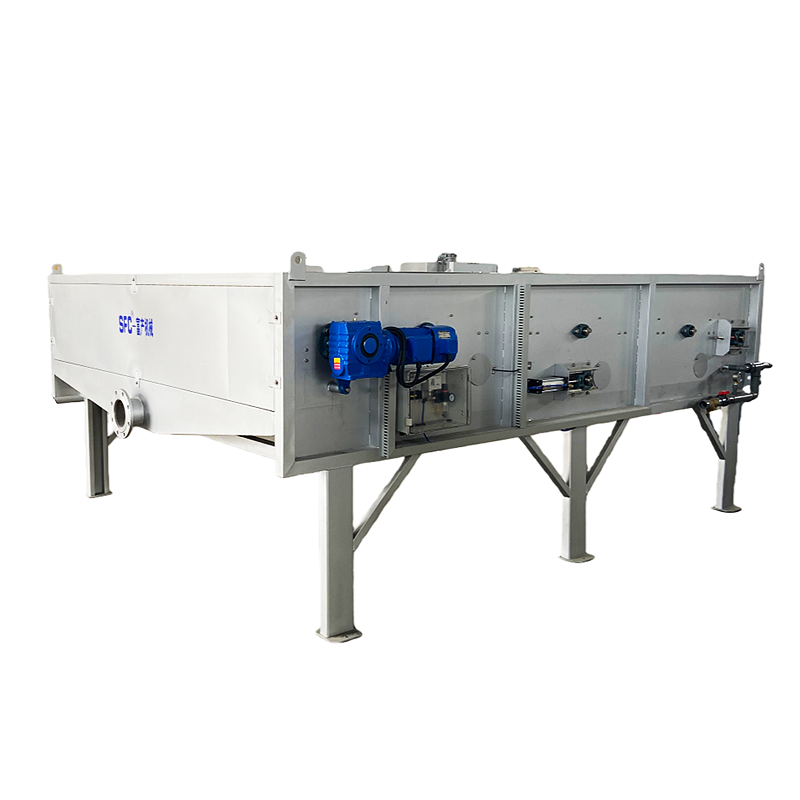
Thickening does not produce a cake. It raises solids from S.S. 0.6–1.5% to an outlet consistency of 2.5–8%, so that the dewatering stage behind it is not carrying water it was never designed to handle.
Gravity belt sludge thickener — FBT series
The FBT series is a gravity belt sludge thickener available in models FBT-1000, FBT-1500, FBT-2000, FBT-2500 and FBT-3000, with belt widths from 1,000 to 3,000 mm. It accepts inlet consistency of S.S. 0.6–1.5% and treats 12–95 m³/h, producing 72–900 kg/h of dried sludge at an outlet consistency of 2.5–8%. The solid-capture rate is 98%, belt speed is adjustable between 3 and 18 m/min, and power consumption is 0.55–1.5 kW. Construction is SS304 stainless steel. Typical duties are municipal and industrial wastewater treatment, paper mills, printing and dyeing, and sludge thickening projects.
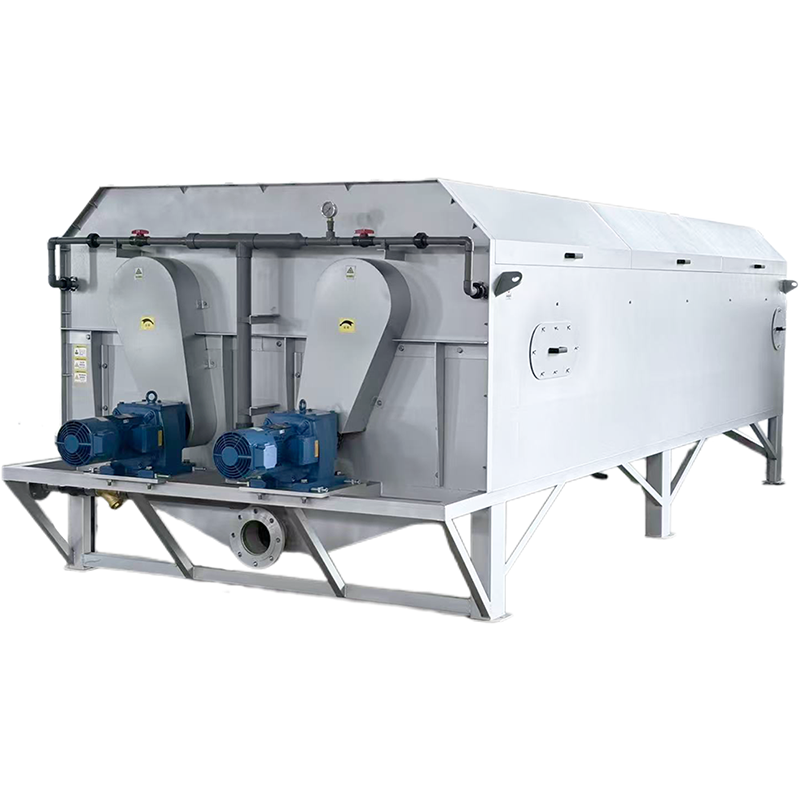
Rotary drum sludge thickener — FRDT series
The FRDT series is an enclosed rotary drum sludge thickener with models FRDT-20 through FRDT-100 and filter openings of 30–80 mesh. It accepts the same inlet consistency, S.S. 0.6–1.5%, and treats 7.5–100 m³/h, producing 45–1,140 kg/h of dried sludge at a 2.5–8% outlet consistency. The solid capture rate is 95% and drum speed is approximately 10 rpm. Driving motor power is 0.75–1.5 kW and disposal agitator motor power is 0.37–0.55 kW. It is also built in SS304.
Choosing between them is mostly a question of site conditions. A gravity belt thickener suits high-flow, continuous duty where belt speed can be tuned to the sludge. An enclosed rotary drum thickener suits plants that need containment for hygiene and odour control or that have limited floor space, and its low-speed drum operation is matched by low wear on rotating parts.
Stage 2 — Sludge dewatering equipment: DL, SRD, GDY, FTB and FTE
Dewatering is where sludge stops behaving like a liquid. Machines in this stage take thickened or low-solids sludge and produce a cake with a water content of 75–85%, depending on the type.
Multi-disc screw press — DL series
The DL series screw press sludge dewatering machine is a multi-disc screw press covering models DL-101 through DL-404. It accepts inlet consistency from S.S. 0.6–5.0% — the widest range in this group — and produces 1.5–900 kg/h of dried sludge at 75–85% water content. Screw specifications run from Ø85×1 to Ø400×4, with screw motor power of 0.18–1.5 kW and conditioning motor power of 0.18–1.1 kW. The dewatering structure consists of fixed rings, moving rings, a screw shaft and a volute filter, all in SS304. Applications include municipal and industrial wastewater treatment, paper mills, printing and dyeing, oily sludge, and decentralised sludge treatment projects.
Wear-free screw press — SRD series
The SRD series is a wear-free multi-disc screw press (models SRD-301 through SRD-404) intended for the sludge types that make conventional presses struggle: low-concentration, sticky, oily and high-inorganic-content sludge. Inlet consistency is S.S. 0.6–5.0%, dried sludge output is 25–900 kg/h, and cake water content is 75–85%. Screw specifications run from Ø270×1 to Ø370×4 with driving motor power of 0.55–1.1 kW. It is used in oily sludge treatment, food processing wastewater, high-inorganic sludge treatment and decentralised projects.
Belt sludge thickening and dewatering machine — GDY series
The GDY series combines gravity belt thickening and belt press dewatering in a single unit (models GDY-1000 to GDY-3000, belt width 1,000–3,000 mm). It accepts S.S. 0.6–1.5% inlet and treats 15–90 m³/h, producing 90–1,050 kg/h of dried sludge at a cake water content of 75–80%. Belt thickener power is 0.55–1.5 kW, driving motor power is 1.1–4.0 kW and disposal agitator motor power is 0.37–0.75 kW. It is intended for high-flow continuous sludge dewatering projects in municipal and industrial treatment, paper mills, and printing and dyeing.
Rotary drum thickening plus belt press — FTB and FTE series
The FTB and FTE series are rotary drum thickening plus belt press dewatering machines, sometimes described as drum thickener belt filter presses, combining pre-thickening and pressing on one frame. The FTB series (FTB-500 to FTB-2000) has belt widths of 500–2,000 mm, accepts S.S. 1.5–2.5% inlet, treats 3.0–30 m³/h and produces 45–450 kg/h of dried sludge at 75–85% water content; driving motor power is 0.37–1.1 kW, drum thickener motor power 0.37–0.55 kW and disposal agitator motor power 0.37–0.55 kW. The FTE series (FTE-1000 to FTE-3000L) is the larger version, with belt widths of 1,000–3,000 mm, S.S. 0.6–1.5% inlet, 12–90 m³/h treating capacity and 90–975 kg/h dried sludge output at 75–85% water content, with 0.55–4.0 kW driving motor power. Both are SS304. FTB units are aimed at small and medium sludge dewatering projects; FTE units at medium and large continuous duty.
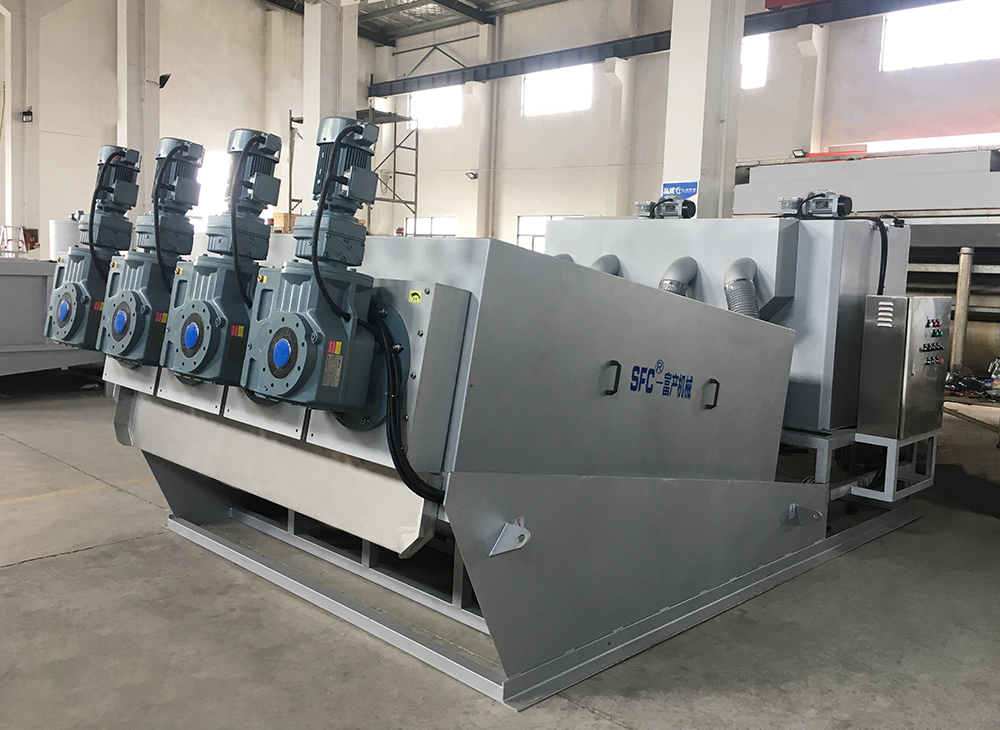
Stage 2B — High-pressure belt deep dewatering: SD series
Deep dewatering is a second mechanical pass, not a drying process. It takes sludge already dewatered to roughly S.S. 15–20% and presses it further, which is why it normally sits between a dewatering machine and a dryer, incinerator or landfill route.
The SD series high-pressure belt deep sludge dewatering machine (models SFC-SD05 to SFC-SD25) accepts S.S. 15–20% inlet and reaches two output bands. At 65–75% water content it treats 0.3–5.0 t/h and produces 60–760 kg/h of dried sludge; at 60–70% water content it treats 0.35–6.1 t/h and produces 70–920 kg/h. Motor power is modest for the duty: 0.55–3.0 kW driving motor, 2.2–5.5 kW sludge mixer, 0.25–1.5 kW sludge distribution spiral and 0.37–0.75 kW sludge crushing screw, all in SS304. It is used at municipal wastewater treatment plants and chemical plants, and as pretreatment for sludge drying and sludge incineration.
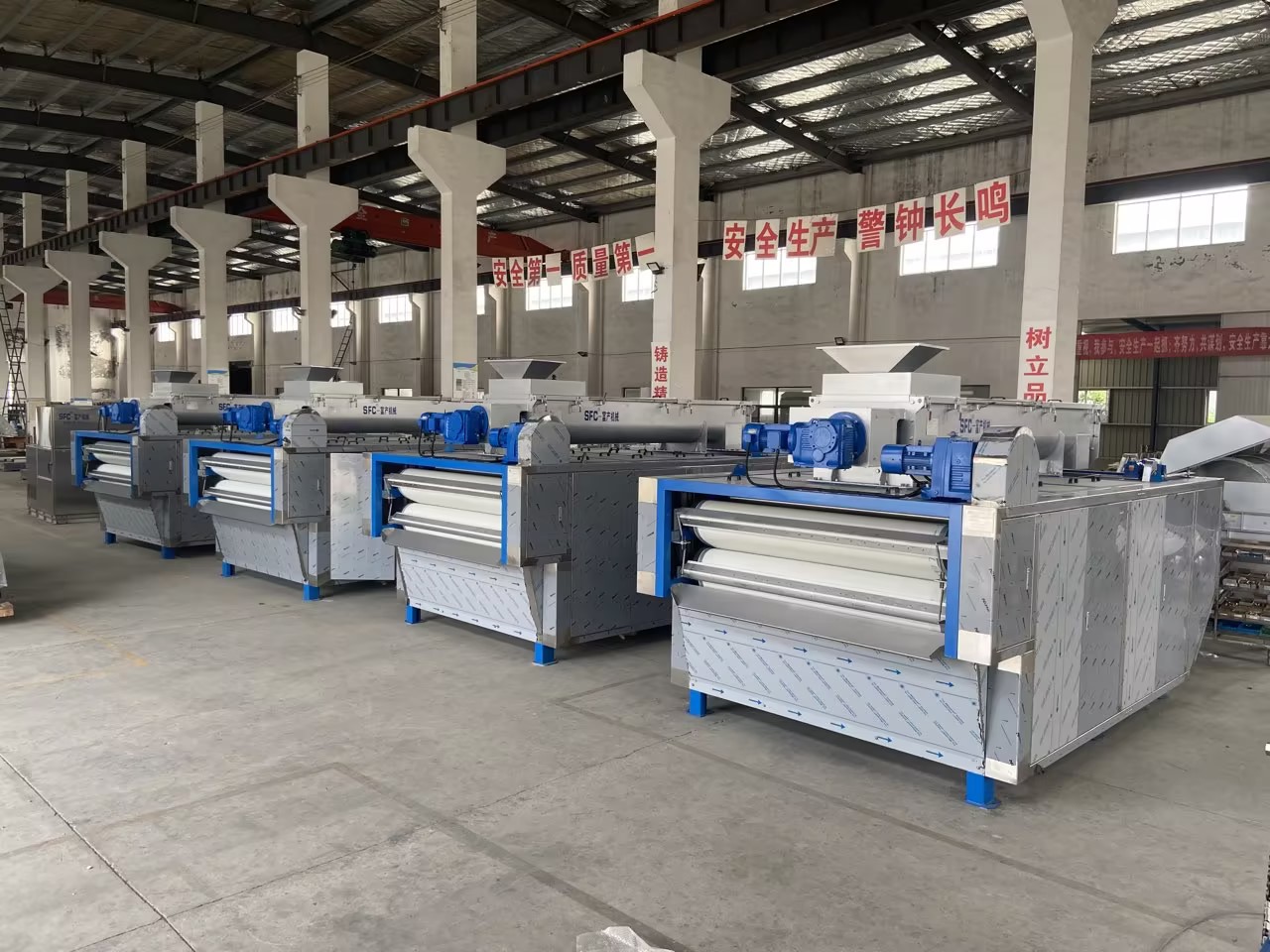
Stage 3 — Sludge drying equipment: SFC-TR and SFC-BSD
Drying is the only stage that removes water thermally. It is used when disposal, co-incineration or resource recovery requires a final water content well below what pressing can achieve.
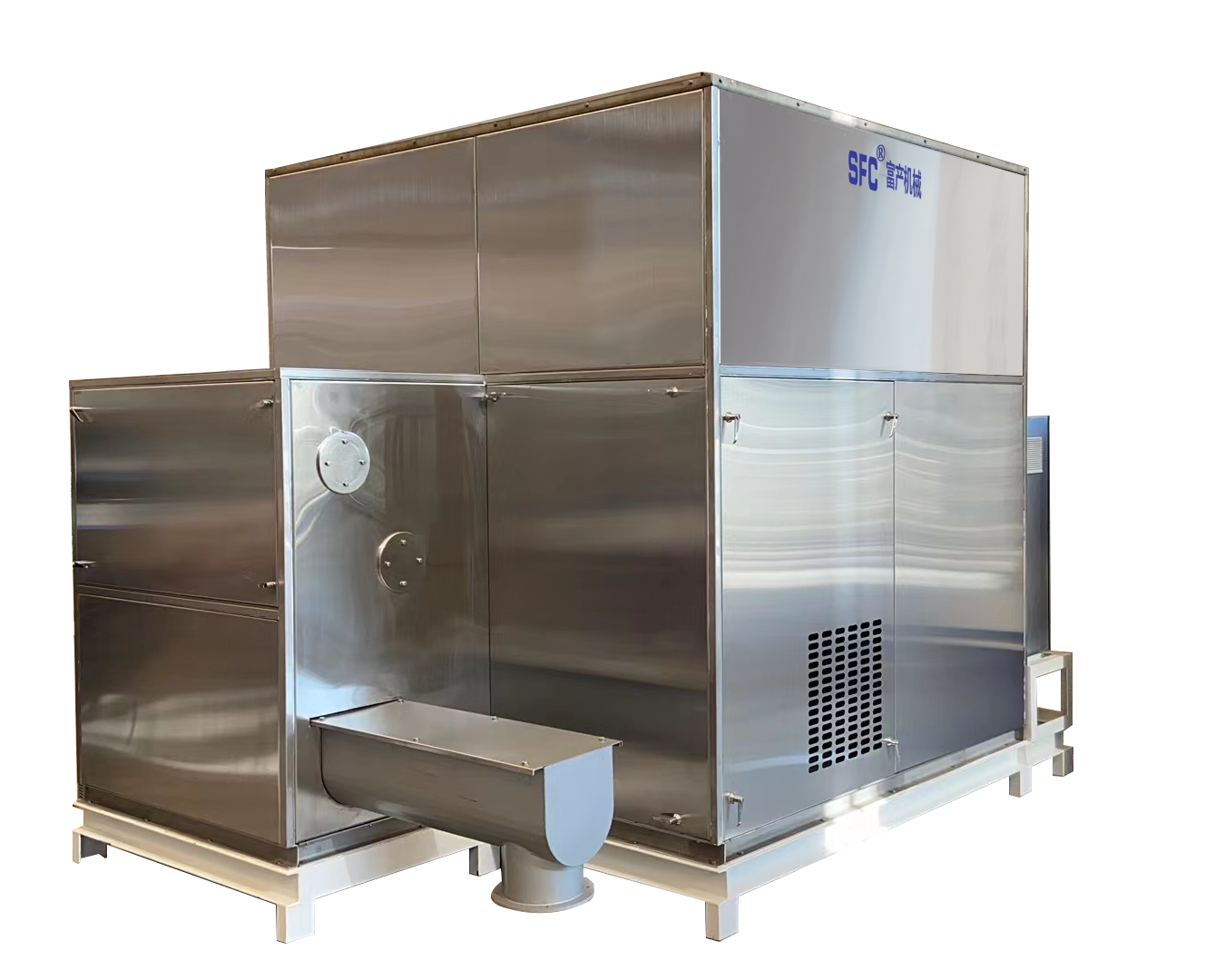
Low-temperature batch dryer — SFC-TR series
The SFC-TR series low-temperature sludge dryer (models SFC-TR1000 to SFC-TR9000) handles 1,000–9,000 L per batch of dried sludge with a water extraction capacity of 21–360 kg/h. Required power is 15–145 kW and unit power consumption is 0.4–0.55 kWh per kg of water removed. Sludge reduction after drying can reach up to 70%. The unit is built in SS304 and is intended for municipal wastewater treatment, industrial wastewater treatment and chemical sludge treatment.
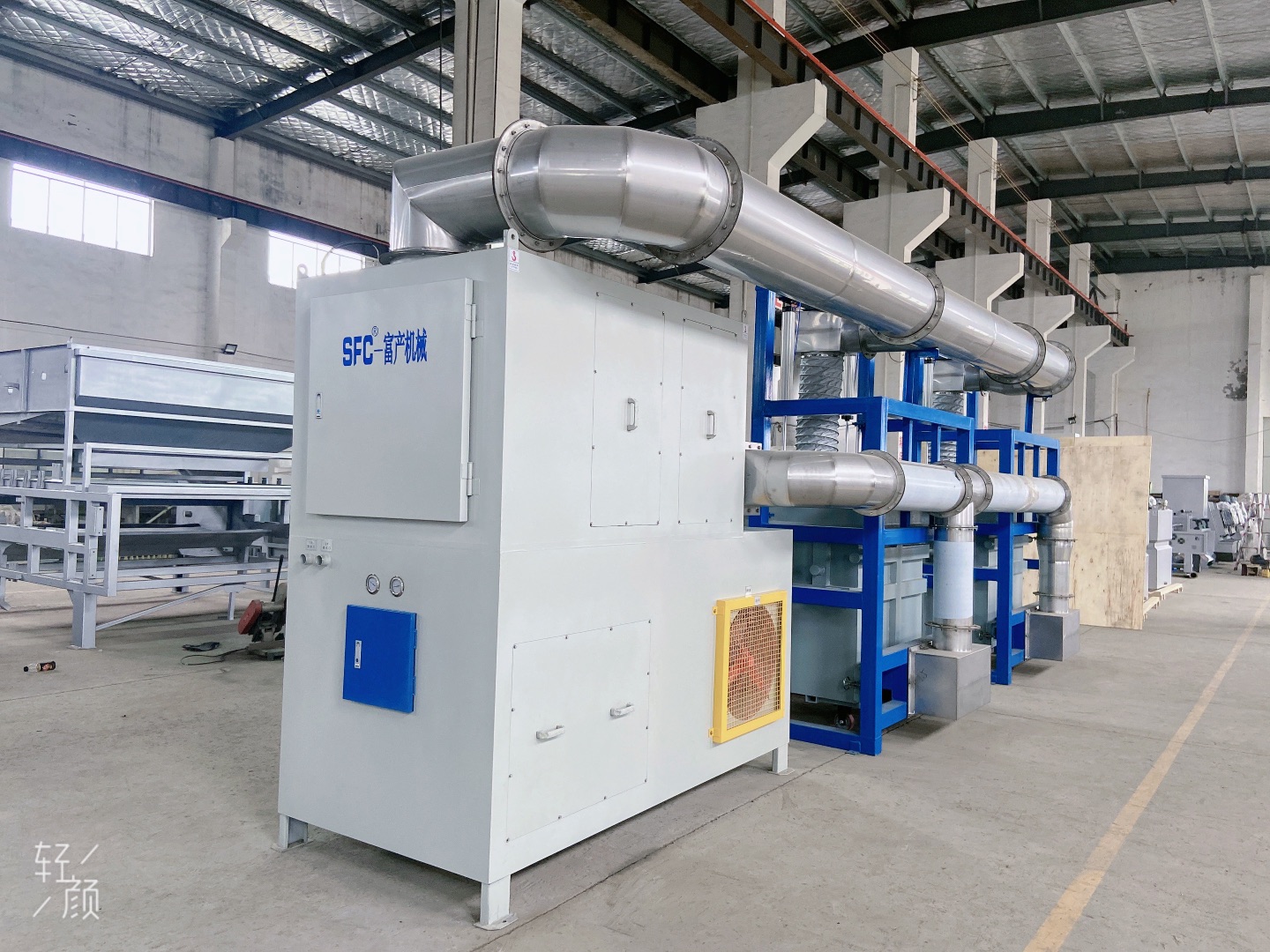
Belt sludge dryer — SFC-BSD series
The SFC-BSD series belt sludge dryer (models BSD1000 to BSD30000) is a fully enclosed, modular low-temperature sludge drying machine. It accepts inlet consistency of S.S. 15–25% or S.S. 25–35%, treats 0.8–57 t/h in the lower band and 1–90 t/h in the higher band, and delivers a final water content of 10–50%. System power consumption is 23–506 kW and the material of construction is SS304. Typical applications are sludge drying, sludge reduction, resource recovery and disposal cost reduction projects.
Step-by-step: how to move from 0.6% to a dry cake
- Measure inlet consistency and flow first. A single solids percentage decides whether you enter at the thickening stage (S.S. 0.6–1.5%), the screw press dewatering stage (S.S. 0.6–5.0%), the deep dewatering stage (S.S. 15–20%) or the drying stage (S.S. 15–35%). Dry residue and water content should be determined using the ISO 11465:2025 method so that quotations are compared on the same basis.
- Set a target water content for every stage, not only for the end. Thickening targets a 2.5–8% outlet consistency. Primary dewatering targets a 75–85% cake. Deep dewatering targets 60–75%. Drying targets a final 10–50%. Each target then becomes the design input for the next machine.
- Match sludge character to the machine family. Sticky, oily or high-inorganic sludge points to an SRD wear-free screw press. High-flow municipal or industrial duty points to a GDY integrated belt thickening and dewatering machine or an FTE rotary drum plus belt press unit. Small or medium projects usually fit an FTB unit. Sludge already at S.S. 15–20% belongs in an SD high-pressure belt press rather than another primary dewatering machine.
- Confirm build, control and compliance details. All series listed here use SS304 construction and continuous operation. Before ordering, confirm the PLC automation level, voltage and frequency, motor specifications, and whether modular options are needed for later capacity expansion. Confirm the certification scope that applies to your market.
- Validate with a sample before the model is fixed. For belt thickening, sludge sample testing and polymer selection are recommended before final sizing. For deep dewatering, conditioning chemicals and project-specific sludge testing are required. For difficult sludge, type confirmation after testing decides between a standard DL multi-disc screw press and an SRD wear-free screw press. Once the duty is confirmed, commercial terms can be settled: lead time is 30–60 days, minimum order quantity is one unit, and every unit is 100% tested before shipment.
Use cases: the same three stages in different industries
- Municipal wastewater treatment plant (CN). Eight FRDT rotary drum thickeners concentrate raw sludge from 99.4% moisture content down to 97%, elevating solids to 3% and improving the dewatering performance of the downstream plate-and-frame filter press. The fully enclosed design supports hygiene and site cleanliness, and the low number of wearing parts supports long-term reliability.
- Food processing wastewater (MY). An FTB-1000 belt drum sludge dewatering machine reduces sludge moisture content from 98.5% to below 80%. Reported outcome after eight years of operation: stable dewatering results, easy upkeep, and sludge handling costs reduced by 30%.
- Vegetable oil processing (CN). A DL screw press sludge dewatering machine reduces sludge moisture content from 97% to 77%, cutting sludge volume by up to 98% in an installation running for eight years.
- Pharmaceutical wastewater (CN). A DL screw press dewatering unit cuts sludge moisture content from 99% to under 85% in a plant that has been in service for ten years, with fully automated operation and low maintenance costs.
- Automotive parts manufacturing (CN). An SFC-TR low-temperature dryer takes sludge already dewatered to 75% moisture by a plate-and-frame press down to below 25%, removing over 700 kg of water per tonne of sludge with a volume reduction above 70%.
- Precision component manufacturing (CN). A BSD-2000 belt dryer reduces screw-press dewatered sludge from 85% moisture content to below 30%, lowering disposal volume and treatment cost; the installation has been in service for six years.
Comparison table: inlet consistency and output by equipment family
| Stage | Equipment family | Inlet consistency | Typical output | Material |
|---|---|---|---|---|
| Thickening | FBT belt sludge thickener (FBT-1000 to FBT-3000) | S.S. 0.6–1.5% | 12–95 m³/h; outlet 2.5–8%; 98% solid capture | SS304 |
| Thickening | FRDT rotary drum sludge thickener (FRDT-20 to FRDT-100) | S.S. 0.6–1.5% | 7.5–100 m³/h; outlet 2.5–8%; 95% solid capture | SS304 |
| Dewatering | DL multi-disc screw press (DL-101 to DL-404) | S.S. 0.6–5.0% | 1.5–900 kg/h dried sludge; cake 75–85% water | SS304 |
| Dewatering | SRD wear-free screw press (SRD-301 to SRD-404) | S.S. 0.6–5.0% | 25–900 kg/h dried sludge; cake 75–85% water | SS304 |
| Thickening + dewatering | GDY belt thickening and dewatering machine (GDY-1000 to GDY-3000) | S.S. 0.6–1.5% | 15–90 m³/h; 90–1,050 kg/h; cake 75–80% water | SS304 |
| Thickening + dewatering | FTB rotary drum plus belt press (FTB-500 to FTB-2000) | S.S. 1.5–2.5% | 3.0–30 m³/h; 45–450 kg/h; cake 75–85% water | SS304 |
| Thickening + dewatering | FTE rotary drum plus belt press (FTE-1000 to FTE-3000L) | S.S. 0.6–1.5% | 12–90 m³/h; 90–975 kg/h; cake 75–85% water | SS304 |
| Deep dewatering | SD high-pressure belt press (SFC-SD05 to SFC-SD25) | S.S. 15–20% | 0.3–6.1 t/h; 60–920 kg/h dried sludge; cake 60–75% water | SS304 |
| Drying | SFC-TR low-temperature dryer (SFC-TR1000 to SFC-TR9000) | Dewatered sludge; 1,000–9,000 L per batch | 21–360 kg water/h; reduction up to 70% | SS304 |
| Drying | SFC-BSD belt sludge dryer (BSD1000 to BSD30000) | S.S. 15–25% or S.S. 25–35% | 0.8–90 t/h; final water content 10–50% | SS304 |
Compliance reference: certifications and standards
Certification scope matters most for buyers in regulated markets, because it defines which equipment can be installed and inspected. The table below lists the certifications held for sludge treatment equipment, including thickening, dewatering, deep dewatering and drying units.
| Certification | Standard | Certificate number | Issued by | Market |
|---|---|---|---|---|
| CE (Machinery Directive and EMC Directive attestation of conformity) | EN ISO 12100:2010; EN 60204-1:2018+A1:2025; EN IEC 61000-6-2:2019; EN IEC 61000-6-4:2019; EN IEC 61000-3-2:2019+A2:2024; EN 61000-3-3:2013+A2:2021; Directives 2006/42/EC and 2014/30/EU | M.2025.206.C130494 | UDEM | EU |
| ISO 9001:2015 | GB/T19001-2016 / ISO9001:2015 | U24Q2SH704766R3S | GICG | Global |
| ISO 14001:2015 | GB/T24001-2016 / ISO14001:2015 | U25E2SH8024416R1S | GICG | Global |
| ISO 45001:2018 | GB/T45001-2020 / ISO45001:2018 | U25S2SH8031937R0S | GICG | Global |
The CE certificate for sludge treatment equipment was issued on 1 December 2025 and is valid to 30 November 2030. The ISO 9001, ISO 14001 and ISO 45001 certificates cover the design and marketing of environmental protection equipment, including sludge treatment equipment, sludge drying equipment and flocculant preparation systems.
FAQ
What certifications should I verify before buying sludge dewatering equipment?
For the EU market, CE marking under the Machinery Directive is the baseline. SFC Machinery's sludge treatment equipment holds CE certification number M.2025.206.C130494 issued by UDEM, covering EN ISO 12100:2010, EN 60204-1:2018+A1:2025, EN IEC 61000-6-2:2019, EN IEC 61000-6-4:2019, EN IEC 61000-3-2:2019+A2:2024 and EN 61000-3-3:2013+A2:2021 under Directives 2006/42/EC and 2014/30/EU; it was issued on 1 December 2025 and is valid to 30 November 2030. The same equipment scope is also covered by ISO 9001:2015 (certificate U24Q2SH704766R3S), ISO 14001:2015 (U25E2SH8024416R1S) and ISO 45001:2018 (U25S2SH8031937R0S), all issued by GICG. For performance claims, ISO 11465:2025 is the reference standard for determining dry residue and water content, so cake dryness figures should be traceable to that method.
Can one manufacturer supply the whole thickening, dewatering and drying chain, including customization?
SFC Machinery supplies all three stages and works in OEM and ODM mode. Customization covers equipment type and model selection based on sludge characteristics and treatment capacity requirements; processing capacity; equipment dimensions and footprint to fit site constraints; PLC control system configuration; power configuration including voltage, frequency and motor specifications; modular design options on dryers for later capacity expansion; and integration of auxiliary conveying, dosing and storage systems. Monthly production capacity is 40 units, every unit is 100% tested, and after-sales support includes remote technical support by phone, email or video, on-site commissioning and installation guidance on request, spare parts supply, warranty service per equipment type, operation and maintenance training, and long-term technical consultation.
What drives the operating budget more than the purchase price of a sludge dewatering system?
Operating cost is dominated by how much water each stage removes and at what energy cost. The published equipment ranges show the split clearly: a gravity belt thickener consumes 0.55–1.5 kW, an FTB combination unit uses a 0.37–1.1 kW driving motor, while low-temperature drying requires 15–145 kW for the SFC-TR series (0.4–0.55 kWh per kg of water removed) or 23–506 kW system power for the SFC-BSD series. Because mechanical stages remove water at far lower energy per kilogram than thermal stages, the largest budget lever is stage selection rather than machine size. Disposal volume is the second lever: drying reduces sludge volume by up to 70%, and in one vegetable oil plant a screw press cut moisture from 97% to 77%, reducing sludge volume by up to 98%. Because capacity, materials and control configuration vary by project, budget is confirmed against a specific model and duty rather than a generic price band.
Can we test our own sludge before choosing a model?
Sample validation is a documented requirement in SFC Machinery's process units, not an optional extra. For belt thickening, sludge sample testing and polymer selection are recommended before final sizing. For high-pressure deep dewatering, conditioning chemicals and project-specific sludge testing are required, because sludge mixer and modifier dosing determine the final cake. For difficult sludge, sludge type confirmation after testing decides whether a standard DL multi-disc screw press or an SRD wear-free screw press is appropriate. Sending a representative sample is the simplest next step: the sales team can be reached at sales@fuchanjx.com or by WhatsApp on +86 138-1673-2007, and the 2026 catalog lists the full model range across the thickening, dewatering, deep dewatering and drying stages for comparison before a quotation is issued.
What is the typical lead time and minimum order quantity for sludge dewatering equipment?
Lead time is 30–60 days, the minimum order quantity is one unit, and monthly production capacity is 40 units. Every unit is 100% tested before shipment. Export markets include Southeast Asia, Russia, South America, and the Middle East, with other regions available on request. Where thickening, dewatering, deep dewatering and drying equipment are ordered together as one line, confirming the sludge sample and target water content for each stage first avoids re-specifying models after the order is placed.
Conclusion
Sludge treatment is a sequence, not a single purchase. Thickening takes S.S. 0.6–1.5% sludge to a 2.5–8% outlet consistency. Dewatering produces a 75–85% cake. Deep dewatering presses that cake to 60–75% when disposal, drying or incineration requires it. Drying, the only thermal step, reaches a final water content of 10–50%.
Every machine family in this guide exists because one inlet condition differs from another: FBT and FRDT for S.S. 0.6–1.5% thickening, DL and SRD screw presses for S.S. 0.6–5.0%, GDY for integrated high-flow belt thickening and dewatering, FTB and FTE for rotary drum plus belt press duty at S.S. 1.5–2.5% and S.S. 0.6–1.5%, SD for S.S. 15–20% deep dewatering, and SFC-TR and SFC-BSD for drying at S.S. 15–35%. All of them are SS304 and all run continuously. Match the stage to the sludge, and the equipment list becomes short.
Next step: confirm your stage with a sludge sample
If you are at the research or evaluation stage, the fastest way to narrow the equipment list is to send a sludge sample with your inlet consistency and target water content. SFC Machinery confirms whether your project starts at thickening, dewatering, deep dewatering or drying, and issues a quotation for the specific model and duty.
Email: sales@fuchanjx.com | Tel and WhatsApp: +86 138-1673-2007 | Web: www.sfceco.com | Address: Room 1201, 1122 Xinjinqiao Rd, Pudong New District, Shanghai, PRC China
Download the Product Catalog (SFC-2026): Product Catalog-SFC-2026.pdf
Have Questions or Need More Details?
Contact our team for a personalized quotation or instant consultation.
Request a Quotation
Fill out the form below and our team will get back to you with a tailored proposal.
WhatsApp Direct Chat
Prefer to chat in real-time? Message us on WhatsApp for instant assistance & quick answers.
- Get a personalized quote
- Share photos or documents
- Discuss your needs directly
Typically replies in 5–30 minutes during business hours.