High-Pressure Belt Press vs Low-Temperature Sludge Drying
The last stage of a sludge line should be the least expensive stage that still satisfies the outlet requirement. For most municipal wastewater treatment plants and chemical plants, that means mechanical deep dewatering first: the SD series high-pressure belt deep dewatering machine lowers cake moisture after conventional dewatering without adding thermal energy. Low-temperature drying — the SFC-TR and SFC-BSD units — belongs after that stage, for projects whose disposal, reuse or co-processing route needs moisture reduced beyond what mechanical pressure can reach.
This is a decision-stage comparison for plants whose thickener and dewatering press are already running or already specified, and where one final stage still has to be chosen. It compares the two options on process position, outlet solids, energy, footprint and enclosure, maintenance, and the testing that should happen before either is ordered. In most cases the two are not competitors at all: they are consecutive stages, and the real question is where the mechanical chain should stop.
One rule governs the numbers here. Manufacturer figures describe equipment as the manufacturer states it. The numbers that decide a purchase — outlet dry solids, polymer dose, energy per kilogram of solids — come from a test on the plant's own sludge, with a defined feed and a defined measurement method.
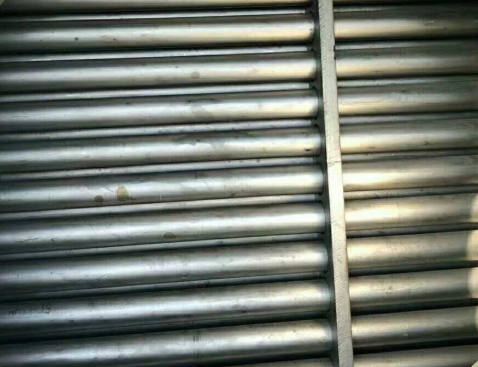
Smooth 316L stainless steel tubes in the low-temperature dryer condenser, built without fins to resist scaling and corrosion.
What the final step actually decides
Sludge treatment is a chain of water-removal stages, and each stage has a different job. Thickening raises solids so downstream equipment can be smaller. Dewatering produces a cake that can be pumped, conveyed and loaded. Deep dewatering pushes moisture lower using mechanical pressure. Drying removes water by evaporation. The choice between the SD series and the SFC-TR/SFC-BSD dryers is therefore a choice about where mechanical water removal stops in this particular plant.
The receiving facility, not the equipment catalogue, sets the requirement. A landfill, a co-processing kiln or a composting site applies a moisture or dry-solids limit written into its acceptance terms. Dewatered sludge cake dry solids are commonly described as ranging from roughly 15% to 45%, a spread wide enough that no general figure can serve as a project target. Two plants with the same inlet flow can legitimately need different final steps.
The cost structures also differ. Mechanical deep dewatering consumes electricity, polymer and wear parts. Thermal drying consumes electricity or heat for evaporation, plus maintenance on heat-exchange surfaces. Comparing the two on installed motor power or headline price hides that difference. The comparable units are kWh per kg of total solids, grams of polymer per kg of total solids, and maintenance cost per year at a stated throughput.
Where the market and the published data sit
The global sludge dewatering equipment market was estimated at USD 6.4 billion in 2026, and Asia Pacific held a 37.57% share of the dewatering equipment market in 2024, according to Global Market Insights and Fortune Business Insights respectively. Market size does not tell an individual plant which stage to buy, but it explains why so many configurations are on offer and why supplier claims are difficult to compare directly.
A 2023 peer-reviewed review of inventory data for sewage sludge dewatering and drying is more directly useful. It identified 55 dewatering datasets and 21 drying datasets, and reported approximate total solids of 25–30% after mechanical dewatering and 35–40% after deep dewatering, chemical-agent consumption of 5–15 g per kg TS for mechanical dewatering, average mechanical dewatering energy of about 0.12 kWh/kg TS for raw sludge and 0.26 kWh/kg TS for digested sludge, and average thermal drying energy of about 3.8 kWh/kg TS.
These are literature bands, not equipment guarantees. The underlying datasets differ in feed sludge, conditioning, measurement protocol and system boundary, and the review's own comparison notes treat mechanical dewatering and thermal drying as different process classes that cannot be ranked on those energy figures alone. They remain the right kind of number for a tender: they separate the ranges the two stages occupy and show that thermal water removal carries a far larger energy input per kilogram of solids than mechanical water removal, before heat-source efficiency is even considered.
Option 1: the SD series high-pressure belt deep dewatering machine
Shanghai Fuchan Machinery Technology Co., Ltd. (SFC Machinery) is an environmental equipment manufacturer established in 2007 in Pudong New Area, Shanghai, with an annual output of 500 sets and about 30% of sales exported to Southeast Asia, Russia, South America and the Middle East. Its range covers sludge thickening, dewatering, deep dewatering, drying and polymer preparation, which is why the two final steps in this comparison can come from one supplier and be sequenced within one line.
The SD series is a high-pressure belt press dewatering system used as a secondary deep dewatering stage after conventional dewatering. Its contribution to the line is a further reduction in final moisture, which lowers the mass that has to be transported and disposed of, and with it transport and disposal cost. Inside the plant it is a mechanical stage: it adds pressure, not heat.
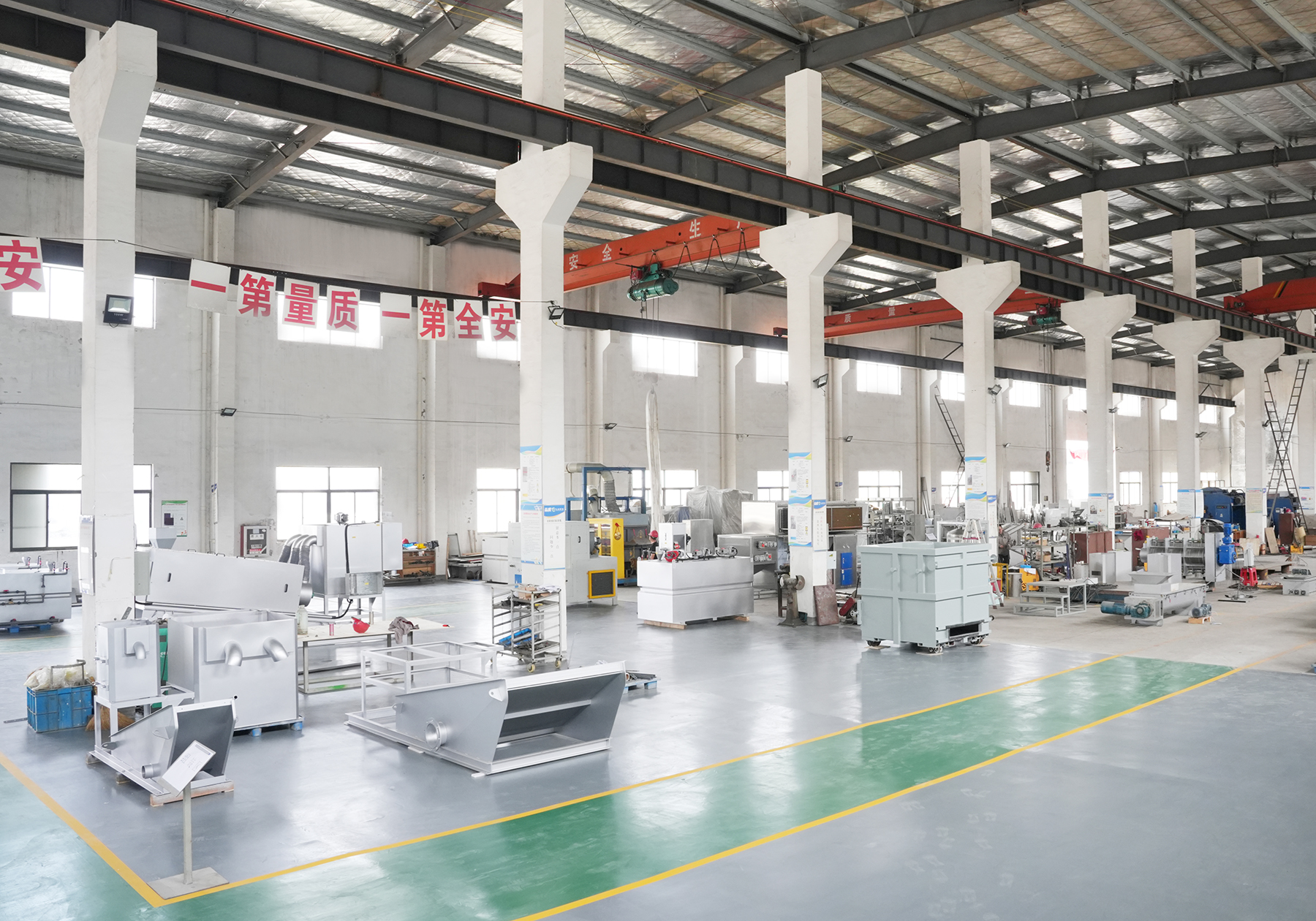
Production line at SFC's Shanghai facility, where thickening, dewatering and drying equipment is assembled.
What determines its outlet solids
Four inputs set the result: feed solids after the preceding stage, polymer conditioning, belt pressure and throughput. None of them can be read off a datasheet for a new sludge. A polymer jar test and a conditioning review ahead of final sizing are the practical way to establish the working dose, and the outlet should be confirmed on the actual sludge rather than extrapolated from another plant.
Operating controls specific to belt machines
Belt dewatering has known failure modes, and SFC's stated control measures for them are worth writing into an operating procedure. Filter-belt deviation is countered by a pneumatic correction valve that must stay free-moving and by a limit switch that should be inspected regularly. Filter-belt clogging is managed with the wash-water system, controlled feed concentration and adjusted belt speed. Belt tension and roller alignment are checked at installation and commissioning, not discovered later.
The economic argument for this stage is simple: it adds mechanical water removal to an existing line without evaporation energy, and every point of dry solids it gains is water the plant does not pay to move.
Option 2: the SFC-TR and SFC-BSD low-temperature sludge dryers
The SFC-TR and SFC-BSD are low-temperature sludge dryers available in container-type and belt-type configurations, both built around a modular, fully enclosed belt design. The series is described with a water extraction capacity of 21–360 kg/h. Low-temperature drying can be integrated with waste-heat recovery where the site has heat available, and SFC states that sludge volume can be reduced by more than 70% with safe low-temperature operation.
The evaporator is where long-term cost is decided. SFC's condenser uses multiple rows of smooth 316L stainless steel tubes without fins, so a natural water film forms on the tube surface, captures dust and prevents scale from adhering; an automated spray-flushing system periodically washes deposits away with the condensate. Against conventional finned-tube dryers, SFC states a service life of 5–8 years where finned-tube units typically show critical corrosion within about three years, roughly 50% lower post-operation maintenance expense for evaporator cleaning, corrosion repair and replacement, a maintenance cycle extended by about 200%, and overall efficiency 1.3–1.5 times that of conventional finned-tube systems.
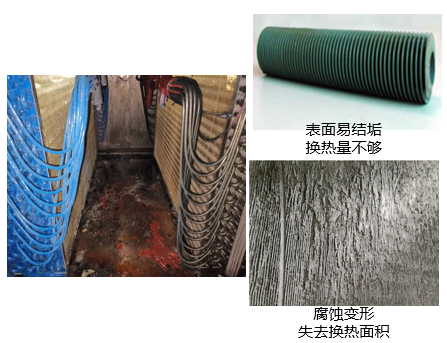
Fouled and corroded finned-tube coils: the failure mode the smooth-tube condenser is designed to avoid.
Fully enclosed construction is not only a housing choice. Where odour control is a requirement, an enclosed drying system combined with a properly connected sludge conveying system is the appropriate configuration; SFC applies the same logic upstream by offering enclosed or semi-enclosed thickening options for odour-sensitive sites.
Reading the 21–360 kg/h figure correctly
That figure describes water extraction, not wet sludge throughput. The duty a project needs is the mass of water that must leave the cake per hour, and it depends on feed solids, target solids and throughput. A worked illustration with assumed numbers shows why. Take 1,000 kg/h of cake at 20% total solids: it carries 200 kg/h of dry solids. Drying it to 60% total solids leaves about 333 kg/h of product, so roughly 667 kg/h of water has to be evaporated. Send the same 200 kg/h of solids in at 30% instead, and the line produces about 667 kg/h of cake and needs only about 334 kg/h of evaporation — half the thermal duty at the same plant throughput. The arithmetic is illustrative rather than a performance claim, but it explains why optimising the mechanical stage before sizing a dryer changes the equipment list.
Head-to-head comparison
| Criterion | SD series high-pressure belt deep dewatering | SFC-TR / SFC-BSD low-temperature drying |
|---|---|---|
| Process class | Mechanical pressure, no evaporation | Thermal low-temperature drying by evaporation |
| Position in the line | After thickening and conventional dewatering; secondary deep dewatering step | After dewatering, when the outlet must go beyond mechanical limits |
| Outlet solids basis | Literature deep dewatering band of 35–40% TS; confirmed on the site's sludge | Set by the project moisture target; SFC states over 70% volume reduction |
| Energy input | Literature average 0.12 kWh/kg TS for raw sludge, 0.26 kWh/kg TS for digested sludge | Literature average about 3.8 kWh/kg TS for thermal drying |
| Duty sizing | Feed solids load, polymer dose, belt pressure, throughput | 21–360 kg/h water extraction across the series; sized on residual water |
| Footprint and enclosure | Belt frame with wash-water, drainage and guarding provisions | Modular fully enclosed belt design; container-type configuration available |
| Odour and housekeeping | Ventilation and drainage planning required around the press | Enclosed structure contains odour and dust |
| Maintenance driver | Correction valve and limit switch checks, wash water, roller alignment, belt tension | Condenser fouling and corrosion, managed by automatic spray flushing |
| Heat-exchange durability | Not applicable to this stage | Smooth 316L tube; SFC states 5–8 year life against about 3 years for finned tube |
| Best fit | Route accepts a mechanically dewatered cake; power cost and disposal volume dominate | Further moisture reduction for reuse, co-processing, incineration feed or long transport |
| Main risk if misapplied | A target outside the mechanical range cannot be reached by adjustment | Thermal energy cost carried with an unstable or over-wet feed |
Basis for the table: SFC product statements for the SD series and the SFC-TR/SFC-BSD dryers, literature bands from a 2023 peer-reviewed review, and process logic. The literature figures belong to different process classes and system boundaries and are not an efficiency ranking. Outlet values must be confirmed by test on the project's own sludge.
Step-by-step: how a project should decide
- Fix the outlet requirement with the receiving facility. Write the accepted dry-solids or moisture range, the measurement method and who performs the test into the specification. An internal target that no landfill or kiln has agreed to is not a requirement.
- Characterise the sludge before selecting equipment. Sludge source, daily volume, operating hours, feed solids and target moisture are the inputs that separate thickening, dewatering, deep dewatering and drying. Missing any of them is the most common reason a selection stalls.
- Confirm the polymer response. Run a jar test and review conditioning before final sizing; poor flocculation depresses the outlet of any dewatering machine regardless of its pressure capability.
- Test whether deep dewatering alone reaches the target. Compare a pilot result on the actual sludge against the 35–40% TS literature band. If the receiving limit is met with margin, stop here: adding a thermal stage buys no additional compliance.
- If drying is required, size it on water extraction. Convert the required outlet into kilograms of water per hour, check peak flow and solids loading against daily volume and operating hours, and only then divide the duty across units.
- Check the site envelope and utilities. Enclosure and odour requirements, available power, waste-heat availability, condensate handling, maintenance access and lifting space decide which dryer configuration is buildable, not only which one is efficient.
- Set the acceptance test and the operating envelope. Define outlet solids at a stated feed, polymer dose, an energy boundary in kWh/kg TS and a maintenance schedule. Expect parameters to be adjusted during commissioning to actual sludge performance, and confirm the final moisture target before operation begins.
Where each option fits: three project situations
Municipal plant sending cake to landfill or co-processing
If the acceptance terms sit inside the mechanical range, the SD series is the final step and no dryer is needed. The decision hinges on a pilot outlet with margin over the limit, and on transport distance: the further the cake travels, the more a few points of dry solids are worth at the weighbridge.
Municipal plant with reuse, incineration or a strict volume target
Here the line is sequential: conventional dewatering, SD deep dewatering, then a belt-type low-temperature dryer sized on the residual water. Raising cake solids before the dryer is the cheapest way to cut thermal duty, and the enclosed configuration addresses odour at the same time.
Chemical plant with a tight plot or odour-sensitive neighbours
A compact enclosed unit is often the constraint-driven answer, and the container-type configuration exists for that situation. Sludge character still comes first: oily, sticky or high-inorganic sludges need a conditioning review before any dryer capacity is fixed, and the heat source must be confirmed, because low-temperature drying with waste-heat recovery performs differently from an electrically driven installation.
Limitations and what to verify before signing
- Mechanical pressure has a ceiling. A belt press removes free and interstitial water; it does not evaporate water bound in the sludge matrix. If the tested outlet misses the limit, further adjustment will not close the gap.
- Thermal drying carries a much larger energy input per kilogram of solids, and its real cost depends on the heat source, its efficiency and local tariffs. The literature figures for mechanical and thermal stages are not an efficiency ranking.
- Dryer performance depends on stable feed, controlled temperature and air circulation. An unstable feed or an over-wet cake raises energy use and can destabilise drying.
- Both stages can be over-sized. Matching capacity to daily sludge volume and operating hours, and checking peak flow and solids loading before the final model is fixed, prevents a plant from paying for capacity it never uses.
- Manufacturer statements describe the manufacturer's design. Only a test on the project's sludge establishes the outlet the plant can guarantee to its own receiving facility.
Frequently asked questions
What certifications and documentation should be verified before ordering either stage?
SFC holds ISO 9001:2015, ISO 14001, ISO 45001:2018 and CE certification. For a purchase, ask for the certificate scope that covers the specific model being quoted, the electrical and control documentation, and the proposed acceptance-test protocol, so that compliance is attached to the equipment actually delivered rather than to the company in general.
Can the SD series deep dewatering machine replace a dryer completely?
Only when the mechanically achievable outlet satisfies the receiving facility. Deep dewatering is reported at roughly 35–40% total solids in the literature, against 25–30% for conventional mechanical dewatering, while dewatered cake is generally described as spanning about 15–45% dry solids. If the acceptance limit sits inside the tested mechanical range, the belt press is the whole final step; if it does not, drying is added after it rather than instead of it.
Which option costs more to operate?
No general answer holds, because the result depends on local electricity and heat prices and on sludge-specific dose and throughput. The honest comparison uses three normalised figures: kWh per kg TS, grams of polymer per kg TS, and maintenance cost per year. Literature benchmarks put mechanical dewatering near 0.12–0.26 kWh/kg TS and thermal drying near 3.8 kWh/kg TS, in different process classes and boundaries; SFC states that its smooth-tube condenser reduces evaporator-related maintenance expense by about 50% against finned-tube dryers, which improves the thermal side of the comparison but does not remove its energy input.
Can we test our sludge before committing to a configuration?
Yes, and the project should. A polymer jar test and conditioning review come before final sizing, a pilot run on the actual sludge establishes the achievable outlet, and the final moisture target is confirmed before operation begins. Operating parameters are then adjusted during commissioning to actual sludge performance.
What information is needed before a model and delivery schedule can be confirmed?
Sludge source, daily sludge volume, operating hours, feed solids, target moisture, peak flow and solids loading, available power and heat, site layout and enclosure requirements. These inputs decide whether the answer is deep dewatering, drying, or both, and how the drying duty is divided across units; a quotation prepared without them usually has to be revised. SFC publishes its full equipment range, including the SD series and the SFC-TR/SFC-BSD dryers, in its product catalogue.
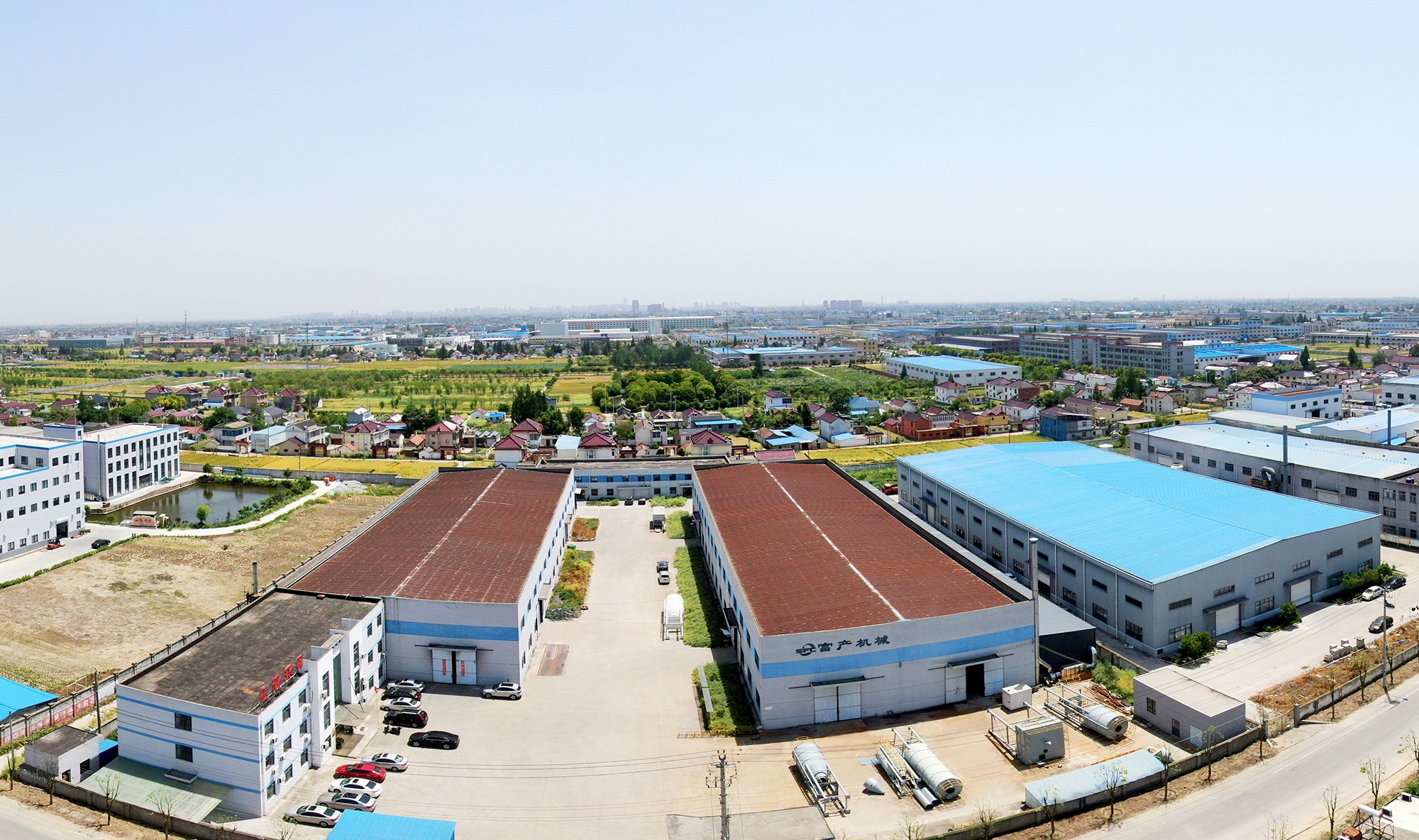
SFC's manufacturing base in Pudong New Area, Shanghai.
Next step: compare both stages against your own numbers. The SFC 2026 product catalogue lists the SD series deep dewatering systems and the SFC-TR/SFC-BSD low-temperature dryers with their configurations, and the technical team at Shanghai Fuchan Machinery Technology Co., Ltd. can review sludge data before a model is proposed.
Conclusion: mechanical first, thermal where the limit demands it
The final step is decided by the outlet requirement, not by the equipment category. Where the receiving facility accepts a mechanically dewatered cake, the SD series high-pressure belt deep dewatering machine closes the line at the lowest energy input per kilogram of solids, and every point of dry solids it gains reduces transport and disposal volume. Where the project needs moisture reduced beyond the mechanical range — for reuse, co-processing, incineration feed or long-distance transport — an SFC-TR or SFC-BSD low-temperature dryer follows the dewatering stage, sized on the water that remains rather than on the tonnage entering the plant.
The sequence also protects the budget. Mechanical water removal is the cheaper kilogram of water removed; thermal drying is the stage that reaches the moisture mechanical pressure cannot. Projects that optimise the first and size the second on the residual duty end up with a shorter equipment list and a smaller energy bill than projects that buy drying to compensate for an under-performing dewatering stage.
Have Questions or Need More Details?
Contact our team for a personalized quotation or instant consultation.
Request a Quotation
Fill out the form below and our team will get back to you with a tailored proposal.
WhatsApp Direct Chat
Prefer to chat in real-time? Message us on WhatsApp for instant assistance & quick answers.
- Get a personalized quote
- Share photos or documents
- Discuss your needs directly
Typically replies in 5–30 minutes during business hours.