Integrated Thickening and Dewatering Systems for Municipal Wastewater Projects
An integrated thickening and dewatering system performs two unit operations on a single machine frame: solids concentration and mechanical dewatering. Municipal excess or surplus sludge arriving at 0.6–2.5% solids leaves the unit as a cake in the 75–85% water content range, with no intermediate thickening tank, no transfer pump between stages, and no second control panel to operate.
This article is written for consulting engineers, plant owners and procurement teams specifying sludge dewatering equipment for a municipal wastewater project. It explains where integrated machines belong in a treatment line, how the GDY, FTB and FTE series from Shanghai Fuchan Machinery Technology Co., Ltd. differ by feed consistency and flow capacity, and what should be fixed in the specification before an order is placed.
Shanghai Fuchan Machinery Technology Co., Ltd. (SFC Machinery) is an environmental equipment manufacturer established in 2007 in Pudong New Area, Shanghai, producing sludge thickening, dewatering, deep dewatering and drying equipment together with polymer preparation and dosing systems.
Problem definition: why municipal plants move from two machines to one
Conventional municipal sludge lines split the duty in two. A gravity belt thickener or a rotary drum thickener lifts dilute sludge to a 2.5–8% outlet consistency, and a belt press, screw press or filter press then produces the cake. Each stage brings its own footprint, drive package, wash-water connection, ventilation point and polymer dosing loop.
The practical consequences of that split are predictable:
- Intermediate handling. Thickened sludge has to be pumped or buffered between the two machines, and that transfer is a common source of blockage and unscheduled cleaning.
- Two control interfaces. Two local panels must be integrated into plant SCADA, doubling the points that need commissioning and calibration.
- Oversized dewatering stage. A press sized on dilute feed spends most of its capacity moving water rather than solids, which is why thickener outlet consistency is such a sensitive design input.
- More places for dosing to drift. Published inventory data puts conditioning-agent consumption for mechanical dewatering at roughly 5–15 g per kg of total solids; running two stages means two dosing points to control.
- Footprint. The dewatering building is frequently the tightest space in a municipal upgrade, and two machines rarely fit where one was planned.
Integration is not automatically the right answer. Where feed consistency already exceeds the inlet band of an integrated belt machine — for example a plant that thickens to 3–5% solids, or a site that already owns a plate-and-frame filter press — a dedicated thickener feeding the existing press can be the more economical move. The decisions below set out how to tell the two situations apart.
Industry background: market scale and published performance benchmarks
Global Market Insights estimates the global sludge dewatering equipment market at USD 5.8 billion in 2025, and forecasts growth from USD 6.4 billion in 2026 to USD 14 billion by 2035. Fortune Business Insights places Asia Pacific at 37.57% of the dewatering equipment market in 2024, a concentration that keeps regional manufacturing and service capability relevant when a municipal project is tendered.
Performance expectations should be anchored to published data rather than to supplier adjectives. A 2023 peer-reviewed review of sludge dewatering and drying inventory data reports typical mechanically dewatered solids of approximately 25–30% TS, approximately 35–40% TS for deep dewatering, conditioning-agent consumption of 5–15 g per kg TS, and average energy use of 0.12 kWh per kg TS for raw sludge and 0.26 kWh per kg TS for digested sludge. The same review puts thermal drying at an average of about 3.8 kWh per kg TS. Drying is a different process class with a materially higher energy burden, and it should be justified separately from dewatering rather than bundled into the same decision.
Definitions also matter. Trade sources describe dewatering as a process that removes most of the water from biosolids and produces a cake at roughly 15–45% dry solids, in contrast to thickening. Equipment datasheets in this article state cake water content (75–85%) rather than total solids. Both bases are legitimate, but the acceptance test must name one of them, otherwise a supplier and a plant can disagree about whether the same machine met the same target.
Equipment classification is another useful reference point. Manufacturers such as HUBER Technology group belt filter presses and screw presses as continuous sludge-dewatering systems, which is the category most municipal tenders actually compete in.
Detailed solution: the GDY, FTB and FTE integrated platforms
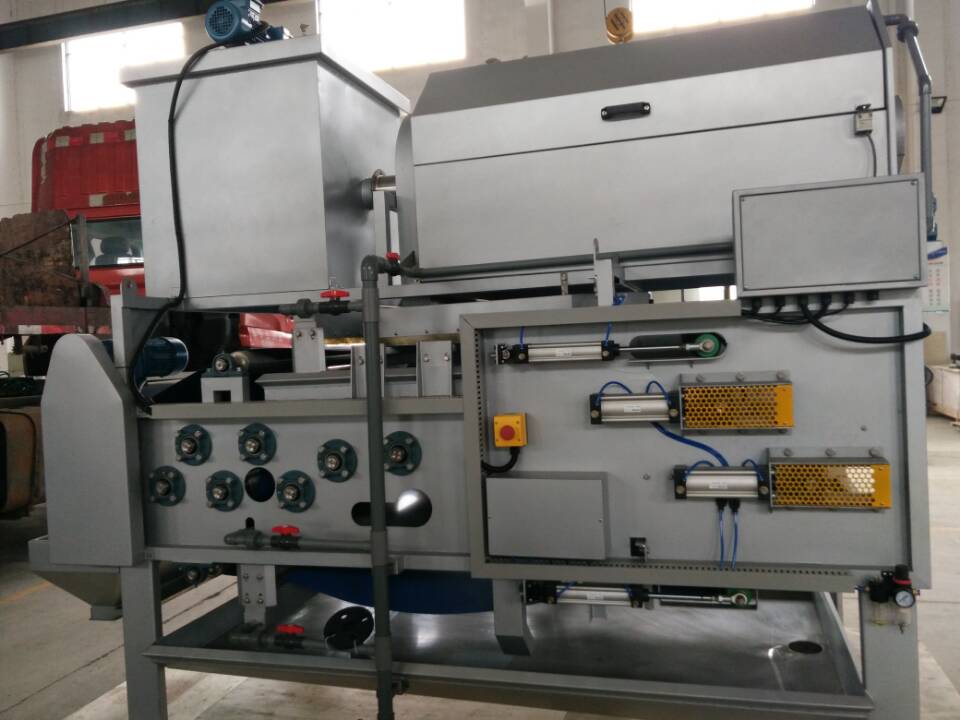
SFC builds three integrated thickening and dewatering platforms, all in SS304 and all combining a thickening stage with a belt-press dewatering stage on a common frame. They differ mainly in thickening principle, belt width, accepted feed consistency and resulting throughput band.
GDY series — gravity belt thickening plus belt-press dewatering
Product 5174, the GDY series, is a belt thickening and dewatering integrated machine that uses gravity belt thickening ahead of belt-press dewatering. Belt width runs from 1000 to 3000 mm across GDY-1000, GDY-1500, GDY-2000, GDY-2500 and GDY-3000. The GDY accepts feed at 0.6–1.5% solids, treats 15–90 m³/h, produces 90–1050 kg/h of dried sludge and delivers cake at 75–80% water content. Installed power is modest for that throughput: a 1.1–4.0 kW main drive, a 0.55–1.5 kW belt thickener drive and a 0.37–0.75 kW disposal agitator. The series is intended for high-flow continuous sludge dewatering in municipal and industrial plants, including paper mills and printing and dyeing wastewater.
FTB series — rotary drum thickening plus belt-press dewatering
Product 5175, the FTB series, replaces gravity thickening with a rotary drum thickener and is offered as FTB-500, FTB-750, FTB-1000, FTB-1500, FTB-1500L and FTB-2000, with belt widths of 500–2000 mm. It accepts a slightly thicker feed — 1.5–2.5% solids — and treats 3.0–30 m³/h, producing 45–450 kg/h of dried sludge at 75–85% cake water content. Drive power is correspondingly low: a 0.37–1.1 kW main drive, with separate 0.37–0.55 kW drum thickener and disposal agitator motors. The FTB is positioned for small and medium sludge dewatering projects where an enclosed drum is preferred for odour and splash control.
FTE series — rotary drum thickening plus belt-press dewatering, wider frame
Product 5176, the FTE series, uses the same rotary drum thickening principle as the FTB on a wider frame, with belt widths of 1000–3000 mm across FTE-1000, FTE-1500, FTE-2000, FTE-2500, FTE-3000 and the corresponding L models. It accepts 0.6–1.5% solids feed — the same dilution range as the GDY — and treats 12–90 m³/h, producing 90–975 kg/h of dried sludge at 75–85% cake water content, with a 0.55–4.0 kW main drive, a 0.37–0.75 kW drum thickener motor and a 0.37–0.75 kW disposal agitator. The FTE is aimed at medium and large continuous projects where the drum configuration is preferred at high flow.
Supporting equipment that completes the line
- Thickening only, when a press already exists. The FBT belt sludge thickener (product 5120) handles 12–95 m³/h, reaches 2.5–8% outlet consistency and reports a 98% solid-capture rate. The FRDT rotary drum thickener (product 5122) handles 7.5–100 m³/h with 30–80 mesh filter openings, a drum speed of around 10 rpm and a 95% solid-capture rate.
- Thicker or stickier feed. The DL screw press (product 5160) accepts 0.6–5.0% solids and produces 1.5–900 kg/h of dried sludge at 75–85% cake water content. The SRD wear-free screw press (product 5166) accepts the same 0.6–5.0% range and is specified for low-concentration, sticky, oily and high-inorganic-content sludge at 25–900 kg/h.
- A drier cake than mechanical dewatering allows. The SD high-pressure belt deep dewatering machine (product 5179) takes 15–20% solids feed and delivers cake at 65–75% or 60–70% water content.
- Volume reduction before disposal. The SFC-BSD belt sludge dryer (product 5183) accepts 15–25% or 25–35% solids feed and reaches a final water content of 10–50%. The SFC-TR low-temperature dryer (product 5181) reduces sludge volume by up to 70%.
Materials, controls and customization scope
All product families listed above are built in SS304. Turnkey scope can additionally cover screw conveyors, sludge storage silos, lime storage silos, air blowers, aeration systems and material handling equipment, so the dewatering stage can be handed over as a complete line rather than as a machine with interface gaps.
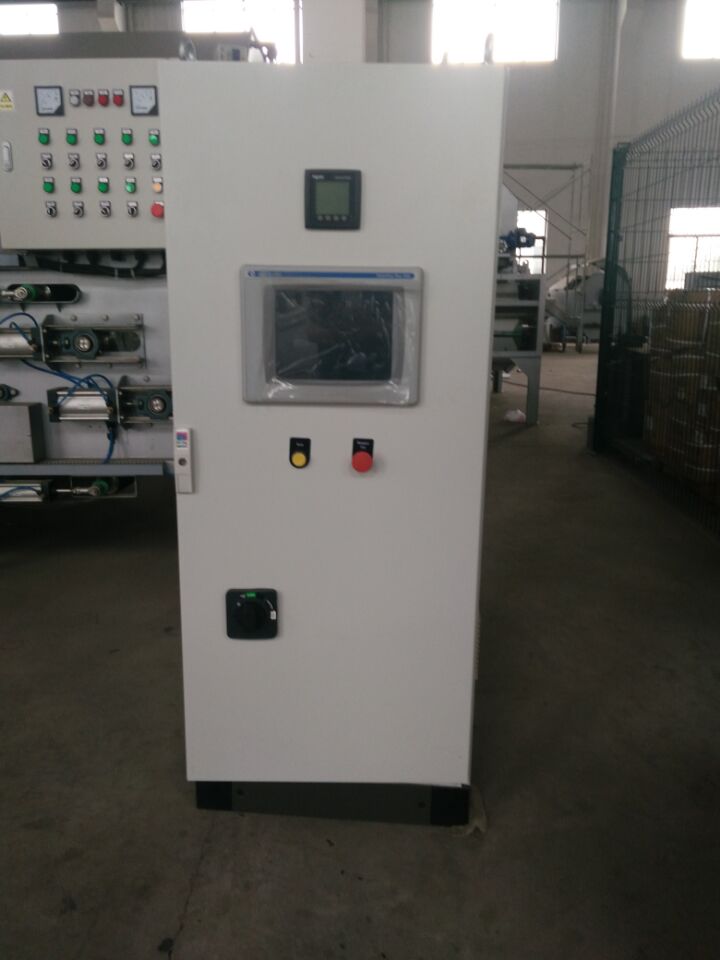
Customization is where most municipal projects are actually won or lost, because the feed is known but the building is not. SFC customizes equipment type and model selection based on sludge characteristics and treatment capacity, processing capacity, equipment dimensions and footprint to fit site constraints, control system configuration and PLC automation level, power configuration (voltage, frequency and motor specifications), modular design options for later capacity expansion, and integration of auxiliary conveying, dosing and storage systems. OEM and ODM production is available.
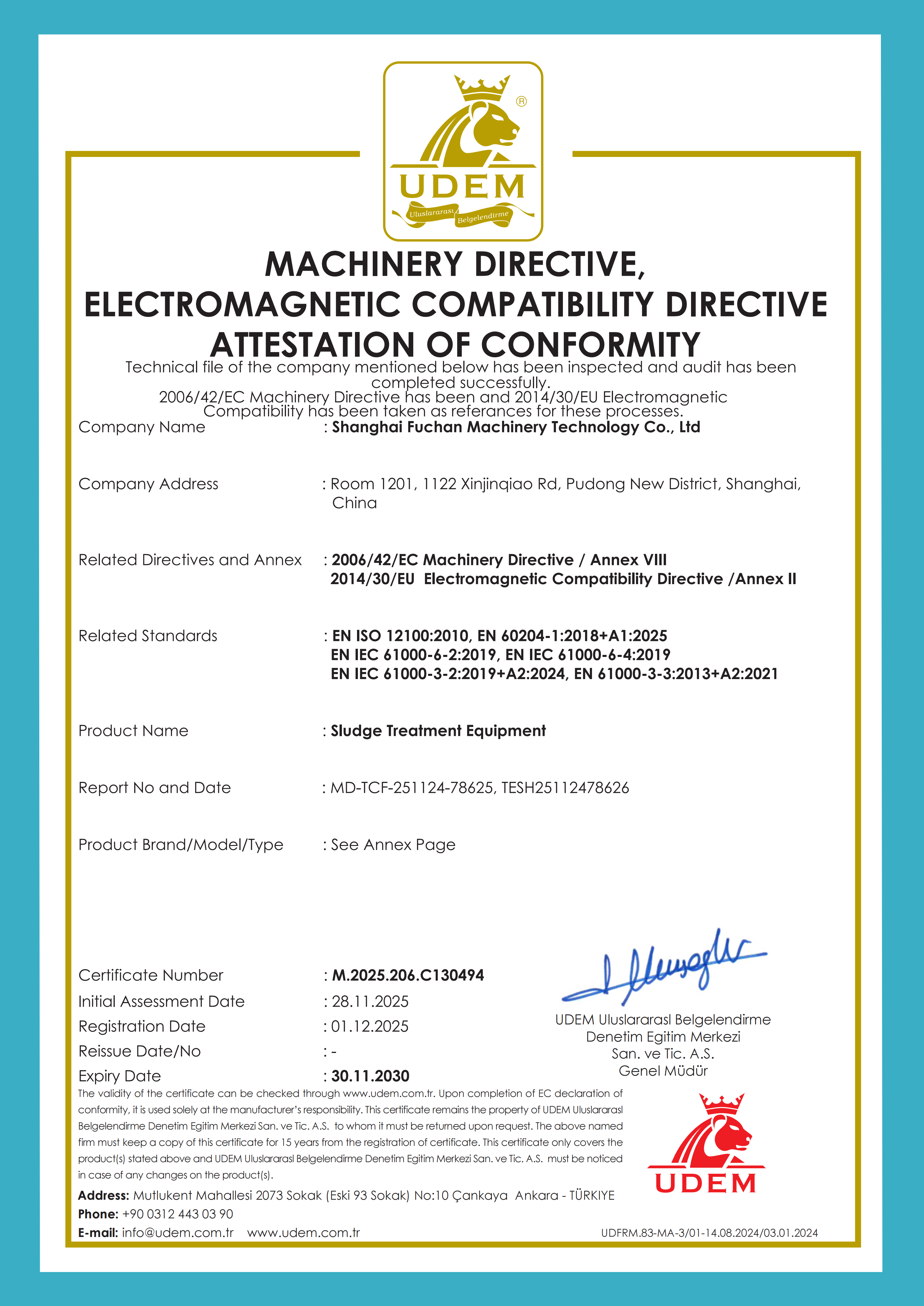
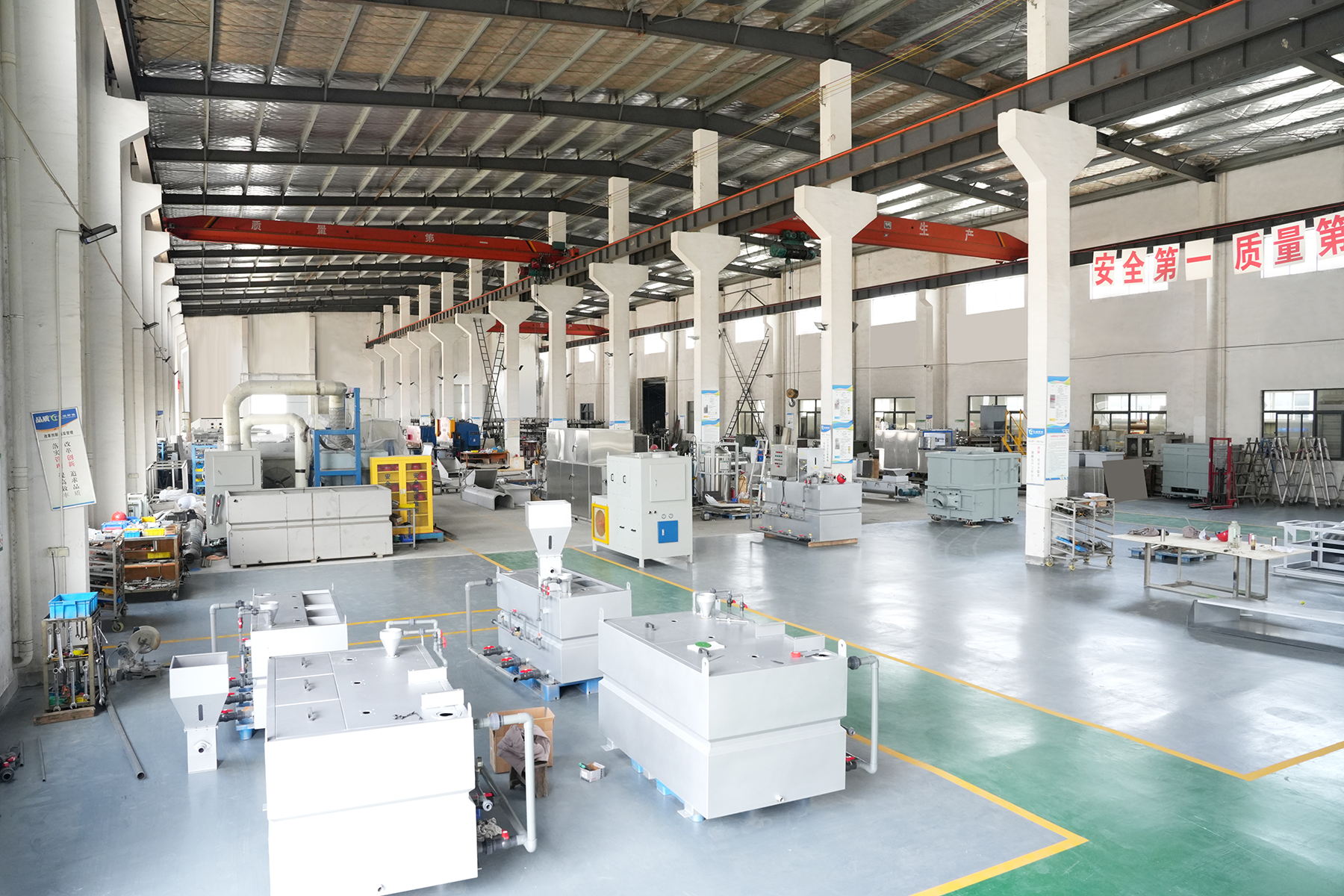
Compliance documentation is available for tender packs. SFC holds a CE attestation of conformity issued by UDEM under certificate M.2025.206.C130494, valid from 1 December 2025 to 30 November 2030 and covering sludge treatment equipment against EN ISO 12100:2010 and EN 60204-1:2018+A1:2025, with EMC standards EN IEC 61000-6-2:2019, EN IEC 61000-6-4:2019, EN IEC 61000-3-2:2019+A2:2024 and EN 61000-3-3:2013+A2:2021 under the 2006/42/EC Machinery Directive and the 2014/30/EU EMC Directive. Management systems are certified to ISO 9001:2015 (certificate U24Q2SH704766R3S, valid to 26 May 2027), ISO 14001 (certificate U25E2SH8024416R1S, valid to 11 March 2028) and ISO 45001:2018 (certificate U25S2SH8031937R0S, valid to 29 April 2028). Manufacturing runs from a 25,000 m² facility in Pudong New Area, Shanghai, with 36 employees, a five-person R&D team, an annual output of 500 sets and a monthly production capacity of 40 units.
Integrated systems at a glance
The table below compares the three integrated platforms on the published product data. It is a sizing table, not a ranking: the correct series is the one whose inlet band matches the design feed.
| Series (product ID) | Integrated stages | Model range | Belt width | Inlet consistency | Treating capacity | Dried sludge | Cake water content | Main drive power |
|---|---|---|---|---|---|---|---|---|
| GDY (5174) | Gravity belt thickening + belt-press dewatering | GDY-1000 / 1500 / 2000 / 2500 / 3000 | 1000–3000 mm | 0.6–1.5% | 15–90 m³/h | 90–1050 kg/h | 75–80% | 1.1–4.0 kW |
| FTB (5175) | Rotary drum thickening + belt-press dewatering | FTB-500 / 750 / 1000 / 1500 / 1500L / 2000 | 500–2000 mm | 1.5–2.5% | 3.0–30 m³/h | 45–450 kg/h | 75–85% | 0.37–1.1 kW |
| FTE (5176) | Rotary drum thickening + belt-press dewatering | FTE-1000 / 1500 / 2000 / 2500 / 3000 and L models | 1000–3000 mm | 0.6–1.5% | 12–90 m³/h | 90–975 kg/h | 75–85% | 0.55–4.0 kW |
All three series are manufactured in SS304. Values are the manufacturer's published product data; site-specific performance still depends on feed characteristics, polymer selection and dosing.
Where the integrated stage sits between thickening and drying
Municipal engineers rarely buy a single machine; they buy a stage in a line. The following table maps each stage to representative equipment, so the boundaries between thickening, mechanical dewatering, deep dewatering and drying stay explicit in the specification.
| Process stage | Representative SFC equipment (product ID) | Reported output | Reported capacity | Typical use |
|---|---|---|---|---|
| Thickening only | FBT belt sludge thickener (5120) | 2.5–8% outlet consistency; 98% solid capture | 12–95 m³/h | Reducing load to an existing press |
| Thickening only | FRDT rotary drum thickener (5122) | 2.5–8% outlet consistency; 95% solid capture | 7.5–100 m³/h | Enclosed pre-thickening |
| Integrated thickening + dewatering | GDY (5174) / FTB (5175) / FTE (5176) | 75–85% cake water content | 3–90 m³/h | One-step reduction in municipal and industrial plants |
| Screw-press dewatering | DL (5160) / SRD (5166) | 75–85% cake water content | 1.5–900 kg/h dried sludge | Dilute, sticky or oily feed; decentralized sites |
| Deep dewatering | SD high-pressure belt press (5179) | 65–75% or 60–70% cake water content | 0.3–6.1 t/h | Drying or incineration pre-treatment |
| Thermal drying | SFC-BSD belt dryer (5183) | 10–50% final water content | 0.8–90 t/h feed | Volume reduction and disposal cost control |
| Thermal drying | SFC-TR low-temperature dryer (5181) | Up to 70% volume reduction | 1000–9000 L per batch | Batch drying |
Step-by-step: sizing an integrated system for a municipal project
- Fix the feed before the flow. Select on solids concentration in the feed, not only on hydraulic flow. The GDY and FTE are specified for 0.6–1.5% feed; the FTB for 1.5–2.5%. If the plant already thickens to 3–5%, an integrated belt machine sits outside its inlet band, and the screw-press range (DL and SRD, 0.6–5.0%) becomes the relevant comparison.
- Convert flow into a dry-solids load. Multiply design flow by feed solids concentration and sludge density to obtain kg TS/h. Because machine output is rated in kg/h of dried sludge, this step links the plant's hydraulic duty to the equipment rating and prevents an oversized press from being ordered on flow alone.
- Check whether integration is the right architecture. Integration removes an intermediate stage, a transfer pump and one control interface. If thickening tanks and a working press already exist on site, retaining them and addressing the bottleneck is usually cheaper than replacing both.
- Choose the thickening principle. Gravity belt thickening (GDY) suits high-flow duties. Rotary drum thickening (FTB, FTE) encloses the thickening step, which helps where odour, aerosol or splash control drives the layout.
- Match belt width and model to the duty. Belt width sets both footprint and throughput ceiling: 500–2000 mm for the FTB, 1000–3000 mm for the GDY and FTE. Confirm the chosen model against its published treating capacity and dried-sludge output rather than against a nominal tank volume.
- Confirm the site envelope. Verify plan area, headroom, wash-water supply and drain, ventilation, and electrical distribution. Main drives across these series are 0.37–4.0 kW, so the electrical constraint is usually distribution and control rather than transformer capacity.
- Write the acceptance basis and procurement terms. State whether the guaranteed figure is cake water content or total solids, and record the feed assumptions used to test it. Include polymer type and dose expectations in the RFQ. Standard commercial terms for this equipment are MOQ 1 unit; delivery FOB or CIF; acceptance by factory inspection or pre-shipment inspection; payment of 30% deposit in advance with 70% balance before shipment; lead time 30–60 days against a monthly capacity of 40 units.
Field results from municipal and industrial installations
Integrated systems are best judged on installed duty. The following results are reported from operating projects.
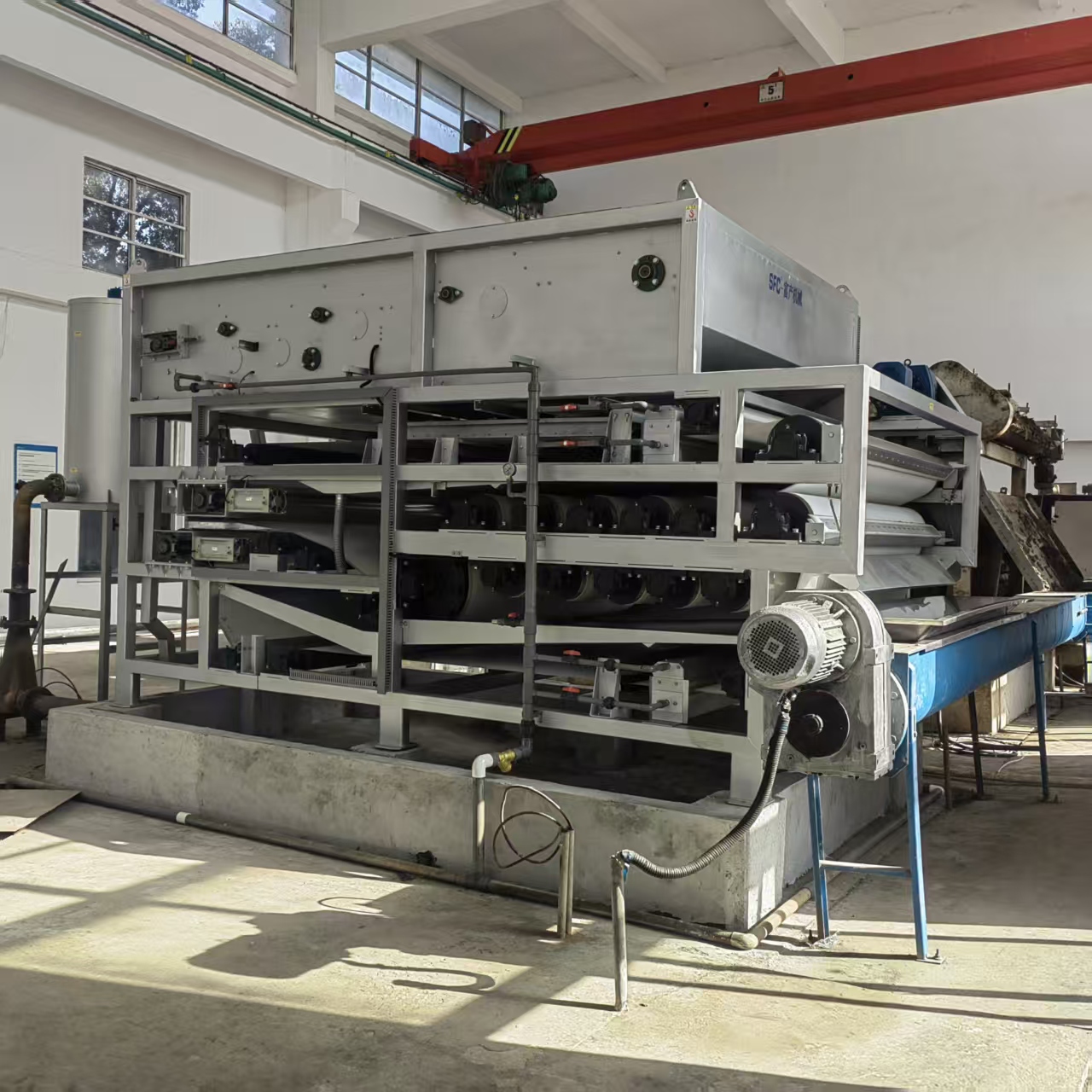
Municipal excess sludge, China (GDY, product 5174). A city sewage treatment plant installed two integrated thickening and dewatering machines to process excess sludge at 99.2% moisture. Over five years of operation the units have delivered a final cake dryness below 80%. Reported operating characteristics are fully continuous unattended running with scheduled walk-throughs only, consistent cake dryness, and minimal maintenance. The site reports the arrangement as more stable than the standard dewatering equipment it replaced.
Food-processing sludge, Malaysia (FTB-1000, product 5175). A single FTB-1000 rotary drum thickening and dewatering machine has operated for eight years, reducing sludge moisture from 98.5% to below 80%. The client reports stable dewatering results, easy upkeep and a 30% reduction in sludge handling costs for that plant.
Chemical wastewater sludge, China (FTB-1500L, product 5175). One FTB-1500L unit has run for five years on sludge from a specialty chemicals plant, cutting water content from 99% to well below 80% and producing a discharge-ready cake, with minimal downtime reported.
Pre-thickening ahead of an existing press, China (FRDT, product 5122). Where a plate-and-frame filter press was already installed, eight rotary drum thickeners were added to pre-concentrate raw sludge. The units concentrate sludge from 99.4% down to 97% moisture, lifting solids content to around 3% and improving downstream press performance; the fully enclosed design is reported as a hygiene and odour-control benefit at that site.
Downstream volume reduction. Two drying projects show what happens when the constraint is disposal volume rather than cake handling. A BSD-2000 belt dryer has operated for six years at a precision-component manufacturer, reducing sludge from 85% to below 30% moisture. At an automotive parts plant, an SFC-TR low-temperature dryer removes over 700 kg of water per metric ton of sludge and reduces volume by more than 70%, starting from a 75% moisture cake.
When an integrated system is not the right answer
Credible selection includes the cases where a different machine class fits better.
- Feed above the inlet band. Above 2.5% solids (FTB) or above 1.5% (GDY and FTE), a screw press rated to 0.6–5.0% or a dedicated thickener is the correct starting point.
- Target cake drier than mechanical dewatering can reach. A 60–70% water content target requires a separate deep dewatering stage. Published literature treats deep dewatering (approximately 35–40% TS) as a distinct performance class from mechanical dewatering.
- Disposal route requires very dry product. If the receiving route needs 10–50% final water content, drying is a separate decision, and the energy burden is materially higher than mechanical dewatering in the reviewed inventory data.
- Very tight buildings. Belt widths of 1000–3000 mm need plan area; where the dewatering room is constrained, an enclosed drum machine may fit where a wide belt machine will not.
- Benchmarks are not guarantees. Literature values aggregate heterogeneous datasets with different feed types, conditioning and measurement protocols. They set realistic expectations for the tender; they do not replace a defined acceptance test on the actual sludge.
Frequently asked questions
Do SFC integrated thickening and dewatering machines come with CE and ISO certification?
Yes. Sludge treatment equipment from Shanghai Fuchan Machinery Technology Co., Ltd. carries a CE attestation of conformity issued by UDEM under certificate M.2025.206.C130494, valid from 1 December 2025 to 30 November 2030, referencing EN ISO 12100:2010, EN 60204-1:2018+A1:2025 and the EMC standards EN IEC 61000-6-2:2019, EN IEC 61000-6-4:2019, EN IEC 61000-3-2:2019+A2:2024 and EN 61000-3-3:2013+A2:2021 under the 2006/42/EC Machinery Directive and the 2014/30/EU EMC Directive. Management systems are certified to ISO 9001:2015 (certificate U24Q2SH704766R3S), ISO 14001 (U25E2SH8024416R1S) and ISO 45001:2018 (U25S2SH8031937R0S).
Can capacity, footprint and control system be adapted to an existing municipal plant?
Customization covers equipment type and model selection based on sludge characteristics and treatment capacity, processing capacity, equipment dimensions and footprint to suit site constraints, control system configuration and PLC automation level, power configuration (voltage, frequency and motor specifications), modular design options for later capacity expansion, and integration of auxiliary conveying, dosing and storage systems. OEM and ODM production is available, and the GDY, FTB and FTE models are built in SS304.
What are the minimum order quantity, payment and delivery terms?
MOQ is 1 unit. Delivery terms are FOB or CIF. Payment terms are 30% deposit in advance with the 70% balance before shipment. Lead time is 30–60 days, against a monthly production capacity of 40 units.
How is performance verified before shipment and on site?
Quality control is 100% testing, and acceptance criteria are factory inspection or pre-shipment inspection. Because dewatering performance depends on feed characteristics, the specification should record the design feed consistency, the polymer type and dose assumptions, and whether the guaranteed figure is cake water content or total solids — otherwise the same machine can appear to meet or miss the same target.
What is the lead time, and what support is provided after commissioning?
Standard lead time is 30–60 days from order confirmation. After-sales support includes remote technical support by phone, email or video conference, on-site commissioning and installation guidance on request, spare parts supply with rapid response, warranty service as specified per equipment type, operation and maintenance training for client personnel, and long-term technical consultation. To start a model match for a municipal project, send the design feed consistency, design flow and target cake water content to sales@fuchanjx.com, or download the 2026 catalogue to compare GDY, FTB and FTE models against your duty.
Conclusion: specify the feed, then the frame
Integrated thickening and dewatering is a sizing decision before it is a purchasing decision. For municipal excess sludge in the 0.6–1.5% range at high flow, the GDY and FTE series cover 12–90 m³/h on belt widths of 1000–3000 mm, with cake at 75–85% water content. For 1.5–2.5% feed in small and medium plants, the FTB series covers 3.0–30 m³/h on 500–2000 mm belts. Where the feed is already thicker than those bands, a DL or SRD screw press (0.6–5.0% inlet) is the more appropriate comparison, and where a 60–70% water content cake or a 10–50% final water content product is required, deep dewatering and drying belong in a separate stage.
Next step
Send the design feed consistency, design flow and target cake water content, and SFC Machinery will match them against the GDY, FTB and FTE ranges and confirm footprint, power configuration and control scope for your project.
Product catalogue (PDF): Product Catalog-SFC-2026.pdf
Email: sales@fuchanjx.com | Tel / WhatsApp: +86 138-1673-2007 | Web: www.sfceco.com
Shanghai Fuchan Machinery Technology Co., Ltd., Room 1201, 1122 Xinjinqiao Rd, Pudong New District, Shanghai, PRC China.
MOQ 1 unit · Lead time 30–60 days · FOB/CIF · 30% deposit, 70% balance before shipment · Factory inspection or pre-shipment inspection.
Have Questions or Need More Details?
Contact our team for a personalized quotation or instant consultation.
Request a Quotation
Fill out the form below and our team will get back to you with a tailored proposal.
WhatsApp Direct Chat
Prefer to chat in real-time? Message us on WhatsApp for instant assistance & quick answers.
- Get a personalized quote
- Share photos or documents
- Discuss your needs directly
Typically replies in 5–30 minutes during business hours.