Rotary Drum vs. Belt Sludge Thickener: A Comparison Guide for Low-Solids Plants
Low-solids sludge, typically at S.S. 0.6–1.5%, contains such a large volume of water that it places unnecessary hydraulic and load stress on downstream dewatering. Thickening before dewatering is one of the most practical ways to increase solids concentration to roughly 2.5–8% before the sludge reaches a filter press, belt press, screw press, or dryer. For buyers evaluating sludge thickening equipment, two widely used technologies are the rotary drum thickener and the gravity belt thickener.
Shanghai Fuchan Machinery Technology Co., Ltd. (SFC), a sludge treatment equipment manufacturer established in 2007 in Pudong, Shanghai, offers both product categories. This comparison guide looks at the enclosed FRDT rotary drum thickener and the FBT gravity belt thickener for plants with S.S. 0.6–1.5%, using the published FRDT and FBT series specifications as the reference fact base.
Why Low-Solids Sludge Needs a Dedicated Thickening Step
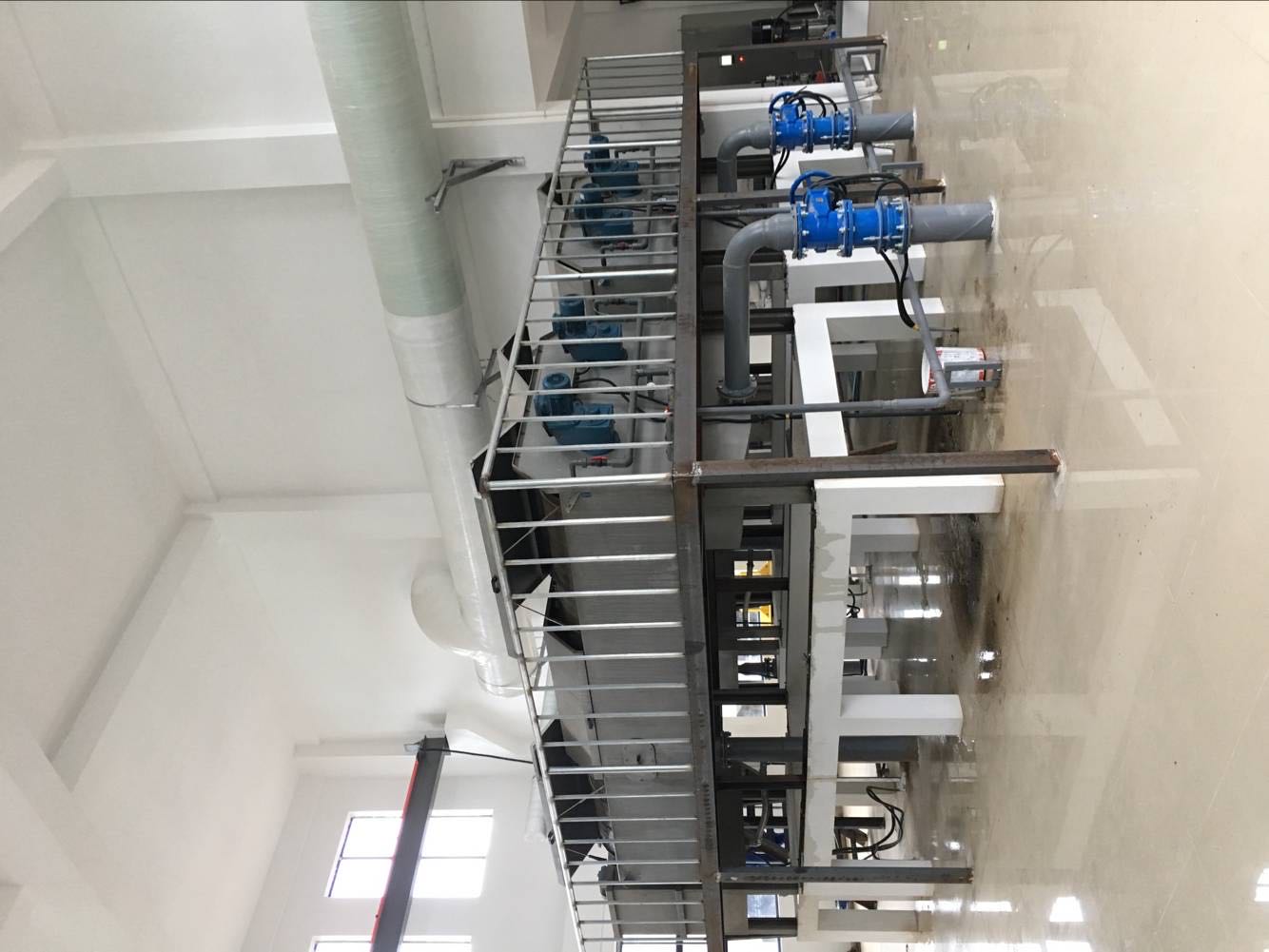
Sludge with S.S. 0.6–1.5% is watery by nature. When such dilute sludge is fed directly into a dewatering machine, the equipment must handle a much higher hydraulic flow while producing the same or lower dry-solids throughput. A thickening step removes part of the free water first, reducing feed volume and improving the performance of downstream equipment such as plate-and-frame filter presses, belt presses, screw presses, or dryers.
SFC’s FRDT and FBT thickening products are both specified for an inlet consistency of S.S. 0.6–1.5%. Both series also share the same stated sludge outlet consistency range of 2.5–8%. This means both technologies are designed to serve the same low-solids feed window. The real selection decision, therefore, is not whether one can accept dilute sludge but how each machine carries out that task in the plant’s physical and operational environment.
Market Context and Technology Relevance
The global sludge dewatering equipment market was valued at USD 5.19 billion in 2024 and is projected to reach USD 10.16 billion by 2032, according to Fortune Business Insights. In the broader dewatering equipment market, the belt filter press segment was estimated to grow at a CAGR of 8.8% from 2025 to 2033, according to Grand View Research. Belt technology remains common in municipal applications, while rotary drum thickening is frequently used as a pre-treatment step before high-solid-capacity dewatering processes.
From a market-structure standpoint, Global Market Insights reports that the top five players in the sludge dewatering equipment market—Andritz, Xylem, Alfa Laval, Suez, and Veolia—collectively held around 35% of the market in 2025. For industrial buyers and engineering consultants, that concentration is a useful reminder that process fit should be evaluated alongside supplier size. The FRDT and FBT comparison below is intended to support that evaluation with machine-level specifications rather than brand generalities.
The Two Thickening Routes: FRDT Rotary Drum vs FBT Gravity Belt
Both the FRDT series and the FBT series are classified as sludge thickening equipment, not final dewatering machines. They raise the solids content of dilute sludge before downstream handling or disposal. This distinction matters when comparing them with a sludge dewatering machine, a screw press dewatering system, or a belt sludge dryer, all of which are separate stages further down the process line.
FRDT Series — Rotary Drum Sludge Thickener
The FRDT is listed as a rotary drum sludge thickener and an enclosed drum sludge thickener. Its filtration media are described as filter openings of 30–80 mesh. The drum rotates at approximately 10 rpm, and the product family is built with SS304 stainless steel. The FRDT series has a drying-solids production range of 45–1140 kg/h and a hydraulic treating capacity of 7.5–100 m³/h under the specified inlet consistency of S.S. 0.6–1.5%.
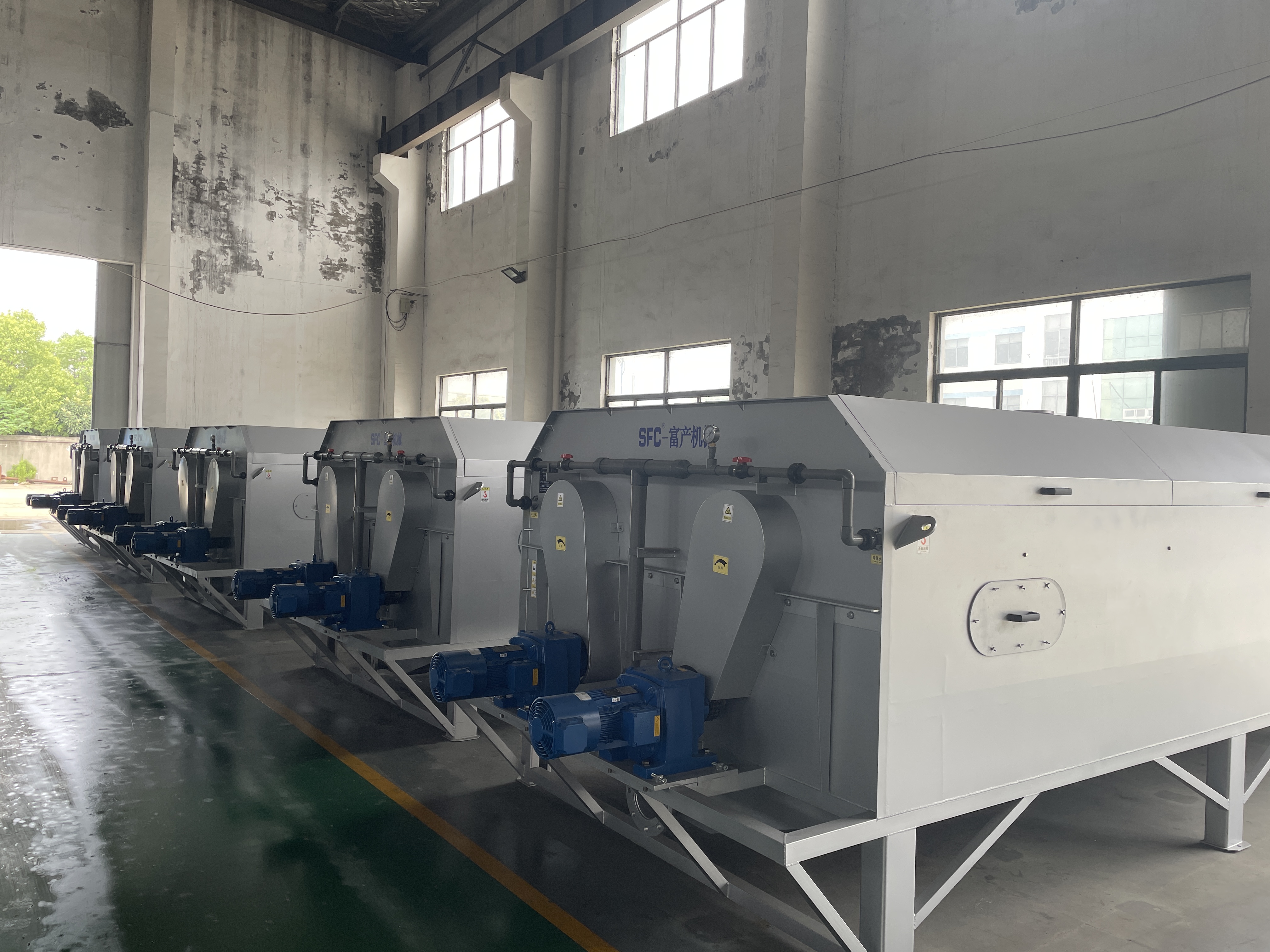
Because the drum design can be fully enclosed, the FRDT is often associated with cleaner, more controlled operating conditions. One documented SFC municipal case highlights the fully enclosed design for hygiene, robust construction with minimal wearing parts, and stable high-efficiency concentration. In that case, eight FRDT rotary drum thickeners were used to pre-concentrate raw sludge ahead of plate-and-frame filter presses.
FBT Series — Belt Sludge Thickener
The FBT series is classified as a gravity belt sludge thickener and a belt-type sludge thickener. Rather than a rotating mesh drum, the FBT uses a moving belt as the filtration surface. Belt width across the series ranges from 1000 to 3000 mm, with belt speed adjustable from 3 to 18 m/min. The FBT has an inlet consistency range of S.S. 0.6–1.5%, treating capacity of 12–95 m³/h, dry-solids output of 72–900 kg/h, and a stated solids-capture rate of 98%.
The FBT’s gravity-belt principle exposes the sludge to an open belt surface where free water drains through the fabric. In practice, this configuration is associated with visual inspection and direct access to the belt. The series is also built in SS304 stainless steel and listed for municipal wastewater treatment, industrial wastewater treatment, paper mills, printing and dyeing, and sludge thickening projects.
FRDT vs FBT: Side-by-Side Specification Comparison
The following information is based on the quoted product parameters for the FRDT and FBT series. Model-by-model capacity is selected from the series range according to project flow.
| Comparison Criterion | FRDT Rotary Drum Sludge Thickener | FBT Belt Sludge Thickener |
|---|---|---|
| Equipment class | Rotary drum thickener / enclosed drum sludge thickener | Gravity belt sludge thickener / belt-type sludge thickener |
| Series coverage | FRDT-20 to FRDT-80 in this comparison; the family also lists FRDT-100 | FBT-1000 to FBT-3000 |
| Belt width / screen medium | Filter opening 30–80 mesh | Belt width 1000–3000 mm |
| Inlet consistency | S.S. 0.6–1.5% | S.S. 0.6–1.5% |
| Treating capacity | 7.5–100 m³/h | 12–95 m³/h |
| Dry-solids throughput | 45–1140 kg/h | 72–900 kg/h |
| Sludge outlet consistency | 2.5–8% | 2.5–8% |
| Solids-capture rate | 95% | 98% |
| Operating speed | Drum speed about 10 rpm | Belt speed 3–18 m/min |
| Motor/power consumption | Driving motor 0.75–1.5 kW; disposal agitator motor 0.37–0.55 kW | Power consumption 0.55–1.5 kW |
| Material | SS304 | SS304 |
| Typical project segments | Municipal wastewater treatment, industrial wastewater treatment, paper mills, printing and dyeing, sludge thickening projects | Municipal wastewater treatment, industrial wastewater treatment, paper mills, printing and dyeing, sludge thickening projects |
Space and Enclosure: Why the Two Designs Do Not Occupy Space the Same Way
Space requirements are an expected part of any thickener evaluation, but the verified reference data for this article does not include floor-area drawings or installation footprint values. What can be compared reliably from the product classifications is the geometric logic of each machine.
The FRDT is an enclosed drum thickener. Sludge enters a rotating drum whose screen is configured around a cylindrical structure. The process is contained inside the drum housing, which supports hygiene and cleaner ambient conditions in the areas where the machine operates.
The FBT is a gravity belt thickener. The filter belt is an open, moving flat surface supported by a frame. Belt width is the defining dimensional parameter, and plants selecting FBT models begin with the 1000–3000 mm belt-width range. Because gravity drainage takes place along the belt, the machine’s overall layout should be reviewed with supplier drawings for the selected model.
For space-sensitive retrofits or enclosed process areas, the compact, enclosed nature of the FRDT drum is an important structural advantage. For plants that already have open gravity-belt layouts or that prefer direct access to the sludge bed and belt, the FBT is the natural comparison point.
Operating Mode Differences
Rotary drum thickening is continuous and drum-driven. The FRDT drum rotates at roughly 10 rpm while water passes through the 30–80 mesh screen. The rotating action helps move the thickened material toward discharge while the filtrate exits through the mesh. In addition to the main driving motor, the FRDT includes a disposal agitator motor, generally in the 0.37–0.55 kW range. The stated process result is a thickened outlet at S.S. 2.5–8%, with the listed solids-capture rate of 95%.
Gravity belt thickening is also continuous but operates on a different principle. Conditioned sludge is distributed onto a moving belt; free water drains downward through the belt by gravity while the retained solids travel with the belt to the thickening discharge. The FBT’s variable belt speed of 3–18 m/min gives the operator a direct way to adjust residence time. The solids-capture rate stated for the FBT is 98%, with the same thickened outlet range of S.S. 2.5–8%.
Neither machine should be considered a substitute for a sludge drying machine. A rotary drum thickener or gravity belt thickener simply concentrates the sludge before it is fed to a downstream press or dryer. If the plant’s final objective is disposal-ready cake with low moisture content, the downstream dewatering and drying stages should be designed as part of the full sludge treatment train.
Step-by-Step Selection Framework for Low-Solids Plants
Buyers evaluating sludge dewatering systems often need a repeatable selection sequence. The steps below are written to be used with the FRDT and FBT specification sheets.
Step 1: Confirm the Actual Feed S.S. Level
Both FRDT and FBT are rated for S.S. 0.6–1.5%. If the plant feed is outside this range, the thickening comparison should be revisited with a different equipment class or a specially reviewed application.
Step 2: Define Hydraulic Flow and Dry-Solids Load
Use the feed flow in m³/h to check the treating capacity. Use the dry-solids load in kg/h to check the dried-sludge throughput. The FRDT family covers 7.5–100 m³/h and 45–1140 kg/h. The FBT covers 12–95 m³/h and 72–900 kg/h. Matching both values is important because low-solids sludge can satisfy a flow limit while still exceeding the dry-solids design.
Step 3: Confirm the Required Thickened Sludge Concentration
Both SFC thickener series are published for an outlet consistency of S.S. 2.5–8%. If the downstream process requires a higher solids content before dewatering, additional equipment or a dewatering press may be necessary.
Step 4: Compare Enclosure and Building Requirements
If the plant layout, odour control, or hygiene policy favours enclosed equipment, the FRDT series is the direct candidate. If an open gravity-belt layout is acceptable and easier for routine visual monitoring, the FBT should be included in the technical comparison.
Step 5: Review Capture Rate and Filtrate Quality
The published solids-capture rate is 95% for the FRDT and 98% for the FBT. Capture rate influences return load to the head of the plant. The final accepted level should be checked against project permit limits and downstream treatment capacity.
Step 6: Request a Project-Specific Drawing
Footprint is not a single number that can be generalised from a model range. After preliminary selection, site-specific layout and connection details should be requested from SFC for the exact model. This avoids the common error of relying on a generic dimension from another project.
Use Case Evidence: Rotary Drum Thickener Ahead of a Plate-and-Frame Press
A documented municipal wastewater treatment application in China used eight FRDT series rotary drum thickeners to pre-concentrate raw sludge before plate-and-frame filter press dewatering. The project was completed within one year. According to the SFC project record, the FRDT thickener concentrated sludge from 99.4% moisture content to 97%, increasing the solids content to 3%. That elevated feed solids level made downstream filter press operation more effective and reduced the hydraulic load on the press.
The same case highlights the fully enclosed FRDT design for hygiene and environmental cleanliness. The equipment is described as having robust construction with minimal wearing parts, which supports long-term reliability. For an evaluation team, this record provides a useful practical reference: the FRDT is not only a theoretical pre-thickening option but has been operating in front of downstream dewatering presses.
Process-Fit Notes for Plants Considering FBT or FRDT
It is important not to confuse a belt sludge thickener with a belt sludge thickening and dewatering machine. SFC also lists integrated machines such as the GDY series belt sludge thickening and dewatering press, but the FBT is a standalone thickener. Likewise, the FRDT is separate from the FTB or FTE rotary-drum–belt press combinations, which add belt-press dewatering after the drum-thickening stage.
For low-solids plants, a standalone thickener is usually justified when the existing or planned downstream press has sufficient cake-dryness capacity but is overloaded hydraulically. If the plant also needs a dewatering press, the buyer should compare a standalone thickener plus press against an integrated thickening-and-dewatering machine.
SFC’s product portfolio also includes screw press dewatering machines, wear-free screw presses, deep dewatering systems, and sludge dryers. This broader context matters because the thickening decision should be made as part of a sludge dewatering system, not in isolation.
Frequently Asked Questions
Are SFC FRDT and FBT sludge thickeners supported by EU and international certifications?
SFC equipment, including sludge treatment equipment, is covered by CE certification under certificate number M.2025.206.C130494, issued by UDEM, with a validity period from 1 December 2025 through 30 November 2030. SFC also holds ISO 9001, ISO 14001, and ISO 45001 management-system certifications. For a specific FRDT or FBT project, the applicable certification scope should be confirmed with the SFC sales team.
Can both the FRDT rotary drum thickener and the FBT belt thickener handle low-solids sludge at S.S. 0.6–1.5%?
Yes. Both SFC product families specify an inlet consistency of S.S. 0.6–1.5%. Both can be used for thickening projects in municipal wastewater treatment, industrial wastewater treatment, paper mills, printing and dyeing, and similar sludge thickening applications. The FRDT is an enclosed rotary drum type; the FBT is a gravity belt type.
What are the main power-related differences between the FRDT and FBT series?
Published power data shows that the FRDT series uses a driving motor of 0.75–1.5 kW plus a disposal agitator motor of 0.37–0.55 kW. The FBT series lists power consumption of 0.55–1.5 kW. Both series therefore operate in the low-power range for sludge thickening equipment. Total installed power should be reviewed with the exact selected model.
Is factory testing available before the thickener is shipped?
SFC’s production and quality-control workflow includes 100% factory testing before equipment release. After shipment, the available after-sales services include remote technical support, on-site commissioning and installation guidance, operation and maintenance training, and spare-parts supply. Buyers can use these steps to validate the equipment before it enters full plant operation.
What is the typical lead time for SFC thickening equipment?
SFC’s general production capability for customized equipment is around 40 sets per month, with a typical lead time of 30–60 days and a minimum order quantity of one unit. Lead time should be confirmed by the sales department when the FRDT or FBT model is selected, because control-system configuration, motor voltage, and site-specific options can affect scheduling.
Conclusion
For low-solids sludge at S.S. 0.6–1.5%, both the enclosed FRDT rotary drum thickener and the open-layout FBT gravity belt thickener are valid sludge thickening equipment candidates. They share the same inlet window and the same thickened outlet range of S.S. 2.5–8%, but they differ in process geometry and operating mode.
The FRDT is the more appropriate machine when the plant wants an enclosed drum design with the hygienic and containment benefits associated with a closed rotating screen. The FBT is the relevant choice when the site is comfortable with an open gravity-belt machine and wants the stated 98% solids-capture rate and belt-speed adjustability. Neither machine eliminates the need for downstream dewatering or sludge drying; both should be evaluated as an upstream stage in a complete sludge treatment train.
For engineers and plant owners moving from comparison to project planning, the next step is to select a tentative model, request a site-specific layout, and match the machine to the actual flow and solids profile.
Download the SFC Product Catalog for the FRDT and FBT series specifications, or contact the SFC sales team for a quotation and project-specific recommendation.
Download Product Catalog
Shanghai Fuchan Machinery Technology Co., Ltd. | Website: www.sfceco.com | Email: sales@fuchanjx.com | Tel/WhatsApp: +86 138-1673-2007