SS304 & CE Compliance: What Sludge Equipment Buyers Verify
SS304 & CE Compliance: What Sludge Equipment Buyers Verify
At the decision stage of a sludge dewatering equipment purchase, two documents decide whether a shortlisted supplier survives due diligence: the material actually used in contact with the sludge, and the compliance evidence behind the CE mark. Both are routinely requested late, and both are difficult to fix after the purchase order is signed. This guide sets out what SS304 stainless steel construction should mean in a specification, what a CE declaration for a complete dewatering unit must cover, and which records a buyer should hold before releasing payment.
Why Material and Compliance Checks Slip to the End of the Purchase
Throughput, cake dryness and price dominate early conversations. Material grade and conformity documentation usually surface in the final week, when the technical comparison is already settled and the commercial negotiation is nearly closed. By that point the buyer is not comparing suppliers — the buyer is asking one preferred supplier to explain itself under time pressure.
That sequence is backwards for two practical reasons.
- Material substitution is invisible after delivery. A painted frame looks identical whether the contact parts behind it are SS304 or a lower grade. Once the machine is installed and enclosed, the only remaining evidence is the paperwork that was issued with it.
- Compliance cannot be retrofitted quickly. A CE declaration of conformity and its supporting technical file describe a specific configuration that was assessed. Changing pumps, control panels or safety devices after assessment breaks the link between the declaration and the delivered machine.
The practical rule is simple: the material grade and the conformity route should be written into the request for quotation, not negotiated as a closing detail.
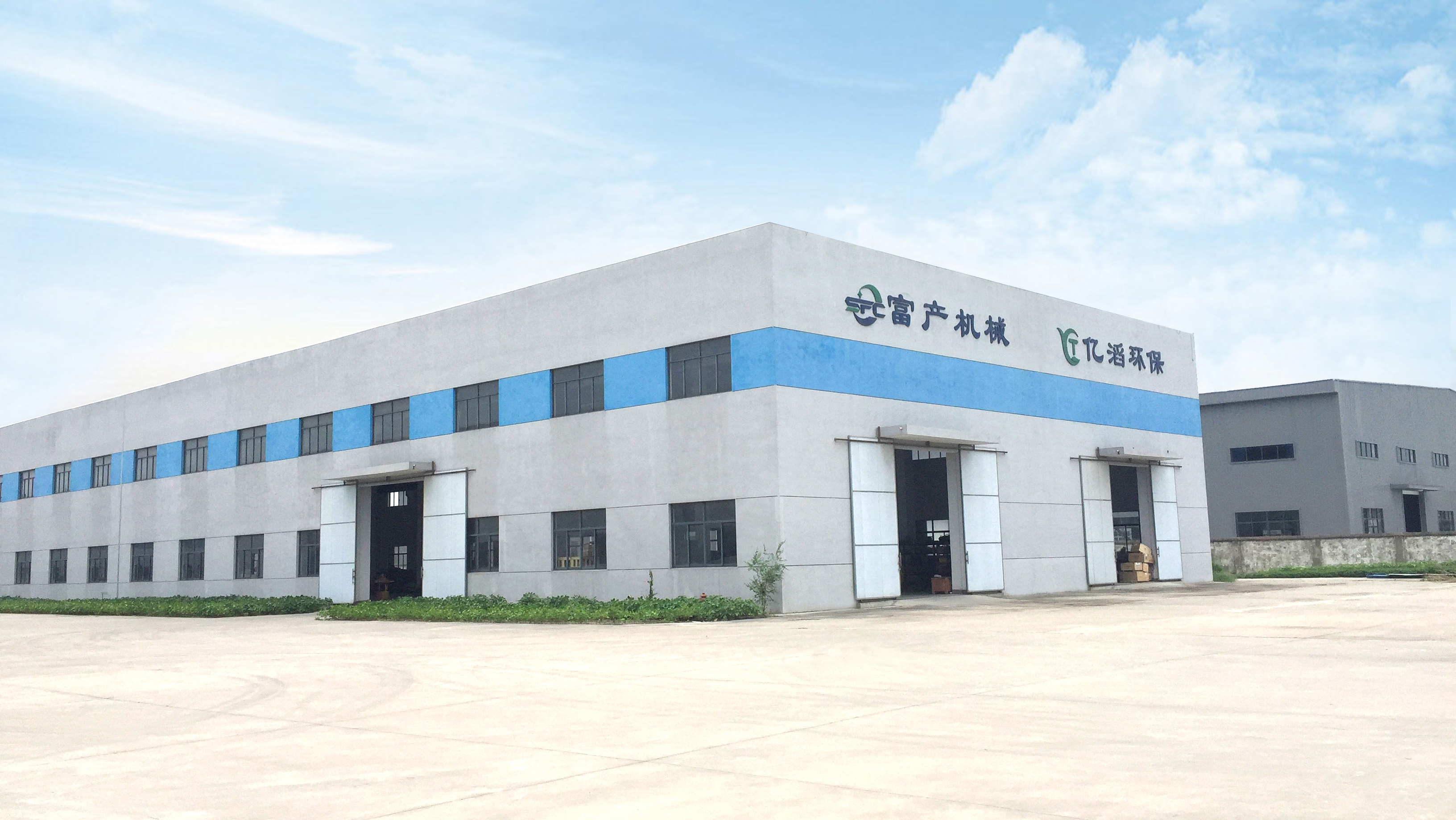 Manufacturing site of Shanghai Fuchan Machinery Technology Co., Ltd. in Pudong New Area, Shanghai. Buyers evaluating a sludge dewatering system should treat the factory as a document source as well as a production site.
Industry Background: Why Compliance Has Become a Screening Criterion
The global sludge dewatering equipment market was estimated at USD 6.4 billion in 2026, according to Global Market Insights, with a forecast running to 2035. Asia Pacific dominated the market with a 37.57% share in 2024, based on Fortune Business Insights data. A market of that size and geographic spread means buyers are routinely comparing machines built in different regulatory environments, under different documentation habits, and to different material conventions.
Two consequences follow for procurement.
First, the equipment class itself is broad. Belt filter presses and screw presses are both classified as continuous sludge-dewatering systems in manufacturer portfolios, and mechanical dewatering typically delivers a cake in the region of 25–30% total solids, within a wider 15–45% dry solids band reported for dewatering processes generally. Machines that sit in the same performance band can still differ substantially in materials, control architecture and certification scope.
Second, project owners increasingly treat conformity documentation as a bid condition rather than a delivery extra. Where a plant is subject to inspection, the paperwork trail is part of the acceptance criteria. A supplier that cannot produce it introduces schedule risk that no price advantage offsets.
What SS304 Actually Establishes — and What It Does Not
SS304, usually written simply as 304, is an austenitic stainless steel grade that is commonly specified for industrial equipment and for sludge-contact components. It is a reasonable baseline. It is not, on its own, a specification.
The gap matters because "SS304 construction" can describe anything from a fully stainless contact path to a stainless outer panel over a carbon steel frame. Three questions close that gap:
- Which components are SS304? Contact surfaces, the screw or belt assembly, the flocculation and thickening zone, fasteners, piping, and the frame are separate decisions and should be listed separately.
- Is the grade stated on a drawing? A material note in a brochure is marketing. A material callout on a general arrangement drawing is engineering evidence.
- Is the grade traceable to the delivered unit? Mill certificates or heat-number records tie the alloy actually delivered to the material that was specified.
Why the grade should follow the medium, not the catalogue
Not every sludge stream is served equally by a 304 specification. Chloride content, chemical conditioning, salinity and the presence of aggressive industrial residues all push material selection upward. Where corrosion resistance is the deciding requirement, higher-alloy stainless is used by design rather than by upgrade.
A documented example from the SFC sludge drying range makes the point. The smooth-tube condenser design in the low-temperature sludge dryer uses multiple rows of smooth 316L stainless steel tubes without fins, replacing the conventional finned-tube evaporator configuration. The stated reason for that material and geometry choice is fouling and corrosion resistance: a natural water film forms on the smooth tube surface and captures dust, while the absence of fins removes the geometry that normally collects scale. An integrated automated spray-flushing system periodically washes deposits away with the condensate.
The relevant lesson for buyers is not that 316L is better in general. It is that material grade should be argued from the medium, the cleaning regime and the maintenance access — and then written down. A specification that names a grade without naming the component and the environment has not specified anything yet.
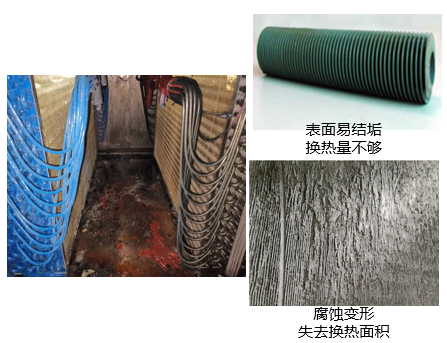 Fouled and corroded fin coils in a conventional finned-tube evaporator. Deposit buildup and corrosion in this geometry are the conditions that material selection is meant to prevent.
Mechanical wear is a material question too
Corrosion is only half of the material story. In screw press dewatering, the screw shaft and the moving and fixed rings are the components that determine how often the machine is opened up. SFC's SRD wear-free screw press design is intended to eliminate direct friction between the screw shaft and the rings, and the company's comparison data states zero wear after 50,000 hours of operation against severe wear after 10,000 hours in conventional multi-disc screw presses.
Whether or not a buyer accepts that comparison at face value, it points to the correct request: ask for wear-part material, surface treatment, expected inspection interval, and spare-parts pricing for the shaft and ring set. Those four answers are more useful than a general claim about build quality.
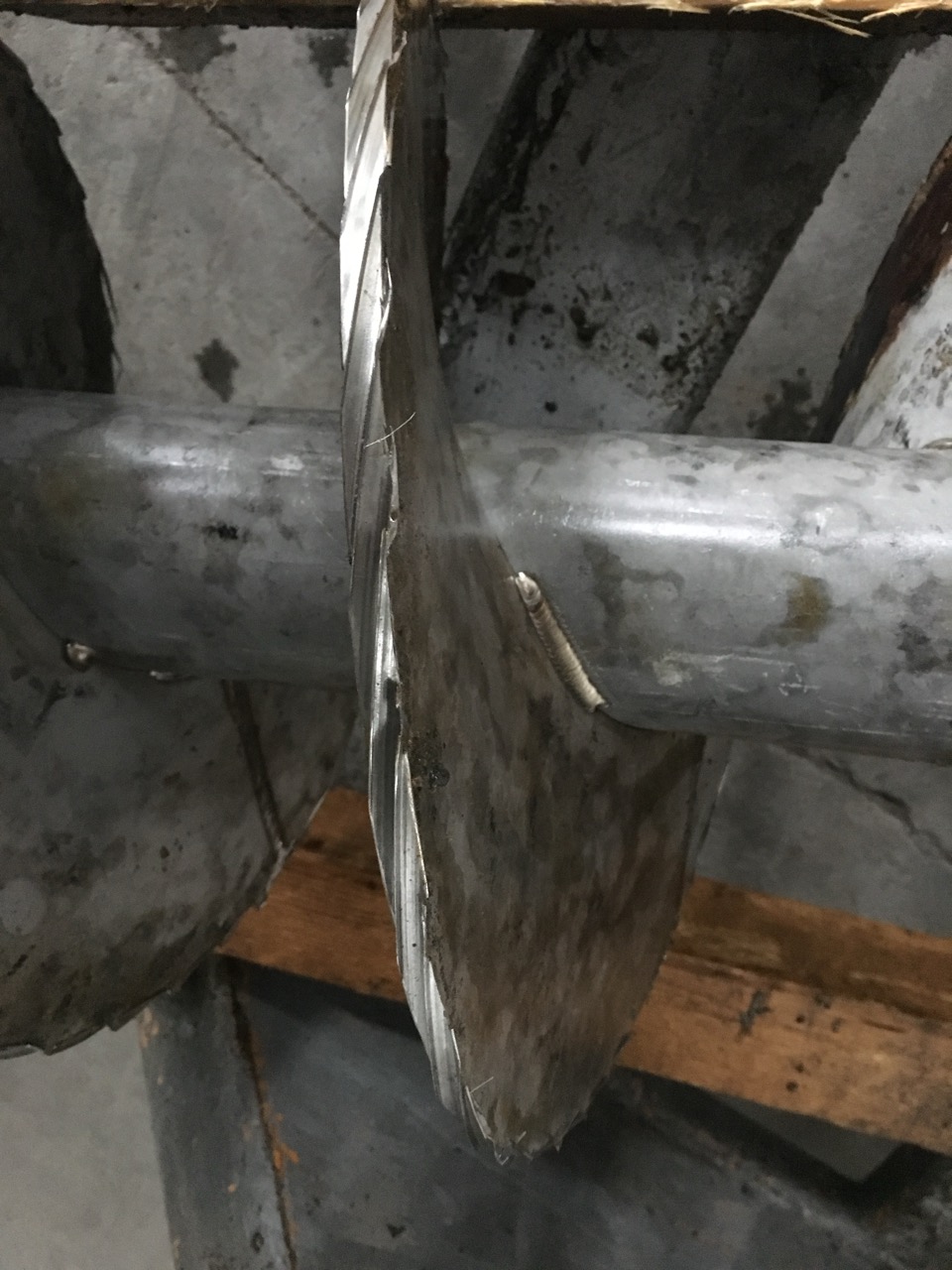 Severe screw shaft wear on a conventional multi-disc screw press. Wear-part material and inspection intervals belong in the quotation, alongside the stainless grade for contact surfaces.
What a CE Mark Must Cover on a Sludge Dewatering System
CE marking is a manufacturer's declaration that the equipment meets the applicable European requirements. It is not an independent quality grade, and it is not a performance guarantee. It is a statement backed by a technical file, and the buyer's job is to confirm that the statement matches the machine being purchased.
Most disputes arise from scope, not from authenticity. A dewatering system is an assembly: the press or thickener, the flocculation unit, the polymer preparation and dosing skid, the feed pump, the control cabinet, conveyors and safety devices. If each bought-in component carries its own declaration but the assembled unit does not, the delivered system may have no single conformity statement covering the combination that will actually be operated.
Records to request before the order is confirmed
- Declaration of conformity naming the machine type or model, the applicable requirements, and the legal entity issuing it.
- Technical file reference, including the risk assessment for the complete assembly rather than for individual components.
- Nameplate and serial number record, with electrical ratings, that matches the declaration.
- Electrical safety test records for the control panel and drives.
- Instruction handbook in the language required by the destination market, covering commissioning, normal operation and emergency stop procedure.
- Sub-assembly declarations for motors, gearboxes and instruments, listed by manufacturer and model.
A quick scope test. If the declaration lists a model number that does not appear on the machine's nameplate, or if it covers only the press body while the delivery includes a dosing skid and control cabinet, the documentation and the delivery are out of step. Resolve this before shipment, not at site acceptance.
Management System Evidence: What ISO Certificates Do and Do Not Prove
Shanghai Fuchan Machinery Technology Co., Ltd. (SFC Machinery) is a sludge treatment equipment manufacturer established in 2007 and located in Pudong New Area, Shanghai. The company holds ISO 9001:2015, ISO 14001 and ISO 45001:2018 certifications, together with CE certification for its sludge dewatering equipment.
Those certificates carry different weight and should be read separately:
- ISO 9001:2015 indicates a documented quality management system — process control, inspection, corrective action, record retention. It supports the expectation that material certificates and inspection reports exist and can be retrieved.
- ISO 14001 and ISO 45001:2018 relate to environmental and occupational health and safety management. They are relevant to site conduct and to how the factory manages its own processes, but they do not describe the product.
- CE certification relates to the product configuration and the technical file behind it, and must therefore be checked against the specific model and assembly being purchased.
None of these certificates substitutes for a material certificate or a mill test report. A supplier can hold a perfect quality management system and still ship a component in a grade the buyer did not intend to accept. The certificate gives the buyer a route to correct it; it does not remove the need to check.
Step-by-Step: How to Run the Verification
The sequence below can be completed within a normal tender cycle if the document requirements are stated at the enquiry stage rather than at contract review.
- Write the materials clause into the RFQ. Name the components and the grade for each. State that substitution requires written approval. Do not accept a single "stainless steel" line item for a complete system.
- Request drawings with material callouts. The general arrangement drawing should identify contact surfaces, wear parts and the frame separately.
- Ask for traceability documents. Mill certificates or heat-number records for contact-surface material, matched to the delivered batch rather than to a stock reference.
- Request the complete conformity package. Declaration of conformity, technical file reference, risk assessment, electrical test records and the destination-language handbook.
- Confirm the configuration that was assessed. Compare the model on the declaration with the model on the quotation and, at delivery, with the model on the nameplate.
- Agree the inspection plan. State which items are witnessed at the factory — typically material identification, dimensional checks, no-load running, and control logic — and which are reviewed as documents.
- Tie commissioning records to performance. Cake moisture and polymer consumption should be adjusted at commissioning against the actual sludge, following a jar test rather than a generic dosing figure.
- Retain a document set on site. Hold the declaration, the material certificates and the commissioning report together. Future maintenance decisions, and any later audit, depend on that set.
Step 7 is where many projects lose the value of the earlier work. Mechanical dewatering chemical consumption has been reported in the range of 5–15 g per kg total solids in reviewed inventory data, and energy use averages around 0.12 kWh/kg TS for raw sludge and 0.26 kWh/kg TS for digested sludge. Those are literature benchmarks, not guarantees for a specific plant. Adjusting polymer dose and throughput against the actual feed, and recording the result, is what converts a benchmark into a defensible operating record.
Where These Checks Matter Most
Material and conformity scrutiny is not uniform across applications. It concentrates where the sludge is aggressive, where continuous operation is expected, or where the plant is subject to outside inspection.
Municipal wastewater treatment
Continuous duty with digested or surplus sludge is the classic case for long-interval servicing. Screw press designs intended for digested, stabilised and thickened surplus sludge are commonly offered for this duty, and the maintenance interval — not the purchase price — tends to drive lifecycle cost.
Printing, dyeing and chemical production
Industrial sludge from these sectors places a premium on wear resistance and on resistance to chemical conditioning. SFC's wear-free screw press design is specified for printing and dyeing factories, chemical enterprises and food processing plants with long-term continuous dewatering demand, with particular suitability stated for oily, sticky or high-inorganic-content sludge.
Drying stages downstream of dewatering
Where a dryer follows the press, heat exchanger materials become the durability question. Thermal drying carries a substantially different energy burden from mechanical dewatering — reviewed inventory data reports an average of around 3.8 kWh/kg TS for thermal drying — so the economics of the drying stage depend heavily on how well the exchanger survives its environment. The 316L smooth-tube condenser described earlier is stated to be suited to municipal sewage sludge and biogas digestate, where high fouling and corrosion resistance are required.
Thickening ahead of dewatering
Rotary drum, belt and multi-disc screw thickeners reduce the load on downstream equipment. Where odour control is required, an enclosed rotary drum thickener or enclosed drying system should be specified at the enquiry stage, because enclosure is a structural decision rather than an accessory.
Comparison Table: Verification Points and Acceptable Evidence
| Verification point | Question to ask at decision stage | Acceptable evidence | Risk if missing |
|---|---|---|---|
| Contact-surface material | Which components are SS304, and which are not? | Drawing with material callouts per component | Grade substitution discovered only at failure |
| Material traceability | Can the delivered alloy be traced to a batch? | Mill certificate or heat-number record matched to the shipment | No remedy route if grade is disputed |
| Wear parts | What are the shaft and ring materials, and the inspection interval? | Wear-part specification plus spare-parts price list | Unbudgeted downtime in year two |
| CE scope | Does the declaration cover the complete functional assembly? | Declaration naming the delivered model and configuration | Unit assembled from separately certified parts without a system declaration |
| Technical file | Is there a risk assessment for the assembled unit? | Technical file reference and risk assessment summary | Safety gaps exposed at site inspection |
| Management system | Which ISO certificates are held, and by which legal entity? | ISO 9001:2015, ISO 14001 and ISO 45001:2018 certificates in the supplier's name | Records that cannot be retrieved after delivery |
| Commissioning basis | How will cake moisture and polymer dose be set? | Jar test result, commissioning protocol, recorded outlet solids | Performance dispute with no agreed reference |
The table is deliberately weighted toward documents rather than specifications. At decision stage, most suppliers can describe a machine. Fewer can produce a coherent, internally consistent document set quickly — and that difference is a reasonable proxy for how the supplier will behave after delivery.
Frequently Asked Questions
Does a CE mark on its own prove that a sludge dewatering machine is compliant?
No. The CE mark is the manufacturer's own declaration that the applicable requirements have been met, supported by a technical file. It is not an independent certification of performance, and it does not by itself confirm that the declaration covers the exact assembly being delivered. Buyers should ask for the declaration of conformity, check that the model and configuration named in it match the quotation, and confirm that the technical file covers the assembled unit including the control cabinet and dosing equipment.
How do I confirm that SS304 is really used on the sludge-contact parts?
Ask for three things: a drawing that names the grade for each component group, a mill certificate or heat-number record matched to the delivered batch, and an inspection point at the factory where material identification is checked. A brochure statement is not sufficient, because "SS304 construction" can describe a fully stainless contact path or a stainless outer panel over a carbon steel frame. The grade should also be justified against the actual medium — chloride content, chemical conditioning and industrial residues all affect whether 304 is appropriate for the application.
Will stricter material and documentation requirements raise the project cost?
They change where the cost sits rather than simply adding to it. Higher-alloy stainless on selected contact surfaces and wear parts usually costs less over the service interval than replacing those parts early, and reviewed inventory data shows that operating cost is driven by chemical consumption and energy as much as by capital price — roughly 5–15 g of chemical agent per kg TS and about 0.12 kWh/kg TS for raw sludge and 0.26 kWh/kg TS for digested sludge in mechanical dewatering. The documentation package itself is largely an administrative effort for a supplier with a functioning quality system, so treat a slow or evasive response as information about the supplier, not as a cost signal.
Can we test a sample or run our own sludge before committing to a model?
Yes, and it is the most reliable way to settle a dewatering selection. SFC recommends a polymer jar test and a review of sludge conditioning before final equipment sizing, and commissioning parameters — polymer dose, feed concentration, throughput, belt pressure or drying time — are adjusted against actual sludge performance rather than against a generic figure. Buyers should send sludge source, daily volume, operating hours, solids content and target moisture as the basis for the trial, so that the recommended model is sized on real inputs rather than on an assumed flow.
Does assembling the material certificates and CE documentation affect lead time?
It affects lead time only if it is raised after the order is placed. Material certificates and conformity documents describe the machine that was built, so they should be listed as deliverables in the purchase order and compiled alongside production, not reconstructed at shipment. Buyers who state the documentation requirements in the request for quotation, and review a draft document set before final acceptance, generally avoid the delay entirely. If you are preparing a specification now and want to see how SFC documents material grades, wear parts and conformity for its dewatering, thickening and drying ranges, the 2026 product catalogue is a practical starting point, and the engineering team can review your sludge data against it before you commit to a model.
Conclusion: Buy the Document Trail, Not Just the Machine
SS304 is a sensible baseline for sludge-contact construction, but a grade name without a component list, a drawing callout and a traceable certificate is a claim rather than a specification. The same logic applies to CE marking: the mark matters less than the declaration behind it and the question of whether that declaration covers the assembly that will actually be installed.
For buyers at decision stage, the practical sequence is unglamorous and effective. Fix the material clause in the RFQ. Request the drawings and the traceability documents. Request the full conformity package and compare the declared model with the quoted model. Agree the inspection plan and the commissioning basis in writing. Suppliers who can complete that sequence quickly are telling you something about how they will handle a warranty claim two years from now.
Shanghai Fuchan Machinery Technology Co., Ltd. (SFC Machinery) has manufactured sludge thickening, dewatering, deep dewatering and drying equipment since 2007, operating a 25,000 m² facility in Pudong New Area, Shanghai, with an annual output of 500 sets and export activity across Southeast Asia, Russia, South America and the Middle East. Equipment and systems are supported by ISO 9001:2015, ISO 14001, ISO 45001:2018 and CE certification.
Next Step
If you are finalising a specification and need the material, wear-part and conformity details for a specific model, download the SFC 2026 product catalogue or send your sludge data and destination market to the engineering team for a documentation and sizing review.
Download the SFC 2026 Product Catalogue (PDF)
Email: sales@fuchanjx.com | Tel / WhatsApp: +86 138-1673-2007 | Website: www.sfceco.com
Have Questions or Need More Details?
Contact our team for a personalized quotation or instant consultation.
Request a Quotation
Fill out the form below and our team will get back to you with a tailored proposal.
WhatsApp Direct Chat
Prefer to chat in real-time? Message us on WhatsApp for instant assistance & quick answers.
- Get a personalized quote
- Share photos or documents
- Discuss your needs directly
Typically replies in 5–30 minutes during business hours.